




Abstract
We examine decoding structure for distributed space-time coded regenerative relay networks. Given the possible demodulation error at the regenerative relays, we provide a general framework of error aware decoder, where the receiver exploits the demodulation error probability of relays to improve the system performance. Considering the high computational complexity of optimal Maximum Likelihood (ML) decoder, we also propose two low-complexity decoders, Max-Log decoder and Max-Log-Sphere decoder. Computational complexities of these three decoders are also analyzed. Simulation results show that error aware decoders can improve system performance greatly without high system overload and Max-Log decoder and Max-Log-Sphere decoder can drastically reduce the decoding complexity with negligible performance degradation.
1. Introduction
Relay-assisted communication is a promising strategy that exploits spatial diversity available among a collection of distributed single antenna terminals for both centralized and decentralized wireless networks. In most relay networks, a two-stage relaying strategy is used. In the first stage, a source transmits and all relays listen; in the second stage, the relays cooperate to forward the source symbols to the destination. Generally speaking, the relay functions can be separated into two types, regenerative and nonregenerative. If the relay processes the received signal, we call it regenerative relay, such as Decode-and-Forward (DCF) [1] and Demodulation-and-Forward (DMF) [2]. Otherwise, we call nonregenerative relay, such as Amplify-and-Forward (AF) [1].
It is well known that the channel between source and relay is unreliable because of fading and noise. The relay receives an attenuated version of the source signal. AF relaying scheme amplifies noise. DCF scheme always using cyclic redundancy check (CRC) will cause interruptions when the relay detects errors from the received message. DMF scheme is a tradeoff between AF and DCF in relay processing. Relay can always keep a transmit link from the source and detects and possibly decodes the source signal [3]. Moreover, the DCF scheme can also be considered as a special case of DMF if we consider the null signal as one choice of the modulation constellation. Therefore, in this paper, we treat DMF as the object to be studied for regenerative relay networks. However, DMF relay has an important disadvantage, which is the error produced in relay's Maximum Likelihood demodulation degrades the effective SNR at the destination significantly, which is called error propagation [4]. For distributed space-time coding system in regenerative relay networks, the degradation is more drastic [5, 6]. In [3], we proposed a threshold-based scheme to minimize the error propagation, which is an active mechanism equipped in relays but subject to the large computation complexity.
In this paper, we intend to investigate the ML decoding structure where the destination is able to be aware of the error probability at the relays. Since the error probability at relay is a monotonic decreasing function of received SNR at relay, the destination can estimate the error probability through training sequences which is transmitted by source and amplified by relay. Meanwhile, each relay also transmits its training sequence to estimate the relay-destination channel [5, 7]. Therefore, error aware distributed space-time decoding is reasonable. After analyzing the conditional likelihood function, we give a general framework of error aware decoder for regenerative relay networks. Because the proposed ML decoder is composed of multiple likelihood function generators, the computational complexity is too large to be affordable in some cases. Due to max-log approximation, we provide a Max-Log decoder based on Csiszár-Tusnady algorithm [8]. Moreover, to reduce the complexity further, we also propose a Max-Log-Sphere decoder which combines max-log approximation and sphere decoding. In addition, we analyze complexities of these decoders in terms of elementary operation number. Finally, simulations verify the low complexity and improved performance of our proposed decoders.
2. System Model
We consider a wireless network with N randomly placed relay nodes, relay
During the first stage, the source node transmits

At the ith relay, the received signal


3. Error Aware Maximum Likelihood Decoder
In this section, we provide a general Maximum Likelihood decoder for distributed space-time coded regenerative relay networks. First of all, destination should know the channel information in this relay networks. The channels from relays to the destination
Step 1.
The source transmits its pilot symbol to all relays through channels
Step 2.
Each relay transmits the vector to the destination like the Amplify-and-Forward based distributed space-time coding [12].
Step 3.
The cascaded channel between source and destination carried by amplified pilots, that is,
Therefore,
If the transmitted signal is


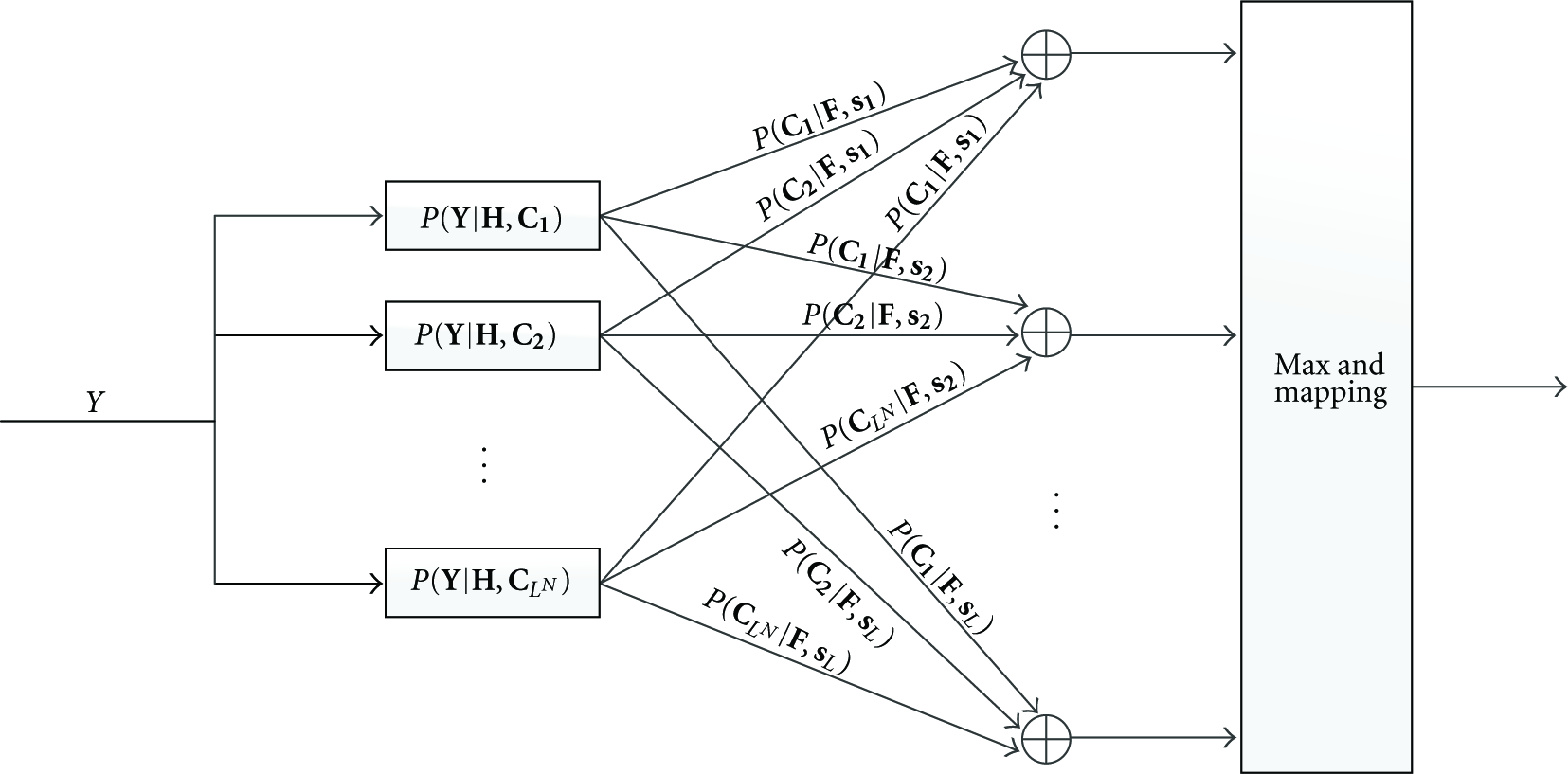
Error aware ML decoder.
The complexity of the error aware ML decoder equals to that of
3.1. Optimality of Error Aware Decoder
To prove the optimality of our proposed error aware receiver, we need to analyze the error performance difference between the error aware decoder and nonerror aware decoder (traditional receiver). Unfortunately, it is difficult to derive the exact error performances of error aware decoder and nonerror aware decoder. To illustrate the optimality, we try to give following two points (in Figure 2).

Illustration of the signal space.
Receiver Rule
Since the error aware decoder is based on ML rule, it should be the optimal receiver [10].
Signal Space Description
To express clearly, we set the source transmit a symbol
Case 1 (No error happens at relays).
In this case, relays decode the received message as
Case 2 (Error happens at relays).
In our interested situation, the impact of noise is very slight therefore, the system SNR is very high and we could only consider the closest symbols as errors. As a result, our candidates are also limited between
4. Low-Complexity Error Aware Decoders
In this section, we will introduce two low-complexity error aware decoders through analyzing and simplifying the structure of ML decoder. The simplifying process we used herein can be extended for more general cases to obtain low-complexity decoders. First, we use Max-Log approximation to derive a Max-Log error aware decoder which can work with Csiszár-Tusnady algorithm. Second, to reduce the complexity further, sphere decoding also is combined into the Max-Log decoder, which is called Max-Log-Sphere decoder.
4.1. Error Aware Max-Log Decoder
Substitute (6) into (7), there is


We can see that decoding distributed space-time code becomes searching a two-dimension array, which is indexed by

Max-Log decoder.
4.2. Error Aware Max-Log-Sphere Decoder
If the length of vector
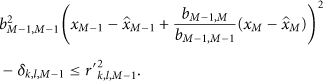
To state the Max-Log-Sphere decoder, we first find the real-valued equivalent of (3), Define


For expression convenience, we define




(1) (2) (3) (4) (5)
Algorithm 1

Max-Log-Sphere decoder.
After terminating the decoder algorithm for
Input (1) Set (2) (Set bounds for (3) (Check if (4) (Increase k) (5) (Decrease m) If (6) Solution found for k. Save k,
Algorithm 2
Note that Max-Log-Sphere decoder needs estimating the noise variance of the receiver. However, Max-Log decoder using Eulerian distance and error probability is more realizable. Hence, there is a tradeoff between computational complexity and implementation to choose which one is suitable.
5. Computational Complexity Analysis
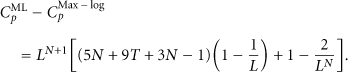
In this section, we analyze and compare the computational complexity of above three decoders. We use the average numbers of real elementary operation,
5.1. Complexity of ML Decoder
By (5), it easy to know that compute

5.2. Complexity of Max-Log Decoder
Recall (10),

5.3. Complexity of Max-Log-Sphere Decoder
Max-Log-Sphere decoder for a


6. Simulation Results
In this section, we provide the simulation results to show the proposed error aware decoders. We denote the total power noise ratio as the system signal-noise ratio (SNR) indicator. And half of total power is assigned for source transmit power, and another half is equally divided by all relays. In this simulation, we adopt distributed linear dispersion code proposed in [12] as the coding scheme for its simplicity, where

6.1. Performance Comparison with Ideal Receivers
Figure 5 demonstrates bit error rate (BER) performances of different decoders where two relays are employed and the signal modulation is BPSK. That is to say

BER performance of error aware decoders (2 relays, ideal receiver).
In Figure 6, we also simulate a 4-relay network to show the BER performance of that decoders. Herein,
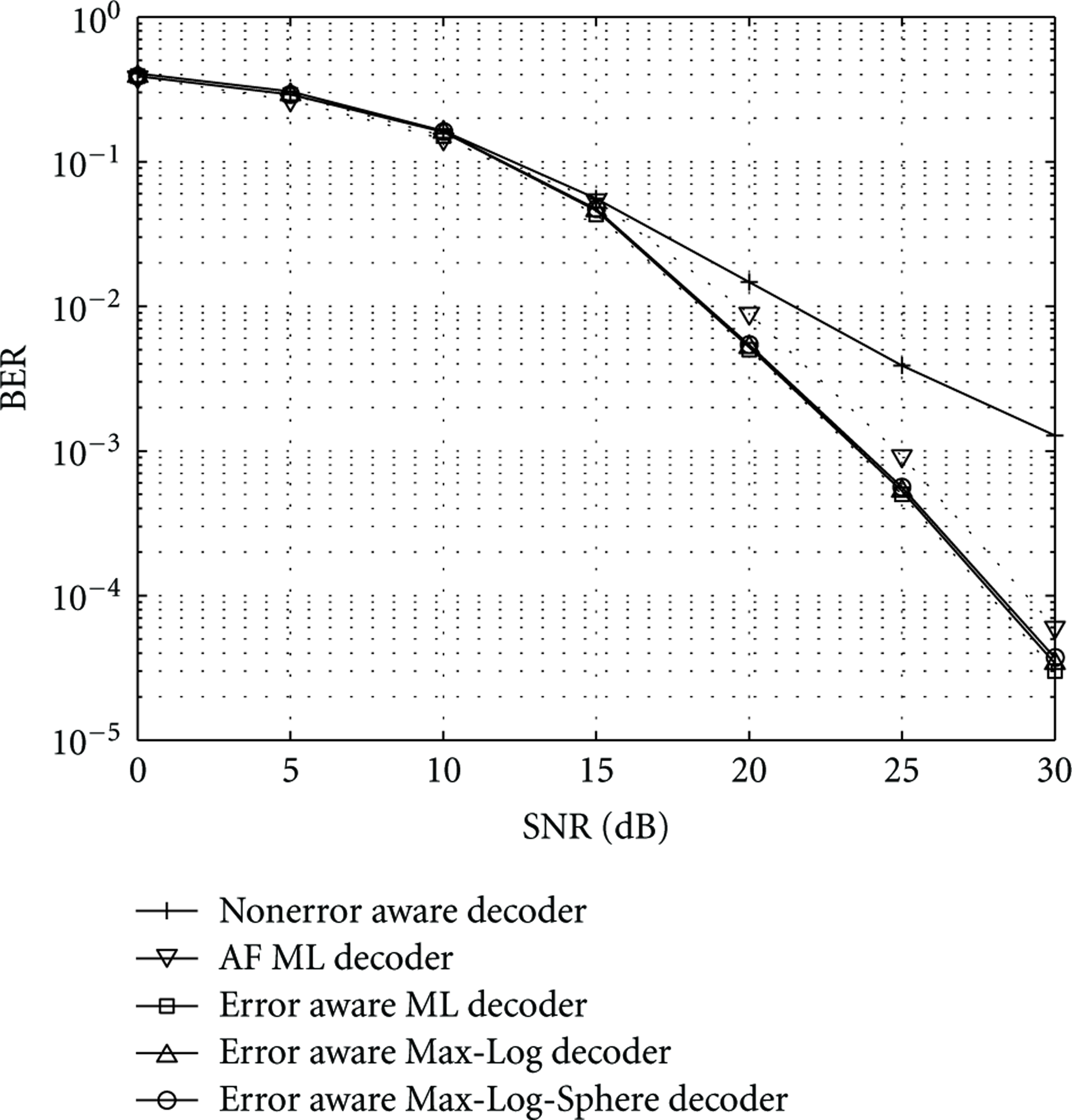
BER performance of error aware decoders (4 relays, ideal receiver).
For distributed space-time coded (DSTC) relay networks, [12] had proved that the maximum achievable diversity order is
6.2. Performance Comparison with Practical Receiver
In order to validate the practical performance of our proposed error aware decoders, we also consider a practical receiver at the destination, where channel state information is generated by channel estimator. It means that channel state information is not perfect and has estimation error. We set the transmit power of pilot symbols used to estimate channel equal to the transmit power of data symbols. The procedure of channel estimation follows that 3-step scheme described in Section 3. Channel estimators are built on minimum mean square error (MMSE) rule [11]. In addition, the performance degradation of low-complexity decoders is incurred by less searching in codebook. Moreover, both Figures 5 and 6 prove that low-complexity decoders achieve similarly performance compared with the error aware ML decoder. Therefore, in following simulation, we do not draw the performance of all three error aware decoders but error aware ML to compare with other schemes.
Figures 7 and 8 give the BER performances of different decoders with practical receivers where channel state information is not perfect. Clearly, the channel estimation error does not change performance relationship among nonerror aware decoder, AF-based ML decoder, and error aware ML decoder. Comparing Figures 5 and 7, we can see that the performance gain obtained by error aware decoder as compared to AF-based ML decoder decreases from 3 dB to 2.5 dB. We also can find that the gain of error aware decoder over nonerror aware decoder decreases from 6 dB to 5 dB through comparing Figures 6 and 8. That is to say that the uncertainty of channel state information does degrade the performance of our proposed error aware decoder but the degradation is limited. Error aware decoder still outperforms nonerror aware decoder. In summary, our proposed error aware decoder works well in practical receivers.

BER performance of error aware decoders (2 relays, practical receiver).

BER performance of error aware decoders (4 relays, ideal receiver).
6.3. Complexity Comparison
We will show the computational complexity of three error aware decoders by elementary operation number. Note that the operation number of Max-Log-Sphere decoder varies with unitary matrices
In Figure 9, we show the average operation number of these three decoders when 2 relays are employed. Obviously,

Average operation number of three decoders with 2 relay, BPSK.

Average operation number of three decoders with 4 relay, QPSK.
7. Conclusion
In this paper, we provide a general framework of error aware distributed space-time decoder for regenerative relay networks. Through two-stage pilot symbols, the destination can estimate not only the relay-destination channel but also the error probability happening at relays. Using these estimated error, Maximum Likelihood decoder is provided. To reduce computational complexity, Max-Log decoder and Max-Log-Sphere decoder are also proposed by max-log approximation. Simulations show that error aware decoders can improve the performance drastically. Max-Log-Sphere decoder can achieve the same performance with ML decoder and needs far lower computational complexity. Without noise estimating, Max-Log decoder can make a good tradeoff between implementation and computational complexity.
Footnotes
Acknowledgments
This work is supported by National Nature and Science Funding of China (no. 61102082), National High-tech R&D Program (863 Program, no. 2011AA01A105), National Science and Technology Major Project of China (no. 2012ZX03001032-002), the Fundamental Research Funds for the Central Universities, the Specialized Research Fund for the Doctoral Program of Higher Education (no. 20110201120011), and the Open Research Fund of National Mobile Communications Research Laboratory, Southeast University (no. 2011D14).