




Abstract
We discuss briefly the constitutive modeling of the stress tensor for nanofluids. In particular, we look at the viscosity of nanofluids containing multiwalled carbon nanotubes (MWCNTs) stabilized by cationic chitosan. MWCNTs can be used either to enhance or reduce the fluid base viscosity depending on their weight fractions. By assuming that MWCNT nanofluids behave as generalized second-grade fluid where the viscosity coefficient depends upon the rate of deformation, a theoretical model is developed. A simplified version of this model, similar to the traditional power-law model, is used in this study. It is observed that the theoretical results agree well with the experimental data.
1. Introduction
Nanofluids are made by adding nanoscale particles in low volumetric fractions to a fluid in order to enhance or improve their rheological, mechanical, optical, and thermal properties. The base fluid can be any liquid such as oil, water, ethylene glycol, or conventional fluid mixtures. Limited available studies on nanofluid viscosity have been reported [1–19]. In most of these studies, the behavior of the viscosity and the shear stress of nanofluids have been interpreted using the widely used empirical model developed by Casson [20]

In this equation, τ0is the yield stress, μ
∞
is the suspension viscosity at infinite shear rate, and
In general, most complex, that is, nonlinear, materials exhibit unusual and peculiar characteristics such as viscoelasticity (as, for example, identified by creep or relaxation experiments, often exhibiting memory effects), yield stress, normal stress differences. The science of studying non-linear fluids is “Rheology” and according to Reiner [21, p. 457]: “rheology started when Bingham in 1916 investigated concentrated clay-suspensions, and Bingham and Green in 1919 investigated oilpaints.” The non-linear time-dependent response of complex fluids constitutes an important area of mathematical modeling of non-Newtonian fluids. For many practical engineering cases, where complex fluids such as paint and slurries are used, the shear viscosity can be a function of one or all of the following:
Time,
shear rate,
concentration,
temperature,
pressure,
electric field,
magnetic field,
….
Thus, in general,
In an effort to obtain a model that does exhibit both normal stress effects and shear-thinning/thickening, Man [25] modified the constitutive equation developed by Rivlin and Ericksen [26] (see also [27, 28]) for a second-grade fluid by allowing the viscosity coefficient to depend upon the rate of deformation; that is,
2. Constitutive Modeling
Mathematically, the purpose of constitutive relations in mechanics is to supply connections between kinematic, mechanical, and thermal fields providing a suitable formulation of a problem which can be solved for properly posed problems. Just as different figures in geometry are defined as idealizations of natural objects, continuum mechanics seeks to establish particular relations between the stress tensor and the motion of the body for “ideal materials” [27]. In some instances, it may be necessary to represent the same real material by different ideal materials in different circumstances. A classic example is that of the theory of incompressible viscous fluids, which gives an excellent description of the behavior of water flowing through pipes but is useless for the study of the propagation of sound waves through water. While a constitutive equation is a postulate or a definition from the mathematical standpoint, physical experience remains the first guide, perhaps reinforced by experimental data. Constitutive relations are required to satisfy some general principles. Wang and Truesdell [29, page 135] list six general principles: (1) determinism, (2) local action, (3) equipresence, (4) universal dissipation, (5) material frame indifference, and (6) material symmetry. Constitutive relations should hold equally in all inertial coordinate systems at any given time (often referred to as coordinate invariance requirement). This would guard against proposing a relation in which a mere change of coordinate description would imply a different response in the material. Many of the so-called “power-law” models used in describing non-Newtonian fluids are not coordinate invariant. In general, this difficulty can easily be overcome by stating the equations either in tensorial form or by using direct notations not employing coordinates at all. The principle of material frame-indifference (sometimes referred to as objectivity), which requires that the constitutive equations be invariant under changes of frame, is perhaps the most important of all. It is a consequence of a fundamental principle of classical physics that material properties are indifferent, that is, independent of the frame of reference of the observer. This principle requires that constitutive relations depend only on frame-indifferent forms (or combinations thereof) of the variables pertaining to the given problem (see Massoudi [30] for further details). Among other approaches to model complex materials, one can list (i) using physical and experimental models, (ii) doing numerical simulations, (iii) using statistical mechanics approaches, and (iv) ad hoc approaches.
In general, based on available experimental observations, it can be said that many nanofluids exhibit characteristics similar to those of non-linear materials such as colloidal suspensions, polymers, rubber, and granular materials. The main points of departure from linear behavior are the following:
the ability to shear-thin or shear-thicken,
the ability to creep,
the ability to relax stresses,
the presence of normal stress differences in simple shear flows,
the presence of yield stress.
To the best of our knowledge, it has not been reported whether nanofluids exhibit normal stress effects, the non-linear phenomena related to the stresses that are developed orthogonal to the planes of shear. Therefore, we propose to use a general model that can exhibit both the normal stress effects and the shear-thinning/thickening effects. To do so, we assume that nanofluids, such as the one studied in the present work, behave as generalized second-grade fluids. For a second grade fluid, the Cauchy stress tensor is given by [26–28]

where p is the indeterminate part of the stress due to the constraint of incompressibility,
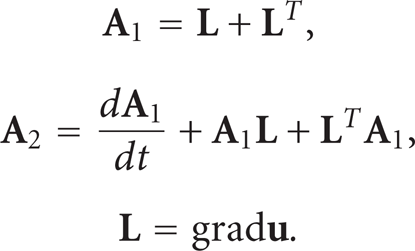
where

By allowing the viscosity coefficient to depend on the rate of deformation, Man [25] modified the constitutive equation, (2) and proposed the following:

where

is the second invariant of the symmetric part of the velocity gradient, and m is a material parameter. When

In this paper, we will use this simplified form, which can also be considered as a generalized power-law fluid model. Using the cylindrical coordinate system for our present measurements and assuming

The z-component of the stress tensor becomes

where the shear-dependent viscosity is defined as
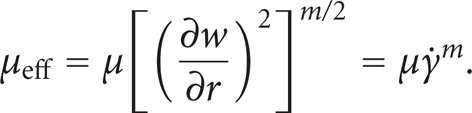
In the next section, we will briefly discuss the results of our experimental investigation and show how this model can be used to describe the observed behavior of the fluid.
3. Experimental Evaluation
In Figures 1 and 2, we present the results on the calculated and measured viscosity and shear stress for water-based nanofluids containing Multiwalled carbon nanotubes (MWCNT) stabilized by low molecular weight chitosan (>75% deacetylation

Viscosity and shear stress as a function of shear rate showing the effect of the MWCNT weight percent. The base fluid is DW + 0.1 wt% chitosan. The measured values are shown by symbols, while the calculated values are shown by the solid and dotted lines. These calculated viscosity values were obtained using (10) and the shear stresses were calculated using (9) with

Viscosity and shear stress as a function of shear rate showing the effect of the MWCNT weight percent. The base fluid is DW + 0.2 wt% chitosan. The measured values are shown by symbols, while the calculated values are shown by the solid and dotted lines. These calculated viscosity values were obtained using (10) and the shear stresses were calculated using (9) with
4. Concluding Remarks
The two important constitutive relations needed for the study of flow and heat transfer in complex fluid-like materials, where the effects of radiation are ignored, are the stress tensor and the heat flux vector. From an engineering perspective, this oftentimes translates into measuring viscosity and thermal conductivity. As a result, most researchers have attempted to generalize Newton's law of viscosity and Fourier's law of heat conduction to various and more complicated cases by assuming that the shear viscosity and/or thermal conductivity could depend on a host of parameters such as shear rate, temperature, and porosity. This unfortunately does not fully take into account the non-linear and time-dependent nature (such as normal stress effects or visco-elastic response) of these complex materials, as these generalizations cannot give rise to implicit constitutive relations.
Nanofluids represent one of the newest complex materials of the modern era. In many ways, constitutive modeling of these fluids, from a macroscopic point of view, is still at its infancy, perhaps similar to the early days of polymer rheology, rubber viscoelasticity or composite materials. With intense interest and research in the past two decades, great strides have been made, and nanofluids, due to their peculiar heat transfer and rheological properties, have been shown to contribute in many diverse ways to many industrial processes and to our lives [35]. An often neglected, yet extremely important, conceptual question, and perhaps still an open question, is whether the same governing macroscopic balance equations can be used for nanofluids. For a recent discussion of this issue, see [36]. Since nanofluids form suspensions, theoretically from the point of view of mechanics, their thermorheological responses can be modeled either using the non-Newtonian approach or the multicomponent approach [37].
To better understand the various mechanisms in the heat transfer processes involving nanofluids, in addition to studying the thermal conductivity or radiation effects, an understanding of the mechanism for viscous dissipation is also important. A proper constitutive model for the stress tensor
Footnotes
Acknowledgments
This work was supported by DOE-NETL under the EPact Complementary program.