




Abstract
Interference measurement is an important part for use in links scheduling protocol in wireless sensor networks (WSNs). To know wireless interference among nodes in the network is essential to guarantee the efficiency of links scheduling protocol. This work presents a point-to-point interference measurement approach based on time division technique for large-scale low-power WSNs. We first propose an optimized time-slots assignment to reduce the time-slot requirement of interference measurement for large-scale WSNs. We then mitigate the problem of communication by using a subtree-based information distribution method. The accuracy of interference measurement is controlled by a control factor that can be specified by user based on the application requirement to achieve a tradeoff between the overhead of measuring interference and measurement accuracy. Our simulation results indicate that our approach has low-energy and-communication overhead when compared with baseline.
1. Introduction
Wireless sensor networks (WSNs) are used in wide range of time-critical applications such as emergency management, structural health monitoring, and industrial monitoring. These applications put forward the stringent requirements on the performance of WSNs. The main factor that impacts the performance of WSNs is wireless communication interference [1, 2]. Due to the broadcast medium, it is possible that wireless transmissions from one radio interfere with the reception of surrounding radios, and resulting in low-communication quality or even data transmission failure. Furthermore, the packet retransmission may lead to high end-to-end delay in the large-scale WSNs. In order to eliminate wireless interference, the interference-aware links scheduling protocols [3, 4] have been developed. These scheduling protocols greatly improve the performance of WSNs by combining with wireless interference model when nodes are scheduled to transmit data. Recent works [5, 6] found that the physical interference model, also referred to as SINR model, can capture the complexity of wireless interference by considering the accumulation of wireless interferences caused by potential interference nodes in the network; hence, the scheduling protocol can significantly benefit from the using SINR model.
However, for each node in the network, it is a great challenge to know all external wireless interferences due to the complexity of interference measurement. In a large-scale WSN, one major challenge for interference measurement is that the number of node pairs that the interference between them needs to be measured is large, and another is the range of measuring interference is related to the interference measurement accuracy that impacts the network performance. To achieve satisfactory measurement accuracy, the radio interference measurement needs to be carefully arranged, which imposes large overhead on communication traffic and energy consumption at each node. In this paper, we formulate the problem of measuring the interference between nodes and its potential interference nodes as a point-to-point interference measurement. The existing interference measurement methods are based on the passive approach, where nodes measure interference when their potential interference nodes transmit data packet. For instance, in [7, 8], nodes measure a small number of interference statistics and then these interference measure results are used to the interference among nodes. Although the passive method has low overhead due to less traffic, it is a high-complexity task to infer the interference among nodes is only based on a small amount of interference statistics in the large-scale network. Furthermore, the result maybe not be accepted when this approach is integrated with existing scheduling protocol.
In this paper, we propose a point-to-point interference measurement approach to accurately measure interference among nodes and meanwhile, reduce the communication traffic and energy overhead. Considering interference measurement, the result may be disturbed because measure packets may be sent simultaneously by two or more nodes in the network, our approach measures point-to-point interference based on time division technique. A series of unique time-slots are assigned by single access point (AP) for each node. In these assigned time-slots, one time-slot is scheduled to send measure packet. The remaining time-slots are used to measure interference caused by its potential interference nodes. An optimized time-slot assignment strategy is developed to reduce energy consumption of interference measurement. We use a subtree-based time-slot information distribution method to avoid unnecessary time-slot information forwarding. Furthermore, we study the relationship between interference measurement accuracy and overhead by using a control factor.
The rest of this paper is structured as follows. Section 2 provides an overview of the related work on wireless interference study in wireless networks. We then introduce the interference measurement approach in Section 4. In Section 5, we describe the results of simulation experiments. Finally, we summarize our conclusions in Section 6.
2. Related Work
In this section, several previous works that are related to wireless interference measurement are discussed.
Zhou et al. [1] presents a radio interference detection protocol (i.e., RID protocol) based on CC1000 radios to measure run-time radios interference, which arises from strong and weak links. The interferences among links are measured by using detection packet sequence that consists of high-power packet and normal-power packet. Son et al. [9] study the SINR model of the same type of radios and find that the measured SINR threshold changes with the number of external interference. However, this conclusion is inconsistent with other radio platforms such as CC2420 [10]. A suit of interference models, including protocol models, SINR models, and disc model are studied in [2] for their modeling accuracies and impacts on the performance of links scheduling protocols. The results show that SINR model is more accurate than other models and lead to significant link throughput improvement. In [11], the impact of 802.11 networks interference on packet delivery in body area networks is investigated. De Moraes and De Araújo [12] propose a general interference analysis model and show that SINR has close relationship with path loss ratio. Another interference and packet delivery model that can be instantiated by data transmission logs is proposed in [13]. Razak et al. [14] propose a model to characterize the throughput under the different kind of interference. Shah and Nachman [15] propose an approach to detect interference when occurs in two different ZigBee networks. In the above approaches, most of them do not consider point-to-point interference measurement. Moreover, they do not consider the measurement accuracy control when measuring interference among nodes in the network.
A study that relates to our work is done by Huang et al. [7]. They propose an interference measurement approach with low overhead for PRR-SINR model that considers the relationship between packet reception ratio (PRR) and SINR or PRR-SINR models. They experimentally study performance of real-world PRR-SINR. Their results show that interference is significantly influenced by the spatial and temporal factors, which pose a big challenge to interference measurement and model on energy constrained wireless sensor nodes. Another low overhead protocol called PIM [8] is proposed for low-power wireless sensor networks, which uses passive approach to derive nodes interference relationship and construct PRR-SINR models. However, both of them do not consider point-to-point interference measurement. In our study, we consider the high overhead of measuring interference for large-scale low-power wireless sensor networks and propose an approach based on time division technique. We also consider the tradeoff between interference measurement accuracy and communication and energy overhead.
3. Problem Statement
The objective of our study is to accurately measure point-to-point wireless interference, and meanwhile it needs to minimize the overhead of energy and communication. In this section, we first describe the necessary assumptions for our study. We then formulate the problem of point-to-point interference measurement for the large-scale WSNs.
For our interference measurement approach, we made some assumptions about the sensor nodes in the network. We assume that time is divided into time-slots and a time-slot is enough to transmit a measure packet. We also assume that each node has the same initial transmission power. We denote the transmission distance by
In this paper, the node that point-to-point interference is measured, is regarded as measure node (i.e., m-node). For a given m-node, the node that locates in the interference range of m-node is called potential interference node that is referred to as i-node. It is worth pointing out that all nodes in the network are m-nodes. Furthermore, m-node can be converted to i-node when we measure interference from the other m-node. The wireless interference measurement that is considered in this paper is shown in Figure 1. We set
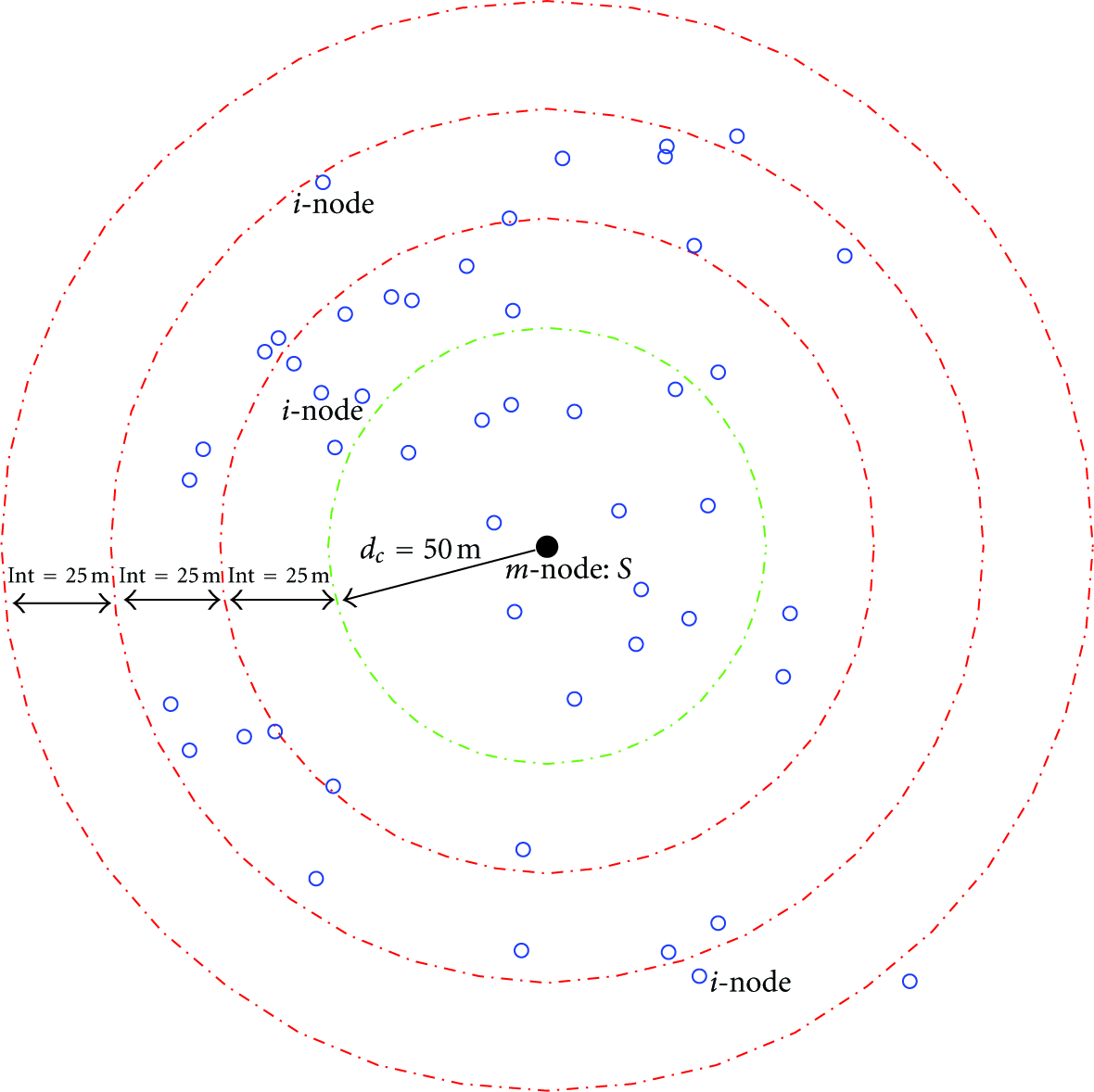
An example of wireless interference measurement. One measure node (m-node) S and the potential interference node (i-node) set lies in the cycle that has different interference distance.
The interference measurement problem can be formulated as follows. We consider a network that is composed of a single access point (AP) and a set of sensor nodes
4. Interference Measurement Approach
This section presents the details of our approach. An advantage of our approach is that it reduces the overhead at resource-constrained nodes while letting AP performs more computationally intensive task that is computing optimized time-slot assignment scheme. In this paper, we assume that a routing tree is constructed by using existing routing protocol proposed for WSNs, for example, the collection tree protocol [16].
4.1. Overview
In this section, we describe the details of our interference measurement approach. Our approach consists of four parts.
Potential interference nodes information collection: firstly, the user gives a control factor of interference measurement λ that is diffused from AP. All nodes then know to how collect λ-hop potential interference nodes (i-nodes) information. We note that some literatures provide effective method to accomplish this task, such as [17]. Moreover, the nodes information collected in the process of constructing routing tree can be used to reduce the communication traffic due to collecting i-nodes information. Finally, all i-nodes information will be sent to AP using contention-based MAC protocol such as CSMA/CA protocol. Time-slot assignment: after AP receives the i-nodes information of all m-nodes, in order to model the interference, an interference matrix Time-slot distribution: after time-slot is assigned by AP, it is important to distribute time-slots to each m-node. We propose a simple subtree-based transmission mechanism to reduce the communication traffic of time-slot distribution which describes in Section 4.3. Point-to-point interference measurement: after AP finishes time-slots distribution, a time synchronization is necessary to guarantee all nodes active in their assigned time-slots. We note that some time synchronization methods can be used in our approach, for example, FTSP [18]. At last, the interference from each i-node in
The components of our approach are discussed as follows.
4.2. Time-Slot Assignment
For a m-node, the number of i-nodes is huge when we use a large λ. The m-node needs a large number of time-slots to accomplish point-to-point interference detection if it allocates a unique time-slot for each i-node. There is no doubt that this strategy can accurately measure interference at the considerable cost of communication and energy. Furthermore, these costs will become very large with the increasing of node density in the network. In addition, the time overhead spent on interference measurement is large with the increasing of i-node. Therefore, a more effective time-slot assignment strategy is necessary to reduce these overheads. In this work, we develop an efficient strategy shown in the Algorithm 1.
We now use a simple example to illustrate the basic idea of time-slot assignment strategy. In Figure 2, the point-to-point interference among nodes 1, 2, and 3 will be measured using assigned time-slot. The dashed lines represent the interference links. Each m-node broadcasts measure packet using the norm transmission power at an assigned time-slot, meanwhile all i-nodes related with m-node can know the receive signal strength through measuring wireless signal strength in the air. The i-nodes of nodes 1, 2, and 3 are {{2, 3}, {1, 3}, {1, 2}}, respectively. The interference matrix I is shown in Table 1.
The interference matrix I of example constructed by AP.


An example of time-slot assignment. We assume nodes are potential interference node to each other.
The time-slot assignment is performed on the AP and the details of time-slot assignment are described as follows. We assume that interference measurement starts with m-node 1. Each i-node of m-node 1 will be assigned a unique time-slot by their order in i-nodes. Therefore, AP assigns time-slot
As illustrated in the above example, the time-slot assignment is optimized and could be proven that our approach only needs at most N time-slots to accomplish point-to-point interference measurement for any wireless sensor network that composed with N sensor nodes. We prove this conclusion in Section 4.5.
4.3. Time-Slot Distribution
Since the interference caused by each i-node is measured at an unique time-slot, node needs to know the time-slots information of its i-nodes. Furthermore, the node also needs to know the time-slot which is used to send measure packet. This time-slots information is sent by AP. A simple information diffusion method is feasible for our approach, but it will lead to very high communication and energy overhead because all nodes may forward unnecessarily information many times until all nodes receive desired time-slots information. Additionally, we find that the communication traffic increases with the increasing of λ, and this impels us to use a more effective time-slot distribution method for a large-scale network to reduce the communication and energy overhead. Therefore, we develop a subtree-based time-slots distribution mechanism. This mechanism reduces energy consumption and communication traffic through filtering unnecessary time-slots information when nodes forward time-slots information to their children.
When the node transmits i-node information to AP through multihop path, the i-node information can also be saved by the node on the path to the AP. Therefore, nodes know all i-nodes information that is related to the subtree rooted at these nodes. Taking these related i-nodes information into account, node only needs to forward time-slots information that is related with nodes in the subtree rooted at this node. The uncorrelated time-slots information is filtered and then energy and communication traffic spent on time-slots information distribution are reduced.
4.4. Accuracy Control
The accuracy of interference measurement is critical for the performance of our approach. The high-precision requirement of interference measurement results in the large overhead of communication and energy. Hence, we need to consider the tradeoff between these overheads. Our approach employs a control factor specified by users to implement the accuracy control of interference measurement.
The main idea of providing accuracy control is to limit the measure distance between interference node and measure node by using accuracy control factor λ. Considering a wireless sensor network, N nodes randomly deploy in area A; hence, the average density of network is 
According to λ, we can compute an area 

4.5. Analysis
In this section, we discuss the performance of our approach. We first discuss the time-slot requirement of point-to-point interference measurement, and then we refer to the scalability of our approach.
In our approach, we use time-slot assignment mechanism to reduce the overhead of interference measurement and we have the following conclusion.
Theorem 1.
For any wireless sensor network composed with N sensor nodes, our approach only needs at most N time-slots to accomplish the point-to-point interference measurement.
Proof.
Considering a wireless sensor network composed with N nodes, an interference matrix 
Therefore, the number of time-slots for interference measurement of network is calculated using (5):

The worst case for our approach is that nodes interfere with each other, and then we have (6):

Taking (4), (5), and (6) into account, we have (7):
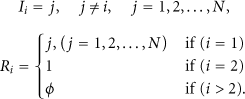
Let 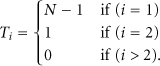
Therefore, the most time-slots used on the point-to-point interference measurement by using our approach is
As discussed in Section 4.4, the accuracy of interference measurement is closely related to the range of interference measurement that is controlled by the control factor λ. Taking advantage of accuracy control mechanism, on the one hand, our approach can reach a tradeoff between interference measurement accuracy and the overhead of communication and energy. On the other hand, our approach can adapt to different-scale network while it can provide accepted cost such as duration time of interference measurement.
The previous work [8] shows that interference has significant spatial and temporal variations, a periodical interference update mechanism is necessary for our approach to decrease the impact of imprecise interference measurement on the performance of links scheduling protocol. Our approach updates interference with a fixed period which can be customized by the user based on the consideration of energy and communication overhead. We suggest that an incremental updating mechanism could be used to reduce the overhead of communication and energy. The intuition behind this is that only a part of nodes has frequent interference change. Hence, we only need to update their interference measurement results. Finally, our approach can be easily integrated into existing links scheduling protocols because it has the lowest requirement on network information.
5. Performance Evaluation
5.1. Simulation Experiments
We study the performance of our approach in comparison to a baseline. They all implement in MATLAB. The baseline does not use optimized time-slots assignment method, each
In all experiments, nodes are distributed uniformly in a
Figure 3 shows the average energy consumption of three random networks as λ increases from 1.5 to 4.0 and the amount of nodes increases from 100 to 300. Some conclusions are drawn from this figure. Firstly, energy consumption for interference measurement highly depends on the density of nodes. Each node consumes more energy under the network that has the higher density of nodes. The major reason for this is that many measure packets have been sent by nodes in the network for measuring interference that was arisen from

The energy consumption per node versus interference measurement accuracy.
Considering the impact of λ on energy consumption, we validate our inferring by statistic potential interference nodes of each node. The result is shown in Figure 4 and it has the same trend that is similar with Figure 3. Similarly, the number of potential interference nodes increases sharply when λ is less than 2.5. Some nodes include all potential interference nodes in the network when λ is 2.5. With the increasing of λ, only part of nodes adds new potential interference nodes to their i-nodes. However, the number of new nodes is limited and cannot lead to the increasing of potential interference nodes for network.

The average λ-hop potential interference nodes.
We study the overhead of communication of our approach for point-to-point interference measurement under the different scale of network. The overhead of communication in this experiment consists of three main parts: neighborhood information transmission, time-slots information distribution, and the overhead of communication when the nodes measure point-to-point interference. Figure 5 shows the result of experiment. As a large number of measure packets are used by node to measure interference, resulting in considerable overhead of communication for baseline. On the contrary, our approach only needs 30% or lower overhead of baseline for the interference measurement because the number of measure packets is only related to the number of nodes in the network. Additionally, we also note that the increasing of communication overhead is far less than baseline, and this advantage can be used to accomplish the point-to-point interference measurement of the larger-scale wireless sensor networks with low overhead of interference measurement.

Communication traffic versus network density.
In the rest of this section, we study the impact of the diameter of network on communication and energy overhead by varying the diameter of network from 200 m to 600 m. In all experiments, the accuracy control factor is set as 2.0. Figure 6 shows that as the diameter of network increases, the communication traffic required for interference measurement increases. However, the increment of communication traffic is not obvious in these experiments. It is apparent that communication traffic is not sensitive to the diameter of network. This is because the potential node information sent to AP is reduced with the increasing of the diameter of network; however, the benefit is partly counteracted by the increasing of the amount of forwarding information because the length of the path from source to AP increases in a large-diameter network. Figure 7 shows that the number of potential interference nodes is reduced with the increasing of the diameter of network. We study the energy consumption of node with the increasing of the diameter of network. The result is shown in Figure 8. It shows that as the increases diameter of network, the energy consumption per node increases. The reason for this is that the potential nodes' information needs to be forwarded by more intermediate nodes on the path to the AP in a large-diameter network, and resulting in additional communication traffic and energy consumption. We also observed that nodes in the low-density network may spend more energy on interference measurement than these in the high-density network as the diameter of network increases. The energy spent on additional communication traffic that is caused by the increasing of the diameter of network is the main reason for this phenomenon. Note that the density of network is related to the number of nodes in the network and the diameter of network.
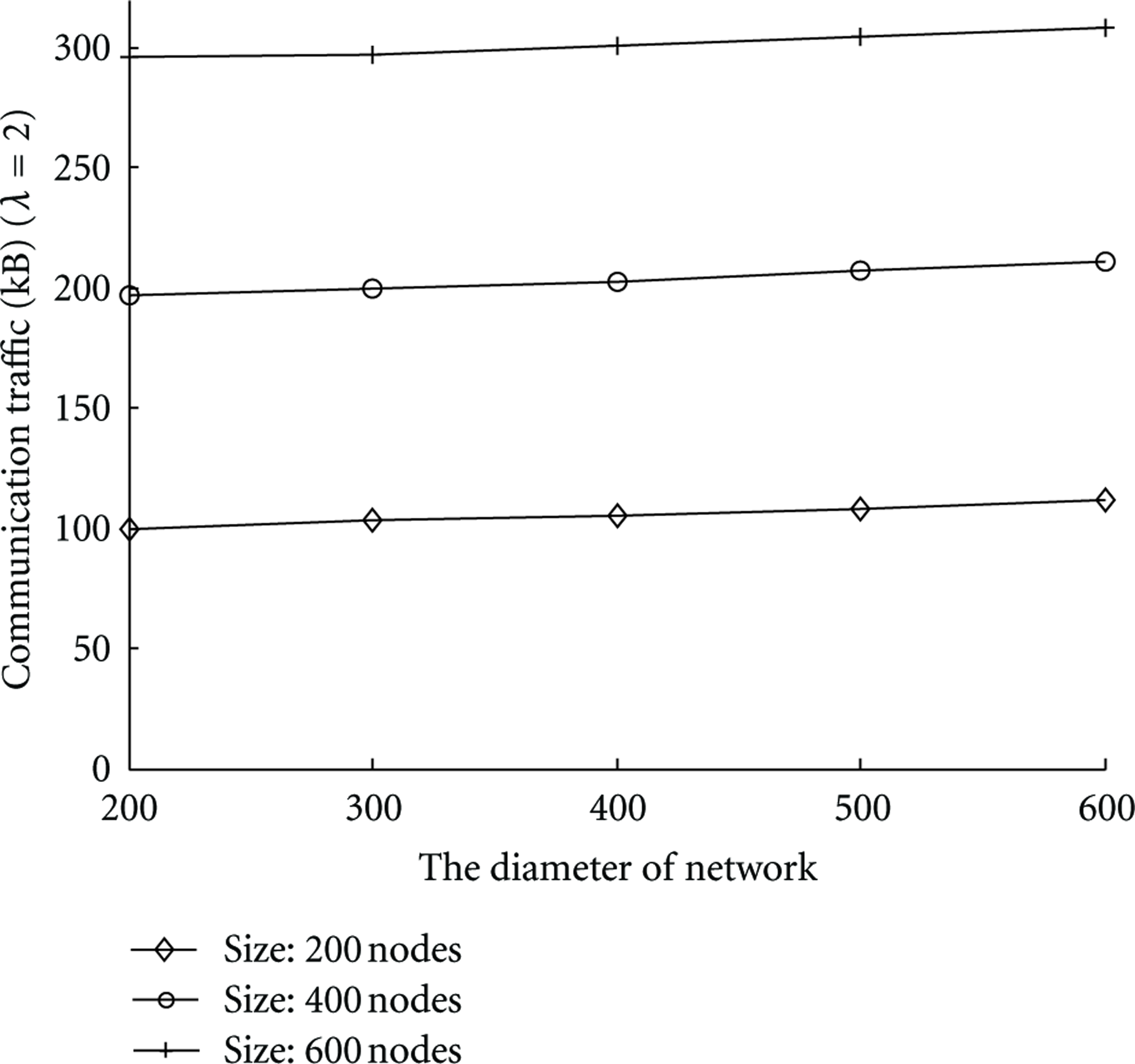
Communication traffic versus the diameter of network.

The average potential interference nodes versus the diameter of network.

The energy consumption per node versus the diameter of network.
5.2. Discussion
We now consider the communication overhead that consists of three parts: potential interference nodes' information transmits to AP, time-slots assignment distribution, and point-to-point interference measurement. We find that time-slots assignment distribution takes up the largest communication overhead. The main reason for this is that upper layer m-nodes have to forward large time-slots information to low-layer m-nodes which belong to the same subtree. The upper layer m-nodes need more communication traffic than low-layer m-nodes and consume more energy. We consider two different kinds of methods to reduce the communication traffic of upper layer m-nodes. First, AP directly communicates with enough power to reach each m-node if needed, that AP can vary the level of transmit power by power control. The weakness of this method is that the scale of network is limited to the communication range which can be supported by AP. However, it is possible for some small-scale time-critical applications of WSNs such as industrial monitoring and control [20] to use this method. Another more feasible method is reducing the communication traffic by compressing time-slots information using coding technique, but it has high complexity. We still need to design a more effective method to reduce the overhead of time-slots information distribution in our future work.
6. Conclusion
In this paper, we present an interference measurement approach which is used to accurately measure point-to-point interference for wireless sensor networks. The point-to-point interference is measured at a unique time-slot which is assigned by single access point (AP), and a control factor is used to adjust the interference measurement accuracy, while achieving the acceptable overhead such as communication traffic and energy consumption. We studied the performance of our approach through extensive simulations. We have shown that the overhead of measuring interference exists in relation to the number of nodes in the network. Furthermore, we also found that the energy consumption increases as the diameter of network increases.
In our future work, we will further improve the efficiency of point-to-point interference measurement by developing a simultaneous interference measurement mechanism. It is an interesting direction to develop the distributed interference measurement approach. In addition, it is considerable to integrate our interference measurement approach with links scheduling protocol.
(1) ts = 1 (2) (3) (4) T(j) (5) T(i) (6) (7) (8) (9) T(k) (10) (11) (12) ts++ (13)
Footnotes
Acknowledgments
The authors appreciate the helpful comments and suggestions of anonymous reviewers. This work was supported by Project of The National High Technology Research and Development Program of China (863 Program): Multiple Source Sensing Technology and Product Development in Agricultural Products Supply Chain (no. 2012AA101701), The IOT Sensing Exhibition Platform-The Network Support Sub-platform of IOT Technology and Application & Development, and Project of Innovative Team of Digital Cultural Media Technology of Zhejiang Province (no. 2010R50040).