




Abstract
It is necessary to investigate techniques for monitoring structures under unknown earthquakes. For this purpose, an algorithm is proposed in this paper for the identification of structures and excitation of multi-story shear buildings with limited measurements of structural responses. The equation of motion of a multi-story shear building under ground motion is established in the absolute co-ordinate system, while the multi-story building is decomposed into substructures. A novel two-step Kalman estimator approach, which is not available in the previous literature, is proposed for the identification substructures and unknown ground motion with less computational effort. Then, for the purpose of intelligent structural monitoring, a new wireless sensor network is developed in this paper. The designed wireless sensor network has a two-level cluster-tree architecture. Hardware designs of the sensor unit and the cluster head are presented; especially the cluster head contains a low power digital signal processor with strong computing capacity. Thus, the wireless sensor network has the unique feature offers distributed computing at group level. Finally, the proposed algorithm is embedded into the wireless sensor network for intelligent structural monitoring and an experimental test shows the technique is effective for intelligent monitoring of multi-story buildings under unknown earthquakes.
1. Introduction
In the past decades, many structural identification and structural damage detection algorithms have been proposed, for example, see [1, 2]. Since some structural external excitations such as earthquakes or wind forces cannot be accurately measured under actual operating conditions, it is necessary to investigate algorithms for structural identification and damage detection under unknown earthquake excitation. Also, in structural health monitoring, the knowledge of external excitation is very useful for the safety evolution of structures.
Identification of structural parameters and unknown external excitation has been investigated by some researchers, for example, Wang and Haldar [3] developed iterative least squares approaches to identify simultaneously the structural parameters and ground motion of an earthquake. Chen and Li [4] proposed a statistical average algorithm for simultaneous estimation of structural parameters and earthquake-induced ground motion. Yang et al. presented several methods including extended Kalman filter with unknown excitation inputs (EKF-UI) [5] and the sequential nonlinear least square estimation (SNLSE) [6] for the identification of structural parameters as well as the unmeasured excitation inputs. However, the aforementioned identification approaches are based on the equation of motion established in the relative coordinate system for earthquake-excited structures. Since the absolute structural responses other than the relative structural responses are often measured in practice, there is a limitation for these approaches to be implemented in practice if the ground motion is unknown. Thus, Zhao et al. [7, 8] proposed hybrid identification methods for multistory buildings with unknown ground motion, in which the equation of motion of an n-story shear building subject to unknown ground motion is established in the absolute coordinate system. However, their methods request the measurements of all structural responses including the displacement, velocity, and acceleration responses. In practice, it is highly desirable to deploy as few sensors as possible [9, 10]. So, it is essential to explore efficient algorithms which utilize only a limited numbers of measured responses of structures subject to unknown (unmeasured) earthquake excitation.
Extended Kalman filter (EKF) has been studied and shown to be a useful tool for structural identification with limited measurements of structural response [11, 12], but EKF approach requires that excitation inputs are measured [5]. Also, in the extended state vector, unknown structural parameters are included as an augmented vector. Hence the size of the extended state vector and the corresponding state equation are quite large [13]. If the order of the EKF is
For the identification of a large number of unknown parameters in large size structural systems, the computational efforts increase tremendously. Consequently, substructural identification approaches are used, in which a large size structure is decomposed into smaller size substructures with fewer unknown parameters [16–19]. The proposed identification algorithm is extended to large size multistory shear buildings by dividing buildings into small size substructures. In the absolute coordinate system, the unknown ground-motion input is applied on the 1st floor of the building as an unknown external force. For each substructure above the 1st floor, substructure is identified by the two-step Kalman estimator approach; for the substructure containing the 1st floor, Zhao et al. [7, 8] demonstrated that this substructural parameters and the ground motion cannot be uniquely identified. Herein, an algorithm is proposed in which substructural responses and parameters are identified by the proposed two-step Kalman estimator and the structural eigenvalue equation. Then, the unknown ground motion is estimated subsequently by least squares estimation and the Newmark-β method.
Therefore, the proposed algorithm enables distributed identification of substructures in multistory shear buildings with less computational effort and storage compared with other existing algorithms. It is suitable for the purpose of intelligent structural monitoring as it can be implemented into the computation core of a wireless sensor network (WSN) which has limited computation storage and capacity. So far, some innovative WSNs have been developed in recent years for intelligent structural monitoring [20–26]. Besides the merit of avoiding the problem of the extensive lengths of wires compared with the traditional wire-based monitoring system, another important virtue of a WSN is that it offers distributed data processing and computation capacity, which is particularly useful for the implementation of algorithms for intelligent structural monitoring [20, 27–29]. Since wireless communication consumes a large amount of energy, approaches which require transmission of long-time history records to the central server should be avoided. One of the efficient strategies is to embed data processing and analysis algorithms in the wireless sensor's microprocessor and then just transmit small amount of useful results wirelessly. The embedded algorithms enable a WSN autonomously analyze data, which grants the network with “intelligent” characteristics. So far, some intelligent WSNs have been established [20, 21, 26–29], but most of data processing and analysis are designed at sensor level. Moreover, many WSNs require deploying a large number of sensors. Hierarchical clustering is considered as an efficient way to facilitate the operation of such networks and minimize the energy consumption [30–32]. In this paper, a hierarchical wireless sensor network is established [33, 34]. The distributed sensors are grouped into clusters, in which a cluster head is assigned to each cluster to control the communication in the allocated cluster. A cluster head not only serves as a router of the network but also possesses computational capabilities with the data collected from the sensor nodes in the cluster. Hardware designs of the sensor unit and the cluster head are presented, especially each cluster head has a low power digital signal processor (DSP) with strong computing capacity. This is the distinguishing unique feature of the proposed WSN different from other WSNs. Therefore, the proposed WSN provides parallel computation resources at group level, which is particularly useful for the implementation of substructure identification as the clusters in WSN match with substructures.
Finally, based on the advantages of the proposed distributed structural identification algorithm and the designed new WSN, intelligent monitoring of multistory buildings under unknown earthquake excitation can be conducted by embedding the proposed algorithm into the cluster heads of the designed WSN. To evaluate the performance of the proposed technique, experimental examination is demonstrated by shake table test of a scaled 8-story shear building under unknown ground motion.
2. Algorithm for the Identification of Building under Unknown Earthquake Excitation
Consider an n-story shear building subject to earthquake-induced ground motion as shown in Figure 1(a). It is well known that the equation of motion of the building with relative to the ground motion structure can be written as


An n-story shear building under earthquake excitation. (a) In the relative coordinate system. (b) In the absolute coordinate system.
2.1. Equation of Motion in the Absolute Coordinate System
In practice, it is hard to accurately measure earthquake-induced ground motion under actual operating conditions, so

Without the loss of generality, damping matrix of the building can be assumed as

For a shear building, its stiffness matrix

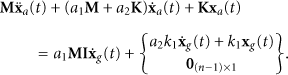
As each value in the vector

2.2. Substructure Approach
If the story number n is not small, the number of unknown parameters is quiet large. Direct identification of the whole building requires a large computation effort and storages. Moreover, as an inverse problem, direct identification of a large number of unknown parameters can lead to the problems of ill-condition and computational divergent. Consequently, substructural identification approaches are used, in which a large size structure is decomposed into smaller size substructures with fewer unknown parameters [16–19]. The multistory building is divided into m substructure as shown in Figure 2(a).

Substructure approach of the multistory building. (a) Building with m substructures. (b) Substructures with external excitation.
2.3. A Two-Step Kalman Estimator for the Identification of Substructure under Known Excitation
For substructure m (

In (7),

Some sensors are deployed on the substructure to measure the response signals. Usually acceleration signals are measured and the observation vector of the substructure can be expressed in the discretized form as


Extended Kalman filter (EKF) has been shown to be useful for structural identification with limited response outputs [11, 12], but in the EKF approach, the extended state vector includes the augmented unknown structural parameters. Structural state vector and the parametric vector are estimated simultaneously [13, 14]. Such estimation requires large computation effort and storages, which can hardly be implemented even by the DSP of a cluster head in the designed wireless sensor network. To remove these drawbacks of the EKF approaches, a two-step Kalman estimator approach, which is not available in the previous literature, is proposed in this paper.
In the first step, substructural response state vector is considered as an implicit function of the structural parameters. Then the discretized observation equation can be rewritten as

Assume




In the second step, recursive solution for the substructural state vector is estimated by Kalman estimator after the recursive solution for the substructural parametric vector
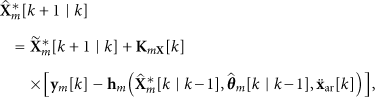

For the estimation of the partial differentiation

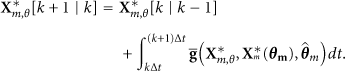
Thus, the substructural relative responses and parameters in substructure m can be identified by the proposed two-step Kalman estimator approach.
For the next substructure

As
Analogously, for other substructures, above substructure 1 (Sub. 1) in Figure 2 can be identified sequentially by the proposed two-step Kalman estimator for the substructure under known excitation.
Thus, for the identification of substructure under known excitation, a two-step Kalman estimator is proposed in this paper. Recursive solutions for the substructural parameters and state vector are derived sequentially. Such solutions are not available in the previous literature. The numbers of unknown parameters to be estimated in each step are greatly reduced, which not only saves computational effort and storage but also avoids the difficulty of computational divergent in the inverse problem.
2.4. Identification of Substructure under Unknown Excitation
For substructure 1 (Sub. 1) of the building in Figure 2, the equation of motion can be extracted from (6) as

As



For the identification of the unknown external excitation on the 1st floor of the building due to unknown ground motion, as shown in Figure 2(b), it is necessary to deploy a sensor on the 1st floor to measure its absolute acceleration response. The discretized observation equation in substructure 1 can be written as

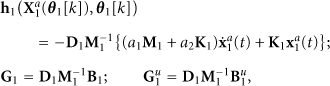
Substructural state vector and parameters above the 1st floor can be identified by the proposed two-step Kalman estimator approach. Then, recursive solution for the unknown external excitation

In order to estimate


With the recursive estimation of unknown external excitation


It is noted that the proposed identification algorithm for substructure under unknown excitation is based on the Kalman estimator approach instead of the conventional Kalman filter approach in other identification algorithms. In the sequential Kalman estimator for the state vector and least squares estimation of the unknown excitation inputs, state vector at time
In summary, the proposed algorithm can identify structural parameters and unknown excitation in a sequential manner, which simplifies the identification problem and reduces both the computational effort and storages compared with other existing work.
After the identification of structural parameters of the building, structural damage can be detected from the changes of structural parameters, especially from the degradation of the identified stiffness parameters.
3. The New Wireless Sensor Network
Recently, a new wireless sensor network (WSN) has been designed by the authors. Some lab and in field experiment tests on the accuracy of data acquisition, time synchronization of measurement data and other capabilities of the wireless sensor units validated that the designed wireless sensor network possesses favorable performances of data collection, transmission, and distributed computation [34].
3.1. Topology of the New WSN
Many sensor networks require deploying many sensors and the transmission of recorded data via long distance. Hierarchical clustering is generally considered as an efficient and scalable way to facilitate the management and operation of such networks and minimize the total energy consumption for prolonged lifetime [33, 34]. In this paper, a two-level cluster-tree network topology is proposed for the wireless sensor network as shown in Figure 3. A large-size structure can be divided into substructures. The distributed sensor units deployed in a substructure are grouped into a cluster. A cluster head is assigned to each cluster to coordinate the sensors in its cluster and to collect data from them during monitoring. Communication between the distributed sensor units with their corresponding cluster head forms the lower level and the network of cluster heads forms the upper level as shown in Figure 3 In wireless communication, the relationship between power consumption E and communication distance d is


A two-level cluster-tree wireless network topology.
In the designed WSN, wireless communication is based on the Zigbee communication protocol built on the IEEE802.15.4 wireless communication standard [35]. IEEE802.15.4 standard is intended to provide the most energy efficient wireless communication protocol available. It also offers a standardized wireless interface for wireless sensor networks, thereby ensuring compatibility between wireless sensor platforms with different designs and functionalities. Thus, while an immediate benefit of IEEE 802.15.4 is its low power consumption, a potentially greater benefit is that it offers a common protocol for wireless sensor networks.
The proposed wireless senor network topology provides parallel computation between the substructures, which is useful for the implementation of computational algorithms for structural health monitoring. This is the unique feature of the proposed WSN different from other WSNs currently available. Finally, a center node combines the function of a cluster head with additional computational capabilities can be used for the final decision on structural health monitoring.
3.2. Hardware Design
Figure 4(a) shows the overall hardware design of the wireless sensor unit. The sensor unit mainly consists of six functional modules: (1) sensor interface; (2) signal conditioning; (3) sensor signal digitization; (4) computational core; (5) wireless communication; (6) battery management. To package the selected hardware components into a compact wireless sensor prototype, a two-layer printed circuit board was designed and fabricated. As shown in Figure 4(b), all electrical components are surface mounted to the printed circuit board. Most of the designs of the above six main modules are similar to those in other wireless sensors. Only the distinguishing features in the hardware structure of the proposed wireless sensor are introduced herein.

Wireless sensor unit in the sensor network.
Compared with other commercial wireless sensors, the Chipcon CC2430 is selected as the wireless transceiver in this design. The chip, named CC2430, released by Texas Instrument Corporation and is a true System-on-Chip (SoC) solution specifically tailored for 2.4 GHz IEEE 802.15.4 and ZigBee applications [36]. The CC2430 combines the excellent performance of the leading CC2420 RF transceiver with an industry-standard enhanced 8051 MCU, 32/64/128 KB flash memory, 8 KB RAM and many other powerful features. It has various operating modes and features of extra low consumption. When the microcontroller runs at 32 MHz, the CC2430 only consumes 25 mA for receiving and 27 mA for transmitting, while 0.3 μA current consumed in stand-by mode. Its short transition time between operating modes further ensure low power consumption. All these features make CC2430 highly suitable for the applications where ultra low power consumption is required.
In the computation core, a low-cost, low-power 8-bit Atmel AVR microcontroller (ATmega 128) is selected for the sensor unit. The microcontroller has 128 KB of ROM and 4 kB of SRAM is integrated with the microcontroller; however, this amount of SRAM is insufficient to store all the collected data. An additional 128 kB of SRAM (Cypress CY62128B) is interfaced with the microcontroller for the storage of sensor data. This microcontroller, together with certain internal and external memories, provides the capability of onboard data interrogation at the sensor level.
The hardware structure of a cluster head in the designed wireless sensor network is similar to that of a sensor unit except that its computational core is replaced by a TMS320C5409 digital signal processor (DSP) as shown in Figure 5(a). The attractive feature of TMS320VC5509A is the extra low power consumption compared with its strong computing ability. The TMS320VC5509A, a 16-bit fixed-point digital signal processor (DSP) produced by Texas Instrument Corporation, is based on the TMS320C55x DSP generation CPU processor core. The C55x CPU provides two multiply-accumulate (MAC) units, each capable of 17-bit

Wireless cluster head of the sensor network.
4. Intelligent SHM of Multistory Building
4.1. The Proposed Technique
The proposed algorithm can identify structural parameters, unknown earthquake excitation and structural damage based on substructure approach and a proposed a two step Kalman estimator. The algorithm enables distributed identification of substructures in multistory shear buildings with less computational effort and storage compared with other existing algorithms. The designed hierarchical sensor network has a two-level cluster-tree architecture, especially the cluster head consists of a low power DSP with strong computing capacity. The new WSN provides parallel computation resources at group level, which is a particularly useful feature for the implementation of computational algorithms for structural health monitoring. Based on the unique advantages of the proposed algorithm and the wireless sensor network, a technique for intelligent monitoring multistory buildings under unknown earthquake excitations can be implemented by embedding the proposed algorithm into the new wireless sensor network. The proposed algorithm for distributed structural identification is coded in C language and embedded into the cluster heads and sensor nodes in the wireless sensor network, which grants the wireless sensor network with “intelligent” characteristics.
As shown in Figure 6, a multistory shear building is divided into m substructures in such a manner each substructural interface responses are measured by accelerometers. A corresponding WSN with m clusters is established in which sensors (s) and cluster heads (ch) are used to record some acceleration responses of the building under unknown earthquake excitation. Intelligent identification starts from substructure m at the top of the building. Sensors (s) in the substructure m transmit reordered acceleration responses to its cluster head (ch) in which the proposed two-step Kalman estimator algorithm is embedded to identify the substructural conditions and send the calculation results of structural parameters and substructural interaction force to the following substructure
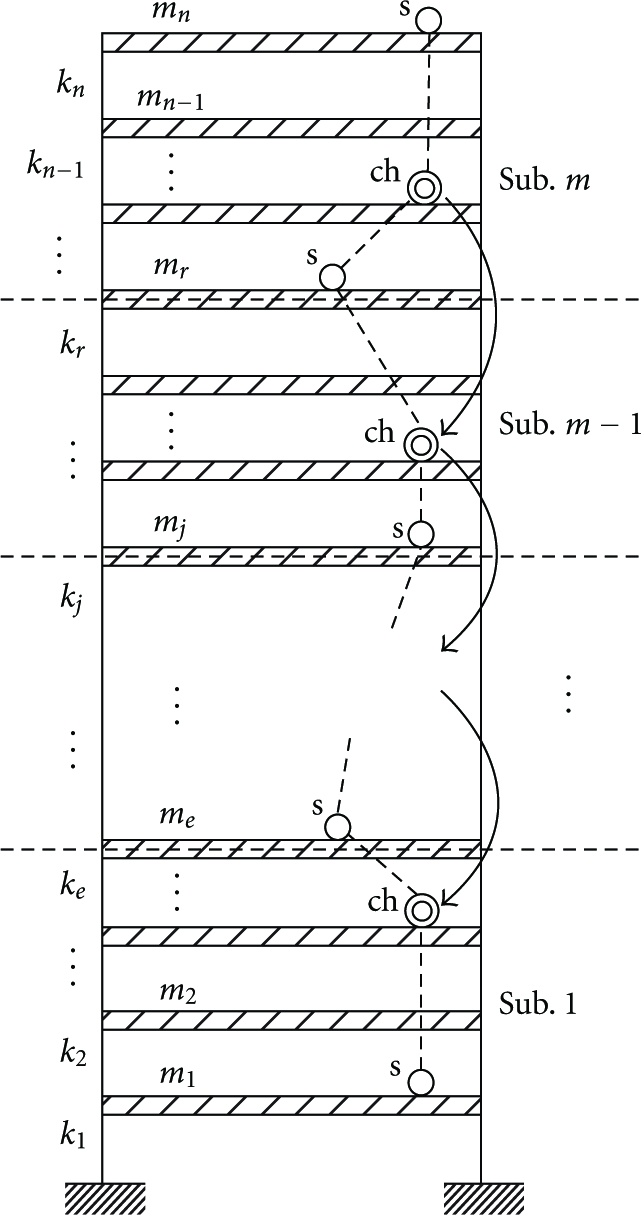
WSN for intelligent monitoring of a multistory building.
It is noted that in the proposed technique by the WSN, each sensor node transmits its recorded data to its cluster head nearby instead of direct to the central PC. Also, each cluster head just transmits its calculation results to its adjacent cluster head. Thus, the transmission of recorded data over long distance is avoided, which greatly reduced the power consumption in data transmission.
4.2. Experimental Validation
To assess the performance of the proposed technique for intelligent monitoring of multistory building under unknown earthquake excitation by the wireless sensing network, an eight-story shear type building in lab under shake table test is selected as an experimental example. As shown in Figure 7(a), the steel structure model behaves as a lumped mass shear building because the building's floors are constructed by rigid beams. The connection of the column-beam is shown in Figure 7(b). The structure model is mounted on a small size shake table which induces 1940 N-S El-Centro earthquake ground motion to the structure, but this ground motion is not unmeasured. Six light PCB accelerometers are deployed on the 1st, 3rd, 4th, 5th 6th and 8th floors to measure structural absolute acceleration responses of at the corresponding floor levels, respectively. Structural damage is simulated by replacing the flexible columns with thinner ones as shown in Figure 7(b), which results in the reduction of corresponding story stiffness

Experimental test of an 8-story shear building model.
As shown in Figure 8, the building is divided into two substructures with floors 1–4 being the 1st substructure and floors 5–8 being the second one. The upper substructure is subject to the measured acceleration

Experimental test of intelligent monitoring.
Figure 9 indicates the results of the identified story stiffness parameters of the undamaged building shown in the PC server while the identified earthquake excitation results (solid line) are compared with the actual ground motion (dotted line) in Figure 10. For the ease of replacement of columns, each column is connected to the rigid beam by two screws at each ends, as shown in Figure 7(b). Thus, the structure model is not an ideal shear-type building, so there is certain difference between the identified story stiffness values and those of the analytical shear building model. From the comparison in Figure 9, it is noted that the proposed technique can identify unknown earthquake excitation with good accuracy.

Identification results of story stiffness of the undamaged building shown on PC.

Comparison of the estimated earthquake excitation with the real one.
Figure 11 indicates the identified story stiffness parameters of the damaged building shown in the central PC. By comparing the identification results of the story stiffness parameters shown in Figures 9 and 11, a final decision of structural damage detection can be made in the central PC. It is clearly shown that the proposed technique can autonomously detect structural damage based on the degrading of identified values of element stiffness parameters of

Identification results of story stiffness of the damaged building shown on PC.
Although a small size 8-story structure model is used as an experimental test, the experiment results demonstrate the strategy and performance of the purposed technique.
5. Conclusions
In this paper, a technique is proposed for intelligent monitoring of multistory building under unknown earthquake excitation by a new wireless sensor network. Original contributions of the paper include: first, an algorithm is proposed for distributed structural identification detection with limited output measurements. It requires fewer structural output measurements compared with previous approaches. The algorithm is based on a proposed two step Kalman estimator for the identification of structural parameters and least squares estimation for unknown excitation. It cannot only identify structural parameters and unknown excitation in a sequential manner but also reduce both computational effort and storages compared with other existing work. Such straightforward derivation and analytical solutions are not available in the previous literature. Then, a new wireless sensor network with a two-level cluster-tree architecture is proposed. The distributed sensors are grouped into a cluster, in which a cluster head consists of a low power DSP with strong computing capacity. Thus, it provides parallel computation resources at group level, which is a particularly useful feature for the implementation of algorithm for intelligent structural health monitoring compared with other WSNs. Finally, intelligent monitoring of multistory building under unknown earthquake excitation is implemented by embedding the proposed algorithm into the new WSN. Such a technique is not available in the previous literature. A lab experimental test demonstrates that the proposed technique is effective for intelligent identification of structural parameters, excitation and structural damage of multistory shear buildings with limited measurements of structural responses.
Footnotes
Acknowledgments
This research has been partially supported by the National Natural Science Foundation of China (NSFC) through the Grant no. 51178406, the China National High Technology Research and Development Program 2007AA04Z420, and the Natural Science Foundation of Fujian Province through the Grant no. 2010J01309.