




Abstract
Low-cost radio frequency identification (RFID) tag is exposed to various security and privacy threats due to computational constraint. This paper proposes the use of both prevention and detection techniques to solve the security and privacy issues. A mutual authentication protocol with integration of tag's unique electronic fingerprint is proposed to enhance the security level in RFID communication. A lightweight cryptographic algorithm that conforms to the EPCglobal Class-1 Generation-2 standard is proposed to prevent replay attack, denial of service, and data leakage issues. The security of the protocol is validated by using formal analysis tool, AVISPA. The received power of tag is used as a unique electronic fingerprint to detect cloning tags. t-test algorithm is used to analyze received power of tag at single-frequency band to distinguish between legitimate and counterfeit tag. False acceptance rate (FAR), false rejection rate (FRR), receiver operating characteristic (ROC) curve, and equal error rate (EER) were implemented to justify the robustness of t-test in detecting counterfeit tags. Received power of tag at single frequency band that was analyzed by using t-test was proved to be able to detect counterfeit tag efficiently as the area under the ROC curve obtained is high (0.922).
1. Introduction
Radio frequency identification (RFID) tags that conform to EPC Class-1 Generation-2 (Gen 2) standards are broadly used in supply chain management, logistic, person identification, and access control. Global RFID market is expected to grow at a compound annual growth rate (CAGR) of roughly 17% to a value of approximately $9.7 billion in the period 2011–2013. However, the privacy and security of the usage of RFID technology are not guaranteed. The issues that raise security concerns are possibility of tag cloning issue, denial of service (DoS) attack, replay attack, and data leakage.
Gen 2 tags are susceptible to cloning attack due to lack of explicit authentication and security functionalities. Complex cryptographic algorithms, including hash function, and symmetric and asymmetric algorithms, are not supported by Gen 2 tags [1–3]. This is because Gen 2 tags have low-computation capabilities that are only able to support simple mathematical functions. Hence, strong adversaries are capable of skimming on transmission channels to obtain tag information [4]. This information may be used to create counterfeit tags that bear the same information as that of a legitimate tag. Counterfeit tags can be attached to bogus products and disguise these as authentic products in the market. The counterfeit tag issue is very serious because it is capable of causing a menace ranging from public privacy and safety issues to loss of industry revenues.
Lightweight cryptographic algorithm (i.e., CRC, PRNG, and XOR functions) can be used to prevent data leakage problem in Gen 2 tag. In addition, received power of tag can be used as tag's unique electronic fingerprint to detect counterfeit tags. Detection techniques are deployed to minimize the negative effects of tag cloning threats [5]. Counterfeit tags can be detected by employing the electronic fingerprinting system in an RFID system since each RFID tag is unique, based on their radio frequencies and manufacturing differences. Received power of tag at single frequency band is analysed by using t-test to distinguish between legitimate and counterfeit tag. Hence, the combination of prevention and detection methods could be the countermeasure to the privacy and security issues being faced by Gen 2 tags.
The remaining of this paper is structured as follows: Section 2 describes the related works and Section 3 illustrates the overview of proposed lightweight cryptographic mutual authentication protocol. Section 4 outlines the experiment setup and data collection for fingerprint-matching method. Section 5 explains the t-test algorithm in details and Section 6 analyzes the accuracy and performance of fingerprint-matching method. Section 7 shows the overall security analysis and Section 8 concludes the paper.
2. Related Works
In Chien and Chen [2], PRNG, CRC, and XOR are used as the fundamentals in the protocol. Two sets of authentication and access keys are designed to defend DoS attack. However, the scheme is vulnerable to replay attack and information leakage. Chien and Huang [6] presented a lightweight mutual authentication protocol to solve replay attack and secret disclosure problem of Li et al. [7] scheme. But cloning attack problem is not resolved in this scheme. Song and Mitchell [8] proposed an authentication protocol that uses challenge-response approach and simple functions such as right and left shifts and bitwise XOR operation in the scheme. However, the scheme is vulnerable to tag impersonation attack and server impersonation attack. Song [9] presented an authentication protocol for tag ownership transfer that meets new owner privacy, old owner privacy, and authorization recovery requirements. However, the ownership transfer protocol is vulnerable to a desynchronization attack that prevents a legitimate reader from authenticating a legitimate tag, and vice versa. Burmester and Munilla [10] proposed a lightweight mutual authentication protocol that supports session unlinkability, forward and backward secrecy. The protocol is optimistic with constant key lookup, and can easily be implemented on a Gen 2 platform. However, the scheme is susceptible to replay and cloning attacks. Chen and Deng [11] proposed mutual authentication protocol that is able to reduce database loading and ensure user privacy. But the authentication protocol did not take into consideration cloning attack issues.
In [12], minimum power responses measured at multiple frequencies are used as unique electronic fingerprint. The power is measured at the range from 860 MHz to 960 MHz in increments of 1 MHz. Two-way analysis of variance (two-way ANOVA) is used to test the equality of means of two groups in terms of minimum power response and different physical characteristic of tags. 10-fold cross-validation on the classifier is used to validate the result obtained, and the AUC is 0.999. The average true positive rate and false positive rate are 0.905 and 0.001, respectively. The research focused on using minimum power responses at multiple frequencies as a unique electronic fingerprint for RFID tags. Hence, this paper extends the idea to show that received power of tag at single frequency band can be used to fingerprint RFID tags. Physical-layer identification of passive UHF RFID tags from three different manufacturers is analyzed in [13]. RFID reader that is capable to simulate an inventory protocol is built to activate tags. RF signal features are extracted from the preambles of tags’ replies. Time domain and spectral features of the collected signals are analyzed. The tags can be classified with an accuracy of 71.4% from different locations and distances to the reader based on the time domain features. In addition, UHF RFID tag that is proved can be uniquely identified in controlled environment based on the signal spectral features with 0% of EER. The physical-layer identification method is complex, and the reader used in conducting the experiment is purposely built. In contrast, the proposed method in this paper is simple and applicable to any Gen 2 reader.
3. Lightweight Cryptographic Mutual
A lightweight cryptographic mutual authentication protocol that conforms to Gen 2 standards is proposed. The proposed protocol consists of initialization phase and authentication phase. The channel between a back-end server and a reader is assumed secure. On the other hand, the channel between a reader and a tag is assumed insecure.
The notations used in the description of proposed protocol are shown in Table 1.
Notations used in the protocol.

In the initialization phase, a back-end server and tag store information are required to perform authentication. The back-end server initially stores seven values of each tag in its database. These are new index denotes as CRC (

Lightweight cryptographic mutual authentication protocol.
In authentication phase, the reader will send query command to the tag. The tag computes
4. Experimental Setup and Fingerprint Data
The proposed RFID tag fingerprint-matching method illustrated in Figure 2 consists of initial phase and detection phase. In the initial phase, received power of each EPC tag is calculated using Friis transmission equation. Reader transmitted power used in the equation is measured using a spectrum analyzer. The received power is measured once the power is held constant. Each tag received power is stored in database. In the detection phase, stored fingerprint and measured fingerprint are compared using t-test algorithm. The tag being measured is proved to be a legitimate tag if P value of t-test algorithm is greater than 0.05. Otherwise, the tag is proved to be a counterfeit tag.
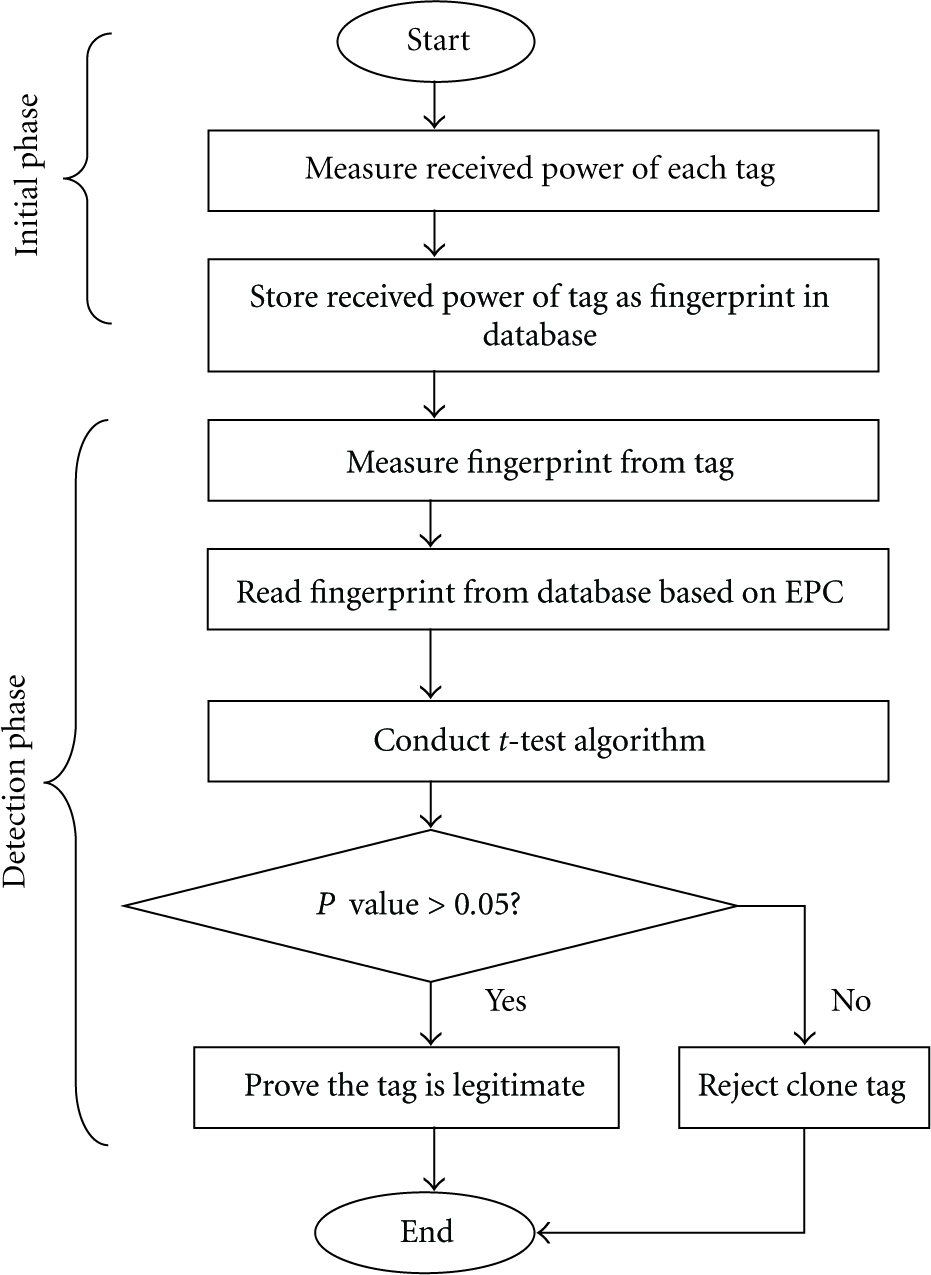
Overall process of fingerprint-matching method.
The received power of tag is calculated based on the reader's transmitted power, which is measured at 919–923 MHz. The frequency band is used based on the Malaysian UHF RFID standard governed by Malaysian Communications and Multimedia Commission (MCMC) [14]. However, the measurement is still applicable to other countries, RFID frequency band. The transmitted power of tag is measured for 100 passive RFID tags at fixed temperature and controlled environment. The legitimate tag fingerprint template is determined by obtaining the average received power of 50 readings per tag. The received power that acts as a unique fingerprint for each tag is measured in dBm. The received power is stored in the database only in order to protect the secrecy of fingerprint value from being obtained by adversaries. The unique fingerprint value that stored in the database can be searched based on the EPC. Hence, the stored fingerprint value in database and measured fingerprint value that obtained from experimental measurement can be compared to verify the genuineness of the tag.
Figure 3 shows the measurement of reader transmitted power platform. The setup consists of a passive RFID reader and antenna, passive EPC tag, and spectrum analyzer. The reader operates at UHF 919–923 MHz and supports Gen 2 protocol. The antenna and tag are placed at fixed position to obtain an accurate and reliable result. To determine precise reader transmitted power, cable loss and power loss within the power splitter must be considered. Hence, power value obtained from the spectrum analyzer is added to the total power loss measured to obtain an accurate reader transmitted power. Figure 4 shows a measurement of reader transmitted power using spectrum analyzer.

Measurement of received power of tag platform.

Reader transmitted power measured with spectrum analyzer.
The tag received power is calculated using Friis transmission equation, as demonstrated in
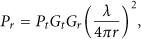
where

where,
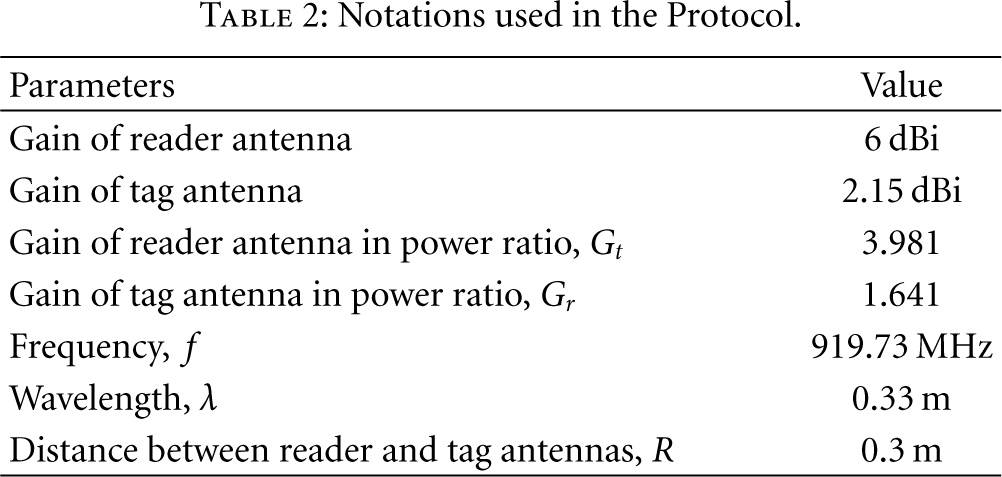
Notations used in the Protocol.
5. t-test Algorithm
Cloning tags may be detected by comparing extracted received power and stored fingerprint using t-test algorithm, as illustrated in

where
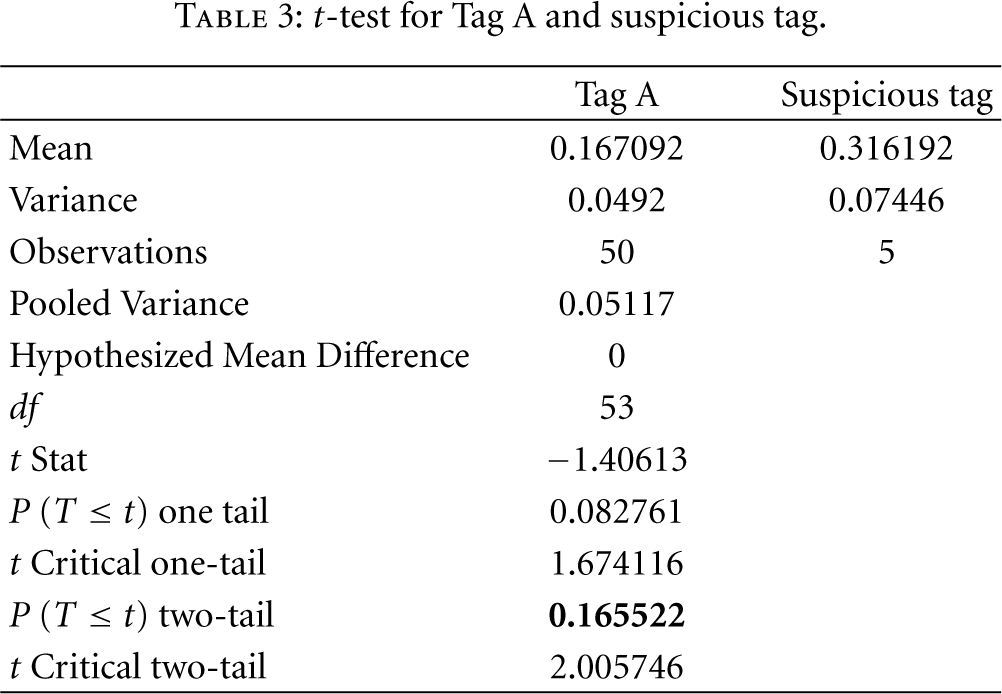
When a tag is suspected to be counterfeit, comparison of stored and measured tag's fingerprint experiment needs to be conducted. In Case 1, a suspicious tag claims to belong to Tag A based on the stored fingerprint. As demonstrated in Table 3, P value obtained from the t-test within Tag A and the suspicious tag is higher than 0.05. This proves that no significant difference exists between the suspicious tag and Tag A. Hence, the suspicious tag is a legitimate tag. The higher the P value is, the more likely that the two groups will match. Otherwise, the tag is proved to be a counterfeit one. In Case 2, a suspicious tag claims to belong to Tag 4. A t-test is conducted between the suspicious tag and Tag B. The P value obtained from Table 4 is less than 0.05. Hence, the suspicious tag from Case 2 is proved to be a counterfeit.
t-test for Tag A and suspicious tag.
t-test for Tag B and suspicious tag.

6. Fingerprint-Matching Performance Analysis
The accuracy of proposed fingerprint-matching method in distinguishing between legitimate and counterfeit tags as shown in Case 2 is analyzed by using FAR, FRR, ROC, and EER. A 2 × 2 contingency table is used to verify four outcomes from the data obtained from Case 2. The outcome is a true acceptance (TA) when measured fingerprint is verified as a genuine value and the tag identity is found in the database. When the measured fingerprint has genuine value but the tag identity is not found in the database, the outcome is false acceptance (FA). Conversely, true reject (TR) is obtained when measured fingerprint has bogus value and the tag identity is not found in the database. False reject (FR) is obtained when measured fingerprint is verified as a bogus value but the tag identity is found in the database. Table 5 illustrates four outcomes obtained from fingerprint-matching method for Case 2.
Four outcomes from fingerprint matching method.

False acceptance rate (FAR) is the measurement of probability in which the fingerprint-matching method falsely verifies different tags as identical. False rejection rate (FRR) is the measurement of probability in which the fingerprint-matching method falsely verifies identical tags as different. FAR and FRR are calculated using (4) and (5), respectively [15],


FAR and FRR for Case 2 are shown in Table 6.
FAR and FRR for Case 2.

ROC curve and EER are used to evaluate the performance of t-test algorithm in verifying measured fingerprint with stored fingerprint. ROC curve illustrated in Figure 5 plots the true acceptance rate (TAR) versus its false acceptance rate (FAR). EER is the rate at which both FAR and FRR are equal. Based on the ROC curve, EER for Case 2 is 0.16, which is considered as a low value. The lower the EER is, the more accurate will be the fingerprint-matching method.
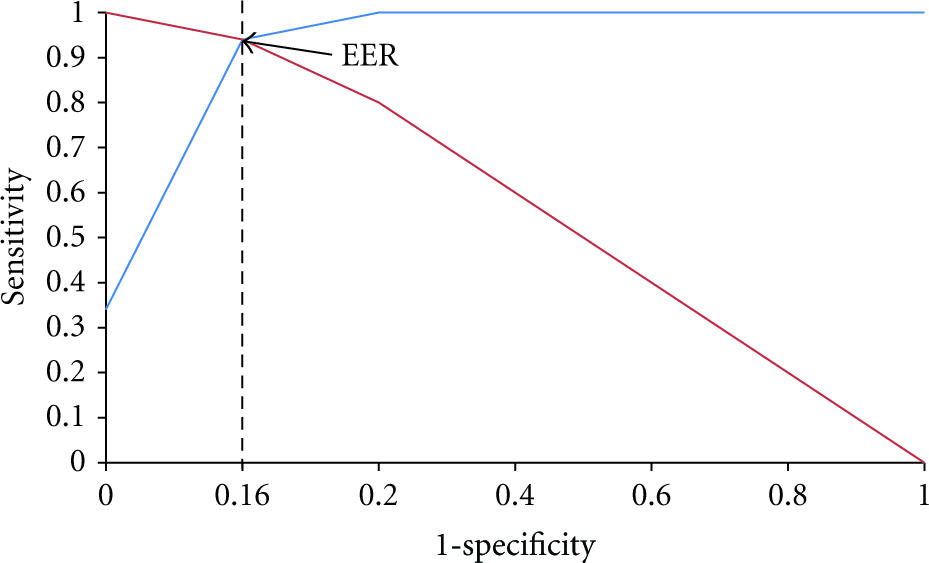
Receiver operating curve with equal error rate.
The area under curve (AUC) of the ROC curve is a measurement of the performance of t-test algorithm in distinguishing between two fingerprint data sets. The accuracy of the t-test algorithm is verified using a rough guide for classifying the accuracy of a test as shown in Table 7 [16, 17].
Accuracy of test categorization.

AUC for Case 2 that obtained from SPSS statistical analysis result is 0.922 as shown in Table 8, which is considered an excellent performance according to the accuracy guide. This proves that the t-test algorithm offers high accuracies in distinguishing fingerprints between data sets of two tags.
Accuracy of test categorization.

Under the nonparametric assumption.
Null hypothesis: true area = 0.5.
7. Security Analysis
The security of proposed protocol that is written in HLPSL is validated using AVISPA tool. The intruder under the Dolev-Yao model has capability to full control over the network [18]. The intruder may intercept and analyze transmitted message as well as impersonate one of the agents (tag, reader, and server) to send modified message to others. Data secrecy and mutual authentication are the security goals that needed to achieve in AVISPA tool. The

AVISPA validation result.
Replay attack can be prevented in this proposed protocol because the value transmitted for each session is different. The proposed protocol is a challenge-response mutual authentication protocol that is based on one-time pad encryption. Hence, different value of session key is utilized in individual session and PRNG plays a vital role in providing different value of session key to encrypt with ET. A random number, n, is XOR with
DoS attack can be defended by using updated session key. The legitimate tag can be identified by verifying the encrypted message with message recorded in the database. On the other hand, the authentication of the reader is verified by the tag by comparing the decrypted message with message recorded in the tag. Both new and old indexes, session keys, and random numbers that are stored in the back-end server are used to prevent desynchronized issue. Desynchronization problem occurred when variables stored in the tag are different with the one stored in the database. Hence, the server can use old variables to resynchronize with the tag.
The secrecy of the tag's information is safe from eavesdropping attack. The
The proposed protocol can prevent the issue of cloning tags by using fingerprint information stored in the database to detect counterfeit tags. Each tag has it own unique received power of tag value. Even though adversaries are able to copy all the data from a tag, they are unable to create a counterfeit tag that has the exact same physical feature as original tag. Thus, any counterfeit tag can be found when the fingerprint of tag detected is not matched with the fingerprint information stored in the tag. The proposed method is analyzed by using one factor only, which is received power of tag at single frequency, whereas two factors, namely, minimum power responses at multiple frequencies and physical characteristic of tags, are tested by using ANOVA in [12]. The accuracy of the proposed method and method of [12] is excellent in both, with the values of 0.922 and 0.999, respectively. The proposed method is simpler but capable to produce comparable accuracy of method [12] which analyses two factors to detect cloning tags.
Table 9 indicates a comparison of results between proposed scheme and related security schemes in terms of replay attack, DoS attack, cloning attack, forward secrecy, and Gen 2 standards compliance. The proposed lightweight cryptographic mutual authentication protocol is proved to possess more security protection compared to existing security schemes.
Comparison between schemes.

8. Conclusions
This paper proposed the use of both prevention and detection methods to enhance the security level in an RFID system. The lightweight cryptographic mutual authentication protocol that consists of lightweight cryptographic algorithm, including XOR, CRC, and PRNG functions, is used as prevention method. The security of proposed protocol is validated using AVISPA tool and is proved safe from replay attack, denial of service threats, and data leakage problem.
In addition, tag's fingerprint extraction and matching method is presented as a detection method in detecting counterfeit tags. Each tag received power is measured, calculated, and stored in the database for further reference. Tag received power can be used as unique fingerprint as these are significantly different in the frequency range of 919–923 MHz. t-test algorithm is used to determine the identity of measured tag. Measured tag is proved as counterfeit if the
Footnotes
Acknowledgments
The authors would like to thank the School of Electrical and Electronic Engineering, USM and the USM RU (Research University) grant secretariat, for sponsoring this work.