




Abstract
Nanofluids are expected to be a promising coolant candidate in chemical processes for water waste remediation and heat transfer system size reduction. This paper focuses on the potential mass flowrate reduction in exchanger with a given heat exchange capacity using nanofluids. Al2O3 nanoparticles with diameters of 7 nm dispersed in water with volume concentrations up to 2% are selected as a coolant, and their performance in a horizontal double-tube counterflow heat exchanger under turbulent flow conditions is numerically studied. The results show that the flowrate of nanofluid coolant decreases with the increase of concentration of nanoparticles in the exchanger with a given heat exchange capacity. The mass flowrate of the nanofluid at a volume concentration of 2 vol.% is approximately 24.5% lower than that of pure water (base fluid) for given conditions. For the pressure drop, the results show that the pressure drop of nanofluid is slightly higher than water and increases with increase of volume concentrations. In addition, the reduction of wall temperature and heat transfer area is estimated.
1. Introduction
Cooling is one of the top technical challenges to obtain the best heat performance in the heat exchange devices. In chemical processes, one of the most important devices related to energy and heat transfer is heat exchanger. The heat exchangers have an important role in the energy conservation, conversion, and recovery. Due to the rapid development of modern technology, heat exchangers used by various industries require high heat-flux cooling to the level of tens of MW/m2. At this level, cooling with conventional fluids such as water and ethylene glycol, and so forth. (because of poor conductivity) is challenging. Therefore, it is necessary to increase the heat transfer capabilities of working fluids in the heat transfer devices. A recent advancement in nanotechnology has been the introduction of nanofluids, that is, colloidal suspensions of nanometer-sized solid particles instead of common working fluids. Nanofluids were first innovated by Choi and Eastman [1] in 1995 at the Argonne National Laboratory, USA. Compared with traditional solid-liquid suspensions containing millimeter-or micrometer-sized particles, nanofluids as coolants in the heat exchangers have shown better heat transfer performance because of the small size of suspended solid particles. It causes that nanofluids have a behavior similar to base liquid molecules.
Nanofluids have attracted attention as a new generation of heat transfer fluids in building heating, in heat exchangers, in chemical plants, and in automotive cooling applications, because of their excellent thermal performance. Recently, there have been considerable research findings highlighting superior heat transfer performances of nanofluids. Demir et al. [2] investigated numerically laminar and turbulent forced convection flows of Al2O3/water nanofluid as working fluid in a horizontal smooth tube with constant wall temperature and reported an enhancement in heat transfer coefficient. Gherasim et al. [3] presented numerical simulations for a radial flow cooling system with an Al2O3/water nanofluid flow. The results indicate that the addition of nanoparticles to the base fluid enhances heat transfer performance. Also the numerical results show that the average Nusselt number and pumping power of nanofluid increase with increasing the particle volume concentration. Mohammed et al. [4] numerically studied the effects of using nanofluid on the performance of a square shaped microchannel heat exchanger (MCHE). Their results demonstrated that Al2O3 and Ag nanoparticles have the highest heat transfer coefficient and lowest pressure drop among all nanoparticles tested, respectively. They concluded that the benefits of nanofluids such as enhancement in heat transfer coefficient are dominant over the shortcomings such as increasing in pressure drop. Ollivier et al. [5] investigated the use of nanofluids as a jacket water coolant in a gas spark ignition engine. They numerically simulated the unsteady heat transfer through the cylinder and inside the coolant flow. Authors reported that because of higher thermal diffusivity of nanofluids, the thermal signal variations for knock detection increased by 15% over the predicted using water alone. Vajjha et al. [6] numerically investigated the heat transfer augmentation by application of two different nanofluids consisting Al2O3 and CuO nanoparticles in an ethylene glycol and water mixture circulating through the flat tubes of an automobile radiator. Their results showed that at a Reynolds number of 2000, the percentage increase in the average heat transfer coefficient over the base fluid for a 10% Al2O3 nanofluid is 94% and that for a 6% CuO nanofluid is 89%. They found that the average heat transfer coefficient increases with the Reynolds number and also with the particle volumetric concentration. Leong et al. [7] have studied the application of nanofluids as working fluids in shell and tube heat recovery exchangers in a biomass heating plant and showed that about 7.8% of the heat transfer enhancement could be achieved with the addition of 1% copper nanoparticles in ethylene glycol-based fluid at 26.3 kg/s and 111.6 kg/s mass flow rate for flue gas and coolant, respectively. Ijam and Saidur [8] theoretically analyzed a minichannel heat sink with a 20 × 20 cm bottom for SiC/water nanofluid and TiO2/water nanofluid turbulent flow as coolants through hydraulic diameters. Their results showed that enhancment in thermal conductivity by dispersed SiC in water at 4% volume fraction was 12.44% and by dispersed TiO2 in water was 9.99% for the same volume fraction. Also, it was found that by using SiC-water nanofluid as a coolant instead of water, an improvement of approximately 7.25%–12.43% could be achieved and by using TiO2-water 7.63%–12.77%. Saeedinia et al. [9] applied CuO-based oil particles varying in the range of 0.2%–2% inside a circular tube. Their results showed that the CuO nanoparticles suspended in base oil increase the heat transfer coefficient even for a very low particle concentration of 0.2% volume concentration. Moreover, a maximum heat transfer coefficient enhancement of 12.7% is obtained for a 2% CuO nanofluid. Shafahi et al. [10] used a two-dimensional analysis to study the thermal performance of a cylindrical heat pipe utilizing Al2O3, CuO, and TiO2 nanofluids. Their results confirmed that the thermal performance of a heat pipe is improved and temperature gradient along the heat pipe and thermal resistance across the heat pipe are reduced and maximum capillary heat transfer of the heat pipe is observed when nanofluids are utilized as the working fluid.
From the above, it is evident that nanofluids have valuable applications in heat exchangers in all types of industries. The previous research works have reported the effect of nanofluids as coolants on the thermal performance of heat exchangers. Their results show that using nanofluid can effectively improve the heat transfer performance, but will also increase the pressure drop and pumping power.
The previous research works do not concentrate on the effect of nanofluids in the reduction of coolant mass flowrate in exchanger with a given heat exchange capacity. The objective of this paper is to provide improvements through nanofluids in place of pure working fluid in heat exchangers with a view of decreasing the mass flowrate for providing the same heat exchange capacity.
In this study, 7 nm-Al2O3 nanoparticle with concentration up 2 vol.% has been selected as a coolant in a typical horizontal double-tube heat exchanger because of its good thermal properties and easy availability. Water has been chosen as heat transfer base fluid.
Al2O3 nanoparticles are generally considered as safe material for human being and animals that are actually used in the cosmetic products and water treatment. In addition, Al2O3 nanoparticles are stabilized in the various ranges of PH. It shall be noted that metal oxides such as Al2O3 nanoparticles are chemically more stable than their metallic counterparts.
In this investigation, first the thermophysical properties of Al2O3/water nanofluid are calculated by using the well-known correlations developed from experiments. Then, the effects of volume fraction of the Al2O3 nanoparticles dispersed in water on the thermal performance and potential reduction in mass flowrate are evaluated.
The applicability of nanotechnology towards wastewater remediation and reduction in the presently high initial and operating costs should be considered as future work.
2. Methodology
2.1. Prediction of Thermophysical Properties of Nanofluid
In order to investigate the heat transfer performance of nanofluids and use them in practical applications, it is necessary first to study their thermophysical properties such as density, specific heat, viscosity, and thermal conductivity. In this study, to validate the numerical results, thermal properties of Al2O3/water nanofluid are determined by employing well-known empirical correlations.
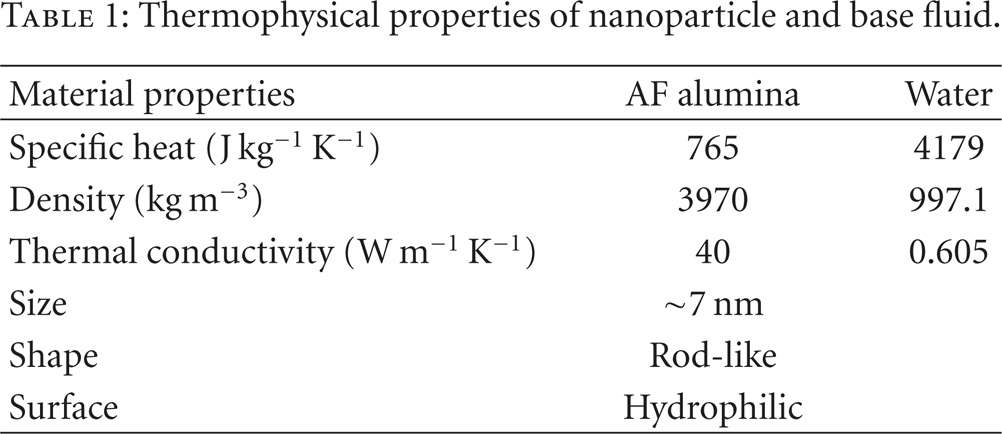
Some properties of hydrophilic rod-like Al2O3 nanoparticles (AF-alumina type) and base fluid (water) which have been used for assessing the nanofluid properties are Tabulated in Table 1. The AF alumina type nanoparticle is rod-like and because of its cylindrical shape and elongation, it has a better heat conduction through the fluid rather than spherical nanoparticles. However the spherical nanoparticles are often most readily available at the best prices.
Thermophysical properties of nanoparticle and base fluid.
The density of Al2O3/water nanofluid can be calculated using mass balance as [11]

where ρ p and ρbfare the densities of the nanoparticles and base fluid, respectively, and ϕ is volume concentration of nanoparticles.
According to the concept of solid-liquid mixture, the specific heat of nanofluids is given by following [12]:

where
The viscosity of nanofluid can be calculated from the following equation:

where a is the slope of the relative viscosity to the particle volume fraction. Value of a is a constant and calculated from the experimental results of Chun et al. [13]. In this work, it is equal to 15.4150.
One well-known formula for computing the thermal conductivity of nanofluid is the Kang model which is expressed in the following form [14]:

In the present paper, this model is employed for calculating the thermal conductivity of Al2O3/water nanofluid.
2.2. Mathematical Modeling
This research attempts to investigate numerically the heat transfer characteristics of a double-tube exchanger with a given heat exchange capacity by water-based Al2O3 nanofluid as a coolant and pumping power.
Figure 1 represents the dimensions of horizontal double-tube heat exchanger and conditions of hot solvent and nanofluid coolant streams that have been taken into consideration in this work. However, the following assumptions are made
The flow is incompressible, steady-state, and turbulent.
The effect of body force is neglected.
The thermophysical properties of nanofluids are constant.
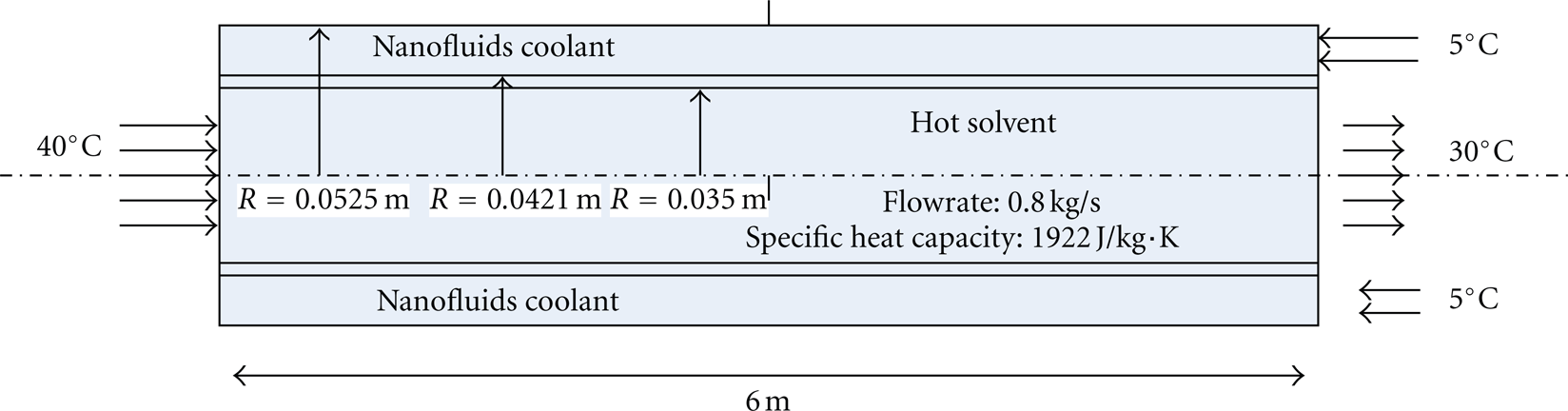
Schematic view of double-tube exchanger with heat exchange capacity of 15.376 kW.
Mathematical correlations shown in Sections 2.2.1–2.2.3 are taken from references [15–17]. It highlighted not only the influence of nanofluids but also the volume fraction of Al2O3 nanoparticles to the heat transfer, mass flow rate, and pumping power of a double-tube exchanger. Calculations have been done on hot solvent and coolant sides.
2.2.1. Hot Solvent Side Caculation
(a) The rate of heat transferred to the hot solvent in a double-tube heat exchanger can be written as follows:

where h and nf denote the relevant parameters of hot solvent and nanofluid coolant,
In this study, the heat exchange capacity of exchanger
(b) The heat transfer coefficient of the hot solvent flowing inside the tube under a turbulent regime (Re > 10000) can be calculated as follows [15]:

where D
i
is the internal diameter of the internal tube

Consequently, heat transfer coefficient of hot solvent that referred to the external area,
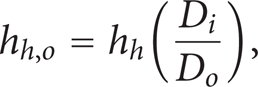
where D o is the external diameter of the internal tube.
2.2.2. Nanofluids Side Calculation
In this research, the inlet temperature of nanofluid coolant is equal to 5°C and other important thermal and hydrolic properties of nanofluid coolant such as outlet temperature and mass flowrate are calcualted from empirical correlations obtined in this section regarding the constant heat exchange capacity of exchanger.
(a) The heat transfer coefficient of the nanofluid as coolant flowing in the annular can be calculated considering the turbulent Nusselt number presented by Li and Xuan [16] as follows:

where Pe d is the nanofluid Peclet number and is defined inthe following form:

where d p is the diameter of the nanoparticles and αnf is the nanofluids thermal diffusivity which is defined as follows:

The Reynolds and Prandtl numbers in (9) are calculated considering the nanofluid properties as follows:

where Deq is the equivalent diameter which is expressed in the following form:

where D s is the internal diameter of the external tube.
It shall be noted that all physical properties of both hot solvent and nanofluid coolant that appeared in previous equations, except the viscosity correction factor, shall be evaluated at the mean temperature between inlet and outlet conditions.
The viscosity correction factor is defined as the ratio of viscosity of the nanofluid at the mean temperature of inlet and outlet conditions to that one at the mean temperature of wall tube. The mean temperature of wall tube, T
w
, cannot be calculated explicitly. Therefore, as a first approximation, it is assumed to be equal to 1 and the first values of heat transfer coefficients (

By having T
w
, the exact value of viscosity correction factoris calculated and the previous values for
(b) The friction factor of Al2O3/water nanofluid can be calculated using the formula presented as follows [17]:

where

(c) The pressure drop

where L is the length of the tube,
2.2.3. Total Heat Transfer Area and Coefficient Calculation
(a) The total heat transfer coefficient can be calculated as follows:
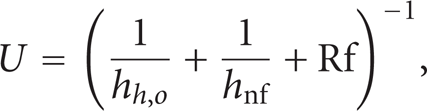
where Rfis the fouling resistance,
(b) The total heat transfer area of a double-tube heat exchanger, A, is computed from the following equation:

where U is the total heat transfer coefficient and F is the temperature correction factor, which in the case of the countercurrent flow can be taken equal to 1.
3. Results and Discussion
As mentioned previously, the Kang model has been applied to predict the thermal conductivity of the Al2O3/water nanofluid. As shown in Figure 2, the thermal conductivity of Al2O3/water nanofluid with different concentrations (0–2% volume fraction) has been calculated using Kang model. These results are important for evaluating the heat transfer performance and flowrate of the coolant. As can be seen, thermal conductivity increases with increasing the nanoparticles volume concentration.

Thermal conductivity of Al2O3/water nanofluid at various volume concentrations.
Figure 3 shows the effect of nanoparticles concentration on the heat transfer coefficient and Nusselt number. Results show that the heat transfer coefficient and Nusselt number can be enhanced by adding nanoparticles to the base fluid.
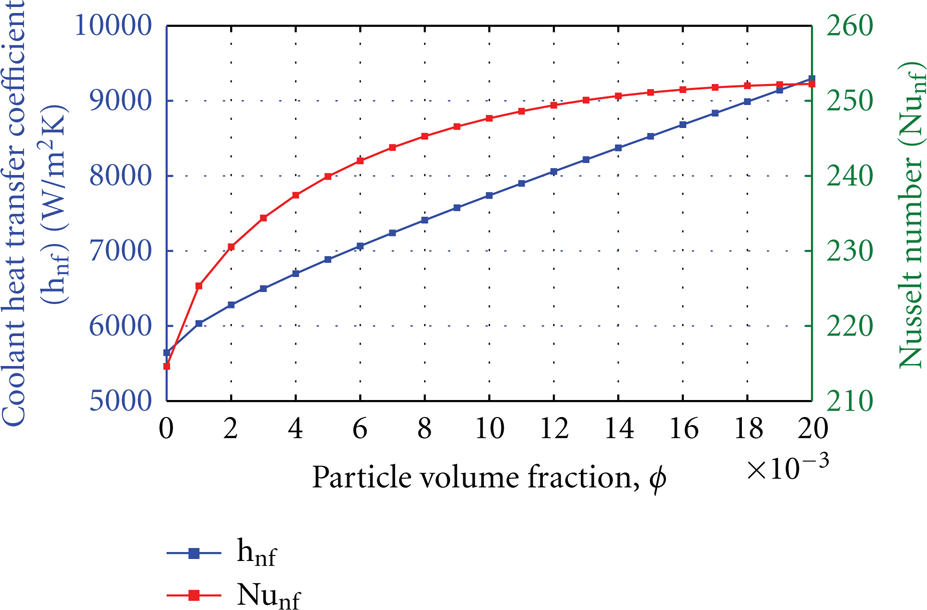
Heat transfer coefficient and Nusselt number for Al2O3/water nanofluid coolant at various concentrations.
Increasing the particles concentration raises the fluid viscosity and decreases the Reynolds number and consequently decreases the heat transfer coefficient (Figure 4). But the results shown in Figure 3 indicate that increasing in particles concentration raises the heat transfer coefficient. Therefore, it can be concluded that the change in the coolant heat transfer coefficient is more than the change in the fluid viscosity with increasing nanoparticles loading in the base fluid.

Heat transfer coefficient of the Al2O3/water nanofluid coolant with regard to nanofluid Reynolds number.
A further inspection of Figures 2 and 3 shows that for a volume concentration of 2%, the heat transfer coefficient increases about 64.65%, while the increase of thermal conductivity is below 40%.
In this study, the ratio of thermal conductivity and heat transfer coefficient of nanofluid in comparison with the base fluid is defined by following equations:

Figure 5 shows these defined parameters for the Al2O3/water nanofluid at various concentrations. This figure reveals that as the concentration increases, the effect of increasing nanoparticles concentration on changing the thermal conductivity is lower than changing the heat transfer coefficient.
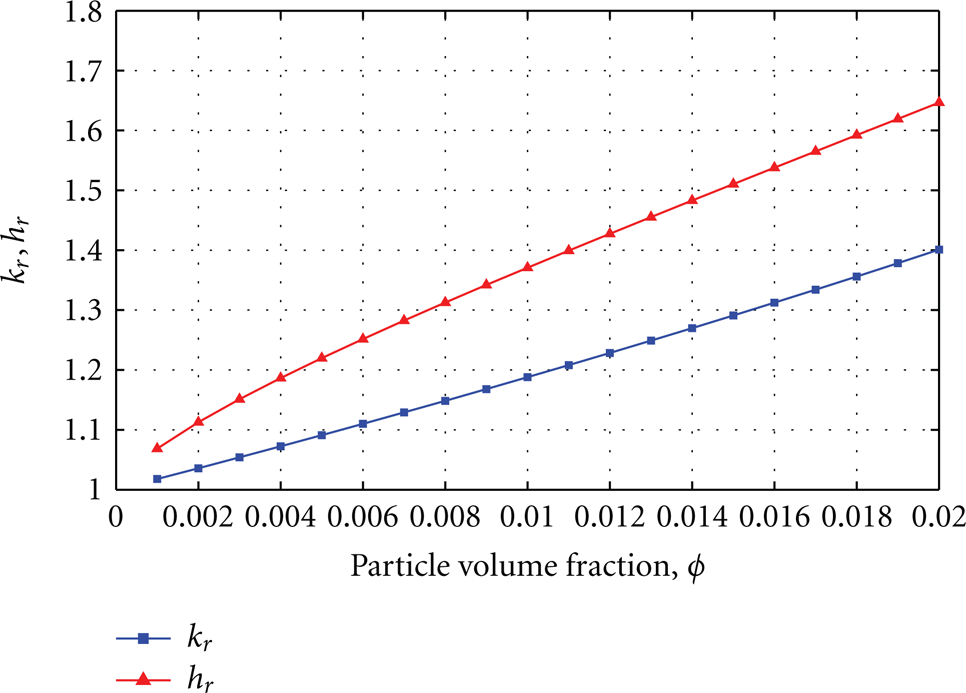
Comparison between k r and h r for Al2O3/water nanofluid coolant in a double-tube heat exchanger at various concentrations.
Enhancement of heat transfer by the nanofluid may be resulted from the following two aspects: first is the suspended particles that increase the thermal conductivity of the mixture; the other one is that chaotic movement of ultrafine particles accelerates energy exchange process between the fluid and the wall.
Figure 6 shows the total heat transfer coefficient for Al2O3/water nanofluid coolant in a double-tube heat exchanger that has been calculated by (18). As shown in this Figure, the total heat transfer coefficient is high when the probability of collision between nanoparticles and the wall of the heat exchanger has increased under higher concentration conditions. It confirms that nanofluids have considerable potential to use in cooling systems. A further inspection of Figure 6 shows that the total heat transfer coefficient of the Al2O3/water nanofluid for volume concentrations in the range of 0.1% to 2% increases by 0.55%–3.5%.

Total heat transfer coefficient of the Al2O3/water nanofluid coolant in a double-tube heat exchanger at various concentrations.
As mentioned previously, the wall temperature, T
w
, shall be calculated to obtain the exact values for viscosity correction factor,

Reduction percent of wall temperature and heat transfer area in a double-tube heat exchanger by using the Al2O3/water nanofluid coolant.
Figure 8 shows the required flowrate of Al2O3/water nanofluid as a coolant at various volume concentrations for providing the same heat exchange capacity (discussed previously). This figure reveals that at the same heat exchange capacity, the flowrate of nanofluid coolant decreases with the increasing concentration of nanoparticles. For a volume concentration range of 0.1% to 2%, the mass flowrate decreases by 4.73% to 24.5%.

Reduction in coolant flowrate in a double-tube heat exchanger using Al2O3/water nanofluid coolant.
In order to apply the nanofluids for practical application, in addition to the heat transfer performance it is necessary to study their flow features. Therefore, the effects of Al2O3/water nanofluid on the friction factor, pressure drop, and pumping power have been studied in this paper. Figures 9 and 10 show the effects of different concentrations of Al2O3/water nanofluid on the friction factor, pressure drop, and pumping power in a double-tube heat exchanger. The results show that nanofluid friction factor and pressure drop increase with increasing nanoparticles loading in the base fluid. For a concentration of 2 vol.%, the friction factor and pressure drop increase by 13.64% and 15.66%, respectively. Therefore, the pressure drop of tube must be considered when the Al2O3/water nanofluid is applied to heat exchange.
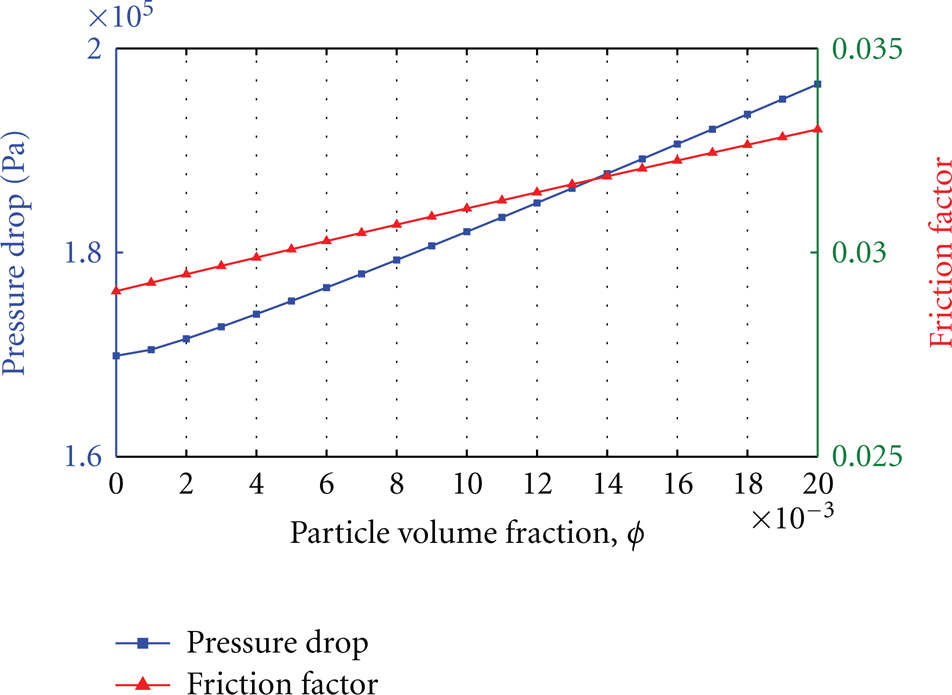
Pressure drop and friction factor of Al2O3/water nanofluid at various concentrations in a double-tube heat exchanger.

Influence of Al2O3 volume fraction on the pumping power.
4. Conclusions
A numerical study has been carried out on the characteristics of 7 nm Al2O3/water nanofluid with volume concentrations up to 2% in a horizontal double tube counter-flow heat exchanger under turbulent flow conditions. Thermal conductivity and viscosity for Al2O3/water nanofluid have been calculated from the experimental results of Chun et al. [13]. The results confirm that nanofluid offers higher heat performance than water and therefore can reduce the total heat transfer area and also coolant flowrate for providing the same heat exchange capacity.
In order to determine the feasibility of Al2O3/water nanofluid as a coolant in a double-tube heat exchanger, the effects of nanoparticles on the friction factor, pressure drop, and pumping power have been evaluated. The results show that using the Al2O3/water nanofluid at higher particle volume fraction creates a small penalty in pressure drop.
Footnotes
Nomenclature
Greek Letters
Subscripts
Acknowledgments
The authors would like to express their appreciation to the Islamic Azad University of Abadan Branch for providing financial support.