




Abstract
As is widely used in our daily life, wireless sensor network (WSN) is considered as one of the most important technologies of the new century. Although, the sensor nodes are usually battery powered with limited energy sources, the system energy consumption must be minimized in order to extend the life time. Since the energy consumption of transceiver front ends is dominant in the whole sensor nodes, we focus on how to minimize energy consumption by the system level design. According to the applications, we analyze four types of RF architectures: on-off keying (OOK) transceiver, phase-shift keying (PSK) transceiver, quadrature amplitude modulation (QAM) transceiver, and frequency-shift keying (FSK) transceiver which are widely used in WSN and establish the related energy models for each kind of architecture, respectively. We connect the baseband parameters such as modulation level, data rate, bandwidth, and propagation distance. with the energy consumption of RF front end for WSN. Afterwards, through theoretical and numerical analysis in system level, we discuss and conclude how to design optimal energy-quality system in terms of various application scenarios.
1. Introduction
With the rapid development of wireless communication and low-power-embedded techniques, wireless sensor networks (WSNs) are widely used in many industrial and civilian application areas, including industrial process monitoring and control, machine status monitoring, environment and habitat monitoring, healthcare applications, home automation, and traffic control. It is obviously that the WSN services are becoming feasible and will bring a major change to our future daily lives as well as future human society. Although, most of the wireless sensor nodes are powered by batteries with limited energy source, it is very important to design an energy efficient system, and there has been a lot of attention paid to.
In recent years, different aspects of low-power techniques have been addressed for WSN. These include delay-controlled transmission scheme [1], energy efficient cooperative communication in WSN [2, 3], energy efficient modulation scaling [4–7], energy efficient routing schemes [8–10], power-management-based task scheduling for digital communication processors [11], cross-layer energy optimization [12]. However, in most of the prior work, the power dissipated in the RF and analog circuit is often ignored or over simplified to constant values. This may lead to erroneous energy evaluations, since the RF and analog sections process analog signals with high-frequency content and typically consume more energy compared to the digital part. According to [13], about 75% of the total power is dissipated in the RF front end. So, it is important to develop an accurate and comprehensive energy model for WSN RF front end. Such a model would definitely be helpful to develop a thorough tradeoff analysis between energy consumption and communication quality of wireless sensor networks.
Several system level energy models have also been proposed in recent years. For microsensor systems, the transceiver energy model considers the circuit start-up energy in addition to steady-state dissipated energy in [14]. Unfortunately, the energy consumption of every component is assumed to be constant; this is not suitable for real WSN application. Another high-level model was proposed in [15], which divides the circuitry power into two parts, one related to the instantaneous symbol rate and the other to the highest symbol rate. However, the dissipated circuit power is not only related to the symbol rate, but also to system parameters, such as signal peak-to-average Ratio (PAR) and signal bandwidth. In [6], a more comprehensive model is presented, however, most of the RF front-end components are still assumed to have constant power consumption, and the power model for power amplifier is gain dependent and does not take into account signal characteristics for instance signal PAR in M-QAM modulation. In order to accurately evaluate the effects of different communication system parameters on RF front-end energy consumption, we build a system level RF front-end energy model with QAM modulation for Wi-Fi application in the former works [16, 17] and tie the physical layer (PHY) parameters, such as bit error rate (BER), modulation level, bandwidth, and bit rate, to the RF circuit energy consumption. However, the prior work just considers one architecture or linear modulation scheme and has not considered the nonlinear system. The results can just be applied to the Wi-Fi system instead of WSN application. Since there are both linear and nonlinear RF front-ends architectures and modulation schemes widely used in WSN, to design an energy efficient system, we should not consider just one architecture or only linear modulation. For various applications, the optimal architecture or modulation scheme may be different. For instance, it is shown in [17] that the energy efficiency for 4QAM is higher than 16QAM with respect to long distance transmission. But 4QAM still be superior compared with other modulation schemes such as OOK modulation, FSK modulation, and PSK modulation? These problems should be clarified.
To design the energy efficient systems suitable for various WSN applications, we must know the available RF front-end architectures used in WSN nodes. In this paper, we develop the energy models for four types of RF front-ends architectures with OOK, PSK, QAM, and FSK modulation, respectively, which are popular in WSN nodes. We consider the effects of BER, PAR, modulation level, bandwidth, data rate and the transmission distance, and so forth in our energy models. And based on the energy models, we first theoretically compare the energy performance of different modulation schemes for different WSN applications in system level. For instance, we compare the energy performance of OOK, BPSK, and 2FSK modulation schemes for narrow bandwidth and low data rate application; QPSK, 4FSK, and 8QAM modulation schemes for medium bandwidth and medium data rate application; 16QAM, 32QAM, and 64QAM modulation schemes are considered for wide bandwidth and high data rate application. At last, we give the most energy efficient modulation scheme for different scenarios and summarize how to design the energy efficient system.
The remainder of this paper is organized as follows. Section 2 describes four RF front-end architectures widely used in the WSN nodes. The power models for the four RF front-ends are described in Section 3. In Section 4, we theoretically prove the most energy efficient modulation schemes and discuss the system design with various WSN applications. Finally conclusions are drawn in Section 5.
2. Typical RF Architectures for WSN Nodes
In order to design an energy efficient system, we must understand the RF architectures of the WSN nodes. In this section, we choose four typical RF architectures with different classes of PA for WSN nodes. There are two types of PA used in these architectures, which are the linear PA (e.g., Class A) and the nonlinear PA (e.g., Class E). The linear PA is adopted in linear modulation systems, such as OOK, PSK, and QAM, whereas the nonlinear PA would be employed in the nonlinear modulation systems, for example FSK modulation.
For the linear modulation, the OOK transceiver has the simplest architecture, which is shown in Figure 1. Direct-conversion transmitter is used in the OOK transceiver architecture. Digital baseband signal is mixed with carrier generated by the crystal and upconverted to RF band. Besides, in the receiver, the signal received from antenna is filtered by the SAW filter, amplified by low noise amplifier (LNA), demodulated by the envelope detector, and amplified by the baseband amplifier. Finally the original data are recovered by analog-to-digital converter (ADC). Noncoherent demodulation is applied in the receiver, which eliminates the mixer and reduces the overall size and power consumption.

The architecture of PSK transceiver is more complex than OOK transceiver, which is shown in Figure 2. The direct-conversion transmitter is also adopted in the PSK system, in which the phase modulation is accomplished by the phase-shifting-network (PSN) controlled by digital baseband signal. The modulation signal is transmitted directly to the PA without crossing the mixer. The heterodyne low-IF receiver is adopted in PSK systems. The main components in the receiver signal chain are the RF filter, LNA, downconversion mixer, baseband amplifier, baseband, and antialiasing filter, and ADC.

Figure 3 describes the RF front end of QAM system, which also employs the same receiver and direct-conversion transmitter. The main components of the analog signal chain of the transmitter are digital-to-analog converter (DAC), reconstruction filter, upconversion mixer, power amplifier (PA), and RF filter.

Besides, for the nonlinear modulation, the architecture of FSK transceiver is shown in Figure 4. Direct-conversion transmitter is adopted in FSK system too. The carriers in different frequencies are also generated by phase-locked loop (PLL) and controlled by the baseband signal. Then, the following processes are the same as the PSK system. The coherent demodulation is applied in the receiver. Note that there is just one pair of mixers in the transmitter and receiver active at the same time for the purpose of low power.

Generally speaking, the power efficiency of linear PA is lower than that of the nonlinear PA, while the bandwidth efficiency of linear modulation is higher than that of nonlinear modulation. For instance, according to [24], the bandwidth for PSK is


Since
3. System Level Power Models
To minimize the total energy consumption of a transceiver, it is essential to develop accurate energy models for all the key signal processing blocks. In the former work [16], we develop the energy models of RF front-end for Wi-Fi application and give the power consumption of the main components. As an extension work, in this work, we establish energy models for WSN nodes with both linear and nonlinear PAs. Since most power parameters of the analog blocks except PA are hard to be adjusted in WSN for low-power purpose, we assume that the power consumption of WSN nodes except PA is constant. As the power consumption of PA is dominant [13], we focus on it first.
The power consumption of PA can be divided into two parts: signal transmission power which is delivered to the antenna and dissipated power which is consumed by the electronic circuits. The transmission power
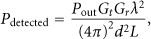
According to [25], the efficiency of Class A PA is defined as


According to [24, 26], the BER for OOK and QPSK modulation schemes are as follows:
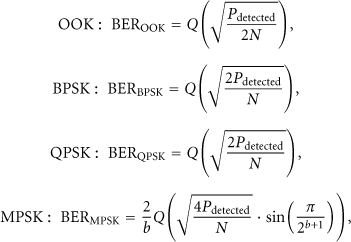

So, the power consumption for the class A PA for OOK, BPSK, QPSK, and MPSK modulation can be written as




In our former work [17], the power consumption of PA in MQAM systems has been proposed as

For the nonlinear modulation, the BER expression for MFSK modulation is shown in [24]:

So, the power model for Class E PA [27] with FSK modulation is as follow:


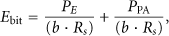
As the energy consumption for the RF front end includes the energy consumption of PA and other blocks; the energy per bit can be expressed as
4. Energy Evaluations for Different Applications
In this part, we analyze and model the energy consumption of the four types of RF front ends with different modulation schemes for WSN applications, which is an extension of our former energy modeling work [16]. According to the data rate and bandwidth requirements, we divide the applications into six types, namely, narrow bandwidth (less than 50 KHz), low data rate (less than 50 Kbps), medium bandwidth (from 50 KHz to 500 KHz), middle data rate (from 50 Kbps to 500 Kbps), wide bandwidth (above 500 KHz), and high data rate (above 500 Kbps). And in this paper, we assume the transmission distance is within 150 meters. So, the values of
Simulation parameters.

Since bandwidth (BW) is a precious resource in most communication system, in this paper we assume it is constant, and the data rate can be adjusted only by changing the modulation level. Also we assume pulse shaping technique is used in the system to remove intersymbol interference (ISI) and pulse-shaping filter roll-off factor α equals 0.2. The power consumption values
4.1. Narrow-Bandwidth System
We choose OOK, BPSK and 2FSK modulation for low-bandwidth system, and the relations between data rate and bandwidth are as follows:

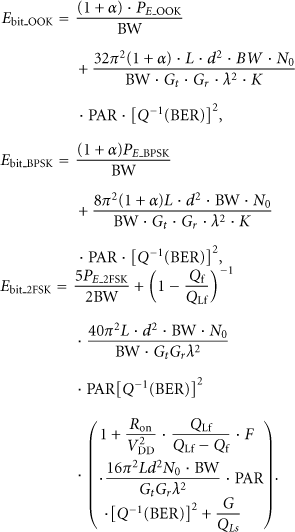
According to (8), (9), (15), and (16), energy per bit for OOK, BPSK, and 2FSK can be expressed, respectively, as
4.1.1. BPSK versus OOK
Firstly, we compare the energy per bit of BPSK and OOK modulation scheme.
Let
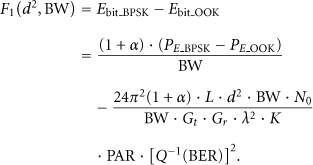
If 
We set the values of the parameters as listed in Table 1, then

If
If
From the analysis above and the restriction of
4.1.2. 2FSK versus OOK
Secondly, let us compare the energy per bit of 2FSK and OOK modulation. Suppose

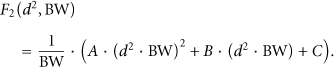
Assume 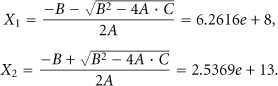
Since
4.1.3. 2FSK versus BPSK
Similarly, we can compare the energy performance of 2FSK and BPSK modulation. If
4.1.4. Example and Discussion
To verify the above theoretical analysis, we choose

Energy per bit for different RF front-end architecture in narrow-bandwidth application, BW = 25 KHz and
From the above example and theoretical analysis, we can conclude that when
4.2. Low Data Rate System
For low data rate application, the bandwidths of OOK, BPSK, and 2FSK modulation can be expressed as follows:

So, the energy per bit for OOK, BPSK, and 2FSK can be expressed, respectively, as
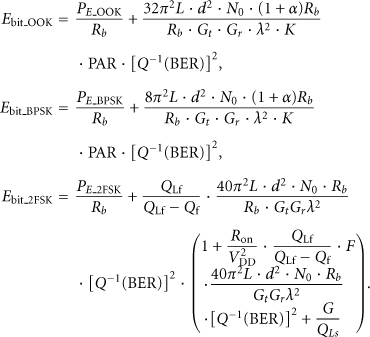
According to (26), Figure 6 shows the energy per bit with OOK, BPSK, and 2FSK modulation when the data rate is 25 Kbps. From Figure 6 we can see that for a given data rate, the OOK modulation scheme has the lowest energy consumption when the transmission distance is short. This is because when the transmission distance is short, which means

Energy per bit for different RF front-end architecture in low data rate application,
With the similar method used to analyze the low-bandwidth system, we can conclude that when
4.3. Medium-Bandwidth System
For medium-bandwidth application, we consider QPSK, 8QAM, and 4FSK modulation scheme. According to (1), (10), (12), (15), and (16), Figure 7 shows the energy per bit with QPSK, 8QAM, and 4FSK modulation when the bandwidth BW is 250 KHz. From Figure 7 we can see that when the transmission distance is short, which means
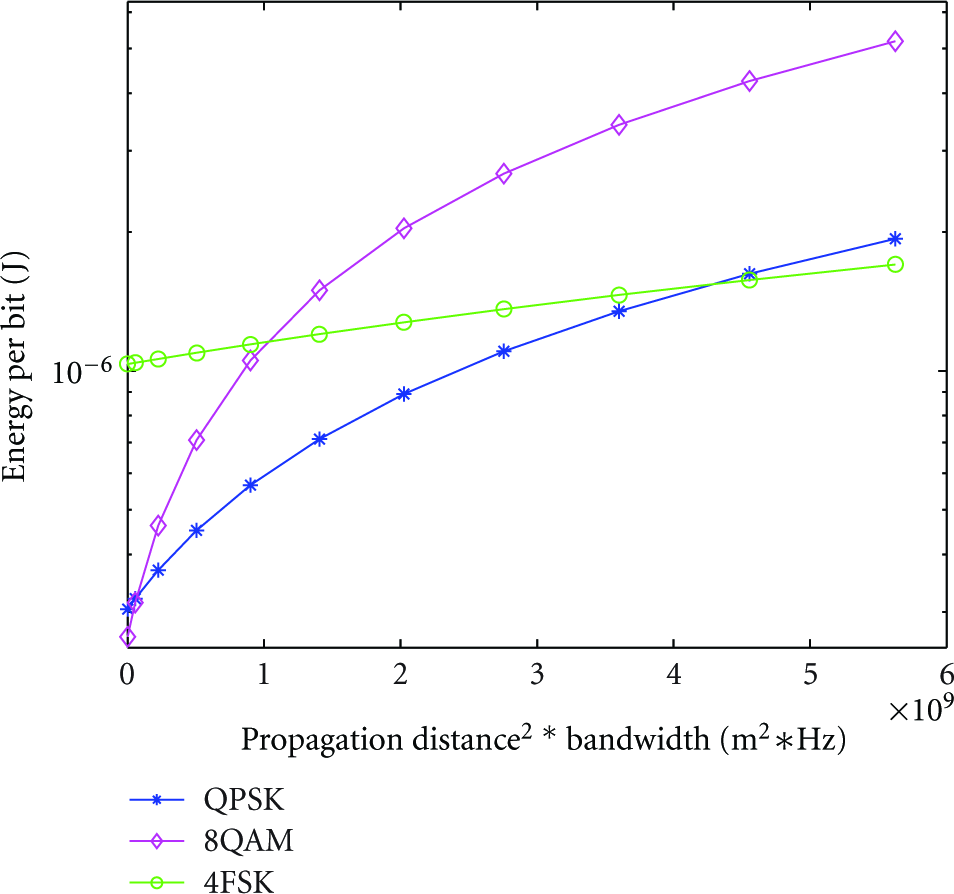
Energy per bit for different RF front-end architecture in medium-bandwidth application and BW = 250 KHz, d = (0 150] m.
With the similar method to analyze the low-bandwidth system, we can compare the energy performance of 4FSK, QPSK, and 8QAM modulation. When
4.4. Medium Data Rate System
For medium data rate application, we also consider QPSK, 8QAM, and 4FSK modulation scheme; Figure 8 shows the energy per bit with QPSK, 8QAM and 4FSK modulation when the data rate is 250 Kbps. From Figure 8 we can see when
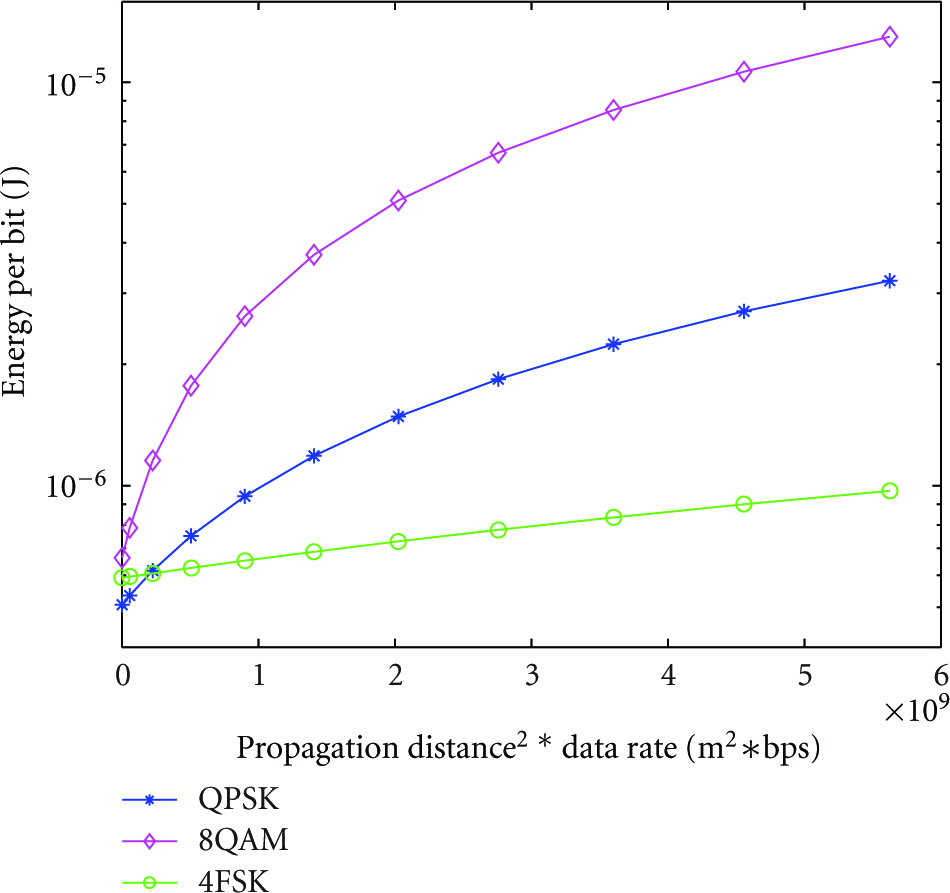
Energy per bit for different RF front-end architecture in medium data rate application,
With the similar method to analyze the low data rate system, we can compare the energy performance of 4FSK, QPSK, and 8QAM modulation. When
4.5. Wide-Bandwidth System
We choose QAM modulation scheme with high modulation level for wide-bandwidth application and analyze the energy performance. In this paper, we adopt 16QAM, 32QAM and 64QAM.
According to (1), (12), and (16), we draw Figure 9 which illustrates the energy consumption per bit for different level of QAM modulation. Here, we choose

Energy per bit for different RF front-end architecture in wide-bandwidth application, BW = 2.5 MHz and d = (0 150] m.
With the same method used to analyze the low-bandwidth system, we obtain that when
4.6. High Data Rate System
In this paper, we also adopt 16QAM, 32QAM, and 64QAM modulation scheme for high data rate application and analyze the energy performance.
According to (1), (12), and (16), we draw Figure 10 which illustrates the energy consumption per bit for different level of QAM modulation. Here, we choose

Energy per bit for different RF front-end architecture in high data rate application,
4.7. Summary and Design Steps for Energy Efficient System
In the former sections, we evaluate the energy performance of different modulation schemes under different WSN applications. In reality, as to most of wireless communication systems, BW is fixed and cannot be adjusted. Then, in order to clearly illustrate the relationship among propagation distance, modulation scheme, and energy consumption, BW is assumed to be constant during numerical analysis in the former subsections. According to the theoretical analysis results, if substituting the values of BW or
Styles energy efficient system for same bandwidth.

Styles energy efficient system for same data rate.

5. Conclusion
In this paper, we describe four kinds of RF front-end architectures which are widely used in wireless sensor nodes. The comprehensive energy models for different WSN nodes are proposed and analyzed in details. Based on the theoretical and numerical analysis, we discuss how to choose the optimal modulation scheme in terms of different propagation distances and bandwidths or data rates, covering from low bandwidth or data rate to high bandwidth and data rate. According to our theoretical analysis, we find that if the bandwidth is the same, for narrow bandwidth systems, OOK is the most energy efficient for short range communication, and BPSK is optimal for long range communication; as to medium bandwidth systems, 8QAM performs best for short range communication, and QPSK is optimal for long range communication; as to wide bandwidth systems, 16QAM is the best for long distance communication. But if we assume the data rate is the same for different applications, the results may be slightly different. The simulation results have verified our conclusion. Finally, some conclusions on designing an energy efficient system are given.
Footnotes
Acknowledgments
This work was supported in part by the National Natural Science Foundation of China (no. 81101127), Shenzhen Basic Research Funds for Distinguished Young Scientists (no. JC201005270306A), and the development funds for Key Laboratory in Shenzhen (no. CXB201104220026A).