




Abstract
The problem of assigning a set of source nodes to a set of routes in wireless machine-to-machine (M2M) networks is addressed using a game theoretic approach. The objective is to minimize the maximum latency over all source nodes as far as possible while the game achieves a pure Nash Equilibrium (NE). To compute such an NE efficiently, we present a distributed dynamic pricing (DP) scheme, where each source node is assumed to pay for using any route so that the route has incentive to relay data for the source node. A loose upper bound is given for the convergence time of DP, and simulation results show that it performs much faster in practice. The price of anarchy in this game is also investigated by comparing DP with a cost-reducing path method; the results show that DP produces optimum assignment in more than 90% of the simulation runs.
1. Introduction
Features such as self-organization, ease of deployment, low cost, and infrastructurelessness bring to wireless M2M networks the advantages of robustness, easy maintenance, economy, and flexibility. Therefore, M2M networks are envisioned to be the key technology for next generation wireless networks [1]. An M2M network consists of a large number of self-organized and self-configured nodes, the behavior of which cannot be controlled easily without any available centralized scheduling command. Thus, the network can easily be congested when there are a great many nodes that want to transmit data via a common set of routes.
Extensive work has addressed the congestion problem by adjusting the source rate based on a feedback method [2–4], but prevention strategies for the congestion have been ignored. Nevertheless, by joining the congestion control in the routing layer, this problem can be solved via the coordination among nodes [5, 6]. However, in most wireless M2M network applications, each user is its own authority, and unconditional forwarding of packets to other users cannot be assumed directly. Therefore, a scheme that stimulates routes to relay the packets of other nodes is required. Motivated by the general network congestion game [7–9] and pricing scheme [10], our study jointly considers the problems of routing congestion and incentive provision.
In this paper, a distributed dynamic pricing (DP) scheme is developed for wireless M2M networks to minimize the maximum latency over all source nodes. First, routing congestion is formulated as a dynamic game in which pricing is employed in the definition of players’ utility function. Each route is encouraged to charge source nodes for delivering their information, and the amount is decided by its latency. Second, dynamics is introduced in the game. The price of each route is changeable rather than fixed so that its load can be adjusted dynamically. We assume that the number of source nodes a route can take has an upper limit, and while the number of source nodes assigned to this route equals its upper limit, we say that this route is supply-demand balanced. Once all routes achieve supply-demand balance, the game terminates and converges to a pure Nash Equilibrium (NE). Finally, simulations are conducted to evaluate the performance of the proposed scheme.
The rest of this paper is organized as follows. Section 2 provides related work in recent years. Section 3 illustrates the system model and Section 4 formulates the network congestion game. A DP scheme is proposed in Section 5. In Section 6, the simulation results are presented. And we conclude in Section 7.
2. Related Work
In [2], an algorithm jointly addressing congestion control and scheduling in wireless M2M networks is developed, the basis of which is rate allocation among flows in the network. By adjusting backoff min-slot and window size of each flow, the network can achieve high overall throughput and low per-flow delay. However, this algorithm cannot be applied for scenarios with dynamic routing, since route of each flow is assumed to be fixed. EWCCP, a protocol that can be added as a thin layer between IP and TCP, is proposed in [3]. It coordinates flows that compete for common channel according to explicit multibit congestion feedback from routers. Authors in [4] found that the main reason of congestion collapse in wireless M2M networks for streaming services is the severe contention among individual nodes at MAC layer, and thus presented a TCP-friendly congestion control scheme where a contention state estimator is defined as the difference between the number of arriving packets and that of leaving packets during each control interval. Similar to the aforementioned literature, congestion control schemes proposed in [11–13] are all feedback-based. Although these existing feedback-based approaches have achieved some success in congestion control for M2M networks, most of them ignored prevention/avoidance strategies for congestion control.
Congestion avoidance can be achieved by jointly considering congestion and routing. The work in [11] provides a multipath routing algorithm, I2MR, which discovers zone disjoint paths using the concept of path correlation so as to avoid interference in multiple nodes and increase system throughput. Cross-layer design of joint congestion control, routing, and scheduling was presented in [12], which enable each source node to adjust its routes for data transmission in each period according to a local congestion price from its neighbors. Other works such as [14–17] have also jointly considered the problems of congestion control and routing in multihop wireless networks or wireless sensor networks. The major distinction between our work and aforementioned work lies in the formulation of the congestion routing. Specifically, we propose a congestion game to model the route-selection behavior of each node who wants to transmit its data via a route with the lowest price. Moreover, we design a distributed algorithm with low complexity by making use of pricing to implement the congestion game framework.
3. Network Model
Consider a wireless M2M network with a set N of n parallel routes from a set M of m source nodes to a destination node,

An example of wireless M2M network.
In the network, each route j has a latency

where L is the size of packet generated by source nodes, and

where
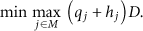
Our study aims to minimize the maximum latency over all source nodes. Hence, the congestion control problem can be modeled as
4. Network Congestion Game
The network congestion game deals with the problem of congestion which is fundamental in networks and distributed systems [7]. Whenever a set of users intend to utilize a much smaller set of resources in a common period, one needs to schedule these users orderly so as to reduce the overall cost and exploit available resources efficiently.
In wireless M2M networks, users and resources are referred to as source nodes and routes, respectively. The network congestion game can be formally defined as a tuple

The problem of incentive provision is managed here by transforming the latency to price which is charged by a route. The source node(s) that chooses this route is the price taker(s). This transformation provides the following benefits: (1) payment can effectively motivate a route to relay the data of a source node, and (2) the route can exploit its price as a lever to adjust its load. The instrument of pricing adopted here is not for maximizing the routes’ revenues, but for achieving a socially beneficial objective. The price of route j is set as a function of its latency and denoted as

Suppose the game is played in a one-shot style, which indicates the game experiences only one iteration and then terminates. Since each player has to make a decision without the decisions of other players, the result may be extreme; that is, routes with low prices may share the entire load, whereas those with high prices may share no load at all. Furthermore, a single iteration does not allow routes to adjust their load. Therefore, we treat this game as a dynamic game where players interact with each other by playing the one-shot game numerous times until it converges to an NE. The next section proposes specific rules for the dynamic game.
5. Algorithm
In this section, a distributed DP scheme is presented to implement the dynamic game and enable it to converge in polynomial time. If a source node wants to deliver information via some routes, it first sends a request to all available routes in the strategy set. The game goes by the following specific rules.
Each route j broadcasts an initial price to all source nodes that can communicate with j by wireless connection, and then waits for their responses. The initial price is set as
After receiving the prices from all available routes, each source node i sends a response to the one(s) with minimum price.
After obtaining the response from each source node in
Definition 1.
The supply-demand degree of a route j is

The above equation means that at iteration t, the maximum number of connections (old and new) that each route can take in is
After receiving the decisions of all routes in Thus far, the interaction between routes and source nodes in a single iteration is finished. Afterwards, each route j needs to determine the price of the next iteration. If the supply-demand is not balanced at the current iteration and there is no new connection accepted or no old connection broken, the price of the next iteration is set to
The above five steps illustrate the process of each iteration in the dynamic game. The following step decides when the game would be over. First, a definition of the market level supply-demand degree is provided.
Definition 2.
The market level supply-demand degree is the average of all the degrees of the routes’ supply-demand, that is,

Once
Two basic metrics for evaluating this algorithm are (1) its ability to converge to a pure NE and (2) the speed it needs to do so. Some significant features of DP are proven from these two aspects.
DP, part 1: executed at each route Initialization Set
Broadcast its price
Broadcast its price source node
Wait for responses from all source nodes in Randomly choose a subset supply-demand is balanced. Set
Set
Broadcast its decision to each source node Set
Set
Supply-demand).
Algorithm 1
DP, part 2: executed at each source node
Wait until receiving price from each route Send a request to route(s) k maximizing for the decision of requested route(s). Choose one randomly to build a formal wireless connection.
Algorithm 2
Theorem 3.
The proposed algorithm converges to a pure NE.
Proof.
Let
First, by contradiction, we prove that for every source node
suppose the price of route k at iteration suppose the price of route k at iteration
Considering (1) and (2) jointly,
Second, we prove that each player i has no incentive to change its choice unilaterally. Without loss of generality, let
Lemma 4.
If there is a source node that changes its choice or a route that lowers its price at an iteration t, then we have
Proof.
Suppose player i changes its choice from k to j, then
This means that Suppose route j lowers its price at some iteration t, then
which implies that


Lemma 5.
Proof.
Lemma 4 states that
Theorem 6.
The number of iterations required to complete the proposed algorithm is
Proof.
Evidently,

Equation (10) indicates that the proposed algorithm terminates in polynomial time, and the upper bound is
6. Simulation Results
We conduct simulations to assess the performance of the proposed algorithm in terms of executed time and to ascertain the optimality of the NE and provide the results in this section. To obtain reliable results, several parameters are investigated, including the number of source nodes, the ratio of source nodes to routes denoted by r, and the degree of source nodes, which is defined as the number of routes that each source node can connect to. The values of these parameters are given in detail in Table 1. Since having assumed that the transmission rate and packet length are the same for all nodes, these two measurements are not included in the variable table. And note that our simulations are dedicated for quite generalized wireless M2M networks and thereby do not rely on specific protocols in MAC layer; it is unnecessary to specify which wireless channel is in use and how to set the window size. A large number of runs are conducted for each simulation and the results are averaged.
Simulation parameters.

6.1. Executed Time
Section 4 shows that the proposed algorithm can be completed in polynomial time and gives an upper bound of the executed time. However, the real speed is essential in practice. Here, we evaluate the practical speed by comparing it with the theoretical time bound T given by (10).
First, we study the effect of the number of source nodes on the proposed algorithm's speed, and the other parameters are set as constants. Figure 2 shows how many iterations the proposed algorithm needs to be completed versus the different number of source nodes when the degree of source nodes is set to an average of 5, and Figure 3 illustrates the value of λ under each corresponding case. It can be seen that with the increase of the number of source nodes, the proposed algorithm requires more iterations to be completed, but the increasing trend is not rapid and it needs only 200 iterations with 1000 source nodes and 250 routes (

Number of iterations the proposed algorithm takes versus the number of source nodes.

P-T ratio λ versus the number of source nodes.
Second, the degree of source nodes is considered as variable, and 10 groups of the maximum degree of the source nodes are set to

Number of iterations the proposed algorithm takes versus the degree of source nodes.

P-T ratio λ versus the degree of source nodes.
On one hand, the given upper time bound is rather loose. On the other hand, the time bound is polynomial and the P-T ratio λ is extremely small in the given simulation. Therefore, the proposed algorithm has good speed performance.
6.2. Optimality
Section 4 indicates that a one-shot style may render the NE of the game undesirable. This part shows how the dynamic game can improve NE by simulation. Figure 6 provides the comparison results when the degree of source nodes is set to an average of 5 and r to 4. Evidently, the latency under OneShotHop is nearly triple of DynamicPricing. Moreover, OneShotPricing is merely better by one point compared with OneShotHop.

Latency under DynamicPricing, OneShotHop, and OneShotPricing versus the number of source nodes.
Since our proposed algorithm is distributed, there is no guarantee that it can compute the optimal NE every time as a centralized approach can. Therefore, learning the optimality of the NE generated by DP is significant. Here, several experiments are conducted to examine the optimality of the proposed algorithm by comparing it with a well-known centralized approach based on the cost-reducing path and to determine whether it can terminate in polynomial time [18]. Before showing the results, price of anarchy (PoA) [19], which measures the optimality of a game, is introduced as a metric and formally given as follows.
Definition 7 (PoA).
For game G, let

First, the effect of the number of source nodes on the proposed algorithm's optimality is studied. The degree of source nodes is set to an average of 5. Figure 7 shows that as the number of source nodes increases, the NE's

PoA versus the number of source nodes.
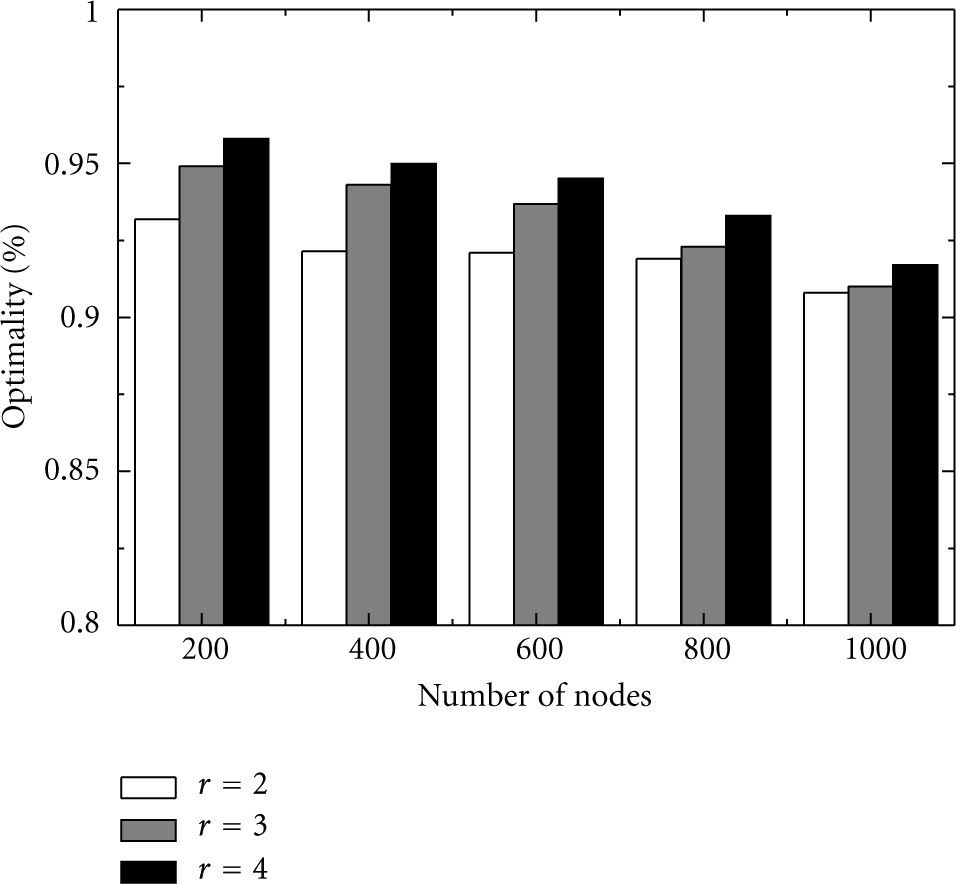
Ratio of optimal-to-all versus the number of source nodes.
Second, the degree of source nodes is considered to be variable. Ten groups of the maximum degree of the source nodes are set to

PoA versus the degree of source nodes.

Ratio of optimal-to-all versus the degree of source nodes.
7. Conclusion
The routing congestion problem in wireless M2M networks has been investigated using a game theoretic approach. A network congestion game has been formulated, in which many selfish source nodes compete for connecting to a smaller set of routes. Since full cooperation among nodes cannot be assumed in wireless M2M networks, pricing has been applied in the game to motivate cooperative data relay. By setting the pricing scheme dynamic, routes altering their prices and source nodes accordingly altering their connected routes, we have proved that the network congestion game converges to a pure NE in polynomial time. The optimality of the proposed algorithm was evaluated by simulation. The results indicate good practical performance.
Footnotes
Acknowledgments
This research is partially supported by research grants from the National Science Foundation of China under Grant nos. 70701025 and 71071105, the Program for New Century Excellent Talents in Universities of China under Grant no. NCET-08-0396, and a National Science Fund for Distinguished Young Scholars of China under Grant no. 70925005, and the Program for Changjiang Scholars and Innovative Research Team in the university (IRT1028).