




Abstract
As an indispensable part of the Internet of Things (IoT), wireless sensor networks (WSNs) need to be completely integrated into the Internet. When an Internet user communicates with multiple sensor nodes in WSNs, secure group key management becomes necessary. However, most current group key management schemes developed for WSNs do not consider the Internet scenario while traditional group key management in the Internet is deemed to be not suitable for WSNs due to the resource constraint characteristics of WSNs. In this paper, we propose a group key distribution scheme for WSNs in the IoT scenario in which we organize sensor nodes into groups in a hierarchical structure. In the upper wired layer, an end-to-end secure communication protocol is used to distribute group keys for subgroups to the trusted head nodes and the head nodes then distribute the group keys through underlying tree-based topology and wireless multicast to minimize energy consumption. We also perform some quantitative analyses as well as experiments to show that our proposed scheme is secure and has t-revocation capability. The total cost of distributing and rekeying the group keys is also analyzed and compared to that in some other comparable schemes.
1. Introduction
As an indispensable part of the Internet of Things (IoT), wireless sensor networks (WSNs) need to adopt IP technologies to create a seamless, global network infrastructure together with the Internet. To achieve the above goal, many standardization organizations are actively pursuing standardization work for creating a global sensor network infrastructure. IPv6 over low power wireless personal area network (6LoWPAN) is one such technology that can enable complete integration of WSNs into the Internet. 6LoWPAN is aimed by the Internet Engineering Task Force (IETF) 6LoWPAN Working Group at enabling most capabilities of IPv6 on constrained nodes [1] and the transmission of IPv6 packets over low power wireless personal area networks based on IEEE 802.15.4 standards [2].
In the IoT scenario, any IP-enabled node in the Internet can communicate with any sensor node in a WSN remotely. It has thus become imperative that secure communication be supported between the remote entities. Recently, some secure communication schemes for creating an end-to-end secure channel between an Internet node and a sensor node have been researched in different layers of the Open System Interconnection (OSI) reference model. The research work by Granjal et al. [3–5] and Raza et al. [6, 7] is aimed at making the application of IPSec in 6LoWPAN sensor nodes a reality while the idea of providing transport level end-to-end security includes modified Secure Socket Layer (SSL) scheme based on Elliptic Curve Cryptography (ECC) [8], Transport Layer Security (TLS) scheme using IBC based on ECC or pairings [9] and the scheme that relies on asymmetric authentication and signcryption [10].
With the secure communication protocols mentioned above, a variety of applications for WSNs in the IoT scenario can be developed ranging from defense systems to health care, industrial monitoring, disaster management, home automation, and so forth [11]. As one of the basic requirements in the applications, an authorized user may need to issue queries and commands to multiple sensor nodes at the same time rather only to a single sensor node. Thus, secure group communication protocol could be more efficient than those mentioned above.
Secure group communication requires secure and robust distribution or negotiation of group keys. A single symmetric key known only to the group in which the authorized user in the Internet and the multiple targeted sensor nodes in WSNs are the members can effectively protect communication for multicast group. Current group key management schemes in WSNs that belong primarily to the broadcast fashion by making use of wireless channels and transmission ranges cannot be directly applied to the IoT context since the user is usually located in different physical locations, even in different networks. Meanwhile, traditional group key management protocols developed for the Internet, such as IP multicast [12] that needs the support of multicast routers or application layer multicast [13] that needs the support of endhosts, are deemed to be inadequate for WSNs due to the characteristics of limited energy, storage, network bandwidth, communication capabilities in most sensor nodes, as well as multihop characteristics of WSNs, that is, each sensor node can act both as a router and as an end host.
In this paper, we propose a group key distribution scheme for WSNs in the IoT scenario. In our proposed scheme, the sensor nodes in WSNs are organized into groups in a hierarchical structure. In the upper wired layer, an end-to-end secure communication protocol is used to distribute group keys for the subgroups to trusted head nodes. In the lower wireless layer, the head nodes distribute the group keys through underlying tree-based topology and wireless multicast to minimize energy consumption of the sensor nodes. The main contributions of this paper can be summarized as follows.
We analyze the need for group key management for WSNs in the IoT scenario and propose a secure and efficient solution to overcome the limitations of existing mechanisms in the IoT scenario. We design a hierarchical group key distribution scheme without requiring any preshared keys between the user and the sensor nodes. The scheme has the t-revocation capability and can minimize communication cost of the WSNs. We demonstrate how our scheme can perform as a secure and efficient countermeasure against some attacks towards WSNs among which the cooperative compromised attack is analyzed emphatically, which is a capability that is absent in most existing mechanisms. We conduct mathematical analysis on our scheme as well as performance comparison between our scheme and the Topological Key Hierarchy (TKH) scheme which is considered to be the most efficient mechanism for group key management in traditional WSNs. The comparison results show that our scheme outperforms the TKH scheme for group key distribution and group key rekeying when a small number of nodes are deleted.
The remainder of this paper is organized as follows. Section 2, we review some related work on group key distribution, group key negotiation, the self-healing theory, and the TKH scheme with which we will compare our scheme in the analysis. In Section 3, we describe our proposed group key distribution scheme, which includes assumptions, initialization, group key distribution, in upper wired layer, group key distribution and rekeying in lower wireless layer. In Section 4, we analyze our proposed scheme in terms of security and performance and compare it to TKH. Finally, in Section 5, we conclude this paper in which we also discuss some future work.
2. Related Work
In both the Internet and the WSNs, group key management can be classified into group key distribution (centralized model) and group key negotiation (distributed model).
2.1. Centralized Model
Group key distribution schemes (e.g., Group Key Management Protocol (GKMP) [14]) usually rely on a group controller which shares a pairwise key with each member of the group and distributes group keys to group members on a point-to-point basis. This approach cannot scale to large groups, which generates O(N) rekeying messages with a network of size N. In Logical Key Hierarchy (LKH) [15], individual and auxiliary keys are organized into a hierarchy and each group member is assigned to a leaf and holds all the keys from its leaf to the root. The root key as the group key is shared by all the group members. This scheme can reduce the number of rekeying messages to O(log N). One-Way Function Tree (OFT) [16] improves LKH by reducing the number of rekeying messages from (2log2 N) to (log2 N) in the binary key tree by using the local key computations. However, since in the multihop WSNs each sensor node can act both as a router and as an end host, rekeying messages generated from the logical key tree may be forwarded through one or more intermediate nodes to reach their final destination nodes, incurring heavy communication overheads. The Topological Key Hierarchy (TKH) [17] lowers the cost of rekeying messages by generating a key tree based on the underlying topology information of WSNs to minimize communication cost.
For group communication for WSNs in the IoT scenario, the authorized user in the Internet can act as the group controller, but all of the schemes mentioned above cannot be directly applied due to the following reasons. Firstly, the rekeying messages generated from the user must be transmitted over both the wired and wireless links, which may incur noticeable delay. Secondly, all of the centralized schemes rely on pairwise keys between the user and each sensor node, thus the user must authenticate and negotiate a shared secret key with each sensor node. Any group key distribution scheme should support end-to-end security communication that will make the cost of communication and computation grow linearly with the number of group members.
2.2. Distributed Model
In distributed group key negotiation, all group members are treated equally. Hence, group keys should be negotiated among all group members through Diffie-Hellman (DH) key exchange or based on secret sharing theory to ensure fairness. In the CLIQUE scheme [18], group members can deliver their DH seeds orderly through insecure channels and the last member get all the DH seeds to compute the group key and then multicast the received DH seeds to other members so that all members can get the group key, thus generating O(
In the IoT scenario, the above group key negotiation schemes are not suitable for WSNs since the cost of communication and computation is more than that of group key distribution schemes. Moreover, the reasons for the infeasibility of group key distribution schemes are also exist.
Hierarchical group key management, for example, the Iolus scheme [20], is a tradeoff of the above two models in which group members are divided into many subgroups each of which has an independent group key. Thus, rekeying can be executed within the corresponding subgroup. Therefore, techniques based on hierarchical group are more suitable for WSNs in IoT scenario. In our proposed scheme, we separate the group key management into two layers. In the upper wired link layer, the Internet user distributes the group key to the head nodes in a WSN by using the end-to-end secure communication protocol. In the lower wireless link layer, each head node distributes the group key using self-healing theory [21] and TKH structure [17], which will be introduced in the next two subsections.
2.3. Self-Healing Theory
To be self-healing with the t-revocation capability, the group manager constructs and broadcasts a t-degree masking polynomial
2.4. TKH Group Rekeying Policy
In the TKH scheme that is applied to WSNs, the nodes in the same subtree (ST) share the same tree key (TK). ST is a tree with nodes below each subroot node, and the subroot nodes are direct neighbors of a sink. The nodes sharing the same parent node in a tree, that is, the sibling nodes, share the same sibling key (SK). Every node shares its own individual key (IK) with the sink. The group key (GK) is used to encrypt all data traffic within a group. TKH offers an advantage that the depth of the key tree is bounded to “4” regardless of the size of the network. Therefore, each node is only required to save a maximum of four keys, which is highly suitable for storage-limited sensor nodes.
TKH takes the advantage of the wireless multicast. Since a message transmission can be heard by multiple neighbors, sibling nodes can efficiently receive a message by a single transmission from their parent. An example is shown in Figure 1.

After node 3 is deleted, (a) shows the repaired tree topology while (b) shows the corresponding TKH structure. The keys that need to be updated when node 3 is deleted are shaded.
When node 3 in ST1 is revoked, the rekeying messages for ST2 and ST3 are


A new node should select a parent node to join the network and the existing nodes can change the corresponding GK, TK, and SK by using the preshared one-way function (Formula (3)) and the sink unicasts,

The TKH scheme does not mention the distribution of GK, TK, SK, and IK. Meanwhile, it is assumed that IK is preloaded into every sensor, which is feasible when the head node is a stationary sink node. However, for WSNs in IoT scenario, the head node may be an ordinary node directly or indirectly dynamically chosen by the Internet user. Therefore, it is impossible for every sensor node which may be the potential head node to store all shared IKs with each other.
Our method is motivated by the above analysis that the TKH scheme is suitable for WSNs due to taking use of the underlying sensor network topology to decrease the forwarding through intermediate nodes and the one-hop wireless multicast to save energy. However, in our proposed scheme, we further reduce the forwarding from intermediate nodes through the only once hop-by-hop wireless multicast along with the underlying topology. The legitimate sensor node in the group can recover the GK from the received information without the shared IK with the head node. Moreover, the adversary has to compromise at least t group nodes instead of only one to get the new GK, which is known as t-revocation property.
3. The Proposed Scheme
Our proposed scheme organizes sensor nodes in a WSN into groups in a hierarchical structure as shown in Figure 2. An end-to-end secure communication protocol is used to distribute group key to the head nodes in subgroups in the upper wired link layer, while the head nodes distribute group keys to subgroup members in the lower wireless link layer through the underlying tree-based topology and by the means of wireless multicast.
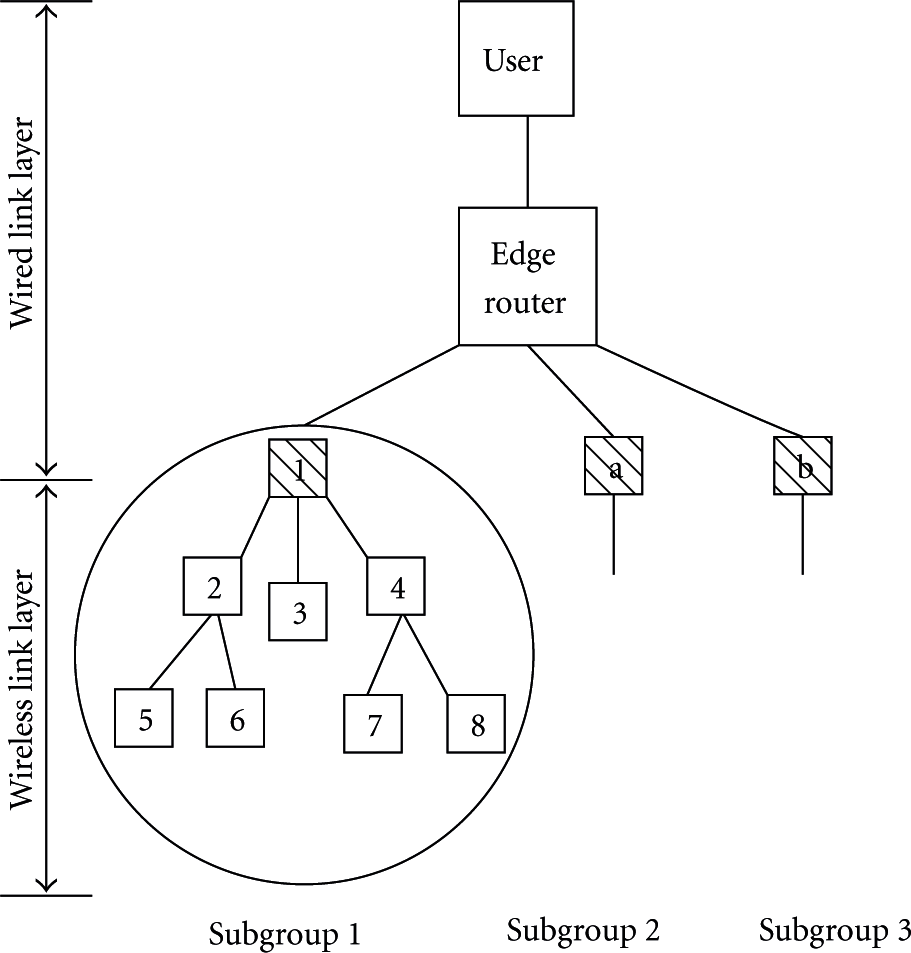
The hierarchical structure of our proposed scheme.
3.1. The Assumption
We assume that the edge router is deployed for a WSN by the service provider (SP) and the edge router is credible andhas unlimited resources intermsofenergy, computation, and storage.
3.2. Initialization
An SP should deploy and manage the WSN to provide services to the Internet users. The SP randomly picks a t-degree shielded polynomial
After deployment, the secure bootstrapping process in the WSN could be used (referring to [22]) to establish pairwise keys between neighboring nodes and trust paths to the edge router so as to form a multihop cluster-tree hierarchical topology, which can be considered as the routing tree in our scheme. The edge router knows the whole network topology, and each node knows its descendants as well as parent nodes.
3.3. The Wired Link Layer
An authorized Internet user U can generate a group key GK for the set C of sensor nodes he/she want to communicate with, where
User U distributes GK, TK and
3.4. The Wireless Link Layer
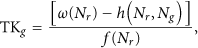
Suppose that the number of STs in the WSN is h. We take the head node
3.4.1. Group Key Distribution
The head node
M: the malicious nodes in the WSN that have been deleted from the WSN and are not included in the routing tree;
I: the invited nodes in
N: the normal nodes in

After receiving B, every remaining node
3.4.2. Node Addition
The authorized Internet user U can add a new sensor node
In the former case, taking

An example of node addition in our proposed scheme.
In the latter case, assuming that
3.4.3. Node Deletion
The authorized Internet user U deletes a sensor node
In the former case, assuming that
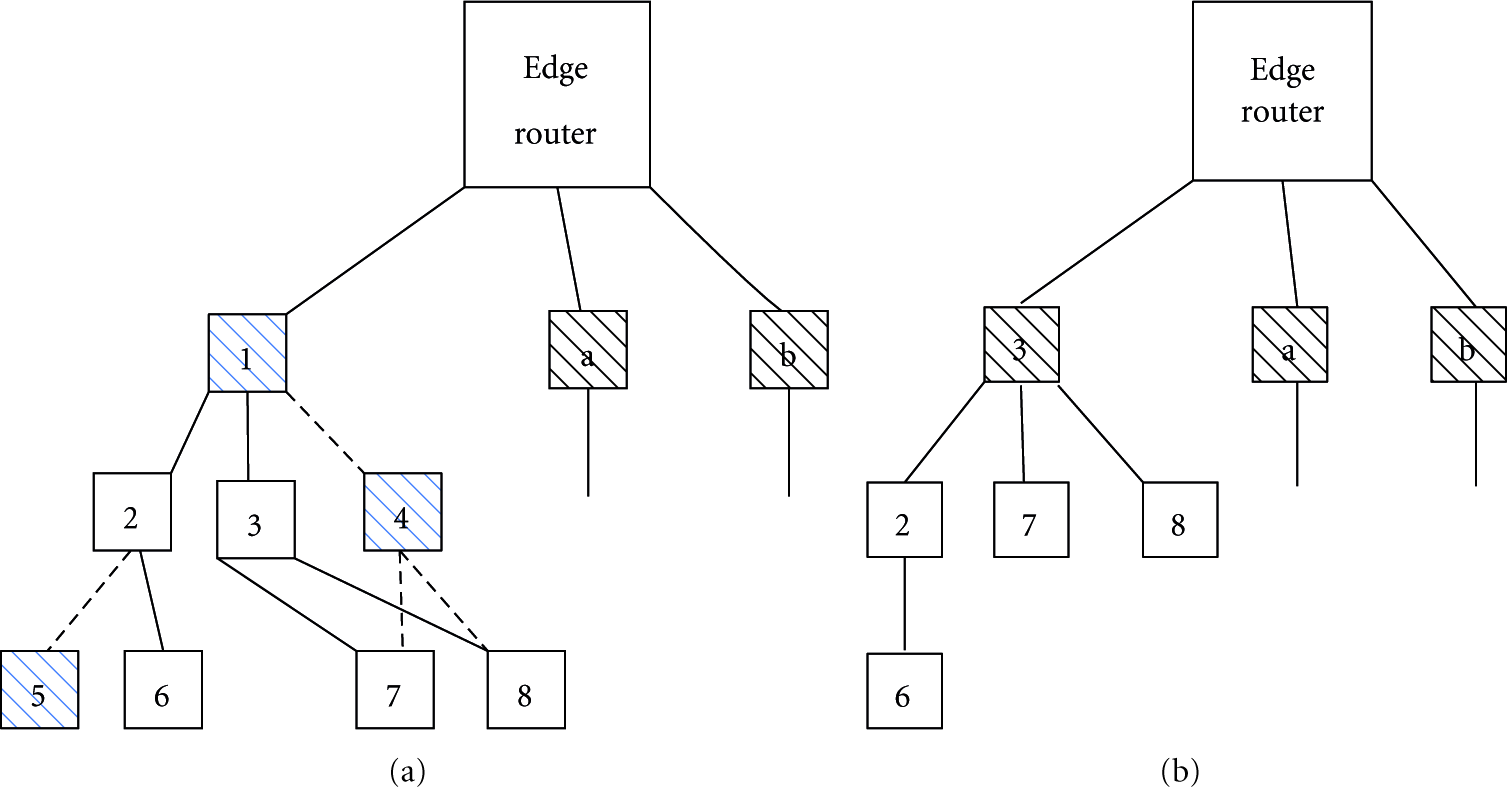
An example of node deletion in our proposed scheme. The repaired tree topology (a) after node 4 and 5 are deleted and (b) after node 1 is deleted, respectively. The deleted nodes are shaded in blue.
In the latter case, assuming that U will delete node 1 in Figure 4, such a nonleaf head node can be replaced by one of its children which also has children in the routing tree, that is node 3 in Figure 4. The edge router will check the network topology and inform U of the new head node 3. U will implement the procedure as described in Section 3.3, node 3 will implement the procedure as described in Section 3.4.1, and all the other STs will multicast
The procedure of node addition and node deletion is illustrated in Figure 5.
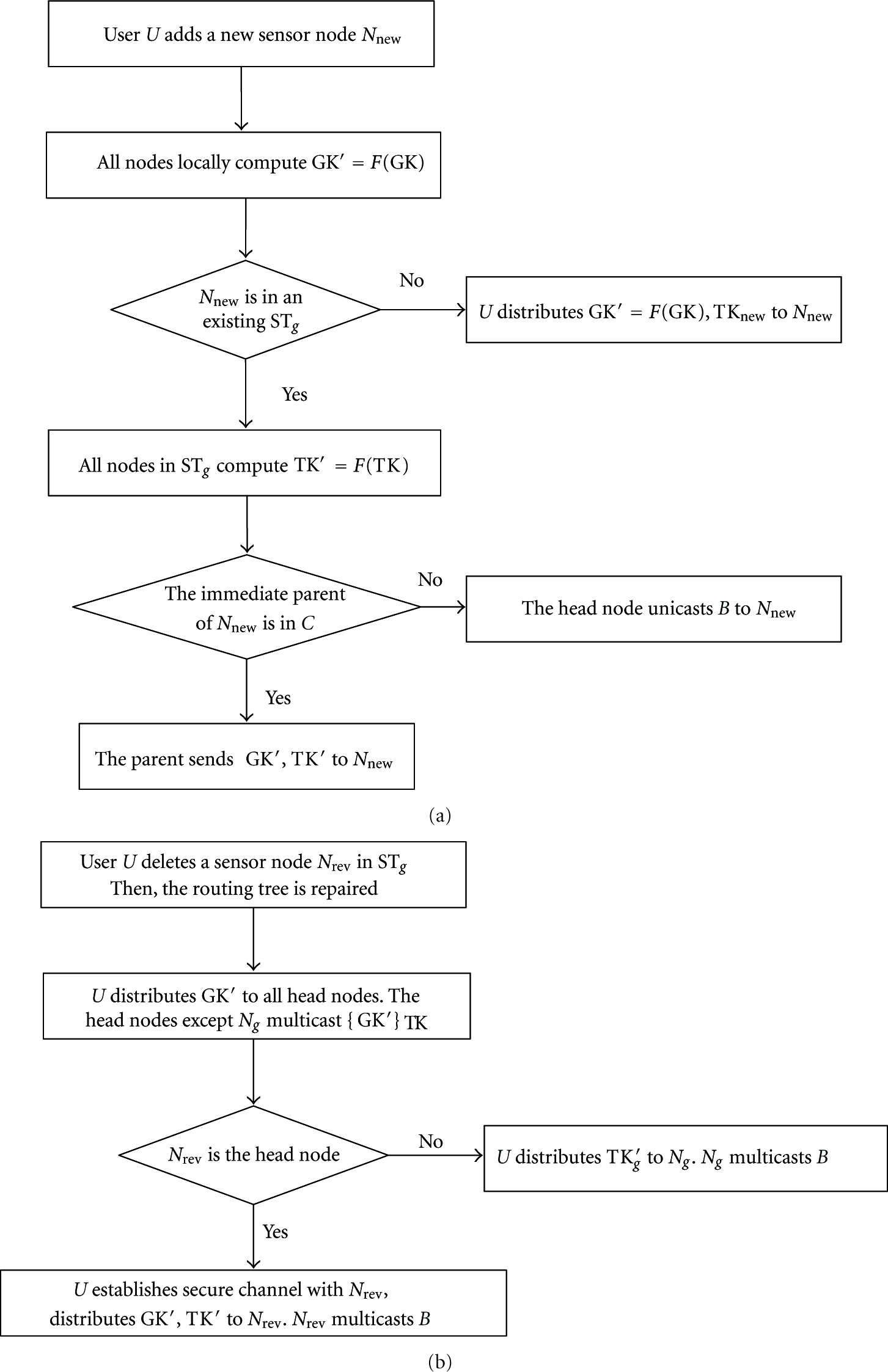
The procedure of (a) node addition and (b) node deletion in our proposed scheme.
3.4.4. Reduction of the Size of Set R
We can see that the multicast information B carries
Bloom filter is a well-known data structure that can be used for efficient membership checking. Using the method, we can find whether an element belongs to a predefined set. A bloom filter consists of a set
Each hash function
Bloom filter may yield false positives, that is, although an element is not in S, its bits


A bloom filter of
4. Analysis
We analyze and show that our proposed scheme can provide confidentiality, forward secrecy, backward secrecy, and t-revocation capability for group keys. We also analyze the performance of our scheme and compare it with TKH scheme in terms of the cost of storage, computation, and communication.
4.1. Security Analysis
(1) Group key confidentiality: any sensor node out of the group defined by the Internet user cannot get the group key.
In our scheme, GK and TK are generated by the authorized user. In the wired link layer, GK and TK are protected by the end-to-end secure channel and transmitted to the authenticated head nodes. In the wireless link layer, firstly, the head node is responsible for distributing GK and TK to other nodes in its ST. Every node must compute TK from
(2) Forward secrecy: any sensor node cannot get the group key after its deletion.
In our scheme, all the deleted nodes are added to the revocation set R and known by every node in the WSN. The head node constructs the new multicast message
(3) Backward secrecy: any sensor node added by the Internet user cannot get the group key before it is actually added.
In our scheme, the newly added node gets the
(4) t-revocation capability: the coalition R cannot get any information about the current GK.
In our scheme, in order to know
4.2. Performance Analysis
For any group key management schemes for WSNs, even in the IoT scenario, storage, computation, and communication overhead as well as energy consumption of the sensor node are among the issues mostly concerned about. We therefore conduct performance analysis by comparing our proposed scheme with TKH in the following three aspects: storage, computation, communication. In the wireless link layer, (1) the WSN in our scheme is bootstrapped based on multihop hierarchical tree topology, (2) the group key distribution makes use of the underlying network topology with the consideration of ST-based group organization, and (3) wireless multicast advantage is taken to replace multicasting mechanisms, which are the same as TKH.
According to our scheme and TKH scheme, we do not consider the node addition event since the topology change and the corresponding rekeying cost is negligible.
In our analysis, we use the
4.2.1. Storage Overhead
In our scheme, every node in WSN is preloaded with a personal key
4.2.2. Computation Overhead
In our scheme, for group key distribution, the head node must compute a point
4.2.3. Communication Overhead
We define communication overhead as the total cost which reflects both the number of messages and the cost of message transmission.
(1) Total cost of distributing group key (TDC): in our scheme, the head node must multicast message

In the TKH scheme, the head node takes the responsibility of unicasting GK, TK and SK to every ordinary node encrypted using the pairwise key between the head node and an ordinary node. So the total cost of distributing group key is:

(2) The total cost of rekeying group key (TRC): we only consider the node deletion event since the rekeying cost of node addition is negligible. When l nodes are deleted, including v head nodes and

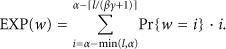

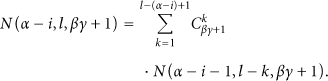


In the TKH scheme, the total cost of rekeying key is
(3) Comparison between our scheme and the TKH scheme: we set the total number in set
Figure 7 shows the total cost of group key distribution for (2,5,3), (4,5,3), (2,7,9), (4,7,9), (8,7,9), and (16,7,9). We can see from Figure 3 that the total cost of group key distribution in our scheme is lower than that in TKH and the difference widens as the size of the network increases. This is because message B is transmitted only once in every hop along the hierarchical routing tree by using the wireless multicast advantage in our scheme. In TKH, however, key messages are different for each node, which are transmitted according to the structure of the TKH tree. Moreover, the length of B (

Total cost of group key distribution.
Figure 8 shows the total cost of rekeying group key when
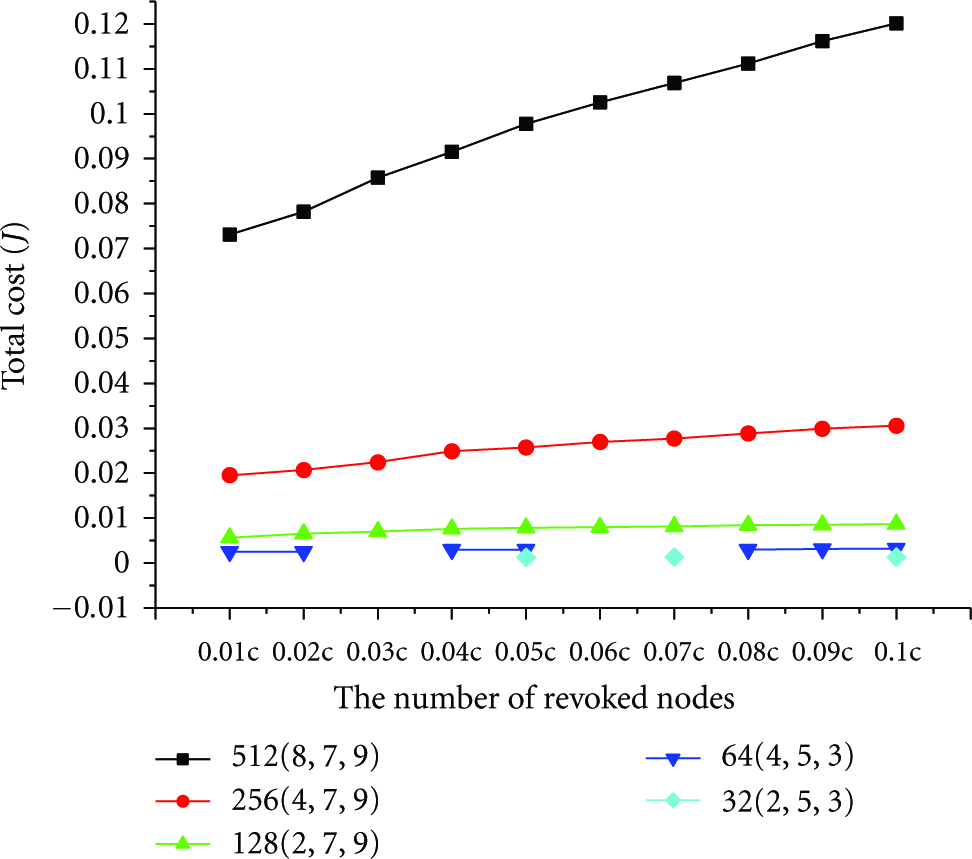
Total cost of rekeying group key in our scheme.
The total cost of rekeying group key in both schemes is shown in Figure 9 when (a) one node is deleted and (b)
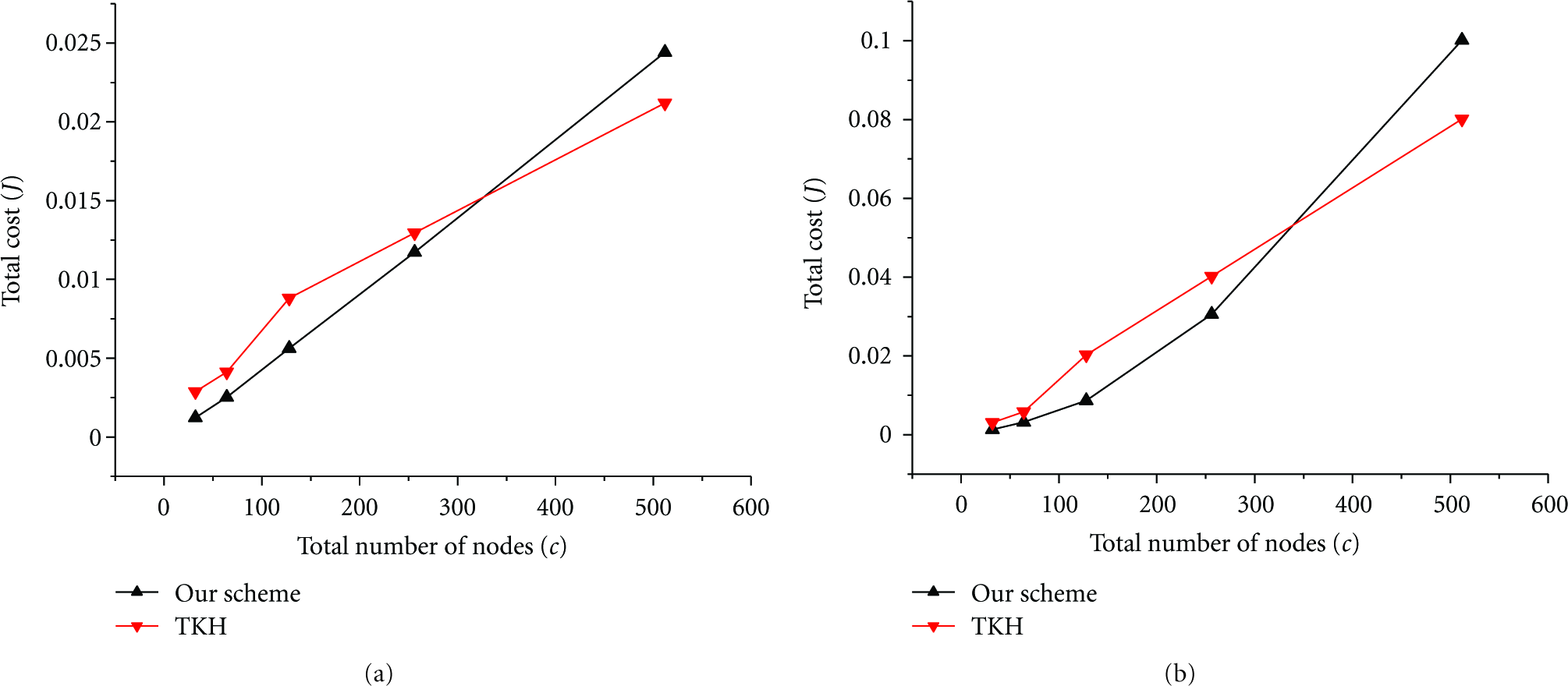
Total cost of rekeying group key when (a) one node is deleted and (b) (
In conclusion, our scheme outperforms the TKH scheme for group key distribution and group key rekeying when fewer numbers of nodes are deleted but it may become less advantageous in group key rekeying as the size of the network increases and when a large number of nodes are deleted.
4.3. Experiment
We set up a real experimental environment in which the 34 Crossbow's MICAZ motes that are used as the sensor nodes each has 8-bit ATmegal 128L clocked at about 7.37-MHz microcontroller and complies with the IEEE 802.15.4 standards with data transmission rate of 250 kbps. As depicted in Figure 10, we only show half of the sensor nodes that are deployed on the fourth and the fifth floor in our lab (the other half are deployed on the second and the third floors in the same fashion). The Stargate NetBridge gateway (Base 0 of the light blue) has an Intel IXP420 XScale processor running at 266 MHz. The MIB 600 attached to the gateway can connect to a wired Ethernet and the 802.15.4. The Internet user uses a Pentium IV machine clocked at about 2.1 GHz CPU with data transmission rate of 100 mbps. Through the IP-enabled router, the remote Internet user can randomly choose
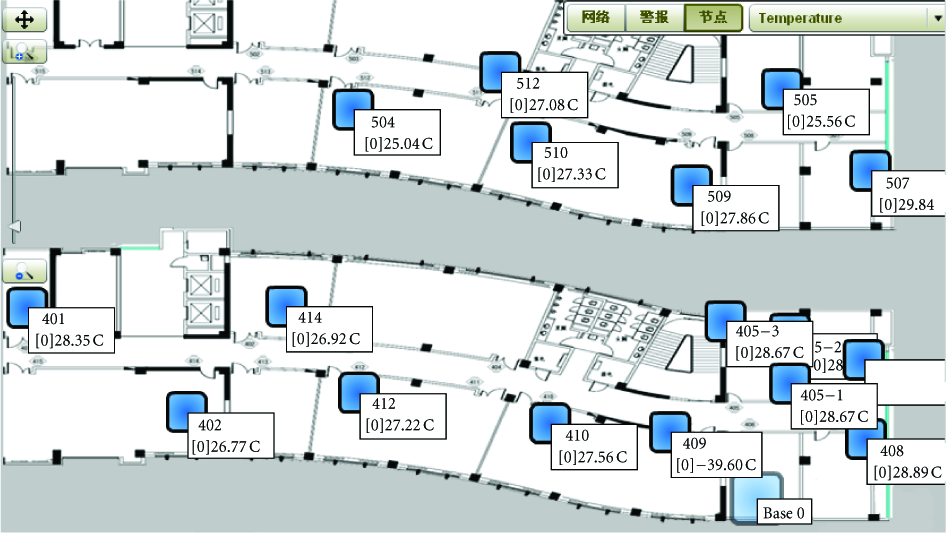
The real experimental environment with

Experimental results for
We can see from Figure 11 that the average TDC in our proposed scheme is 1.33 mJ, lower than 1.78 mJ in the TKH scheme. However, both of them are higher than the theoretical values of 1.3 mJ and 1.7 mJ, respectively. Meanwhile, the average TRC in our proposed scheme is 1.28 mJ and 1.35 mJ when
5. Conclusion
In this paper, we proposed a group key distribution scheme for WSNs in IoT scenario in which the sensor nodes are organized in two logic layers in a hierarchical structure. In the upper wired link layer, an end-to-end secure communication protocol is used to distribute group key to the head nodes in the subgroups. In the lower wireless link layer, each head node distributes the group key by using the underlying tree-based topology and wireless multicast advantage to minimize energy consumption. An analysis on the proposed scheme showed that our proposed scheme can achieve t-revocation security. We also performed some analyses to compare our scheme with the TKH scheme in terms of the cost of storage, computation, and communication. The analyses showed that our scheme outperforms the TKH scheme in terms of total cost of communication for distributing group key and rekeying group key when fewer nodes are deleted but less advantageous when the size of the network increases and when a large number of nodes are deleted in rekeying group key. In the future, we will conduct more experiments to verify the results in real applications and further improve the performance in large-scale WSNs when a large number of nodes are deleted.
Footnotes
Acknowledgments
The work in this paper has been supported in part by National Natural Science Foundation of China (Grant no. 61272500) and in part by Beijing Education Commission Science and Technology Fund (Grant no. KM201010005027).