




Abstract
Density control is of great relevance for wireless sensor networks monitoring hazardous applications where sensors are deployed with high density. Due to the multihop relay communication and many-to-one traffic characters in wireless sensor networks, the nodes closer to the sink tend to die faster, causing a bottleneck for improving the network lifetime. In this paper, the theoretical aspects of the network load and the node density are investigated systematically. And then, the accessibility condition to satisfy that all the working sensors exhaust their energy with the same ratio is proved. By introducing the concept of the equivalent sensing radius, a novel algorithm for density control to achieve balanced energy consumption per node is thus proposed. Different from other methods in the literature, a new pixel-based transmission mechanism is adopted, to reduce the duplication of the same messages. Combined with the accessibility condition, nodes on different energy layers are activated with a nonuniform distribution, so as to balance the energy depletion and enhance the survival of the network effectively. Extensive simulation results are presented to demonstrate the effectiveness of our algorithm.
1. Introduction
With the help of technological advances in MEMS, a mass production of tiny and economical sensors becomes possible. A wireless sensor network consists of a large number of sensor nodes deployed in region of interest to collect related information and communicate the results to the users [1]. The network can be embedded in our physical environment and have many potential applications, such as battlefield surveillance, environment monitoring, and fire detection.
Since the microsensors are usually supported by battery, they are thus limited in resources and vulnerable in nature. When sensor nodes are deployed to monitor hazardous applications like over a battlefield, an important question is to guarantee that the target area is covered and the detection probability is high. If a small number of nodes are deployed, blind spots or sensing holes might be left, which may reduce the accuracy of the results obtained. In order to enhance the reliability of the network, sensor nodes are usually deployed with high density, up to 20 nodes/m3. However, as all of the nodes share common sensing tasks, if those sensors operate in the active mode simultaneously, data collected in such a high-density network would be highly correlated and redundant, consuming an excessive amount of energy. To illustrate the point, imagine the scenario that when a certain triggering event occurs, a large number of nodes will send packets at the same time, making such a network less responsive and less energy efficient. As a result, deploying such a sensor network to monitor hazardous applications and maintaining its sensing coverage could be a daunting task.
In general, density control is an effective method to solve the above problem. Recently, a class of work has appeared to find the optimal subset of sensor nodes for densely deployed wireless sensor network while these working nodes can completely cover the monitored area [2– 8]. In addition, the problem is proved to be NP-complete [3]. However, most of the current works do not consider the issue of uneven energy depletion with distance to a predetermined sink. They all aimed to achieve a uniform hexagonal distribution to preserve area coverage with the fewest sensors. When using such a uniform distribution in many-to-one sensor network applications, the sensor nodes around the sink should forward more data and deplete their energy faster. Consequently, an energy imbalance problem manifests itself, as an energy hole is created around the sink node. If this happens, no more data can be transmitted to the sink. Moreover, the network lifetime ends soon and more energy of the nodes would be wasted. Experimental results in [9] show that when the network lifetime is over, up to 90% of the total initial energy of the nodes is left unused if the nodes are distributed uniformly in the network. It becomes a major concern for network designers to maintain the balance of power consumption so that the lifetime of sensor network is prolonged.
In this paper, we formulate the energy imbalance problem and present a nonuniform distribution of sensor nodes to analyze the maximum network lifetime for many-to-one wireless sensor networks. In contrast to constant data acquisition rate, we import the pixel-based transmission mechanism to avoid sending needless duplication of the same sensing data. Furthermore, a density control algorithm is proposed to achieve balance of energy depletion by introducing the concept of the equivalent sensing radius. The rest of this paper is organized as follows. In Section 2, we review the related work in the literature. In Section 3, we theoretically analyze the nonuniform node distribution strategy. And after that, an energy-balanced density control algorithm is proposed in Section 4. Section 5 describes the simulation results of the proposed algorithm. Finally, the paper is concluded in Section 6.
2. Related Work
As one of the most fundamental issues in wireless sensor networks, the density control problem has attracted significant research attention. Therefore, coverage together with sensor management has been a strong research focus for the last few years. In [3], the authors provide a method for finding the maximum number of disjoint cover sets that are working successively in a WSN. In each cover set, a sufficient number of sensor nodes necessary to cover the targets are active, while the remainder of the nodes are put to sleep. However, their approach is based on a centralized solution. A distributed approach named PEAS is proposed in [4], in which the nodes use a simple rule to decide about their activity. If a node cannot find any active node in the probing range, it becomes active. Otherwise, it returns to the sleeping mode. Although this approach eliminates the complexity of getting neighbours' status, it does not require location information and cannot guarantee full sensing coverage for the target area. Similarly, the authors in [5] propose a scheduling scheme that enables each node to enter active or sleeping state based on the coverage relationship with its neighbours. In their approach, in order to avoid the “blind point” caused by two neighbours simultaneously turning off, a random back-off time is introduced before the node makes a decision about its status. However, these algorithms cannot achieve full sensing coverage for the target area. Our previous work reported in [6] attempted to find the best cover to maintain a full coverage of the network with the least number of working nodes, and a NSGA-II based approach was proposed. The coverage problem is also explored in [7], and a distributed, localized algorithm, called OGDC (Optimal Geographical Density Control), is proposed to maintain coverage as well as connectivity. They prove that if the communication range is at least twice the sensing range, complete coverage implies connectivity. In particular, the jointly coverage and connectivity problem is studied in [8], and a sleep-awake scheduling scheme is proposed for energy conservation and surveillance quality provisioning. In [10], the coverage maintenance protocol named as PCP is proposed, and the simulation results show that it can significantly save the number of activated sensors by using probabilistic sensing model.
These algorithms all focused on finding a uniform distribution, thus to reduce the number of working nodes. However, as the sensors closer to the sink tend to carry more traffic loads and thus would consume more energy, the uniform deployment will cause the network lifetime descended by the sensors at the first-hop from the sink. This is also known as the “energy hole” problem, which is characterized by a mathematical model in [11]. Apparently, it cannot prolong the system lifetime under a uniform distribution by simply increasing the number of nodes. The authors in [12– 14] have also investigated several approaches to mitigate this problem. In [12], the authors present a mathematical model and aim to investigate some approaches towards mitigating this energy hole problem. However, the uneven energy depletion still exists, even by using their mere system design and the associated routing strategy. The authors in [13] investigated the energy hole problem and designed guidelines for maximizing lifetime and avoiding energy holes in sensor networks with nonuniform distribution. In [14], the authors proposed a nonuniform deployment scheme based on a general sensor application model. They derived a formula to determine the number of nodes as a function of the distance from the sink. Simulation results show that their method can enhance the network lifetime. Since each sensor was also assumed to report the data to the sink with the same acquisition rate, it cannot achieve the energy balance completely in the entire network.
3. Preliminaries
3.1. Assumptions and Network Model
In this section, we present our network model and basic assumptions. Assume that a set ofN heterogeneous sensors are deployed in a circular area with radiusd in order to monitor some physical phenomenon. We refer to the complete set of sensors that has been deployed as
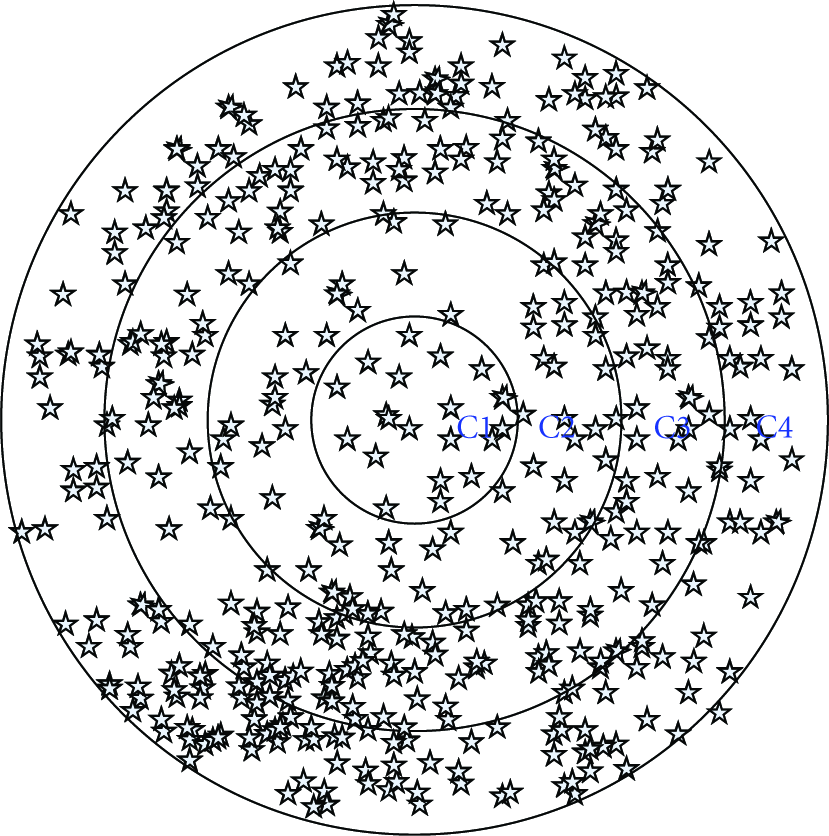
A circular target area with four coronas.
The network works in rounds, and each round is further divided into two phases: the first phase of node selection and the second phase of stability monitoring. In the first phase, the suitable sensor nodes are selected to work and the rest of the nodes are set to sleep state thus to save energy. During the second phase, each working node should send their sensing messages to the sink node per unit monitoring cycle
We use a simplified power consumption model and do not consider the MAC layer and physical layer issues. In our model, the energy consumption is only dominated by communication costs, as opposed to sensing and processing costs. The initial energy of each sensor is
3.2. Nonuniform Node Distribution
Based on the network model, nodes belonging to corona


Sensors in corona

Thus, we can formulate

Ideally, when all the nodes deplete their energy with the same ratio, the network lifetime is prolonged and the energy efficiency is improved. In particular, there is no energy wasted and the network lifetime can be given by

Theorem 1.
Maximum energy efficiency is possible, in the sense that all the working nodes take the pixel-based transmission mechanism, and the node distribution densityρ
i in corona Ci satisfies

Proof.
To use the deductive method, suppose that (6) is true, and thus (2) can be described as follows:

Owing to

Since
Theorem 1 shows that in a circular monitored area, based on the pixel data transmission mechanism, if the sensors in each corona obey a nonuniform distribution and the distribution density meets a certain condition, the energy-balanced depletion of the whole network can be achieved. Besides, the node density
Further we will analyze the lifetime enhancement of the nonuniform distribution strategy to the traditional one. Suppose that the node density in nonuniform distribution satisfies (6) and the initial conditions are the same. In the uniform distribution, the density


Thus the lifetime enhancement is

Therefore, the network lifetime of nonuniform distribution can be extended
4. Energy-Balanced Density Control
4.1. Problem Formulation
The problem of Energy-Balanced Density Control (EBDC) is formalized as follows. Given a set ofN potential sensors,
4.2. Density Control Based on Equivalent Sensing Radius
The proposed algorithm, called EBDC, is inspired by the algorithm introduced in [7]. As a contribution, we made major modifications with the purpose of selecting sensors at variable densities according to (6).
Definition 2 (Equivalent sensing radius).
It is defined as the sensing radius when the given distribution density
As the hexagonal distribution is the optimal sensor distribution to fully cover the target area with the fewest sensors, define
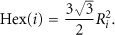
And the minimum distribution density

Thus, the relationship of the equivalent sensing radius and the distribution density

Theorem 3.
If the sensor selection algorithm uses the equivalent sensing radius

Proof.
According to the definition of equivalent sensing radius, we can combine it with the energy-balanced condition in (6). Thus we have

After transformation, we have

This concludes the proof of Theorem 3.
Therefore, by introducing the concept of equivalent sensing radius, the problem of EBDC can be transformed into a uniform density control problem with different sensing radius, which gives the chance of using the existing schemes to solve it. In this paper, the density control algorithm is combined with OGDC approach, which only needs relative location during node selection.
In order to make sure that the node selected in each corona satisfies hexagonal distribution with its equivalent sensing radius, first, each sensor needs to know which corona is located. The calculation mechanism of corona number is presented in Section 4.2.1. And then the optimal principle for sensor selection is adopted [7]: anytime when a sensor in corona
4.2.1. Calculation of Corona Number
Since the sensors are deployed with high density, there are challenges to calculating each sensor's location and measuring the distance between sensor nodes accurately. Moreover, it seems to be impossible for sensor
The calculation of minimum hop count in DV-hop localization algorithm is similar to classical distance vector routing. At first, the sink node broadcasts a beacon to be flooded throughout the network containing its position with a hop-count parameter, which is initialized to be one. Then, each receiving node maintains the minimum counter value per anchor of all the beacons received and ignores those with higher hop-count values. At every intermediate hop, beacons are flooded outward with hop-count values incremented. Through this mechanism, all of the sensor nodes can get the minimum hops to the sink. The calculation of corona number based on hop count is shown in Figure 2.

The calculation of corona number.
4.2.2. Selection of the Starting Node
After all the sensors calculated their corona number and the corresponding equivalent sensing radius, they are powered on with undecided status. Then the node volunteer whose energy exceeds a predetermined power threshold
4.2.3. Actions Taken When Receiving a Power-on Message
When a node receives a power-on message, it first checks whether theCorona_Num are equal. If this message comes from an adjacent corona, and the receiving node is not “ON”, or there are not any uncovered crossings, it will omit this message and sets itself to “OFF” state. Otherwise, it will become a starting node of its corona and transmits a new power-on message with newCorona_Num and a new equivalent sensing radius. If the power-on message comes from the same corona, the subsequent actions taken are to ensure that the working sensors selected form a hexagon distribution.
Similar to OGDC,

Flowchart of the actions taken after receiving a power-on message.
4.2.4. Direction Range
in Power-on Message
The parameterα in power-on message indicates the direction along which next working node hoping to be activated. In terms of large coverage area,α is distributed uniformly in
Define the coordinate of candidate starting sensor as

The possible intersection between sensing disc and the corona borders. (a) At most one crossing point. (b) Two crossing points between the sensing disc and the inner border of the outer adjacent corona. (c) Two crossing points between the sensing disc and the outer border of the inner adjacent corona. (d) Four crossing points between the sensing disc and the border of both inner and outer adjacent coronas.
If case (i) satisfies, we have
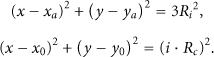
Assuming the calculated crossing points as
If case (ii) satisfies, we have

Assuming the calculated crossing points as
If case (iii) satisfies, we have

Using

After the direction range
5. Simulations Results
In this section, we evaluate the performance of the proposed density control algorithm. The basic simulation parameters are listed in Table 1.
Simulation parameters.

Initially, in order to deploy more nodes close to the sink node, the deployment model of two-dimensional Gaussian distribution is adopted. Given the coordinate of sink as 
As the finally selected nodes obey approximate uniform distribution in the corona in each round, the sensing data forwarding strategy is similar to [13]. Any node in corona
There are 1000 potential sensors randomly distributed in the circular area of radius 60 using Gaussian distribution deployment model, as shown in Figure 5(a). The target area is divided into three coronas denoted by

Distribution of wireless sensor network.
Figure 5(b) shows the working sensors selected after running NSGA-II 500 generations. The number of working nodes selected from corona
In order to verify that the working sensors selected by our algorithm can balance energy consumption, the energy depletion of this working set in one round is investigated especially. In our simulation, the working round is set as 1000 s, and the monitoring cycle is 3 s. The energy depletion of those nodes in one working round is shown in Figure 6.

Energy consumption of the working nodes in one round.
From Figure 6, we can see that although the nodes in corona
Figure 7 shows the relationship between the total energy left and working rounds. From Figure 7, we can see that the total energy left with working rounds has an approximate linear relation. When the network runs to 150 working rounds, the remaining energy is 102300. Continuing to run algorithm, we can see that the energy attenuation with the working cycles becomes more flat. That is because the remaining survival nodes can no longer establish communication with the sink node, and the energy consumption is mainly caused by network sensing with little data forwarding. Although there is about 10% of the residual energy, due to the uneven distribution of these final survival nodes, they cannot meet the needs of the network coverage and connectivity any more.
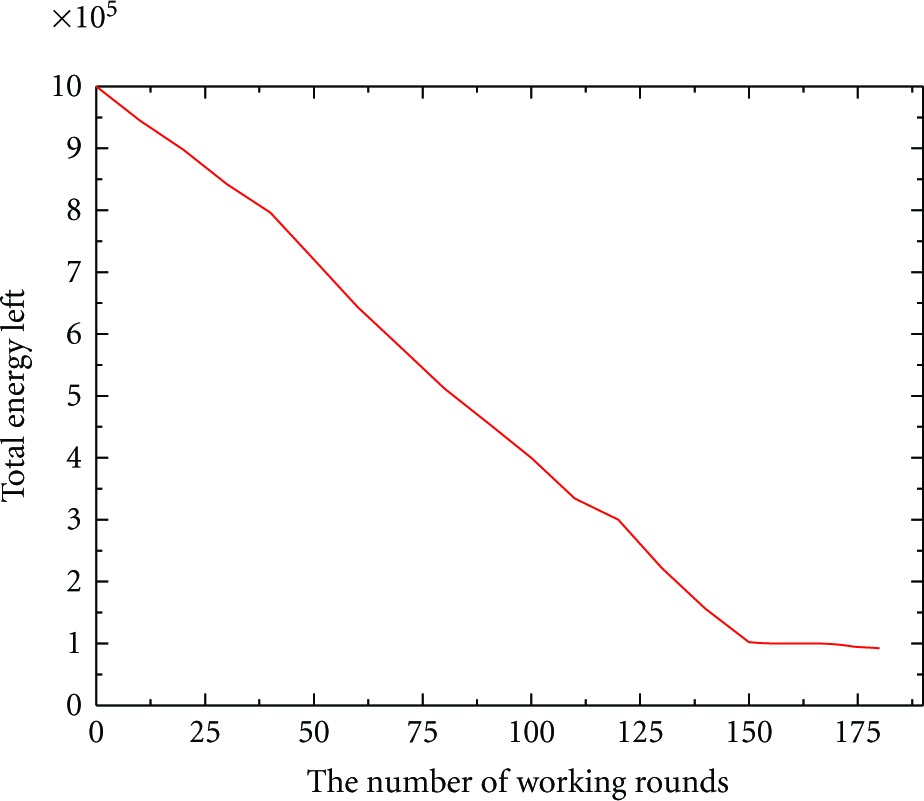
Changes of energy left in different working rounds.
We further compare the performance of EBDC with OGDC, PCP, and the nonuniform distribution in [13]. In those series of simulations, we vary the deployed nodes density from 1000 to 3000 nodes in the circular area with radius 60. The round length is set as 1000 s and the monitoring cycle is 3 s.
Figure 8 shows the network lifetime comparison with different node deployments. Although OGDC focuses on how to select the optimal cover set, it does not consider the imbalance consumption of energy near the sink. This mainly causes the nodes near the sink node to forward data more frequently and finally gets a much shorter network lifetime. As PCP uses a probabilistic detection model, it needs fewer active sensors to cover the target area completely and thus has more working rounds than OGDC. However, the problem of imbalanced energy depletion is not solved effectively in PCP. Although literature [13] adopts a nonuniform node distribution, the energy imbalance still exists because of constant data acquisition, which inevitably leads inner sensors consume more energy than outer sensors. As the pixel-based transmission mechanism is imported in our scheme, the total transmitted messages in each round are much smaller. Our algorithm can achieve the energy balance by selecting suitable nodes to work and thus has a much longer network lifetime.
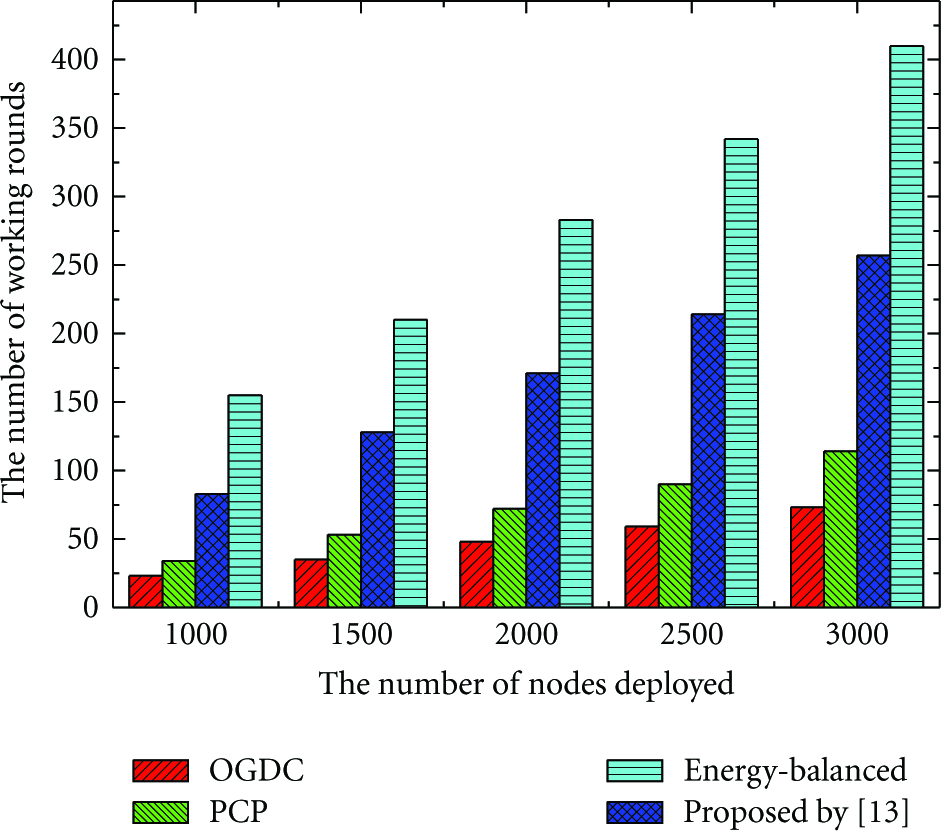
The number of nodes deployed versus working cycles.
Figure 9 shows the comparison of the energy unused ratio with different deployed nodes, which refers to the ratio of the residual energy to the total energy at the end of the network lifetime. With the increase of deployed nodes in the network, the energy unused ratio shows a downward tendency using our algorithm. This is because that the energy consumption of each node selected by our algorithm in each working cycle is almost equal. The energy unused is mainly caused by the initially uneven distribution of nodes. The more nodes deployed, the more chance can be got for the survival nodes connecting to the sink and thus reduce the energy unused ratio. Since OGDC and PCP adopt a uniform node selection strategy and do not consider the phenomenon of energy imbalance consumption, both of them have a large energy unused ratio. Actually, as the nonuniform distribution strategy does not take the pixel-based data transmission mechanism, the energy imbalance cannot be avoided. Compared with the above methods, our density control algorithm based on energy balance has the higher-energy efficiency, which verifies the effectiveness of the algorithm.

Comparison of energy unused ratio with different deployed nodes.
6. Conclusion
In this paper, we have investigated the density control problem to select the energy-balanced working nodes for sensor networks. We analyze energy attenuation in nonuniform distribution strategy theoretically and prove that when the pixel-based transmission mechanism is adopted, a full energy balance can be achieved through the rational node distribution density. Contributively, a distributed nonuniform density control algorithm with the concept of equivalent sensing radius is proposed. Simulation results show that our algorithm has a better performance than the existing algorithms and can prolong the network lifetime effectively.
In the future, as our work requires that each node knows its relative locations, we plan to investigate more deeply the impact of location on the performance of the proposed approach. We also intend to extend EBDC to the probabilistic sensing models and investigate some potential applications of EBDC such as topology control, distributed storage, and network health monitoring.
Footnotes
Acknowledgment
The authors would like to thank the reviewers giving valuable comments on the earlier version of this paper. This work is supported by the National Natural Science Foundation of China under Grant nos. 60903159, 61173153, 61070162, 71071028, and 70931001; China Postdoctoral Science Foundation funded project under Grant no. 20110491508; the Specialized Research Fund for the Doctoral Program of Higher Education under Grant no. 20070145017; and the Fundamental Research Funds for the Central Universities under Grant nos. N090504003 and N090504006.