




Abstract
Positioning of the location information of wireless sensor network nodes is one of the key issues in wireless sensor network applications. The traditional node positioning method based on least-square algorithm heavily depends on the ranging accuracy, and therefore cannot guarantee high precision. This paper presents a new method for wireless sensor network node positioning based on nonlinear weighting least-square algorithm. Regarding ranging equation error-weighted sum as a whole, this method starts with the initial iteration point of stepwise refinement to explore the optimal solution and further reduces the positioning computational complexity by the simplification of the Taylor equation. Experimental results demonstrate that promising results have been achieved by using this method.
1. Introduction
Wireless sensor networks are widely used in military and industrial fields due to its strong ability to acquire information, high-level autonomy, broad coverage, long life cycle, and aniattenuation under harsh environment, and so forth. Sensor nodes, as the basic units of wireless sensor networks, which generally use limited battery-powered energy, are difficult to achieve the later energy resources supply once layout. Sensor nodes can obtain a variety of information from the surrounding environment, such as temperature, humidity, gas concentration, pulse, oxygen, and so on. The positioning of the location information of the wireless sensor network nodes is one of the key issues of wireless sensor network applications. If there is no access to the node location information, monitoring information obtained by the sensor would become meaningless in many scenarios. Target tracking and attacking is asked to provide location information [1]. In addition, node location information is very beneficial to network coverage quality and routing efficiency [2].
Wireless sensor networks positioning methods can be classified in various manners. For example, depending on whether to measure distances or not, they can be categories into nonranging-based approach [3] and ranging based approach; depending on where to perform algorithm, they can be categories into distributed approach [4] and centralized approach [5]. Non-ranging approach is to measure the connections between nodes to obtain the network connectivity and then compute node location, such as the MDS-MAP [6], APTI, DV-HOP, and so on. On the other hand, the ranging method first obtains information, including distance or angle between the nodes, by ranging techniques such as Received Signal Strength Indicator (RSSI) [7], Time-Difference-of-Arrival (TDOA) [8], and Angle-of-Arrival (AOA). The next step is to predict location information of unknown nodes by the positioning algorithm, such as the weighted cancroids algorithm [9] and least-square algorithm [10]. RSSI-based ranging technique [11] is a very popular ranging based positioning method. Most existing node hardware has the RSSI function, which does not require additional hardware and software support. RSSI-based positioning are widely used in practical applications because of its low power consumption for node positioning, as well as small size requirements [11]. However, the accuracy of RSSI-based ranging method may be compromised due to the impact of external environment and other factors.
The traditional node positioning method based on least-square algorithm heavily depends on the ranging accuracy, and therefore cannot guarantee an accurate positioning. The Gaussian filtering and Taylor formula are introduced into this paper which based on the nonlinear least-square method in paper [10]. This paper presents a new method for wireless sensor network node positioning based on nonlinear weighting least-square algorithm. The main contributions of this paper including: (1) introducing a channel propagation model for measuring the distance between unknown nodes and anchor nodes, and (2) enhancing measurement accuracy by the Gaussian filtering method. In this manner, this paper has improved wireless sensor network localization algorithm based on the weighted nonlinear least square to achieve high-precision positioning. Compared with the traditional linear equations consisting of the ranging equations of weighted least-square sum, this algorithm achieves high-precision node localization. Simulation results demonstrate the effectiveness of the method.
2. Wireless Channel Models and Node Distance Measurement
2.1. Channel Model of Wireless Sensor Networks
The RSSI-based distance measurement has received widespread attention for its no requirement of complex hardware support, the outstanding advantages of the node energy consumption and low size overhead. In this paper, we adopt the positioning-based ranging algorithm, by which the distance can be measured efficiently. The unknown node first receives the RSSI value from the anchor node and further relies on the network channel model to estimate the distance (parameter d) from the unknown node to anchor node. Since the transmission of node radio waves can be influenced by many factors, such as multipath effects, scattering, the signal that an unknown node receives from an anchor node may have a significant fluctuation. Researchers have developed multiple channel models for small indoor environment and outdoor free space environment [12]. Lognormal channel model is widely used in common RSSI techniques for its simplicity and good match of the relationship between signal attenuation and distance. To be specific, the channel model formula is as follows:

where
We can conclude from (1) that the RSSI value received from the same anchor node contains Gaussian distributed noises. Therefore, the corresponding RSSI value RSSI should consequently follow a Gaussian distribution. Before calculating distance by RSSI, we take into consideration Gaussian filtering for the received RSSI, for the purpose of filtering out certain values which have great deviations from the actual value.
2.2. Distance Measurement Based on Gaussian Filtering
Assuming that the unknown node received k RSSI value in total from an anchor node, and unknown node receives the ith RSSI value, which is expressed as
With a received number of RSSI, we can calculate α and β by the maximum likelihood estimation method as follows:

Therefore, the RSSI value received is subject to the probability density function

In order to filter out some RSSI values with significant deviations, we first select a high probability range to filter out the values exceeding the selected probability range

We can derive that

In order to reduce the RSSI signal interference, we take value from the range

Following (1), we have

Since

We know that
3. Linearized Least-Square Method and Its Limitations
With the distance information that an unknown node obtains from N anchor nodes using above method, we can list N equations. Since there exist errors in distance measurements, if we calculate the N equations, the equation will be no solution. In order to highlight the contribution of the proposed nonlinear least-square approach in this paper, we use “linear least-square” to denote the traditional approach. By transforming nonlinear equations into linear equations, we figure out the estimated least-square solution [13–15].
The ith anchor node coordinate is
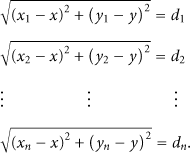
Square both sides of (9),
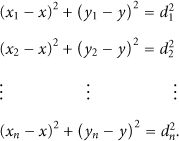
Linear least-square solution is as follows. Eliminating the nonlinear part by minus the last equation with each else equation in (10), then we can obtain an overdetermined linear equations (12). Generally, the number of equations is larger than the number of variables, the exact solution cannot be obtained, and we can obtain estimated solution through the least square. The linear equation is as follows:

Number in A is

The number in B is
We can figure out

Since (12) is obtained by subtracting the last equation from all other equations in (10), we can assume that

As a matter of fact, the linear least square is the solution of
4. Node Positioning Based on Weighted Nonlinear Least Square
Due to the accuracy loss caused by linearization with the method of the linear least-square, this paper improves node positioning accuracy of the weighted nonlinear least-square method on basis of the literature [10]. By directly calculating the sum of squared errors to eliminate the dependency of the solution on the accuracy of any equation, we can obtain the optimal solution from the overall information, as well as reduce the computational complexity. In this paper, we commence the nonlinear part of the equation using the Taylor formula to reduce the computation intensity in the node. Simulation results show that this method does better in positioning than the linear least-square method.
Assuming the parameter in (9),


So the total deviation is as follows:

Precise node positioning requires the solution of the corresponding value
The general solution of
In this paper, we simplify ζ by commencing the nonlinear part of the equation using the Taylor formula to reduce the amount of computation, so we have a quadratic function

The first order Taylor series expansion
Assuming that

So the first order Taylor series expansion

Assuming that

So,

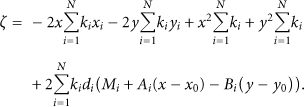
Getting rid of the transformation in the form ζ can be expressed as follows:

In order to compute

The solution is as follows:

The point Taylor expansion
5. Simulation and Analysis
In this paper, we carried out many simulation experiments about positioning method. The experiments were performed by Matlab programming with a large number of unknown nodes and anchor nodes in multiple area.
Experiment 1.
Arrange randomly 100 nodes in the regional area
Figure 1 is the node distribution diagram of one simulation. The average error caused by the weighted nonlinear least-square method is 5.8710, while the error by linear least-square method is 6.8610. The weighted nonlinear approach is advantageous to the linear approach. From Figure 2, we can see that some point positioning error mutations in the positioning of the linear least-square method for the reason we mentioned before. The positioning accuracy depends on the ranging error of the last equation in (10): if the ranging error in the equation is large, positioning effect will accordingly be poor. The proposed algorithm does not depend on other ranging errors, and the positioning error of the proposed algorithm is relatively stable. Experiments verified the effectiveness of the proposed algorithm.

Node distribution diagram.

Positioning errors of the two positioning algorithms.
Experiment 2.
Arrange randomly 100 nodes in the regional area 100 m × 100 m, change the ratio of anchor nodes to unknown nodes, and select five different ratios for 100 simulation runs to compare the two algorithms in positioning errors trend as the ratio of anchor nodes to unknown nodes changes.
It can be observed from Figure 3 that the performance of the proposed algorithm is better when the ratio of anchor nodes to unknown nodes is small, because the coverage of the anchor nodes in the region is relatively sparse in this situation. Relatively, the error also increases as the distance between unknown nodes and anchor nodes increases. Compared with the linear least-squares location method, the proposed algorithm is less dependent on ranging. Figure 3 shows that both algorithms indicate a decreasing trend of positioning error when the ratio of unknown nodes to anchor nodes in the network goes up. With an increasing number of the anchor nodes, the positioning error of the two algorithms has been reduced accordingly. The distance between the two segments gradually decreases as the ratio of anchor nodes to unknown nodes increases. This is because, with the increase of the ratio, the accuracy loss of linear least-square approach caused by ranging error decreases, and the number of anchor nodes that unknown nodes can receive from will increase which compensates for the loss of accuracy to a certain extent.

The relationship of two positioning algorithm effects.
6. Conclusion
In this paper, we have proposed a node positioning method based on nonlinear weighting least square to address the problem of positioning accuracy loss in the traditional least-square linear equation. In addition, this paper proposed a Gaussian filter to improve the ranging accuracy. On this basis, we have also proposed wireless sensor network localization algorithms based on the weighted nonlinear least square to achieve high-accuracy positioning. In contrast to the traditional linear equations consisting of the ranging equation of weighted least-square sum, the algorithm achieves high-precision node localization. Experimental results demonstrate the effectiveness of the method.
Footnotes
Acknowledgments
This paper is sponsored by the National Natural Science Foundation of China (61003236, 61170065), the Natural Science Foundation of Jiangsu (BK2011755), Scientific Technological Support Project of Jiangsu (BE2012183, BE2012755). The Project is sponsored by Jiangsu Provincial Research Scheme of Natural Science for Higher Education Institutions (11KJB520016), Scientific Research and Industry Promotion Project for Higher Education Institutions (JHB2012-7), Doctoral Fund of Ministry of Education of China (20103223120007), and Priority Academic Program Development of Jiangsu Higher Education Institutions (information and communication).