We consider a problem of finding the effectiveness of applying varying amounts of motion in fields of autonomous unmanned vehicles performing group search operations. These fields are typically deployed to provide extended coverage over that provided by a single sensor in spatially extended search regions. The autonomous nature of these distributed sensing assets is attributable to constraints on communications bandwidth and manpower. Due to the potential large cost discrepancy between fielding moving searchers and fixed searchers, the potential benefit of searcher motion relative to that achievable by deployment of larger numbers of fixed nodes is a critical operational consideration. We build a parametric analytical model of searcher performance for fields of moving searchers, and through a perturbation analysis examine the effectiveness of searcher motion vice nonmotion in terms of numbers of searchers required to achieve similar goals. Numerical simulations support the conclusions that are obtained.
1. Introduction
The use of distributed sets of sensing assets as searchers has recently become a practical operational consideration for large area search and surveillance. The advancements in communications technology and autonomy have led to an opportunity to field groups of unmanned searchers that provide similar coverage to that of manned assets, without undue risk to human life. As a result of recent advances in sensing technology, electronics, energy storage, and micro-manufacturing, the availability of these assets has also led to a new cost benefit for surveillance fields, as a set of small (sometimes even expendable) search assets can be used to replace large expensive assets. Furthermore, with the potential for interaction between the search assets, there is an opportunity to take advantage of information learned from other searchers, and to even create emergent swarm-style search operations.
Groups of searchers performing cooperative search behave effectively as a sensor network. Sensor networks are found in many applications (see the surveys in [1–3] and the references therein). The development of these networks includes collaboration on a centralized (top-down) level [4] as well as local networked algorithms [5]. The use of these networks to find moving adversaries has been well-studied in military applications [6, 7], and has recently [8] been applied in general tracking applications for cooperative robotics. Recognizing the potential benefit of these approaches, there has been much effort in developing strategies for optimizing the coverage of the sensor network [9–11] in addition to methods to optimize the configuration of the network against a moving target [12, 13]. These past studies have all been limited in that they presume a given number of sensors and a given amount of motion, and then try to optimize the performance. We are interested in the design problem of determining the relationship between motion and numbers of sensors.
In the undersea domain, the technology limitations are more severe, as both motion and sensing are energy-intensive operations that therefore add considerably to system cost. In addition, undersea communications are often limited to acoustic communication modes, providing a limited communications range that is often intermittent and unreliable. For that reason, the undersea community is drawn to consideration of groups of unmanned systems that are deployed collectively (i.e., in prescribed patterns) but operate autonomously rather than as an interactive group. The scaling of the size of individual searcher capability (both in terms of sensing range and amount of mobility) relative to the number of searchers deployed is critical to early technology development for these assets. By using an analytical formulation of the searcher employment problem to assess the parametric drivers on system performance, we expect to develop guidance that will drive the technology decision tradeoffs for unmanned undersea searchers.
The mathematical basis for assessing the search benefit of a group of unmanned searchers is a variation of the classical search theory as developed by Koopman [14]. These early studies consider the search performed by individual assets against a moving target [15]. By combining performance analysis with optimization methods, the search effort may be optimally allocated throughout the space [16]. When an individual searcher is allowed to move in response to the search goal, the methods of search games are applied to obtain optimal motion paths [17]. These methods are an extension of the pursuit problem of differential games [18]. All of these methods are based on individual searchers with a simple search goal. The approaches have a common framework, in that they utilize spatial methods of probability to determine the performance of a single asset under a canonical description of target motion.
When multiple searchers are considered, the problem of allocation of effort becomes a question of employment of multiple assets with a common goal. The problem of discrete search with multiple searchers against a fixed target has been previously examined [19]. Modifications to the employment of search assets that account for the use of intelligence information about the underlying search region have been recently developed [20]. When the group of searchers are allowed to move (such as for unmanned vehicles), the problem is one of modeling the employment combined with the performance of the individual assets. The approaches to these group searcher problems include Bayesian analysis of group search strategies [21] as well as analysis of preplanned group strategies [22]. For autonomous systems (in which there is no intersearcher communication), the behavior of the individual nodes is represented as probabilistically independent entities, and group performance is given by as a function of the corresponding independent and identically distributed random variables. Thus, there is an expectation that the problem of autonomous distributed search is tractable in a parametric analysis.
The surveillance performance of a sensor network can be described by considering the field to be representative of a density of sensors performing search against a target whose kinematics are described by a set of random motion parameters which are defined as descriptive of the expected target motion over a small interval of time. In this context, the term surveillance refers to the process of observing a fixed region of space over an area of time determines the presence of any intruders throughout that time interval. We refer to this problem as one of distributed search, in which the sensors perform their surveillance operation through a process of continual search—where search effort allocation is achieved by distributing the desired spatial locations of the sensors, rather than individual searchers. When, in addition to the spatial distribution, the sensors are allowed to move (and thus behave as classical individual searchers), there is a natural question of how much improvement limited amounts of motion provides to the overall mission? The main contribution of this paper is to provide an analytical framework for providing parametric guidance as to the relative benefits of sensor capability, numbers of searchers, and searcher speed in performing autonomous search against a moving target. Numerical simulation results are used to validate the analytical results that are developed.
The remainder of this paper is organized as follows. Section 2 provides an overview of the perturbation-based analysis approach that we employ for developing analytical solutions. Then Section 3 develops the multiple sensor search performance model for a group of moving sensors searching for a moving target. Perturbation-based approximations to these performance measures are developed in Section 4, where we consider three perturbation limits: searchers much faster than target, searchers much slower than target, and searchers near the speed of the target. These perturbation limits allow for closed-form analytical expressions in terms of the uncertain target motion parameters, which then provide for analytical solutions of the expected performance with respect to the probability distribution on target motion. In Section 5, the perturbed forms are used to determine the relationship between the number of moving searchers required to achieve the same group performance as a similar set of fixed sensors. The paper concludes with comments for future study.
2. Analysis Approach
Our approach to this problem is to first build an analytical parametric model of sensor network performance of moving searchers collaboratively sensing a moving target. We then examine a few asymptotic limits of this model to develop analytical forms for analysis. Our analysis consists of determining level sets of these models that balance the numbers of moving nodes that achieve similar performance (on average) to a given number of fixed nodes. This can be used as guidance on how many assets (fixed sensing nodes) are saved by the addition of various amounts of motion, and how savings are affected by the amount of target motion under consideration (i.e., how much better/worse off is the situation when the target is moving much faster). These parametric performance models can be used with a technology-specific cost model to develop simple optimization solutions to find the most cost-effective amount of motion to include in an application. In all cases, we consider surveillance fields comprised of identical, idealized searchers (idealized in the sense that sensing performance follows a simple “cookie-cutter” detection rule, but with a detection probability that is less than unity). The searchers also behave autonomously once deployed, so that there is no information passed between searchers. In this regard, collaborative behaviors such as swarming and collective motion [22] are beyond the scope of this analysis. The assumption of autonomous behavior also implies that the analysis is limited to a nominal nontrivial period of time, during which the nodes do not receive directives from a central control authority. This analysis focuses on the problem of providing detection opportunities for the individual sensors, which is prerequisite to any higher-level fusion opportunities. However, this analysis does not replace the need for further study on the fusion system performance, which is a topic of further study.
3. Sensor Network Performance Model
Consider a set of sensor nodes (also referred to as searchers), that are deployed over a region to provide detection coverage against moving targets. Each sensor is assumed to have an identical “cookie-cutter” detection performance, in which any target that comes within detection range of the sensor is detected with a given probability; all targets outside of this range are not detected. Furthermore, consider the field to successfully detect a target when any single sensor in the field successfully makes a target detection. In this context, we make use of the existing approach of modeling distributed search, in which we treat the sensors as a probability distribution of assets, and sample from the sensor distribution to arrive at an effective field-level probability of successful search . This probability is a fundamental kernal of field-level performance, as it was derived from first principals [23], and shown to provide an effective model of performance over time [24]. While seemingly simplistic, this representation can be utilized to form aggregate performance measures, such as the cumulative probability of detection CPD over arbitrary intervals of time. In particular, if the target motion is Markov under the time intervals T (where T corresponds to a time interval during which the target is nonmaneuvering), then the added performance (in a likelihood space) of each time interval is independent of the performance of any previous time intervals, and thus we have
for any arbitrary fixed interval of time with given by , assuming . Note that (1) shows that is a monotonic function of under this Markovian assumption (in particular, note that , for all ). We therefore use as our fundamental measure of performance, and recognize that monotonicity implies the mapping between and is one-to-one for any fixed time interval.
Assume a set of m searchers surveilling a region of interest of size (i.e., ) for a moving target. Let the target motion over a time interval of length T (such that for some arbitrary ) be described by the random parameters defining the target position, speed, and course (orientation), respectively, at the start of the time interval. The target parameters are sampled according to a Markov process from the probability density functions (PDF's) , respectively. These Markov process descriptions of target motion performance are commonly used in the target tracking community [25]. Let the searcher motions be described by a given speed , and assume the searcher orientations ϕ to vary according to a random distribution . We note that directed (nonrandom) searcher orientations can be represented by using an appropriate delta function for the distribution function .
The theory of distributed search that has been previously developed [23] assumes that motion of the sensors relative to the target frame of reference can be used to define the probability of successful search . Assume a searcher detects the target with probability whenever the searcher and target fall within range of one another. For a nonmobile (fixed) searcher with , the probability of a selected searcher successfully obtaining a detection of a target whose location is uniformly distributed in the search region (i.e., located anywhere in the space such that , for all ) is given by
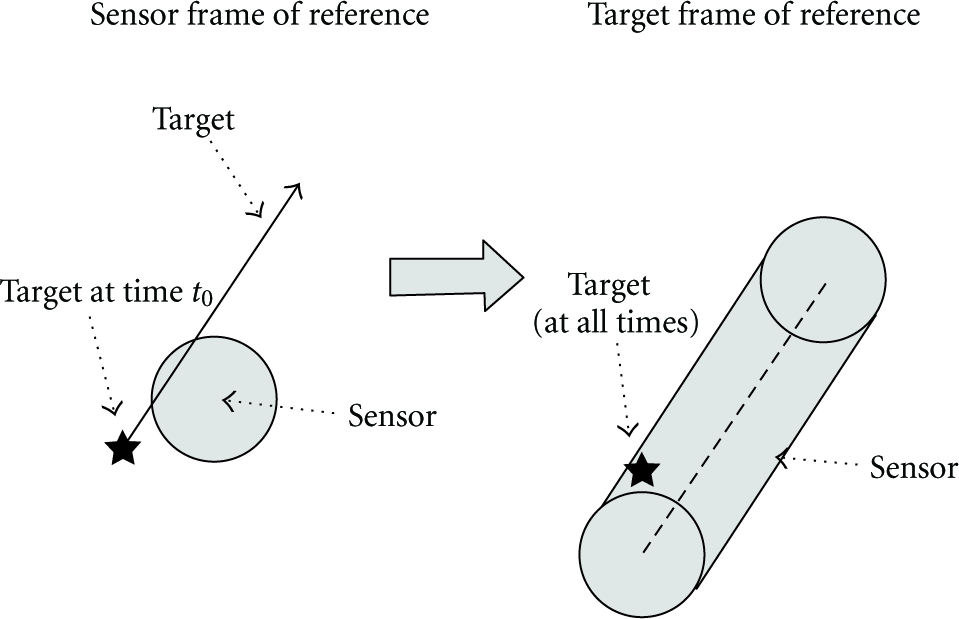
where is the fraction of the surveillance region that is “covered” by the searcher and target interaction geometry over the time interval . Thus, ψ represents the fractional area of the region comprised of all points within distance from the path created by the target's motion over the time interval of length T. Explicitly, the size of this region is determined analytically by translating the frame of reference from a natural world-view coordinate system to a target-centric frame of reference as shown in Figure 1. In this interpretation, the detection probability p in (2) is equal to the joint probability that the (single-point) target location shown in the target frame of reference falls inside the shaded sensor region and that it receives a detection (occurs with probability ).
Translation of sensor coverage region against a moving target from a sensor frame of reference to a target frame of reference.
The value of ψ is found by writing the area of the shaded region shown in the target frame of reference in Figure 1, and dividing by the size of the total surveillance region A. This is given by
The expression in (3) assumes a model of sensors that are fixed and spatially distributed uniformly over the search region; this assumption also makes the dependence on target heading θ disappear. For searchers that are nonuniformly distributed, the direct evaluation of ψ becomes unwieldy. Thus, we focus our analysis on searchers that are uniformly distributed. However, situations with nonuniform distributions can be represented by a set of irregular search regions, each of which has uniform searcher coverage. For the case of interest in this study, the sensors behave as moving searchers, in which case the expression in (3) does not hold. However, the translation from sensor to target coordinates as shown in Figure 1 still applies, in which case the velocity term of interest is the relative speed and relative heading between the search and the target. This leads to a variant of the equation for ψ in the case of moving searchers, which is given in terms of the relative velocity between searchers as target as
where we have dropped the dependence on relative heading , as it does not enter the evaluation for uniformly distributed searchers.
In two-dimensional space, the relative velocity between two bodies that are both moving with simple motion (constant heading and speed) is found from taking the derivative of their relative positions. In particular, consider a searcher position to be given by and the target position by . The relative position, given by , is written as
Taking a time derivative of (5) yields the relative velocity as
The relative speed as needed for the evaluation of (4) is given by the magnitude of the relative velocity of (6), explicitly given by
which is a constant value (independent of time) for this non-maneuvering motion model. The relative speed takes its maximum value for objects moving in opposite directions (where so that ) and takes its minimum value for objects moving in the same direction (where so that ), as expected. While the relative heading is similarly derived, we do not include that detail, as relative heading does not explicitly appear in the evaluation of ψ.
Note that the variable ψ from (4) is generally a random variable due to the random nature of . Thus the detection performance of an individual searcher (as given by (2)) is also a random variable. From the expression for an individual searcher's performance in (2), we sample (using Bernoulli trials) over the m searchers to obtain what we refer to as the probability of successful search. The value of is given by the probability of at least one of the searchers detecting the target over the time interval of length T. For a given probability of individual searcher performance , this is explicitly given by
which uses (2) for and the relative motion form of ψ from (4). Equation (8) is a restatement of Koopman's random search law [14] for the case of a set of m moving searchers with a moving target. We note that (8) is a function of the random variables , θ, and through their dependencies in (7). In practice, we are interested in the expected value of the , as that provides the expected performance with respect to the uncertainties inherent in the target characterization. Specifically, the expected search performance for m searchers moving at speed is given by
where is the probability density function associated with the joint random variable (incorporating all of the target kinematic uncertainty) and where the approximation notation has been dropped for clarity of exposition.
The probability of successful search in (9) represents a necessary condition to obtain the detections required for any subsequent processing (such as what is done with data fusion for false alarm reduction) or prosecution. We focus on this detection level of performance, instead of the resulting surveillance system performance, since it provides an analytical basis for parametric analysis that incorporates the necessary impacts of the spatial distribution and motion of the sensor nodes. Since the searchers move only to achieve the needed detection performance, this level of model provides an objective function that can be utilized for deriving conditions on the necessary combination of searcher motion, searcher distribution, and individual searcher sensing range that are required to achieve desired field level performance.
Previous studies [23, 26] have used expressions such as (8) and (9) in nonrelative motion coordinates to study groups of fixed searchers finding moving targets [23]. For a group of m identical searchers that are stationary (such that ) and seeking a target moving with speed , the relative speed of (7) becomes . This deterministic variable can be viewed as a limit of the random form of with . Given this restriction, the special case of fixed searchers reduces to
where superscript 0 is used to note that the fixed searcher problem is one of non-random performance. This is the exact expression that has been used in the previous studies found in [23, 26]. In fact, the following theorem illustrates an interesting correspondence between fixed sensor fields seeking a moving target and a group of moving sensors seeking a fixed target.
Theorem 1.
The probability of successful search performance of a uniformly distributed set of m sensors moving at speed to detect a stationary target is equal to the performance of the same m sensors employed in a uniformly random fixed pattern to detect a target moving at speed .
Proof.
From (7), the relative velocity of a sensor moving at against a target moving at zero is given by . From (9), the expected value of for m such sensors is given by . From (10), the expected value of for m fixed sensors against a target moving at is given by . For , it is clear that .
Numerically, we have verified the results of this theorem in a simulation experiment. Specifically, consider a case of sensors with detection range of (corresponding to a detection probability of ) in a square search region of size . Simulations were run for 500 different fixed field realizations, each of which was run for 10,000 simulations of a various target trajectories, each corresponding to a target moving at a speed of over a time interval of . For each realization the number of simulation runs reporting a detection was counted to obtain a probability of detection; these values were averaged over the 500 simulations to obtain a numerical value of . For this scenario, the mean value obtained was with a standard deviation of . Running a similar experiment for moving sensors against a fixed target location yielded a mean value of with a standard deviation of . Clearly these experiments illustrate the validity of the theorem. We note that the evaluation of (9) for this situation yields , which clearly falls well within the simulation sampling error for both cases.
4. Perturbation Approximations for the Effectiveness of Moving Searchers
We next seek to determine equivalences between fields with no motion and fields with motion utilizing different numbers of searchers. To perform the comparison, (9) and (10) are rewritten into a common form that illustrates the differences due to motion. We first consider the situation where the sensors are moving slowly relative to the target, such that . For the moving sensor performance equation (9), the relative speed term is rewritten as
where is a random variable representing the difference between the deterministic speed and the (random) relative speed . The use of ε (where ) is done to denote the additive term as small. Using this substitution, (9) is rewritten as
A small-argument expansion is applied to the exponential term, such that
It is now clear that the integral has the form of a simple expected value of the relative motion speed, leading to the final form of
where
is a nondimensional parameter representing the fractional increase in search rate speed due to the motion of the sensors. Equation (15) illustrates that the impact of sensor motion on sensor field search success is gained through a term that is proportional to the increase in relative search rate.
We note that the only approximation utilized in converting from the expected value form (9) to (15) was in the small-argument expansion of the reduced exponential. In particular, the assumption used was that
This approximation holds for any situation in which the search swath covered by the moving searchers over the time interval of length T is small relative to the size of the overall search region A (given by ). For large fields of search sensors, we assume this is always the situation, even for searchers that are moving fast (relative to the speed of the target). Thus, we apply the approximation form (15) for all searcher speeds, even those that violate the small-speed assumption implied by (11).
4.1. Slow Searcher Analysis
For very slow searchers, we employ a perturbation analysis to obtain an approximate analytical form for in (16). In particular, we consider the searcher speed to be much slower than the speed of the moving target , such that the substitution with holds. Now the relative speed of (7) is given by
By making the asymptotic expansion for small values of ε, the relative speed is approximated by
Keeping the leading order terms, the form for of (16) becomes
where the subscript is used to reflect the speed of the searchers relative to that of the target, and the approximation has been replaced by equality for convenience of exposition. For unknown target direction, the probability density function for target direction is given by . We switch the order of integration in (20) and evaluate to yield
We note that (22) shows that is independent of any specific form of (for this case of unknown target direction). Thus, the benefits to search are the same for randomly oriented searcher trajectories as for those that are carefully aligned relative to one another (against a target moving in an unknown direction). Substitution of the form of ε yields the final form of as
which is used throughout our analysis.
Given the value of from (22), we substitute into (15) to arrive at
Note that in the limit as , we have , as expected. To evaluate the effectiveness of this analytic expression for the group search performance, we perform a set of simulation experiments. In the simulation, we consider a set of 500 realizations of searcher location placements. For each setup, we simulate a random set of searcher orientations against a randomly chosen target track, and repeat that experiment 10,000 times. For each experiment we record whether a not a detection is accomplished, and tally the number of detections (out of 10,000) to obtain a probability of successful search (). These probabilities are then averaged over the set of 500 realizations to obtain the resulting expected value of . For the simulation, we consider a search area of size with a target moving at m/sec over an non-maneuvering observation interval of sec. We place a set of sensors each having a detection range of (corresponding to a detection probability of ). For this set of simulations, we have the sensors move at a speed of and arrive at a mean probability of successful search of with a standard deviation of . Evaluation of the approximate analytical form of (23) for this scenario results in a value of , which clearly matches the simulation within expected accuracy.
4.2. Moderate Speed Searcher Analysis
For searchers moving at speeds near the target speed, we employ a different perturbation expansion to obtain an approximate analytical form for in (16). In particular, we consider the searcher speed to be near the speed of the moving target , such that the substitution with holds. Now the relative speed of (7) is given by
By making the asymptotic expansion for small values of , the relative speed is approximated by
Keeping the leading order terms, the form for of (16) becomes
where the subscript is used to reflect the speed of the searchers relative to that of the target, and the approximation has been replaced by equality for convenience of exposition. For unknown target direction, the probability density function for target direction is again given by . We switch the order of integration in (26) and evaluate to yield
We note that, much like the case for , (28) shows that is independent of any specific form of (for this case of unknown target direction). Thus, the benefits to search are the same for randomly oriented searcher trajectories as for those that are carefully aligned relative to one another. Substitution of the form of ε yields the final form of as
which is used throughout our analysis.
Given the value of from (28), we substitute into (15) to arrive at
To evaluate the effectiveness of this analytic expression for the group search performance, we perform a similar set of simulation experiments to that done for the slow searchers. Except for the motion speed, the parameters for the simulation are the same as for that case. For this set of simulations, we have the sensors move at a speed of m/sec and arrive at a mean probability of successful search of with a standard deviation of . Evaluation of the approximate analytical form of (23) for this scenario results in a value of , which clearly matches the simulation within expected accuracy.
4.3. Fast Searcher Analysis
For searchers moving at speeds much faster than the target speed, we employ a perturbation expansion similar to that for slow searchers to obtain an approximate analytical form for in (16). In particular, we consider the searcher speed to be much faster than the speed of the moving target , such that the substitution with holds. Now the relative speed of (7) is given by
We note that the term under the square root is the same as in (18), and make the same perturbation expansion to arrive at
Keeping the leading order terms, the form for of (16) becomes
where the approximation has again been replaced by equality for convenience of exposition. For unknown target direction, the probability density function for target direction is again given by . We switch the order of integration in (32) and evaluate to yield
We note that, much like the cases for and , (34) shows that is independent of any specific form of (for this case of unknown target direction). Thus, the benefits to search are the same for randomly oriented searcher trajectories as for those that are carefully aligned relative to one another. Substitution of the form of ε yields the final form of as
which is used throughout our analysis.
Given the value of from (34), we substitute into (15) to arrive at
To evaluate the effectiveness of this analytic expression for the group search performance, we perform a similar set of simulation experiments to that done for the other cases of searcher speed. Except for the motion speed, the parameters for the simulation are the same as for those cases. For this set of simulations, we have the sensors move at a speed of m/sec and arrive at a mean probability of successful search of with a standard deviation of . Evaluation of the approximate analytical form of (35) for this scenario results in a value of , which again matches the simulation within expected accuracy.
5. Performance of Moving Sensors Relative to Fixed Sensors
To evaluate the performance of moving the sensors in a sensor network field, we consider comparisons against networks of fixed sensors. In particular, given the same sensing capability (per node), we determine the number of fixed sensors required to achieve the same expected search performance as the field of moving sensors. This provides a view of the benefit of motion—in terms of an expected reduction in the number of moving searchers required. To achieve this comparison, we reformulate the performance of a network of fixed sensors into a form that is directly comparable with (15).
Consider a field of m fixed sensors superimposed with a field of n identical sensors (i.e., all sensors are uniformly distributed over the search region). The expected performance of the m sensors is given by (10) as
and, similarly, for the n sensors their expected performance is given by
The expected performance of the combined sensor field is similarly given, and relates to these two subfields by the following theorem.
Theorem 2.
Consider two sets of independent fixed sensors ℳ and 𝒩 that are uniformly distributed over a region of size to detect a target moving at speed . The expected performance of the combined set of sensors is related to the expected performance of the individual sets according to
Proof.
Since the sensors are independent, the probability event of set ℳ reporting a detection is independent of the probability event of set 𝒩 reporting a detection. Let represent the complementary probability to successful search, that is, is the probability that the search was not successful. Thus, the joint probability of successful search of the combined set is the complementary probability to the event that both sets ℳ and 𝒩 do not detect the target. Thus,
The result of Theorem 2 is just a simple extension of the independence of the group detection events, but it is important to assessing the results of two groups of searchers operating simultaneously over the same region.
For a set of m fixed sensors with expected performance given by (36) combined with n fixed sensors with expected performance given by (37), the resulting performance is found by direct application of Theorem 2. Explicitly, this yields
Equation (40) shows that the joint performance of overlapping field of n and m sensors results in an expected performance whose equation form is very similar to (15). Thus, the expected performance of a field of fixed sensors is equivalent to a field of m moving sensors whenever . Upon examination of (15) and (40), this equivalence condition is met whenever
where is as defined in (16). This condition can be interpreted as defining the number of additional fixed sensors that are required to obtain the same performance achieved by making all of the sensors move at speed .
To examine the impact of the condition in (41) on sensor field design, we replace with its form from (37) under a small argument expansion for the exponential. This approximation is valid for small numbers n of additional fixed sensors and/or for small total coverage of the n fixed sensors relative to the entire region. If the n fixed sensors cover a substantial portion of the entire region, then performance is obtained from the fixed sensors and the analysis goal of determining the utility of added motion is moot. Under the small argument consideration, we use the approximation form for (37) inside of the equivalence relation (41) to obtain the form
Upon introduction of the non-dimensional parameter , the equivalence reduces to the simplified form
Equation (43) expresses the fractional increases in the number of fixed sensors required in a sensor field to achieve the same expected performance as that obtained by allowing the sensors to move at speed . This expression is given in terms of two non-dimensional parameters, η and , the first of which (η) provides a dimensionless measure of the relative thinness of the target motion pill that was illustrated in Figure 1, and the second of which () represents the amount of search rate increase due to the motion of the sensors. Large values of η correspond to situations with search gains dominated by sensor range, while small values of η correspond to situations with search gains dominated by target motion. Thus, it is no surprise that in the limit as , the required number of additional fixed nodes n goes to zero in (43)—corresponding to the situation for very large sensor detection ranges. Conversely, as the value of η approaches its other limit , the number of nodes required is , corresponding to the additive search rate gained by the m moving searchers.
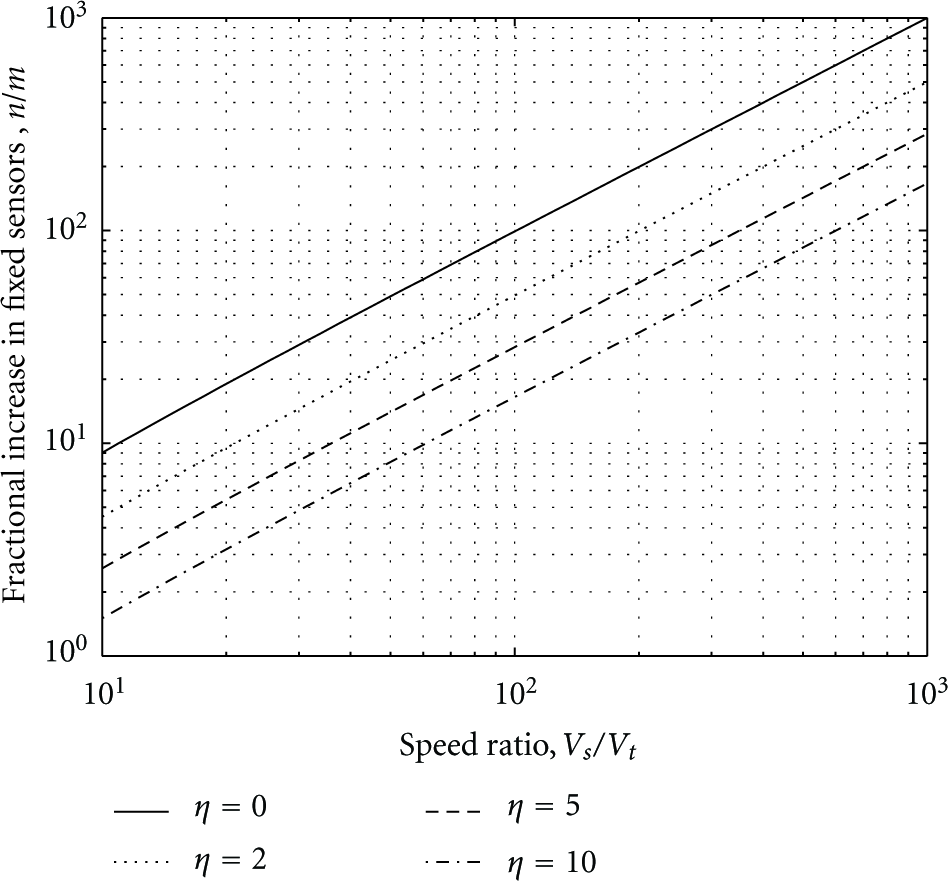
To illustrate the effectiveness of the parametric representation in (43), we provide plots of the required increase in the number of fixed sensors (i.e., ) as a function of the searcher speed relative to the target speed (i.e., ). The first of these plots is for the case of slowly moving searchers, utilizing the approximate form of from (22) and is given in Figure 2. Four different values of η are presented to illustrate the effect of sensing dominated by sensor range (high η) through sensing dominated by target motion (low η). As evidenced by the figure, small amounts of motion by a field of sensors have only a marginal effect on expected search performance (albeit always there is some positive improvement for any amount of motion). In fact, even for sensors that move at 20% of the speed of the target, the effect of motion on field search effectiveness is to only increase performance by the same margin as adding 1% additional fixed sensors (i.e., for a field of moving sensors, the expected performance due to motion is met by increasing the field size to fixed sensors).
Effective increase in required number of fixed searchers to achieve the same performance as a group of slowly moving searchers.
For increases in sensor speed, the situation improves, but not dramatically. In Figure 3, we show the case for searchers moving near the speed of the target, utilizing the approximate form of from (28). In this figure, the improvement in performance for faster searchers is evident; however, even for the most generous case as (corresponding to search gains dominated by target motion) the impact of moving the searchers at a speed identical to that of the target is to increase expected performance to a level that can be obtained by 27% more searchers. Thus, a field of searchers moving at speed would have the same expected performance as a field of m + fixed sensors. Also note that even that level of performance is only obtained in the limiting case of search gain dominated by target motion (corresponding to , which effectively occurs only when ).
Effective increase in required number of fixed searchers to achieve the same performance as a group of searchers moving near the target speed.
As searcher speed further increases to the point where it significantly surpasses the speed of the target, the situation improves as expected. In Figure 4, we show the case for searchers moving much faster than the speed of the target, utilizing the approximate form of from (34). In this figure, the improvement in performance for very fast searchers is clear. For example, for searchers that move at a speed that is 100-times faster than the target (i.e., ), the expected number of fixed searchers required to achieve the same performance is a factor of 100 (in the case of maximal use of target motion, as given by ). This is to be expected for targets that are nearly stationary (relative to searcher motion). However, in these cases it is unlikely that a field of sensors would be deployed; in practice, a single sensor moving that much faster than the target makes an acceptable search platform. Furthermore, if multiple searchers are utilized in such cases, they are usually restricted to nonoverlapping discrete subregions of the search space, such that the problem is no longer one of a sensor network of moving autonomous nodes.
Effective increase in required number of fixed searchers to achieve the same performance as a group of fast-moving searchers.
In Figure 5, the curves from all three limiting cases of searcher motion are shown plotted on the same scale. It is clear that the asymptotic expansions utilized for each of the domains appear to be consistent with one another, as one can visually interpolate smooth curves between these domains to cover domains outside of the scope of the perturbation expansions.
Effective increase in required number of fixed searchers to achieve the same performance as a group of moving searchers. All three perturbation regions are shown here on the same plot.
6. Conclusion
In this paper, we examined the search effectiveness of varying amounts of motion in fields of autonomous sensing assets that search for a moving target. By representing the performance of groups of autonomous searchers parametrically, we have developed a framework for making informed design and employment decisions based on the parametric drivers on system performance. In particular, we show the connection between numbers of searchers and the amount of searcher motion, and how that tradeoff is dependent on the amount of motion for the search object. It is anticipated that these results will be utilized to inform technology investment decisions for the next generation of autonomous sensing systems. When combined with cost models of a particular sensing and platform motion technology, these results can be used to determine the most cost-effective combination of mobility and sensing range to employ on a set of distributed search nodes; that is a subject on ongoing study. We conclude with a caveat that this analysis considers only the effects of searcher motion on field search performance; other uses of motion, such as covert deployment or field reconfiguration in response to a change in operational priorities or environmental conditions, may impact eventual technology decisions.
Future work involves the development of analytical approaches to investigate the benefits of cooperative pattern searches, including search modes such as leader/follower and search swarms. We also plan to remove the restriction on spatially uniform distributions of the searchers, to consider the potential benefits of small amounts of motion in preplanned configurations such as sensor barrier formations. Extensions to the target representation that involve random walks (as opposed to the Markov process model currently used) that account for variations in the time between target maneuvers are also planned. Finally, the development of reactive search problems (where the target is aware of the searchers) leads to a set of game-based problems that provide many new research challenges for developing this type of analytical design guidance.
Footnotes
Acknowledgment
This paper has been supported by the Office of Naval Research code 321MS.
References
1.
AkyildizI. F.SuW.SankarasubramaniamY.CayirciE.A survey on sensor networksIEEE Communications Magazine20024081021052-s2.0-003668807410.1109/MCOM.2002.1024422
2.
EstrinD.CullerD.PisterK.SukhatmeG.Connecting the physical world with pervasive networksIEEE Pervasive Computing20021159692-s2.0-000205857510.1109/MPRV.2002.993145
3.
QiH.IyengarS. S.ChakrabartyK.Distributed sensor networks—a review of recent researchJournal of the Franklin Institute200133866556682-s2.0-003545203310.1016/S0016-0032(01)00026-6
4.
NiuR.VarshneyP. K.ChengQ.Distributed detection in a large wireless sensor networkInformation Fusion2006743803942-s2.0-3375094437110.1016/j.inffus.2005.06.003
5.
ChamberlandJ. F.VeeravalliV. V.Decentralized detection in sensor networksIEEE Transactions on Signal Processing20035124074162-s2.0-003730709010.1109/TSP.2002.806982
6.
MusmanS. A.LehnerP. E.ElsaesserC.Sensor planning for elusive targetsMathematical and Computer Modelling19972531031152-s2.0-003107953710.1016/S0895-7177(97)00019-8
7.
PennyD. E.Multi-sensor management for passive target tracking in an anti-submarine warfare scenarioIEE Colloquium on Target Tracking199919999015
8.
DerenickJ.SpletzerJ.HsiehA.An optimal approach to collaborative target tracking with performance guaranteesJournal of Intelligent and Robotic Systems2009561-247672-s2.0-6874909107110.1007/s10846-008-9302-x
9.
DhillonS. S.ChakrabartyK.Sensor placement for effective coverage and surveillance in distributed sensor networks3Proceedings of the Wireless Communications and Networking ConferenceMarch 200316091614
10.
MartínezS.BulloF.Optimal sensor placement and motion coordination for target trackingAutomatica20064246616682-s2.0-3314446355510.1016/j.automatica.2005.12.018
11.
ZouY.ChakrabartyK.Sensor deployment and target localization based on virtual forcesACM Transactions on Embedded Computer Systems2003316191
12.
ClouqueurT.PhipatanasuphornV.RamanathanP.SalujaK. K.Sensor deployment strategy for target detectionProceedings of the 1st ACM International Workshop on Wireless Sensor Networks and Applications (WSNA '02)September 2002Atlanta, Ga, USA42482-s2.0-0036983208
13.
FerrariS.Track coverage in sensor networks2006Proceedings of the American Control ConferenceJune 2006Minneapolis, Minn, USA20532059
14.
KoopmanB. O.Search and Screening: General Principles with Historical Applications1980New York, NY, USAPergamon Press
15.
PollockS. M.A simple model of search for a moving targetOperations Research197018883903
16.
StoneL. D.Theory of Optimal Search19892ndOperations Research Society of America
17.
AlpernS.GalS.The Theory of Search Games and Rendezvous20003New York, NY, USAKluwer Academic
18.
IsaacsR.Differential Games: A Mathematical Theory with Applications to Warfare and Pursuit1965New York, NY, USAJohn Wiley & Sons
19.
SongN. O.TeneketzisD.Discrete search with multiple sensorsMathematical Methods of Operations Research20046011132-s2.0-2114445214010.1007/s001860400360
20.
KressM.SzechtmanR.JonesJ. S.Efficient employment of non-reactive sensorsMilitary Operations Research200813445572-s2.0-77149128630
21.
FurukawaT.BourgaultF.LavisB.Durrant-WhyteH. F.Recursive Bayesian search-and-tracking using coordinated UAVs for lost targetsProceedings of the IEEE International Conference on Robotics and Automation200625212526
22.
LeonardN. E.PaleyD. A.LekienF.SepulchreR.FratantoniD. M.DavisR. E.Collective motion, sensor networks, and ocean samplingProceedings of the IEEE200795148742-s2.0-3394739463410.1109/JPROC.2006.887295
23.
WettergrenT. A.Performance of search via track-before-detect for distributed sensor networksIEEE Transactions on Aerospace and Electronic Systems20084413143252-s2.0-4464919172610.1109/TAES.2008.4517006
24.
TraweekC. M.WettergrenT. A.Efficient sensor characteristic selection for cost-effective distributed sensor networksIEEE Journal of Oceanic Engineering20063124804862-s2.0-3375012348610.1109/JOE.2006.875102
25.
Bar-ShalomY.LiX. R.KirubarajanT.Estimation with Applications to Tracking and Navigation: Theory, Algorithms, and Software2001New York, NY, USAWiley-Interscience
26.
CoxH.Cumulative detection probabilities for a randomly moving source in a sparse field of sensors1Proceedings of the 23rd Asilomar Conference on Signals, Systems and Computers1989384389