




Abstract
Wireless sensors are battery-limited sensing and computing devices. How to prolong the lifetime of wireless sensors becomes an important issue. In order to reduce the energy consumptions when nodes are in idle listening, duty-cycle-based MAC protocols are introduced to let node go into sleep mode periodically or aperiodically. The long duty cycle makes sensors increase the transmission throughput but consumes more energy. The short duty cycle makes sensors have low energy consumption rate but increases the transmission delay. In this paper, a dynamic traffic-aware MAC protocol for energy conserving in wireless sensor networks is proposed. The proposed MAC protocol can provide better data transmission rate when sensors are with high traffic loading. On the other hand, the proposed MAC protocol can save energy when sensors are with low traffic loading. Simulation results show that the proposed protocol has better data throughput than other duty-cycle-based MAC protocols, for example, S-MAC and U-MAC. We also developed a set of comprehensive experiments based on the well-known OMNET++ simulator and revealed that our proposed TA-MAC performs significantly outstanding than related schemes under various situations.
1. Introduction
A wireless sensor network (WSN) is composed of hundreds or thousands of autonomous and compact sensing devices, gathering and delivering information about events of interest to observers. In a wireless sensor network, the energy efficiency of communications among sensors is a major issue. Various energy conservation schemes for sensor networks have been proposed [1–5]. TDMA-based protocols, for example, LEACH [1] and BMA [2], provide contention-free mechanisms for sensors to avoid the competition of the radio channels. The major advantage of TDMA-based protocols is energy efficiency due to no energy wasted on collisions caused by channel contention [6–8]. However, classic TDMA protocols are hard against the unpredictable variations of sensor networks.
In traditional wireless sensor networks, sensors need to be in listening for sensing data transmission. If no sensing event happens, nodes are in idle for a long time. Idle listening wastes energy when a node is active, even there is no meaningful task on the radio channel. Traditional MAC protocols, such as 802.11, are unsuitable for sensor networks' data delivery. Idle listening in 802.11 consumes as much energy as it does when receiving data. In order to reduce the energy consumption when nodes are in idle listening, duty-cycle-based MAC protocols are introduced to let nodes go into sleep mode periodically or aperiodically [9–13].
S-MAC is a MAC protocol that can specify when nodes are awake and asleep within a frame [9]. In S-MAC, the period of a regular cycle consists of a listen and a sleep state. The duty cycle is defined as the ratio of the node in listen state compared with the period of a regular cycle. Within a virtual cluster, a node exchanges synchronization and schedule information with its neighbors to ensure that the node and its neighbors wake up at the same time. In S-MAC, a uniform duty cycle is assigned across the whole network. The uniform duty cycle assignment is not suitable for all sensors because not all sensors have the same duty or workloads. If the uniform duty cycle is set too long, it may cause energy wastage on nodes with low data traffic because the nodes are in idle listening. If the uniform duty cycle is set too short, it may increase transmission latency on nodes with heavy data traffic because they do not have enough time to transmit all collected data [9]. T-MAC protocol enhances the design of S-MAC by listening to the radio channel for only a short time, and then nodes enter into sleep mode if no data is received during that time [10]. After synchronization, T-MAC shortens the awake period of a node if the radio channel is idle for a short time. If data is received, the node remains awake until the transmission is finished or the awake period ends. By using adaptive duty cycling, T-MAC can reduce energy usage for data transmission. However, in return for gaining energy, the costs are the low data throughput and the long transmission latency.
U-MAC protocol tunes duty cycle according to the traffic loads of sensor nodes. In wireless sensor networks, making nodes asleep for a long time to lower the energy consumption may result in higher transmission latency [11]. U-MAC tries to solve the problem by tuning duty cycle according to sensors' traffic loads. To reflect the traffic loads, U-MAC adopts a utilization function to calculate the load of each node. Upon synchronization, a node calculates its traffic utilization since the last synchronization time. The node adjusts its duty cycle according to the calculated utilization and then broadcasts the new schedule to its neighbors. The performance evaluation shows that the U-MAC can have good throughput when traffic loading is high. Meanwhile, U-MAC can save more energy than S-MAC when traffic loading is low. However, the problems of duty cycle synchronization between sender and receiver are not well solved in U-MAC. For a forwarding sensor, the duty cycle will be increased for getting more time to transfer data. For a receiving sensor with low traffic utilization, the duty cycle will be decreased. After a long time, the forwarding sensor is working in the high duty cycle and the receiving sensor may work in the low duty cycle. When the forwarding sensor sends a packet to a receiving sensor, the packet may be lost due to the receiving sensor enters into its sleep period early. As a result, channel utilization and transmission delay are varying in U-MAC.
In this paper, we propose a dynamic traffic-aware duty cycle adjustment MAC protocol named “TA-MAC” which can adjust sensor's duty cycle adaptively according to status of sending/receiving buffer, traffic loading, and battery life. After the information of a sensor is obtained, the sensor adaptively adjusts the duty cycle for sending and receiving packets. The goals of the proposed MAC protocol are twofold: (i) to conserve energy on sensors with low traffic loading and (ii) to decrease transmission latency and increase data throughput on sensors with heavy traffic loading. Each sensor can have different duty cycle for data transmission, long duty cycle is allocated for sensors that have more data need to be sent in sending queue. Each sensor extends its duty cycle if the sensor has data need to transmit. For sensors that failed to send data due to radio channel competition, these sensors will go to sleep state for energy conserving and wait for next wake-up time to compete the radio channel again for transmitting data.
The rest of the paper is organized as follows. Section 2 describes the related works. Section 3 presents the proposed dynamic duty cycle adjustment MAC protocol. Section 4 shows the experimental results. Section 5 concludes the proposed MAC scheme.
2. Related Works
This section provides a brief overview of existing energy conserving MAC protocols in asynchronous and synchronized approaches.
For asynchronous protocols, for example, B-MAC [12], WiseMAC [13], and X-MAC [14], they are utilizing adaptive preamble sampling schemes to reduce duty cycle and minimize idle listening. In B-MAC, nodes are awake and asleep asynchronously. When a sender has data, the sender sends a packet with a preamble longer than the sleep period of the receiver. When the receiver wakes up and detects the preamble, it stays awake to receive the data. B-MAC equips periodic channel sampling, called low-power listening (LPL), to enable low-power communication, without the need of explicit synchronization among the nodes. The receiver only wakes for a short time to sample the medium, which reduces the energy consumptions. In [13], El-Hoiydi and Decotignie proposed the WiseMAC protocol for the downlink channel of infrastructure wireless sensor networks. WiseMAC is based on the preamble sampling technique [15]. By sampling the medium, WiseMAC listens to the radio channel for a short duration, for example, the duration of a modulation symbol, to check for network activities. Nodes sample the medium with the same constant period. In WiseMAC, the access point learns the sampling schedule of all sensor nodes. Having the sampling schedule of the destination, the access point starts the transmission with a wake-up preamble. To reduce the length of the extended preamble, the receiver sends the time of its next awake period in the data acknowledgment frame. By using the preamble sampling technique, WiseMAC can reduce energy usage for transmitting data. However, WiseMAC is not suitable for long distance multihop data transmission. In [14], Buettner et al. proposed the X-MAC protocol that uses a shortened preamble approach for retaining the benefits of low-power listening. In wireless sensor networks, long preamble introduces excess latency at each hop and suffers from excess energy consumption at nontarget receivers. Instead of sending a long preamble stream, X-MAC inserts small pauses in the preamble stream, which forms a series of short preamble streams. These gaps enable the receiver to reply an early acknowledgement packet back to the sender during the short pause between preamble streams. When a sender receives an acknowledgement packet from the receiver, it stops sending preamble and then starts the transmission of data packet. Nontarget receivers who overhear the strobed preamble can go back to sleep immediately. X-MAC's shortened preamble approach can reduce energy usage at both the transmitter and receiver side. X-MAC also proposed an algorithm for adapting the duty cycle of the receiver to adapt to different traffic loads. However, the effect of the proposed adaptive algorithm is not clear in the performance evaluation.
Synchronized protocols, such as S-MAC [9], T-MAC [10], and U-MAC [11], can specify when nodes are awake and asleep within a frame. In S-MAC, neighboring nodes form virtual clusters to synchronize the working schedules [7]. Nodes periodically wake up, receive and transmit data, and then return to sleep to reduce energy consumptions. Within a virtual cluster, a node exchanges synchronization and schedule information with its neighbors to ensure that the node and its neighbors wake up at the same time. After the schedule is synchronized, nodes with data can transmit packets using RTS (Request To Send) and CTS (Clear To Send) packets when the nodes awake. Nodes without data will be in idle state for waiting connection until the end of the awake period and the nodes then enter sleep mode. S-MAC uses a SYNC packet to accomplish the synchronization of working schedule. When a node receives the SYNC packet, the node will adjust its timer immediately. In S-MAC, the listen interval is divided into two parts: (i) interval for receiving SYNC packets and (ii) interval for receiving RTS/CTS packets.
In [10], Van Dam and Langendoen proposed the T-MAC protocol that enhances the design of S-MAC by listening to the channel for only a short time, and if no data is received during this window, the node enters sleep mode. After the synchronization, T-MAC shortens the awake period of a node if the channel is idle for a short time. Once a data is received, the node remains awake until the transmission is finished or the awake period ends. By using adaptive duty cycling, T-MAC can reduce energy usage for data transmission. As a tradeoff, the costs are the reduced data throughput and the increased transmission latency. In [11], Yang et al. proposed the U-MAC protocol that tunes duty cycle according to the traffic loads of sensors. In a wireless sensor network, making nodes asleep for a long time to lower the energy consumption may result in higher latency. U-MAC tries to solve the problem by tuning sensor's duty cycle according to the traffic loads and selective sleeping after transmission. To reflect the traffic loads, U-MAC adopts a utilization function to calculate the loads of each sensor. Upon synchronization, the sensor calculates its traffic utilization since the last synchronization time. The sensor adjusts its duty cycle according to the calculated utilization and then broadcasts the new schedule to its neighbors.
Most of the recent works focus on how to prolong a sensor's or network's lifetime. However, these works do not consider the performance of data transmission when sensors have different workload. Our work differs from all of the above works by striking the balance between the battery life and transmission latency according to the traffic situations. The main difference is that the proposed MAC protocol is based on the demand of data transmission of sensors. The use of traffic-aware protocol can conserve sensors' battery life and reduce the transmission latency caused by sleep.
3. The Dynamic Traffic-Aware Duty Cycle Adjustment MAC Protocol
Most energy conserving MAC protocols adjust the sensor's duty cycle according to some factors like transmission latency and traffic load. For example, DS-MAC [16] adjusts the sensor's duty cycle according to the data transmission delay of sensors. U-MAC [5] determines the sensor's duty cycle according to sensor's traffic utilization. Some duty cycle adjustment algorithms change the sensor's listening time, others adjust the sensor's frame time [16, 17]. Existing adaptive duty cycle algorithms consider only limited factors to adjust the sensor's duty cycle. The lack of complete information of the network and sensor's sending/receiving status leads to additional energy consumption. Figure 1 shows an example of data transmission in U-MAC with cross topology. In Figure 1, the forwarding node needs to receive data from senders and then transmit the data to receivers. Since U-MAC adjusts the sensor's duty cycle according to the calculations of sensor's traffic utilization, the forwarding node has higher duty cycle than the other nodes. On the other hand, the sending nodes and receiving nodes will have lower duty cycle than the forwarding node. If a receiving node's duty cycle is the same as the forwarding node, increasing duty cycle can indeed improve the data transmission rate. Figure 2 shows that the duty cycle adjustment can enhance the transmission efficiency if the participant sensors increase their duty cycles.
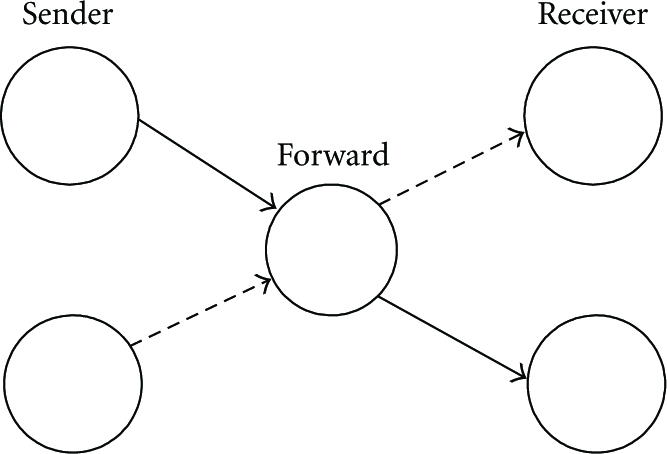
Sensors in U-MAC with cross topology.

The increasing of sensors' duty cycles raises transmission efficiency.
In U-MAC, senders and receivers try to reduce the duty cycle to save energy consumption if they are in low traffic utilizations. Figure 3(a) shows that all sensor nodes have the initial duty cycle of 20%. Over a long time, Figure 3(b) shows the senders A, B, C and receivers E, F, G reduce the duty cycle because of the low traffic utilizations. However, the forwarding node D increases its duty cycle in high usage status because of node D is communicating with multiple senders and receivers. When the senders and the receivers go to sleep, the forwarding node keeps on trying to transfer data packets from senders to receivers because of the forwarding node is in high duty cycle. In case of senders and receivers in low duty cycle, the forwarding node cannot receive packets from senders because of senders are in sleeping. Meanwhile, the forwarding node cannot transfer data packets to receivers because of receivers are in sleeping too. As a result, the forwarding node is wasting energy as it is in idle state.

The result of duty cycle adjustment of sensors in U-MAC over a long time.
Reducing the duty cycle of sensors can save energy to prolong sensors' life when sensors are in low traffic loads. Extending the duty cycle of sensors can improve data efficiency and reduce transmission delay when sensors are in high traffic loads. However, the duty cycle synchronization problems are not well solved in U-MAC. As a result, channel utilization and transmission delay are varying case by case in U-MAC.
To overcome the aforementioned issues, we propose a dynamic traffic-aware duty cycle adjustment MAC protocol named “TA-MAC” that can adjust duty cycle adaptively according to status of sensor's sending/receiving buffer, traffic loading, and battery life. The proposed traffic-aware duty cycle adjustment MAC protocol is based on the existing U-MAC protocol, and more functions are designed by us to enhance it. In U-MAC, the forwarding node has higher duty cycle due to its high traffic load. When senders continue to send data packets to receivers, this makes the forwarding node continues to increase the duty cycle to adapt to the current load. However, the senders and receivers do not have such a high traffic load. Therefore, the senders and receivers will lower their duty cycle. To solve such issue, the proposed MAC protocol utilizes an additional control message to achieve duty cycle synchronization between two sensor nodes. The receiving node can decide whether to keep the same duty cycle or not. If the forwarder and receiver have the same duty cycle, the sensors can have more time to transmit data. Based on such idea, the proposed MAC protocol performs outstanding than related schemes under various situations, and the performance comparisons are shown in next section. In the following, we present the technical details of the TA-MAC protocol.
3.1. TA-MAC Algorithm
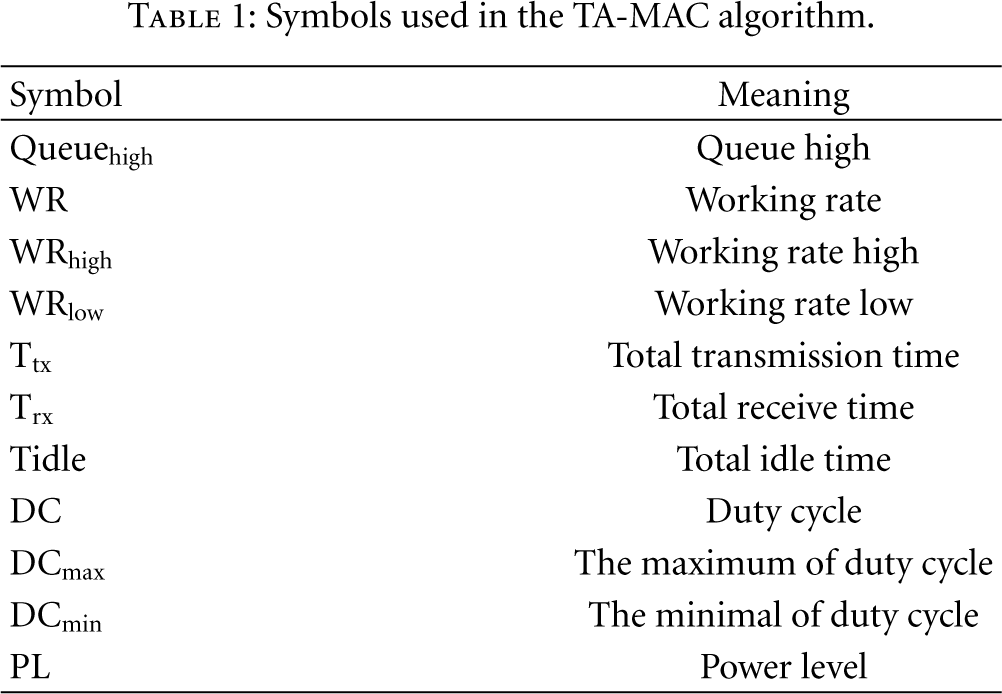
Algorithms 1 and 2 present the proposed TA-MAC algorithm. Table 1 depicts the symbols used in the proposed algorithm. The initial duty cycle of all nodes is set to the minimum duty cycle value
Symbols used in the TA-MAC algorithm.
Pkt: the packet that generated by sensor
1: Initial DC : DCmin 2: 3: Sending_Queue = Sensor.GetSendingQueueLength() 4: 5: Sensor.DC = DCmax 6: Pkt.Type = DC 7: Pkt.Data = Sensor.DC 8: Send(Pkt) 9: Sensor. State = Queuehigh 10: break 11: 12: 13: 14: Sensor.DC = Sensor.DC * 15: 16: Sensor.DC = Sensor.DC * 17: 18: Curren_DC = Sensor.DC 19: 20: Pkt.Data = Sensor.DC 21: Send(Pkt) 22: Sensor.State = DCmax 23: break 24: 25: //when the DC is less than DCmax, clean the request 26: 27: Sensor.State = Normal 28: 29: //when the queue length less than the queue threshold, clean the request 30: 31: Sensor.State = Normal 32: 33:
1: 2: 3: 4: Sensor. DC = Pkt.Data 5: 6: 7: 8: Sync() 9: 10: 11: 12: Rts() 13: 14: 15: 16: Cts() 17: 18: 19: 20: Data() 21: 22: 23:
The algorithm is divided into two parts: (i) sending duty cycle adjustment packet and (ii) processing the duty cycle adjustment packet.
3.1.1. SendDCAdjust: Sending Duty Cycle Adjustment Packet
When the transfer of a synchronization packet is completed, the node enters into duty cycle adjustment mode, where the adjustments can be further divided into two conditions: (i) normal state and (ii) abnormal state.
The duty cycle adjustment in normal state is based on the sensor's working rate, duty cycle, and the remaining energy. Working rate WR denotes the proportion of working time of a wireless sensor in a period of duty cycle. The working rate WR can be calculated by the total working time divided by the total operating time (active time). If the current working rate WR is higher than the working rate threshold WRhigh, the current duty cycle is lower than the maximum duty cycle
The duty cycle adjustment in abnormal state is triggered when some situations occurred, for example, sending/receiving queue is full. Each node has a sending queue and a receiving queue for storing incoming/outgoing packets temporarily. When a packet is generated, the packet is immediately put into the sending queue and waiting for transmission. Since the queue length is limited, when the queue is full, later packets will be dropped due to out of memory, resulting in the reduction of transmission throughput. Figure 4 shows the illustration of packets that are dropped because the sending queue is full.

The illustration of packets that are dropped because the sending queue is full.
To overcome the above-mentioned issue, before the sending queue is going to full, the proposed MAC protocol will increase the sensor's duty cycle rapidly to the maximum duty cycle value
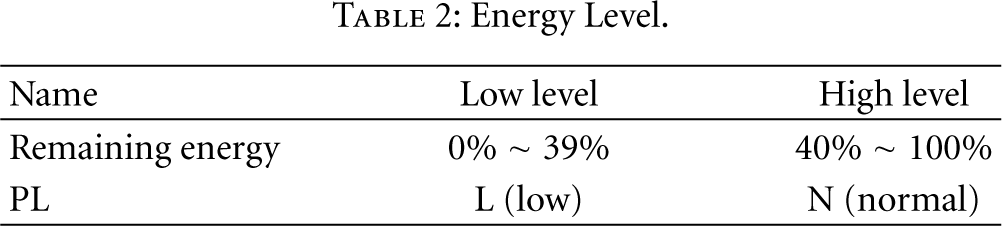
Energy Level.
Increasing the duty cycle can improve the efficiency of packet transmission; however, the receiver must be synchronized to follow the same schedule in order to receive the data sent from the sender. The duty cycle in the sender and receiver is independent. When the sender's duty cycle is higher than the receiver's duty cycle, it will cause the receiver to sleep earlier than the sender. As a result, the data cannot be sent to the receiver even the sender is still in working condition. In Figure 5, node A is the sender and node B is the receiver, the packet throughput cannot be increased even the node A increases its duty cycle, because of node B is in sleeping state. Therefore, node A wastes its precious battery power in idle waiting.

The packet throughput cannot be increased even if the node A increases its duty cycle because node B is in sleeping state.
For the above problem, the proposed MAC protocol sends an additional control packet to let the sender and receiver have the same duty cycle. In the proposed MAC protocol, a control packet named DCAdjust is defined. In Figure 6, node A and node B can have the same duty cycle after additional duty cycle synchronization. Finally, node A can have more time to transmit data to node B. As a result, data throughput is increased. Figure 7 illustrates the structure of the control packet DCAdjust. The packet is used to tell the receiver about the current state of the sender's duty cycle. The receiver will determine whether to synchronize the sender's duty cycle or not according to its remaining battery power. The structure of the control packet is similar to the IEEE 802.11 RTS (Request To Send) packet. The control packet has a 1-byte field named DC information, which is used to record the sender's duty cycle. Since the length of the control packet DCAdjust is small, the energy spent in sending and receiving the control packet DCAdjust is low.

Node A and node B have the same duty cycle after duty cycle synchronization.

The data structure of the DCAdjust control packet.
3.1.2. Handle the DCAdjust Packet
When the receiver is receiving the control packet, DCAdjust, the receiver will adjust its duty cycle according to its remaining energy. If the receiver does not have enough energy, the receiver will not change its duty cycle.
4. Performance Evaluation
In order to evaluate the performance of the proposed control scheme, we use the OMNeT++ discrete event simulator with EYES WSN simulation framework to simulate the wireless sensor networking environment [12]. There are five nodes in a 10 by 10 grid in the simulated sensor model. Nodes exchange messages using the wireless communication. A message will be heard by all the neighbors situated within the transmission range. Three duty-cycle-based MAC protocols are evaluated in the simulation: S-MAC, U-MAC, and TA-MAC. In the S-MAC control scheme, a frame length is set to one second and with a length of the active time 100 ms. The topologies used to evaluate our proposed scheme are shown in Figures 8 and 9. Figure 8 shows five nodes that transmit data in a linear topology. Figure 9 shows five nodes that transmit data in a cross topology.

Linear topology.

Cross topology.
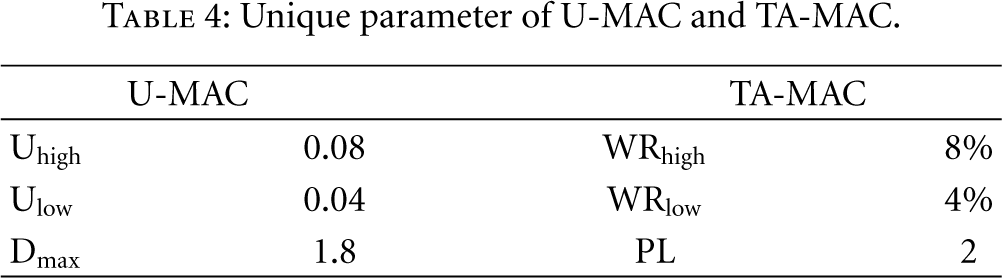
In the simulation, the power consumption and data communication parameters are based on the value of TR1001 hybrid radio transceiver [13]. In our experiments, we set the transmission range to 20 meters. The bandwidth is set to 115.2 kbps. Each data packet size is 100 bytes and 4 bytes for control packets including RTS, CTS, and SYNC/LSYNC. The simulated parameters can be divided into two categories: (i) common parameters and (ii) unique parameters. The common parameters are used in all simulated MAC protocols. The unique parameters are used in specific MAC protocols for specifying special parameters to specific MAC protocols. Table 3 depicts the common parameters, and Table 4 depicts the unique parameter of different MAC protocols in the simulating environment.
Common parameters of different MAC protocols.

Unique parameter of U-MAC and TA-MAC.
Figures 10, 11, and 12 show the simulation results of the different MAC protocols in linear topology. Figure 10 shows the data throughput of the different MAC protocols. In Figure 10, TA-MAC and U-MAC increase sensors' duty cycle with n% under high traffic load when the sending/receiving queue is not full. When the sending queue usage exceeds the queue threshold (Queuehigh), TA-MAC rapidly adjusts its duty cycle to the maximum duty cycle (
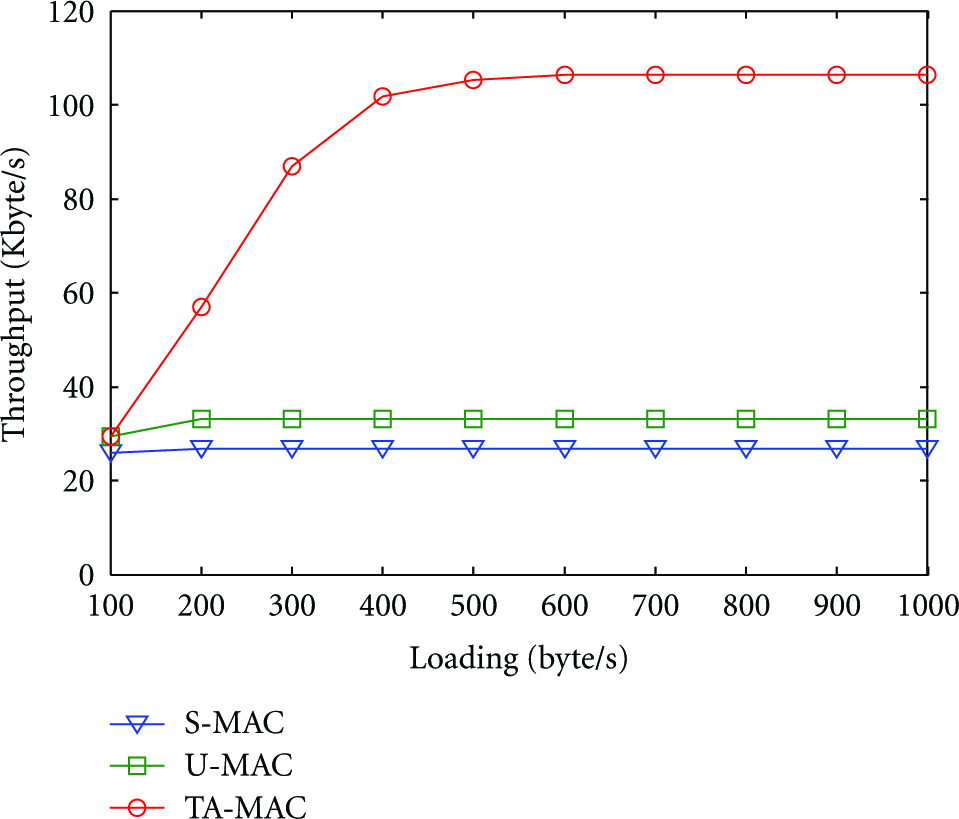
Data throughput for nodes in linear topology.
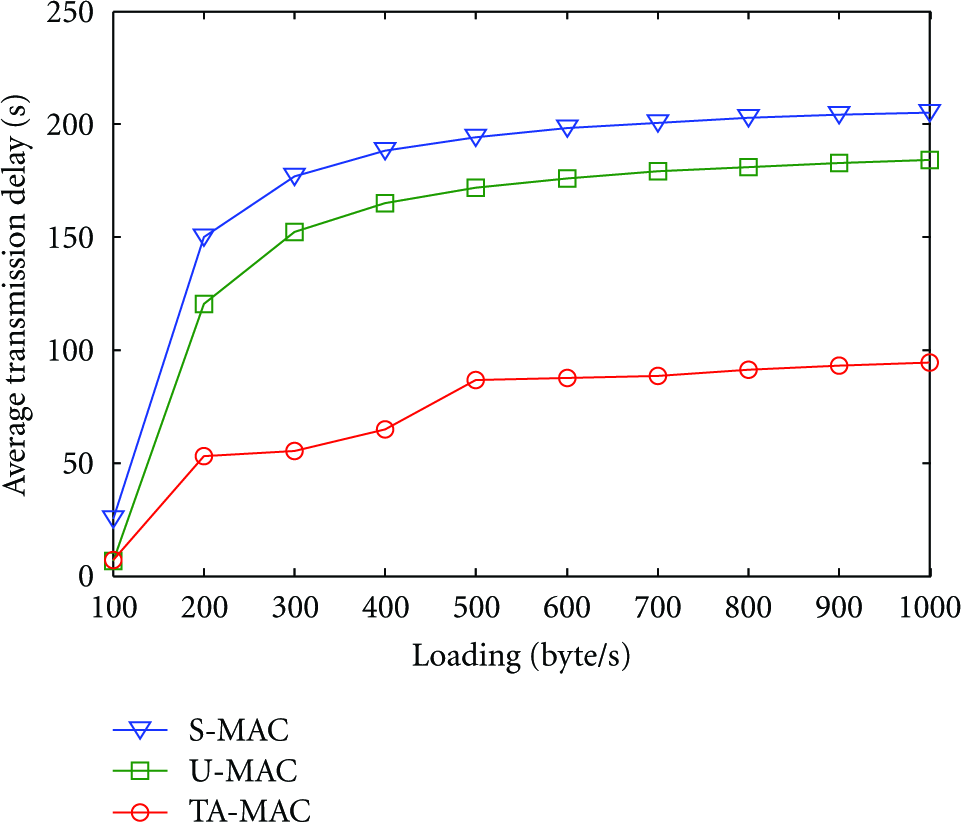
Transmission latency for nodes in linear topology.

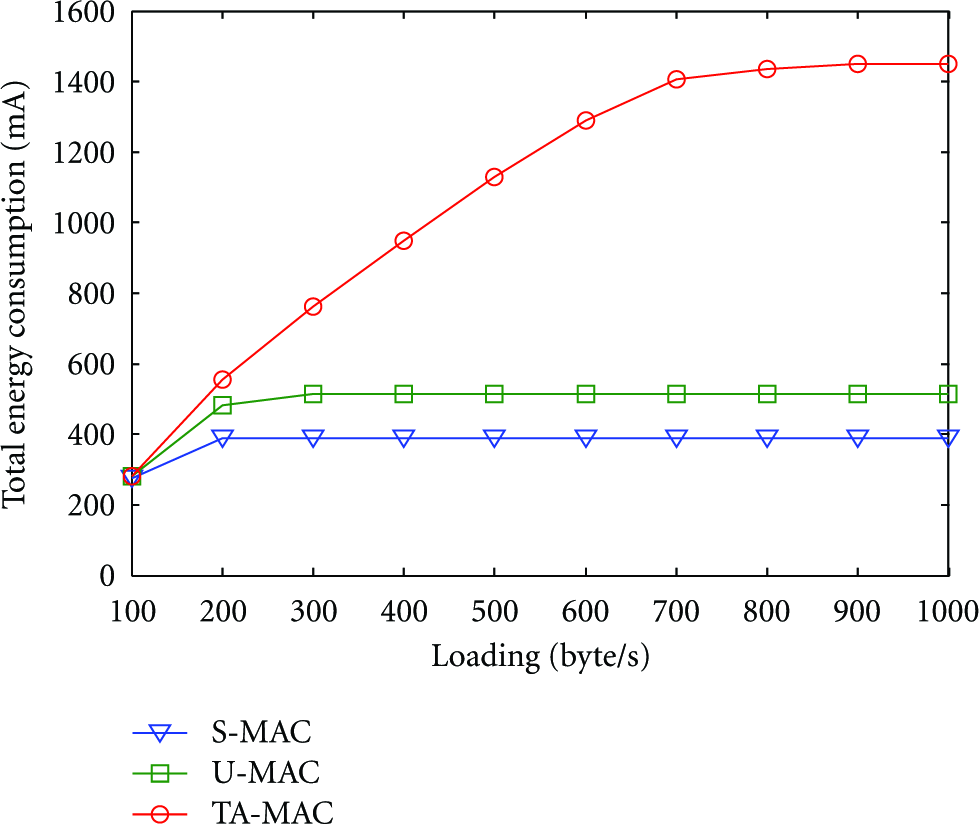
Energy consumption for nodes in linear topology.
Figure 11 shows the transmission delay of the different MAC protocols in linear topology. The lack of working time in S-MAC and U-MAC increases the transmission latency between senders and receivers. TA-MAC can increase duty cycle significantly when the traffic load is high. Meanwhile, the sender and receiver can achieve duty cycle synchronization. Therefore, TA-MAC can have lower transmission latency than that in U-MAC and S-MAC.
Figure 12 shows the total energy consumptions of the different MAC protocols in linear topology. S-MAC uses a fixed duty cycle to transmit data. Therefore, the energy consumption of S-MAC does not increase as the traffic load increases. U-MAC increases sensor's duty cycle according to sensor's traffic load; however, the increasing is slow. Therefore, the energy consumption of U-MAC is increasing slowly until it reaches the maintenance level. TA-MAC adjusts its duty cycle to the maximum duty cycle (
In the cross topology, the forwarding node suffers from high traffic loads from senders. The packet queue becomes full immediately when senders send data. Figure 13 shows the data throughput of the different MAC protocols in cross topology. In Figure 13, TA-MAC adjusts the forwarding node's duty cycle with n% according to its traffic load and sends a DCAdjust packet to the receiver for synchronizing duty cycle. When the receiver receives the DCAdjust packet, the receiver adjusts its duty cycle to the same value of the sender. After the duty cycle is synchronized, the sender can transmit data to the receiver without scheduling miss and then the data throughput is increasing rapidly. As the traffic load increases, the duty cycle of the forwarding node reaches the maximum duty cycle (

Data throughput for nodes in cross topology.
Figure 14 shows the transmission delay of the different MAC protocols in cross topology. U-MAC adjusts the sensor's duty cycle according to its traffic load. U-MAC has longer duty cycle than that in S-MAC. Therefore, U-MAC has shorter transmission delay, compared with S-MAC. TA-MAC can increase duty cycle significantly when the traffic load is high. Meanwhile, the sender and receiver can achieve additional duty cycle synchronization. As a result, TA-MAC can have lower transmission latency than that in U-MAC and S-MAC.

Transmission latency for nodes in cross topology.
Figure 15 shows the total energy consumptions of the different MAC protocols in cross topology. The energy consumption of S-MAC does not increase as the traffic load increases due to its fixed duty cycle design. U-MAC increases a sensor's duty cycle according to the sensor's traffic load. The forwarding node consumes more energy than other nodes. U-MAC has lower energy consumption than TA-MAC because the receivers in U-MAC are sleeping more due to out of duty cycle synchronization. On the contrast, T-MAC has more time to transmit queued data. Therefore, the energy consumption in TA-MAC is higher than that in S-MAC and U-MAC.
Energy consumption for nodes in cross topology.
5. Conclusions
In order to reduce the energy consumptions when nodes are in idle listening, duty-cycle-based MAC protocols are introduced to let node go into sleep mode periodically or aperiodically. When a sensor's listening time is extended, the sensor can have more time to receive data, which can enhance the transmission efficiency and reduce the latency when sensors have the heavy load. When a sensor's duty cycle is reduced, the sensor has long sleep time to reduce energy consumption in idle listening. In this paper, a dynamic traffic-aware MAC protocol for energy conserving in wireless sensor networks is proposed. The proposed MAC protocol can provide better data transmission rate when sensors are with high traffic loading. Meanwhile, the proposed MAC protocol can save energy when sensors are with low traffic loading. Simulation results show that the proposed protocol has better data throughput than other duty-cycle-based MAC protocols, for example, S-MAC and U-MAC.
Footnotes
Disclosure
C.-C. Chen was an associate professor in Southern Taiwan University while this work was initiated, and he is with Institute of Manufacturing Information and Systems, National Cheng Kung University since 2011.