




Abstract
A large-scale deployment of femtocell BSs (FBSs) causes substantial energy consumption. This paper proposes a hybrid BS-cooperative power management (HBCPM) scheme with self-organized sleep mode in virtual cell-based femto networks. Firstly, HBCPM builds a leader-member virtual cell framework, in which only one FBS is a FBS leader (FL) and others are FBS members (FMs). Then, the FL acts as an autonomous entity and is responsible for detecting active calls in the virtual cell coverage, while the FMs without active connections can entirely shut down pilot transmissions and the related processing all the time. So it is suited for self-organizing networks (SONs). Based on the proposed scheme, the state transition model is established by the semi-Markov stochastic process, and the analytic formulas of average cumulative delay and interference time as well as the energy consumption are derived. Meanwhile, three prominent-related schemes are also studied by the proposed model. With the practical long-term evolution (LTE) system parameters and three-dimensional femtocell network model, the numerical simulation and theoretical analysis match pretty well, and the tradeoff between the energy consumption and average cumulative delay is also manifested. Moreover, simulation results show that the proposed algorithm outperforms other three schemes in terms of average cumulative interference time and the energy consumption.
1. Introduction
1.1. The Motivation
The tremendous success of mobile cellular networks leads to wide proliferation and demand for ubiquitous heterogeneous broadband mobile wireless services, meanwhile, recent investigation confirms that most of voice services and data services take place in indoor scenarios [1]. Due to the high penetration loss and the long transmission distance, there is a huge cost for the macrocell to serve massive indoor users with extensive transmission demands. To address this problem, the applications of so called femtocell BS (FBS) have been investigated [1]. FBS is a short-range, low-power, low-cost, as well as customer-owned cellular base station deployed by the terminal consumers. It is connected to the existing broadband access network via fixed backhaul such as digital subscriber line or coaxial cable. FBS brings with it not only the enhanced indoor coverage without much additional cost, but also the other significant benefits such as increased spectral efficiency, offloaded macrocell burden, improved network capacity, and prolonged life for phone battery.
Although femtocell technique is deemed to be an emerging candidate solution of catering for the ever-growing demand for the wireless service, researchers and operators so far mainly focused on capacity or spectrum efficiency improvement by adding the femtocell into the macrocell [2–4] and do not pay much enough attention to the potential energy expenditure with more FBSs. ABI research [5] predicts that more than 36 million of femtocells are expected to be sold worldwide with 150 million of customers by the end of year 2012, and thus the energy consumption of the wireless cellular network might be drastically increased by the overwhelming FBSs. The growth of the energy consumption will cause an increase in global carbon dioxide emissions and impose more and more challenging operational costs for operators. Therefore, it is necessary to consider the energy consumption of femtocell networks, and then design an energy saving scheme without sacrificing its core benefits and functions.
Contrasting with macrocells, the traffic load of femtocell networks has more significant fluctuations in space and time due to a number of factors such as user mobility and behavior, as well as supporting very fewer simultaneous users for each FBS. During daytime, traffic load is generally higher in office areas compared to residential areas, while it is the other way around during the night. Therefore, there will always be some femtocells under the low traffic load, while some others may be under the heavy traffic load. However, FBSs in current cellular network architecture are always required to be active on air interface by continuously transmitting pilot signals and doing some related processing. In addition, the wireless air interface consumes energy with the same rate in receive, transmit, or idle states. In turn, the less the wireless air interface is operating, the less energy is consumed as well as the fewer interference time is caused. Hence, the most important issue in developing networks which are energy-aware is to model the power consumption of the wireless air interface [6]. So, energy saving potential of FBSs needs to be exploited by designing protocols to enable to shut down the wireless air interface, or to go to the sleep mode in FBSs [6]. Then, it is also necessary to study a suitable scheme to control the sleep mode behavior for FBSs.
1.2. Related Work
With green communication emerging, energy efficiency has become an important system design parameter for the long-term economic evaluation indicator of cellular networks. Researchers and operators gradually focus on the energy efficiency in two-tier femtocell networks [7–9]. Khirallah and Thompson present a methodology for estimating the total energy consumption, taking into account the total operational power and embodied energy, and TCO (total-cost-of-ownership) of two-tier femtocell cellular networks [7], which also shows that macro-femtocell networks reduce the networks TCO at the expense of increased energy-consumption. The above study mainly analyze energy efficiency whether can be improved with the femtocell deployment. However, they do not consider how to reduce energy consumption for a large-scale deployment of femtocells. Cheng et al. [8] introduce a spectrum splitting strategy to minimize the downlink energy consumption while suppress cross-tier interference. Domenico et al. [9] propose two resource management schemes that can limit the overall interference per resource block (RB) from neighbor FBSs and reduce the transmission power in each RB as well.
Usually, the wireless interface consumes energy with the same rate in receive, transmit, or idle states. In turn, the less the wireless interface is operating, the less energy is consumed. Therefore, the best strategy to minimize the energy consumption is to shut down the wireless interface, or to go to energy saving mode [6]. By contrast, there are relative less literature on designing protocols to enable sleep modes in FBSs and controlling the sleep mode behavior of FBSs for energy efficient improvement. The LTE standard introduces power saving protocols such as discontinuous transmission (DTX) and discontinuous reception (DRX) mode for both mobile stations and base stations [10]. DTX and DRX are methods to momentarily power down the device by switching off the transceivers whenever there is no need to transmit or receive. A timer-based energy-efficient solution is presented in IEEE 802.16 m standard [11] that the FBS periodically transmits pilot signals in low traffic scenario. The transmission period of the pilot signal is divided into two parts: fixed available and unavailable intervals, where the FBS switches off pilot transmissions and enters into the sleep mode. To reduce unnecessary available intervals, Widiarti et al. propose a dynamic shutting down pilot transmissions mechanism based on FBSs grouping [12]. However, the above schemes will not be efficient as long as the sleep/idle users are in the FBS coverage. Regarding this, the FBS does not need to turn on its pilot transmissions and related processing via user activity detection, irrespective of the location of registered users [13]. Nevertheless, this scheme only studies how to reduce the energy consumption from single FBS aspect, not suitable for the large-scale femtocell deployments. It also does not analyze the impact of various key parameters on the proposed scheme such as session arrival rate and so on.
1.3. The Contributions
In this paper, a novel hybrid (centralized/distributed) BS-cooperative power management (HBCPM) scheme is proposed for self-organized sleep mode in virtual cell-based femto networks. Firstly, according to the femtocell network topology, BCHPM builds a leader-member virtual cell framework, that is, femtocell networks are classified into a number of virtual cells based on one-hop neighbor list, the size of which is the sum of the sizes of FBSs. Within each virtual cell, the FBS is elected as either a FBS leader (FL) or a FBS member (FM) based on the list degree and the sum of received pilot signal power. Moreover, because of the time variation characteristic of the femtocell network topology, the role assignment algorithm for the newly installed FBS is introduced. Secondly, the FL is responsible for detecting active calls in the virtual cell coverage, while the FMs without the active user can completely switch off the pilot transmission and the associated processing all the time. Once the active registered user is detected by the FL, FL cooperates with the target FM, and then the target FM becomes active on the wireless air interface. Thirdly, the performance of HBCPM is analyzed theoretically in terms of average cumulative delay and the energy consumption and average cumulative interference time from the following two aspects: (i) state transition model is established; (ii) the analytic formulas of average cumulative delay and interference time and the energy consumption are derived. Finally, according to theoretical analysis of the proposed scheme, we further research three-prominent related schemes, and then, we assess the effectiveness of the proposed scheme by comparing its performance with them. With a three dimensional (3D) femtocell network model and practical LTE parameters, simulation results show that the proposed scheme outperforms three existing schemes in terms of average accumulative interference time and the energy consumption. Furthermore, the results provide some guidelines for deploying energy efficient femtocell networks.
The rest of this paper is organized as follows. Section 2 presents a 3D femtocell network deployment model, and describes a novel hybrid BS-cooperative power management scheme for the self-organized sleep mode in virtual cell-based femto networks. Section 3 analyzes the proposed scheme theoretically from the aspects of the energy saving and average cumulative delay and interference time. Meanwhile, three-prominent related schemes are investigated in theory as well. Section 4 provides simulation results and discussions. Finally, Section 5 concludes the paper and future work.
2. Approach: HBCPM
2.1. Femtocell Cellular Network Model
Figure 1 shows three dimensional topology of two-tier femtocell cellular networks, also called macrocell-femtocell overlay networks. A large number of FBSs with a small coverage area are randomly distributed on every floor of office blocks or residential buildings. The buildings are in the coverage of single overlay macrocell BS (MBS), and all FBSs in the building are under the centralized control of a femtocell server referred as the femto gateway (F-GW), which manages operation and maintenance (OAM) information such as the femtocell location and the identification through a backhaul link [14]. In addition, closed subscriber group (CSG) mode is adopted in this paper, where only authorized users and a list of invited users are allowed to access the given femtocell and occupy the resources for data communications.

The two-tier femtocell cellular network deployment.
2.2. Proposed Scheme
This section presents the HBCPM approach, which is based on the following two main components: (i) leader-member virtual cell construction, (ii) hybrid FBS-cooperative power management.
2.2.1. Leader-Member Virtual Cell Construction
The objective of this part is to describe the virtual cell construction procedure which divides the femtocell network into different virtual cells. Considering the uneven distribution of the FBSs in femtocell networks, a virtual cell construction algorithm is proposed on the basis of the femtocell distribution density and the received pilot signal power strength. According to the third generation partnership project (3GPP) standard [15], when a FBS is installed or switched on, it firstly enters into an initialization state. The FBS in this state needs to scan the radio environment to search for neighbor FBSs for getting necessary information. During this scanning process, the one-hop neighbor list including the received pilot signal power indicator from neighbors can be obtained. Note that the received pilot signal power strength must be above the predefined threshold to ensure that they are very close.
Utilizing the one-hop list, each FBS can calculate the sum of the received pilot signal power and the number of the FBSs in the list (i.e., list degree), and then sends these information to the F-GW. Note that the greater the sum of the received pilot energy strength or the list degree is, the more FBSs are located around this FBS. In subsequent frame, the F-GW elects the one which has the highest list degree among all FBSs as the first FL. If more than one FBSs are chosen as the FLs, the one with the maximal is chosen as the first FL. If the sums of the received pilot signal power are equal, break the tie randomly. After the first FL is determined, each FBS in the first FL's one-hop list decides whether it can be a FM of the first FL. If one FBS calculates that the pilot signal power received from the first FL is maximal in its one-hop list, it serves as FMs and attached to the elected FL. Otherwise, wait for the next role assignment. After the first virtual cell is generated, the second virtual cell is initiated with the FBS having the highest sum of the received pilot signal power among FBSs excluding the ones belonging to the first virtual cell and is updated as the first virtual cell. Besides, the rest of virtual cells are also constructed in the same way.
More formally, the whole algorithm to construct the virtual cell is summarized in Algorithm 1, where the set of operational FBSs in the femtocell network is given by
(1) Each FBS n creates the one-hop list and calculates the list degrees pilot signal power (2) Elect the FL FBS randomly; (3) Update the lth virtual cell as (4) If (5) update (6) Update φ to exclude the FBSs belonging to the first virtual cell, that is, (7) Repeat steps 2~6 until the set φ is empty.
Furthermore, a role assignment algorithm is studied for the newly added FBS. When the new FBS
(1) (2) (3) (4) the F-GW elects this FBS as the FL of (5) (6) ( largest pilot power strength as the FL of (8) (10) (11)
2.2.2. Hybrid FBS-Cooperative Power Management
The object of this part is to present the FBS-cooperative power management algorithm in each virtual cell. We need to introduce a low power consumption device installed with each FBS, called a sniffer. It is used to detect the energy strength of an active call. In each virtual cell, the sniffer of the FL needs to keep alive all the time. When there is an active call in the virtual cell coverage, the sniffer of FL detects an energy rise of the received signal on the uplink frequency band. If the received signal energy strength is higher than the predefined threshold, the registered user with an active call is considered to be close enough to the virtual cell.
Figure 2 shows the operational flowchart of cooperative FBS power management procedure. Assume that the FL can exchange information with the FMs in the same virtual cell, similar to the information interaction among MBSs through X2 interface in 3GPP [14]. Take a virtual cell for example. In the initial state, the FBSs without the active user in the virtual cell disable pilot transmissions and the associated processing and the sniffers, while the sniffer of the FL is busy performing measurements on the macrocell uplink band. When the sniffer of the FL detects an active registered user in the vicinity of the virtual cell and the received energy strength

Flowchart of hybrid FBS-Cooperative Power Management.
Specially, when the sniffer of the FL detects the registered user making an active call in the target FM coverage area, the FL directly notifies the target FM to activate the sniffer and pilot transmissions. By doing so, the active user can detect the target FM and perform handover to it with a slight delay.
3. Theoretical Analysis
This section establishes a state transition model based on the proposed scheme, and then closed form expressions of the energy consumption, average cumulative delay, and interference time are derived.
3.1. State Transition Model
To analyze the proposed scheme, we build up the state transition model including the following three states as shown in Figure 3. For the ease of description, define these states as state 1, state 2, and state 3, respectively. In each state, the FL needs to keep its sniffer on for the active call detection. In state 1, not only the pilot transmission and the associated processing of the FMs are off, but also the sniffer. When the sniffer of the FL detects an active registered user in the vicinity of the virtual cell and the received signal energy strength exceeds the threshold level, the FM moves into state 2. In state 2, both the sniffer and the time counter of the FM are on. If there is no session arrival in the timer range, the time counter is reset and the sniffer is switched off immediately, and the FM returns back to the state 1. Otherwise, the FM enters into the state 3. In state 3, the pilot transmission and the processing of the FM are both on, which provides services with active users. If the active call completes, the FM disables its pilot transmission and moves into state 2. Specially, when the sniffer of the FL detects an active registered user in the target FM coverage, the target FM directly enters into state 3.
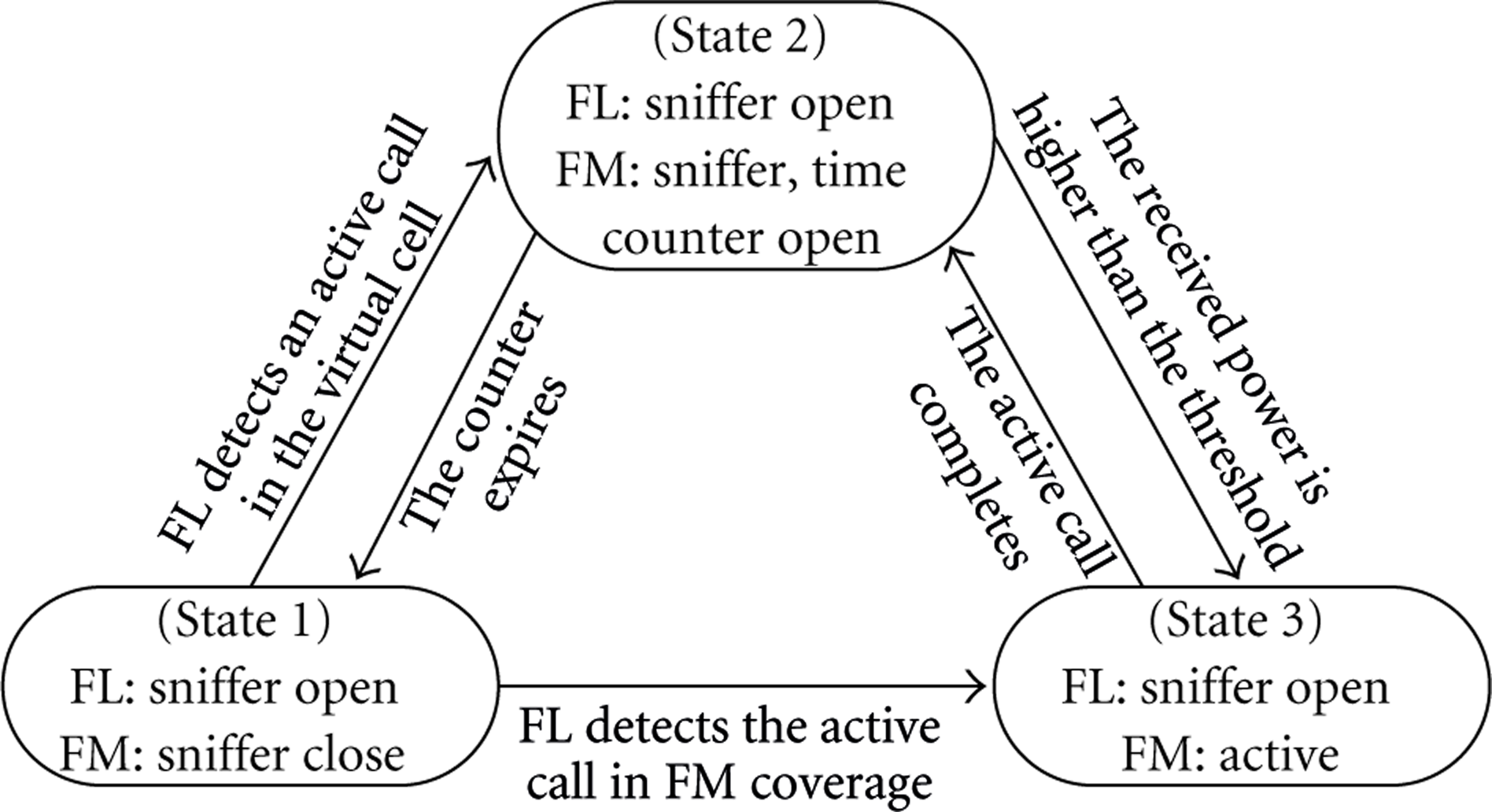
State transition model for HBCPM.
3.2. Analysis of the Proposed Scheme
Our objective in this subsection is to derive the analytic formulas of the energy consumption, average cumulative delay, and interference time. For simplicity, we consider a single virtual cell which consists of a FL and a FM as illustrated in Figure 4. The detection area of the FL is the coverage of the virtual cell, while the detection area of the FM is its own coverage. First, we shall make the following assumptions for the rest of the work.
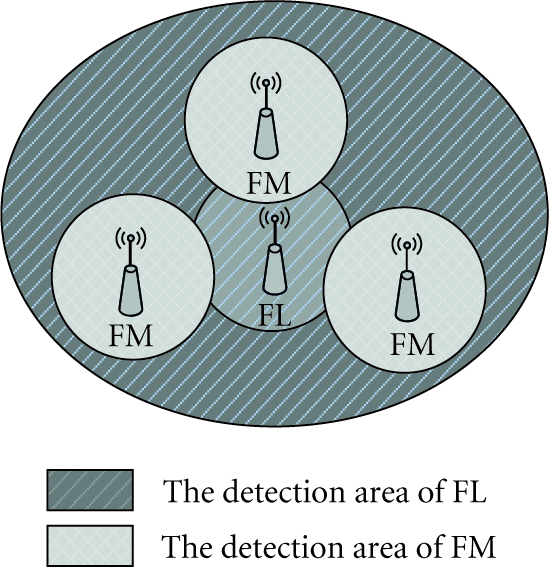
simplified model of femtocell deployments.
AS 1
At the initial condition, no user exists in the FM coverage or the users under the coverage of the FM are in sleep/idle mode.
AS 2
The session arrival in the virtual cell coverage and the FM coverage follow Poisson distribution with the rate
AS 3
The time duration in state 1 follows a
AS 4
The timer range of the time counter of the FBS is constant and set as
Let the waiting time of the nth session arrival be defined as

According to the state transition model, define the energy consumption E of the FBS per hour, average cumulative delay

where

where

where

Utilizing the time distribution
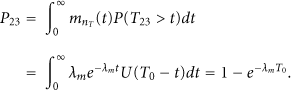
Due to

Due to
The mean residence time


In state 3, the time duration is a busy period following

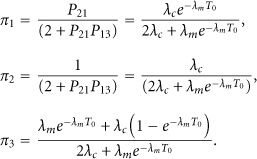
According to the stationary probability

The partial derivative of the steady state probabilities with respect to the timer range
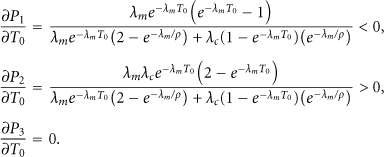
Therefore, the steady state probability
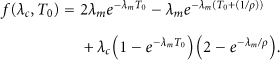
In the subsequent, the analytic formulas of the energy consumption and average cumulative delay and interference time are expressed as:


3.3. Analysis of the Compared Scheme
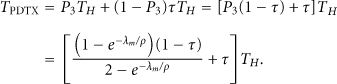
In this subsection, we analyze the existing prominent schemes theoretically and make a comparison among these schemes. IEEE 802.16 m [11] proposes a simple and practical scheme, called as periodical discontinuous transmission (PDTX), in which the FBS without active user changes alternately between available interval (AI) and unavailable interval (UAI). During the UAI, the FBS switches off the pilot transmission and the related processing. During the AI, the FBS becomes active on the air interface for synchronization and signaling purposes. In PDTX, Let τ be the low duty cycle in each period between AI and transmission period, the energy consumption and the cumulative interference time can be derived as

Widiarti et al. [12] present a novel sleep mode for the FBS based on a grouping methodology, called as GPDTX. This scheme is closely related to the user location. The FBS in the absence of users switches off the pilot transmission, while the FBS with a nonactive user periodically transmit the pilot signal. Suppose that the user lies indoor with a probability
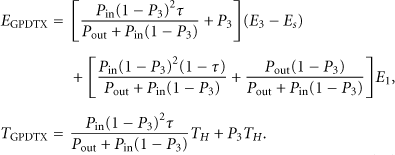
The partial derivatives of the energy consumption and interference time with respect to

Therefore, the energy consumption and cumulative interference time are the monotone increasing function with the increasing of


Compare (17) and (21), (18) and (22), they are the same with each other. It implies that when the users stay at home all the time, GPDTX has the same energy-saving effect as PDTX. However, the signaling overhead of GPDTX is more serious than that of PDTX.
Reference [13] investigates the behavior of the sleep mode for the FBS based on user activity detection, called UDTX. The FBS switches off the pilot transmission until it detects the active user in its coverage. After completing the service for the active call, it immediately moves into a sleep mode. Hence, the energy consumption and interference time can be derived as

4. Performance Evaluation
In order to evaluate the performance of the proposed scheme, Monte Carlo simulation analysis is employed. A dual-strip model is chosen to simulate the multifloor based 3D femtocell cellular networks [15]. In this model, each stripe has 2 by 10 apartments and 6 floors. Each apartment is of size 10 m × 10 m. There is a street between the two stripes of apartments, with a width of 10 m. Each femto block is of 120 m × 70 m. Two critical parameters are introduced: the deployment rate ω and the activation rate ν. The deployment rate is used to simulate that each apartment has a FBS with a probability ω. The activation rate is defined as the active proportion of FBSs. If the FBS is active, it will transmit the user data in the traffic channel, or else it will transmit the pilot signal in the control channel. These two parameters determine operational femtocell density μ, that is,
The channel propagation model [15] includes path loss and log-normal shadowing. The path loss consists of free space loss, indoor path loss, indoor wall penetration loss, floor penetration loss, and outdoor wall penetration loss. If the FBS and the FUE (or another FBS) are inside the different apartments, the path loss is expressed as (24), or else (25). Consider


where R denotes the distance between the FBS and the FUE (or another FBS), and
In addition, the simulation parameters are mostly referenced from [15] as summarized in Table 1. The simulation analysis is divided into the following two aspects. Firstly, with realistic LTE system parameters and 3D femtocell network model, we verify the rationality of the theoretical analysis and investigate the impact of the key parameters of the proposed scheme on the performance of femtocell networks. Secondly, we assess the effectiveness of the proposed scheme by comparing its performance with other three-prominent schemes.
Simulation parameter.

4.1. Parameter Analysis of the Proposed Scheme
Figure 5 depicts steady state probability of the proposed scheme according to the timer range of the FBS. The close agreement between theoretical and numerical simulations indicates that analytic expressions (12) are the accurate approximations for practical steady state probability in the dense femtocell environments. Moreover, it can be seen that as the timer range of the FBS increases, the steady state probability of the state 1 decreases, the steady state probability of the state 2 increases, and the steady state probability of the state 3 has no correlation with the timer range and remains unchanged. That is also in accordance with the theoretical analysis.

Steady state probability for both theory and simulation.
Figure 6 shows the plots of the steady state probabilities of the proposed scheme from the simulation analysis. The steady state probabilities are compared with different session arrival rate. Moreover, for a fixed timer range of the FBS, as the session arrival rate increases, the steady state probability of state 1 decreases, while the steady state probabilities of both state 2 and state 3 increase. That is mainly due to the fact that the higher the session arrival rate, the greater the probability of the activation for the FM.

Steady state probability for numerical analysis.
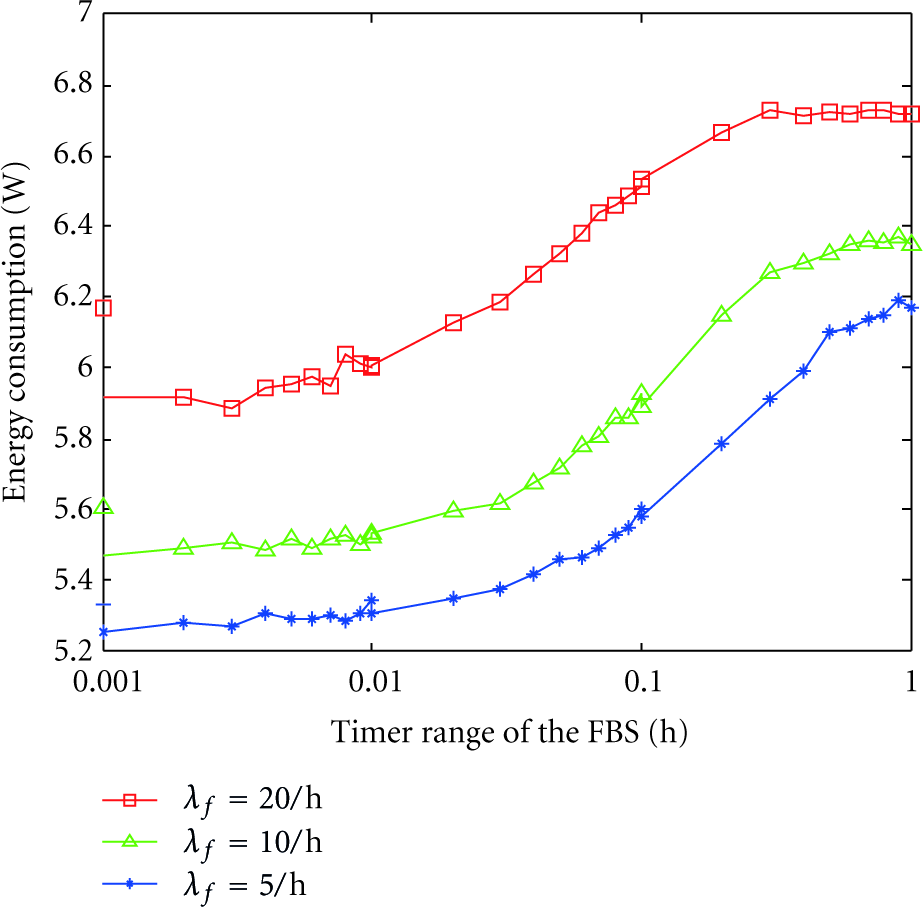
Figure 7 shows the energy consumption of the proposed scheme according to the timer range of the FBS. It can be seen that the theoretical analysis and numerical simulations get matched pretty well, which indicates that the analytic expression (15) is the accurate approximation for the practical energy consumption in dense femtocell environments. Moreover, we also can know that as the timer range of the FBS increases, the energy consumption increases. That is mainly due to the fact that the longer the timer range is, the greater the steady state probability of the state 3 is, which consumes the most energy of the all states.

Energy consumption for both theory and simulation.
Figure 8 depicts the relation between the energy consumption of simulation analysis and the timer range, respectively. For the same value of timer range, as the session arrival rate increases, the energy consumption increases. For fixed session arrival rate, the energy consumption increases with the increasing of the timer range.
Energy consumption of simulation analysis versus timer range.
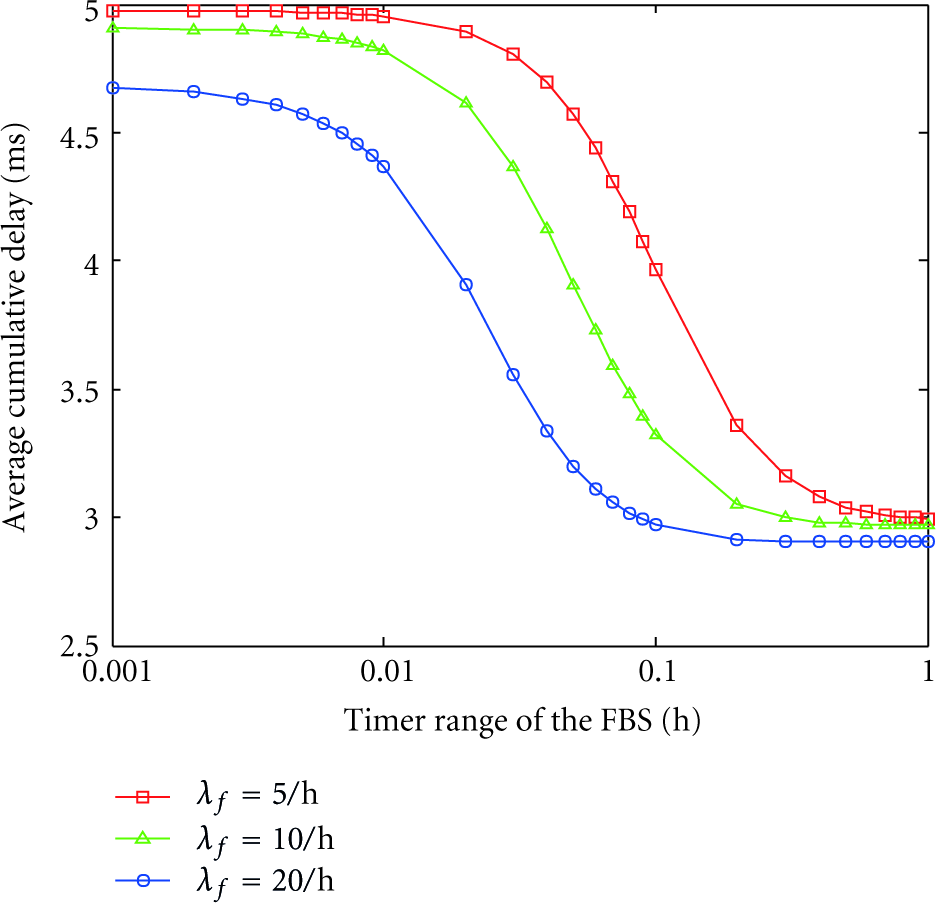
Figure 9 depicts the average cumulative delay of the proposed scheme according to the timer range. It can be seen that as the timer range increases, the average cumulative delay decreases. That is mainly due to the fact that the greater the timer range, the more the session arrival will directly enter into the state 3, which will avoid the delay from state 1 to state 2. In addition, as the session arrival rate increases, the average cumulative delay decreases.
Average cumulative delay versus timer range.
From the analysis above, we can conclude that the timer range has a significant effect on the energy consumption and the average cumulative delay and cumulative interference time. Hence, we should choose the proper timer range for the energy efficient FBS. Furthermore, as the timer range of the FBS increases, curve trends of energy consumption and average cumulative delay are just contrary. Hence, we should elect the proper operation to balance them.
4.2. Performance Comparison with Different Schemes
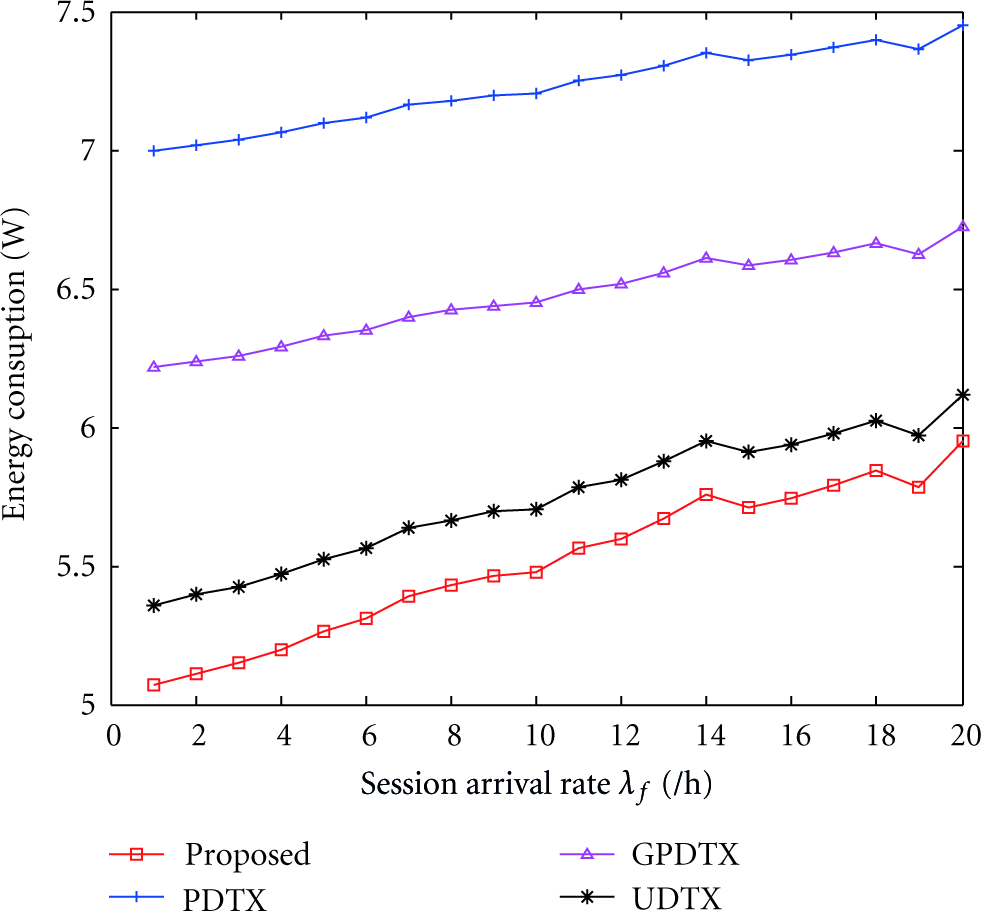
Figure 10 and Figure 11 depict the energy consumption of different schemes with various session arrival rates. It is assumed that low duty cycle τ is 0.4 for two figures, and
Energy consumption for different schemes.

Energy consumption for different schemes with different
However, it can be seen from Figure 11 that the energy consumption of GPDTX decreases with the increasing of the probability
Figure 12 shows the cumulative interference time for different scheme according to the session arrival rate. It can be seen that as the session arrival rate increases, the cumulative interference time for various schemes increase. For a fixed session arrival rate, the cumulative interference time using PDTX is the worst of all, while the curves of the proposed scheme and UDTX are nearly coincided with each other, and best of all. The cumulative interference time using GPDTX decreases with the decreasing of

Interference time for different schemes with different
5. Conclusion
This work proposes a novel hybrid BS-cooperative power management scheme for self-organized sleep mode in virtual cell-based femto networks. Firstly, according to the femtocell network topology, HBCPM builds a leader-member virtual cell framework. Within each virtual cell, the FBS is elected as either a FL or a FM based on the list degree and the sum of received pilot signal power. Moreover, because of the time variation characteristic of the femtocell network topology, the role assignment algorithm for the newly installed FBS is introduced. Secondly, the FL is responsible for detecting active calls in the virtual cell coverage, while the FMs in the absence of the active user can completely switch off the pilot transmission and the associated processing all the time. Thirdly, utilizing the semi-Markov process, state transition model of HBCPM is established, and then the analytic formulas of energy consumption and average cumulative delay and interference time are derived as well as three-prominent related schemes. Simulation results verify that the proposed scheme outperforms three existing schemes in terms of interference time and energy consumption. Further, the timer range of the proposed scheme has a significant effect on the energy consumption and the average delay.
In addition, this scheme can be easily applied to orthogonal frequency division multiple access (OFDMA) networks [18, 19], or orthogonal frequency and code division multiplexing (OFCDM) systems [20]. In the future, we plan to incorporate the user mobility model to study its effect on the performance of the proposed scheme and evaluate the energy consumption with the prominent related schemes. Further, we also plan to design and implement the FBS cooperative power management algorithm in official blocks.
Footnotes
Acknowledgments
This work is supported by the National S&T Major Project of China (no. 2010ZX03003-001-01, 2011ZX03003-002-01), and the Cobuilding Project of Beijing Municipal Education Commission, the National Natural Science Foundation of China (61101109), and the Youth Research and Innovation Project of Beijing University of Posts and Telecommunications.