




Abstract
The emergence of the oscillation death phenomenon in a ring of four coupled self-excited elastic beams is numerically explored in this work. The beams are mathematically represented through partial differential equations which are solved by means of the finite differences method. A coupling scheme based on shared boundary conditions at the roots of the beams is assumed, and as initial conditions, zero velocity of the first beam and three normal vibration modes of a linear elastic beam are employed. The influence of the self-exciting constant on the ring dynamics is analyzed. It is observed that oscillation death arises as result of the singularity of the coupling matrix.
1. Introduction
In the past years the collective behavior of coupled nonlinear oscillators has been widely studied in many disciplines, for example, physics [1], biology [2], ecology [3], chemistry [4], and mechanics [5]. A wide diversity of nonlinear dynamic phenomena such as locking [1], partial synchronization [6], full synchronization [7], antiphase synchronization [8], and clustering [9] have been reported in coupled oscillators. Many coupling schemes have also been tested: local [10], nearest [11], global [12], diffusive [13], adaptive [14], delayed [15], hierarchical [16], and so on. An interesting behavior of coupled oscillators is amplitude death and oscillation death, which are steady states where the coupled oscillators stop their oscillation in a permanent way and become frozen in time [17–19]. Sometimes this cessation of oscillations in time is named quenching [20]. Amplitude death arises through a Hopf bifurcation mechanism in coupled oscillators with an important parameter mismatch or in identical oscillators with time delays [21]. An already existing unstable steady state with zero amplitude is transformed by the coupling into a stable one allowing its observation; that is, the coupling induces stability at the origin of the phase space. On the other hand, oscillation death occurs through a saddle-node bifurcation mechanism allowing the emergence of new fixed points: a new stable steady state with nonzero amplitude is created by the coupling [19, 21]. Frequently, in the literature amplitude death is confused with oscillation death [22–27]. Even the famous finding of Lord Rayleigh [28] related to the quenching of two organ pipes standing side by side is indistinctly considered as amplitude death or oscillation death [29]. To date, in spite of the significant conceptual and technical differences between amplitude death and oscillation death, there is not yet a clear distinction between these phenomena. Fortunately, a precise distinction between amplitude death and oscillation death concepts can be found in [19].
The elimination of oscillations in a population of synthetic genetic clocks with phase-repulsive coupling is studied in [30]. These authors report that as the coupling strength is increased, silencing of oscillations is found to occur via the appearance of an inhomogeneous limit cycle, followed by oscillation death. In [31] the coupled behavior of two different oscillators, namely, a Rössler oscillator and a linear one, is analyzed. The region of oscillation quenching is analytically obtained using a proper coupling strength and parameter region, and, in general, it is concluded that even though two different oscillators are coupled with each other, they exhibit oscillation quenching, just as coupled oscillators with a large parameter mismatch. The coupled behavior of a set of five oscillators that mimics phenomena in cardiovascular systems, each one with its own characteristic frequency and amplitude, is studied in [21]. The authors derive analytic conditions that allow the prediction of oscillation death through the two aforementioned bifurcation routes and conclude that oscillation death occurs not only by changes in couplings but also by changes in the oscillator frequencies or amplitudes. In [32] the induction of Hopf bifurcation and oscillation death by time delays in two coupled networks, each one with four nodes, is investigated. Two-way coupling between a single node in one network with one in another is assumed. It is concluded that a system with two networks that involve delayed shortcut connections exhibits oscillation death that is caused by delay coupling. Oscillation death in a pair of coupled oscillators with diffusive and direct couplings is reported in [19]. For larger systems, these authors report the emergence of Turing-like pattern structures and find that death states in coupled oscillators in the absence of any effects of parameter mismatch and delayed time are possible.
By far, the bulk of the published reports on the collective behavior of coupled oscillators is related with oscillators described by ordinary differential equations or maps, for example, [17, 18, 33]. In the last decade the published works on the coupled behavior of spatially extended systems described through partial differential equations are growing; however, the majority of them are focused on synchronization [34–37]. Currently, there are few reports on oscillation death in oscillators described by partial differential equations. In a recent paper by one of the present authors [38] the synchronization phenomenon in a ring of four self-excited elastic beams governed by partial differential equations with nearest neighbor coupling is analyzed. The self-excited elastic beams are intended to represent turbine blades coupled through the shaft and subject to vortex induced vibration. In the above paper it is shown that if the coupling constant is near to zero, the motions of the beam tips are very complex and exhibit multiple frequencies and amplitudes. As the coupling constant is increased to values just below for which the coupling matrix is singular, the motion becomes more regular, and finally the coupled beams exhibit a single frequency and amplitude. In the present paper the emergence of oscillation death in a ring of four coupled self-excited elastic beams is explored. As in [38], the self-excited oscillations of the beams are assumed to occur due to vortex-induced vibration. Numerical simulations show that this phenomenon occurs for the case in which the coupling matrix becomes singular. The paper is organized as follows: Section 2 presents the mathematical model and the coupling scheme. In Section 3 the mathematical conditions that allow the emergence of oscillation death are derived and explained. Section 4 describes the numerical method and the parameters employed in the solution of the four coupled partial differential equations. Section 5 presents the numerical results for the coupled behavior of the ring. The influence of the initial conditions on the emergence of oscillation death is analyzed. Besides, some numerical results on the nontrivial fixed point stability are discussed. Finally, the concluding remarks are shown in Section 6.
2. Mathematical Model and Coupling Scheme
The motion of an elastic beam of homogeneous section and properties is governed by the dimensionless equation [39]

where X, τ, and

where A is the self-exciting constant. As is justified in [44], (2) contains two key issues of a fluid-structure problem: the elastic response of the structure and the nonlinear fluid-structure interaction. These issues are responsible for the complex vibration behavior of rotating blades in turbomachinery.
A clamped-free beam is considered, which has one end fixed to the shaft whilst the other end is freely moving. This kind of beam is subject to the following boundary conditions [39]:
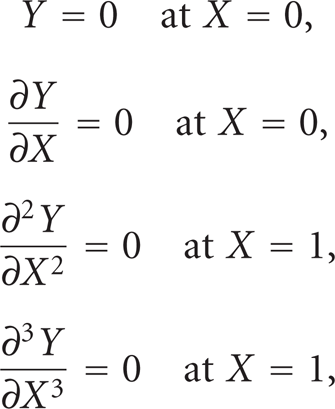
where X = 0 and X = 1 correspond to the root and the free end of the beam, respectively.
It is assumed that there are four coupled beams forming a ring, as is seen in Figure 1. Four beams are chosen for study because this is the smallest number of beams for which there is at least one beam that is not an immediate neighbor. Each beam has its own transverse displacement


Four beams coupled through the shaft.
As in [38], coupling through the roots of the beams is assumed. This corresponds to transmission of vibrations to the nearest neighbors through the shaft. Transverse displacements are zero at the bases of the beams, and the coupling occurs through the slopes of the beams at that point:

where
From (5) the fourth-order linear system
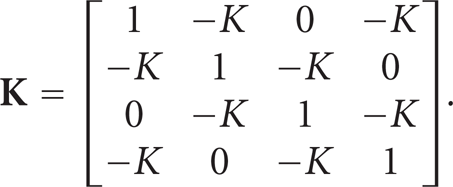
Clearly,


3. Emergence of Oscillation Death
Oscillation death arises through a saddle-node bifurcation mechanism which allows the emergence of new fixed points; that is, new stable steady states with nonzero amplitude are created by the coupling [19, 21]. The trivial solution of the Van der Pol oscillator is an unstable equilibrium point located at the origin. Due to the self-excited nature of the Van der Pol oscillator, nontrivial solutions are time dependent and oscillatory; that is, solutions that start close to the equilibrium point move away from it and are transformed into closed trajectories that become a limit cycle. One would expect a similar behavior for the ring of self-excited beams represented by (4). On the other hand, fixed points require the existence of time-independent solutions
From (7),
From (8),
4. Numerical Solution
Many mathematical tools have been employed in the past to solve vibration problems in beams, for example, separation of variables [39], spectral method [44], modal perturbation [45], and so on. Given that analytical solutions of the four coupled nonlinear partial differential equations here considered are difficult to obtain, in this work a numerical solution is selected. The explicit discretization schemes suggested in [46] are applied. Convergence tests on time and space were carried out using dimensionless time steps
Recently, blade tip-timing techniques have been employed to measure the transient deflection of blades in order to analyze turbomachinery vibration [47]. A tip-timing system allows the derivation of characteristic vibration parameters, such as blade displacement, velocity, and acceleration from the measured data in order to describe the vibration properties of the blade assembly. Therefore, in this work the tip deflection of every beam, that is, the free end transverse displacement, is monitored and tracked for analysis of the ring dynamics. The transient and steady-state behaviors of the coupled beams are analyzed from the corresponding time series of the tip deflections.
5. Numerical Results
The four beams are assumed to be identical; that is, they have the same value of the self-exciting constant. The tested initial conditions were as follows: (i) the first three normal vibration modes [46] of a linear elastic beam ruled by (1) and zero velocity for all beams and (ii) nonzero velocity for the first beam and zero positions and velocities for the rest of the beams. For initializing the ring with modes the procedure was as follows: the first beam is initialized in certain mode, and the rest are initialized in a different one.
5.1. Short-Term Behavior
Figure 2 shows a short-term time series of the first beam tip deflections employing K = 0.5 and A = 1.0 with mode 1-mode 2 as initial conditions; this means that the first beam is initially in the first normal vibration mode and the rest of the beams are in the second one. In this figure a transient death of oscillations is observed for the first beam; however, as time elapses the first beam and the ring finally become oscillatory.

Time series of the first beam tip position for A = 1 with Mode 1-Mode 2 as initial conditions.
Figure 3 depicts the short-term dynamic behavior of the coupled beams for A = 1 using mode 1-mode 3 as initial conditions. In this case there is not transient cessation of oscillations, and the dynamics response of the ring is always oscillatory. Numerical results for several combinations of modes as initial conditions show similar behavior of that shown in Figures 2 and 3; that is, permanent oscillatory response is exhibited by the ring.

Time series of the first beam tip position for A = 1 with Mode 1-Mode 3 as initial conditions.
The effect of the initial velocity of first beam on the short-term tip deflection is appreciated in Figure 4 using A = 1 and initial velocity of the first beam equal to

Time series of the first beam tip position for A = 1.0 with initial velocity of first beam equal to 0.1.
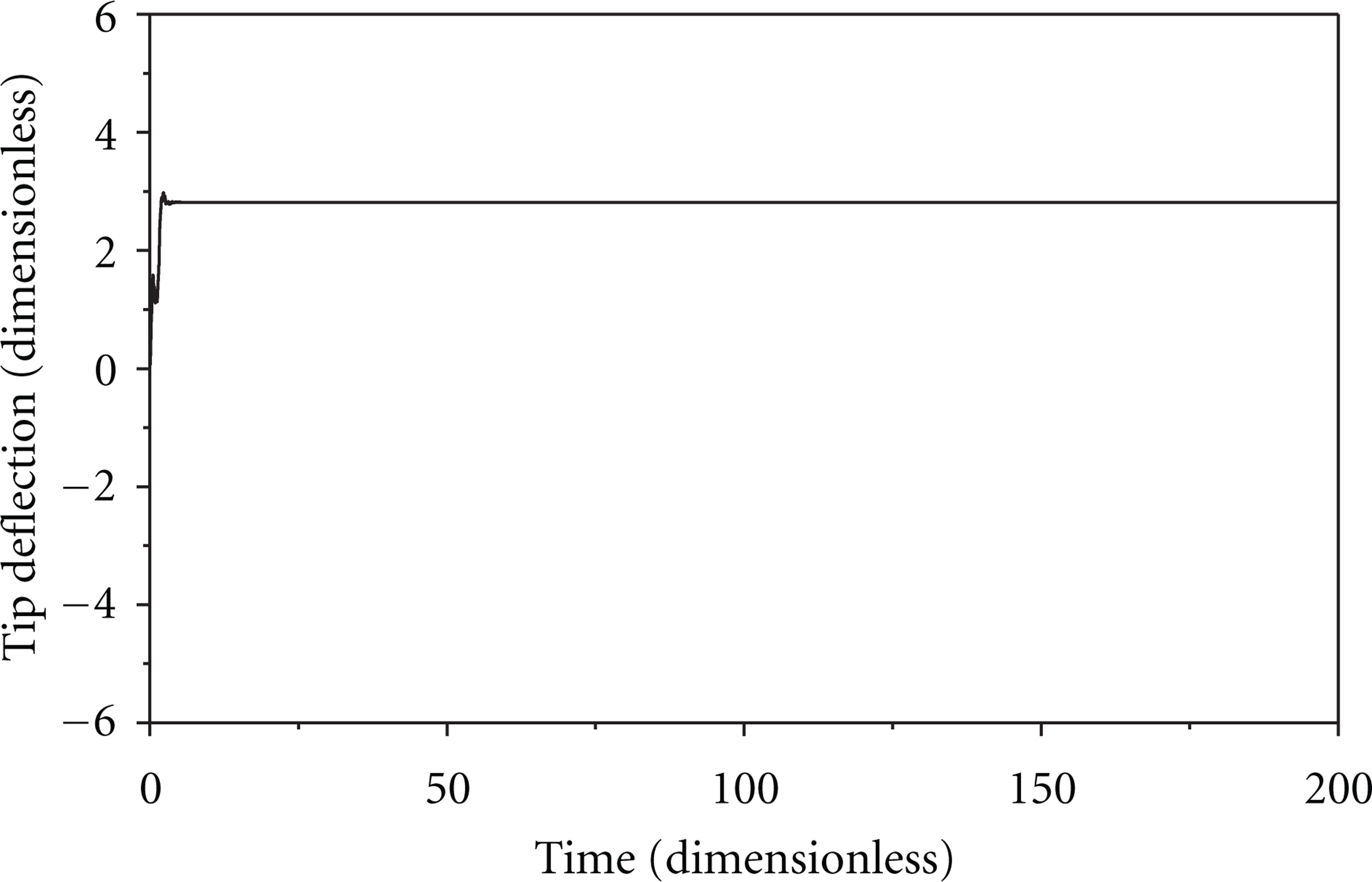
Time series of the first beam tip position for A = 1.0 with initial velocity of first beam equal to 2.

Time series with the same parameters and initial conditions of Figure 5. Solid line belongs to the first beam; dotted line belongs to the rest of the beams.
5.2. Long-Term Behavior and Oscillation Death
The length of the time to reach the steady state depends on the value of the beams self-oscillation constants and the chosen initial conditions. The long-term stability of oscillation death depends on some kind of eigenvalues of the coupled ring. These eigenvalues would indicate if the final steady state is a fixed point or a permanent oscillating one. Determining the eigenvalues of the ring lies beyond the scope of this numerical study and should constitute the topic of future work.
Emergence of permanent oscillation death when
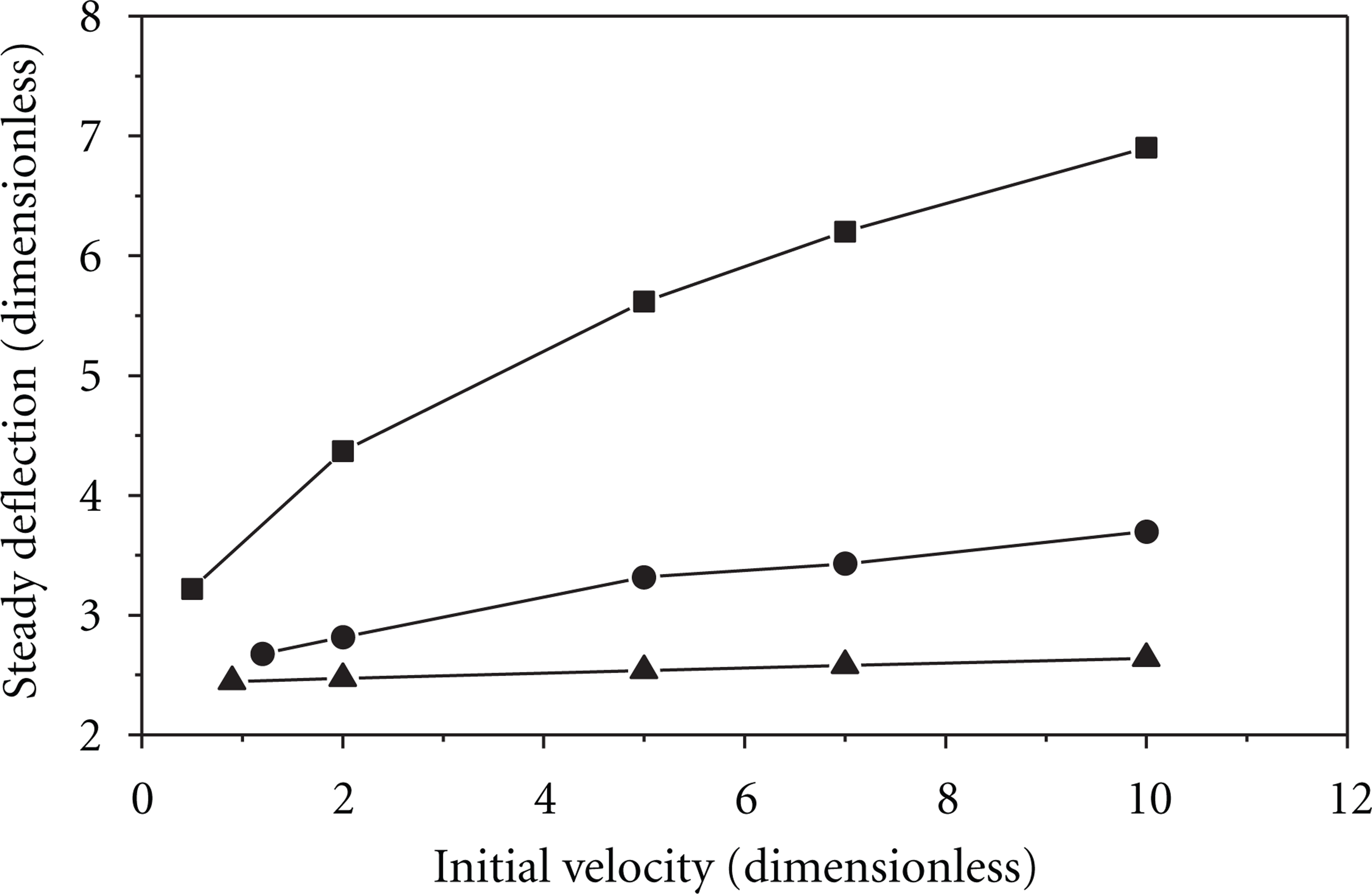
Steady-state tip deflection as function of the first beam initial velocity. Square, A = 0.1; circle, A = 1; triangle, A = 10.
5.3. Stability of the Nontrivial Steady State
In order to study the stability of the oscillation death, a perturbation was introduced in the ring once the nonoscillating state is reached. Figure 8 shows the numerical results for a perturbation introduced at τ = 100 using A = 1 and an initial velocity of the first beam equal to 2. The steady-state deflection

Time series showing a perturbation of the steady-state tip deflection at τ = 100. A = 1 with initial velocity of first beam equal to 2.
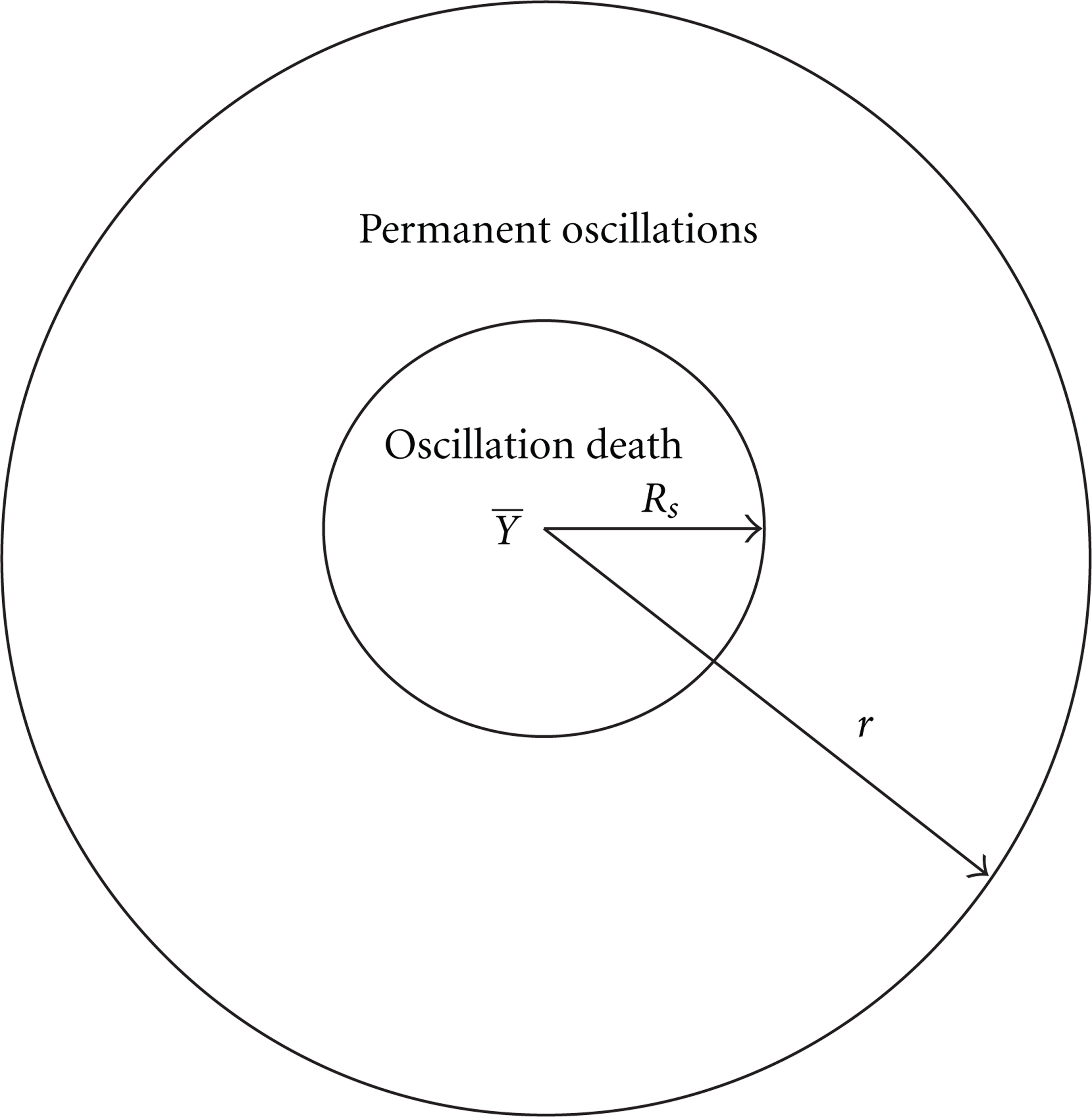
Sketch of the Lyapunov stability ball of oscillation death.
6. Conclusions
Short-term and long-term dynamic performance of a ring of four coupled self-excited elastic beams has been studied in this work considering singularity of the coupling matrix. Long-term results show that the coupled beams exhibit oscillation death when the coupling matrix is singular. Oscillation death is not observed when the modes ofa linear beam are employed as initial conditions. However, oscillation death arises when a nonzero velocity of the first beam is assumed as initial condition. The amplitude of the permanent tip deflection depends on the values of the initial velocity and the self-exciting constant. Oscillation death emerges for values of the initial velocity above a critical value. Below this critical value, oscillation death disappears, and permanent oscillatory behavior is exhibited by the ring.