




Abstract
In ubiquitous healthcare systems, machine-to-machine (M2M) communication promises large opportunities as it utilizes rapidly developing technologies of large-scale networking of devices for patient monitoring without dependence on human interaction. With the emergence of wireless multimedia sensor networks (WMSNs), M2M communications improve continuous monitoring and transmission and retrieval of multimedia content such as video and audio streams, images, and sensor data from the patient being monitored. This research deploys WMSN for continuous monitoring of target patients and reports tracking for preventive ubiquitous healthcare. This study performs optimization scheme movement coordination technique and data routing within the monitored area. A movement tracking algorithm is proposed for better patient tracking techniques and aids in optimal deployment of wireless sensor networks. Results show that our optimization scheme is capable of providing scalable and reliable patient monitoring results.
1. Introduction
The rapid increase in the size of aging population combined with the rise in the healthcare costs is demanding cost-effective and ubiquitous patient monitoring systems. This challenge can be addressed by a reliable patient monitoring solutions for both short-term home healthcare and long-term nursing home care for stationary and mobile patients. A number of these devices communicating through wireless technologies can form a wireless body area network (WBAN) and consist of a set of mobile and compact intercommunicating sensors either wearable or implanted into the human body which provides a new enabling technology for patient monitoring. The emergence in wireless multimedia sensor networks (WMSNs) enables continuous monitoring and transmission and retrieval of multimedia content such as video and audio streams, images, and sensor data from the patient being monitored from remote locations. We made the highlighted changes in the second and third addresses as per official websites.
The growing interest in sensor applications has created a need for protocols and algorithms for large-scale self-organizing ad hoc networks, consisting of hundreds or thousands of nodes. Hence, in the past decade, wireless sensor networks (WSNs) have been the topic of considerable research effort due to their potential for healthcare applications and their ability of being incorporated in M2M networks. Machine-to-machine (M2M) communication is a promising technology in healthcare due to short range wireless networking, wireless mobile networks, and advances in device networking [1]. Although M2M networks do not only consist of sensors, WSNs are a key component of M2M communication, thus, they are referred to as M2M networks [2]. WMSNs are not only capable of sensing, controlling, and actuating scalar data but also capable of sensing and controlling multimedia contents. The network nodes are generally equipped with data processing and communication capabilities which are used for collecting and disseminating healthcare data.
M2M technology is capable of building wireless M2M ecosystems covering a wide range of healthcare applications. With increased processing power, it would enable to jointly deliver federated healthcare services to users that fully leverage the power of M2M technology. With its capability of capturing and analyzing the massive amount of data available in all kinds of smart devices, M2M is a business concept used for automatic transmission of various data from remote sources by wired, wireless, radio, and other transmission technologies.
In monitoring applications, WSNs are modeled as graphs for routing and coverage of sensor devices. The coverage of a sensor network represents the quality of monitoring that the network can provide, for instance, how well an area of interest is monitored by ubiquitous sensors and how effectively a wireless sensor network can locate and monitor patients. Wireless sensor networks can assist in detecting target patient as well as keep the movement information of the patient. Sensor nodes establish face structure to track the designated target patient.
This research studies the coverage of the wireless multimedia sensor network based on the dynamic aspect of the network that is dependent on the movement of wireless sensors. Specifically, we are interested in the coverage resulting from the mobility of ubiquitous sensors for mobile patient monitoring. We represent the performance criteria as a parametric mathematical function of the distributed wireless sensor positions and perform a numerical optimization procedure on the defined function. In this optimization scheme, we limit our current focus to problems of detectability, that is, the system's design goal is to find mobile targets that are moving inside a monitoring area. For the goal of optimization, we optimize sensor placements with the goal of maximizing the probability of successful target tracking for a set of wireless sensors. Additionally, we study the effect of node mobility, fairness across multiple simultaneous paths, and patterns of packet loss, confirming the system's ability to maintain stable routes despite variations in node location and data rate.
2. Related Works
The emergence of low-power, single-chip radios based on the 802.15.4 [3] standards has precipitated the design of small, wearable, truly networked medical sensors. Several design issues and techniques for WSNs describing the physical constraints on sensor nodes, applications, architectural characteristics, and the communications protocols proposed in all layers of the network stack have been addressed by [4, 5]. The use of wireless sensors in invasive and continuous health-monitoring systems was presented by [6]. An implementation of bedside patient monitoring was developed by [7], while [8] implemented a WAP-based telemedicine system. A comprehensive list of recently proposed routing protocols is presented by [9], and routing algorithms used in WSNs were classified as data-centric, hierarchical, and location-based. The early literature on wireless networking addressed the design of efficient routing algorithms without optimization of the energy required to send the messages. Additionally, a comprehensive survey of routing techniques proposed for wireless sensor networks is also presented by [10]. The techniques addressed routing challenges and design issues that may affect the performance of routing protocols in WSNs. The growing interest in sensor applications has created a need for protocols and algorithms for large-scale self-organizing ad hoc networks, consisting of hundreds or thousands of nodes. Although M2M networks do not only consist of sensors, wireless sensor networks (WSNs) are key components of M2M communication that sometimes sensor networks are referred to as M2M networks [11]. Despite the keen interest in M2M and great value in building such a system, M2M is still relatively new and the technology faces several significant challenges.
The coverage of a wireless sensor network represents the quality of monitoring that the network can provide, for instance, how well an area of interest is monitored by wireless sensors and how effectively a sensor network can detect target patients. While the coverage of a sensor network with immobile sensors has been extensively explored and studied by [12, 13], researchers have recently studied the coverage of mobile sensor networks. Most of this work focuses on algorithms for repositioning of sensors in desired positions in order to enhance monitoring and tracking of the network coverage [14–16].
3. Ubiquitous Healthcare Design Requirements
Typically, the requirements for a ubiquitous sensor network design depend heavily on the specific application and deployment environment. In this chapter, we identify several characteristics that nearly all ubiquitous sensor networks would share.
Mobility of devices: both patients and healthcare are mobile, requiring that the communication layer adapts rapidly to changes in link quality. For example, if a multihop routing protocol is in use, it should quickly find new routes when a doctor moves from room to room during rounds. Platforms for wearable sensor: healthcare applications generally require very small, lightweight, and wearable sensors. Existing mote platforms are good for demonstrations, but we have found that the large battery packs and protruding antennas are suboptimal for delivery of medical services. Multiple receivers: we expect that the data from a given patient will typically be received by multiple doctors or healthcare personnel caring for the patient. This suggests that the network layer should support multicast semantics. Communication reliability: in healthcare domains, a great emphasis is placed on data availability. Although intermittent packet loss due to interference may be acceptable, persistent packet loss due to congestion or node mobility would be problematic. Depending on the sensors in use, sampling rates may range anywhere from less than 1 Hz to 1000 Hz or more, placing heavy demands on the wireless channel.
3.1. M2M Communication
The design of the ubiquitous healthcare system is based on M2M technology. M2M is a combination of various heterogeneous electronic, communication, and software technologies. A typical M2M system comprises the following basic components: intelligent sensor devices, M2M area network, M2M gateway, communication network, and remote client or application [17]. In ubiquitous healthcare system, intelligent devices include wireless multimedia sensors, actuators, RFID tags, wireless body sensors, mobile devices, PC or workstation that incorporates a communications among them.
As described above, the M2M gateway is responsible for extracting raw data from an intelligent device and preparing it for the network. The gateway uses a protocol or driver to interact with the intelligent device and translate the data into a format that another device, application, or human can understand. Mainly, an M2M gateway facilitates communication among the various devices and provides a connection to a backhaul that reaches the Internet. With Internet serving as communications network in an M2M application, it is the central connection component between an intelligent device and a remote client. It provides communications between the M2M gateways and the patients being monitored. The server is the destination of the information.
3.2. System Architecture
The design and deployment of these wireless sensor networks can be a cost-effective alternative to the growing number of sensor networks. In this paper, we illustrate a typical scenario in a home for the aged where a patient is monitored by a caregiver or a medical staff regularly. Consider an elderly patient who has a systemic, arterial hypertension and needs to check his blood pressure from time to time. One solution is to keep his blood pressure under control. This can be done by continuously monitoring and logging his vital parameters. If he is having an emergency situation while being alone in a room, the emergency help may not be available immediately. This situation can be improved by doing patient monitoring using wireless sensor networks. This will enable monitoring for mobile and stationary patients in indoor and outdoor environments.
The development of WMSN allows real-time analysis of sensors’ data, provides guidance and feedback to the user, and generates warnings based on the user's state, level of activity, and environmental conditions related to patients. WMSNs include a number of wireless multimedia sensors to generate necessary patient information which includes blood pressure, heart rate, temperature, ECG, EKG, and brain-related information. Additional information is also measured and monitored such as video, audio, current location, motor activity, and other relevant data. The system architecture of a WMSN is shown in Figure 1 where it is composed of a set of wireless sensors attached to the body.

WMSN for patient monitoring.
For M2M communication, the ubiquitous healthcare system is based on a publish/subscribe routing framework, allowing multiple sensor devices to relay data to all receivers that have registered an interest in that data. This communication model fits naturally with the needs of medical applications where a number of caregivers may be interested in sensor data from overlapping groups of patients. A discovery protocol is provided to allow end-user devices to determine which sensors are deployed in the network, while a query interface allows a receiving device to request data from specific sensors based on type or physical node address. The query interface also provides a filter facility, whereby a query can specify a simple predicate on sensor data that will transmit only when the data passes the filter. For example, a doctor might request data on a patient only when the vital signs fall outside of a normal range.
4. System Assumptions
In this research, we show our assumptions on the distributed wireless sensor network and target models in target track parameter scenarios. Our goal is to study the coverage of wireless sensor networks with regards to patient tracking and monitoring and obtain the estimation models with respect to the distributed wireless sensors’ computation and measurements. We consider patient monitoring systems where multiple sensor detections must occur over a given time interval. Such scenario occurs where data transmission is taking place between sensors. The dynamic aspect of the network coverage depends on the movement of sensors in the network which can be stationary or mobile where patients are moving randomly. As such, this study focuses on a bounded area such as hospital where patients are confined in a predefined area of monitoring. Additionally, a sensor can detect the accurate location of the patient, because the sensor utilizes trilateration to compute the object's location. The trilateration has been proposed in [18]. A sensor node knows its location, and this information can be acquired from global positioning system (GPS) or other mechanisms.
We consider a patient monitoring region
The monitoring region represents the set of all possible sensor locations which can track the patient in an uneven velocity. The monitoring region is defined as a function of tracking position




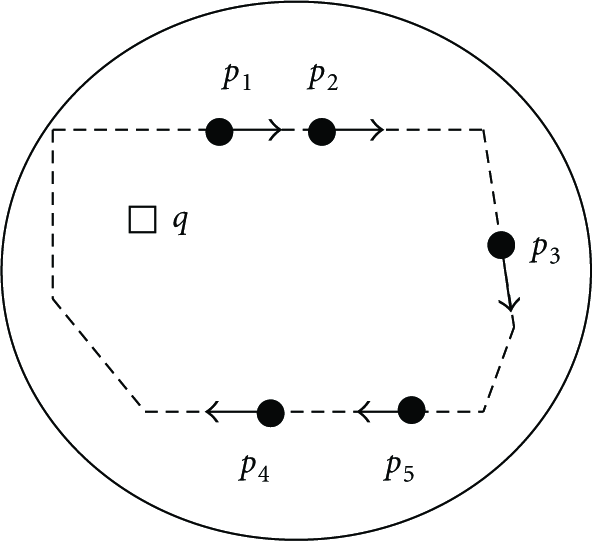
Sensor movement coordination.
Additionally, we define the probability of a sensor being within monitoring region Z and tracking the target patient as

Movement tracking.
While a target patient is tracked, the sensor network has to record the target tracks. A source S obtains the target location that is informed from the first target node p after completing a target discovery process, and then S starts to move toward the first target node p's location. When S reaches the position of the first target node p, S queries the target node for next position. The target node p informs S the target's or next target node's location information. If the target is still located, the source S moves to the target location and catches the target p. If the target has left, the target node n informs S next node q's location. Then, the source moves toward the next target node again. The node p also informs the next node q the information that the source S will reach q. This node does not need to track target for source S anymore. The next target node q becomes the first node. This process is repeated until the source catches target.
Hence, we require k out of N sensors to track the target within Z with equal probability



4.1. Routing Mechanism
This healthcare system is based on a publish and subscribe routing framework in which sensors publish relevant data to a specific channel and end-user devices subscribe to channels of interest. Publish and subscribe communication decouples the concerns of devices generating data from those receiving and processing it. Practical implementation of a publish/subscribe model must take a number of considerations into account. First, wireless multimedia sensors should not publish data at an arbitrary rate, since the wireless channel has limited bandwidth. Second, given that publishers and subscribers are not necessarily within access range, some form of multihop routing is necessary. Third, the communication layer should take mobility into account when establishing routing paths. In the healthcare scenario, patients and healthcare personnel are mobile. Many patients may be ambulatory and free to roam around the house or in the building.
A good energy-aware routing technique should balance two different goals: choosing a path with maximal residual energy and choosing a path with minimal energy consumption. Of various existing protocols, routing layer protocol used in this healthcare system is based on the adaptive demand-driven multicast routing (ADMR) protocol [20]. ADMR is chosen due to its simplicity and extensively application in simulation. The publish and subscribe commands allow a node to state that it wishes to associate with a particular channel, while leave terminates a publish and subscribe request. ADMR establishes multicast routes by assigning nodes to be forwarders for a particular channel. A forwarder simply rebroadcasts any messages that it receives on a given channel, using duplicate suppression to avoid multiple transmissions. Nodes are assigned as forwarders through a route discovery process that is initiated when a patient device requests to publish data. Multicast routing allows nodes to avoid transmitting redundant data; for example, if multiple doctors subscribe to vital signs from the same patient, the patient need only transmit its data once to the channel, where it will be forwarded to each recipient.
4.2. Discovery Protocol
In order for the wireless sensor nodes to discover each other and determine the capabilities of each sensor device, a simple discovery protocol is layered on top of the ADMR framework. ADMR supports a special-case broadcast channel that uses a simple controlled flooding mechanism to deliver a message unreliably to every node in the network. Each wireless sensor node periodically publishes metadata about itself, including node ID and sensor types that it supports, to the broadcast channel. Receiving devices that wish to learn about other nodes in the network can subscribe to the broadcast channel to receive this information. Note that the metadata information about a node is static and is not updated frequently. It would be straightforward to reduce the number of broadcast messages by performing in-network aggregation of this metadata.
4.3. Movement Tracking Algorithm
This section presents the algorithm for patient tracking. The goal of this algorithm is the decentralized movement coordination of wireless sensors and localization of target patients. This algorithm assumes a constant
Set time to t While sensor agent (1) Get the estimate position from central server. (2) Detect counterclockwise and clockwise neighbors along the bounded region. Compute distances in coordinates relative to position origin. (3) Compute control value, next desired position defined by corresponding point (4) Move to new position (5) Get measurement of target and send it to central server. End while
5. Optimization Scheme
This section presents the algorithm for patient tracking. The goal of this algorithm is the decentralized movement coordination of wireless sensors and localization of target patients. This algorithm assumes a constant
In this section, we will present optimization scheme to compute the area coverage relative to its movement of the wireless sensors. In order to optimize the area coverage of movement coordination of wireless sensors, we require an efficient approach to numerically evaluate the multidimensional integral. As described above. The optimization goal is to find the area coverage which results in the maximum of the probability Maximize subject to the following constraints

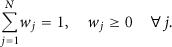
The representation of the area coverage relative to its movement
6. Evaluation
This section presents the evaluation of the ubiquitous healthcare system utilizing wireless multimedia sensor networks such as video recorder and audio sensor placed inside the house. Although the location of each node is fixed, this testbed affords us the opportunity to measure communication reliability and throughput under a wide range of link conditions and data rates. Also, wireless body sensors are attached to patients as well as mobile devices to aid the transmission of patient information. The system enables forwarding of messages to and from sensor device for the control and monitoring of the patient and the environment.
The setup enables to run tests with many different parameters without having to reprogram the sensor devices each time. In each experiment, we experiment wireless sensors on each patient device that generates data at a constant rate. Each experiment was executed for at least 2 minutes, and statistics were calculated after removing the first 60 seconds of each trace to avoid measuring startup effects.
This experiment measures three separate sender-receiver pairs with different number of radio hops in the ADMR path. Increasing the transmission rate leads to degradation in reception rate due to dropped packets issuing queries, receiving data, retrieving statistics, and so forth.
Figure 4 shows the packet reception ratio (the number of received packets divided by the number of transmitted packets) for three separate sender-receiver pairs. In all three cases, the same node is used as the sender, while the receiving node is varied. Receivers were selected to vary the number of radio hops along the ADMR path. Note that the hop count varies over time because ADMR routes are dynamic. The single-hop case should be very common in clinical settings where the doctor or nurse is generally near the patient.

Patient data reception rate.
The numerical approach used to calculate
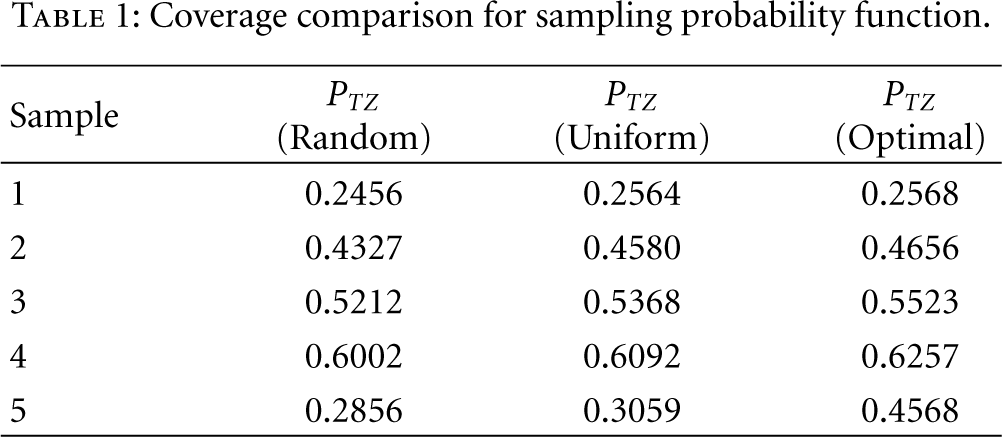
To verify the utility of this placement scheme a Monte Carlo simulation was performed. The steps for experiment included the following. For N sensors, (1) generates a random sample within monitoring region Z. (2) Generates a random sample uniformly within monitoring region Z. (3) Generates a random sample for optimal calculation of the sensor area coverage function
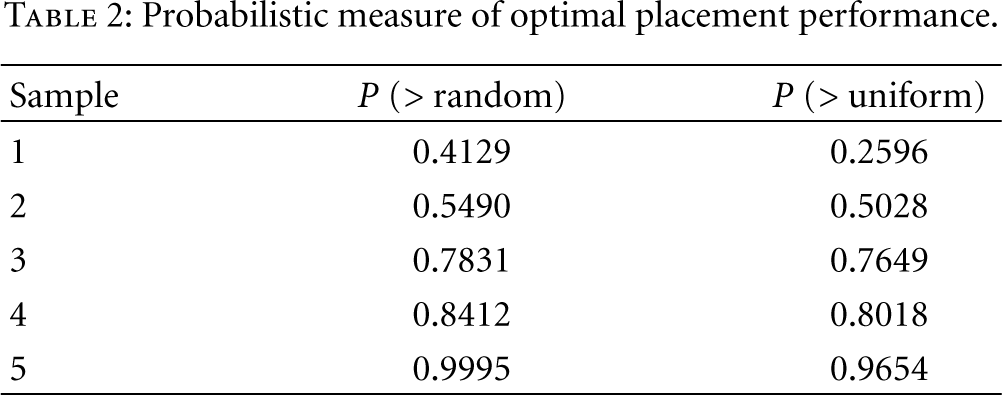
The probability of performing better than uniform is then estimated as the ratio of this count and the total number of Monte Carlo simulation runs. This experiment is repeated to compare sampling from the optimal sensors that are coverage function. Table 1 shows the
Coverage comparison for sampling probability function.
Probabilistic measure of optimal placement performance.
These observations from the numerical procedure described in this research showed two computational pieces, a genetic algorithm and a semidefinite programming algorithm approach. In actual experiment, for the samples in this paper, the genetic algorithm consumed the majority of the computational time, 60% of the time. Following it was the semidefinite programming which consumed 25% of the time. Lastly, the placement procedure took approximately 15% of the total time usage. MATLAB software was used for the optimization procedure. The sensor positions were used as basis for the calculation of the optimization procedure for both the genetic algorithm and semidefinite programming. It is expected that computational time of the two-level optimization is relatively independent of the scale of the problem.
6.1. Effect on Mobility
Mobility of the senders or receivers of information has impact on communication reliability. As senders or receivers move in a hospital, radio link quality will vary and ADMR will create new routes. Therefore, we expect to see some data loss due to node mobility, but ideally a valid route will be maintained at all times.
In this experiment, we consider fixed nodes as patient sensors transmitting data at 5 packets per second. The senders were widely distributed throughout the building. A single receiver node attached to a laptop acted as a roaming node. The user carrying the laptop moved around the second floor of our building at a normal walking pace, pausing occasionally, entering and leaving rooms, for a duration of about 25 minutes. This movement pattern is intended to represent a doctor walking through a hospital ward.
Figure 5 shows the reception ratio for each of the 3 senders, averaged over 60-second windows. As the receiver walks around, we see the reception ratios vary over time but do not see any large dropouts or catastrophic effects due to mobility. We have also recorded the hop count and ADMR path cost for each packet and see a general correlation between improved delivery ratio and reduced path cost. These results show that ADMR deals gracefully with node movement, at least for typical mobility rates.

Effect on mobility.
6.2. Low Latency Transmission
In wireless ad hoc and sensor networks, the problem of routing has received more attention than any other design and operation problem. Many wireless routing algorithms have been proposed in the last couple of decades. Flooding and broadcast routing is often necessary during the operation of the wireless network, such as to discover node failure and broadcast some information. Multicast routing, on the other hand, is very common in wireless networks, and it is used to communicate in a one-to-group fashion. Moreover, it involves wireless multicast advantage (WMA) [22] which means that, if a node transmits a packet by spending high power, it is possible that more than one node receive its transmission. Finally, unicast is always in an end-to-end fashion and it is the most common kind of routing in networks. The case of unicast routing, although a special case of multicasting, involves no wireless advantage; however, choosing a good path from source to destination requires knowledge of node and link states. This is especially the case when battery lifetime maximization is an objective. Given a selected route, nodes on this route between the source and destination who act as routers deplete their energies with each packet they forward.
6.3. Reliability
The best approach to implementing reliability is not immediately clear. Using link-by-link acknowledgment and retransmission with multicast requires additional MAC support and may incur high overhead. End-to-end reliability is highly sensitive to overall path conditions.
One approach that is worth considering makes use of redundant transmissions and coding techniques that allow data to be reconstructed on the receiver despite packet loss. We are still investigating this idea, but, to capture a rough estimate of how it would perform, we have conducted experiments where each message is simply transmitted multiple times by the sender. In this way, a receiver can recover the original data if any one of k transmitted packets is received. This approach consumes considerably more bandwidth but should yield an estimate of the improvement obtainable via more sophisticated techniques.
7. Conclusion
This paper has presented the deployment of distributed wireless network of sensors for monitoring target patients. An optimization scheme was implemented for optimal placement of sensors and movement coordination techniques within a search region given the underlying characteristics of sensors and expected targets. A movement tracking algorithm was also proposed to serve as a guide for the wireless sensor networks for optimal deployment and provide distributed detection criteria. The problem for placement of sensors was addressed as a sampling from the optimal sensor density, and a deterministic conditional sampling approach for placing individual sensors was developed and compared to random sampling. With the practical advantages of deploying sensor networks using density-based approach, it would be of clear interest to modify our model by including the upper bounds of the movement and detection range of the wireless sensors. Broader future research includes the consideration of more complex and heterogeneous collection of sensors and the dynamic assignment of wireless sensors to different patient targets.
Despite the fact that there is keen interest in M2M technology and great value in building an efficient M2M network, M2M is still relatively new and the technology faces several significant challenges. Major challenges today, in addition to energy efficiency, are in the areas of security, privacy, reliability, robustness, latency, cost-effectiveness, software development, and standardization. Although many routing techniques look promising in terms of energy efficiency, most of these algorithms were designed for a network where nodes are stationary. While it is true that most of today's M2M applications have few mobile nodes in a network, in the near future, there will be many M2M networks consisting of hundreds of mobile nodes.
For future study, we aim to reduce or eliminate the signaling overhead of exchanging status information by some feature extraction and local estimation functions.
Footnotes
Acknowledgment
This research was supported by the ICT Standardization program of KCC (Korea Communications Commission).