




Abstract
The fatigue reliability of a steel member in a bridge is estimated by using the probabilistic stress-life method. The stress history of a member is defined as the loading block when a truck passes over a bridge, and the stress range frequency distribution of the stress history is obtained by a stress range frequency analysis. A probabilistic method is applied to the stress range frequency distribution, and the parameters of the probability distribution for the stress range frequency distribution are used in a numerical simulation. To obtain the probability of failure of a member under a loading block, Monte Carlo simulation is performed in conjunction with Miner's rule, the modified Miner's rule, and Haibach's rule for fatigue damage evaluation. Through these analyses procedures, we obtain an evaluation method for fatigue reliability that can predict the block number of the failure load and residual fatigue life.
1. Introduction
In a steel bridge, the main cause of fatigue damage is the increase in the number of large and overloaded trucks driven over the bridge. The truck's load condition considerably shortens the fatigue life of the bridge. In the stress-life method of fatigue analysis or in the fracture mechanics method, the stress history is measured at the member that receives the fatigue loading. This condition is a random variable that controls the life of a member. The probability of failure of the probabilistic variant concerning a member fracture can be calculated exactly to estimate the remaining life of the member that receives the fatigue loading. Although the basic method can calculate directly the probability of failure in order to assess the probability safety of a member, it is difficult to calculate the probability of failure with precision by using an analytical method. Hence, a reliability analysis can be used to calculate and express quantitatively the possibility of failure as a failure probability. In this study, damage evaluation methods were used, including Miner's rule, the modified Miner's rule, and Haibach's rule to estimate the probability of failure on the load block number of subsidiary materials, and a Monte Carlo simulation (MCS) was executed based on these results [1, 2]. Through these analysis procedures, we developed an evaluation method for fatigue reliability that can predict the block number of the failure load and residual fatigue life.
2. Fundamental Theories
2.1. Fatigue Reliability Analysis
In the proposed fatigue reliability analysis model, when a truck passes over a bridge, a stress history is generated in a member. This history is defined as the loading block. Stress range frequency analysis is used to calculate the stress range frequency distribution based on the stress history. The program for reliability analysis of steel bridge welding member (RASB) used in this study has a rainflow count to execute the stress range frequency analysis [3, 4]. A probabilistic method can be applied to the stress range frequency distribution that is generated by the stress range frequency. The maximum likelihood method (MLM) ascertains the parameters of the probability distribution, which expresses the stress range frequency distribution.
We estimated the parameters for the Gumbel probability distribution and the lognormal, exponential, and Weibull distributions. The S-N curve describes the relationships between the normal stress range and the fatigue life cycle. The curve is linear on a logarithmic coordinate axis, as shown in Figure 1.

2.2. Linear Cumulative Damage Assessment
Generally, an S-N curve is used in the fatigue design of steel structures. However, some steel structures for fatigue reliability analysis are based on the S-N curve in logarithmic coordinate and Miner's rule. Miner's rule used to predict the fatigue life [3, 5] is defined as follows:

where D is the summation of the damage index, D i is the fatigue damage index, n i is the frequency for the arbitrary stress range, and N i is the fatigue life. However, Miner's rule can be influenced less by the stress condition than by the fatigue threshold when the degree of fatigue damage becomes high. Unlike Miner's rule, the modified Miner's rule and Haibach's rule, as shown in Figure 2, can account for the stress condition.

Relationship between stress range and fatigue life using linear cumulative damage.
2.3. Fatigue Reliability of a Member
The cumulative probability distribution of a failure loading block can be expressed as

where x refers to the loading block needed for failure. The fatigue reliability function

The failure loading block according to reliability can be calculated on the curve of a cumulative probability density function. Figure 3 shows the curve of a cumulative probability density function of a failure loading block calculated by MCS. With a reliability of 99.9%, the failure loading block was found to be B99.9, 90% B90, and 50% B50 as shown in Figure 3.
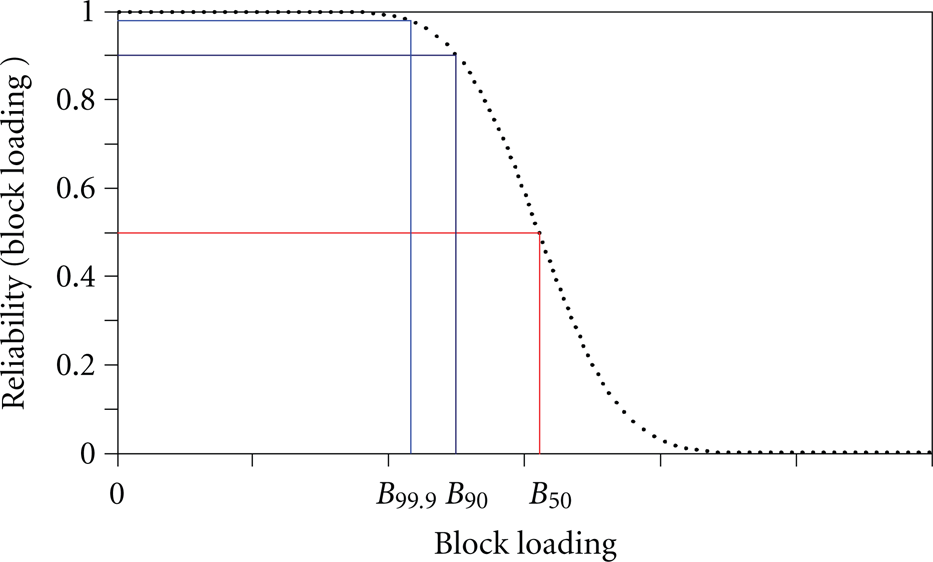
Fatigue reliability function.
2.4. Assumption for Remaining Fatigue Life Calculation
When the damage index is equal to one, the number of failure loading blocks is obtained from numerical analysis using MCS with the equivalent stress range and the frequency distribution of stress range per loading block. Hence, the fatigue life of a steel member is assumed to be given by

where ADTT is the average truck traffic volume, B f is the number of failure loading blocks acquired by MCS, and the fatigue life is expressed in years.
3. Measurement of Strain History
In this study, the detail category and design fatigue strength were used as specified by the Specification of Bridge Design in Korea [6]. In the fatigue design instructions, this detail category has a slope of m = 3 and a stress cycle fatigue strength of
The analyzed member is shown in Figure 4. According to the stress type and detail category of the design standard for a highway bridge, when a member between a vertical stiffener and the bottom flange of a cross beam on a steel box girder bridge receives alternative stress or tensile stress, the allowable stress range is category C and the allowable stress range over 2 million cycles is 82.32 MPa.

Connection category C.
The average daily traffic of the bridge for the stress history was measured to be 264 buses, 936 large trucks, and 44,760 small cars. This bridge is a two-span continuous girder bridge with a total of four lanes in both directions.
First, the stress history was measured on a welding member on the steel bridge located optimally for fatigue damage, as shown in Figure 4(c). In particular, stress intensity occurred between the vertical stiffener and the bottom flange of the cross beam because the truck crossings created tensional stress in accordance with deflection. Also, fatigue damage could occur due to flaws in welding or due to the effect of residual stress in the welding [7]. A strain gauge mounted on this part provided strain history data. Strain history multiplied by Young's modulus illustrates the stress history, as shown in Figure 5.
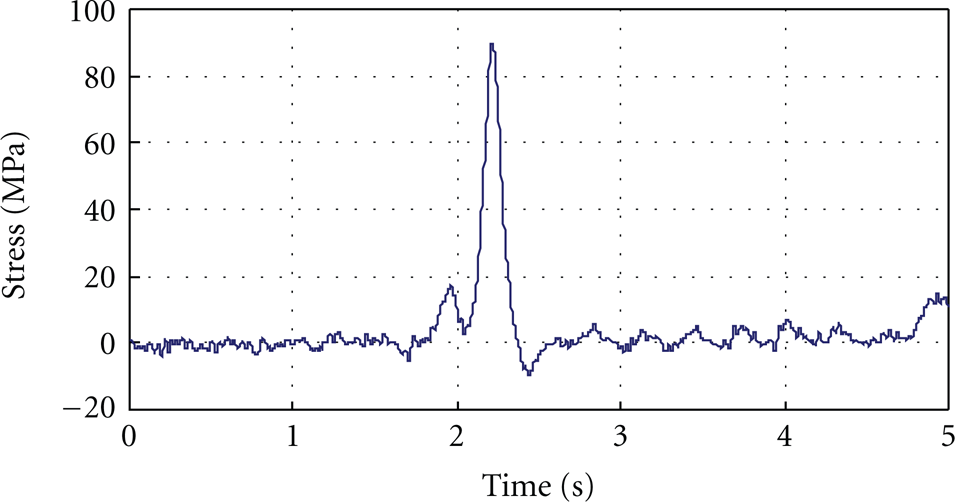
Stress history of a loading block.
4. Fatigue Reliability Assessment of a Member
4.1. Stress Range Frequency Analysis
The stress history was modified starting from the maximum or minimum point, so that the half-cycle of the stress range could not be counted. The frequency analysis of the stress range was performed by applying the rainflow cycle count algorithm in RASB [8].
4.2. Probability Distribution Parameter
A stress range frequency analysis was performed for 400 loading blocks measured on the structural detail of a steel highway bridge. A probabilistic method was applied to the stress range frequency distribution. The frequency distribution of the stress range is represented as a probability distribution in order to enable MCS.
The probability distribution parameters were obtained by using the maximum likelihood method (MLM) to find a particular probability distribution that adequately expresses the stress range frequency distribution [9, 10]. The probability distribution in this study is classified into the Gumbel probability distribution, lognormal, exponential, and Weibull. Consequently, the lognormal probability distribution sufficiently expressed the stress range frequency distribution of 400 loading blocks. Parameter λ of the lognormal is 0.377, ζ is 0.952, and the determinant
Determinants and parameters of each probability distribution (400 loading blocks).


Stress range frequency distribution and each probability distribution (400 loading blocks).
4.3. Random Number Generation Method
When using MCS, a procedure is needed to generate random numbers suitable for a distribution pattern of each random variable.
After extracting a uniform random number between 0 and 1, this random number is translated properly to comply with a particular probability distribution. Here, a probability variable that complies with the probability distribution can be generated by producing a uniform random number that is translated into the variable of an appropriate probability distribution [11].
The standard normal distribution is universally used in statistical probability and in structural reliability theory. However, because the probability distribution function is defined as an integral type, a general inverse transformation method cannot generate the random number of the standard normal distribution. Since the lognormal distribution is also given with the integral pattern of the probability distribution function, the reciprocal transformation method is not available. Therefore, a random number for two distribution functions must be generated using a new method.
For the method where a uniform number is randomly generated, the Box Muller defined the uniform distribution numbers at random, U1 and U2, and showed that variables Z1 and Z2 in (5) are a pair of probability variables of each independent standard normal distribution

where Z1 and Z2 are the standard normal variables selected randomly (μ = 0.0, σ = 1.0). Therefore, the nonstandard normal variables selected randomly (

In a different method, the pair

where Z1 and Z2 are independent of

Similarly, by following (9), which has a mean μ and standard deviation

where Z is a random variable that has a mean of 0.0 and a standard deviation of 1.0, and

4.4. Probability Distribution of Failure Loading Blocks by MCS
The lognormal probability distribution sufficiently expressed the stress range frequency distribution of 400 loading blocks, which were measured in the field. With the parameters of the stress range frequency distribution, MCS generated the probability variable of the lognormal probability distribution, which evaluates damage per loading block.
As shown in Figure 7, after MCS generated the probability variable (stress range) of n i units for a loading block, it obtained the equivalent stress range. In particular, the Miner's rule damage assessment method was used to calculate the equivalent stress range of the stress range over the fatigue limit. Subsequently, in the S-N curve, D was calculated using N i and n i , which corresponds to the equivalent stress range (S e ) in (11). MCS from iteration method determines the failure loading blocks until D equals to unity


Simulation procedure.
Finally, because the variable to be determined is the failure loading block, when the damage index per loading block is 1.0, a structural member is considered to be broken, and MCS finds the failure loading block. From iteration method, the relation between the average daily truck traffic (
The probability distribution for failure loading blocks was estimated; hence, the lognormal probability distribution can be adequately explained. The probability distribution parameters of the failure loading blocks were calculated by using MLM. Also, the determinant was used to evaluate the fitness degree of the probability distribution of the failure loading blocks.
Figure 8 shows the lognormal probability distribution curves and the probability distribution of failure loading blocks according to
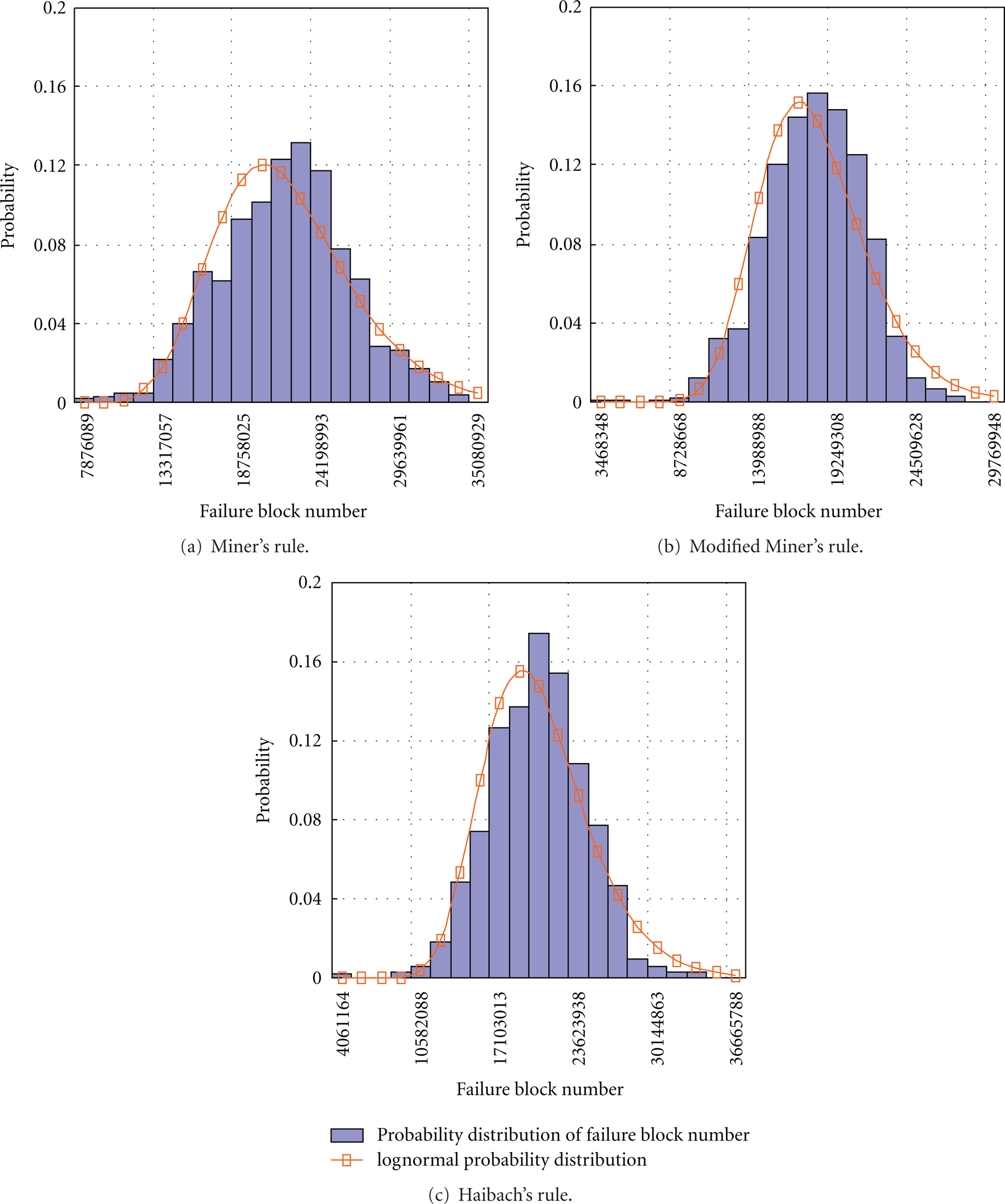
Failure probability distribution (

Cumulative probability density of failure loading blocks according to simulations.
4.5. Calculations of Member Fatigue Reliability
Figure 10 shows the fatigue reliability curves of the lognormal cumulative probability density according to

Fatigue reliability according to simulations.
4.6. Remaining Life Calculation of Fatigue Member
A fatigue damage index of 1.0 implies that the failure of an objective member will occur. In this study, after measuring the strain history produced by trucks of over 8 tons for 400 loading blocks, the stress range frequency distribution was obtained. Because the ADTT corresponds to 24 hours per day, the traffic volume of the measurement day was representative (average). Afterward, this traffic situation was assumed to be continuous. In the previous steps, the fatigue life was obtained by dividing the failure loading block into ADTT.
According to a fatigue reliability of 50%, 90%,99%,
Fatigue life according to fatigue life estimation method (run = 1000, ADTT = 936).

4.7. Fitness of Probability Distribution and Effect on Simulations
The stress range is the major factor that dominates fatigue life. Because a particular probability distribution can express the stress range frequency distribution, the lognormal probability distribution sufficientlyexpressed the stress range frequency distribution of 400 loading blocks measured in the field. Here, the fitness degree between the stress range frequency distribution and the theory probability distribution was judged using the determinant
Figure 10 shows the influence of the scale factor λ, the shape factor ζ of the lognormal probability distribution, the determinant
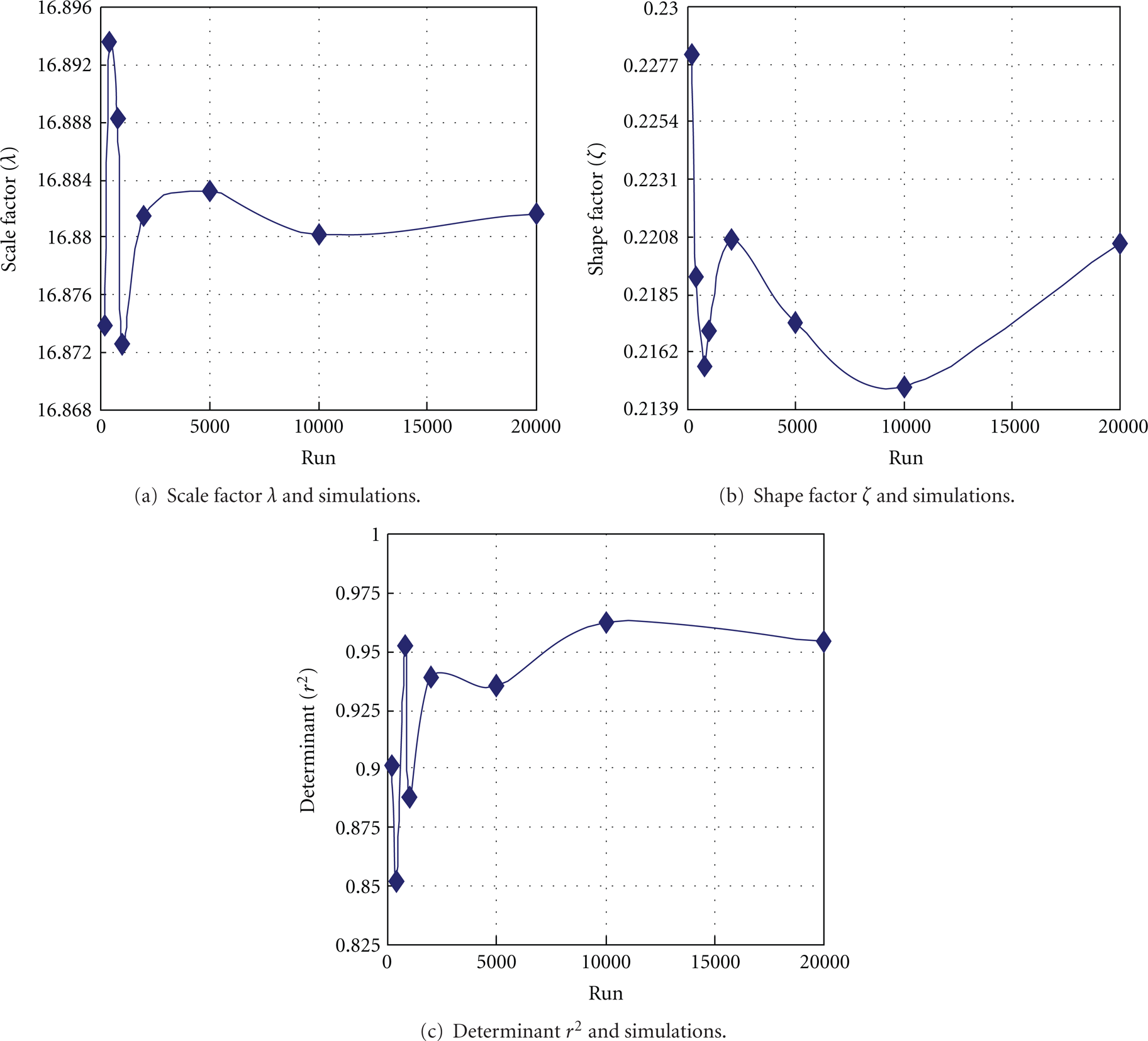
Relations between parameters, determinants, and simulations.
5. Conclusion
Stress history was measured at the welding of the bottom flange and vertical stiffener of a cross beam of a steel box girder bridge. The fatigue reliability model was used to assess the structural detail, and our conclusions are as follows.
The stress range frequency distribution of the loading blocks is a major factor in the dominating fatigue life. Therefore, the probability distribution parameters of the stress range frequency distribution of 400 loading blocks were estimated using the MLM. The lognormal probability distribution was adopted as the probability distribution of the stress range frequency distribution and failure loading blocks. The determinant was used as the criterion for judging the fitness degree was larger than that of any other probability distribution.
From the parameters of the lognormal probability distribution, the shape factor ζ does not represent any direct correlation with the number of simulations repeated. However, the scale factor λ and coefficient of determination
Monte Carlo simulation, which can calculate the failure loading block with a probability distribution parameter of stress range frequency distribution, was appropriate for estimating the probability of failure of the fatigue member under a loading block. Thus, it was the method chosen for our fatigue analysis.
Footnotes
Acknowledgment
This work (Grants no. 00045555) was supported by Business for Cooperative R&D between Industry, Academy, and Research Institute funded by the Korean Small and Medium Business Administration in 2011.