




Abstract
Gasohol is one of renewable clean alternative energies, which is widely used around the world. Gasohol had been raised to be used in 9 provinces of China since 2001. However, its closed use was merely promoted in Heilongjiang province since November 1, 2004. Moreover, this issue aroused extensive discussions and controversies. One of them is the condensation dripping water issue from exhaust pipe in cold winter. Does the ethanol cause the road freezing in cold winter? To deal with this issue, taking the Harbin city as a case study, this work designs detection experiments of the condensation dripping water from exhaust pipe. Moreover, the amount of the condensation dripping water from exhaust pipe for gasohol and gasoline vehicles with the same working condition is obtained and measured, and their results are compared and analyzed. Simultaneously, the method of reducing the condensation dripping water is proposed. The results illustrate the effectiveness of the proposed method.
1. Introduction
Due to the increasing demand for energy and stringent air pollution regulations, nations worldwide are actively researching and developing alternative clean fuels. Gasohol is one of them used for vehicles [1, 2]. Some studies have assessed the feasibility of employing ethanol as an additive in automobile engine fuel due to its high octane value [3] and the ability of ethanol to increase the octane value of gasoline [4, 5]. In addition, in order to increase the effectiveness of using the ethanol, its related operating performance issue has been addressed. For example, Yang et al. discuss the effect of ethanol-blended gasoline on emissions of regulated air pollutants and carbonyls from motorcycles [6]. Chen et al. discuss the cold-start emission problem of an SI engine using ethanol-gasoline blended fuel [7]. Graham et al. discuss the emission issue from light duty gasoline vehicles operating on low blend ethanol gasoline and E85 [8]. Deh Kiani et al. predict the performance and exhaust emission in SI engine using ethanol-gasoline blends using artificial neural networks [9]. Wu et al. investigate the effect of air-fuel ratio on SI engine performance and pollutant emissions using ethanol-gasoline blends [10]. Costa and Sodré presents the compression ratio effect on an ethanol/gasoline fuelled engine performance [11]. Schifter et al. discuss the combustion and emission behavior for ethanol-gasoline blends in a single cylinder engine [12]. Kar et al. discuss the organic gas emission problem from a stoichiometric direct injection spark ignition engine operating on ethanol-gasoline blends [13].
Based on the above overview, the researchers mainly focus on operating performance issues of ethanol/gasoline, they pay little attention to the condensation dripping water issue from exhaust pipe for the gasohol vehicle. In fact, the gasohol had been raised to be used in 9 provinces of China since 2001. However, it was merely promoted the closed use in Heilongjiang Province since November 1, 2004. Moreover, this issue aroused an extensive discussion and controversy. Especially in the cold winter, some users reflect that the condensation dripping water from exhaust pipe of gasohol vehicles is sharply increased [14]. And as a result, the following upsetting issues generate; that is, environmental pollution is further accelerated, roads show the freezing phenomenon, and traffic congestion and accident are more severe [15]. Does the ethanol cause the road freezing in cold winter? In order to solve it, it is urgent to introduce the condensation dripping water detection and its control issue from exhaust pipe for gasohol vehicle under low environmental temperature conditions and in cold winter.
The structure of this paper is organized as follows: in Section 2, the condensation dripping water detection method and its experiment program are presented. In Section 3, the condensation dripping water from exhaust pipe for gasohol and gasoline vehicles is obtained and measured, respectively. In addition, their results are compared and analyzed. In Section 4, an improved method of reducing condensation dripping water from exhaust pipe is described and introduced. Finally, Section 5 concludes our work and describes our future research steps.
2. Detection Method and Experiment of Obtaining Condensation Dripping Water
2.1. Experiment Materials and Procedures
Taking the POLO car of Shanghai Volkswagen (engine displacement is 1.6 L) as an experimental vehicle, the condensation dripping water from exhaust pipe with a specific amount of fuels is obtained and measured; in addition, their results are compared and analyzed. Note that the engine operating condition is the stable idling condition with a constant exhaust gas temperature. In addition, in order to avoid the inaccurate measurement result influenced by the variable atmospheric wind speed, the test site is selected as a specified no-wind location in Harbin city of Heilongjiang province of China.
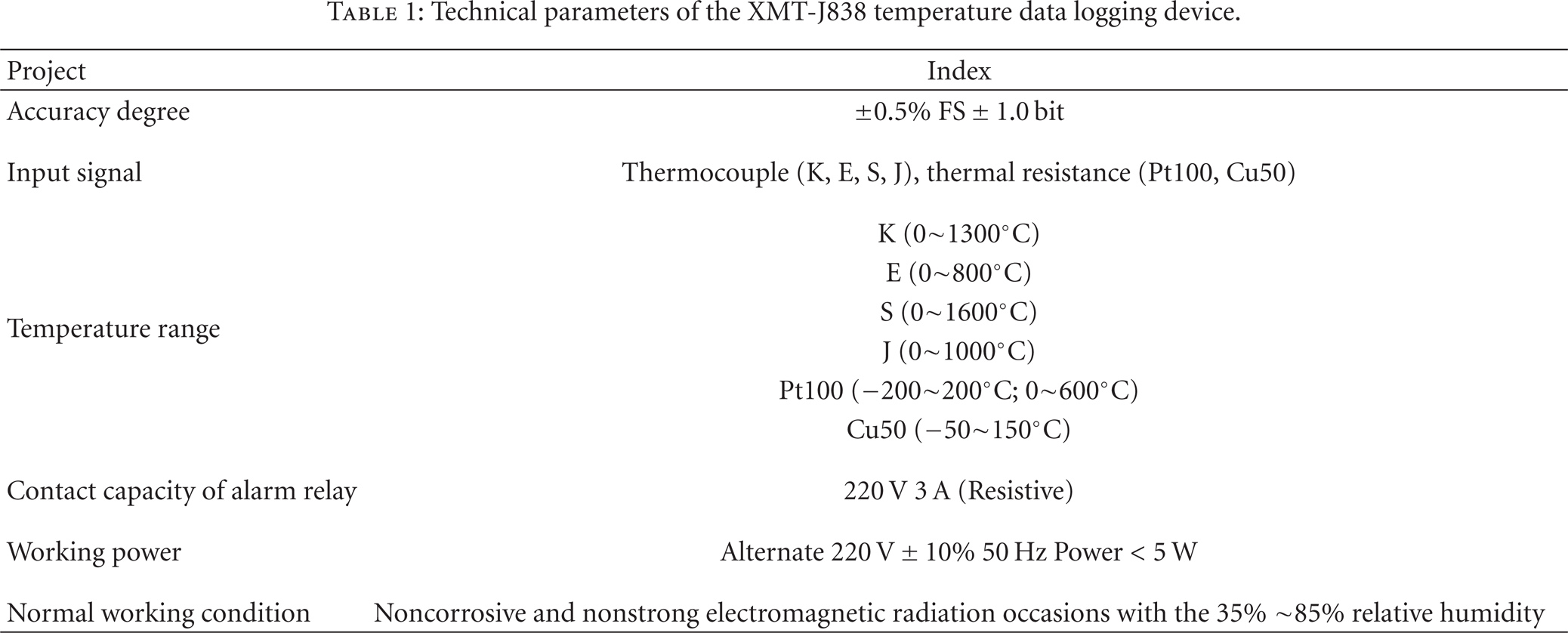
The used experiment tools and materials are listed as follows: a XMT-J838 temperature data logging device, which is used to detect the temperature of the exhaust pipe. In addition, its parameters are listed in Table 1; a CTM2002A/B vehicle comprehensive test instrument is used to control the fuel consumption amount and combustion time: the 500 mL 93# gasoline and 500 mL E10 gasohol (the general gasoline with the 10% alcohol content), respectively.
Technical parameters of the XMT-J838 temperature data logging device.
2.2. Experiment Procedures
Experiment procedures of obtaining condensation dripping water are presented below.
Start an engine, preheat to a stable idling condition and the engine speed is set to be 750 r/min. Note that in cold winter, the main travelling condition is idling one, thus it is set to be the experimental condition.
Install the temperature detection device of the exhaust pipe. The physical assignment graph of installing ones is shown in Figure 1. Note that measurement temperature points should be wrapped to avoid the outside interference.
Connect a self-made oil device. Note that the self-made oil device can detect the fuel consumption.
Measure the experiment condition. When the exhaust temperature is detected to be a specified constant, the experiment is set up. After the 500 mL fuel (93# gasoline or E10 gasohol) ends, the amount of the condensation dripping water is measured. It consists of two parts, one is the condensation water from the box, and another is the dripping water from the tail of the exhaust pipe. In addition, the engine working time is measured. Note that the actual data is the average of 5 times measure results at one environmental temperature.

Physical assignment graph of installing temperature data logging devices.
3. Experiment Results
Under different low environmental temperatures, the condensation dripping water for the 500 mL 93# gasoline and 500 mL E10 gasohol is collected and measured as shown in Table 2. In addition, the combustion time/engine working time is obtained as shown in Table 2.
Obtaining condensation dripping water through burning 500 mL fuel.

Based on the results from Table 2, the following conclusions can be obtained: firstly, the combustion time of the gasohol is smaller than that of the gasoline at different low environmental temperatures, but their mean combustion time is basically consistent, one is 2115.83 s and another is 2139 s. Secondly, the amount of the condensation dripping water of the gasohol is smaller than that of the gasoline at most different low environmental temperatures. Moreover, compared to the gasoline, the amount of the condensation dripping water is decreased by 8.52%, namely (161.33–147.58)/161.33 × 100% = 8.52%. In a word, based on the results, compared to the traditional fuel, the amount of the condensation dripping water from exhaust pipe is not increased but decreased at the idling condition and at low environmental temperatures. That is, the condensation dripping water from exhaust pipe of a gasohol vehicle is not one of the main reasons of road freezing in cold winter. The above-mentioned phenomenon is aroused by the following reasons: compared to the gasoline, the gasohol has larger latent heat. Usually, the latent heat of gasohol more than two times of that of the gasoline. And as a result, at low environmental temperatures, the combustion process of gasohol is deteriorated and the water vapor content of combustion products is decreased; thus, the condensation dripping water from exhaust pipe is increased to some extent.
In addition, in order to make future tests and observe the regular pattern of the condensation dripping water from exhaust pipe, the relationship graph of between the amount of the condensation dripping water from exhaust pipe and environmental temperature for the gasohol and gasoline is drawn as shown in Figures 2 and 3, respectively. What is more, their linear regression curve is obtained to observe the regular pattern.
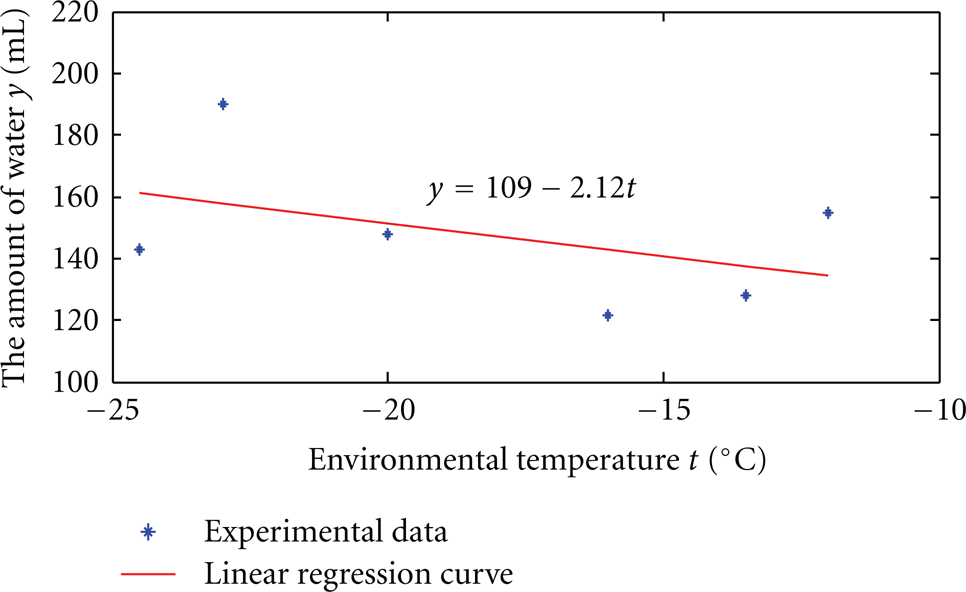
Relationship graph between the amount of the condensation dripping water from exhaust pipe and environmental temperature for the gasohol.

Relationship graph of between the amount of the condensation dripping water from exhaust pipe and environmental temperature for the gasoline.
From Figures 2 and 3, the amount of the condensation dripping water from exhaust pipe is decreased as the environmental temperature increases overall. The results denote that the combustion characteristics of engine and the evaporation characteristics of fuels are improved as the temperature increases, thus the amount of the condensation dripping water from exhaust pipe decreases.
4. Control Method for Reducing Condensation Dripping Water
It is reported that the number of the car ownership is
Based on the above method, the experiment of colleting condensation dripping water for the E10 gasohol vehicle with the same working condition is executed. The results are listed in Table 3.
Obtaining condensation dripping water through burning 500 mL E10 gasohol.
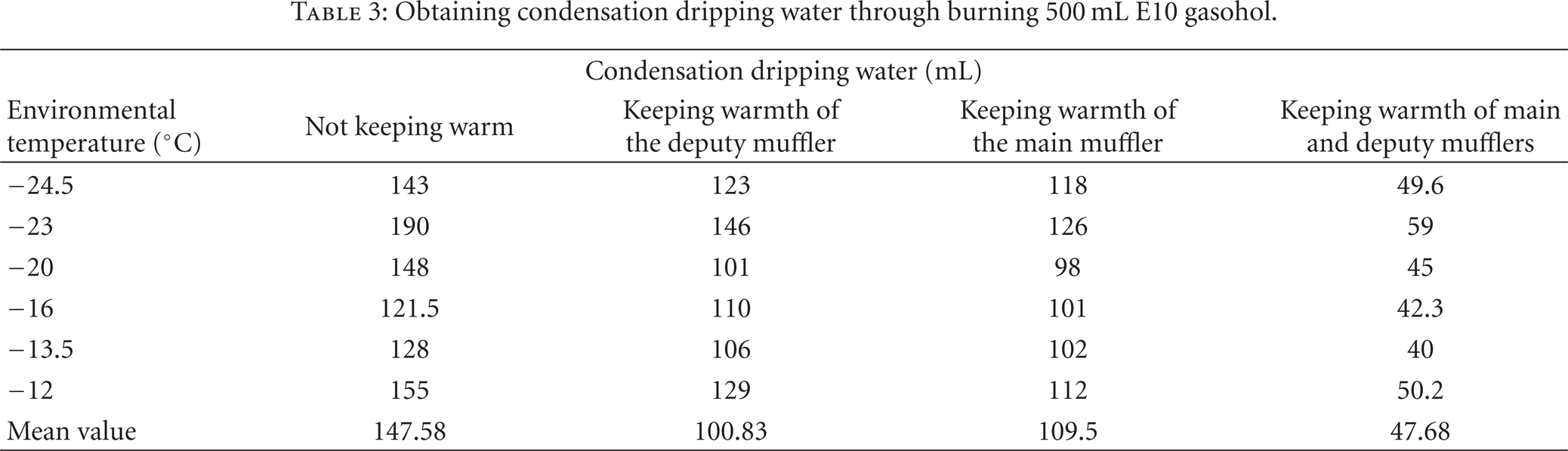
From Table 3, after mufflers are insulated via wrapping asbestos, compared to the no keeping warm condition, the amount of the condensation dripping water is effectively reduced. The results denote that the proposed method is feasible and effective to control the generation of the condensation dripping water from exhaust pipe.
In addition, their combustion times of not keeping warm and keeping warmth of the deputy muffler are obtained as shown in Table 4. From Table 4, compared to the no keeping warm condition, the amount of the combustion time is effectively increased. The results denote that the condition of combustion is improved.
Combustion time through burning 500 mL E10 gasohol.

5. Conclusions
Due to the increasing demand for energy and stringent air pollution regulations, nations worldwide are actively researching and developing alternative clean fuels. Gasohol is one of the widely renewable alternative fuels used for vehicles. However, it is used in Heilongjiang province of China and aroused an extensive controversy. One of the upsetting issues is the condensation dripping water issue from exhaust pipe of the gasohol and the citizen recognizes it as an important reason of the road freezing. In order to very this matter, our works are presented as follows.
This work proposes a detection issue of condensation dripping water from exhaust pipe and its control method for the gasohol vehicle for the first time.
Compared to the same amount of the gasoline, the experiment results denote the amount of condensation dripping water is not increased under low environmental temperature conditions and at the stable idling condition. This result refutes the opinion of Harbin citizens effectively. That is, the using of gasohol is not one of main reasons of road freezing at low environmental temperatures, namely, it can be used safely in cold winter.
We deduce that the intensification of the road freezing phenomenon is related with the growth of car ownership. Thus, we propose a keeping warm method for main and deputy mufflers to control the generation of the condensation dripping water. The results denote this method is feasible and effective.
There exits some limitations with the proposed method. Firstly, in order to further test the result, experimental data of different types of vehicles should be collected. Secondly, the better and higher efficiency control methods should be discussed to ensure their practicality. In addition, the prediction of the amount of condensation dripping water should be discussed based on artificial intelligence [17–20].
Footnotes
Acknowledgments
The authors would like to thank the comments provided by anonymous reviewers and the editor, which help to improve this paper. In addition, this work is supported by the Fundamental Research Funds for the Central Universities (no. DL12BB32).