




Abstract
In wireless ad hoc networks, designing an energy-efficient routing protocol is a major issue since nodes are energy limited. To address energy issue, we proposed a triangular energy-saving cached-based routing protocol by energy sieving (TESCES). TESCES offered a grid leader election by energy sieving (GLEES), a cache-based grid leader maintenance (CGLM), and a triangular energy-saving routing discovery (TESRD). In GLEES, only few nodes join in grid leader election to be elected as a grid leader. New grid leader is elected directly by cache without sending extra control packets in CGLM. TESRD selects an energy-efficient path to transmit data packets. Hence, TESCES could save more energy for transmitting packets and prolong routing lifetime. Simulation results showed that TESCES could reduce 31% of energy consumption, prolong 67% of routing lifetime, and increase 19% of survival ratio of nodes. Furthermore, TESCES may be more outstanding as the number of nodes increased.
1. Introduction
Mobile ad hoc networks (MANETs) had attracted much attention recently. It consisted of a set of mobile nodes that can communicate with others through multiple hops without base stations. Packets sent by the source node are relayed by several intermediate nodes before arriving at the destination node [1–6].
Since battery technology is not likely to progress as fast as computing and communication technologies, designing an energy-efficient protocol to construct energy-efficient routing path becomes an important issue in MANETs [7–10]. The work in [11] indicated the fact that a protocol's behavior does have a significant impact on energy consumption of nodes. A node should tune its wireless interface card into doze mode whenever the node will not lower its own and the network's performance.
Among existing routing protocols, grid-based routing protocols are often used for energy-saving by tuning nodes into doze mode [12–16]. In grid-based routing protocols, once node is elected as a grid leader in its grid. Routing is conducted in a grid-by-grid manner through neighboring grid leaders. Only grid leaders must keep in active mode. Other nodes are tuned into doze mode to save energy without demoting network connectivity.
When the remained energy of the current grid leader will be insufficient for grid management or data transmission, nodes in the same grid need to wake up and tune into active mode once receiving control packets for a grid leader election. However, some of these woken nodes with lower remained energy may consume more redundant energy for grid leader election. For routing discovery, grid-based routing protocols often select the route with minimum hops for transmitting packets without considering the required energy dissipation, such as AODV (ad hoc on demand distance vector routing protocol) [2] or DSR (dynamic source routing protocol) [1].
To address the above issues, we proposed a triangular energy-saving cached-based routing protocol by energy sieving (TESCES) in this paper. In TESCES, a grid leader election based on energy sieving (GLEES), a cache-based grid leader maintenance (CGLM), and a triangular energy-saving routing discovery (TESRD) are constructed. In GLEES, only few nodes need to join in grid leader election by GLEES. Hence, nodes with lower remained energy need not tune into active mode for saving energy. In CGLM, a node is directly to be elected as a new grid leader without broadcasting extra control packets. TESRD builds an energy-efficient routing path for transmitting packets. TESCES therefore could reduce more energy consumption and prolong the lifetime of routes compared with a fully energy-aware and location-aware protocol (FPALA) and an energy-saving cache-based routing protocol (ESCR).
To evaluate and compare the performance of TESCES, FPALA, and ESCR clearly, we provide the mathematical formulas of energy consumption for grid leader election and maintenance. Simulation results showed the efficiency of TESCES. The rest of the paper is in the following sections. Section 2 presented the related work. Section 3 stated TESCES. Section 4 presented simulation results. Section 5 concluded this paper.
2. Related Works
Grid-based routing protocol is a kind of geographic routing protocols based on grid architecture. It partitions the network area into several square/hexagon grids by the location information such as global position system (GPS) [12, 13, 17–19], as shown in Figure 1. Routing is performed in a grid-by-grid manner. One node is elected as a grid leader in its grid. The responsibility of a grid leader includes (i) issuing routing discovery requests to its neighboring grid leaders, (ii) propagating data packets to its neighboring grid leaders, and (iii) maintaining routing paths which pass the grids. Nonleader nodes are not responsible for these jobs unless they are destinations of (i) and (ii) and sources or destinations of (iii). To reduce the unrequired collisions, the communication of nodes is divided into intragrid and intergrid modes. Routing discovery and maintenance could be modified from any of the following protocols: source routing and next-hop routing [14, 17].

(a) Square grid, (b) Hexagon grid.
However, most of grid-based routing protocols concentrated on routing discovery and maintenance without considering energy issues. To address energy issues, a fully energy-aware and location-aware routing protocol (FPALA) [12, 13] and an energy-saving cache-based routing protocol (ESCR) [14] were proposed. FPALA built a power mode management mechanism for grid leader election to save energy. All nodes need to wake up for joining a grid leader election. The node with the maximal remained energy in its grid is elected as the grid leader. Non-leader nodes then tune into doze mode to save energy without demoting the connectivity of network. For grid leader maintenance, FPALA restarts a new grid leader election whenever the remained energy of the current grid leader is insufficient. Nodes thus could save energy in grid leader elections. However, in FPALA, all nodes still need to tune into active mode to be elected as the grid leader by broadcasting extra control packets. Hence, nodes have to extra consume the redundant energy. To address this issue, energy-saving cache-based routing protocol (ESCR) was proposed [14] by us.
ESCR built a cache table in the first grid leader election. While the remained energy of current grid leader is not enough, a candidate node could be elected as a new grid leader directly from cache without broadcasting any controlled packets. ESCR thus could save more energy than FPALA in grid leader maintenance.
However, nodes with lower remained energy still have to broadcast extra control packets in active mode to consume the unnecessary energy for grid leader election. Moreover, FPALA and ESCR both adopt the existing source routing or next-hop routing to build routing paths without considering the energy constrained for routing discovery. We therefore proposed a triangular energy-saving cached-based routing protocol by energy sieving (TESCES) in this paper.
3. Triangular Energy-Saving Cache-Based Routing Protocol by Energy Sieving
Triangular energy-saving cached-based routing protocol by energy sieving (TESCES) is a kind of energy-aware and location-aware grid-based routing protocols in MANETs. TESCES partitions the network area into several square grids based on GPS. One node in each grid is elected as a grid leader. For grid-based area,

Relation between l and r in grid.
The minimum of value r implies that a grid leader is capable of talking to any one of its 8 neighboring grid leaders. Each node is set with a cache table to record
In TESCES, routing is performed in a grid-by-grid manner through several grid leaders. Communication is divided into intra-grid and inter-grid modes. In intra-grid mode, node communicates directly with others with the same grid through its grid leader in one hop. In inter-grid mode, node communicates with one in different grid via its grid leader in multiple hops.
For routing discovery, TESCES uses a triangular energy-saving routing discovery (TESRD) to replace a traditional routing discovery, such as AODV [2]. In TESRD, nodes on the selected route could consume less energy by adjusting the transmission energy according to the required transmission distance while forwarding packets to next one.
3.1. Grid Leader Election by Energy Sieving
In grid-based routing protocols, the grid leader is responsible for routing, relaying packets, and maintaining correct operations of grids. Hence, an efficient grid leader election is needed.
However, in traditional grid leader election, all nodes in a grid need to turn into active mode for transmitting election packets. Some nodes thus may consume unnecessary energy because the remained energy is much lower than others in the same grid. For example,
Hence, in TESCES, a grid leader election by energy sieving (GLEES) is proposed to address this issue. In GLEES, each node is equipped with a GPS to get its location information. Power energy consumption of nodes could be adjusted by tuning the transmission radius. The full energy of each node is denoted as
GLEES defined a threshold value of joining in grid leader election ( First, node i compares While node j receives a BID packet, node j compares When the last node i does not get any BID packet in a predefined time ( When node k receives a GATE packet, it replies a BID_E( The grid leader sorts its cache table in a descending way by
GLEES could avoid no grid leader to be elected in grid leader election. When no grid leader is elected after
For example,

Example of GLEES.
3.2. Cache-Based Grid Leader Maintenance
Routing maintenance is to keep the lifetime of a routing as long as possible. Under TESCES, except the source and destination nodes, each intermediate node is the grid leader. Therefore, the grid leader maintenance in each grid is an important issue for routing maintenance. To address this issue, cache-based grid leader maintenance (CGLM) was proposed. When the remained energy ( When The new grid leader broadcasts a GATE packet to declare its existence and then deletes the first row in its While
In CGLM, new grid leader is elected directly without broadcasting any extra control packets. CGLM thus could save more power energy for data transmission.
For example, assume that
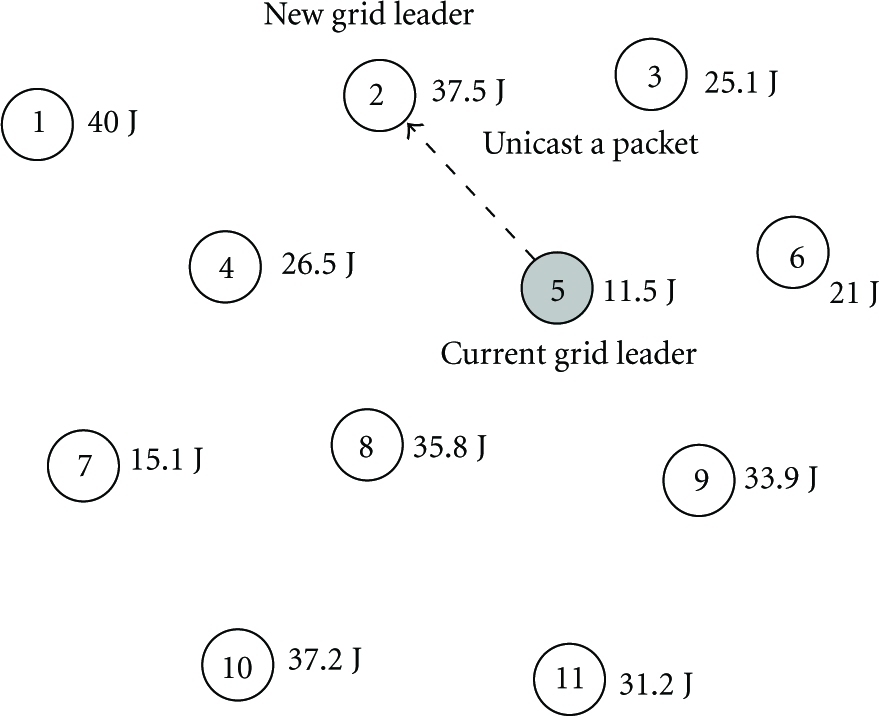
Example of CGLM.
3.3. Triangular Energy-Saving Routing Discovery
In traditional grid-based routing protocols, minimum hop routing discovery is often used through several grid leaders without considering the energy constrain [12, 17]. To address this issue, we proposed a triangular energy-saving routing discovery (TESRD) by integrated HCB model [8, 9, 20] with GPSR [21].
TESRD is a two-phase process. In the first phase, packets are marked with their destinations' locations by their originator. A forwarding grid leader makes a locally optimal choice to decide the next packet's hop. The locally optimal choice of next hop is the neighboring leader that is geographically closest to the next packet's destination. Forwarding packets in this regime follows the closer geographic hops until the destination is reached.
In the second phase, TESRD adopts a greedy algorithm to compute global near-optimal power-efficient routings based on the local optimal choice for the next forwarding node. In TESRD, let s be the sending node and r the next receiving node along the routing path. The distance d is measured from s to r. Transmission energy consumption is proportional to

Example of TESRD.
To reduce energy consumption, TESRD could select a more energy-saving path based on the changes of gid of next intermediate node. Assume that the gid of node s and r are (

Case 1 in TESRD.
In case 2, if

Case 2 in TESRD.
In case 3, if

Case 3 in TESRD.
3.4. Medium Access Control Channel Assignment
In TESCES, routing is conducted in two levels: intra-grid and inter-grid. The former is supported by the point coordination function (PCF) of IEEE 802.11, and the latter is supported by the distributed coordination function (DCF) of 802.11. The time interval is divided evenly into a sequence of superframes for all nodes participating in the networks. We appendixed BID_E and GATE_E packets to the modified superframe based on FPALA. The inter-grid and intra-grid routing phases are under the superframe, as shown in Figure 9.

Superframe of TESCES.
In the leader phase, all nodes must be awake. Only leaders have right to access their channels. If no leader exists in a grid, the next phase becomes an election phase for nodes to compete to be a grid leader. If E of the leader is below
For the intra-grid routing, if a packet is targeted at a node resident in the same grid, this packet is sent to the node directly during the intra-grid phase. For the inter-grid routing, a packet is forwarded in a grid-by-grid manner during the inter-grid phase. An inter-grid routing could be modified based on the protocols: source routing or next-hop routing. However, these protocols do not address the energy issue. Hence, we proposed a triangular energy-saving routing discovery (TESRD) in TESCES.
To avoid channel interference among neighboring grids, totally night channels are needed in TESCES, as shown in Figure 10. The number (1–9) in each grid represents the channel to be used by that grid. The channels based on frequency reuse form a pattern, called a cluster that appears repeatedly in a regular way.

Channel Assignment in TESCES.
3.5. Energy Consumption Formula
To evaluate the performance effectively, the notations in the energy formula were defined as listed in Table 1. We formulated the energy consumption of grid leader election in TESCES,


Notations of mathematical formula.

The formula of energy consumption of the grid leader maintenance of TESCES is calculated as (4). For FPALA, the formula of energy consumption of grid leader maintenance is the same as 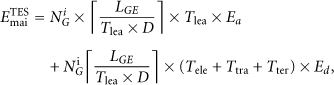
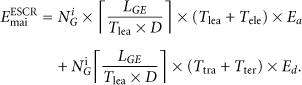
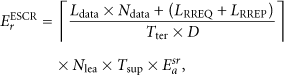
Energy consumption of routing discovery is calculated based on time of transmitting packets. Hence, examining the total superframes is to obtain transmitting time for TESCES, FPALA, and ESCR. Assume that the number of grid leaders along the routing is 



4. Simulation Results
Performance of TESCES was measured and compared with those of FPALA and ESCR by simulations coded in a C# language. First, we described the simulation environment and performance metrics and then analyzed the experimental results. The simulation parameters are listed in Table 2. The time ratio of the intra-grid phase to the inter-grid phase is 1 : 4. Energy consumption could be adjusted based on the transmission radius of nodes [12, 14].
Simulation parameters.

4.1. Performance Metrics
We evaluate the routing lifetime (
4.2. Experimental Results
TESCES improves 67% and 84% of

Routing Lifetime.
Figure 12 showed that TESCES reduces 31% of

Total energy consumption (
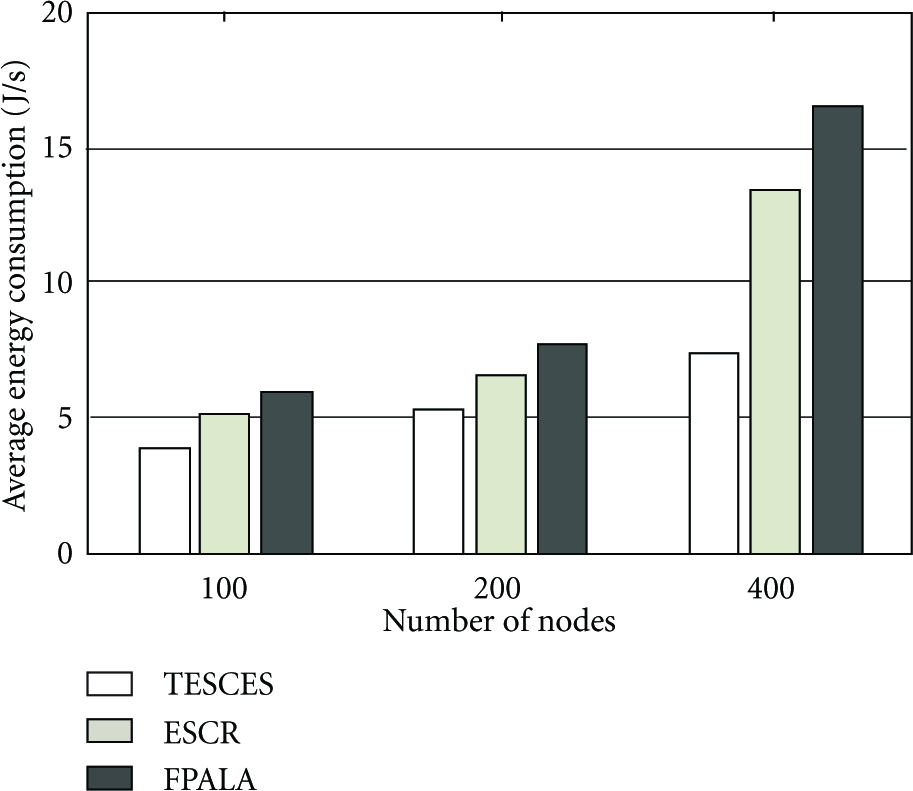
Average energy consumption (
TESCES increases 9% of
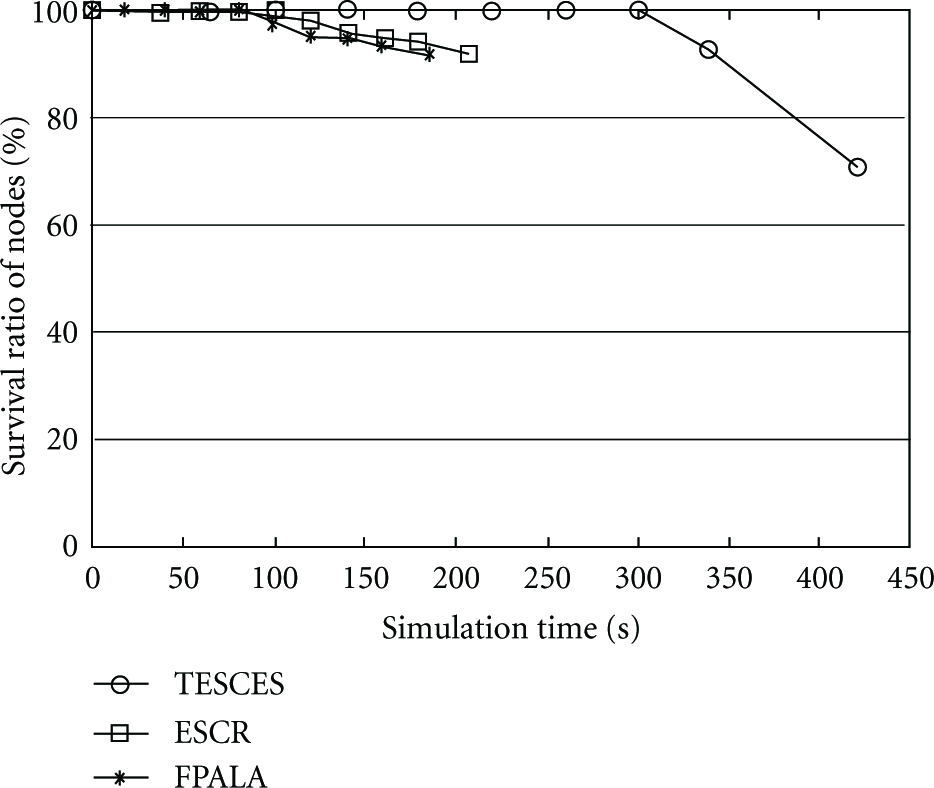
Survival ratio of nodes (
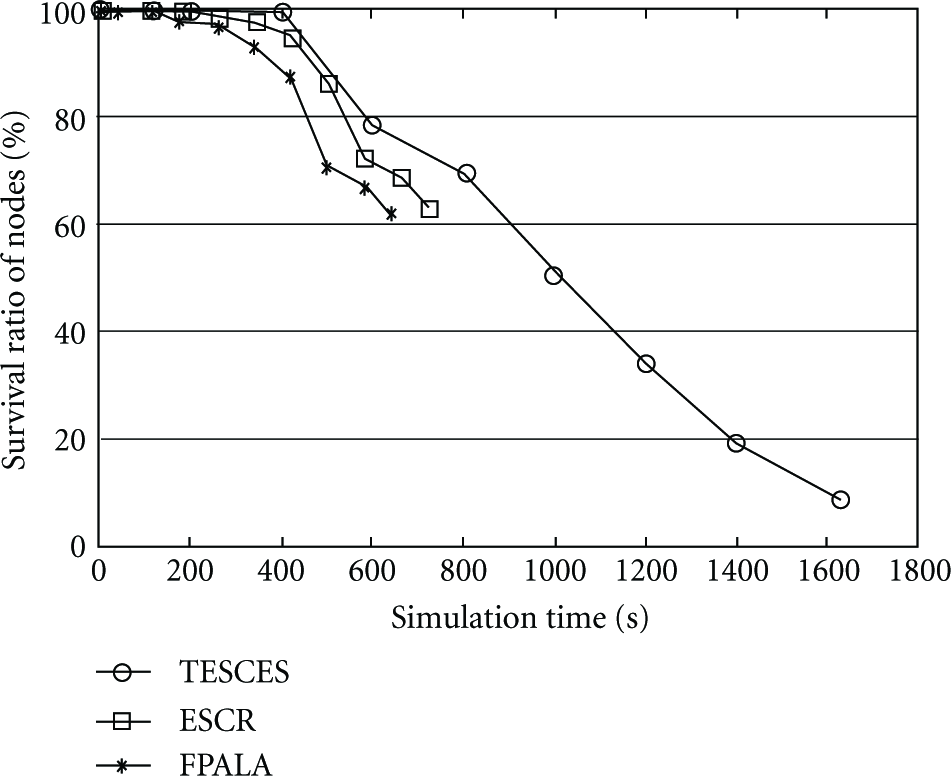
Survival ratio of nodes (
Energy consumption evaluation is consisted of the energy consumption of grid leader election, grid leader maintenance, and routing discovery. Hence, the formulas (1)–(8) are used in constructing these figures.
Simulation is ended off when no path exists between the source and destination nodes. The available routing paths in FPALA and ESCR both are broken earlier than TESCES. The curves for ESCR and FPALA thus do not continue for whole simulation time, as shown in Figures 12, 14, and 15.
To avoid most of nodes to consume redundant energy,

Energy consumption with different

Energy consumption with different

Energy consumption with different
In Figures 16, 17, and 18,
In Figure 16, TESCES has largest
In Figures 16, 17, and 18, TESCES in
5. Conclusions
Since the power energy of mobile nodes are limited, designing an efficient energy-saving routing protocol becomes an important issue in wireless ad hoc networks. To address this issue, many energy-aware routing protocols were proposed. Among these protocols, grid-based routing protocol is the general solution because nodes could be tuned into doze mode to save energy. The grid-based routing protocol is composed of grid leader election, grid leader maintenance, and routing discovery.
In grid leader election, each node has to consume energy to be elected as a grid leader. However, some nodes are unsuitable to be the grid leader because its remained energy is much lower than that of others. Nodes with lower remained energy need not consume the redundant energy in grid leader election.
In grid leader maintenance, each node needs to be in active mode for a grid leader election when the remained energy of current grid leader is insufficient for forwarding packets.
In routing discovery, most of grid-based routing protocols concentrated on robustness and minimum hop count of routes but ignored the required energy consumption. Nodes thus may consume more energy to transmit data.
To address the above issues, a triangular energy-saving cache-based routing protocol by energy sieving (TESCES) was proposed in this paper. In TESCES, a grid leader election by energy sieving (GLEES), a cache-based grid leader maintenance by cache (CGLM), and a triangular energy saving routing discovery (TESRD) are constructed.
In GLEES, only some nodes need to join a grid leader election to be elected as a grid leader, and other nodes are turned into doze mode to save energy. In CGLM, the new grid leader is appointed from cache table directly without broadcasting control packets to save energy while the remained energy of current grid leader is lower than the threshold. TESRD selects an energy-efficient routing path compared with the on-demand routing discovery. Therefore, TESCES could save more energy for data transmission and prolong the time of routing.
To measure and compare the performance of TESCES, FPALA, and ESCR, we conducted some simulations for evaluating grid leader election, grid leader maintenance, and routing discovery. Simulation results proved that TESCES could save more power energy than FPALA and ESCR.
Experimental results showed that TESCES prolongs 67% of ESCR and 84% of FPALA, respectively. For energy consumption, TESCES reduces 31% of ESCR and 40% of FPALA. For survival ratio of nodes, TESCES increases 11% of ESCR and 19% of FPALA.
Furthermore, the routing lifetime, energy consumption, and survival ratio of nodes may be better in TESCES as the number of mobile nodes is increased.