




Abstract
Energy efficiency is one of the basic requirements of wireless sensor networks (WSNs) yet this problem has not been sufficiently explored in the context of cluster-based sensor networks. Specifically, the interaction of different types of sensor nodes is one of the major factors of energy efficiency in large-scale heterogeneous networks. In this paper, we aim at improving the interactions among sensor nodes, and we present a heterogeneous local-world model to form large-scale wireless sensor networks based on complex network theory. Two types of nodes, normal nodes and cluster nodes, are added to the networks. The degree distribution for this model is obtained analytically by mean-field theory. This approach depicts the evolution of the network as having a topological feature that is not completely exponential and not completely power law; instead, it behaves between them. The experiment and simulation indicate that the control method has excellent robustness and a satisfactory control effect (interaction of different types of sensor nodes). Furthermore, the results also show that the higher the generation rate of the cluster nodes is, the closer the degree distribution follows the power-law distribution.
1. Introduction
Wireless sensor networks (WSNs) are composed of a large number of sensor nodes. These nodes are deployed in a specific area to monitor physical phenomena. Wireless sensor networks are poised to revolutionize our abilities for sensing and controlling our environment. However, sensor nodes rely on batteries to provide energy in WSNs. As a result, the primary problem in WSNs is always energy savings for sending and receiving data. Consequently, power control must be performed in WSNs. In recent years, with the development of WSNs, advances in wireless communication and sensing technology have made it possible to produce a large number of individually cheap and small units. Usually, these small pieces of equipment are used in WSNs, as combinations of sensors and wireless network nodes. With the increasing scale of WSNs, some characteristics of complex networks have emerged. The problem of coefficient, error, and attack tolerance remains to be solved in large-scale networks. As a result, it is crucial to find out a good way to handle these problems.
In recent years, complex networks have received increasing attention for exhibiting the topological structure, function and dynamical properties of many real-world networks such as the World Wide Web, the Internet [1, 2], social networks [3], biological networks [4], and ad hoc networks [5]. One of the most important discoveries is the B-A model [6]. This model is based on two foundational mechanisms: growth and preferential attachment. A new node is added to the network at each step and connects with an old node with a specific probability, which is related to the degree of the old node. The B-A network has the scale-free property and follows the power-law distribution.
While the B-A scale-free network model captures the basic mechanism that is responsible for the power-law degree distribution, it is still a minimal model with several limitations. As stated in [7], Li Xiang and Chen Guanrong proposed a Li-Chen model to modify a limitation in the B-A model. They suggested that there should be a local world of each node in various real-world complex networks. Moreover, the preferential attachment mechanism of a scale-free network does not work in a global network but does work in the local world of each node. The Li-Chen model represents a transition between a power-law and an exponential distribution. The BA scale-free model is only one of its special cases. This case fits the real circumstance, in which new nodes enter the networks, and a new node chooses only some of its local world nodes to link with. Numerical results have shown that networks constructed with a local preferential attachment mechanism can maintain the robustness of scale-free networks undergoing random errors and can concurrently improve the reliance against targeted attacks on highly connected nodes [6, 8].
2. Related Work
Because cluster structure networks can be modified to obey the property of scale-free, many people attempt to adjust the traditional structure of WSNs to a new structure of scale-free. Thus, sensor nodes can save energy even if there is a large-scale network in the monitoring area. They obtain a satisfactory result when forming WSNs that possess the scale-free character as well. It is shown that scale-free networks are robust against the random removal of nodes or node failures. Therefore, another advantage of this type of WSN is the robustness of the network, which is a groundbreaking result in this research field and provides good inspiration for this paper.
In 2007, Chen et al. [9] studied a new evolving mechanism for deducing the fault-tolerant communication topology among the cluster heads with complex network theory. Based on the B-A model's growth and preferential attachment element, they not only used a local-world strategy for the network when a new node was added to its local-world but also selected a fixed number of cluster heads in the local world, for the purpose of obtaining a good performance in terms of random error tolerance. In 2009, Zhu et al. adopted two evolving algorithms for WSNs, which are based on complex network theory [10]. The first model was applied to deduce energy-aware communication topology, and this model can generate scale-free networks that have satisfactory performance of random error tolerance. The second model involved limiting the number of communication links for each node base in the first model. Moreover, based on the model in Hailin Zhu's paper, Li et al. investigated an improved local-world model of WSNs in 2011 [11]. There are two types of nodes in [11]: normal nodes and cluster nodes, which is different from the homogeneous WSNs. The authors created a heterogeneous evolving network model. In addition, they limited the number of linking edges in every cluster node to form a good scale-free property in WSNs and to control the energy consumption in the sensor nodes. However, they did not consider the tendency for interactions between different types of sensor nodes, which could reduce the energy efficiency (to a variable degree) in WSNs.
In this paper, an evolving model for WSNs based on the B-A model and the Li-Chen model [7] is proposed. Aimed at improving the interaction among different types of sensor nodes in WSNs, the proportion of a normal node in a cluster node's neighbor nodes is increased in this model.
The remainder of this paper is organized as follows. In Section 3, we propose an algorithm for an energy-aware evolution model. In Section 4, we analyze the model by mean-field theory, and we provide numerical experiments that demonstrate the features of the networks that are generated by the proposed algorithms. Finally, Section 5 gives the conclusions of this paper.
3. The Generalized Local-World Model
3.1. The Local-World Model
A local world is a small community with a few nodes in a large-scale network. The model of the local-world is deduced from the B-A model. In the Li-Chen model, each node has only local connection information; nodes connect only in their local world based on local connection information. Then, M nodes are selected randomly from the existing network as the “local world” of the newly added node. The network generation algorithm of the Li-Chen model can be described in two steps, as follows
(1) Growth
Starting from a small number
(2) Local Preferential Attachment
At each time step t, before connecting the new incoming node to m existing nodes, randomly select M nodes as its local-world; then, connect m nodes in its local world, using a local preferential attachment with probability

After t time steps, there will be a network with
3.2. Generalized Local-World Models for Wireless Sensor Networks
In this section, we model a WSN as an inhomogeneous network with growth and preferential attachment. This model contains two types of nodes: normal nodes and cluster nodes. There is only one cluster node attached to a normal node; in other words, the normal node has only one edge, which means that the normal node cannot relay data from other nodes. A cluster node can integrate and transmit data from other nodes. Both of the two types of nodes can connect to a cluster node, and the number of edges is limited in every cluster node because of its energy efficiency. As every new cluster node joins the network, it is randomly assigned an initial energy
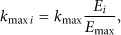
Then, the growing model is described as follows: starting with a small number of nodes,
(1) Growth
At every time step, a new cluster node or a normal node with one edge enters into the existing network with a probability p or
(2) Preferential Attachment
The new incoming node links to an old cluster node that is selected randomly from the preexisting network. Nodes in WSNs have the constraint of energy and connectivity and only communicate data with the cluster nodes in their local area. First, M cluster nodes are selected randomly from the network as the new incoming node's local world
If the new incoming node is a cluster node, then the probability is set as follows: If the new incoming node is a normal node, then the probability is adapted as follows:
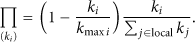

In [10], the authors consider the expenditure of energy in the process of linking nodes together. The disadvantage is that the energy in a cluster node would be exhausted in only several rounds. In fact, the energy consumption is relatively low; thus, the energy consumption is not considered in this stage, and only
After step
From
From the discussion above, the whole probability

4. Analytical Results of the Model for WSNs
In this section, using mean-field theory [6], the theoretical analysis of the degree distribution

Case 1 (
).
When

The denominator of the above equation is the number of cluster nodes in time t. From the initial condition

Case 2 (
).
This case means that the local world

In a network, the degrees

Then, we can simplify (9) as the following:

To calculate


From (12) and (13), we know the following:

When

Case 3 (
).
In this case, a newly added node selects one of the cluster nodes in its local world

A comparison of (15) with (16) shows that they have almost the same solution under the same simple assumption. To calculate the above equation, we assume here that

We define

Then, we can obtain the following:

Combining the initial condition

Moreover, to find the degree distribution
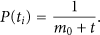
Then,

Hence, the degree distribution

Next, inserting A and B back into

To compare different ratios of cluster nodes to the whole network's forming factor, in this case, we take two different ratios of p to show the diversity of our simulations. In addition, we make another comparison by changing M in the case of different ratios p. Here, all of the simulations are operated by MATLAB, which are based on our simulation toolboxes. The two types of p are 0.25 and 0.5.
When we set

The scenario of forming WSNs over 500 times when
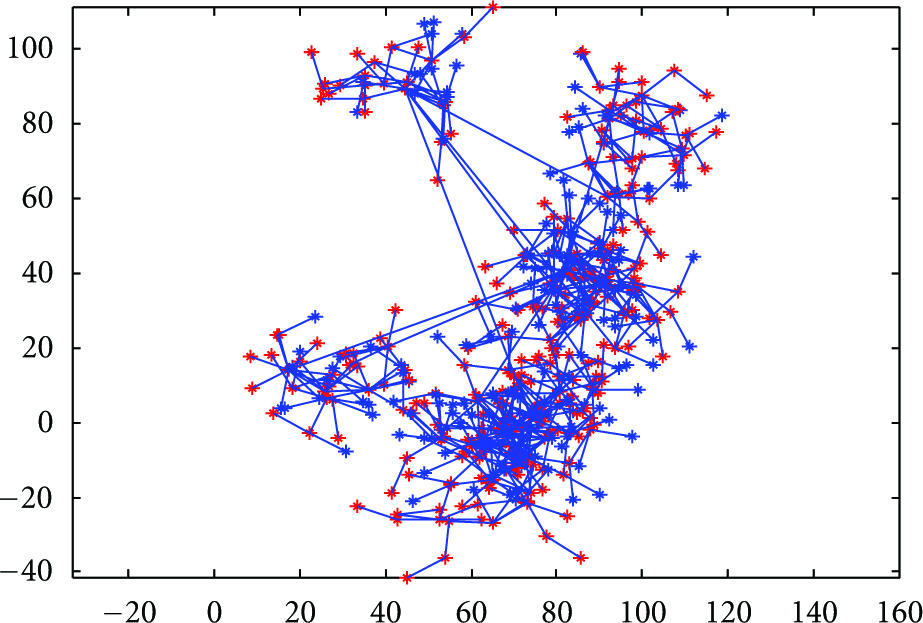
The scenario of forming WSNs over 500 times when
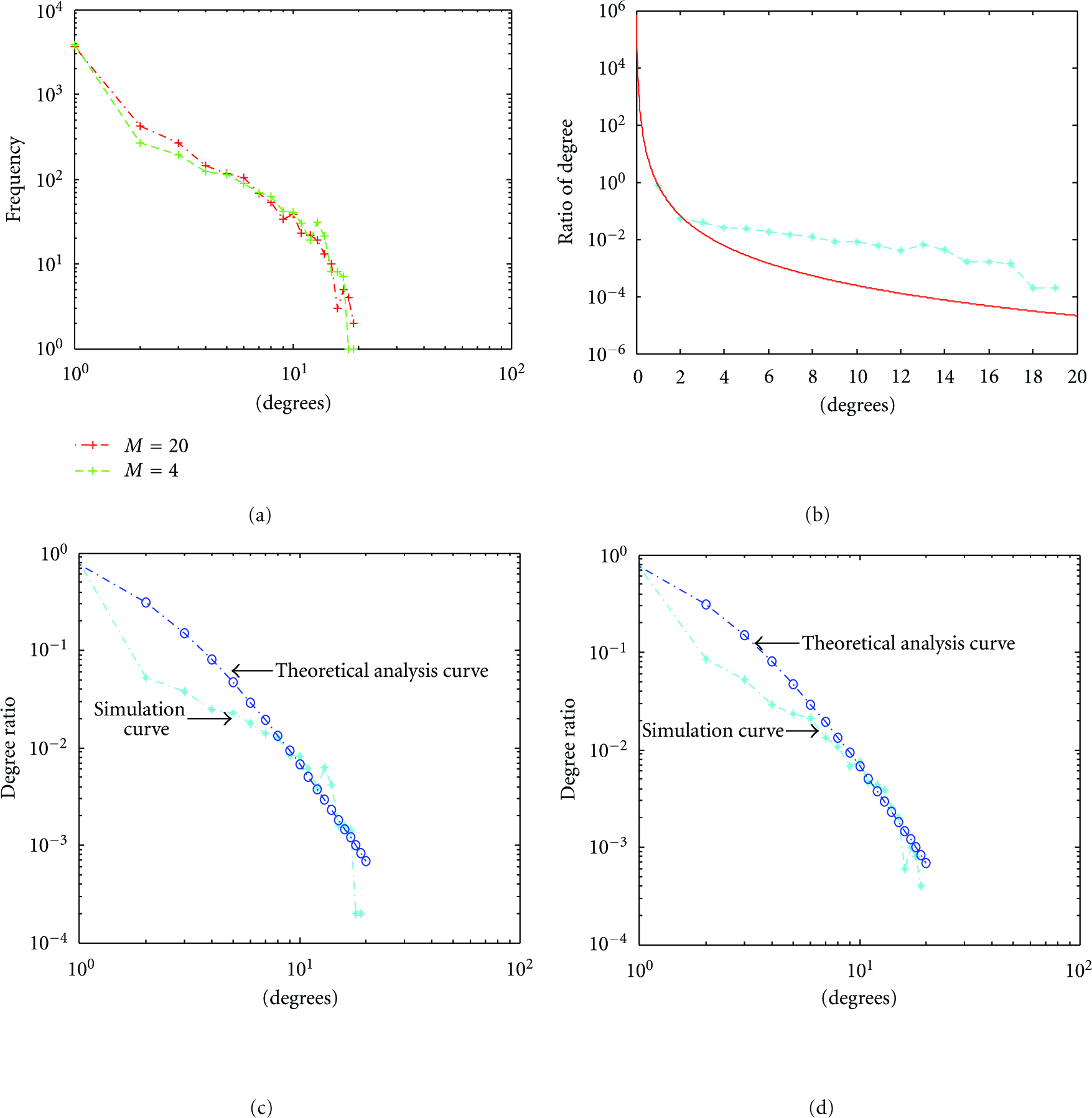
The degree distribution does not follow the power-law distribution but instead distributes between a power-law and an exponential distribution, and the frequency of the degree in the whole network is shown in Figure 3(a). In Figure 3(b), the picture shows the relationship between the degree and its ratio. Another standard line (the fitted straight line) is drawn from the data to contrast with the ratio line. The figure shows that the two lines do not fit well. In another words, in this situation, the degree distribution does not follow a scale-free distribution. Figure 3(c) and Figure 3(d) compare the experiment data with the theoretical model in (24).
We set our simulation parameters to be
The relationship between the degree and its ratio

Plot of the simulation result for

We set our simulation parameters to be
Figures 5(c) and 5(d) not only show the ratio of the difference degree in the actual condition and the theoretical condition but also indicate that the two lines match closely with each other. As analyzed above, the model that we proposed has some restriction on the growth of a scale-free network, with the result that the simulation result is different from the theoretical model.
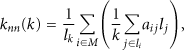
Because the distribution of the node degree could not uncover the internal complexity of the topological structure, it is worth investigating the connectivity correlation among the cluster nodes, which could lead to a more profound understanding of the structure. For the sake of depicting the relationship among the cluster nodes and normal nodes, we first discuss the property of the average nearest-neighbor connectivity. Because the cluster nodes play the role of a backbone in ensuring the data processing performance of the WSNs, we compute this performance here as in [12]:

Degree distribution and its average frequency in neighboring nodes.

Degree distribution and its average frequency in neighboring nodes when
Second, to show our link mechanism's property, Figures 8(a) and 8(b) are adopted to describe the result of the interaction among different types of sensor nodes between the two types of nodes. Figures 8(a) and 9(a) show the edge number of every cluster node linking to the neighbor cluster node, and most of the cluster nodes distribute in the frequency of 1 and 2. Moreover, Figures 8(b) and 9(b) depict the detailed distribution of cluster nodes for different values of M. A frequency of 2 is ranked in the second place from Figure 8(b), and when all of the data are calculated, a frequency of 2 is the average edge number of neighbor cluster nodes, which is also illustrated in Figure 9(b). The frequency of 2 is located in the second place, and we can find that the frequency of 2 is the mean of the edge number of neighbor cluster nodes, which is obtained from calculating the data. Thus, the conclusion of (13) is proven to be correct.

We set our simulation parameters to be

We set our simulation parameters to be
We can draw a conclusion that, with an increase of p (the proportion of cluster nodes), the degree distribution changes from an exponential distribution to a power-law distribution, which our experiments have proven from the discussion above.
5. Conclusions
This paper presents an evolving model for improving the energy efficiency of WSNs. This model adapts and balances the interactions of different types of sensor nodes to reach the goal of energy efficiency with two different types of probability in the evolving network. Furthermore, the proportion of edges linking to a normal node is improved in every cluster node. Our numerical experiments above show that our new model reaches the requirements for and improves on the network robustness. A good model adapts the cluster structure when the number of nodes increases continuously. However, it ignores the dead sensor nodes with the growth of the network in our model. For the next step, we will pay more attention to the random deletion of sensor nodes that are too close to a real environment of WSNs.
Footnotes
Acknowledgments
This work is supported by National Natural Science Foundation of China under Grant nos. 61063037 and 61163056, by Key Projects in the Science & Technology Pillar Program of Jiangxi Province of China under Grant no. 20111BBG70031-2, and by Innovation Special Funds Projects for Graduate Students of Jiangxi Province under Grant no. YC2011-S079.