




Abstract
We consider a wireless sensor network that comprises a single hop between the sensor nodes and the central controller node with multiple antennas. In this system model, we concentrate on the single-beam opportunistic communication and propose two novel packet transmission schemes that can perform multiuser diversity gain based on the signal-to-noise ratio (SNR) and the normalized SNR (NSNR) measurements at the sensor nodes with single antenna. The main objective of the multiuser diversity is to increase the total throughput over the fast fading channels. Proposed schemes are based on the principle of cross-layer design that integrates with physical layer characteristics of wireless channel and medium access control (MAC) layer characteristics of network. In our design, we assume that the sensor nodes know only their own channels to the controller node and the packet transfer from the sensor nodes to the controller node is initiated when the channel quality of any node exceeds the predefined threshold at the current time slot. To determine the optimum threshold, we maximize the probability of successful packet transmission where only one sensor node transmits its packet in one time slot under the simplified collision model. Simulation results are demonstrated to compare the performance of the proposed schemes in terms of throughput, energy efficiency, and fairness. The obtained results show that the presented opportunistic strategy can be used to improve the network throughput.
1. Introduction
In recent years, a rapid growth was seen in availability and deployment of the wireless devices. Advances in energy efficient designs, digital circuitry, signal processing, sensing technology and microelectromechanical systems (MEMS) have enabled the development of wireless sensor networks (WSNs) as a new emerging technology. WSNs may consist of several hundred spatially distributed inch-scale sensor nodes (SNs) which are densely deployed over a sensing area with the aim of measuring environmental phenomena. The SNs have a limited battery energy and finite lifetime while it is expected to operate for months. The major source of the energy consumption is the radio transceiver and the energy efficient solutions are proposed at all layers of communication stack. Especially the MAC layer has direct control over the radio transceiver and it plays a crucial role on the energy efficiency and also the throughput for WSNs [1].
The MAC protocol is necessary to coordinating packet transmissions of the SNs to optimize the network throughput at an acceptable fairness and minimal energy consumption. When the channel conditions are bad, in other words, when the channel goes into deep fade, a packet transmission attempt is highly failed and may lead to a waste of energy. Therefore, the SNs may wait longer until their channels become better. However, deferring the transmissions to increase the energy efficiency until the channel becomes better may decrease throughput or equivalently cause a longer latency [2]. The MAC protocol designs for WSNs often trade performance characteristics, such as throughput and latency, for a decrease in energy consumption to increase the SNs' lifetime [3, 4]. Thus an efficient packet transmission scheme must be able to adapt to channel variations while maintaining a good balance between the energy efficiency and the throughput for WSNs.
Even though the energy efficiency is one of the most important design consideration for WSNs, certain applications necessitate the throughput performance. At this point, the cross-layer design proved to achieve better optimization results than its layered counterparts and it has received much attention over the past few years to improve the throughput. Recently, some cross-layer proposals in the literature exploit the interaction between the MAC and physical layers to increase the network throughput. When the physical layer is modeled as a simple collision channel, the MAC protocol is designed considering that packets arrive error-free at the CN only when one SN transmits, because the collisions directly impact the overall networking metrics such as energy efficiency, throughput, and delay. Since the MAC layer coordinates the sharing of the wireless channel, it is also responsible for minimizing the number of collisions. It is clearly that to maximize the throughput of the WSN, during each time slot, the SN with the best channel state should transmit and other SNs should remain in an idle state.
In this study, we consider a WSN with single-hop infrastructure, where besides SNs there is a controller node (CN) on top of the hierarchy that acts as a common sink over wireless links. The SNs collect the data about a physical phenomenon to directly send them to the CN and thus no routing protocol is needed. In a cellular WSN, the channel conditions of the SNs have time-varying behavior due to fading as well as shadowing and propagation loss. Therefore, different SNs experience different channel gains at a given time; this effect is called multiuser diversity (MUD) [5]. The time-varying link quality allows opportunistic usage of the channel and the presence of fading is crucial in order to realize the MUD gain, but it is limited in environments with little scattering and/or slow fading. In such environments, the MUD gain is obtained by opportunistic beamforming (Opp-BF) by using multiple antennas at the CN. By varying the phase and power of the signals allocated to the elements of antenna array, the large and fast channel fluctuations are induced over the deployment area, so that the MUD can still be exploited [6]. Opp-BF method also ensures fairness as the beamforming vector aligns with various SNs' channels at different time slots.
It is well known that making use of channel knowledge of the SNs at the MAC layer allows opportunistic usage of the channel and improves throughput performance through collision elimination. The design and operation of the optimal MAC protocol depends on the availability of channel state information (CSI) of SNs that are available at the CN. Close to perfect CSI at the SNs are available in many downlink (DL) channels, where a pilot signal can be employed for channel estimation. When a training sequence is transmitted by the CN, the large number of SNs can estimate their channel conditions. However, obtaining CSI at the CN requires feedback from each SN. If short-term CSI measurements of active SNs are fed back to the CN through the uplink (UL) channel, an opportunistic scheduler can use this information and receive packet from the SN with the best channel quality. Thus, the network throughput can be maximized by always serving the SN which has most favorable channel conditions in each time slot. Besides, the CN can initiate packet transmission which means that collisions can be completely avoided with perfect scheduling. Consequently, the overall system performance is maximized and the network lifetime is prolonged to the utmost limit.
In practice, the assumption of centralized access to CSI at the CN becomes harder to justify as the number of SNs increases or the wireless channel changes rapidly. Moreover, this requirement results in significant energy consumption, especially due to the fact that the SNs periodically feed back to the CN. Because of the constraints on the UL channel, the idea of using centralized scheduling in multiple access is inappropriate for WSNs. Therefore, there is a need to develop alternative strategies in a nonfeedback system where the CSI of the SNs are unknown by the CN. In this study, we assume that all the SNs can only estimate their own channels but are unaware of others, called decentralized CSI [7, 8]. We propose a threshold-based opportunistic MAC protocol for time slot assignment to the SNs. The proposed method enables the SNs to measure their channel qualities based on SNR and normalized SNR (NSNR) metrics over the common pilot signal broadcasted by the CN. Then, each SN is authorized to send a packet autonomously, when its channel gain is above the predefined threshold. The optimum threshold is obtained through maximizing the probability of successful transmission in the same time slot. Hence, the scheduling of SNs are established without the assistance of the CN.
The remainder of the paper is organized as follows. Section 2 describes the system model. Section 3 discusses the motivation for designed MAC protocol and presents the related work. Proposed opportunistic packet transmission schemes are explained in Section 4. A clear description of the threshold optimization problem is also explained in this section. In Section 5, simulation results of the proposed schemes are presented, in terms of the channel state probabilities, throughput, energy efficiency, and fairness. Finally, the paper is concluded in Section 6.
Notation.
The boldface is used for vectors. For a given vector
2. System Model
The system of interest is a single cell of the cellular WSN in which one CN serves K SNs. The CN is equipped with M antennas whereas each SN is equipped with single antenna. We assume that the CN is more powerful than the SNs in terms of signal processing and communication capabilities. Using multiple antennas at CN is justified by the fact that the power and size constraints of the CN are less stringent. The SNs are randomly deployed in an open field and connect into a WSN and periodically take samples from the environment and forward it through a direct link to the CN for further processing. The sensed data is encapsulated into blocks of symbols called packet and the packet transmission is slotted. Since SNs do not know when the convenient channel conditions will exist for packet transmission, their radio transceivers should be kept turned on at all time slots without any power-saving mechanism which operates alternately in sleep and awake modes. Then, the SN with strong channel gain transmits its own packet, while the SN with bad channel condition stays in an idle state until channel conditions become favorable to be scheduled at the UL channel. We also assume that the SNs are capable of applying adaptive coding and modulation, but the details of the underlying physical layer of WSN operation are beyond the scope of this study.
The channel vector between the kth SN and the CN is denoted by
Proposed scheme consists of two iterative operations following one after another in time, that is, pilot signal broadcast in the DL phase and packet transmission in the UL phase, respectively. The DL and UL phases share the same frequency band with alternating time slots in time division duplex (TDD) system. Therefore, we assume the DL and UL channels are identical in two directions. As shown in Figure 1, the pilot signal broadcast time duration of the blocks of
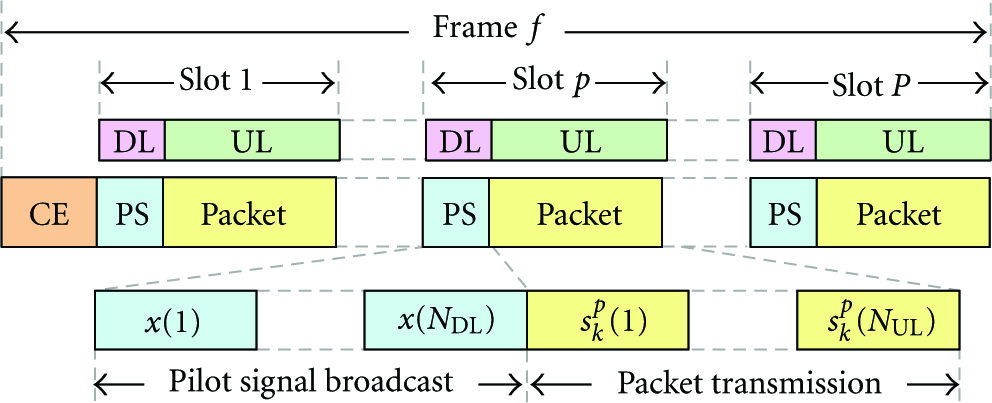
Slotted timing structure of proposed packet transmission schemes.
2.1. Pilot Signal Broadcast in the Downlink (DL) Phase
The DL system model of the proposed packet transmission scheme is shown in Figure 2. In pilot signal broadcast operation, the randomly generated beamforming vector is sent out directly over the deployment area and each of the SNs measures its own channel gain. During a particular time slot p, the CN forms the beam by choosing the
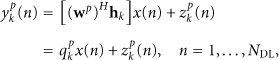
where,

The downlink (DL) system model of the WSN based on proposed MAC protocol.
We assume all the SNs have independent channels and the ratio of the transmit energy to the noise variance

Similarly, the NSNR is defined as the ratio of the received SNR to the maximum SNR. The NSNR expression of the kth SN can be computed as below

where
2.2. Packet Transmission in the Uplink (UL) Phase
The UL system model of the proposed packet transmission schemes is shown in Figure 3. In packet transmission operation, the SNs compare the calculated CSI metric with the predefined threshold. During a particular time slot p, the data packet of the kth SN which has CSI over the current threshold is denoted by

where the

The uplink (UL) system model of the WSN based on proposed MAC protocol.
The signals received from all antennas of the CN are combined to improve the SNR of transmitted packet. The weighting vector in the UL phase is the same as the beamforming vector in the DL phase. The CN combines the received signals

where
Under the assumption of simplified collision model, there are three different channel states for SNs in the UL phase, namely, successful packet transmission, collision, and idle listening. If only one of the SNs transmits during a particular time slot, successful packet transmission occurs whereas simultaneous transmissions of more than one SN in the same time slot result in collision as shown in Figure 4. Otherwise, none of the SNs exceeds the threshold, an idle listening eventuates, and the CN will not receive any packet until the next transmission period. In our single-hop scenario, we assume that the energy consumption of the SNs in the idle listening period may be significantly lower than the energy consumption in the packet transmission period.

Packet transmission operation in a WSN with single-hop infrastructure.
3. Related Methods
Opportunistic scheduling gives higher throughput in wireless networks than nonopportunistic algorithms like round-robin because priority is given to the users with the most favorable channel conditions. Some of the recent MAC protocols in wireless networks prompt the use of opportunistic scheduling that exploits the variations in channel conditions to improve the network throughput. This opportunistic approach can also be employed for WSNs as in [10–12]. But, since the characteristics of the WSNs differ from wireless networks in several ways, traditional MAC protocols are not suitable for WSNs without modifications. The driving motivation of this study is to investigate the benefits of opportunistic scheduling with limited MUD gain due to a lack of feedback on the UL channel. The proposed MAC protocol is specially tailored for applications that require higher throughput, adaptivity, and autonomy.
3.1. TDMA Scheme
The simple TDMA scheme which uses round-robin scheduling, which we call round-robin (RR) scheme, provides the highest short-term fairness when the time slots are allocated in rounds of K time slots, where K is the number of SNs [13]. Then, the scheduled SNs do not have to contend for the shared medium nor worry about packet collisions since only the owner of the time slot is allowed to transmit a packet. The throughput of the RR scheme is given as [14]

where
Moreover, TDMA scheme with opportunistic scheduling takes advantage of favorable channel conditions in assigning time slots to the SNs. Accordingly, the time slots are assigned to the SNs that can maximize the network throughput within a round. In maximum SNR/NSNR scheduling, which we call Max-SNR/NSNR scheme, the CN assigns the current time slot to the kth SN if and only if its instantaneous SNR/NSNR of the kth SN is larger than that of all other SNs,

or

So, the received packet's SNR in the UL channel is equal to the SNR of the kth SN which has the best channel conditions in the DL channel.
3.2. Maximum Likelihood Scheme
An opportunistic MAC protocol, which we call maximum likelihood (ML) scheme, was proposed in [10] which is very close to the work that we present here. The ML scheme defines the optimum threshold based on maximum likelihood decision rule. When an SN is in the beamforming configuration (

Otherwise, for the SNs that are not in beamforming configuration (

When the event that the kth SN is covered by the beam is denoted by

Similarly, the distribution of the SNR
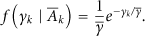
These two conditional distributions are exploited to derive the maximum likelihood rule. Then, the decision threshold is found as

In ML scheme, whenever the SNR of a certain SN is above the threshold
4. Proposed Schemes
The proposed packet transmission schemes opportunistically benefit from the channel gain threshold that depends on the channel quality measurements at the physical layer characteristics to regulate the packet transmission decision of SNs in MAC layer. The optimum threshold is determined to maximize the probability of successful packet transmission where only one sensor node transmits its packet in one time slot. This optimization is done by using two well known CSI metrics, SNR and NSNR, respectively. The operation of the proposed packet transmission schemes is summarized in Figure 5.

The operation flow chart of the proposed packet transmission schemes.
4.1. Proposed SNR Scheme
Due to its ease of implementation and computational simplicity, the SNR has been applied to many different applications in opportunistic systems benefiting from the MUD technique. The probability of any node having the SNR over the threshold is analyzed by the use of the probability density function (PDF) and corresponding cumulative distribution function (CDF) of SNR metric. The SNR metric in (2) has an exponential distribution therefore the PDF and CDF expressions are given by [10]
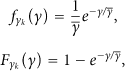
respectively.
In a homogeneous WSN, the capability of each SN is the same and thus each SN transmits its own packet with the same probability distribution. The packet transmission probability is expressed as the probability of an SN having an SNR over the threshold. According to this PDF expression, the probability that one of the SNs has an SNR above the threshold β is given by

For successful packet reception, the probability for which only one SN has an SNR above the threshold β (and all the others are below the threshold) may be written as follows:

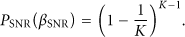
Thus, the optimum threshold

By using the optimum threshold
The system SNR

Note that the value of system SNR is equal to zero with probability
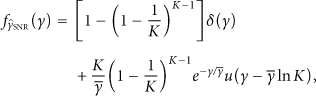
where
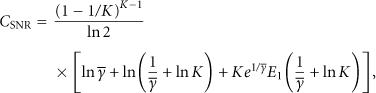
where
4.2. Proposed NSNR Scheme
In practice, average SNR of the SNs is different due to differences in distances to the CN. In this case, giving priority to the SNs with the good channel conditions causes unfairness in WSN. Instead of giving priority to the SNs that have SNR over the threshold, an alternative CSI metric can be considered that is normalized SNR (NSNR). Therefore, the resource allocation may be provided more efficiently. The PDF and CDF expressions of NSNR metric are given by [16]

respectively.
According to this PDF expression, the probability that one of the SNs has an NSNR above the threshold β is given by

For successful packet reception, the compact form of the packet success probability in which only one SN has an NSNR above the threshold β (and all the others are below the threshold) is written as follows:

Then, the optimum threshold

By using the optimum threshold

Note that the successful packet transmission probability of proposed NSNR scheme is the same as the proposed SNR scheme's successful packet transmission probability in (18).
As shown in Appendix B, the PDF of system SNR for the proposed NSNR scheme, which is denoted by
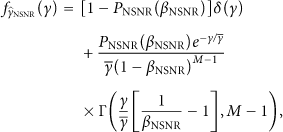
where
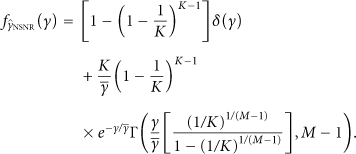
Finally, the throughput of the NSNR scheme can be obtained by

Due to the complicated form of the PDF of system SNR in (28), the achievable throughput of the proposed NSNR scheme is calculated numerically.
5. Simulation Results
In this section, the system performance of the proposed schemes is analyzed in terms of optimum threshold, channel state probabilities, throughput, energy efficiency, and fairness. To validate our analysis, the proposed schemes are compared to the ML scheme [10] and the RR scheme as introduced in Section 3. The performance evaluation is realized by using statistical (Monte Carlo) simulation for
5.1. Optimum Threshold Analysis
The optimum threshold for the ML scheme, the proposed SNR, and NSNR schemes are obtained analytically as function of K and M parameters by (13), (17), and (25), respectively. The variation of the optimum threshold β versus the number of SNs is shown in Figure 6 for
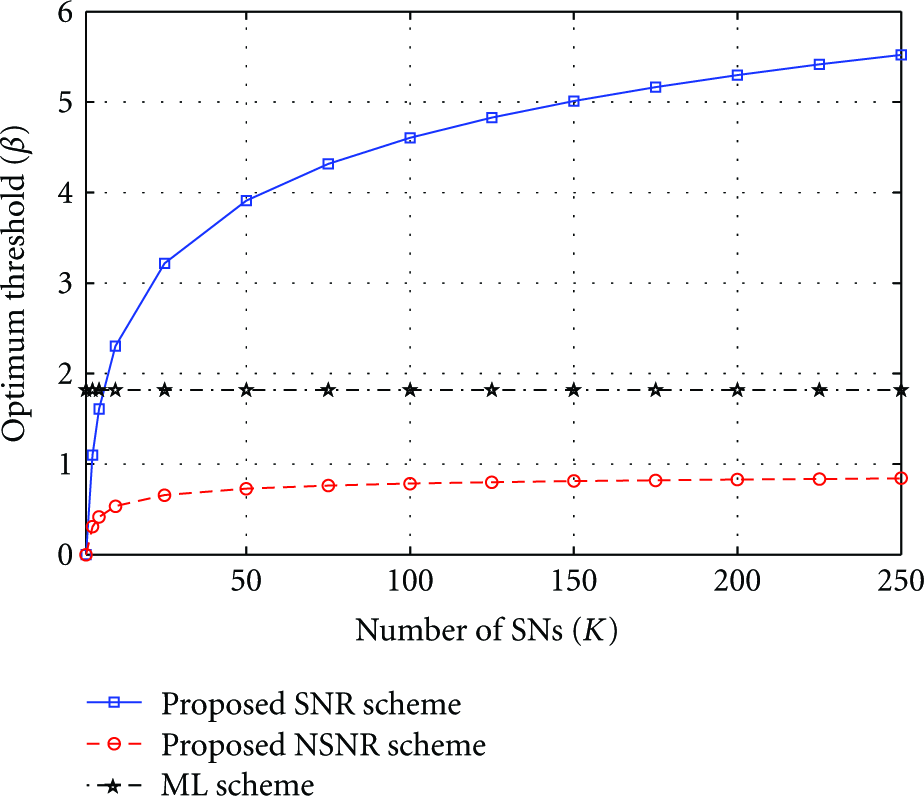
Variation of the optimum threshold with different number of K values for

Variation of the optimum threshold with different number of M values for
5.2. Channel State Analysis
As mentioned before, the SNs with channel quality above the threshold are allowed for packet transmission, while all the others remain silent. Figure 8 shows the probability of successful packet transmission versus the number of SNs for
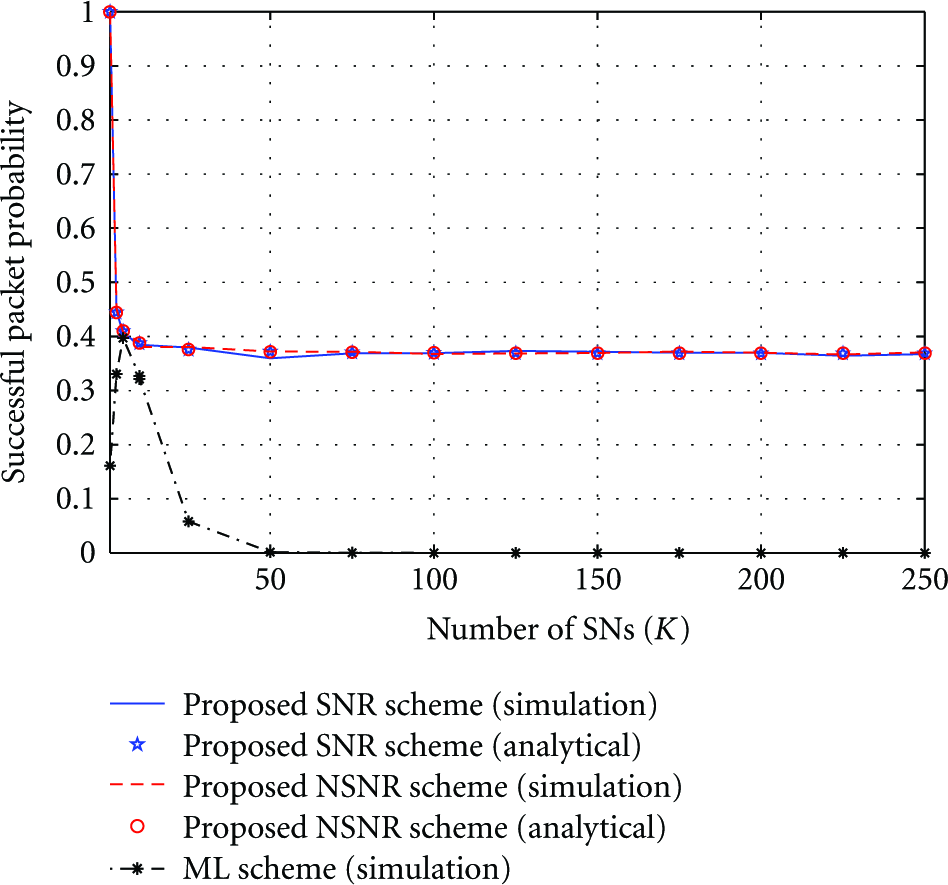
Probability of successful packet versus number of SNs in the WSN for

Probability of successful packet versus number of antennas at the CN for
Sometimes none of the SNs exceeds the threshold where the WSN is in an idle listening mode. Even though SNs do not consume excessive energy, idle channel reduces the expected number of successful packets. Figure 10 shows the probability of idle listening versus the number of SNs for
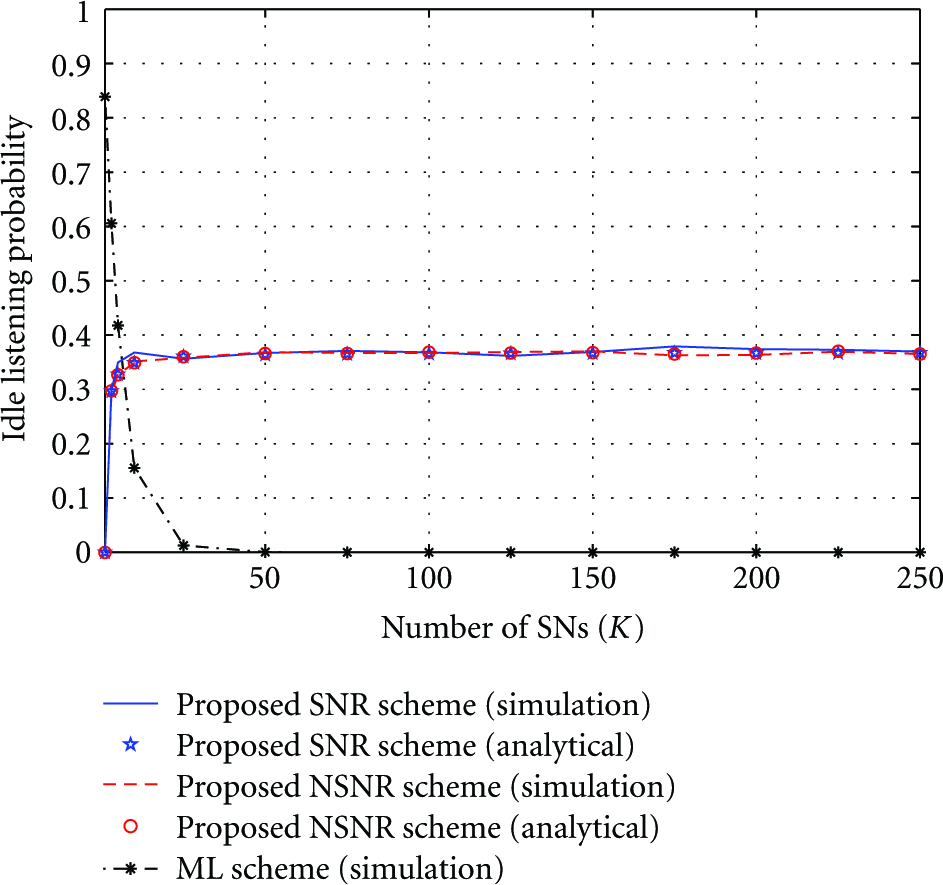
Probability of idle listening versus number of SNs in the WSN for
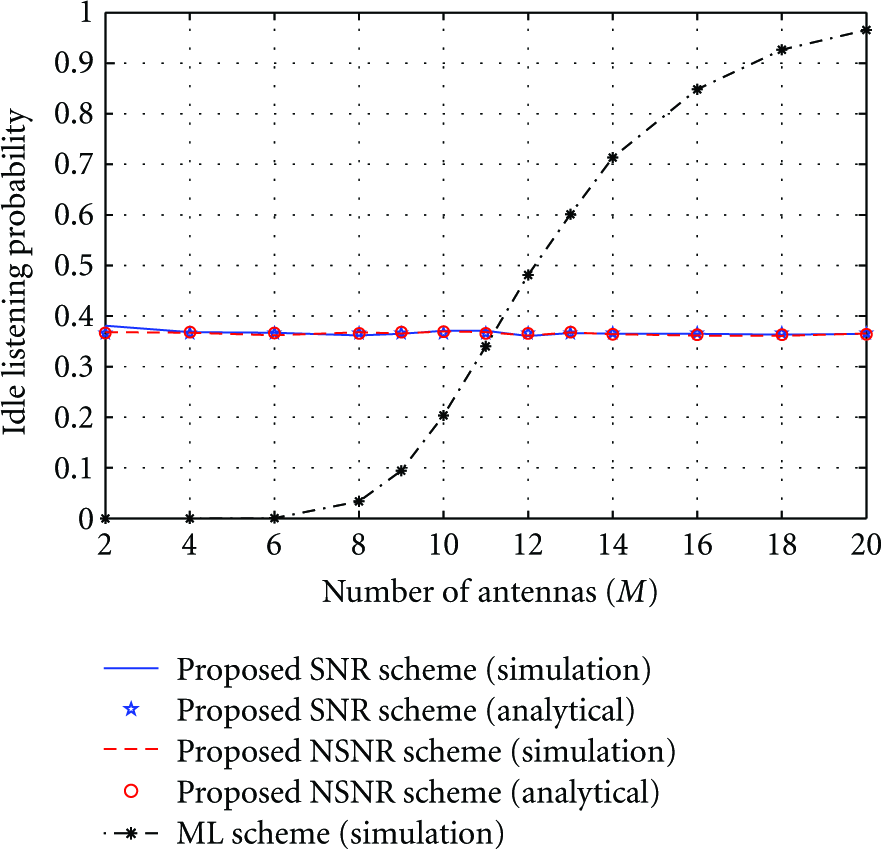
Probability of idle listening versus number of antennas at the CN for
The useless energy consumption of the SNs is highly dependent on the number of collisions. Energy waste due to frequent collisions can significantly decrease the SN's lifetime. As shown in Figure 12, the collision probability of the proposed schemes is less than that of the ML scheme for

Probability of collision versus number of SNs in the WSN for
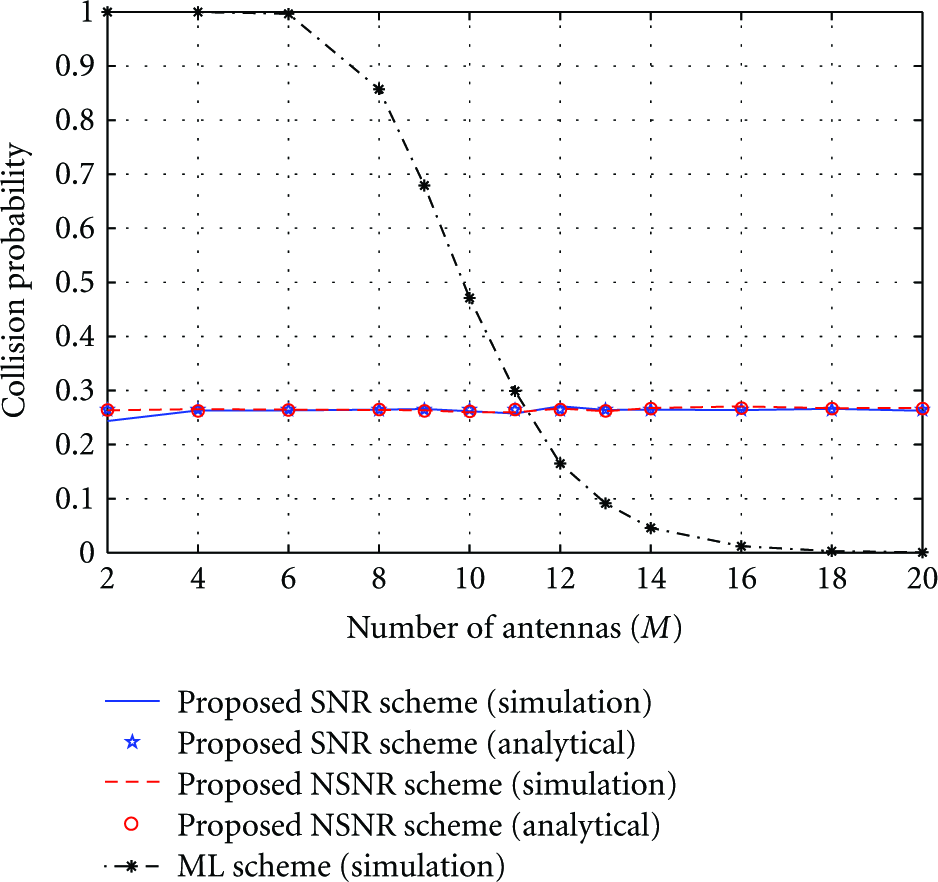
Probability of collision versus number of antennas at the CN for
On the other hand, the RR scheme has constant channel state probabilities in all cases. In RR scheme, the CN receives all of the packets transmitted over the WSN without collision and the packet success rate is equal to %100. Therefore, the collision and idle listening cases are completely avoided through the RR fashion.
5.3. Throughput Analysis
In this section, we derived the throughput gains of the proposed schemes, evaluated them numerically, and compared to the other schemes mentioned in Section 3, namely, the ML scheme, the RR scheme, and the Max-SNR/NSNR schemes. Figure 14 shows the throughput performance of proposed schemes versus the number of SNs for
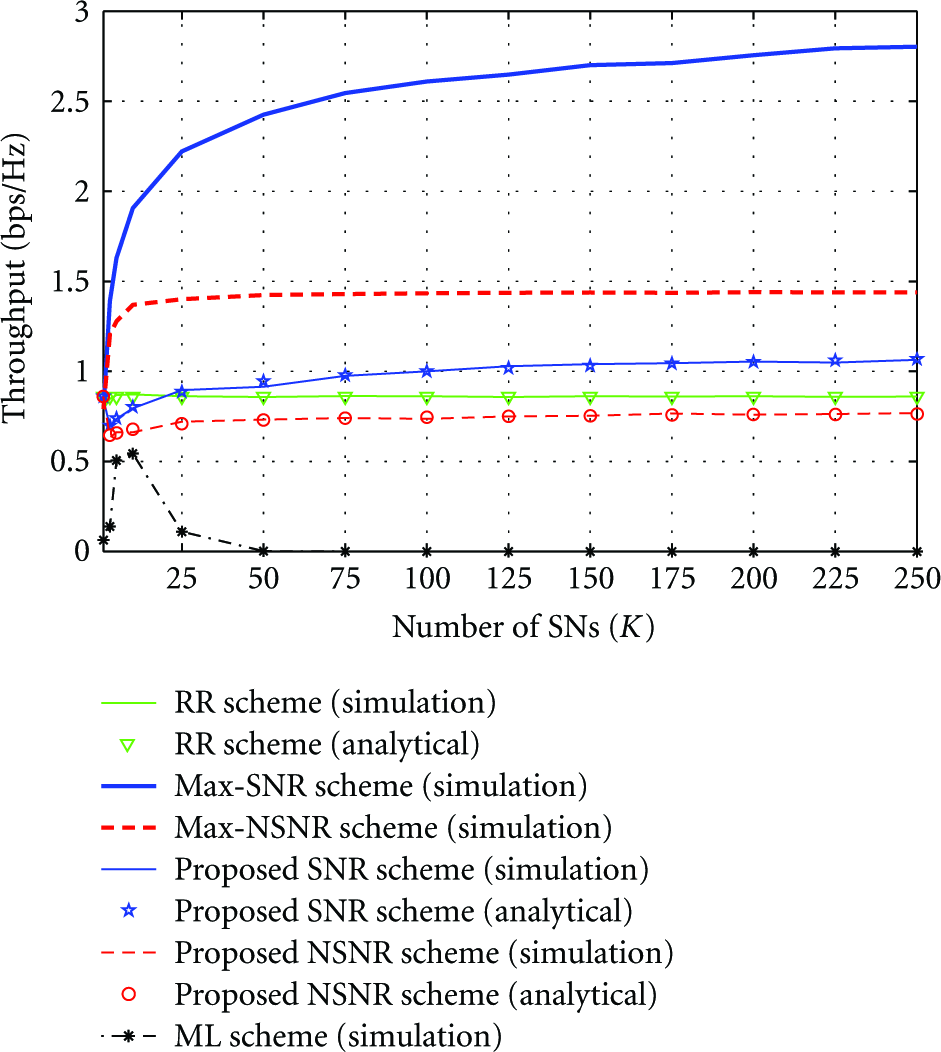
Throughput versus number of SNs in the WSN for
Similarly, Figure 15 shows the throughput performance of proposed schemes versus the number of antennas at the CN for

Throughput versus number of antennas at the CN for
5.4. Energy Efficiency Analysis
In [2], the energy efficiency is defined as the ratio of the number of successful transmissions over the number of transmission attempts. According to this definition, the energy efficiency is related to the minimization of packet loss due to collision. Proposed schemes optimize the probability of successful packet transmission; therefore they are expected to have good performance in terms of energy efficiency. Figure 16 shows the energy efficiency versus the number of SNs for

Energy efficiency versus number of SNs in the WSN for

Energy efficiency versus number of antennas at the CN for
5.5. Fairness Analysis
The throughput maximization could cause unbalanced use of the network resources. In order to improve the service quality, the fairness among the SNs should be maintained. In this study, the fairness is defined as the ratio of the number of SNs successfully transmitting at least in one time slot to the total number of SNs. We measure fairness in the case where the total number of time slots is equal to the number of SNs in the WSN. Therefore, if a different SN transmits successfully in each time slot then the fairness will be %100 as in RR scheme. As seen in Figure 18, the fairness decreases with the increasing number of SNs for the proposed SNR scheme and the ML scheme for
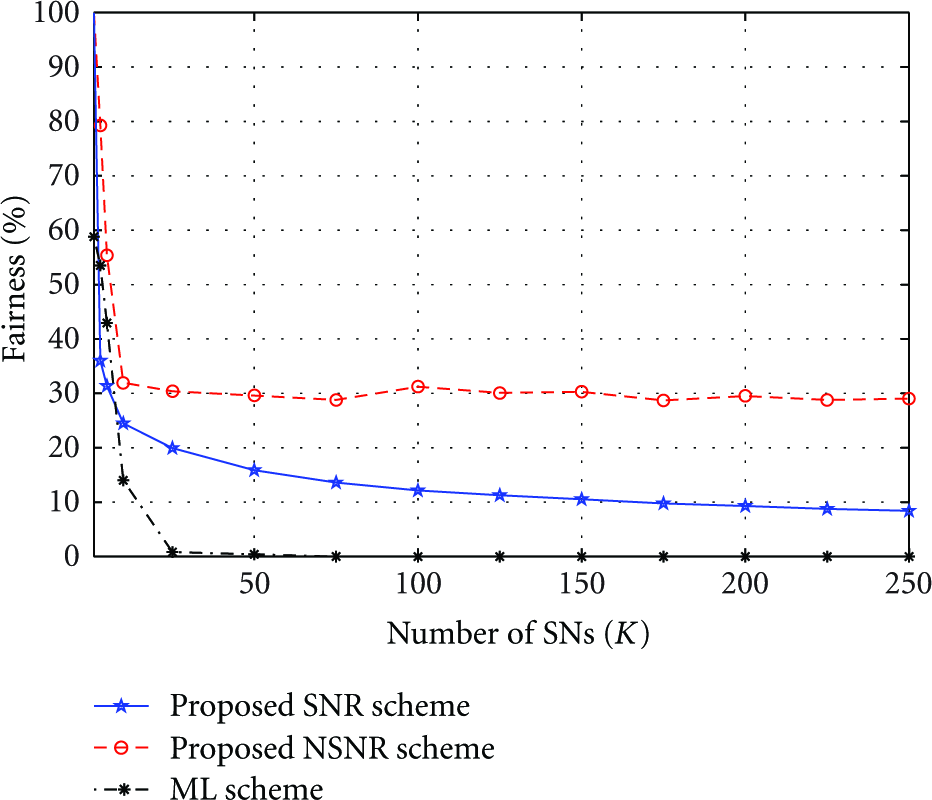
Fairness versus number of SNs in the WSN for

Fairness versus number of antennas at the CN for
6. Conclusion
In this study, we employed an opportunistic packet transmission strategy to exploit MUD gain without the UL feedback channel in an autonomous manner. We proposed a threshold-based opportunistic MAC protocol for WSNs that operates on simplified collision model. Each SN is allowed to transmit only when it has a strong channel gain. The optimum threshold is determined to maximize the probability of successful packet transmission where only one SN transmits packet in the same time slot. Simulation results were provided to show the performance of the proposed schemes. It was shown that the proposed SNR scheme provides higher performance in terms of throughput, while the proposed NSNR scheme achieves better fairness at the cost of a slight performance loss. The simulations also indicate that our implementation achieves higher system performance than existing work in [10] through better optimization of channel gain threshold. We furthermore compared the throughput performance of the proposed MAC protocol with the simple TDMA-based MAC protocol which uses round-robin scheduling. According to obtained results, the proposed SNR scheme also provides higher network throughput than RR scheme as more SNs being deployed. Another important attribute of the proposed MAC protocol is the scalability to the change in network size. In practice, some SNs may die over time and some new SNs may join the WSN later and the time-varying nature of the network size does not affect the performance of the proposed method due to preferred optimization framework. Whereas if the number of SNs dynamically changes in the RR scheme, the scheduling process must be readapted.