




Abstract
Broadcasting is a message-transferring method characteristic for majority of sensor networks. Broadcast encryption (BE) is broadcasting encrypted messages in such a way that only legitimate nodes of a network can decrypt them. It has many potential applications in distributed wireless sensor networks (WSNs) but perfect deploying of that method is very difficult. This is because of a WSN is a very dynamic network which includes nodes with limited computational, storage, and communication capabilities. Furthermore, an attacker in this environment is powerful. He can eavesdrop, modify, and inject messages or even capture a large number of nodes, so the solutions must be both secure and efficient. This paper describes several BE schemes from the point of view of WSNs. We present in details the schemes called onetime, and we show how these methods can be applied in distributed sensor networks. We mainly focus on data origin authentication and rekeying processes, crucial for security in such a hostile environment. An analysis and evaluations of proposed schemes are also provided.
1. Introduction
The popularity of WSNs is an effect of recent advances in communication and development of the microelectromechanical systems (MEMS) technology. Now we have low-cost, low-power, and small devices which are mainly used for sensing, measuring, gathering, and then transmitting data from distributed locations (or an environment) to some acquisition center. Potential applications of WSNs are military (surveillance, command control, reconnaissance, intelligence, etc.), environmental (flood or fire detection, pollution transport, hostile objects observation, etc.), medical (elder people or patients monitoring), and other home and commercial applications. Surveys on the sensor network technology and its applications are presented in, for example, [1–3]. WSNs need communication protocols with special properties. Such approaches must be self-organizing [4], self-healing, fault tolerant, and secure. It is difficult to achieve all these features for devices with as limited hardware resources as wireless sensors are. Therefore the protocols must be additionally lightweight.
Broadcast encryption is an ideal proposition for WSNs. Sending encrypted messages which can be decrypted only by a predefined group of nodes can be very helpful in a WSN. Additionally, with this method we can manage strictly selected nodes [5] or configure them. Furthermore, by BE, we can fix a group of nodes and equip them with a shared key limited to just this group. Since then participants of the group can communicate each other in a secure way. However, BE must be realized in a very efficient and secure way and this is the crucial problem of BE. There are BE schemes using symmetric and asymmetric (public key) cryptography; in this paper, we focus mainly on the symmetric cryptography approaches. As we already mentioned, a typical node in a WSN has very limited resources. A small battery and weak computation efficiency make usage of the public key cryptography (PKC) impracticable. Although there are many BE schemes based on PKC, in further considerations we will not focus on them in this paper. A lightweight PKC is an objective of many research papers, but its implementations are too slow for many applications, see for example, [6–8]. Furthermore, an imprudent application of PKC (or of some other expensive method) can make a wireless network susceptible to denial of service (DoS) attacks. Another crucial resource is memory. Constructing a security protocol, we must minimize amount of a key-storage memory. Next hardware constraint is the radio bandwidth. Because of low-transmission power, messages sent and received should be as short as possible, which gives an advantage to the symmetric cryptography.
In contrast, adversaries in these environments are very powerful [9, 10]. Eavesdropping, modifying, replying, and injecting packets are very easy when radio waves are used as a medium. Moreover, we should assume that an adversary can physically capture a number of sensors or can take control over them. Hence, the BE schemes for WSNs should be resistant to these types of attacks or at least should discover them.
The rest of the paper is organized as follows. We define the BE (with related issues) and present some significant approaches in Section 2. In Section 3, we give detailed overview of the schemes called one-time schemes. Some improvements of these schemes we present in Section 4 and next we analyze them in Section 5. Finally, in Section 6 we give conclusions and propose future research.
2. Broadcast Encryption
BE is some special class of key distribution schemes, which belongs to the conference key distribution protocols. Its goal is to allow a broadcast center (BC) to distribute an encrypted content to an arbitrary dynamically changing set of destination nodes. Only these nodes are able to decrypt messages. Let U be a set of all nodes in a WSN, T be a set of privileged (destination) nodes, and
The BC in a BE scheme uses two types of messages that are sent together. They are a header and a ciphertext. A transmission of these messages is called a session. The ciphertext is a message encrypted with the session key (SK)

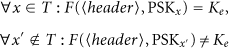
In BE schemes, the length of the
Analyzing security of BE, we need basic definitions and terms. Now we define some of them.
Resiliency
To the set S of a BE scheme means that even if an eavesdropper obtained all preshared keys of nodes from some set S then he can obtain no knowledge about a secret common to the member nodes of any other set of nodes T, for the sets such that
Managing
It is adding, deleting, and revocation of users; it should be performed without a significant overhead.
Backward Secrecy
It is a property of BE which ensures that newly added users (to the set T) are not able to decrypt previous broadcast content.
Forward Secrecy
It means that when a user is removed from the privileged set T, then he is not able to decrypt later broadcast content.
Traitor Tracing
It is a mechanism for identifying traitor users who gave keys (or decrypted ciphertext) to unprivileged users.
BE systems can be classified as stateful and stateless schemes. The stateful approach requires that users are always connected to a broadcast center. The BC is used for keys update. Users in stateless schemes cannot update their keys, so a permanent connection with the BC is not required.
In a distributed WSN environment we need an efficient and secure communication protocol. Since nodes are vulnerable to malicious tampering, the BE approach must be resilient or at least k-resilient for high k. The network management should be very efficient from sensor resources point of view. We must note that in a typical network the nodes are not designed for computing but rather for data transmitting [6]. Thus, to decrease energy consumption, the right strategy is to perform heavy computations at the BC. Wireless Sensor Networks are dynamic by nature, so the backward and forward secrecy must be provided by a BE scheme designed for WSNs. Broadcast encryption is also often used in digital rights management (DRM) systems. For these applications (pay TV, DVD protections, etc.), the traitor tracing feature is very helpful to counteract a copyright piracy. This problem has been addressed in past years in many papers, see for example, [11–15]. Full tracing traitors schemes seem to be too exhaustive for WSNs, which are low cost by nature. Nevertheless, in our review, of BE we treat this function as an advantage of the schemes.
2.1. Related Approaches
The broadcast encryption problem is connected with group key agreement protocols, multicast security, and other constructs designed for secure group communication. Some of these methods can be used to solve the BE problem in sensor networks.
In literature there are many decentralized schemes for key agreement in distributed sensor networks, see for example, [16–18]. They play a similar role as BE but they work in a quite different way, because these protocols' objective is to agree on a key between two nodes (or, eventually, a larger group of nodes) and to achieve this a Broadcast Center is not deployed. Usually, this class of schemes consists of the following phases: pre-distribution, key discovery and path/channel establishment. Pre-distribution is realized during nodes' preparation before the network deployment, but the second and the third phases are realized when the network's nodes are active. Such protocols are ideal for self-organizing applications, but absence of a BC in a key discovery and the path/channel establishment phase may lead to security flaws. In such a case, a malicious attacker can abuse these phases and as a consequence, establish a fake path, revoke some legitimate nodes or perform DoS attack for example, by sending many discovery messages. Ramkumar in [19] described a BE scheme based on a random key pre-distribution. His solution is also decentralized and it does not need the PKC. In further considerations we will concentrate on a group key agreement driven by a broadcast center but the solutions based on the PKC are also noteworthy.
Other efficient constructs in related problems of key distribution are presented in [20]. Besides, introducing a novel authentication scheme, this paper presents a performance comparison of several authentication schemes (including PKC approaches). Brooks et al. in [21] introduced a special infrastructure for security in sensor networks. A network is partitioned into special regions with a chosen node as a key server. Further, within these regions a secure multicast communication is performed.
Papers [22, 23] present surveys of key management schemes in WSNs. The performance of selected schemes is also presented in [24]. A general conclusion from the above reviews is that no key distribution technique is ideal to all scenarios where sensor networks are used. A key distribution protocol selection must depend on a specific network's application, its resources, and characteristics.
2.2. The Broadcast Encryption Schemes
Let us assume for the rest of the paper that
The next class of protocols are tree-based schemes. This type of secure group communication was proposed independently in two papers. The paper [27] focuses on binary trees, while the paper [28] assumes the degree of the tree as a parameter. The keys are derived by a symmetric cipher and the properties of these protocols are similar. Each user needs to store

Tree-based broadcast encryption (forming and revocation processes).
Some attempts of reducing the nodes' key storage and eliminating the rekeying process are presented in [32]. Another hierarchical scheme that was designed to increase efficiency can be found in [33]. Daza in [34] presented a BE approach for mobile ad-hoc networks. In his method the transmission overhead is low, but the approach bases on a secret-sharing scheme and the ElGamal-based PKC. The method is interesting but the application of PKC makes it too expensive for standard sensors. In paper [35] Yoo et al., basing on polynomial interpolations, increased the efficiency of the Naor-Pinkas scheme [14]. Their protocol requires
Sometimes users (nodes of a network) are represented in an alternative way. For example, a novel approach where the set of privileged users is described by attributes, was introduced in [36]. Each node has a set of attributes and a decryption key depends on this set. The advantage of that proposition is that BC can revoke a group of the nodes (not only a single one) sending messages of a size linear with respect to the number of all attributes. It is realized by decryption and restriction of access policy, driven by AND/OR functions on attributes. This solution is resilient and the attributes make it easy to manage, but the challenge is to construct an efficient attribute-based encryption scheme. Another approach is the BE scheme proposed in [37], which operates on users' profiles. It is realized by introducing different types of broadcasts with corresponding probabilities. For each user his profile is created, which denotes probabilities that the given user will subscribe the given broadcast. Next, using profiles, the scheme can optimize some popular tree-based BE protocols. In particular, the solution can reduce a bandwidth required by the complete subtree and by the subset difference approaches. This reduction is significant when the scheme allows some unprivileged nodes to decrypt a content. A tradeoff between storage and communication in BE schemes is an important subject of research. The results of this aspect are presented in papers [38–40]. It is especially important for such environments like a WSN, because of nodes' limitations. A rational tradeoff between a number of preshared keys stored in each node and a volume of broadcast transmission is crucial especially for Wireless Sensor Networks.
3. The One-Time Schemes
The one-time schemes were chronologically the first solutions for the BE problem. We say that a protocol is one time if, while using this protocol, PSKs must be updated after every usage. Generally, this is treated as a disadvantage but we will show that the key update after a session period can provide us some additional security benefits. Moreover, such protocols are very efficient from the storage overhead point of view. In majority of one-time solutions, a node needs to store
Chiou and chen in the paper [41] introduced methods for the BE using a secure lock. Their paper presents public-key and symmetric-key based broadcast protocols. The lock is constructed in such a way, that only a privileged node is able to open it. The construction is based on the Chinese Remainder Theorem (CRT). Each user belonging to T (a privileged node) adds its congruence equation to a set. The system of such equations must be solved by each node to obtain a common secret. The CRT is used as the solution algorithm. Unfortunately, the computational overhead of this scheme is acceptable only for very small groups of nodes, and it is definitely too expensive for sensors with limited capabilities.
Protocols presented by Berkovits in [42] belong to first authentication solutions for BE. The methods are based on two threshold secret sharing schemes: the Shamir's scheme [43] and the Brickell's scheme [44]. We will shortly describe only the first scheme; the second one has similar properties. The Shamir's method uses the polynomial interpolation. Each ith user has the point it selects the random secret it finds a polynomial P of degree it broadcasts
By the Lagrange interpolation polynomial, any privileged user is able to calculate
4. The One-Time Scheme with Additional Capabilities
In this section, at first we will propose methods for keys generation. We will show how a broadcast center and nodes can use a session key and preshared keys to achieve security goals (secret communication). Next we will consider the aspect of the source authentication. We will describe some popular methods realizing this security service that is crucial, especially for WSNs. Adequate keys management and authentication can really improve security and efficiency of BE schemes. The methods that will be proposed in this section are applicable in different schemes but we will show them in case of the Berkovits scheme [42] described in Section 4. Security analysis of the improvements proposed will be presented in Section 5.
Now, let us introduce a notation required in the rest of the paper:
In the Berkovits' scheme, a node needs to store one secret point (a point of the polynomial's graph) that is coded as a block of bits. In each session, that point must be updated. During network's operation, one must enumerate the updated session keys. Let's assume that:
4.1. PSK and SK Derivation
As mentioned before, users using a one-time scheme must update keys every session. Now we describe this process. Let us define a generic function

Method I
The first approach is simpler and therefore fast. In this solution, we define a key update as


Method II
The second method is more secure, but sometimes it requires more computations. The key derivation is realized as follows:


4.2. Source Authentication
Providing strong authentication in a distributed sensor network is a hard task [45]. To do this one must at first modify the broadcast message


The PKC Approach
PKC provides us digital signatures. It is an ideal method to authenticate BE messages, but only when the sender's resources are able to do this. The BC authenticates the broadcast traffic by signing it:

The Standard Approach
Because PKC in WSNs is not recommended, we must use symmetric methods. Assume that

The Enhanced Approach
Now we want to improve the standard approach presented above making it useful for WSNs. We propose to attach the list of privileged nodes T to the broadcast message. Additionally, we XOR the session key


5. Analysis
Now, we will analyze the foregoing methods. We will start from analyzing functions of the BE scheme, next we will focus on the rekeying process and the authentication approaches while an analysis of security and performance will summarize this section.
The BE Functions
A newcomer is a node which is new in a privileged set in an actual session. j is the number of newcomers, and i is the number of an actual session. When we want add nodes to a privileged set, a natural way is to create a new set T, a new SK and a new
Efficient deletion of nodes from T is one of the hardest tasks in BE protocols. Nodes leave, fail and sometimes we want to revoke malicious nodes. Presented BE scheme does not provide an efficient deletion function. If we want to delete some nodes then the BC must make a new session without these nodes. When we want to delete some nodes the BC must make a new session without these nodes. In that operation the forward secrecy is ensured. The BC generates a new SK independently, so the revoked node cannot decrypt present and future messages. Such an operation requires
An interesting solution for improving the performance of revocation is forming subsets of privileged nodes. We can divide T into several subsets and perform a BE scheme on these subsets separately. This way we achieve subkeys and now we can repeat the process until we will generate a common SK. That strategy is related to tree-based schemes that are described in Section 2, or to other hierarchical constructions. Such a method can be used for pairwise key derivation in tree-based settings. Thus, the overheads are similar to overheads in other tree-based solutions presented in Section 2.
A traitors-tracing service known from DRM systems is not available, but the scheme allows to trace the source of a preshared key leak. When a pirate node uses a passed SK to decrypt the content, we are not able to determine the source of the leak. However, the SK for any session is different, so a traitor must pass a SK in each session. In a WSN it may be discovered by an anomaly detection or an intrusion detection system. More serious is an adversary's active attack. A privileged node can be captured and its session can be cloned into other nodes. Now an attacker is able to decrypt the traffic. When we detect a piracy hardware and tamper it, we can determine which node was captured. The BC keeps all seeds and actual keys of the node what requires
Rekeying versus Not ReKeying. BE schemes are designed to hold backward secrecy and forward secrecy properties in a sense of protection of unassigned messages against users joining or leaving the privileged set. However, in WSN-like applications, we should be more demanding. Consider a situation presented previously when an adversary captures a privileged node. It is standard assumption in environments like sensor networks. If a BE protocol does not require rekeying in each session, then an adversary having PSKs of a privileged node and its previous traffic can decrypt it all. In networks, where an adversary has capabilities to compromise nodes, we need backward secrecy assurance. To achieve this property, we must deploy some method of rekeying. We presented two approaches: in (4b) and in (5b). By solution given in (4b), we can generate a key of any session and at any moment. It is fast, but after compromising PSKs, also an adversary is able to obtain a key of any session. The approach given in (5b) holds backward secrecy. An actual user's key is produced from the previous key
Authentication
In this paragraph of the paper, we will present an analysis of authentication schemes presented in Section 4. We omit authentication schemes based on PKC due to reasons mentioned throughout the paper and we will focus on symmetric methods of authentication that are very efficient in WSNs, see for example, [47, 48]. At first we consider standard approach from (9). It is a good method when authentication is realized between two parties. When a large group shares the same authentication key, each member can send or modify a message and the authentication will pass. We can improve (9) by a concatenation of the key
Now, we will analyze next authentication method given in (10), which improves the previous one. The BC broadcasts the following message authentication of a fake message will pass if and only if the list of receiver nodes contains only compromised nodes, if an adversary adds an uncompromised node to the receivers' list then that added node is able to detect the forgery.

This means that a source which broadcasts a content must know all PSKs of the set of nodes T he declared, otherwise a regular node from that list can detect a forgery. However, the node processes a message only if it is on declared in the list, so a fake messages will not desynchronize a session. These features make our authentication scheme very useful in broadcast communication.
Security and Performance
Now we consider security of the scheme given in (10).
Security of Scheme based on Shamir's Secret Sharing Scheme which is perfect secure (information-theoretic secure) [42, 43].
Construction is resilient [42], so an attacker cannot obtain a session key.
Now we should consider confidentiality and integrity of the scheme.
Assume that encryption
Then, Theorems 4.4 and 3.2 from the paper [49] imply that construction from (10) is IND-CCA secure.
Now, we evaluate performance of our scheme. We assume that we use the presented scheme in tree-based setting (Figure 1), and we compare it also with the stateful tree-based broadcast encryption. We also assume that its security level is 128 bits. According to the properties of the schemes, their transmission and storage overheads are the same. The only difference is a computational overhead in the pairwise keys agreement process. The standard solutions use cryptographic primitives, thus for tests we chose assembler implementation [48] of the AES [50] block cipher. The polynomial interpolation required was implemented in C. ATmega1281 Microcontroller (with 8 MHz clock speed, 8 KB of RAM and 128 KB of Flash) was selected as a characteristic platform for a regular node in the sensor network. One pairwise rekeying function takes 0.4 ms on each sensor using the block cipher. At the same platform, the polynomial interpolation takes less than 0.1 ms. The implementation of the polynomial interpolation needs only 1329 bytes, while the AES uses 2141 bytes of storage.
6. Conclusions and Future Research
In this paper, we considered the BE problem in distributed wireless sensor networks. We defined the problem, described main existing solutions, and next focused on one-time schemes, a type of schemes that are most suitable for WSNs. The one-time schemes are resilient, that is essential in such applications. Such protocols are very attractive for WSNs also in other respects. Their storage overhead of the range
In this paper we extended the specific Berkovits' scheme [42], but we did not stress this fact, because our modifications are mainly generic and can be adopted in majority of BE schemes. The scheme used is relatively fast but in future research we will focus on designing more efficient one-time BE schemes. The new constructions will be dedicated to sensor networks. Another interesting subject of research is the freshness aspect in BE. It ensures that data transmitted is fresh beside of being confidential and authentic. Compiling the security services of data confidentiality, authenticity and freshness will make BE protocols more secure remaining them lightweight.
Footnotes
Acknowledgment
This work is partially supported by the National Science Center (NCN), under Grant with decision's number DEC-2011/01/N/ST7/02995 and by the 7FP NoE EuroNF project.