




Abstract
The Machine-to-Machine (M2M) communications allow information exchange between machine devices, which can be carried out without any human interaction. However, there are a large number of small and low-power machine devices in the wireless M2M networks. To guarantee the quality of service (QoS) requirements of the destination devices, we study the amplify-and-forward (AF) relay beamforming, where multiple relay M2M devices can transmit signals from the source M2M device to multiple destination M2M devices. In this paper, we propose two iterative strategies to jointly optimize the source antenna selection and the collaborative relay beamforming weights with the aid of perfect channel state information (CSI). The aim of the proposed strategies is to maximize the worst-case received signal-to-interference-and-noise ratio (SINR) under two different types of relay power constraints, which are the total relay power constraint and individual relay power constraints, respectively. Using the semidefinite relaxation (SDR) technique, the optimization problem of collaborative relay beamforming can be formulated as a semidefinite programming (SDP) problem, which can be optimally solved. Simulation results validate our theoretical analysis and demonstrate that after several iterations, the performance of the proposed iterative strategies can obtain near-optimal performance.
1. Introduction
Machine devices, such as sensors, communicate with each other in machine-to-machine (M2M) networks, which do not need intervention from human beings [1]. A wireless M2M device may act as a source point and communicate data packets on behalf of the other M2M destination devices [2]. However, the wireless M2M networks are composed of a large number of small and power-limited machine devices, which can only transmit low-power signals. Due to the propagation loss between the source devices and the destination devices, it is very challenging to guarantee the quality of service (QoS) requirements of the destination devices. Recently, many increasing researches showed interest in the relay devices to deal with this problem [3]. The sources transmit signals through one or more relay devices towards the destination devices in wireless M2M networks. Relay devices can be designed to work collaboratively to guarantee the QoS requirements by forming a virtual beamforming system [4, 5].
In general, there are three types of relay schemes, including the amplify-and-forward (AF) [6], decode-and-forward (DF) [7], and compress-and-forward (CF) [8] schemes. In the AF scheme, relay nodes receive the signals transmitted from the source and forward the amplified signals to the destinations. In the DF scheme, relay nodes decode and reencod the received signals to the destinations. In the CF scheme, relay nodes send quantized and compressed signals to the destinations. Among them, the AF scheme is the most attractive for the collaborative relay beamforming due to its low implementation complexity. With the aid of channel state information (CSI), the relay nodes can work collaboratively in a way similar to a multiple antenna systems to construct virtual beams towards the destinations [9].
In this paper, we study the collaborative relay beamforming for multiple destinations in the multiple relay M2M networks, where multiple relay M2M devices form virtual beams to transmit signals from a source M2M device with multiple antennas towards multiple destination M2M devices. Firstly, we present two methods to select the source antenna to transmit the destination's signals. In Method
According to our proposed iterative strategies, the source M2M device must know all the CSI of the wireless M2M networks to jointly optimize the source antenna selection and the relay beamforming weights. However in practice, the feedback channels are always limited and could be overloaded if the number of relays and destinations is large. To deal with this practical problem, Choi [12, 13] studied the distributed AF relay beamforming schemes for the single destination where the relays can work cooperatively to form a virtual beam with local CSI (The local CSI means that each relay node knows its instantaneous incoming and outgoing channel coefficients (from relay nodes’ point of view). However, the CSI of the other relay nodes is assumed to be not known.) when a consensus algorithm was employed in [12], and different MMSE criteria were proposed in [13]. D. H. N. Nguyen and H. H. Nguyen [14] proposed two relay power allocation schemes in a distributed manner to minimize the sum relay power with guaranteed SNR at the destinations and maximize the SNR margin subject to individual relay power constraints, respectively, under the orthogonal transmissions of each source-destination pair. In the end of this paper, we discuss the distributed multirelay beamforming strategy to maximize the worst-case received SINR for multiple destinations, where each relay may independently calculate its beamforming weight with the local CSI.
The rest of this paper is organized as follows. In Section 2, we present a brief discussion of related works on relay beamforming which motivated our work. Section 3 describes the multiple relay M2M networks with multiple destinations. Section 4 presents two methods to select the source antenna for each destination. In Section 5, we optimize the multi-relay weights that achieve the maximum worst-case SINR under two different types of relay power constraints. Then, two iterative strategies to jointly select the source antennas and optimize the multirelay weights are proposed, respectively. Section 6 presents and analyzes the simulation results. The distributed multi-relay beamforming strategy is discussed in Section 7. Conclusions are drawn in Section 8.
Notation.
Vectors are written in boldface lowercase letters, for example,
2. Related Works
Andreev et al. [2] studied a typical smart metering M2M application and proposed a client relay scheme to improve the performance of M2M devices with poor communication link. Khajehnouri and Sayed [3] designed relay strategies in sensor networks with minimum mean square error (MMSE) performance subject to local and global relay power constraints, respectively. Elkheir et al. [15] presented an M2M communication scheme, where the source communicates with the corresponding destination node with the help of one or more relay nodes. The objective in [15] was to minimize the total relay power under specific performance constraints and the individual power of each relay. Zheng et al. [16, 17] proposed the relay beamforming schemes that achieve the maximum received signal-to-noise ratio (SNR) for a single destination under both total and individual power constraints with the aid of perfect CSI [16] and imperfect CSI [17]. In addition, distributed beamforming for AF relay nodes was investigated when a consensus algorithm was employed for cooperative beamforming in [12], and the minimum mean square error (MMSE) criteria were used in [13].
However, existing approaches focused on relay strategies with the single or multiple relay beamforming for only one destination in wireless M2M networks or sensor networks. The relay M2M devices can be used to support multiple destinations for the M2M communications. Nguyen et al. [18, 19] studied the optimal relay beamforming schemes in a multiple AF relay cooperating network with multiple source-destination pairs. The aim in [18] was to minimize the total relay power under the signal-to-interference-and-noise ratio (SINR) requirement at each destination. In [19], Nguyen et al. minimized the sum relay power with the guaranteed QoS in terms of SNR at the destinations in orthogonal channels. Liu and Petropulu [20] studied the relay beamforming to minimize the sum transmit power at the relays with multiple pairs of the source and destination, assisted by multiple relays. Zheng and Blostein [21] considered the collaborative relay beamforming system to minimize the sum power at the relays and the transmit power at the source, where a single source with multiple antennas transmits signals to multiple users through multiple single-antenna relays. Phan et al. [22] studied the joint power allocation and AF relay selection problem to maximize the destination rates and minimize the total transmit power at the relays, respectively, for multiple destinations in multiple orthogonal source-destination pair networks.
The main difference between our work and the works in [18–22] is that we present two methods to select the source antenna and optimize the relay beamforming weights to maximize the worst-case received SINR under two different types of relay power constraints, which are the total relay power constraint and individual relay power constraints, respectively, while the proposals in [18–21] were to minimize the total relay transmit power under the QoS of destinations, and Phan et al. [22] maximized the destination rates and minimized the total transmit power at the relays, respectively.
3. System Model
We consider a multiple relay M2M network consists of a source with L antennas, M relay nodes, and K destinations each with a single antenna as shown in Figure 1, where
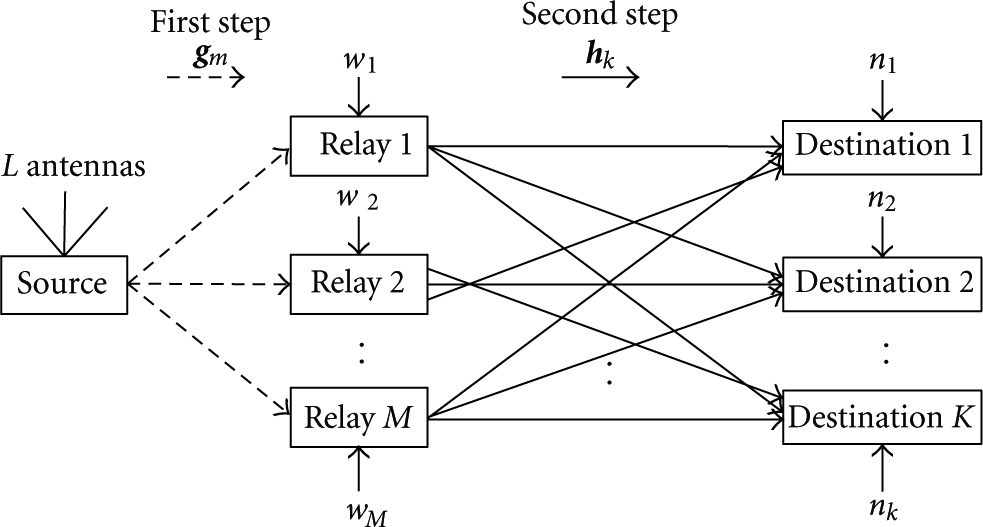
The multiple relay M2M networks with multiple destinations.
It is assumed that the AF relay protocol has two steps. During the first step, the source selects the best available antenna to broadcast the kth destination's signal
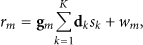
where
Then, during the second step, the relay nodes forward the received signals to the destinations using complex weights

The destination k receives the additive signals from all the relay nodes, which is given by

where

where

4. Source Antenna Selection for Each Destination
In this section, we present two methods to optimize the source-antenna selecting vector
In Method
In Method
In our methods, the computational complexity of selecting one antenna scales linearly with the dimension of channel matrix
5. Iterative Strategies for Max-Min SINR with Relay Power Constraints
In this section, we assume that the source-antenna selection vector
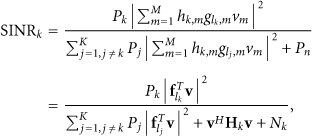
where
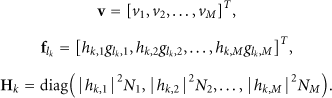
In the following, we optimize the multi-relay beamforming weights to maximize the worst-case received SINR for multiple destinations and propose the iterative strategies under two different types of relay power constrained in the multiple relay M2M network. We first investigate the case where the total relay power is limited, and then study the scenario where the individual relay transmit power is constrained.
5.1. Total Relay Power Constraint
In this subsection, we optimize the multi-relay beamforming weights for multiple destinations under a total relay power constraint
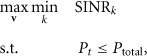
For the optimum, we can formulate the problem as
where


In order to guarantee the QoS for multiple destinations, we consider the maximization of the worst SINR among all destinations in (8). However, the object function of the optimization problem (8) is quasi-convex. Directly solving Problem (8) is usually difficult due to its nonconvexity. We could adopt the bisection search algorithm to efficiently find the optimal solution of Problem (8). Specifically, we could solve a sequence of the following feasibility problems for each given

Denote the optimal solution of (8) by
With the received SINR in (6) and the total relay transmit power in (9), we can express Problem (11) as

Using the definition

where
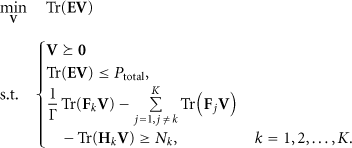
Note that Problem (14) becomes an SDP problem, which can be optimally solved using interior-point methods, whose computational complexity is polynomial [11]. As shown in [24], for a given solution accuracy ϵ, the interior-point methods need at most
The solution of the SDP problem in (14) provides a lower bound of the objective function in the original problem in (13) due to excluding the rank-one constraint. However, in our extensive simulations, we have never observed that the optimal solution of Problem (14) has a rank higher than one. The similar observation was also reported in [18] and [25] to design the optimal beamforming schemes. Thus, the original problem in (13) can be optimally solved. For the cases where Problem (14) has a rank higher than one, several randomization techniques [26] can be used to provide a good approximation solution
Based on the above results, we propose an iterative strategy (see, Algorithm 1) to jointly select the source antennas and optimize the multi-relay beamforming weights with the total relay power constraint for multiple destinations.
1: Initialize 2: 3: Initialize the multirelay beamforming weights is a uniform random variable chosen from the interval [0, 2π]. 4: Apply Method 1 or Method 2 in Section 4 to select the source antenna for each destination with the current fixed relay weights. 5: Optimally solve Problem (14) with 6: If Problem (14) is feasible, then obtain the optimal solution 7: 8: obtain the multirelay beamforming weights vector which is the optimal solution of the original problem (11). 9: 10: obtain the multirelay beamforming weights vector using the randomization techniques. 11: 12: If the total relay power is sufficiently close to a fixed point, or the iteration number exceeds a predetermined number, then stop the iteration and go to Step 13. Otherwise go back to Step 4. 13: 14: 15: 16: 17: 18: 19: the multirelay beamforming weights vector
According to [11], the bisection search method requires
5.2. Individual Relay Power Constraints
In this subsection, we study the scenario where each relay power is constrained by
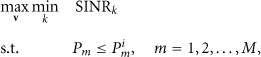
We can formulate the problem as
where

Since the optimization problem in (15) is quasi-convex, we can also obtain the optimal solution of (15) by repeatedly solving the following problem using the bisection search method to search for the

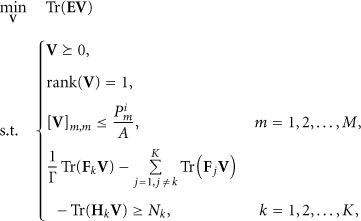
With the received SINR in (6) and the mth relay transmit power in (16), we can express Problem (17) as

Using the definition
where

Note that Problem (20) can be optimally solved with a polynomial time complexity [11]. As shown in Section 5.1, the computational complexity of Problem (20) is the same as that of Problem (14), which is
In the following, we propose another iterative strategy to jointly optimize the source-antenna selection and the multi-relay beamforming weights with the individual relay power constraints for multiple destinations.
According to [11], the complexity of Algorithm 2 is
1: Initialize 2: 3: Initialize the multirelay beamforming weights a uniform random variable chosen from the interval [0, 2π]. 4: Apply Method 1 or Method 2 in Section 4 to select the source antenna for each destination with the current fixed relay weights. 5: Optimally solve Problem (20) with 6: If Problem (20) is feasible, then obtain the optimal solution 7: As shown in Algorithm 1, obtain the multirelay beam- forming weights vector 8: If the total relay power is sufficiently close to a fixed point, or the iteration number exceeds a predetermined number, then stop the iteration and go to Step 9. Otherwise go back to Step 4. 9: 10: 11: 12: 13: 14: 15: the multirelay beamforming weights vector
6. Simulation Results
In this section, we present simulation results to validate the performance of our iteration strategies for multiple destinations in the multiple relay M2M networks. It is assumed that the flat channel coefficients
In Figure 2, we compare the performance of the proposed iteration strategies for different values of the total relay SNR of
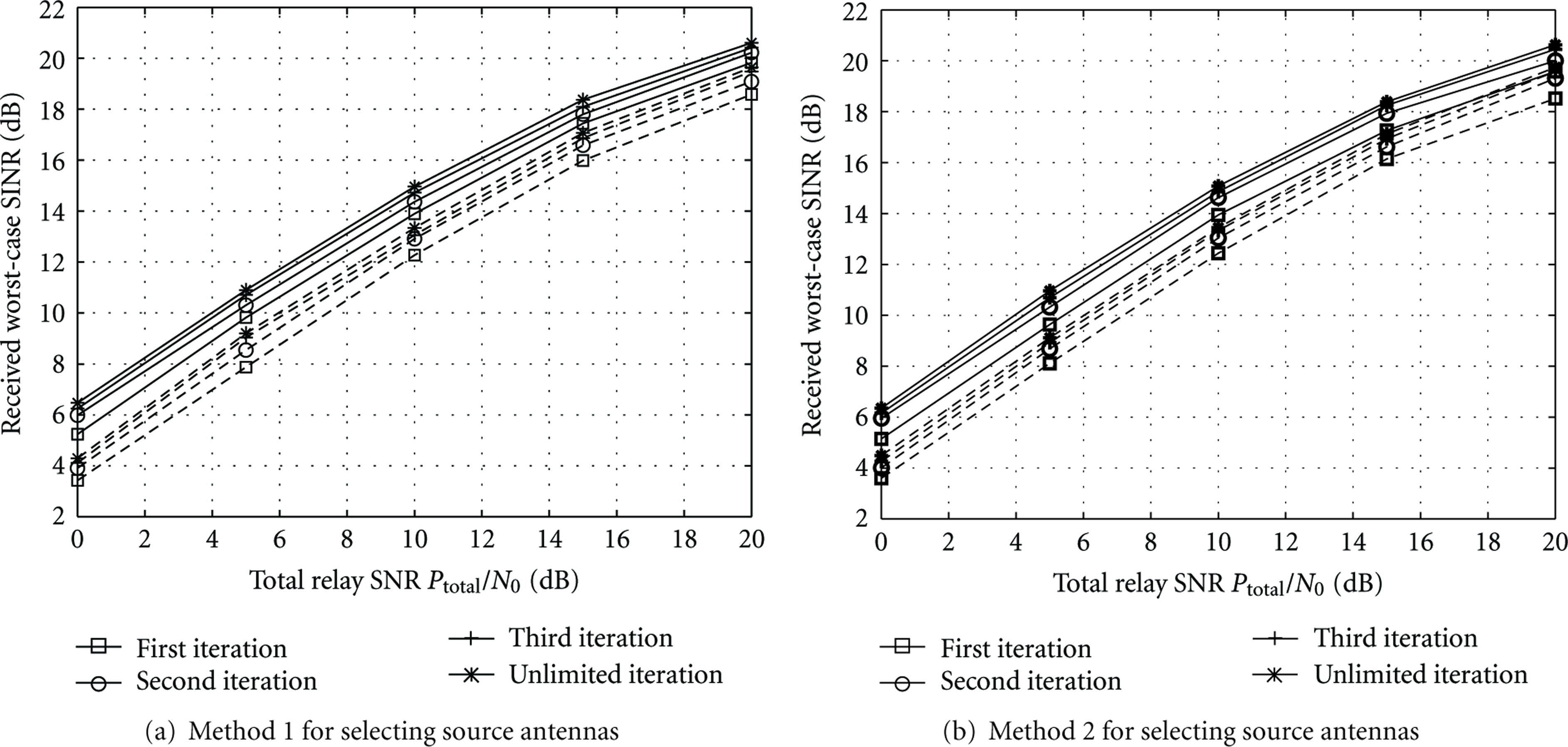
Expected worst-case received SINR of the proposed iteration strategies with the total relay power constraint (solid lines) and the individual relay power constraints (dashed lines) for different numbers of iterations.
Figure 3 demonstrates the worst-case received SINR results for the proposed iteration strategies with different values of the total relay SNR of

Expected worst-case received SINR of the proposed iteration strategies with the total relay power constraint (solid lines) and the individual relay power constraints (dashed lines).
7. Discussion
In the above results, the source M2M device must calculate the collaborative relay beamforming weights with the aid of perfect CSI and then broadcast them to the relays, respectively. Thus, the perfect CSI from the source to relays and from relays to the destinations needs to provide feedback to the source M2M device. The source can also know the noise level of relays and destinations from feedback channels. However in practice, wireless M2M networks, the feedback channels are always limited and could be overloaded if the number of relays and destinations is large. To deal with this issue, we can develop the distributed relay beamforming strategies to reduce the CSI exchange and allow each relay to learn its beamforming weight based on the local CSI. It is assumed that each relay node can learn the local CSI from the source by training and from destinations by feedback, respectively, and measure its noise level. In [16], a distributed strategy with local CSI is proposed for maximizing the received SNR at the single destination based on the Karush-Kuhn-Tucker (KKT) analysis. For the optimization problem of the received SINR at destinations, most previous works have focused on reducing the CSI exchange overhead. Instead of the instant CSI feedback, statistical channel information and partial CSI feedback are used in [28]. In [29], the CSI exchange overhead is drastically reduced by partitioning relays into two clusters which have different needs for CSI for calculating the relay beamforming weights. However, distributed relay beamforming strategies with the local CSI for maximizing the worst-case received SINR at multiple destinations have not been intensively discussed. In order to derive distributed beamforming strategies for the received SINR problem in the nonorthogonal systems, we can consider another criterion, that is, MMSE criterion to construct distributed relay beamforming strategies in [13] and [30]. It has been proved to be adopted for the single destination in the multiple relay systems to develop distributed beamforming strategies with the local CSI [13] and can be expected to be suitable for multiple destinations [30]. It is demonstrated that the MMSE minimization problems can be converted into the maximization of the worst-case SINR problems. Thus, in the future work, we can develop the maximization of the worst-case SINR distributed relay beamforming strategies by using the MMSE distributed beamforming strategies.
8. Conclusion
In this paper, we proposed two iterative strategies to jointly optimize the source-antenna selection and the AF relay beamforming weights with the guaranteed QoS in terms of SINR for multiple destinations in wireless M2M networks. We presented two methods to select the source antenna for each destination: (1) use the greedy algorithm to select the best available channel for each destination; (2) balance the channel condition for each destination and its interference to the other destinations based on Method
Footnotes
Acknowledgment
This work has been supported by the National Basic Research Program of China (973 Program, no. 2009CB320403).