




Abstract
RFID events are a large volume of stream data that continuously come out for tracking and monitoring objects. Many studies have been done to detect a complex event in the RFID stream. However, the existing studies have many problems which increase unnecessary operations when complex events do not satisfy minimum conditions. In this paper, we propose a new scheme to detect complex events when the minimum conditions are satisfied to remove unnecessary operations. To check the minimum conditions of the complex events, we register complex queries in a query index. We detect complex events using the query index and bitmap. To demonstrate the superiority of the proposed method, we compare it with the existing methods through various experiments. As a result, it is shown that the proposed method outperforms the existing methods as a whole.
1. Introduction
RFID data are a large volume of stream data sensed by RF waves continuously for tracking and monitoring objects [1]. RFID tag has an identifier corresponding to its object. RFID readers can recognize a number of tags without any limitation at the same time. Sensor devices such as wireless motes and RFID readers are gaining adoption on an increasing scale for tracking and monitoring purposes [2, 3]. The wide deployment of these devices will soon generate an unprecedented volume of events. An emerging class of applications such as supply chain management, security, indoor location service, healthcare, and environmental monitoring requires the events to be filtered and correlated for complex pattern detection [4–7]. They require to be transformed to new events that reach a semantic level appropriate for the applications [8]. These requirements constitute a distinct class of queries that translate data describing a physical world into information useful to the end applications in real time [9].
RFID systems access other RFID systems to get information for tags. RFID events are divided into primitive events and complex events [10, 11]. A primitive event is the information of a tag recognized by an RFID reader. A primitive event consists of the identifier of a tag, the identifier of a reader, and a timestamp that the reader recognizes the tag. For example, we assume that a reader R is established in front of a building and the reader detects an object O at the time t. It is represented by (R, O, t). A complex event is a semantic event which consists of primitive events for application services. Primitive events are originated from the past to the current. Therefore, historical primitive events must be maintained to organize complex events. It is required to process the complex event that is composed of the historical primitive events [8, 12].
In recent, complex query processing schemes have been studied to detect a complex event over RFID stream. Moon et al. developed an RFID business aware framework for extending RFID events using business rules [13]. The work of [13] proposed the RFID complex event definition tool (Biz EDT) which provides drag-and-drop support to define activities and their flows and to generate complex events by a graphical user interface. Demers et al. designed and implemented the Cornell Cayuga System for scalable event processing [14]. The work of [14] proposed a query language based on Cayuga Algebra for naturally expressing complex event patterns. Bai et al. proposed a stream query language to process RFID events by extending an SQL-based stream query language with temporal operators and related constructors [3]. Wu et al. proposed a complex event language, called SASE and a query plan-based approach to efficiently implement this language [8]. The SASE is a declarative language which consists of a subset of six operators such as sequence scan, sequence construction, selection, window, negation, and transformation to satisfy the needs of RFID monitoring applications. Kawashima et al. extended SASE to calculate the confidence of complex event pattern outputs which are emanated from primitive physical events stream with noise information [15]. Wang et al. developed a graph-based RFID complex event detection scheme called RCEDA. To process the complex events, Wang et al. formulated a declarative rule based approach for the powerful support of automatic RFID data transformation between the physical world and the virtual world [16]. RCEDA generates pseudoevents when events are detected to process nonspontaneous events.
However, the existing schemes perform unnecessary operations to detect the complex events in the large-scale primitive events occurred from a lot of readers. It causes the low throughput and outputs with low quality. In this paper, we propose a novel processing scheme to efficiently process the large-scale complex events. To enhance the existing complex event processing schemes, we define the minimum conditions for complex events and identify complex events to know whether they satisfy the minimum requirements from all the compositions of complex events or not. The complex event is a logical event that combines a number of primitive events using the predefined event operators for serving RFID business applications. We use many event operators like AND (∧), OR (∨), NOT (!), SEQUENCE (:), INTERVAL (;), and so on. When the conditions are just satisfied, the operations for detecting the complex events are invoked. To check the minimum conditions of the complex events, we register them into the grid structure and detect them with a query index and a bitmap structure. Because the proposed scheme performs just operations only when the minimum requirements are satisfied, the number of operations is reduced and unnecessary operations are removed.
The rest of the paper is organized as follows. Section 2 introduces the related work of our paper. Section 3 presents the proposed complex event processing which treats the complex events as continuous queries to organize the query index. Section 4 describes experimental evaluation results to show the superiority of our approach. Finally, Section 5 concludes the paper.
2. Related Work
RFID events are divided into primitive events and complex events. A primitive event provides the information of RFID tags. A complex event is a composite logical event for an application. A primitive event is the information of a tag sensed by an RFID reader. A primitive event consists of an identifier of the tag, an identifier of the RFID reader, and a time sensed by the RFID reader. For example, we assume that an RFID reader R is established in front of a building and detects an object O at the time t. It is represented by (R, O, t). RFID tags can be grouped into units of similar patterns by the EPC code [17]. Also, readers can be managed by some groups according to their roles and positions. Services process complex events that consist of primitive events.
A complex event is a logical event that consists of primitive events for application services. A primitive event is originated from the past to the current. Thus, a historical primitive event must be maintained to organize complex events. It is required to process a complex event that is composed of historical primitive events. For example, we assume that a library processes complex events for borrowing books. If a book
Event operators to make a complex event.

Wang et al. proposed a graph-based RFID complex event processing algorithm, called RCEDA using a graph-based computation model [10, 16]. RCEDA defines the specification and semantics of RFID events and rules and constructs a graph representing the events. In each rule, RCEDA constructs an event graph with leaf nodes representing primitive events, internal nodes presenting complex events, and edges linking constituent events with parent complex events. For each event graph, if there is any internal constraint defined on an event node, event node's internal constraint is propagated to all the descendant nodes. Interval constraints are propagated top-down in the event graph, where internal constraints define set to be the minimum of the current interval constraint and that of its parent event node. RCEDA generates pseudoevents in event detection to process temporal constrained nonspontaneous events generated from SEQ+ and NOT constructors, where a pseudoevent is a special artificial event used for querying the occurrences of nonspontaneous events during a specific period, and is scheduled to happen the expiration time of an event node. When pseudoevents are created, they are put into a sorted pseudoqueue according to their scheduled execution timestamps. The incoming RFID event queue is ordered by their observation timestamps. When the event engine fetches an event, it always fetches the earliest event from the two queues.
Gyllstrom et al. proposed SASE that processes a complex event over real-time streams of RFID readings [9]. SASE designed a complex event language for specifying application logic for such transformation and devised a new query processing techniques to efficiently implement the language. The SASE language has a high-level structure similar to SQL for ease of use by database programmers, but the design of the language is centered on event pattern matching. SASE devised native sequence operators based on a nondeterministic-finite-automata-based model which can read query-specific event sequences efficiently from continuously arriving events. These operators are then used to form the foundation of each plan, pipelining the event sequences to subsequent operators such as selection, window, and negation. The user defines a query and registers it as a continuous query with the complex event processor. The complex event processor supports continuous long-running queries written in the SASE language over event streams.
To deal with the large volume of RFID data, Liu and Wang proposed a complex event processing engine based on DSMS [18]. To detect complex events, Liu and Wang [18] use tree-based graph according to the expression of detection patterns in DSMS. To present the detection in tree-based graph, it contains the leaves of the tree representing the primitive events and the branch nodes representing the operators. The leaves of the graph just pass the primitive events to the parent nodes immediately receiving them without any storage. The parent nodes have separated storages for their children nodes. Since the RFID data stream always floods into the system, we need a buffer to cache the data stream. The buffer can also work to preload data for processing to improve the efficiency and reduce the response time. When the event processor gets the sufficient information, it will match the collected data with the rules from the rule storage. Once the matching process is completed, a result will be generated and sent to the result manager which will deliver the result to the enterprise application. All the behaviors of the components in the engine are coordinated by the scheduler.
3. The Proposed Complex Event Processing
3.1. The Architecture of Complex Event Processing
To enhance the existing complex event processing schemes, we define the minimum conditions for the complex events and identify complex events to know whether they satisfy the minimum requirements from all the compositions of complex events or not. When the minimum requirements are satisfied, the detection phase that determines the meaningful event pattern required by an application from RFID streams is performed. This process reduces the number of operations and the computation cost in the proposed scheme. Figure 1 shows the proposed complex event processing architecture. When a complex event is registered, it is assigned with a new identifier

The complex event processing architecture.
We use the query index to rapidly hand over the occurrence information of the primitive events to the complex event repository for multiple complex events. The query index is a memory-based grid index. In query index, each cell has the query identifier list that stores the continuous query identifiers. Figure 2 shows an example of the query index, where

An example of a query index: (a) shows the logical representation of a query index; (b) shows the physical representation of a query index.
When the complex event is registered, it is represented in complex query repository as a tree-based graph consisting of leaf nodes and internal nodes. Figure 3 shows an example of the query index and the tree-based graph for a complex event

An example of a tree-based graph.
In the complex query repository, a node is classified into four types such as normal node, trigger node, virtual node, and negative node. The normal node means an ordinary node which is not used as the trigger node, the virtual node, and the negative node. The trigger node represents a starting point for detecting a complex event. The virtual node is an artificial node stored into an internal node and is generated to efficiently process OR and INTERVAL operators. The negative node represents NOT operator, that is, nonoccurrence event. The trigger node is the node to check minimum conditions and specially is the last primitive event in a case of SEQUENCE operator (:). For
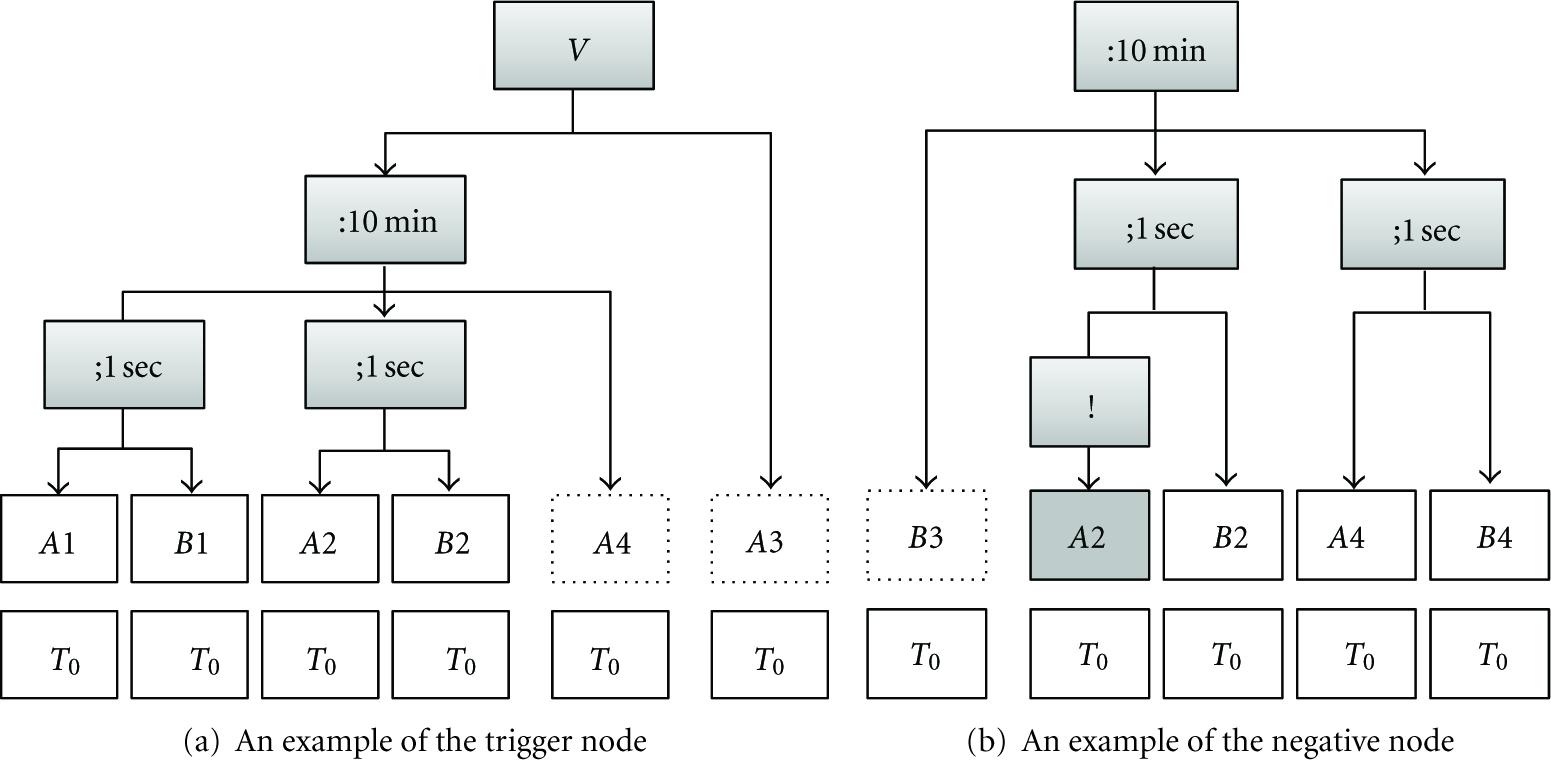
Examples of the trigger node and the negative node.
The occurrence history of the primitive events is not managed in the complex query repository. However, the information of the previous occurrence event is required to detect the complex event. We define the bitmap structure to store the occurrence history of the primitive event. The bitmap is a bit string of logical regions for reader and tag domains in the query index. We manage the bitmap that represents the occurrence of primitive events during the longest time interval for time constraints such as SEQUENCE and INTERVAL operators. The bitmap structure sets a specific bit of the bit string to “1” along the occurrence time whenever the primitive event contained in the complex event occurs. Figure 5 shows the bitmap structure. Since the primitive events A1 and B3 occur at time
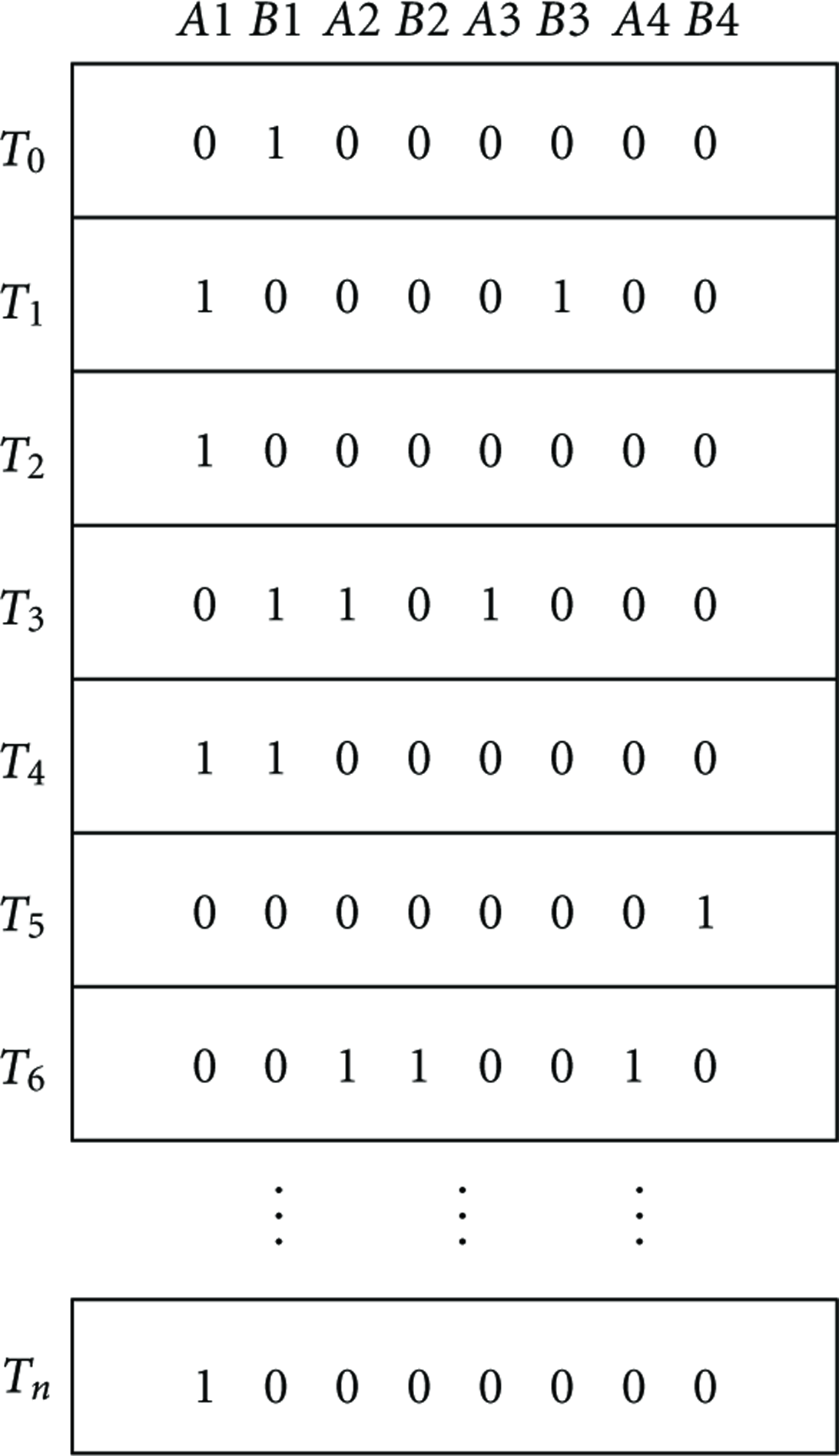
The bitmap structure.
3.2. The Complex Event Detection
To process the complex events, they must be registered into the middleware. The registration of a complex event means that it is translated into a continuous query, a query index is organized in the logical grid, and a bitmap is assigned for storing the history of the primitive events. Whenever primitive events occur, RCEDA, one of the existing complex event processing methods, accesses all the combinations of the complex events to detect the complex events. It may be much overhead. The proposed scheme performs operations to detect complex events after checking the minimum conditions from them. To check the minimum conditions, the latest update times are updated in the nodes corresponding to the registered complex events whenever the primitive events occur. When events just occur in the trigger node, the checking procedure for the minimum requirements is invoked. The minimum requirements do not mean the detection of the complex events. Next, operations to detect the candidate set of the complex events are performed by checking the bitmap.
Figure 6 shows a procedure to check the conditions of the complex events. The primitive event B4 accesses the complex event

A procedure for checking the minimum conditions of the complex events when the primitive event occurs.
We use a query index based on bitmap which needs smaller storage and enhances the processing performance. In the query index, each node in a grid has a bit pattern which represents the relationship between nodes and queries [19]. When the primitive events occur, we can compute quickly the minimum conditions because a node in a grid without unnecessary operations is checked. Even though the complex events satisfy the minimum requirements, it may not occur practically. To detect such complex events, the additional operations using the bitmap are required. Since the conditions of the complex event are satisfied, all bitmaps are retrieved when the final operation is performed. The proposed scheme determines sliding windows by considering the primitive events and the duration of operations in the upper nodes. The detected candidate sets are transferred to the upper nodes. This procedure is repeated until they reach the top node.
Figure 7 shows query processing using the sliding window. Figure 7(a) shows the case that the minimum requirements of the complex event are satisfied. At

Query processing using the sliding window.
3.3. The Expansion of Complex Event Processing
We use the virtual node in the graph-based tree to efficiently process OR operator. In Figure 8(a), the node A3 is the virtual node connected by OR operator. If a number of primitive events occur in node A3, we traverse the left subtree of the root node each time to extract the candidate set that satisfies a complex event regardless of its minimum conditions. To solve this problem, we create a new internal node for the left child of OR operator as the virtual node. Figure 8(b) shows that a new internal node is created as the virtual node. For the child node (:10 min) of OR operator, we create a new internal node I_Q3 and allocate a bitmap structure for a new internal node. A new internal node is treated as a general complex event independently.

An example of a virtual node.
4. Experimental Evaluation
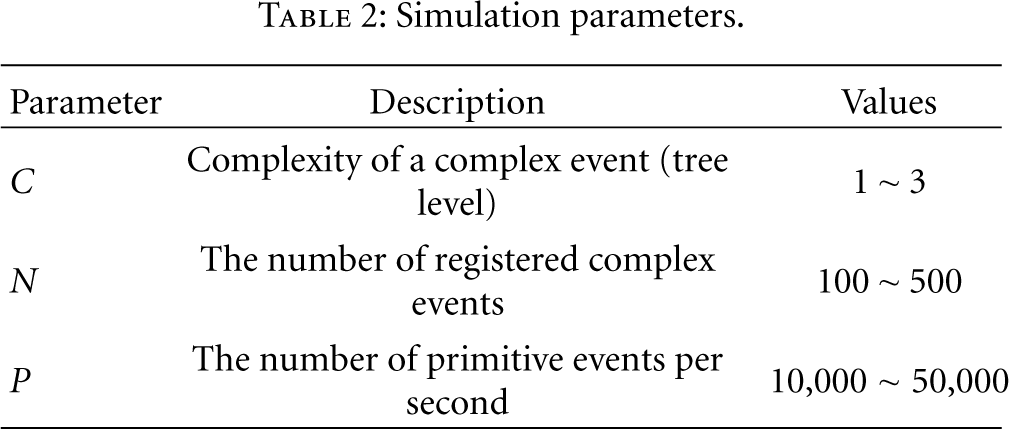
We compare the proposed scheme with RCEDA [16] through various experiments. We used the system with Pentium (R) 4 2.8 Ghz processor, 1 Gbyte memory, and Microsoft Windows XP Professional. First, we evaluate the number of the occurred complex events and the number of the detected complex events according to the complexity of the complex events. Second, we evaluate the number of average operations as the number of complex events and the number of primitive events per second is changed. Third, we evaluate the average elapsed time for processing the complex events. Table 2 shows simulation parameters.
Simulation parameters.
We evaluate the average elapsed time and the number of operations for processing complex events. The complex event is organized as a tree. We assume that the tree is a binary tree and N is 500. C denotes the tree level. Figure 9 shows the average elapsed time to detect complex events. We can see easily that both the proposed scheme and RCEDA increase the average elapsed time similarly as P increases. At C = 1, RCEDA achieves better performance than the proposed scheme by about 10 ms because the proposed scheme performs additional operations for checking the minimum requirements and for generating intermediate results for the detection phase. It means that checking the minimum requirements in the proposed method has elapsed more time than detecting complex events in RCEDA. However, the proposed method significantly decreases the average processing time over RCEDA as the complexity increases. In RCEDA, when the number of complex events is 30,000, the processing time is over one second. That is, in RCEDE, as the complexity of a complex event is increased, the number of the accessed primitive events and the number of unnecessary intermediate candidate sets are also increased.

Average processing time for the complexity.
Figure 10 shows the number of the accessed complex events as the complexity increases. As shown in Figure 10, the number of complex events processed in RCEDA is increased significantly. However, in the proposed scheme, many complex events are filtered out by the minimum requirements and the number of the processed complex events is reduced. In the result, when processing the complex events with high complexity, the proposed scheme achieves better performance than RCEDA. Figure 11 shows the average processing time as the number of the registered complex events, N, is changed. The average processing time is increased in both schemes. However, RCEDA shows higher increasing rate than the proposed scheme.

The number of the accessed complex events for the complexity.

Average processing time for the number of complex events.
Figure 12 shows the average processing time for the complex events as the number of the primitive events per second, P, is changed. The average processing time of the proposed scheme is not increased significantly as P is increased. This is because many complex events are filtered out by checking the minimum requirements. However, RCEDA increases significantly the average processing time as P is changed. If the number of events occurred per second is over 40,000, the complex event is not processed within a second. It causes the processing delay to detect the complex event.

Average processing time for the number of primitive events.
5. Conclusion
We proposed an efficient complex event processing scheme for RFID stream. First, we checked the minimum requirements of the complex event. If they are satisfied, operations for detecting the complex events are performed. The proposed scheme organizes a query index and exploits a tree structure to register and manage the primitive events. Because the proposed scheme just performs operations only when the minimum requirements is satisfied, the number of operations is reduced and unnecessary operations are removed. Finally, we have shown through various experiments that the proposed scheme outperforms RCEDA.
Footnotes
Acknowledgments
This work was supported by Basic Science Research Program through the National Research Foundation of Korea (NRF) Grant funded by the Korea government (MEST) (no. 2009-0089128) and Basic Science Research Program through the National Research Foundation of Korea (NRF) Grant funded by the Korea government (MEST) (no. 2009-0080279).