




Abstract
Mobility in mobile sensor networks causes frequent route breaks, and each routing scheme reacts differently during route breaks. It results in a performance degradation of the energy consumption to reestablish the route. Since routing schemes have various operational characteristics for rerouting, the impact of mobility on routing energy consumption shows significantly different results under varying network dynamics. Therefore, we should consider the mobility impact when analyzing the routing energy consumption in mobile sensor networks. However, most analysis of the routing energy consumption concentrates on the traffic condition and often neglects the mobility impact. We analyze the mobility impact on the routing energy consumption by deriving the expected energy consumption of reactive, proactive, and flooding scheme as a function of both the packet arrival rate and topology change rate. Routing energy consumption for mobile sensor networks is analytically shown to have a strong relationship with sensor mobility and traffic conditions. We then demonstrate the accuracy of our analysis through simulations. Our analysis can be used to decide a routing scheme that will operate most energy efficiently for a sensor application, taking into account the mobility as well as traffic condition.
1. Introduction
Mobile sensor networks are dynamic networks formed by a set of mobile sensor nodes and sink node connected through wireless links. These sensor nodes sense a data in application domains (ranging from wildlife monitoring to vehicle tracking) and then transmit the sensed data to the sink node through wireless multihop routing. Sensor nodes have processing and communication capacities, whose main tasks include controlling sensors, processing sensed data, and transmitting the collected data to a sink node. A typical sensor node has a low-power CPU, tiny memory (RAM/ROM), R/F module, many kinds of sensing units, and constrained battery power. For example, Berkeley's MICA motes only have an 8-bit CPU, 4 KB RAM, and only two AA alkaline batteries. The most energy-consuming component is the R/F module, which provides wireless communications. The energy consumption when transmitting 1 bit of data on a wireless channel is similar to thousands of cycles of CPU instructions [1]. Thus, the energy efficiency of the routing schemes for wireless sensor networks largely affects the energy consumption and network lifetime of wireless sensor networks [2].
In recent years, many routing schemes have been proposed. Typically, there are two main categories of routing schemes, proactive schemes (e.g., DSDV [3], SPIN [4]), and reactive schemes (e.g., AODV [5], DSR [6], and MOR [7]). In the proactive schemes, each node periodically sends control packets to the network in order to maintain a routing table. When the network topology changes, the nodes propagate control messages throughout the network in order to update fresh entries in the routing table regardless of the data packets' arrivals. In the reactive schemes, each node sends control packets for route discovery to find the path to the destination only if they are needed, on demand. The reactive scheme can use energy more efficiently than the proactive scheme does for higher mobility. This is because only if a source wants to send to a destination, it invokes the route discovery mechanisms. Meanwhile, the energy consumption of the reactive scheme can increase dramatically under heavy traffic load. If the routing information become frequently inaccurate or stale during the packet transmission, the flooding scheme [8, 9] as a data transfer method can be used.
These various behaviors of the routing schemes according to the mobility and traffic load cause a different pattern in the energy consumption. Hence, knowledge of the characteristics of the network environment such as the mobility and traffic load is necessary when selecting a suitable routing scheme for a specific sensor network application. Fortunately, most sensor networks have some homogeneous characteristics. In a homogeneous network, each node periodically sends its readings to a sink node with the same traffic load in terms of the packet arrival rate, which is the number of sent packets to a sink node per unit time. Additionally, mobility can result from the same network environmental influences (e.g., wind, water, etc.) or the same mobile object (e.g., human, vehicles, etc.) by which the sensors may be carried. Through this assumption, we can approximately estimate the expected mobility variables or know the traffic rate of the sensor networks.
In this paper, we investigate the energy consumption of proactive, reactive, and flooding schemes for various node mobility and traffic loads in terms of the topology change rate and packet arrival rate, respectively. Through analytical evaluation of the energy consumption, we propose a decision mechanism of the routing scheme that will operate most energy efficiently for a sensor application. Our approach is to minimize the energy consumption by modeling the expected energy demands of proactive and reactive schemes as well as flooding scheme. We present the analytical tool needed to compare the energy consumption among the routing schemes.
The remainder of this paper is organized as follows. In Section 2, we present recent works in the modeling of routing schemes for the mobile sensor networks. In Section 3, the system model is described. In Section 4, we derive the expected energy consumption of the routing schemes (i.e., proactive, reactive, and flooding schemes). In Section 5, we analyze the mobility impact on routing energy consumption by comparing proactive, reactive, and flooding schemes. In Section 6, we evaluate the performance of our energy consumption model using a simulation. Finally, additional conclusions are drawn, and potential directions for future work are given in Section 7.
2. Related Works
Several studies on analytical approaches have been proposed for routing schemes [10–15].
Gao [10] presented an analytical approach that showed the characterization of the energy consumption for a sensor network application. However, this work does not cover different characteristics on the performance of the routing protocol.
Yang et al. [11] proposed an analytical model that would ensure the optimal periodic route maintenance for proactive schemes. The authors categorized the proactive protocols based on the periodic route and link maintenance operations done. They focused on the proactive scheme without a comparison of the proactive and reactive schemes, and their model is different from our study in focus of the analysis.
Zhou et al. [12] proposed a mathematical and simulative framework for quantifying an overhead of reactive scheme. They presented a simplified model of OLSR and AODV protocols and studied the scalability of the reactive scheme. However, this work was specific for reactive scheme operating under certain conditions.
Lebedev [13] proposed an analytical tool for a comparison of both the proactive and reactive schemes in the presence of faulty links. In [13], the authors used a different model of energy consumption. Furthermore, the mobility impact was not taken into consideration.
Zhao and Tong [14] proposed an analytical model focusing on the energy consumption in proactive and reactive schemes, delving further into the asymptotic behavior of the routing schemes. One of the goals is to investigate the relationship between the mobility and the energy consumption of the routing schemes, whereas the authors in [14] concentrated on the impact of the traffic conditions.
Xu et al. [15] presented a unified framework for the evaluation of the performance of the proactive and reactive routing schemes. In [15], network configurations varied for the traffic, mobility, and network density for the performance of the reactive or proactive routing schemes. The analysis in [15], however, differs from ours in both the modeling of the energy consumption and the focus of the analysis. For example, the expected energy consumption (J/bit) as shown in our study was not included in the analysis of [15].
3. System Model
3.1. Network Model
We take into consideration a network with N mobile sensor nodes distributed randomly in a square network of size

The network model.
Mobile nodes move according to the random direction mobility model (RDMM) [16]. In this model, mobile nodes choose a random direction and velocity at every epoch. We take into consideration that the number of packets generated at each node is distributed uniformly (
3.2. Energy Model
The energy consumption in the mobile sensor network is categorized as four operating modes: sleep, listening, reception, and transmission. Each node goes to sleep for some time and then wakes up and listens to see if any other node wants to talk to it. The energy consumed by the sleep and listening mode is
Energy consumed by reception and transmission. (CC2420, 250 kbps).

3.3. Link Availability and Path Availability
In proactive and reactive schemes, link breaks caused by node mobility lead to the degradation of routing performance by reconstruction and rediscovery in order to update fresh entries in the routing table. As node mobility becomes higher, the likelihood that the link between two nodes will be valid decreases.
The link availability can be defined as the probability that any link between two mobile nodes will be valid from time 
For a path with h hops, path availability is the product of the individual link availabilities of the h hops [19]. Therefore, the path availability in terms of the probability that the path with h hops will be valid during time T is given by

Assuming that a significant number of links are involved in a path, the path availability for an h hop path can be simplified to
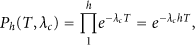
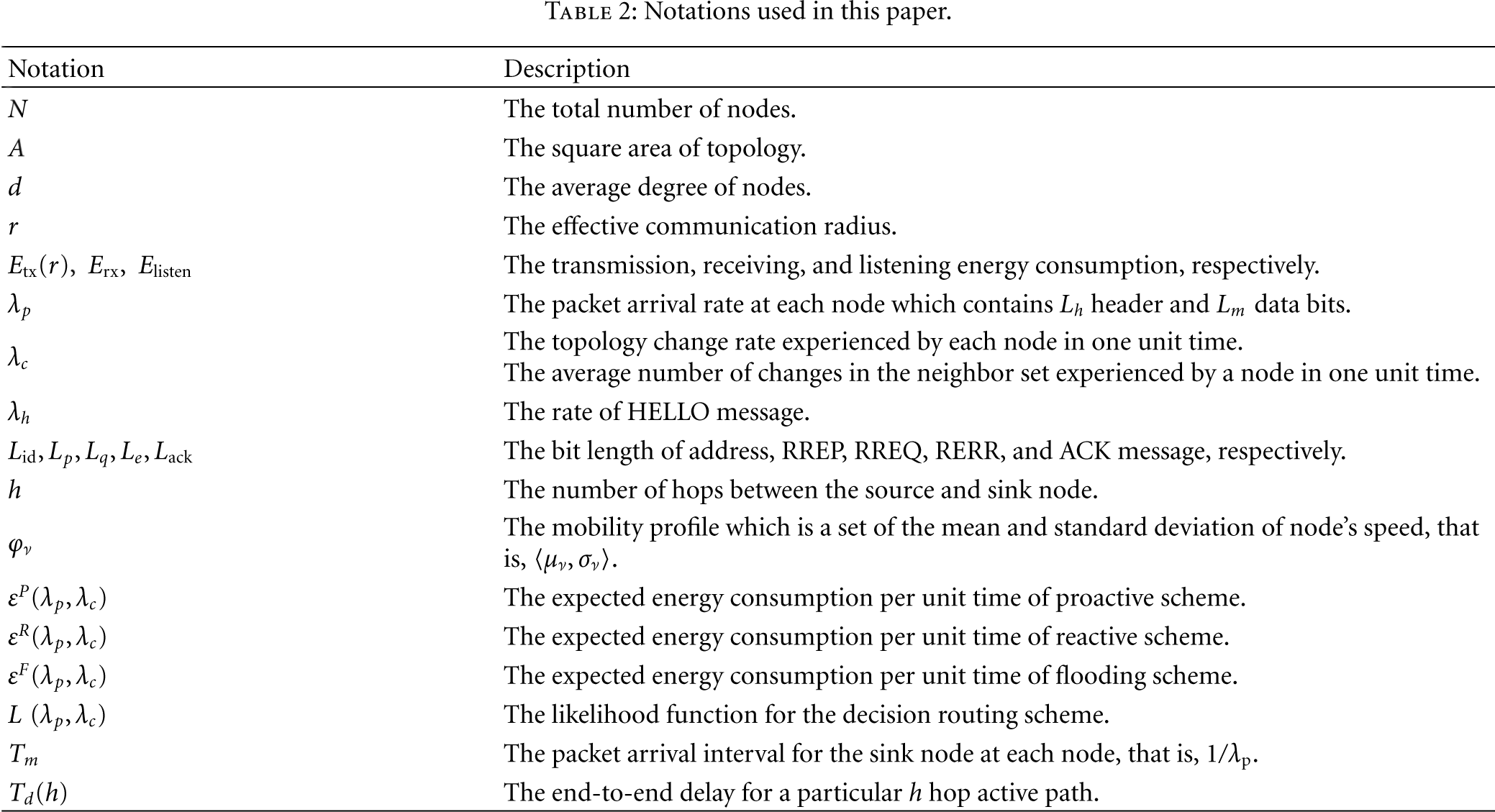
By incorporating the path availability in the modeling of the routing schemes, we can study the relationship between node mobility and the routing energy consumption as a probabilistic model. Table 2 shows the notations and functions in this paper.
Notations used in this paper.
4. Analysis of the Energy Consumption of the Various Routing Schemes
In this section, we study the expected energy consumed by the proactive, reactive, and flooding schemes while taking into specific consideration the node mobility. To analyze a comparative performance of the routing schemes, we consider a variant routing scheme similar to DSDV [3], AODV [5], and pure flooding [8] for the proactive, reactive, and flooding schemes, respectively.
4.1. Energy Consumption of the Proactive Scheme
We evaluate the expected energy consumption per unit time of the proactive scheme. The expected energy consumption of proactive routing can be expressed by


We assume that each sensor node sends 
We consider that a node attempts to retransmit until some maximum number of retransmission (n) in order that conformation is received. The time taken for a message to be transmitted across a path with h hops is assumed to be randomly distributed with a mean value of 

A plot for (4) is shown in Figure 2. This plot shows the expected energy consumption of the proactive scheme according to the topology change rate

The energy consumption of the proactive scheme.
4.2. Energy Consumption of the Reactive Scheme
The expected energy consumption per unit time of the reactive scheme is the sum of the amount of energy required by the route discovery process and data transmission per unit time

When the route path is active in a cached routing table, the node can transmit without the routing overhead. If there is no cached entry in the routing table, the source node initiates a route discovery process by broadcasting a route request (RREQ) packet, which is received and rebroadcasted by other nodes until it reaches its destination. We assume that an RREQ packet will reach almost every node N in the network. Thus, the energy consumed by an RREQ broadcast can be computed as


However, when a route breakage occurs during the route discovery process, the intermediate node which detects the route breakage returns a route error message (RERR) towards the source node

To describe the traffic condition in the mobile sensor network, the interarrival intervals of the data packets in the sensor nodes are assumed to be fixed as 

Assuming that the route discovery process continues until the source node successfully receives the RREP reply, we can simplify the energy consumption for a discovery process to

Thus, this retransmission procedure is expected to contribute immensely to the energy consumption. After the discovery processes, the node transmits the buffered data packets based on the routing table. We consider that the energy consumed by the data transmission is the same as (15) in the proactive scheme.
A plot for the expected energy consumed unit time by the reactive scheme can be described as a function of the topology change rate

The energy consumption of the reactive scheme.
4.3. Energy Consumption of the Flooding Scheme
To analyze the energy consumption of the flooding mechanism, we start with the case of pure flooding (

Figure 4 shows the plot of the expected energy consumption of the pure flooding and the probabilistic flooding schemes. Since the flooding-based routing scheme has no routing information, the energy consumption of the flooding scheme is independent of the mobility pattern.
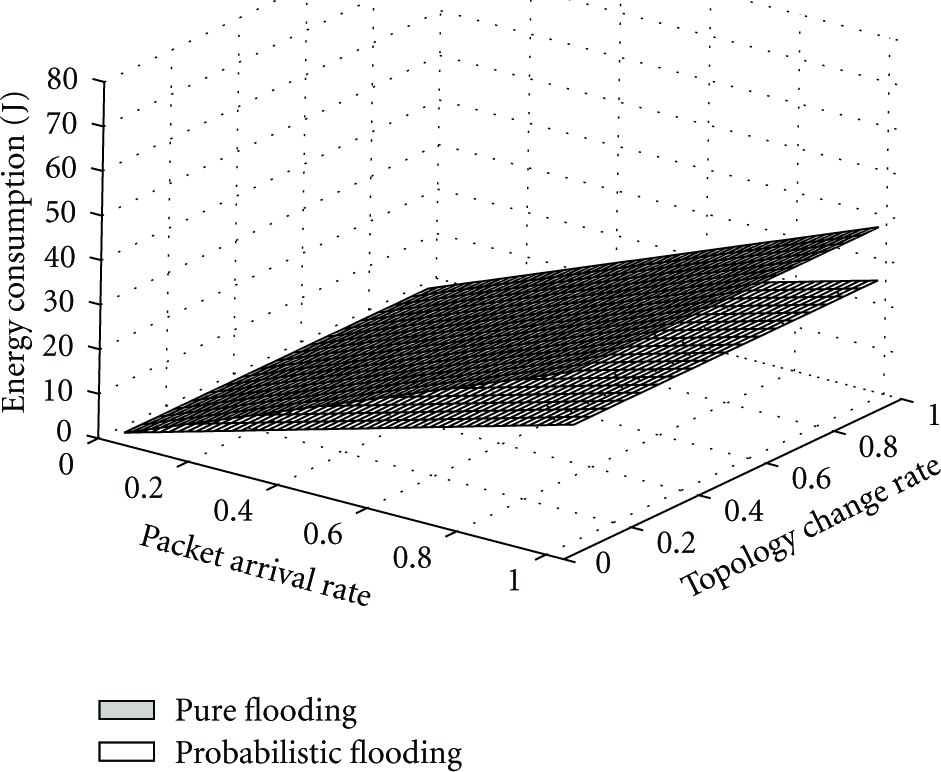
The energy consumption of the flooding scheme.
5. The Mobility Impact on Routing Energy Consumption
In the previous section, we investigate the probabilistic energy consumption model for the proactive, reactive, and flooding schemes in mobile sensor networks. The results described in the previous section provide some insight into the notion that each routing scheme reacts differently during link failures. In this section, we analyze the impact of mobility on the energy consumption of the routing schemes under various networks configurations. Our routing decision approach is designed to select the most energy-effective routing schemes by finding the routing scheme i that minimizes the energy consumption 
Figure 5 shows a different energy consumption pattern according to the topology change rate and packet arrival rate for the proactive, reactive, and flooding schemes where

The energy consumption pattern according to the topology change rate and packet arrival rate.
We also observe that the reactive scheme is more sensitive to the topology change rate than the proactive scheme as the traffic load increases. In proactive scheme, the control messages such as DUMP or INCREMENT [3] are not retransmitted. However, in the reactive scheme, the control messages such as RREQ are retransmitted for a limited number of times if an RREP is not received within a certain interval. Due to an increase in such retransmissions, the energy consumption of reactive scheme significantly increases as both the packet arrival rate and the topology changes rate increase. This means that the increase of energy consumption caused by a repetitive route discovery process can be greater than that of the periodic control traffic when the mobility is higher. From Figures 5(c) and 5(d), the sensitivity to the mobility is less as the message length is smaller in reactive scheme. A more extensive performance comparison of the proactive, reactive, and flooding schemes can be found in Figure 6. Our analysis can be used to decide a routing scheme that will operate most energy efficiently for a sensor application, taking into account the mobility as well as traffic condition.

The comparison of the energy consumption of the routing schemes.
6. Simulation
We compare the analytical results obtained in Section 4 against simulation results. We initially consider 120 nodes initially randomly distribute in a square area with a size of 500 m × 500 m. Each node has the same transmit power of coverage of 80 m. After the initial placement, nodes keep moving continuously according to the RDMM model where every node is moving at the same constant speed and only its direction is changed. The topology change rate is estimated from the velocity by heuristic method. The traffic of the activated nodes is set to be the constant bit rate (CBR) with a packet size of 256 bytes. We consider that the energy consumption of reception and transmission for the sensor nodes is equal to the case of a CC2420 radio transceiver [17]. For each configuration, a simulation result is obtained from ten random runs. In addition, since we are interested in the steady state, we ignore the simulation data earlier than 3 seconds from the start time.
We use the NovaSim simulator [21] and compare the proactive (
Parameters used in the simulation.

Figure 7 shows the comparison of the energy consumption under light traffic load (
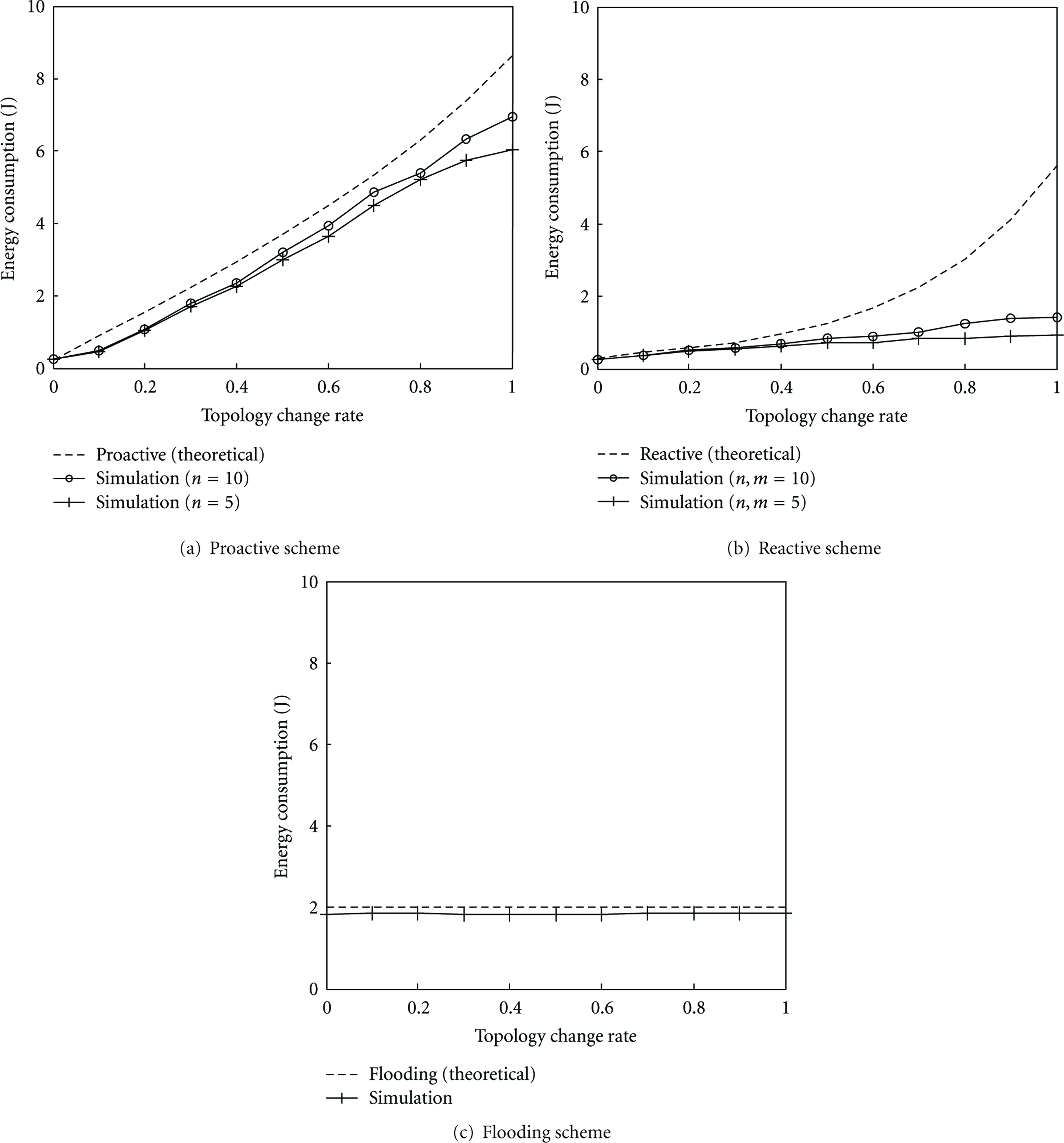
Comparison of analytical and simulation results under light traffic load (
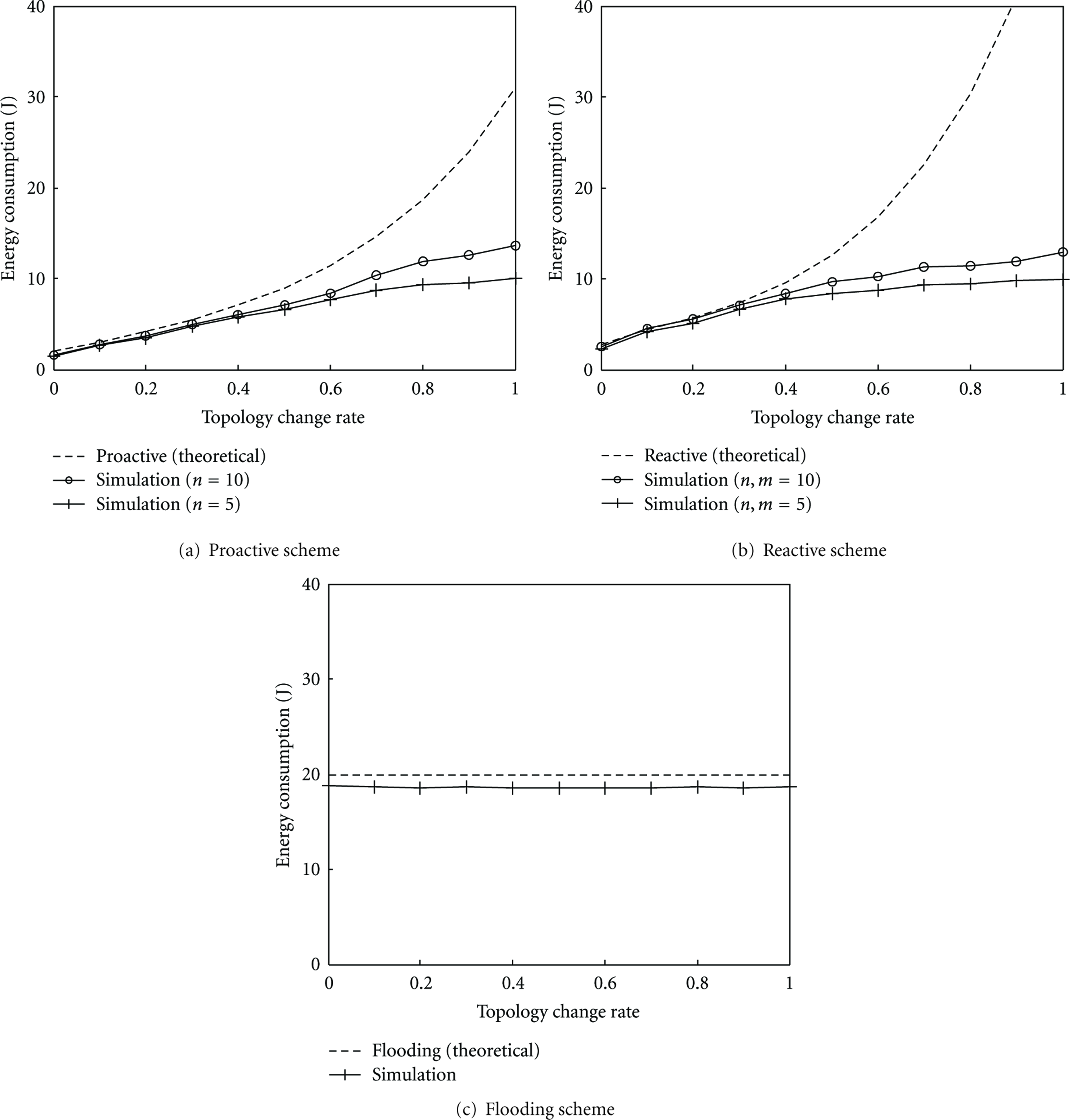
Comparison of analytical and simulation results under heavy traffic load (
Figure 8 depicts the comparison of energy consumption at the heavy traffic load (
7. Conclusion and Future Works
We analyzed the energy consumption of the proactive, reactive, and flooding schemes. Through the analysis, it was that the performance of the routing schemes in terms of energy consumption had a strong correlation between mobility and traffic conditions. We also presented a comparative performance analysis of the routing scheme in terms of energy efficiency. A routing scheme can be determined by a range of network parameters, such as the packet arrival rate and topology change rate (related to node mobility). For the sake of validity, we demonstrated the accuracy of our approach through simulations. Our proposed approach presents an energy consumption framework that helps to strengthen and deepen our understanding of the effect of mobility and traffic load on routing schemes.
In our future work, we will focus on analyses that are more sophisticated by considering the devices characteristics for the sensing, processing, and communication units. In addition, we will study an energy-efficient algorithm to dynamically switch the routing protocols between proactive, reactive, and flooding schemes according to the mobility as well as traffic conditions.
Footnotes
Acknowledgments
This research was supported by the MKE (The Ministry of Knowledge Economy), Korea, under the ITRC (Information Technology Research Center) support program supervised by the NIPA (National IT Industry Promotion Agency), NIPA-2012-C1090-1221-0010.