




Abstract
A game theoretic method was proposed to adaptively maintain the energy efficiency in distributed wireless sensor networks. Based on a widely used transmission paradigm, the utility function was formulated under a proposed noncooperative framework and then the existence of Nash Equilibrium (NE) has been proved to guarantee system stability. To pursuit NE, an NPC algorithm was proposed to regulate heterogeneous nodes with various communication demands given the definition of urgency level. Results from both simulation and real testbed presented the robustness and rapid convergence of NPC algorithm. Furthermore, the network performance can remain in a promising state while the energy consumption is greatly decreased.
1. Introduction
Power control is one of the critical issues in wireless sensor networks (WSNs), especially when node is battery-powered. In wireless network, both throughput and bit error rate (BER) depend on the signal to interference and noise ratio (SINR) on receiver side, which will result in the transmission dilemma in wireless sensor networks. If transmitter raises its transmission power
Most of solutions focus on regulating transmission power to increase the network capacity and prolong the battery life. To better manipulate transmitter power, Yates proposed an analytic method for power iteration, which is based on the satisfaction of signal to interference ratio (SIR) requirement [1]. A SIR balancing algorithm was developed by Zander that each and every terminal, by using this algorithm, would periodically adjust their power to converge to the corresponding SIR equilibrium [2].
As wireless sensor network has been evolving as the popular platform for large-scale applications, an alternative approach to the power control problem based on the game theory has been discussed. For example, in military and emergency scenarios, wireless sensor nodes under the same authority tend to work with each other in a fully cooperative way. Wu et al. proposed a fill-fledged cross-layer optimization design, which operated in a bandwidth-limited regime and in an energy-limited regime. The significant performance could be achieved by making a tradeoff between throughput and energy efficiency [3]. Wu and Bertsekas pointed out that generally power levels are assigned from a discrete set, and each mobile node holds its own interest so that the acceptable signal quality would individually not be the same. Eventually, the optimal solution could be found in a finite number of iterations [4]. To effectively communicate in energy-constrained network, Zhou et al. investigated the minimum energy relay selection mechanism jointly with transmission power control [5].
Recently, the applications of wireless sensor networks tend to focus on civilian usage that lacks of authority for any single node. In this situation nodes can not fully cooperate with each other, therefore noncooperative frameworks for solving the power control problem have been proposed. Long et al. featured the network that each individual held its own independent decision for the power selection. Based on the theory of stochastic fictitious play, a pure Nash Equilibrium was realized with QoS requirement [6]. Altman et al. taken SINR as objective function and characterized both cooperative scenario and noncooperative one, while in noncooperative scenario, the system is modeled in a Hawk-Dove game form and each individual can choose either conciliation or conflict fighting for shared subcarriers [7]. Considered both SINR and network capacity, Sun et al. presented a distributed noncooperative game algorithm for the system to reach the proved unique NE [8]. Shi et al. consider the problem of power control for two independent relay-assisted wireless systems that that once both systems act noncooperatively to optimize their own rate, they can always reach a unique Nash equilibrium [9]. Tsiropoulou et al. studied the distributed power control problem via convex pricing of nodes' transmission power in the uplink of CDMA wireless networks and proved that their formulated MSUPC-CP game had a unique Pareto optimal Nash equilibrium. Finally a distributed iterative algorithm is proposed to compute the game's equilibrium [10]. Kesselheim analyzed the SINR capacity maximization problem, the proposed algorithm, under the SINR constraints, can maximize the number of simultaneous communications [11]. Lu et al. emphasized on noncooperative distributed power control in Gaussian interference channel and provide two types of power control schemes: gradient projection type and nonlinear type, both of which, however, were on the same propose of utility maximization. Convergence requirements were finally studied to supplement the utility function [12].
Those previous works, however, either did they not systematically analyze the convergence or did they not propose a reasonable solution to attain that convergence. For that matter, we have been fundamentally concerned about constructing a noncooperative game model for wireless sensor networks. Based on the importance levels of various messages, nodes in the game can define their own utility function individually. Because there is no central controller or infrastructure, the information of each node cannot be knowledgeable by others. Thereby, even if Nash Equilibrium (NE) exists, it may not be achieved directly through the Best Response (BR) choice. In this case a convergence algorithm is proposed so that nodes can be guided and quickly converge to the NE point with a stable network performance.
The remainder of the paper is organized as follows. Section 2 builds up system model and defines the utility function. Convergence analysis and detailed description of NPC algorithm are given in Section 3. Experiments from both the simulation and real testbed are evaluated in Section 4. Finally, Section 5 concludes the paper and discusses future work.
2. System Model and Utility Function
2.1. Preliminaries
In wireless communication, Energy is consumed by both receiver and transmitter denoted as

Nash Equilibrium is a fixed point of best response power strategy profile that everyone chooses its BR power based on the choices of others which builds up internal connection for everyone.
Lemma 1.
An NE point exists in the game G if
Power strategy set
In order to be compatible with the NE requirements, power strategy should first be quantified. The smallest unit is defined as
Theorem 2.
Define F as the interference power, then game G will be power stabilized, if and only if
Proof.
Consider a scenario that each transmitter has already reached to its balance point, and because of some unknown stimulus, there is an increment of ρ to the background noise of every node. If the system is power stabilized, there must be another balance point for each and every transmitter to assign its power strategy. Now let us define
Let

After ρ was added into the system, during the first iteration we have

Firstly,

For

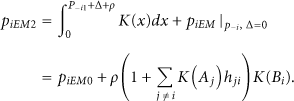

Thus for

This completes the proof of theorem.

The escalation of interference.
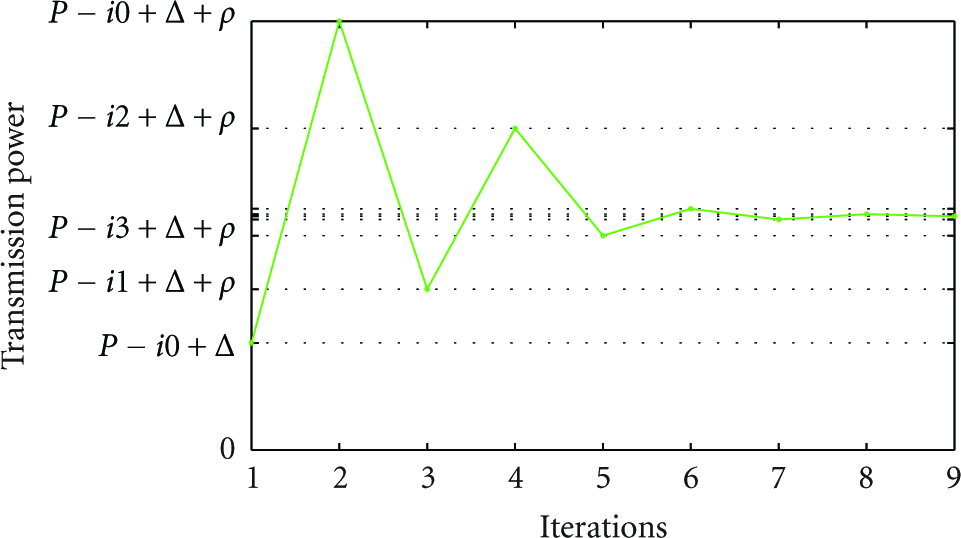
System converged with low magnitude of fluctuation.

System converged with high magnitude of fluctuation.
Based on the Theorem 2 one can verify whether the game model will be power stabilized.
2.2. System Model
In order to formulate a noncooperative framework, the utility function should first be made. According to the Shannon Theorem, channel capacity can be expressed as
During transmission, energy consumed by transmitter and receiver makes up the link consumption
2.3. Utility Function
Power consumption is taken as the cost for the game model, and the utility function is proposed as follows:

Supposing that the background noise is AWGN with the same thermal noise power σ for every receiver, (9) could be rewritten as

In order to find out whether (10) is qualified for noncooperative power control game; the existence of NE should firstly be proved [13]. Since we already quantified the power strategy set
Definition 3.
A function

According to [13] we can prove the quasiconcaveness of
The local maximum can be calculated from
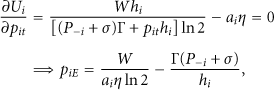

Therefore
Theorem 4.
NE in game G is unique.
Proof.
Since

In which

The above matrix makes up a seamless connection for each node within the network. And

Since the existence of NE has been proved in game G, we have

Since E,Q,M, and S are constants, the solution of (17) is unique, and NE is unique in game G.
Based on the two conditions in Theorem 2, the first condition
3. Convergence Analysis and NPC Algorithm
3.1. Urgency Index
Game model formulated in (10) can be applied individually. Generally the tradeoff making during the transmission is not merely about energy consumption and network capacity, but the urgency of information should also be taken into consideration. Here we define a parameter
According to (12)

Since


Thus, from (12), (19), and (21) we get inequality set as follows:


From (19) we notice that in any circumstances (24) is satisfied, thus (25) is always satisfied:


Therefore in (23) the communication can be well established if

Otherwise the communication will shut down.
So players, based on their needs, could adjust the value of
3.2. NPC Algorithm
Assuming that each transmitter knows its SINR before making their self-fulfilling choice based on the feedback of the receiver. Let

Figure 4 presents the whole process of NPC algorithm in details.
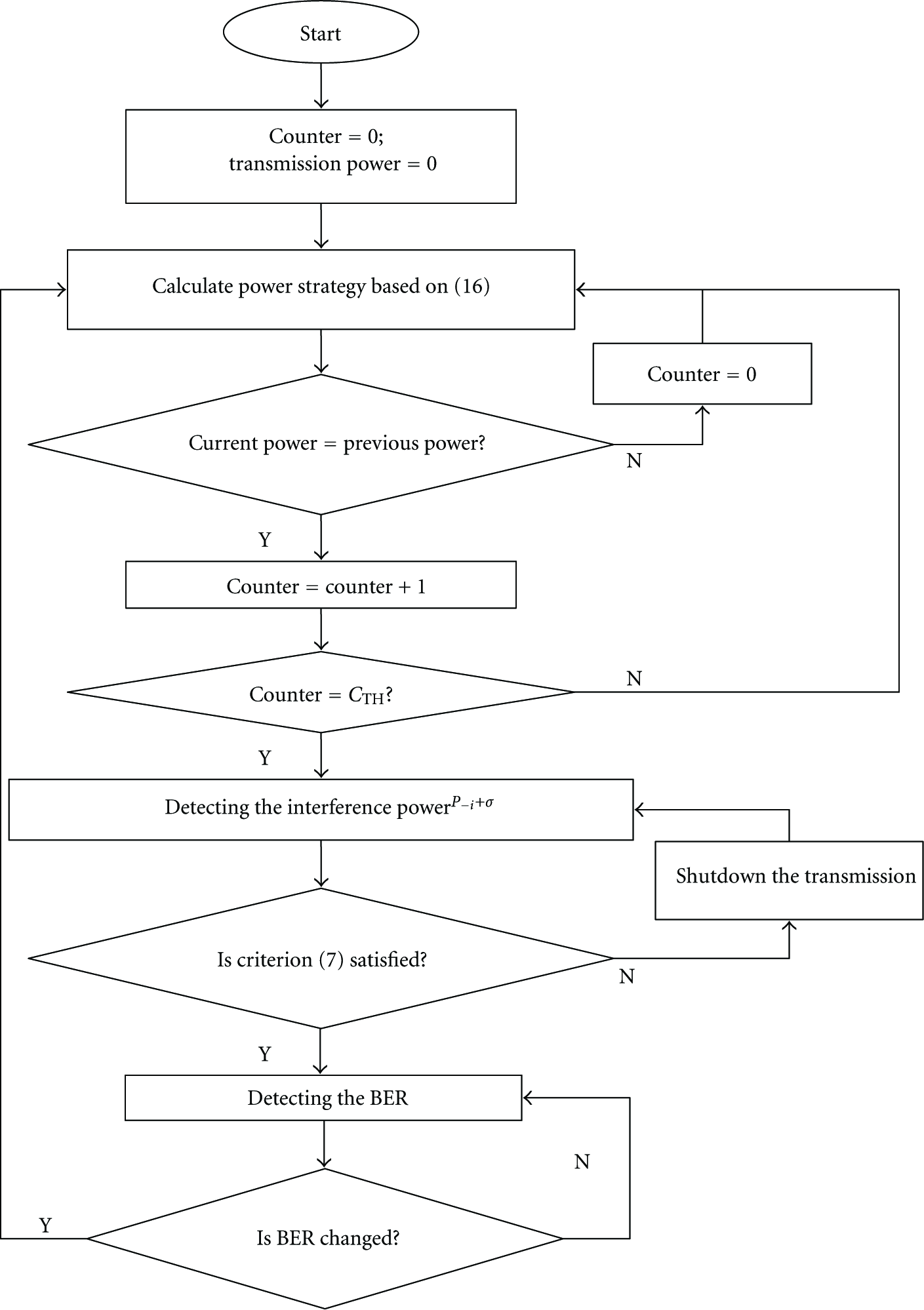
The process of NPC algorithm.
Each time step transmitter update its power strategy based on (27).
4. Experimental Results
4.1. Theoretic Simulation
We simulated a network on the MATLB platform in a
The bandwidth
We randomly chose N links in the above scenario, and each link with it own utility function working successfully if
We chose 12 different links. On the first stage 10 links started working at the same time under the highest data urgency level. After that each link defined its own unique urgency index asynchronously while link 11 and 12 joined the network. Finally the background noise was raised to examine robustness of the system.
Figure 5 shows that on the first stage (0–300), for approximately 200 iterations, nodes could be power stabilized with smooth changes. However, for link 3 it was so unsustainable to its current BER that the communication will be shut down. The second stage (300–800) reveals that no matter new links access joined or the existing links changed their data urgency level, the system can still reach to the balance, and it is the same truth that those cannot afford the high BER will do the same as link 3 did. Finally on the last stage (800–1200), we raised the background noise and the result shows that the system was sustainable for the sudden changes. The respective BER for each node during the whole process is shown in Figure 6. When system is stable, the BER of each node which remains in the system is in a relatively low level.
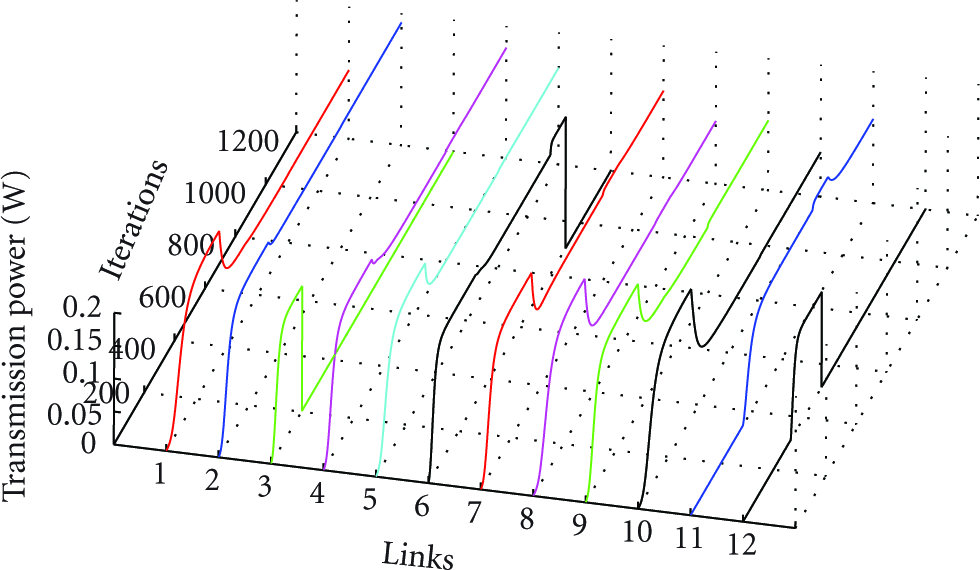
Transmission power of each link during iterations.
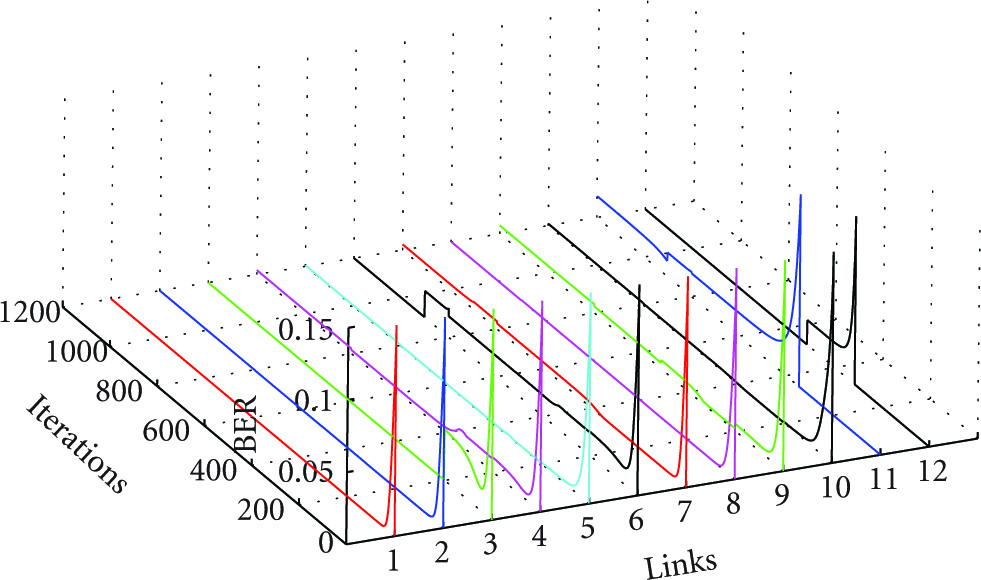
BER of each link during iterations.
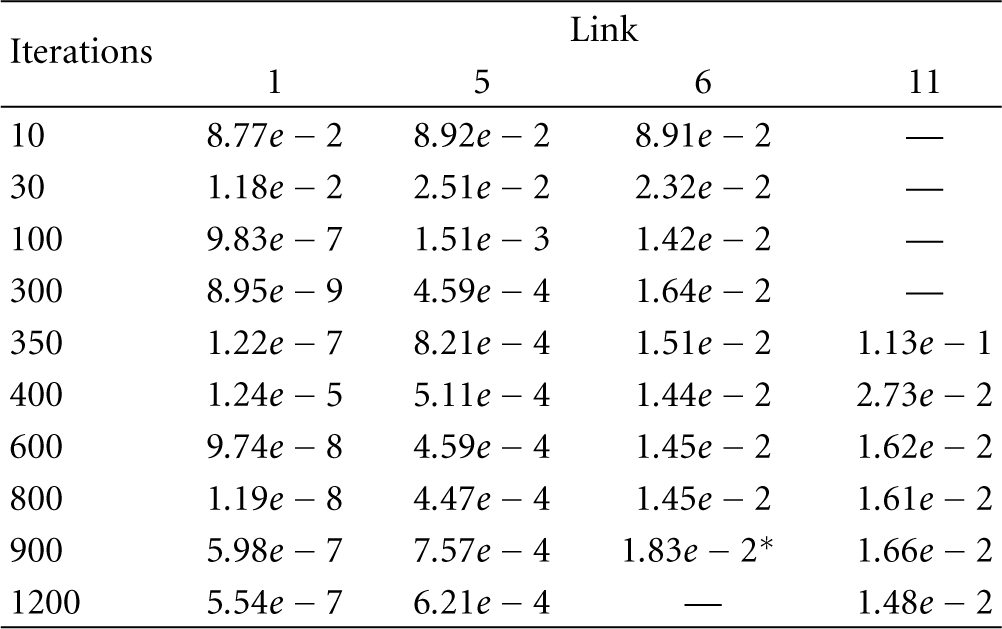
The links showed in Tables 1 and 2 are typical to represent the quality status of all the experimental links. From Table 1 we can see that link 1′s quality was good because its BER was constantly at a low level, which means link 1 was rarely affected by the neighbors. However, for link 6, it was always with a high transmission power. Finally when the power stabilized BER was unaffordably high as marked with asterisk token, the transmitter of link 6 chose to shutdown transmission immediately. For link 5 it did not perform as good as link 1 did, because its noise was much higher. Link 11 accessed into the network after 300 iterations, despite the fact that the (26) is satisfied, its BER was constantly high. The reason for this is that link 11 was under a relatively low urgency level, so it was unnecessary for link 11 to raise its transmission power.
Power strategies of certain links during the iterations.

BER of certain links during the iteration.
4.2. Real Testbed
To analyze the feasibility of our approaches, a SOC solution, CC2530, tailored for IEEE 802.15.4/Zigbee applications, was used in our implementation for real testbed. The transmission power cannot be quantized into as many as the theoretic analysis did, but by connecting with the RF front-end, CC2591, there were 20 available levels of transmission power to operate.
The network was made up of 5 pairs of nodes with each pair consisting of one transmitter and receiver. Nodes were placed in a mesh form as shown in Figure 7. The distance from transmitter to receiver of each pair was 5 m. And any adjacent pair was 6 m away from each other. Each node was working in the same channel, and message was delivered with only one hop.
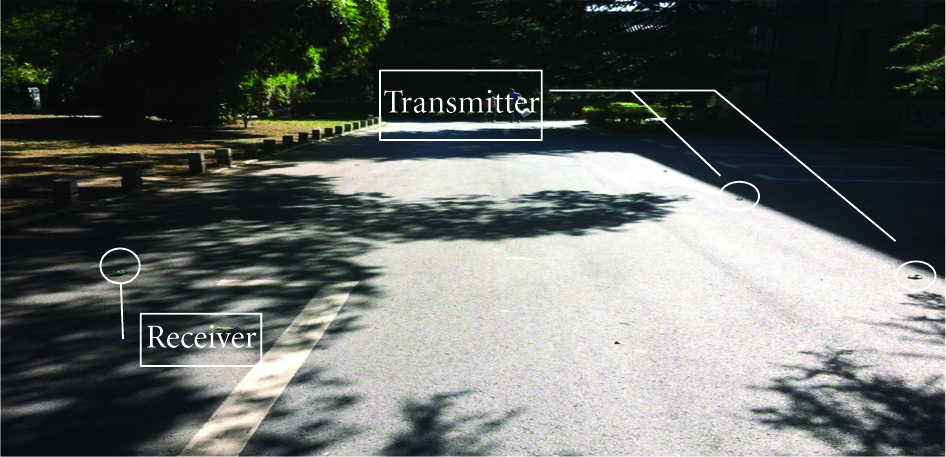
Network topology of the experiment.
The receivers at each end got the best quality of signal for the reception, while the receivers at middle got the signal with most interference. The transmitter can adjust its transmission power according to the feedback of its SINR, which was detected by its own pair of receiver.
The parameters of the node and algorithm were defined as follows.
The maximum transmission power was 20 dbm and the minimum interval of the transmission power was 1 dbm, the bandwidth was
To evaluate performance of NPC, 5 transmitters were initialized with the maximum transmission power which was 20 dbm.Two other counterpart methods were applied as comparison. The Default is a default setting of transmission power recommended by Manufacture Company. BRF is a strategy selection method directly based on the best response function (12) that is applied by [8].
We compared the performance of two pairs of links which had the highest interference and lowest interference, respectively.
Figure 8 shows that in less than 50 iterations the transmission power was stabilized by NPC algorithm, and the transmission power of the least interfered link pair ended up to be 11 dbm with packet error rate (PER) of 4%. While on default setting, the power level was 17 dbm, and placed on the same position, the PER was 2.7%. BRF ended up with the same power as NPC did. However on default setting the PER was not much lower than NPC but the power consumption was exaggeratedly higher. While on BRF, the fluctuation of the transmission power would greatly jeopardize the stability of the network. Our network scale was not big enough; otherwise the transmission power would risk to be evolved divergently.

PER and Transmission Power of the best performed node.
Figure 9 shows the comparison of PER and Transmission power of each methods on link pair with the heaviest interference. The whole process is the same like Figure 8 illustrated. As we can see, because of the high interference, the transmitter had a great cutback in its power, and compared with the default setting, PER was only less than 2%, but the amount of power diminished was 17 dbm–6 dbm, which on a great extent, conserved the energy for the node. To the BRF, the Transmission power ended up to be 1 level lower than on the NPC algorithm, the result may due to the variation of the environment.
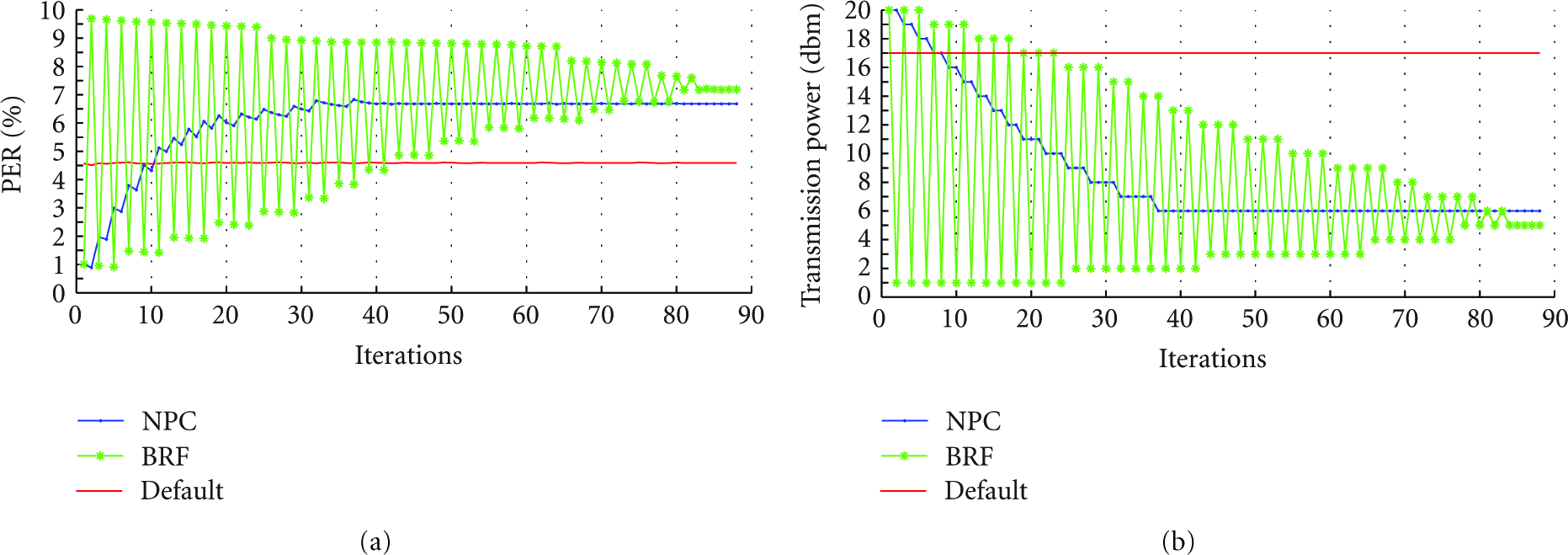
PER and Transmission Power of the worst performed node.
To analyze the energy efficiency of NPC algorithm, we evaluated the performance of each pair under the three different methods with PER/Consumption as measurement of energy efficiency and stabilization time as convergence speed.
During the experiment, consumption was measured as total consumption of link pair. Figure 10 shows that NPC and BRF were with almost the same energy efficiency which was much better than default setting, however according to Figure 11 BRF iterated with twice more time than NPC and as interference increased convergence speed will become smaller. Thus, energy efficiency has been remarkably enhanced by NPC algorithm, while the convergence speed was a little less than default setting and was much faster than BRF offered. Therefore, the superiority of the NPC algorithm is that without accessing into the profile of others, the power selection strategy can optimize the energy usage of each node with guaranteed smooth changes without which the sudden burst of interference is inevitable.

Energy Efficiency of 5 nodes under different methods.

Convergence Speed of 5 nodes under different methods.
5. Conclusions
In wireless sensor network, nodes prefer to form and organize the system in a distributed way. Without central node, it is quite recommendable to take Noncooperative behavior into consideration. The conditions of formulating a NPC game were firstly proved in the paper. After that we presented a utility function based on the dilemma of power usage and proved the existence of unique NE in this specific game model. The notion of urgency index was given for node to define its utility with the consideration of data urgency level. For system convergence, NPC algorithm was presented and compared with other methods. The experiments showed that, without inquiring the profile of each node, NPC algorithm can quickly lead the system to stabilize with relatively smooth changes as well as good network performance. For those qualities, NPC algorithm can be applied to the scenarios where nodes do not share information together while the system design requires energy efficiency. Currently the design, however, mainly concentrates on the physical layer for transmitter to choose its transmission power based on the SINR that makes the network performance not quite good at the beginning. For this reason the next step of our research will focus on the cross-layer power control design with noncooperative game approaches.
Footnotes
Acknowledgments
This work is partially supported by Program for New Century Excellent Talents in University; Hunan young core teacher project; Young teacher project from Hunan University.