




Abstract
Wireless Multimedia Sensor Networks (WMSNs) have gained significant attention with capabilities of retrieving video and audio streams, still images, and scalar sensor data but with challenge of high data loss. As more and more wireless devices are equipped with multiple network interfaces, multimedia delivery over multipath has been cognized as a more promising approach in wireless transmission. In this paper, based on the Concurrent Multipath Transfer (CMT) extension for Stream Control Transport Protocol (SCTP), we propose a novel environment-aware CMT (e-CMT) to overcome the high data loss challenge, as well as “a hot potato” congestion problem in wireless transmission. The e-CMT provides environment-aware cognitive ability for efficient video delivery with three modules, which are Path Quality-aware Model (PQM) that devotes to estimate path quality and select candidate path using for retransmission, Adaptive Retransmission Trigger (ART) that contributes to cognize packet loss and trigger efficient retransmission behaviors, and Congestion-avoid Data Distributor (CDD) that serves to enable Partial-Reliable retransmission to mitigate congestion condition. We design a close realistic topology to present how the e-CMT outperforms the original CMT for efficient video delivery over multihomed WMSNs.
1. Introduction
Due to the advances in low-cost and low power consumption, Wireless Sensor Networks (WSNs) have gained variety of attentions and resulted in thousands of peer-reviewed publications. Significant results in this area have enabled multiple applications used in military and civilian. Most of researches and deployments on WSNs are concerned with scalar sensor networks that measure physical phenomena, such as temperature, pressure, humidity, or location of objects that can be transferred through low-bandwidth and delay-tolerant data streams. In general, WSNs are designed with purpose of data-only delay-tolerant applications without high bandwidth requirements [1].
The growing availability of low-power wireless networking technologies and low-cost multimedia devices such as Complementary Metal-Oxide Semiconductor (CMOS) cameras and microphones, which can acquire rich-content media from the environment like images and videos, provides the opportunity for development and deployment of distributed Wireless Multimedia Sensor Networks (WMSNs) which has capabilities of retrieving video and audio streams, still images, and scalar sensor data [2]; these capabilities make WMSNs can be applied to many fields such as video surveillance, traffic avoidance and so on. However, most researches on WMSNs mainly focus on the design of network layer and Medium Access Control (MAC) layer [3], they seldom consider the design of multipath transfer way in transport layer to enhance the performance of video content delivery over multihomed WMSNs.
As more and more wireless multimedia devices are equipped with multiple network interfaces, it becomes increasingly common for a wireless video device to be connected to more than one access networks employing either a homogenous technology or heterogeneous, the multihomed technology is becoming an important technology in wireless transmission. Due its feature of multihoming, Stream Control Transport Protocol (SCTP) [4] shows its advantages on the serious data loss nature of wireless networks, and its performance adopted in multimedia streaming services over-multihomed wireless networks has been studied widely [5]. Thus, SCTP will become a promising transport protocol for video delivery over multihomed WMSNs. Figure 1 illustrates the multihomed SCTP based wireless multimedia sensor networks.

Multihomed SCTP-based video delivery over wireless multimedia sensor network.
Video transport usually has stringent bandwidth, delay, and loss requirements due to its nature of real time [6]. To improve the performance of video content delivery over multihomed WMSNs, it is important to distribute data across all available paths to achieve high users’ of quality of experience. Concurrent Multipath Transfer (CMT) [7] extension for SCTP (CMT-SCTP), further referred to as CMT, uses the SCTP's multihoming feature to distribute data across multiple end-to-end paths in a multihomed SCTP association and maintains more accurate information (such as available bandwidth and RTT) of all the paths [8]. These features make CMT attract more and more studies for the video delivery under stringent bandwidth, delay, and loss wireless transmission. However, the original CMT lacks the capability of cognizing wireless link condition; this disadvantage makes CMT cannot enable an adaptive retransmission trigger mechanism to provide a best services for the high data loss nature of WMSNs.
Motivated by fact that the design of efficient video content delivery over multipath will be an urgent needs in the future WMSNs, this paper proposes a novel environment-aware CMT (e-CMT) with considering network condition and the causes of the condition change to provide an efficient video delivery approach over multihomed WMSNs. The e-CMT is constructed by three modules, which are Path Quality-aware Model (PQM) that devotes to estimate path quality and select candidate path using for retransmission, Adaptive Retransmission Trigger (ART) that contributes to cognize packet loss and trigger efficient retransmission behaviors, and the further proposed Congestion-avoid Data Distributor (CDD) that serves to enable Partial-Reliable retransmission to overcome “a hot potato” congestion problem in wireless transmission.
The rest of the paper is organized as follows. In Section 2 a brief description of related work is given. Section 3 gives an overview of the e-CMT. Section 4 details the e-CMT design. Section 5 evaluates and analyzes the performance of the e-CMT. Section 6 concludes the paper and gives our future work.
2. Related Work and Contributions
Multimedia data delivery over multipath has been cognized as a more promising resolution to overcome the challenges such as high-rate required and time-sensitive delivery in WMSNs, especially for video streams due to its real-time nature and usually has stringent bandwidth, delay, and loss requirements. Felemban et al. [9] proposed a novel packet delivery mechanism called Multi-Path and Multi-SPEED Routing Protocol (MMSPEED) for probabilistic Quality of Service (QoS) guarantee in WSNs. Politis et al. [10] proposed a power efficient multipath video packet scheduling scheme for minimum video distortion transmission over WMSNs, they proved that the transmission of video packets over multiple paths in WSNs can improve the aggregate data rate of the network and minimizes the traffic load handled by each node.
Video content transfer over multihomed SCTP-based WSNs is becoming an attractive research topic. Stephan et al. [11] proposed a novel approach that consists of bundling SCTP-based multiple connections at the transport layer on the gateway to improve the reliability by employing redundancy in WSNs. Qiao et al. [12] proposed a multihomed SCTP-based Body Sensor Networks (BSNs) framework and investigate handover strategies during sensor nodes’ movement to increase data reliability for BSNs. Lu and Wu [13] studied the performance of SIP based attractive services using SCTP over WSNs. However, these researches mentioned above cannot utilize the capabilities of the multihomed technology because of SCTP's single-path transfer way.
As an extension of SCTP, CMT has been recognized as a good protocol for multimedia content delivery over multihomed wireless networks with ability of flows across multiple interfaces. Our previous work [8, 14, 15] investigated the performance of multimedia data transfer using CMT over multihomed wireless networks with the designed Evalvid-CMT platform. Huang and Lin [16] proposed PR-CMT to provide a timed reliable service for multimedia data transfer. All previous work showed that CMT can achieve a high users’ experience of quality for multimedia streaming services in wireless transmission.
One of the most challenges in wireless transmission is its nature of high data loss. In order to cope with lost packets to enhance the performance of CMT, Iyengar et al. [7] proposed five retransmission policies for the original CMT. Huang and Lin [17] proposed RG-CMT with goal of providing a fast retransmission for concurrent multipath data transfer over wireless vehicular networks. With RG-CMT, lost packets can be fast retransmitted from the relay gateway to the vehicle. Cui et al. [18] proposed a Fast SACK (FSACK) scheme which can be applied to both SCTP and CMT. With FSACK, the sender can select the optimal return path which serves the data delivery or retransmission. Shailendra et al. [19] proposed an additional 32-bit Path Sequence Number (PSN) attached in the payload chunk header and SACK to provide the flexibility to retransmit the lost chunk and achieve a more benefit multimedia delivery in CMT.
Combing aforementioned, we note that current CMT researches only focus on how to improve the performance of CMT based on the original CMT's fast retransmission trigger regardless of the network condition change and the causes of change. This disadvantage makes CMT cannot really achieve the desired performance in wireless transmission.
This paper makes important contributions against the state of art of the literature in the following three stages:
introducing an accurate path quality-aware model to sense each path's current transmission status and the causes of transmission condition change;
designing an efficient packet loss sensor and further proposes an adaptive retransmission trigger mechanism to handle the high packet loss challenge in WMSNs;
introducing an intelligent data distribution strategy to deliver data accordance with each path's current transmission quality and mitigate network congestion if any.
3. e-CMT Overview
As mentioned in the related work section above, current researches on CMT do not consider network condition and the causes of condition change. Moreover, they seldom consider the characteristics of multimedia data during protocol design. These shortages make CMT cannot provide an efficient transmission behavior to achieve the desired performance in wireless transmission.
To make CMT support a best service for efficient multimedia content transfer over multihomed WMSNs, this paper pays attention on following three research problems.
How to design a newly path quality-aware sensor to distinguish the transmission quality of each path and the causes of transmission condition change.
How to design an adaptive retransmission trigger in compliance with real-time condition to handle the high packet loss challenge of WMSNs.
How to make CMT support a self-aware cognitive capability for efficient multimedia content transfer over multihomed WMSNs.
With purposes mentioned above, we propose e-CMT, a novel environment-aware concurrent multipath data transfer approach for efficient multimedia delivery in WMSNs. Figure 2 shows an overview of the e-CMT. The e-CMT consists of three modules, which are dubbed as Path Quality-aware Model (PQM), Adaptive Retransmission Trigger (ART), and Congestion-avoid Data Distributor (CDD), respectively. All the three modules are implemented at the CMT sender side. Following descriptions introduce the responsibilities of the three modules simply, as well as how to make adequate collaboration with each other.
PQM: PQM is in charge of providing a path quality-aware model, selecting candidate path for retransmission, and providing path condition information for ART and CDD.
ART: ART is responsible for analyzing the causes of path condition change, sensing packet loss, and triggering adaptive retransmission behaviors accordance with network condition.
CDD: CDD aims at cognize the condition of candidate path, determinates available data chunk and decides whether to enable Partial-Reliable retransmission to mitigate congestion condition.

An overview of the e-CMT.
Once a received Selective Acknowledgment (SACK) indicates that a data chunk is missing, the e-CMT starts efficient multimedia content retransmission complying with the following below steps.
The e-CMT sender enables the ART to cognize the path condition where the unacknowledged chunk comes from and trigger a proper retransmission behavior.
The e-CMT sender starts the PQM to evaluate the quality of all available path within an SCTP association, then selects candidate path for retransmission.
Before retransmission, the e-CMT sender uses the CDD to decide whether to enable Partial-Reliable or not accordance with cognizing the condition of candidate path.
By adequate communication and collaboration among PQM, ART and CDD, the e-CMT can act as a well-transport protocol for video data transfer in multihomed WMSNs with capabilities of cognizing path condition, triggering efficient retransmission behavior, and reducing deteriorated congestion.
4. e-CMT Details Design
This section details how the proposed e-CMT enables environment-aware cognitive feature for efficient video delivery over multihomed WMSNs. We first introduce the PQM which is used to sense paths’ quality and select candidate path for retransmission. We then address how the ART working for analyzing the causes of path condition change and triggering adaptive retransmission for the lost packets. Finally we examine how the CDD devotes to congestion mitigation by making intelligent decision whether give up retransmission or not.
4.1. Path Quality-Aware Model (PQM)
Most works on multimedia content transfer use Available Bandwidth (AB) [20–22] to evaluate the path quality. A well-known AB model [20] consists of Round Trip Time (RTT) and Packet Loss Rate (PLR) which can be expressed as

where MTU is the Maximum Transmission Unit. PLR can be evaluated by the two-state discrete Markov Chain known as Gibert's Model detailed in [20–22], while RTT can be estimated by

where
Since RTT is a good parameter to reflect the end-to-end path congestion condition and PLR can work accurately for packet loss evaluation occurred by both congestion and link error. Thus, we just consider RTT and PLR to define a Path Quality-aware Model (PQM) for multihomed SCTP hosts which can be expressed by
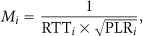
which
For (3), there are three variables, namely,

where
Combining RTT and PLR, the PQM cannot only select candidate path served for efficiently retransmission but also enable an important capability of distinguishing the causes of the path quality change. This feature is very useful for the intelligent retransmission scheme design.
4.2. Adaptive Retransmission Trigger (ART)
An efficient retransmission trigger in CMT would significantly reduce the issue of packet loss in the high packet loss nature of wireless networks. In the original CMT, when a Transmission Sequence Number (TSN) is reported missing indications τ (
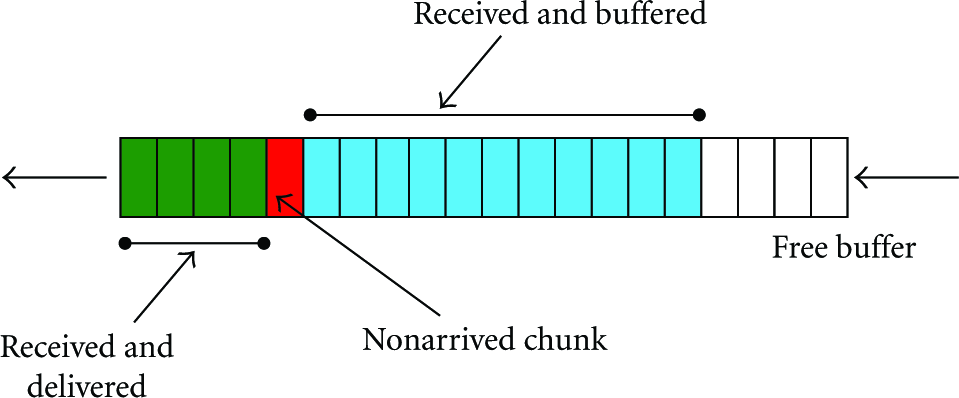
Receiver buffer contains a unacknowledged chunk.
To enable the cognitive feature for sensing data loss accurately and efficiently, once having a missing reported by the Selective Acknowledgment (SACK), the e-CMT sender further cognizes the network condition for corresponding path (denoted as LossOccurPath) that the missing chunk comes from. Thereby, the e-CMT sender can make a more accurate decision if trigger retransmission behavior or not in compliance with the detected network condition. For example, if a deteriorated unreliable network condition (with high packet loss) is detected for the LossOccurPath, the e-CMT sender will mark the data chunk with τ (τ is an integer and
To make the e-CMT sender support an environment-aware capability, four network conditions are defined based on (4) for the transmission paths within the SCTP association, which can be expressed as the following.
Network Condition-1 (NC-1): if
Network Condition-2 (NC-2): if
Network Condition-3 (NC-3): if
Network Condition-4 (NC-4): if if
To make sure the e-CMT do not perform worse than the original CMT, for NC-1, NC-3, and NC-4 condition, the e-CMT sender marks the DATA chunk with τ (

The state model of the cognitive retransmission trigger designed in the e-CMT.
Once the e-CMT sender receives a SACK that indicates that a TSN (e.g.,
The e-CMT sender inquires the destination (denoted as
The e-CMT sender calculates
If the network condition of
If the
The e-CMT sender sorts the destinations in a descending order of its measured
Before retransmission, the e-CMT sender verifies the cwnd of this path. If the cwnd is full, the next destination in the list will be selected as the
The e-CMT sender distributes the
The Algorithm 1 details the adaptive retransmission trigger in the e-CMT.
Definition: Once a SACK contained Gap Ack Reports is received by the e-CMT sender, the sender will loop each destination (1) (2) (3) (5) (6) marks retransmission; (7) (8) marks (9) (10) (11) (12) (13) (14) sorts (15) sets (16) (17) the e-CMT sender distributes the chunk over (18) (19)
4.3. Congestion-Avoid Data Distributor (CDD)
How to provide a best service for the real-time characteristic of video streaming services in congestion condition is still a challenge. This subsection addresses a Congestion-aware Data Distributor (CDD) to overcome “a hot potato” congestion problem in wireless transmission and to enhance the quality of multimedia content delivery. With the CDD, the e-CMT can provide Partial-Reliable transmission when severe network congestion occurs. That is, Once having a DATA chunk is distributed over the
To make an efficient congestion-avoid data distribution strategy happen, in frame level, we define that only available frame can be retransmitted in the CDD if severe congestion condition is detected. A retransmission-required multimedia frame is an available frame if it can be received by the receiver before its playout time. Vice versa, a retransmission-required multimedia frame is an unavailable frame if it cannot be received by the receiver before its playout time. An unavailable frame will be given up its retransmission by the e-CMT sender for congestion mitigation.
Below expression (5) can be used to verify whether the retransmission-required multimedia frame is an available frame or not before its delivery on the selected candidate path

which
With the CDD, the e-CMT will enable following workflows to reduce congestion once a retransmission is distributed over the
the e-CMT sender estimates network condition of the
if the network condition is recognized as NC-1, namely,
if the frame is verified as an available frame, the e-CMT sender retransmits it over the
if the frame's left time is less than
The Algorithm 2 details the congestion-avoid data distributor in the e-CMT.
Definition: Mf
k
: a retransmission-required multimedia frame Once having a multimedia retransmission (Mf
k
) is distributed over (1) The sender calculates values of (2) //evaluates Mf
k
's left time (3) sets (4) (5) retransmits the Mf
k
; (6) (7) gives up Mf
k
's retransmission; (8) (9)
5. Simulation and Analysis
Internet measurement studies showed complex behaviors of Internet traffic [22, 23] that are necessary for performance evaluation of network protocols. Therefore, without background traffic, the performance evaluation of CMT cannot fully investigate the CMT's behaviors that are likely to be observed when it is deployed in wireless environments such as WANs and WMSNs. We consider a more close realistic simulation topology including reasonable background traffic, and then we present sufficient performance evaluations for the e-CMT based on the designed simulation topology.
5.1. Background Traffic Design
Accordance with the Internet survey [24], TCP traffic on the Internet is about 80%–83%, and UDP traffic is about 17%–20%. In addition, the content-rich multimedia streaming will be the most attractive services in the future networks, more and more multimedia content encoded by VBR will be deployed in the Internet. Thus, a more reasonable background traffic that consists of TCP traffic and UDP traffic (TCP : UDP is 4 : 1) should be taken into account to evaluate the performance of data distribution over concurrent multipath.
Since NS2 [25] still cannot support VBR traffic, we enable VBR traffic generator into NS2 by adding PT_VBR as packet enumeration and then setting VBR for PT_VBR's value in packet information function. The parameters used for VBR traffic generator are set as Table 1. Parameters of TCP traffic generator and UDP traffic generator used in our experiments just adopt the default values which are provided by NS2.
Parameters used in VBR traffic generator.

5.2. Simulation Topology Setup
Nowadays the most frequently used standard for variety of attractive services such as Video-on-Demand (VoD) and Internet Protocol Television (IPTV) over multihomed wireless networks is IEEE 802.11 [26, 27]. As it is shown in Figure 1, we assume that both Aggregator Node (AN) and Storage Hub (SH) in WMSNs are equipped with two IEEE 802.11 interfaces (which have also been discussed by Misra et al. [28]). And the AN acts as the SCTP sender to transfer multimedia content to the SH (the SCTP receiver), we compare and analyze the performance between the e-CMT and the original CMT in detail. We believe that the e-CMT can present the same behaviors in other proposed standards such as IEEE 802.15.4 [29].
The simulation topology is shown in Figure 5 and includes the SCTP sender and receiver. Both CMT endpoints have two wireless 802.11b interfaces of 11 Mbits/s at 2.4 GHz. To avoid interferences occurance between the two 802.11b interfaces, both of them are assigned to tow different channels. The Maximum Transmit Unit (MTU) of each path is 1500B. The queue length in both paths is 50 packets. Default receive buffer (rbuf) values in commonly used in operating systems today vary from 32 KB to 64 KB and beyond. So, we compare the performance of the two approaches with an rbuf value of 32 KB, 64 KB, 128 KB, and 256 KB, respectively.

Simulation topology.
We introduce a realistic Internet traffic gathered from BUPT consisted of FTP traffic, VBR traffic, and CBR traffic. All FTP/TCP, VBR/UDP, traffic and CBR/UDP traffic generators connect to the two APs (AP1 and AP2), respectively with a reasonable bandwidth value of 100 Mb, and the propagation delay is 5 ms in accordance with [30]. We perform two experimental scenarios dubbed Cases 1 and 2 to study the performance of e-CMT, respectively.
Case 1.
The loss rate on Path 1 (with FTP/TCP traffic and CBR/UDP traffic, the ratio is 4 : 1) is always kept at 1%, and on Path 2 (with FTP/TCP traffic and VBR/UDP traffic, the ratio is 4 : 1), it is with varied value at 5%, 10%, 15%, 20%, 25%, and 30%, respectively.
Case 2.
The loss rate on Path 2 is always kept at 1%, and on Path 1, it is with varied value at 5%, 10%, 15%, 20%, 25%, and 30%, respectively.
To avoid the false missing report, a well-known challenge in CMT, we just set
5.3. Performance Evaluations
Firstly, we present a set of experiments to investigate the performance of e-CMT compliance with aforementioned Cases 1 and 2 condition. We compare the performance in terms of average throughput between the e-CMT and the original CMT with different rbuf value. Notice that we do not consider multimedia content in those experiments in order to present how e-CMT outperforms the original CMT with its cognitive feature for packet loss conveniently. Later experiments will focus on multimedia content to show how the e-CMT improves the quality of video data transmission. For convenience, we illustrate the results of original CMT as “o-CMT” in test result figures, and the results with our algorithm are illustrated as “e-CMT”, respectively.
Figures 6, 7, 8, and 9 show the comparisons on average throughput for the e-CMT and the original CMT under an rbuf value of 32 KB, 64 KB, 128 KB, and 256 KB, respectively. As shown in those figures, owing to effect side occurred by background traffic, the available bandwidth that is insufficient and that leads to both the original CMT and the e-CMT could not achieve a better performance. Moreover, we can note that average throughput of either the original CMT or the e-CMT follows a decline in the relationship with the PLR of Path. However, since the e-CMT enables the cognitive feature for packet loss and starts fast retransmission behavior to resend the lost packets over candidate path selected by a well metric, thus, it outperforms the original CMT under different rbuf.

Comparison with an rbuf value of 32 KB.
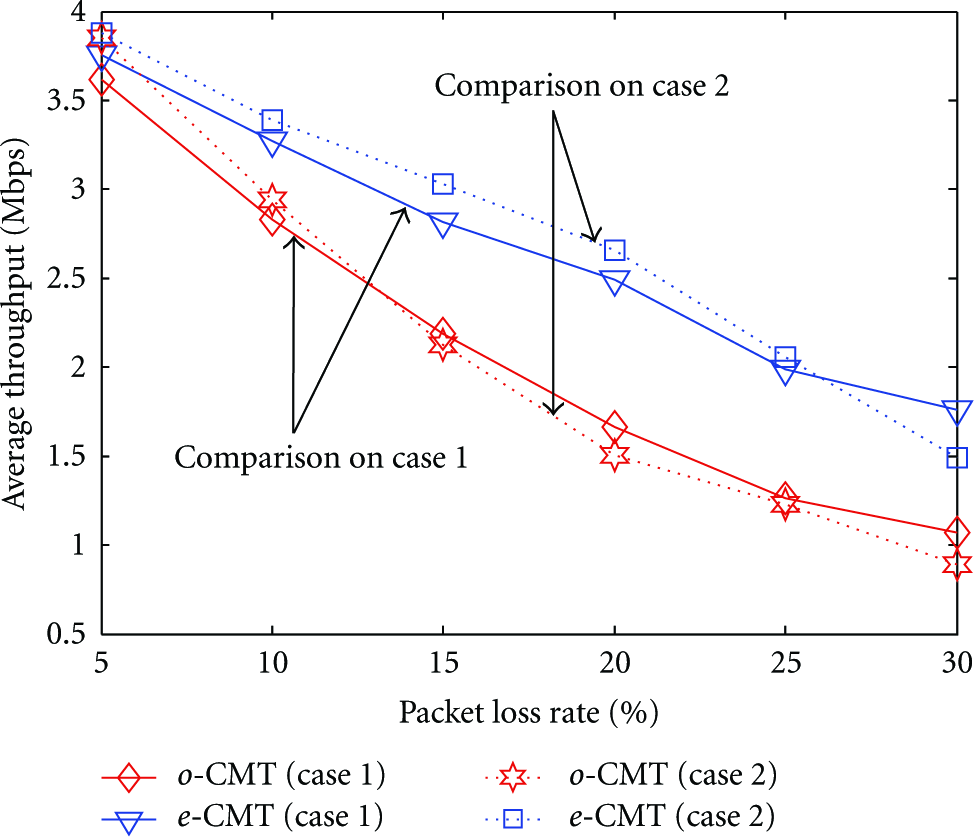
Comparison with an rbuf value of 64 KB.
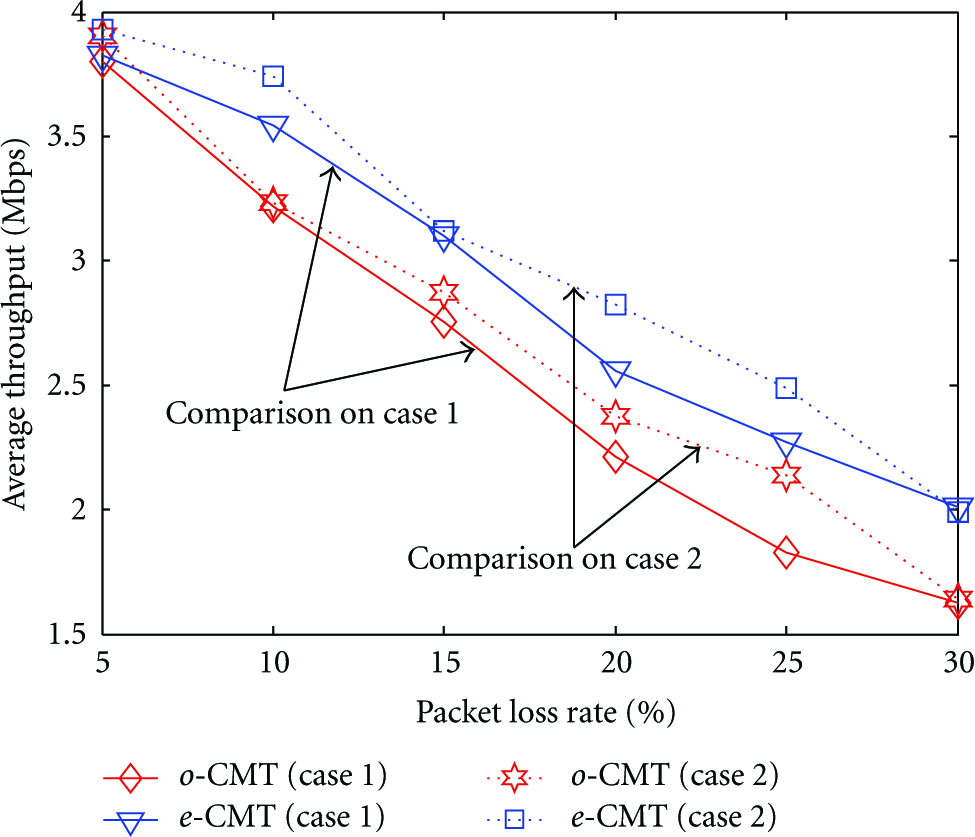
Comparison with an rbuf value of 128 KB.

Comparison with an rbuf value of 256 KB.
From Figure 6 to Figure 9, whatever the packet loss occurs on Path 1 or Path 2, we can figure out some significant phenomenons which are detailed as follows.
As PLR comes higher, the gap between the e-CMT and the original CMT comes larger mostly. This phenomenon justifies that cognizing network state and the causes of change are very important for transport protocol. When the link unreliable condition comes deteriorated, these lost packets can be cognized and retransmitted by the e-CMT. Moreover, the e-CMT considers packet loss rate to construct a more reasonable metric. With the metric, the e-CMT can select a more satisfiable candidate path and redeliver lost packets efficiently. This feature makes e-CMT reduce the packet loss probability and improve the throughput when it reschedules a packet into a link with a smaller packet loss rate. This is why the e-CMT achieves more benefit over the original CMT as PLR on either Path 1 or Path 2 increases.
As rbuf comes larger, the e-CMT gains less improvement in terms of average throughput over the original CMT. This phenomenon is reasonable since rbuf increases result in more packets that can be delivered over the wireless link and received by the receiver rapidly. Besides, our previous work [31] clarified that the impact of the background traffic on throughput is increased as the increasing of the rbuf. This reason leads to the e-CMT with less significant improvement on average throughput as PLR increases. However, since the e-CMT takes the packet loss rate into account during the retransmission to reduce the packet loss rate. Correspondingly, the e-CMT still can achieve a better performance over the original CMT.
Secondly, we compare the performance between the e-CMT and the original CMT in terms of multimedia data concurrent multipath transfer. To serve a best service for multimedia content delivery, the e-CMT will enable both the ART feature examined in Algorithm 1 and the CDD feature examined in Algorithm 2.
We use a YUV video sequence with a QCIF format (
Since Peak Signal to Noise Ratio (PSNR) is the most vital QoS parameter being used to measure the quality of video streaming services, we use PSNR to measure the performance of e-CMT and the original CMT. The results for the PSNR measurements for the e-CMT and the original CMT are illustrated in Figure 10. Under Case 1 condition, the e-CMT achieves a PSNR value of 27.84 dB and the original CMT gains about 25.64 dB. Under Case 2 condition, the e-CMT obtains a PSNR value of 27.98 dB and the original CMT gains about 25.82 dB. The reason the e-CMT can outperform the original CMT is that the e-CMT can cognize link loss and retransmit the lost packet timely in the high loss condition. Moreover, if deteriorated congestion condition is detected, the e-CMT gives up redundancy retransmission for unavailable frame; this feature makes the e-CMT can achieve more playable frames than the original CMT.
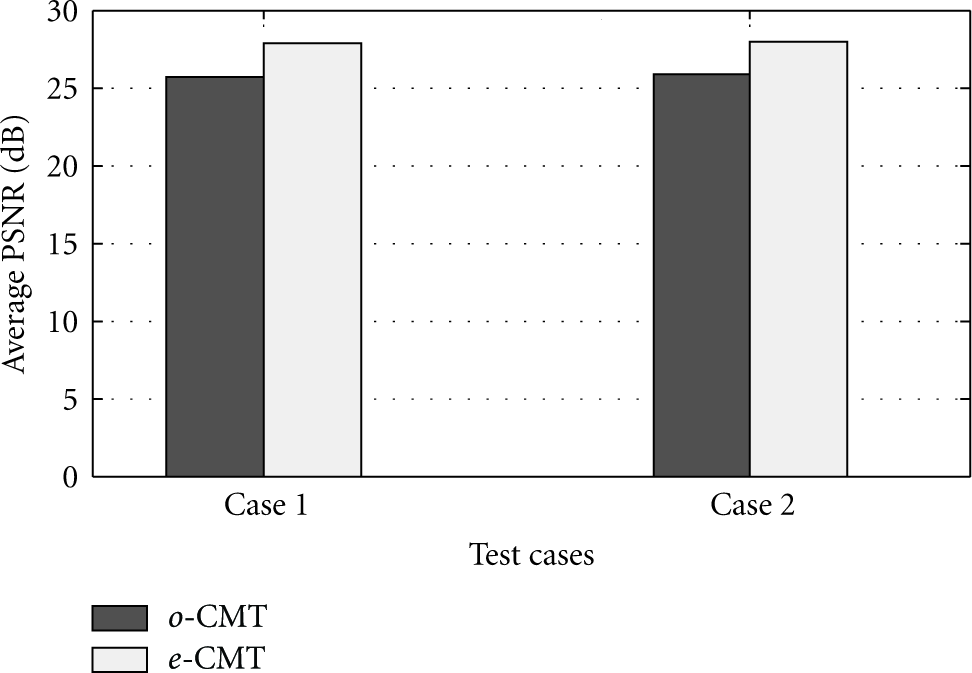
Comparison on PSNR.
We also evaluate other several well-known video sequences in terms of playable frames. Figure 11 shows the statistical results of four different videos sequences. The standard deviations were evaluated based on the Percentage of the Playable Frames (PoPFs). These results show that the e-CMT outperforms the original CMT for these videos. The proposed e-CMT achieves PoPF about 77.3% and 77.6% under Cases 1 and 2 conditions, respectively. And the original CMT gains 71.2% under Case 1 and 71.7% under Case 2.

Standard deviations of other video sequences.
Based on variety of experiments, we observe that the e-CMT outperforms the original CMT because not only its efficient sense and retransmission feature but also with the capability of intelligent retransmission decision for congestion mitigation. Hence, the e-CMT can achieve high users’ experience of quality of multimedia streaming services, it is good protocol selected for real time of video transmission over multihomed WMSNs.
6. Conclusions and Future Work
Video streaming transfer over wireless multimedia sensor networks is becoming an attractive research topic but with challenge of high data loss. On the other hand, multimedia content delivery over multipath has been recognized as a more promising resolution to overcome the challenges such as high-rate required and time-sensitive delivery in multihomed wireless networks. This paper presented a novel environment-aware CMT dubbed as e-CMT with goal of providing effective video content delivery over multihomed WMSNs. By distinguishing the causes of transmission condition change, the e-CMT can trigger retransmission behavior timely and redeliver lost packet over a candidate path selected by PQM. Before retransmission, an intelligent congestion-aware data distributor will be enabled to make decision if to give up retransmission or not accordance with transmission condition of the retransmission destination. Sufficient simulation results showed that the e-CMT can provide an efficient retransmission approach and achieve better users’ experience of quality of video streaming services than the original CMT.
We note that the e-CMT just only focuses on how to improve CMT protocol itself that depended solely upon the information provided by transport layer. As cross-layer coordination design becomes a promising resolution for multimedia content delivery in wireless transmission [32], our future work will pay attention on the cross-layer coordination and communication among transport layer and other layers to design an efficient concurrent multipath multimedia data transfer protocol. Moreover, our future work will consider multimedia encoding characteristics to make more intelligent transmission, for example, when wireless link is recognized as deteriorated congestion condition (NC-1), the high important and available I-frame will be retransmitted while the low important but available P-frame and B-frame will reduce the number of retransmission or give up retransmission.
Footnotes
Acknowledgments
This work was partially supported by the National High-Tech Research and Development Program of China (863) under Grant no. 2011AA010701, in part by the National Basic Research Program of China (973 Program) under Grants 2013CB329100 and 2013CB329102, in part by the National Natural Science Foundation of China (NSFC) under Grant nos. 61001122, 61003283, and 61232017, Beijing Natural Science Foundation of China under Grant no. 4102064, in part by the Fundamental Research Funds for the Central Universities under Grant no. 2012RC0603, no. 2011RC0507, in part by Jiangsu Natural Science Foundation of China under Grant no. BK2011171 and in part by Jiangxi Natural Science Foundation of China under Grant no. 20122BAB201042.