




Abstract
We theoretically and experimentally analyze the process of adding sparse random links to random wireless networks modeled as a random geometric graph. While this process has been previously proposed, we are the first to prove theoretical bounds on the improvement to the graph diameter and random walk properties of the resulting graph as a function of the frequency of wires used, where this frequency is diminishingly small. In particular, given a parameter k controlling sparsity, any node has a probability of
1. Introduction
Ever since the first observation of “six degrees of separation” by Milgram [1], small-world phenomea have been noted in numerous diverse network domains, from the World Wide Web to scientific coauthor graphs [2]. The pleasant aspect of the small-world observations is that, despite the high clustering characteristic of relationships with “locality,” these various real-world networks nonetheless also exhibit short average path lengths as well. This is surprising because purely localized graphs such as low-dimensional lattices have very high average path lengths and diameter, whereas purely nonlocalized graphs such as random edge graph models of Erdos and Renyi [3] exhibit very low clustering coefficient. With intuition consolidating these two extremal graph types, the first theoretical and generative model of small-world networks was proposed by Watts and Strogatz [4]: start with a one-dimensional k-lattice, and re-wire every edge to a new uniformly at random neighbor with a small constant probability. They showed that even for a very small but constant rewiring probability, the resulting graph has small average path lengths while still retaining significant clustering.
Despite the prevalence of small-world phenomenon in many real-world networks, wireless networks, in particular ad hoc and sensor networks, do not exhibit the small average path lengths required of small-world networks despite the evident locality arising from the connectivity of geographically nearby nodes. Although taking a high enough broadcast radius r clearly can generate a completely connected graph of diameter one, this is a nonrealistic scenario because energy and interference also grow with r. Rather, from a network design and optimization perspective, one must take the smallest reasonable radius from which routing is still guaranteed. To discuss such a radius in the first place, we must employ a formalization which is common in all theoretical work on wireless networks [5, 6]; namely, we fix the random geometric graph model of wireless networks. Given parameters n, the number of nodes, and r, the broadcast radius, the random geometric graph
This serves as a first motivation for the following question: In the spirit of small-world generative models [4] that procured short average path lengths from a geographically defined lattice by adding random “long” edges, can we obtain significant reduction in path lengths by adding random “shortcut” wired links to a wireless network? The first to ask this question in the wireless context was Helmy [7] who experimentally observed that even using a small amount of wires (in comparison to network size n) that are of length at most a quarter of the physical diameter of the network yields significant average path lengths reduction. Another seminal work on this question is that of Cavalcanti et al. [8] which showed that introducing a fraction f of special nodes equipped with two radios, one for short-range transmission and the other for long-range transmission, improves the connectivity of the network, where this property is seen to exhibit a sharp threshold dependent on both the fraction f and the radius r. Other works yet include an optimization approach with a specified sink, in which the placement of wired links is calculated to decrease average path lengths in the resulting topology [9]. The existing body of literature authored by practitioners in the field of wireless networks on inducing small-world characteristics (particularly shortened average path lengths) into wireless networks by either introducing wired links or nodes with special long-range radios or directional antennas yields that such hybrid scenarios are eminently reasonable to consider for real networks. Among the literature dealing with this small-world hybrid wireless networks, the closest in spirit to our work, and indeed the only theoretical work to our knowledge on hybrid wireless networks is that of [10]. In [10], both deterministic and randomized wiring schemes are given, and bounds are proven on path lengths and energy efficiency under a model in which (i) a designated sink is specified, (ii) routing is based on greedy geographic forwarding only, and (iii) the frequency of wires can be controlled with a parameter
In particular, we consider the following models of adding new wired edges: divide the normalized space into bins of length
Whereas the first part of this work concerns bounding the average shortest-path lengths of modifications of random geometric graphs, the second part concerns bounding the efficacy of random walks on such graphs. When speaking of a random walk, we connote the natural random walk process which is formed by starting from an arbitrary vertex and continuing each step by picking a neighbor uniformly at random from the set of neighbors of the current vertex. If shortest paths may be viewed as optimizing routes under global information, the trace of a random walk can be viewed as a path the node takes under total uncertainty and only local information. Whereas this may not be an optimal source-destination routing method, it can prove useful for general information collection, sampling, gossiping, and discovery of alternate paths when the optimal ones suffer failure [11–14]. The usefulness of random walk based methods depends entirely on the properties of the underlying graph and can be measured via different metrics dependence on the intent of the method. Two such metrics are the cover time, which is the expected time (as in number of steps) in which the random walk visits all nodes of the network, and mixing time, which is the maximum time (measured as number of steps starting from an arbitrary node) in which the random walk is within ε distance to the stationary distribution [15].
To give a perspective on what constitutes good cover time properties and what constitutes good mixing time properties, consider that the optimal values for these two properties are exhibited on a clique, the worst case asymptotic cover time is exhibited on a lollipop graphs, and the worst case asymptotic mixing time is exhibited on a barbell graph. The clique has cover time
In this work, in addition to establishing bounds on resultant path lengths upon sparse random edge additions in the first part, we are the first to consider both theoretically and experimentally the improvement in the resultant mixing time and algebraic connectivity, in comparison to that of the random geometric graph. Although short average path lengths are necessary for a graph to exhibit optimal random walk sampling properties, it is far from sufficient (the barbell graph being a notable counterexample). As a strange omission, the small-world literature thus far has primarily ignored spectral gap as a measure in their analyses and generative models despite the known expansion of random edge graph models [20, 21]. It is well established that the mixing time is intrinsically related to the node expansion, edge expansion [22], algebraic connectivity, and random walk properties of the given graph [15–17].
Our motivation is as follows: Yet another limitation of random geometric graphs in comparison to random edge graph models that is especially problematic for oblivious routing, sampling, and gossiping applications [11–13] is that whereas sparse random regular graphs as well as random connected Erdos-Renyi graphs are expanders with excellent mixing properties, connected random geometric graphs
In terms of related work, we must note the work [25] of Abraham Flaxman, which is an excellent related work in which the spectra of randomly perturbed graphs have been considered in a generality that already encompasses major small-world models thus far. [25] demonstrates that, no matter what is the starting graph
Finally, we note that this work is a significant extension to the author's conference paper [26].
2. Theoretical Preliminaries
The results can be divided logically into those concerning average path lengths and those concerning random walk sampling properties. Therefore, the preliminaries are also so divided.
2.1. Random Geometric Graph Preliminaries
Random geometric graphs above the connectivity threshold exhibit certain “smooth lattice-like” properties including uniformity of node distribution and regularity of node degree that are useful in their analysis. As introduced in [14], we utilize the notion of a geo-dense graph to characterize such properties, that is, a geometric graph (random or deterministic) with uniform node density across the unit square. It was shown that random geometric graphs are geo-dense and for radius
Formally, a geometric graph is a graph
Definition 1 (see [14]).
Let
The following states the almost regularity of geo-dense geometric graphs [14].
Lemma 2.
Let
Recall that the critical radius for connectivity
Lemma 3 (geo-density of
).
For constants
Both geo-denseness and other results both in this paper and in previous work on random geometric graphs follows from a “folk theorem” often referred to as coupon collection (due to the example process given), so we state this before continuing the characterization of random geometric graphs [15].
Theorem 4 (Coupon Collection).
Assume that there are a total of n types of coupons, and one attempts to collect all types by picking m coupons independently and uniformly at random. Upon this process, let
This process and the corresponding folk theorem is also alternatively referred to as “balls in bins”.
Given that geo-denseness of connected random geometric graphs is established, we wish to utilize the “binning” directly for its lattice-like properties. As such, for the sake of notational convenience, we shall introduce the notion of a lattice skeleton for geo-dense geometric graphs, including random geometric graphs above connectivity.
Definition 5.
Let
We note, before proceeding, that such ideas of geometric bins in representing random geometric graphs are not new to this work (hence, they appear as preliminaries), but rather have arisen naturally in a number of theoretical works on wireless networks above the connectivity regime. The idea of the random geometric graph as a global lattice skeleton composed of local cliques in particular as appears here has been formalized via the global-local decomposition representation of such graphs introduced in the author's thesis [27].
What is directly clear by geo-denseness is that there is not much variance in the sizes of the bins.
Remark 6.
Let
Further, utilizing the choice of
Lemma 7.
Let
In particular, for for all for all i, j if for all i, j, k, l if link for all i, j, k, l if
From (ii) it is clear that each bin
Corollary 8.
For
Having established that connectivity and distances for

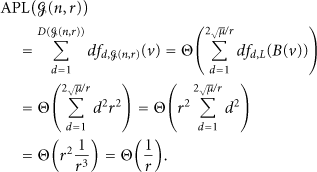
Thus, the average path length for random geometric graphs above the connectivity threshold is the same as the order of the diameter (maximum shortest-path lengths) for such graphs, which is
2.2. Random Walk and Connectivity Preliminaries
When speaking of a random walk, we connote in particular this natural process: if the random walk is currently at node q, then the simplest probabilistic rule by which one chooses the next node is simply to choose a node uniformly at random from among the set of neighbors of q. And, the Markov chain
In such terms, the stationary distribution of 𝔐, if such exists, is the unique probability vector π such that


To define mixing time, we must first introduce the relevant notion of distance over time. Let x be the state at time



Now, on the way towards proving the rapid mixing property of a random walk, we shall make use of a number of beautiful connections amongst mixing time, the eigenvalues of the Markov chain (in particular the spectral gap, namely, the difference between the first and second eigenvalues), and connectivity properties of the underlying graph as encapsulated by notions called conductance which is a normalized form of expansion. In introducing the connection between expansion and rapid mixing, we note that intuitively graphs with minimal “bottlenecks” have also a lower probability of getting stuck in any particular set of states, and thus a faster mixing time as well. We shall see that the graph-connectivity-based property of “no bottlenecks” is formalized in a continuous manner with the notion of conductance and in a combinatorial manner with expansion. And, then we shall make the relationship between conductance and mixing time precise.
In fact, one of the motivations we have in considering random edge additions to random geometric graphs is precisely based on the nice connectivity properties that random d-regular graphs possess, which we shall see are very much not possessed by random geometric graphs: random d-regular graphs are expanders w.h.p. for
The conductance of a reversible Markov chain 𝔐 is defined by [17]

In graph-theoretic terms, the conductance of 𝔐 is the minimum over all subsets

As the stationary distribution π is defined to be such that
Theorem 9.
For an ergodic Markov chain (ergodicity is guaranteed by the chain being finite, connected, and non-bipartite, as in this work.), the quantity
And, to relate conductance explicitly to mixing time, it thus suffices to bound the spectral gap with the conductance.
Theorem 10 (see [16]).
The second eigenvalue

Combining, as in [14] one has the following.
Corollary 11 (see [17]).
Let 𝔐 be a finite, reversible, ergodic Markov chain with loop probabilities

In particular, the following is immediate too.
Remark 12.
For a random walk to be rapid mixing, it is necessary and sufficient that the conductance be inverse poly-logarithmic.
Finally, we must speak of the mixing properties of the random geometric graph above the connectivity threshold as shown in [14, 18, 19].
Theorem 13.
Given
In particular at
Corollary 14 (mixing time of RGG).
Radius
On the other hand, recall that Even sparse random regular graphs are rapid mixing.
Remark 15.
It is well-known that the random 3-regular graph
3. Models of Random Edge Additions
As we start to consider the business of adding random edges to a given initial graph
Given such a characterization, let us be given a 5-geo-dense geometric graph
Similarly to the above, let us define the resulting graphs as follows: let
Remark 16.
Given
Before proceeding to prove results on average path lengths for
Remark 17.
For any k, if every
Now, we note that the maximum distance of any node in a
Remark 18.
Every node is within
This remark shall prove relevant in relating inter-node distances in the graph
As we stated in the introduction, our results regarding mixing time, conductance, and spectral gap will hold for even weaker models of edge addition (or rather link station placement) than those of
4. APL and Diameter Bounds
4.1. APL and Diameter Bounds for
Thus, we now proceed concerning inter-node distances for the first model
Combining Remarks 16, 18, and 15, we obtain our first bounds on the resulting average and worst-case path lengths.
Theorem 19.
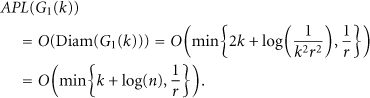
The diameter and average path lengths for
Proof.
Let
For any broadcast radius r, it is clear that when
Corollary 20.
For
4.2. APL and Diameter Bounds for
The case for the second model
Theorem 21 (expansion of
; see [25]).
Let
Despite the similarities to the situation for
Visually, if we could just contract the lattice subskeleton formed from the
Theorem 22.
The diameter and average path lengths for

Prior to the theorem proof, let us note the immediate corollary for low broadcast radius, which again notes an exponential improvement in diameter and average path lengths for polylogarithmic k.
Corollary 23.
For
Now let us introduce the theorem proof.
Proof (Proof of Theorem 22).
Consider the graph of node-contractions
Consider any two nodes Base: in accordance with Remark 18, replace Inductive case I: for Inductive case II: let node
Clearly, the above construction is valid, replacing contracted edges with valid subpaths at each step. Moreover, at every step, the replacement path is at most a
5. Mixing Time and Connectivity Bounds
5.1. Theoretical Bounds on the Mixing Time of
Whereas the primary results for this paper concern sparse random edge additions to random geometric graphs, along the way to proving such results, a more general result on the mixing time for sparse random edge additions to arbitrary connected graphs of at most polylogarithmic degree was also found. Further, surprisingly, results on rapid mixing of modifications of random geometric graphs are valid on the weaker model
To begin with, we only lose some generality for conductance results by restricting ourselves to consideration of radius
Finally, before proceeding to our main results, we present a more general model for
Note that for all variations of
Theorem 24.
The conductance of
From this main theorem this corollary follows immediately from Remark 12.
Corollary 25.
For
In fact, somewhat surprisingly, another more general corollary also follows from the proof of Theorem 24, the consequence of which we shall mention while presenting the main proof shortly.
Corollary 26.
For
We present the proof of Theorem 24 now and indicate the point to which the arguments apply to Corollary 26 as well.
Proof.
In describing how
From introductory remarks, we may restrict ourselves to this process w.l.o.g.: pick


Combining the two conditions, let us first consider areas A that satisfy the following:

We will indicate when we consider what happens for smaller areas.
We note that the above statements are not dependent on the edge set of the underlying graph
Now, from Definition 3 consider the conductance measure


By Coupon Collection Theorem 4 and (16), it follows that if
It follows from the construction of


What happens for small sets
Recall that the minimum requirement given for the base graph of the general model

Substituting polylogarithmic functions for
For the specific case of the base graph being our relevant model of random geometric graphs about the connectivity threshold, a tighter result can be obtained as small sets exhibit good expansion in such graphs.
For modifications of random geometric graphs in particular, let us guarantee for


Returning to the case of large sets
5.2. Experimental Bounds on the Algebraic Connectivity
Experiments were conducted for networks of 100 to 1620 nodes. The networks were constructed in a way that is consistent with the models
The results can be seen in Figure 1, where the Y-axis is the spectral gap of the normalized Laplacian, namely, the normalized algebraic connectivity. Notably, the spectral gap for the random geometric graph approaches zero quickly, whereas the spectral gap for

Spectral gap comparison for
5.3. Observations on Experimental Results
Since we are considering the normalized Laplacian spectral gap, automatically all results must be between 0 and 1. Note that we considered the normalized spectral gap because we want to avoid the scaling problem that could arise if we compared the non-normalized spectra for graphs with very different degrees. Further, we consider the Laplacian instead of simply taking the adjacency matrix, because the Laplacian is symmetric, making faster computations while giving comparable bounds. That all results are less than 0.1 in particular should not be bothersome as well, for two reasons: first, even if we were taking the strong property of being an expander into account, a graph family whose normalized spectral gap never falls below a given constant (e.g., 0.01) would be satisfactory, regardless of the constant. But, we are not attempting to show such a strong property anyway. We are concerned with sufficient expansion, in terms of rapid mixing, which does not even require a constant lower bound, but merely that the rate at which the spectral gap falls is slow (in particular, inverse poly-logarithmic).
In fact, as theoretical result Theorem 24 already demonstrates that
6. Conclusion
We have presented theoretical bounds on the diameter, APL, conductance, and mixing time of sparse random edge additions onto random wireless networks around the connectivity regime, where our bounds are expressed as functions of the wiring frequency. We have also shown experimental results comparing the normalized algebraic connectivities of the underlying random geometric graph to the hybrid models. In particular, we have shown that when the wiring frequency is at least inverse poly-logarithmic, then the subsequent hybrid network exhibits polylogarithmic diameter and mixing time, both of which are exponential improvements to the wireless network about the connectivity regime. We have also shown that there is correspondingly significant asymptotic improvement to the normalized algebraic connectivity which is known to govern network robustness. Taking broadcast radius on the order of the connectivity threshold is particularly important in the case of sensor networks where energy must be preserved and interference diminished and thus comprises the relevant base graph model as used in much theoretical work on such networks. Nonetheless, the results regarding bounds on diameter and APL are also expressed for general broadcast radii. The mixing time bounds in particular are relevant for distributed gossip applications where it is well established that the performance is dominated by this value. Taken as a whole, this work provides a strong support for hybrid sensor networks.
From a practical standpoint, one may ask how such random wired links should be established atop a wireless sensor network in order that the hybrid model presented be of true relevance. In this regard, we note that the analyses presented is sufficiently general to include an existing sparse wired network atop which a wireless network resides. A benefit of theoretical bounds is precisely this lack of restriction of how the network details are established. In fact, the random edges of the superimposed links need not even be wired, but may be generated via a sufficiently sharply angled and long-ranged directional antenna model as well, as long as the problem of the side lobe may be solved. We point the reader to the existing literature on small worlds for hybrid networks stated in the introduction, as many proposals are given towards the practical aspects of hybrid network creation.
We reiterate that this is the first theoretic graph work to establish solid theoretical foundations of the improvement to graph diameter and mixing time of sparse totally random links (of a nonbroadcast nature) upon a random wireless network above and around the connectivity threshold. The two most relevant works with which to compare and contrast results would be those of [10, 25]. The results of [25] take the base graph to be arbitrary but the wiring probability to so high as to rewire every edge on average. Moreover, that work is concerned with the extremal property of the resulting graph being an expander or not, rather than general expressions of the degree of expansion or mixing time. The arguments used are beautiful and tight, but are neither sufficiently general to take diminishing random wiring probability, nor sufficiently relevant for the base graph being the random wireless domain in particular. The work of [10], in contrast to [25] does consider asymptotically diminishing wiring probability and restricts to the relevant model of wireless base graph around connectivity. However, in that case, base station is fixed and a particular type of greedy forwarding is assumed for the routing protocol, so that they actually obtained the worst results for the case of totally random links. Moreover, they do not discuss the mixing time at all. Thus, our work may be considered to be a positive complementation to that work in the sense that we obtain positive results when routing is both shortest paths-based and random.