




Abstract
Akund fiber is a new type of natural cellulose fiber. Because of its excellent properties, akund fiber has become one of the new ecological materials which have huge development potential. Recently natural fibers have shown great promise in a variety of applications that were previously dominated by synthetic fibers due to their important aspects of biocompatibility, possible biodegradation, nontoxicity, and abundance. Moisture absorption and release behaviour of natural fiber plastic composites is one major concern in their outdoor applications. So the knowledge of the moisture content and the moisture absorption and release rate is very much essential for the application of akund fiber as an excellent reinforcement in polymers. An effort has been made to study the moisture absorption and release behaviour of akund fiber and the mechanical performance of it at relative air humidity from 0% to 100%. The gain and loss in moisture content in akund fiber due to water absorption and release were measured as a function of exposure time under the environment, in which temperature is 20°C and humidity is 65%. The regression equations of the absorption and release process were established.
1. Introduction
Akund fiber, also called calotropis fiber, is a new type natural cellulose fiber and is obtained from Calotropis procera and Calotropis gigantea, belonging to the Apocynaceae family. As one type of natural cellulose fiber, akund fiber has good touch to skin like cotton and beautiful luster like silk. Akund fiber has a large hollow structure with a thin wall that looks like an air-filled pipe. It is about 2 to 4 cm long and 12 to 42 microns in diameter. Because of its excellent properties, akund fiber has become one of the new ecological materials which have huge development potential [1].
With enhancement of environment protection consciousness of people recently, natural fibers have shown great promise in a variety of applications that were previously dominated by synthetic fibers due to their important aspects of biocompatibility, possible biodegradation, non-toxicity, and abundance. Currently, automotive and construction industries have been interested in composites reinforced with natural plant fibers as alternative materials for glass-fiber reinforced composites in structural applications with modest demands on strength reliability [2, 3]. It has been known that the high level of moisture absorption by natural fibers, the poor wettability, and the insufficient adhesion between the untreated fibers and the polymeric matrix lead to bonding failure with age [4]. Moreover, the absorbed moisture has many detrimental effects on the mechanical performance of these fibers. Therefore, an understanding of the hygroscopic properties of natural fibers is very important to improve the long-term performance of composites reinforced with these fibers [5]. In this paper, an effort has been made to study the hygroscopic properties of akund fiber and the mechanical performance of it at relative air humidity ranging from 0% to 100%. The gain and loss in moisture content in akund fiber due to water absorption and release were measured as a function of exposure time under the environment, in which temperature is 20°C and humidity is 65%. The regression equations of the absorption and release process were established. As akund fiber belongs to the plant fiber, which is similar with cotton and kapok fiber, and both cotton and kapok fiber are used to composite reinforce fiber, therefore, in order to explain the akund fiber's absorption and release moisture ability clearly, whole the analysis is according to the comparison with cotton and kapok fiber.
2. Experimental
2.1. Materials
Akund fiber and kapok fiber were collected from Yunnan province, China. The cotton fiber was collected from Xinjiang province, China. The compositions and structural parameters of samples studied in this work are listed in Table 1. All the test fiber was put in the constant temperature and humidity room, whose temperature was 20°C and relative air humidity was 65% for 24 hours.
Composition and structural parameters of samples [6].

2.2. Instruments
Y802A type eight basket constant temperature oven, AUY120 type electronic balance (uncertainty = ±0.0001 g), HHS2100 L type constant temperature and humidity test case, and XQ-2 single fiber strength and elongation test instrument were used.
2.3. Experimental Process [7, 8]
2.3.1. Moisture Absorption Experiment
In the case of the moisture absorption methods, each sample having a mass of 1.0 g was dried in the Y802A type eight basket constant temperature oven at 60°C for one hour. The dried samples were placed in the constant temperature and humidity room (the temperature was 20°C and relative air humidity was 65%) and weighed on the electronic balance (uncertainty = 0.0001 g) every 5 minutes, until the fibers reached to moisture absorption balance. The samples after reaching to absorption balance were dried in the constant temperature oven at 105°C to achieve a constant mass. The moisture content Mc at time “t” was calculated using

where M d and M w are, respectively, the mass of the dried smaple (in g) and the mass of the wet sample after time t (in g). In all cases, the mean ± standard deviation data from three repeated experiments were taken to ensure reliability of the results.
2.3.2. Moisture Release Experiment
In the case of the moisture release methods, each sample having a mass of 1.0 g was put in a 60 × 30 weighing bottle. The open weighing bottle was placed in a constant temperature and humidity test case for 48 hours in which the temperature was 20°C and the relative air humidity was (98 ± 2)%. Then the weighing bottle was closed; the sample was removed to the constant temperature and humidity room (the temperature is 20°C, and the humidity is 65%), and weighing bottles were opened. Every 5 minutes, the samples were weighed, until the fibers reach to moisture release balance. Then the samples were dried in a constant temperature oven at 105°C to achieve a constant mass. The moisture content Mc at time “t” was calculated using

where M d is the mass of the sample after drying to a constant mass (in g) and M h is the mass of the humidified sample (in g). In all cases, the mean ± standard deviation data from three repeated experiments were taken to ensure reliability of the results.
2.3.3. Fiber Strength Test in Different Humidity
In the case of the fiber strength test methods, each sample having a mass of 1.0 g was put in a 60 × 30 weighing bottle. The open weighing bottle was placed in a constant temperature and humidity test case for 48 hours in which the temperature was 20°C and the relative air humidity, respectively, were 0%, 30%, 60%, 80%, and (98 ± 2)%. Then the weighing bottle was closed; the sample was removed to the constant temperature and humidity room (the temperature is 20°C, and the humidity is 65%). And according to the GB/T 14337-2008 methods of testing the fiber strength, 50 fibers were tested in each test.
3. Results and Discussion
3.1. The Moisture Absorption and Release Curve
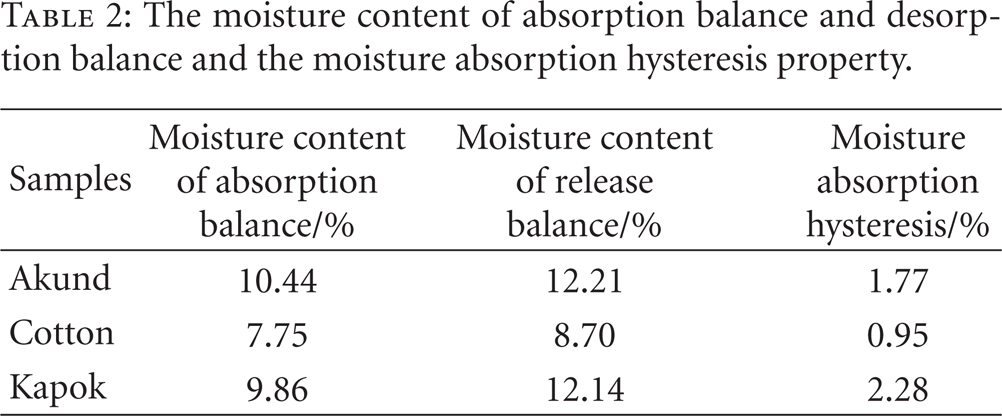
The moisture absorption and release curves of akund fiber, cotton, and kapok are shown in Figures 1 and 2, and the experiment data are listed in the Table 2.
The moisture content of absorption balance and desorption balance and the moisture absorption hysteresis property.

Moisture absorption fitting curve.
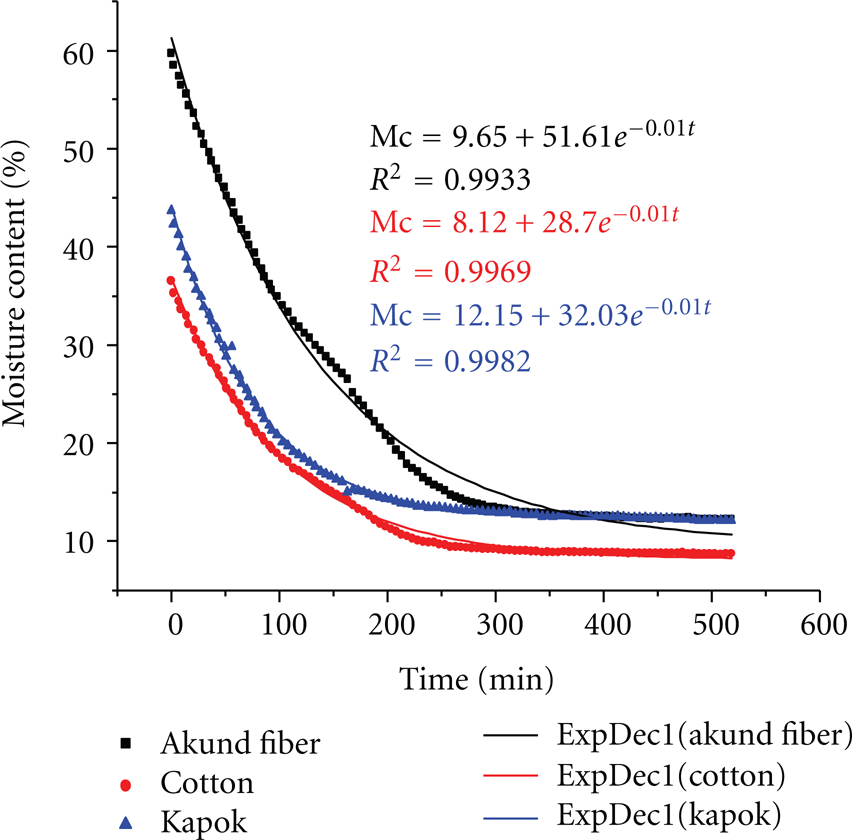
Moisture release fitting curve.
From Table 2, it can be seen that the moisture content of akund fiber in standard state is about 10.44% and akund fiber has the same moisture absorption hysteresis quality as cotton and kapok, in which the moisture content in absorption balance is smaller than that in release balance. The moisture hysteresis of akund fiber is 1.77%, which is bigger than that of the cotton fiber and smaller than that of the kapok fiber. From Figures 1 and 2, it can be found that during the process of moisture absorption and release, akund fiber takes longer time to equilibrate than the others, and it has a higher equilibrate moisture content than the others. The moisture content of akund fiber has a fluctuation of up and down. The general shape of the water absorption and release curves for akund fiber is similar to those of cotton and kapok. The moisture content of akund fiber changes from 4.25% to 9.98% in the first 60 min, the changes is only from 10% to 10.44% in the following 100 min, and in the last 20 min, there are almost no changes in the moisture content. These results exhibit the two-stage absorption and release behaviour of akund fiber. The first stage occurred very rapidly having a linear uptake to 60% of absorption and release. The second stage of absorption and release began very slowly and proceeded up to complete balance.
3.2. Establishment of the Regression Equation of Moisture Absorption and Release Process
It is well accepted in the literature [7, 8] that the theoretical curve of the fibers’ moisture absorption and release process is an exponential curve, so the regression equation of moisture content (M) versus exposure time (t) can be expressed using

where, a, b, and c are all constants.
Taking (3) as a function, the regression equation can be established from the test data by custom function fitting of the moisture content (Mc) versus the exposure time (t) using data analysis software, Origin Pro 7.5. The fitting curves and the regression equations are shown in Figures 1 and 2.
From Figures 1 and 2, it could be found that the fitting curves of the moisture absorption and release are similar to the original data, and the coefficients of determination (R2) of the regression equations are all above 0.98. Therefore, the regression equations can effectively express the relation between the moisture content (Mc) and the exposure time (t) during the moisture absorption and desorption process.
3.3. Establishment of the Regression Equation of the Moisture Absorption and Release Rate
The moisture absorption and release rate of fibers can be expressed by the weight of moisture absorption and release of unit quality fiber at instant time. So the differential equation of (3) is the regression equation of the rate of moisture absorption and release, which is shown

According to the regression equation of the moisture absorption and release rate of akund fiber, cotton, and kapok, the regression curves of the moisture absorption and release rate of the three kind of fibers could be determined, which are shown in Figures 3 and 4.
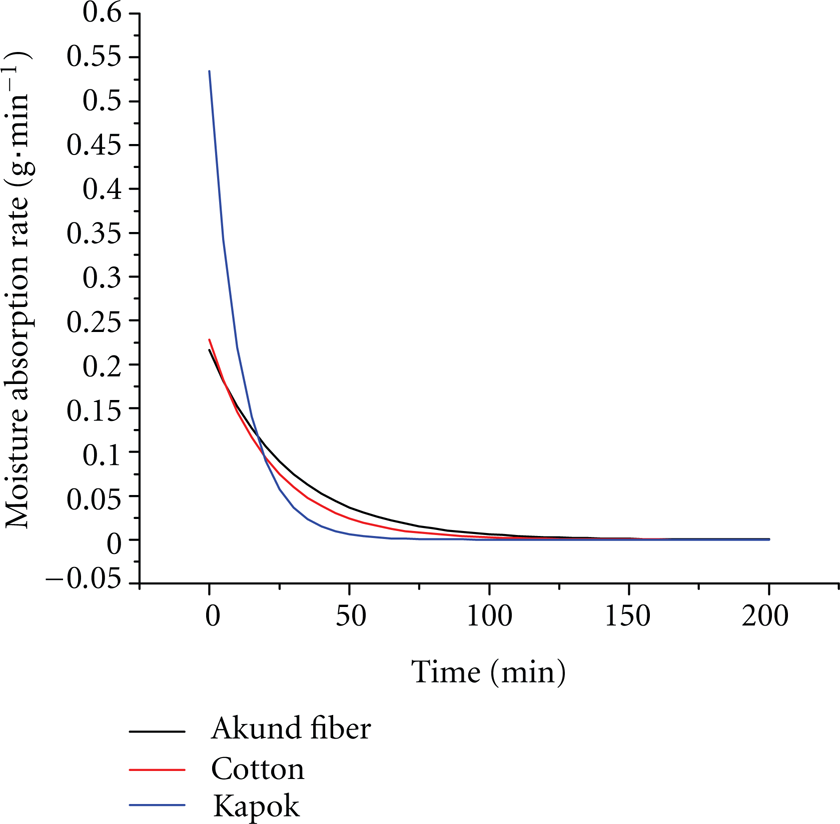
The moisture absorption rate.

The moisture release rate.
From Figures 3 and 4, it can be seen that the initial moisture absorption rate of akund fiber is similar with that of cotton in standard state and much lower than that of kapok. And the initial moisture release rate of akund fiber is similar with that of kapok, and higher than that of cotton. The rate of moisture absorption and release of the three fibers reduces gradually over time. The rate decrement of the moisture absorption and release of kapok is the fastest. Kapok reaches the moisture absorption and desorption balance first, the cotton is next to the kapok and the akund fiber is the slowest. So it can be concluded that akund fiber has a quick moisture release and slow moisture absorption performance.
3.4. The Mechanical Performance of Akund Fiber at Different Relative Humidity
In order to determine the environmental factor of the utility of akund fiber, the breaking strength of akund fiber was determined at different humidity values and the results are shown in Figure 5.

The breaking strength of akund fiber at different relative air humidity values.
From Figure 5, it is evident that with an increase in the relative air humidity, the breaking strength of akund fiber increases. This is attributed to the possible changes in the interaction between the large molecular chains as a result of water entering into the fiber interior. The water absorption of akund fiber leads to the improvement of unevenness of macromolecular force and the increase in the number of the fracture molecular chain. And it is interesting to note that the samples have an approximately 4.3% increase in breaking strength from the low-humidity condition (0%) to the high-humidity condition (100%).
4. Conclusions
According to the above results and discussion, we can draw the following conclusions:
The moisture content of akund fiber in standard state is a little more than that of kapok. The ability of moisture absorption and release of akund fiber is similar with that of kapok.
Akund fiber has a quick moisture release and slow moisture absorption performance. The initial rate of moisture release of akund fiber is much higher than that of cotton, and similar to kapok. But its initial speed of moisture absorption is the slowest, and closest to cotton.
The mechanical performance of akund fiber changes as the relative air humidity changes. Its breaking strength increases gradually with the increase of relative humidity. The wet strength of akund fiber is much higher than the dry strength.