




Abstract
Vortexing occurs during draining of liquid from tanks. We studied the critical height of a liquid being drained from tank, that is, the liquid height at the moment when the air-core vortex reaches to the drain port. We firstly performed some experiments for determining the critical height, and then based upon the information obtained from the experiments; a simple analytical expression was derived to predict the critical height. The experimental results show that the vortex suppressor, which is suggested in the present paper, could effectively reduce the strength of vortex and consequently reduce the critical height. The results also show that the new analytical expression can predict the critical height with less than 20% error when vortex suppressor is used. To the best of our knowledge, draining from tanks with bell-mouth drain ports has not been paid attention to by other authors.
1. Introduction
During draining of liquid from a container through a drain port, a dimple appears on the liquid free surface close to the drain port. Then the dimple develops into a vortex with an air core, this air-core vortex extends to the drain port as the liquid level reaches a critical height, hcr [1, 2]. The air entrainment by the air-core vortex to a centrifugal pump can make significant loss of efficiency and other problems.
There have been attempts to suppress vortexing using different methods. Abramson et al. [1] found a simple cross-type baffle over the orifice effectively eliminated the effect of vortexing on the flow rate through the orifice. Ramamurthi and Tharakan [3] studied the effectiveness of shaped ports in suppressing air vortex and they found that a stepped drain port is effective to prevent vortex formation. Sohn et al. [4] used the tanks of square cross-section for suppressing the vortex formation. Lakshmana Gowda et al. [2] have suggested the dish-type (or cu-shaped) suppressor to prevent vortex formation during draining after imparting initial rotation. Sohn et al. [5] showed that a vane-type suppressor is effective to prevent vortex formation. A circular flat plate with porous wall was used by Mahyari et al. [6]. Sohn et al. [7] studied the effect of eccentric drain holes in suppressing vortex.
In some of space vehicles and rockets, bell-mouth-shaped discharge ports are used in liquid propellant tanks (Figures 1 and 2). The reason for using this type of port could be (1) nonaxiality of pump and tank, (2) not having enough space in the engine section; (3) the critical height reduction. In the literature (to our knowledge), there is not any investigation about vortex formation with bell-mouth port, so in the present paper, we study vortex formation in a cylindrical tank with bell-mouth drain port. Moreover, we suggest a simple device (vane-type suppressor) to prevent vortex formation.
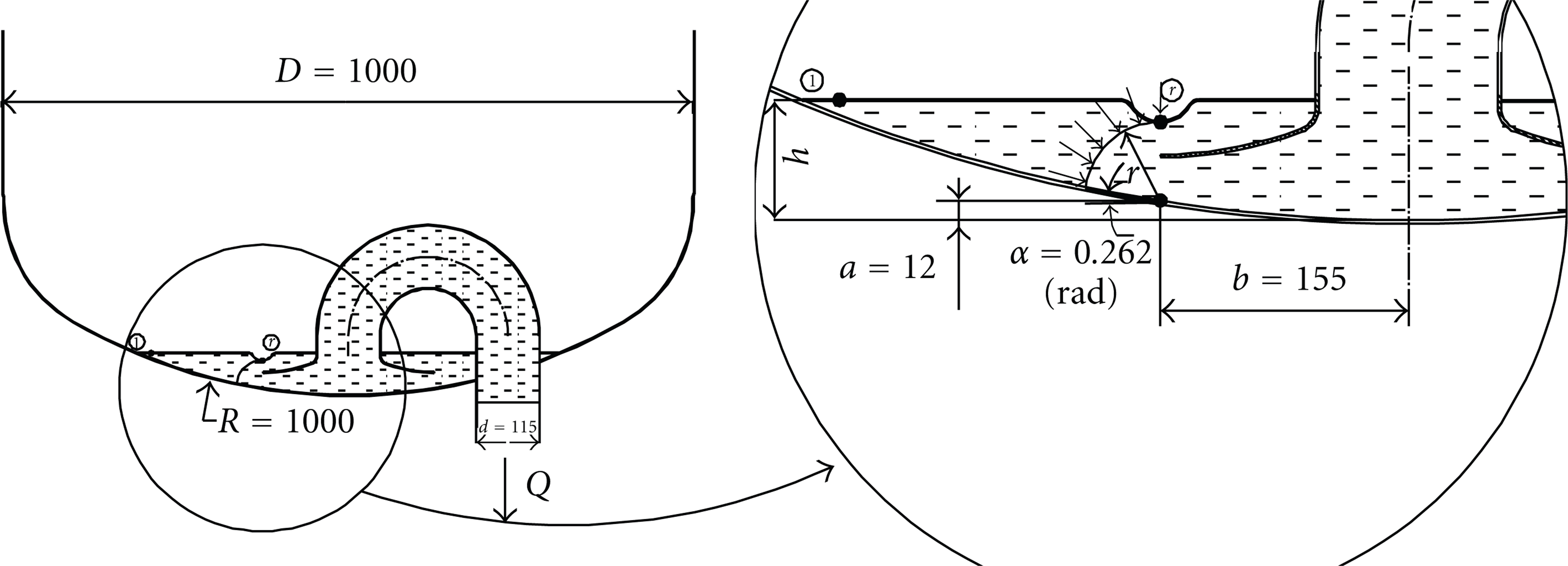
The test tank, the symbols, and the control volume used in the present study (unit: mm).

The bell-mouth drain port with eight vortex suppressor plates (unit: mm).
In the following parts, firstly the critical height is determined experimentally with and without vortex suppressor. Then based upon the obtained experimental information, a new analytical expression is extracted to predict the critical height.
2. Experimental Study
The experimental model was cylindrical tank with circular cross section, calling it test tank from now on (Figures 1 and 2). The diameter and length of the test tank are 1000 mm and 2000 mm, respectively. For reducing scale effect, the dimensions of the test tank were chosen close to real cases. The bell-mouth drain port centrally located at the bottom of the test tank along the vertical axis. We suggested a suppressor device to prevent vortex formation. This device consists of eight plates, which were placed under the bell-mouth drain port. Their positions and geometrical dimensions were shown in Figure 2.
The experiments were conducted to measure the critical height of liquid draining from the test tank. At each test, liquid was drained from the tank through the bell-mouth drain port with constant volume flow rate. The experiment procedures included (1) charging the test tank from the reservoir tank by using pump, liquid entered from top of the test tank, (2) after charging, with 3-minute delay time, the experiment started and liquid was drained from the test tank to the reservoir tank by pump. The flow rate was controlled by a valve that connected to the drain port, and the volume flow rate, Q, was measured by flow meter, (3) the free surface of liquid in the test tank was recorded by a video camera through graduated Plexiglas at fuselage of the test tank, and (4) after air entered the drain port, the experiment finished and pump was turned off. The critical height of air-entrainment was obtained easily by watching the motion picture film recorded in the third stage of the test. To check the reliability of the obtained results, each experiment was repeated several times.
The slightest disturbance in the liquid affects very strongly the critical height [1, 2, 8]. In the present experiments, since the test tank was charged from the top of tank, the liquid of the test tank became disturbed. It was observed from the experiments that the liquid disturbance has little effect on the critical height beyond 3 minutes of delay time, which was chosen as the time duration between the end of charging and the start of draining. Thus, prior to any experiment, the liquids in the tank were kept undisturbed for 3 minutes to create a near-quiescent liquid when the drain valve was opened and the pumping was started.
Figure 3 shows two pictures of vortex formation near to bell-mouth drain port in two different times: the dimple formation and air-entrainment vortex. In the present paper, the height of the liquid in the test tank as air vortex reaches to drain port was assigned as the critical height and was measured.
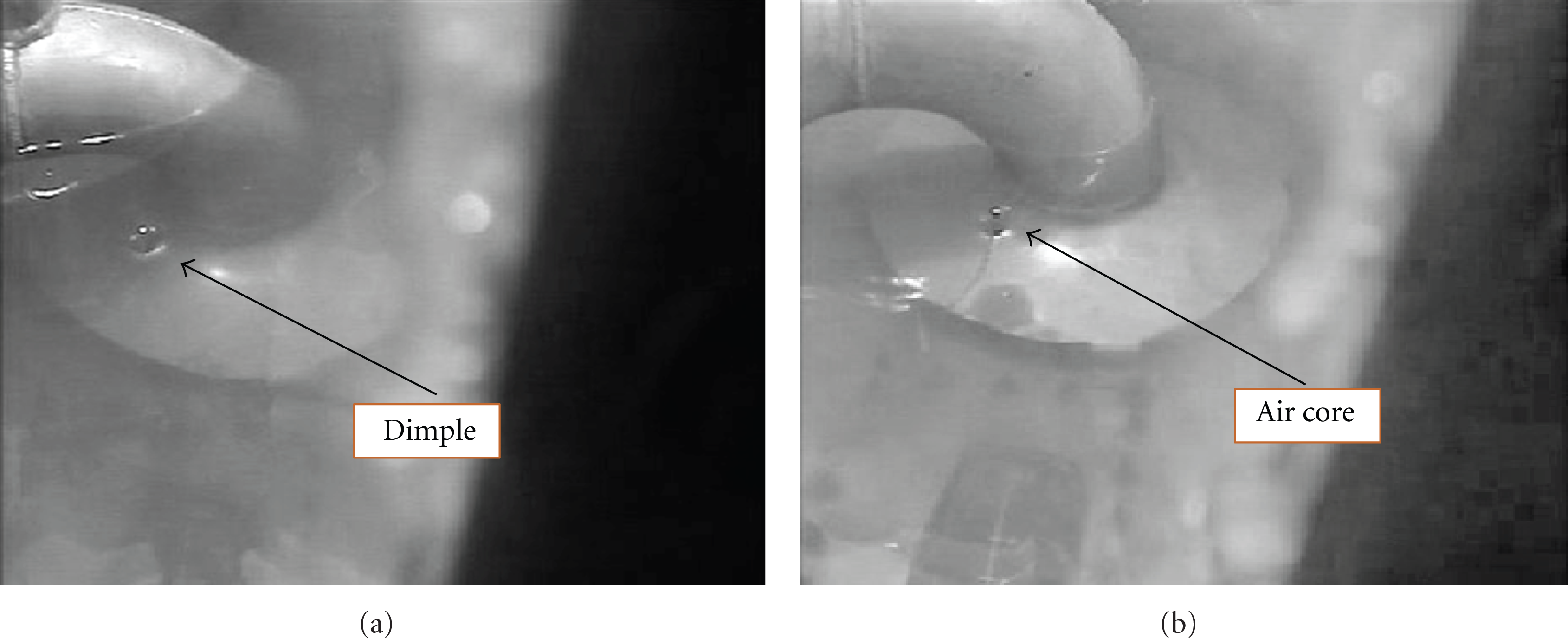
Vortexing in the bell-mouth drain port: (a) the formation of a dimple on the free surface; (b) the vortex with air core and air entrainment (the critical height).
The critical heights verses drain flow rate obtained from experiments were presented in Figure 4 at various initial liquid heights (0.6, 0.90, 1.30, and 1.50 m). These results have been shown in two groups: with and without vortex suppressor device. It is seen in Figure 4 that the vortex suppressor reduces the critical height effectively. Figure 4 shows that the critical height increase gradually with increasing drain flow rate, and it is nearly independent of the initial height of liquid.

The analytical and experimental results of the critical height at various initial liquid heights as (a) 1.5 m, (b) 1.3 m, (c) 0.9 m, and (d) 0.6 m.
3. Theoretical Approach for Predicting the Critical Height
In this section, based on the experimental observation and some assumptions, an attempt will be made to predict analytically the critical height at which air vortex reaches to the drain port. The analytical method, which is applied here to predict the critical height, is similar to the study conducted by Lubin and Springer [8]. The analysis was performed based on some assumptions as follows:
the effects of viscosity of liquid are negligible;
the effect of surface tension at the interface is negligible.
It is pointed out that Hite and Mih [9] determined the critical Reynolds and Weber number at which the surface tension and viscous effects are negligible. In current tests, both Weber and Reynolds numbers were larger than these critical criteria; therefore, we took these two previous assumptions;
(c) prior to the air vortex reaches to the drain port, the flow is steady. This assumption is based on two experimental parameters: (1) the diameter ratios between the test tank and the pipe of the bell-mouth port
(d) the strength of vortex is low; we suppose that the vortex suppressor, which was suggested in the present study, can prevent vortex formation effectively.
Prior to the air vortex reaches to the drain port (see Figure 1), we can write the Bernoulli equation, based on the above assumptions, along a streamline between points (1) and (r) as follows:

where

where bandα are the geometrical parameters (see Figure 1), and θ is variable of integration (the angle between normal line of the surface dA and horizontal line). The conservation of mass equation is written as:

where Q is the drain flow rate from the test tank through the bell-mouth port.
In writing (3), it is further assumed that at every point on the surface of the control volume, the flow velocity has the same value and is normal to this surface.
In (1),

Equation (4) shows that with reducing r, P r firstly increases up to specific radius, which is shown by rcr, and then decreases. We can obtain rcr as follows:

If the free surface height decrease and rreaches to rcr, then P
r
monotonically decreases on streamline from the free surface to the drain port and consequently the air can enter the drain port. This liquid height is the critical height. By inserting rcr, as obtained by (5), into (4) and considering that at the critical height

The critical height is obtained from (5) and (6) by trial and error. Equations (5) and (6) show that the critical height depends on the geometrical parameters, drain flow rate, liquid density, and gravitational acceleration.
In the present experimental study, the geometrical parameters (
4. The Comparison and Discussion of the Results
The analytical and experimental results of the critical height were presented in previous sections. These results, shown in Figure 4, consist of three groups: experimental results with and without vortex suppressor device, and analytical results. Below, each group is discussed and compared with other groups.
There is a clear difference between the critical height of the without-suppressor-device group and that of the analytical-results group. This difference emerged from vortex formation.
The critical heights of the analytical results are close to the experimental ones with vortex suppressor. This fact shows that the vortex suppressor, which was used in bell-mouth drain port, effectively prevents vortex formation. In addition, the assumptions that were applied to derive the critical height are approximately correct. It is guessed that the little difference between these results is due to deviation in assumption (d) and error in estimation of V r (3).
The experimental results (with and without vortex suppressor) show that the critical height is not strongly dependent on the initial height of the liquid in the tank. It will increase slightly for lower initial height, which may be due to the presence of higher initial disturbances under such condition. The disturbance is caused by charging the test tank from the top. Therefore, the generated disturbance can be more intensive in the case of lower initial height as compared to the case with the higher initial height.
5. Conclusion
In the present paper, liquid draining from propellant tank was studied. The critical height of air entrainment to the drain port was measured experimentally, and then a new analytical expression was derived to calculate the critical height. The main results and important points are as follows:
the vortex suppressor, which was suggested in this study, could reduce the vortex strength and the critical height considerably;
the analytical expression, which was extracted based on Bernoulli equation and some assumptions such as no vortex formation, could predict the critical height with vortex suppressor with less than 20% error;
we could say that by using a vortex suppressor device similar to the one used in this study, the analytical method, which was proposed here, may be used to estimate the critical height in other bell-mouth drain ports;
the dimension of experimental model that was used is large and close to real liquid propellant tank dimensions. Therefore, the results that were obtained here are applicable to design these tanks.