




Abstract
The steady two-dimensional boundary layer flow of a nanofluid over a shrinking sheet with thermal radiation and suction effects is studied. The resulting system of ordinary differential equations is solved numerically using a shooting method for three different types of nanoparticles, namely, copper (Cu), alumina (Al2O3), and titania (TiO2). The results obtained for the velocity and temperature profiles as well as the skin friction coefficient and the local Nusselt number for some values of the governing parameters, namely, the nanoparticle volume fraction, shrinking, suction, and viscous dissipation parameters, are discussed. The numerical results show that dual solutions exist in a certain range of suction parameter.
1. Introduction
Conventional heat transfer fluids such as water, oil, and ethylene glycol play significant roles in various industrial processes, such as power generation, heating and cooling processes, and chemical processes [1]. However, due to poor heat transfer capability of these fluids, they cause limitation in heat transfer processes. One of the great techniques to increase the thermal conductivity of these fluids is by suspending nanometer-sized particles into the base fluids. This mixture is called nanofluid, which was initiated by Choi [2]. Nanofluid has high thermophysical properties in thermal conductivity and convective heat transfer coefficient and thus is expected to enhance the heat transfer performance of the base fluids [3]. Daungthongsuk and Wongwises [1], Das et al. [4], Kakaç and Pramuanjaroenkij [5], Wang and Mujumdar [6], and Saidur et al. [7] have made a comprehensive literature review in their books and review papers in discussing the heat transfer characteristics in nanofluid besides identifying future research in convective heat transfer of nanofluid. The current and future applications of nanofluids have been discussed by Wong and de Leon [8]. Manca et al. [9] and Jaluria et al. [10] reported that research activities of heat transfer in nanofluids are significantly increasing and the number of research articles dedicated to this subject showed exponentially increasing.
The viscous fluid flow due to a shrinking sheet was first studied by Miklavčič and Wang [11]. Wang [12] then extended this problem to a stagnation flow towards a shrinking sheet. From these two investigations, Wang [12] concluded that the flow over a shrinking sheet is likely to exist; either an adequate suction on the boundary is imposed, or a stagnation flow is considered. Ishak et al. [13] extended this problem to a micropolar fluid and found that dual solutions exist for a certain range of the shrinking parameter. This new type of shrinking sheet flow is essentially a backward flow as discussed by Goldstein [14]. The flow induced by a shrinking sheet shows physical phenomena quite distinctfrom the forward stretching flow (Fang et al. [15]). Both the flow and heat transfer in a viscous fluid over a stretching/shrinking surface have been extensively investigated during the past decades owing to their importance in industrial and engineering applications. These flows occur in material processing such as extrusion, melt spinning, drawing, or continuous casting. Cooling of stretching/shrinking sheets is needed to assure the best quality of the material and requires dedicated control of the temperature and, therefore, knowledge of flow and heat transfer in such systems (Liu and Andersson [16]).
Recently, Yacob et al. [17] investigated numerically the problem of boundary layer flow over a stretching/shrinking sheet beneath an external uniform shear flow immersed in a nanofluid, considering a convective surface boundary condition. They found that the heat transfer rate at the surface increases as the nanoparticles volume fraction increases. Moreover, dual solutions were found to exist for a certain range of the shrinking parameter. Bachok et al. [18] analyzed the flow and heat transfer characteristics over a stretching/shrinking sheet in a nanofluid. They also reported the nonunique solution for the shrinking case. Very recently, Rohni et al. [19] investigated the unsteady flow of a nanofluid over a shrinking sheet with mass suction effect at the boundary. They found that heat transfer characteristics are markedly influenced by the mass suction, the unsteadiness, and the solid volume fraction parameters, and dual solutions were found to exist for a certain range of the unsteadiness parameter. Later, the similar problem on a shrinking/stretching sheet was investigated by Bachok et al. [20]. It should be mentioned to this end that the enhanced thermal behavior of nanofluids could provide a basis for an enormous innovation for heat transfer intensification, which is of major importance to a number of industrial sectors including transportation, power generation, micromanufacturing, thermal therapy for cancer treatment, chemical and metallurgical sectors, as well as heating, cooling, ventilation, and air-conditioning. Nanofluids are also important for the production of nanostructured materials, for the engineering of complex fluids as well as for cleaning oil from surfaces due to their excellent wetting and spreading behavior (Ding et al. [21]).
The aim of the present study is to investigate the flow and heat transfer characteristics over a permeable shrinking sheet in a nanofluid with the thermal radiation effect taken into consideration. This study is the extension of Hady et al. [22] to the case of shrinking sheet with the inclusion of suction effect. Using a similarity transformation, the governing partial differential equations are transformed into nonlinear ordinary differential equations and then solved by means of the shooting method. The influence of the governing parameters on the flow and thermal fields is graphically presented and analyzed.
2. Mathematical Formulation
Consider a steady two-dimensional, incompressible, and laminar boundary layer flow of a viscous nanofluid over a permeable shrinking sheet coinciding with the plane
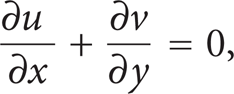
Table 1 shows the thermophysical properties of the fluid and nanoparticles. Under the usual boundary layer approximations and using the mathematical nanofluid model proposed by Tiwari and Das [23], the basic equations are (Hady et al. [22])


The boundary conditions of (1)–(3) are

where u and v are the velocity components in the x and y directions, respectively. The thermal properties of nanofluid are given as follows (Hady et al. [22] and Oztop and Abu-Nada [24]):

In the above equations, μnf is the effective viscosity of the nanofluid, ρnf the density, αnf the thermal diffusivity, νnf the kinematic viscosity, ϕ the solid volume fraction, c
p
the specific heat at constant pressure, and k
f
and k
s
are the thermal conductivities of the base fluid and the nanoparticle, respectively. We notice that the equation given by Brinkman [25] has been used as the relation for effective dynamic viscosity μnf in this problem. Xuan and Li [26] have experimentally measured the apparent viscosity of the transformer oil-water nanofluid and of the water-copper nanofluid in the temperature range of
Thermophysical properties of base fluid and nanoparticles (Oztop and Abu-Nada [24]).

The radiative heat flux in (3) can be simplified as (Hady et al. [22])
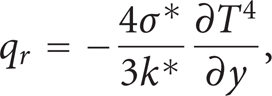
by using the Rosseland approximation for radiation where σ∗ and k∗ are the Stefan-Boltzmann constant and the mean absorption coefficient, respectively. Assuming that the temperature differences within the flow are such that the term 
which was obtained by expanding
Let 
where

Following the work of Hady et al. [22], we take the similarity transformation

where prime denotes differentiation with respect to η. Based on (10), the mass transfer velocity v w is given by

Substituting (10) into (1), (2), and (8), we get the following system of nonlinear ordinary differential equations:


To get similar solutions, we let

The boundary conditions (4) become

where
Physical quantities of interest are the skin friction coefficient C
f
and the local Nusselt number 
Using variables (10), we obtain

where
3. Results and Discussion
The nonlinear ordinary differential equations (12) and (14) subject to the boundary conditions (15) were solved numerically using the shooting method. The results obtained show the parametric study showing the influences of the governing parameters, namely, the nanoparticle volume fraction ϕ, shrinking parameter n, suction parameter S, and Eckert number Ec on the flow as well as the thermal fields. In this method, dual solutions were obtained by setting different initial guesses for the unknown values of
In order to restrict the computation domain, the variable
Figures 1 and 2 present the variations of the skin friction coefficients

Variation of the skin friction coefficient with S for different nanoparticles when
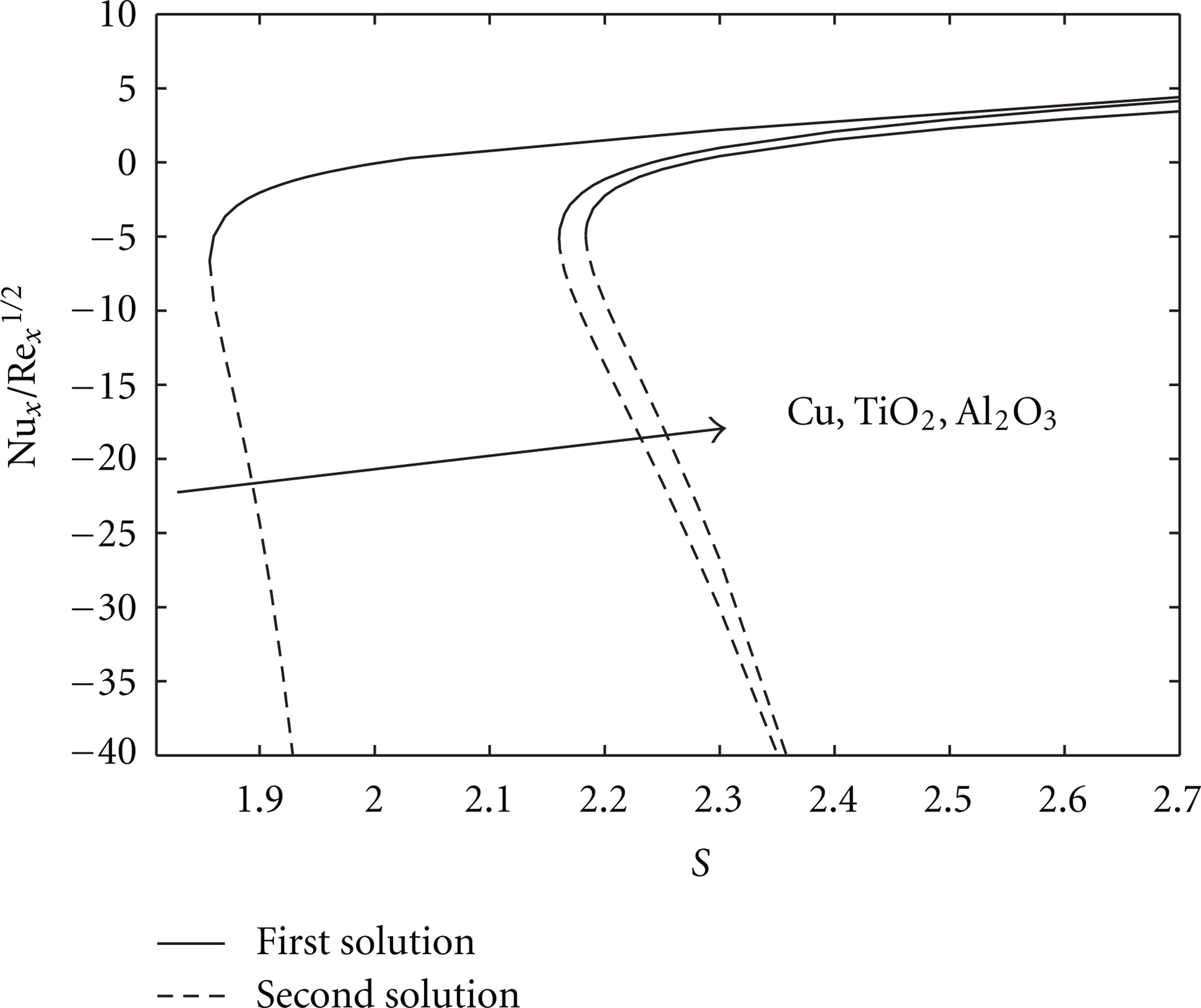
Variation of the local Nusselt number with S for different nanoparticles when
The variation of the skin friction coefficients

Variation of the skin friction coefficient with ϕ for different nanoparticles.

Variation of the local Nusselt number with ϕ for different nanoparticles.
The samples of velocity and temperature profiles for some values of the governing parameters are illustrated in Figures 5 and 6, respectively. These profiles satisfy the far field boundary conditions (15) asymptotically which support the validity of the numerical results obtained, besides supporting the existence of dual solutions shown inFigures 1–4.
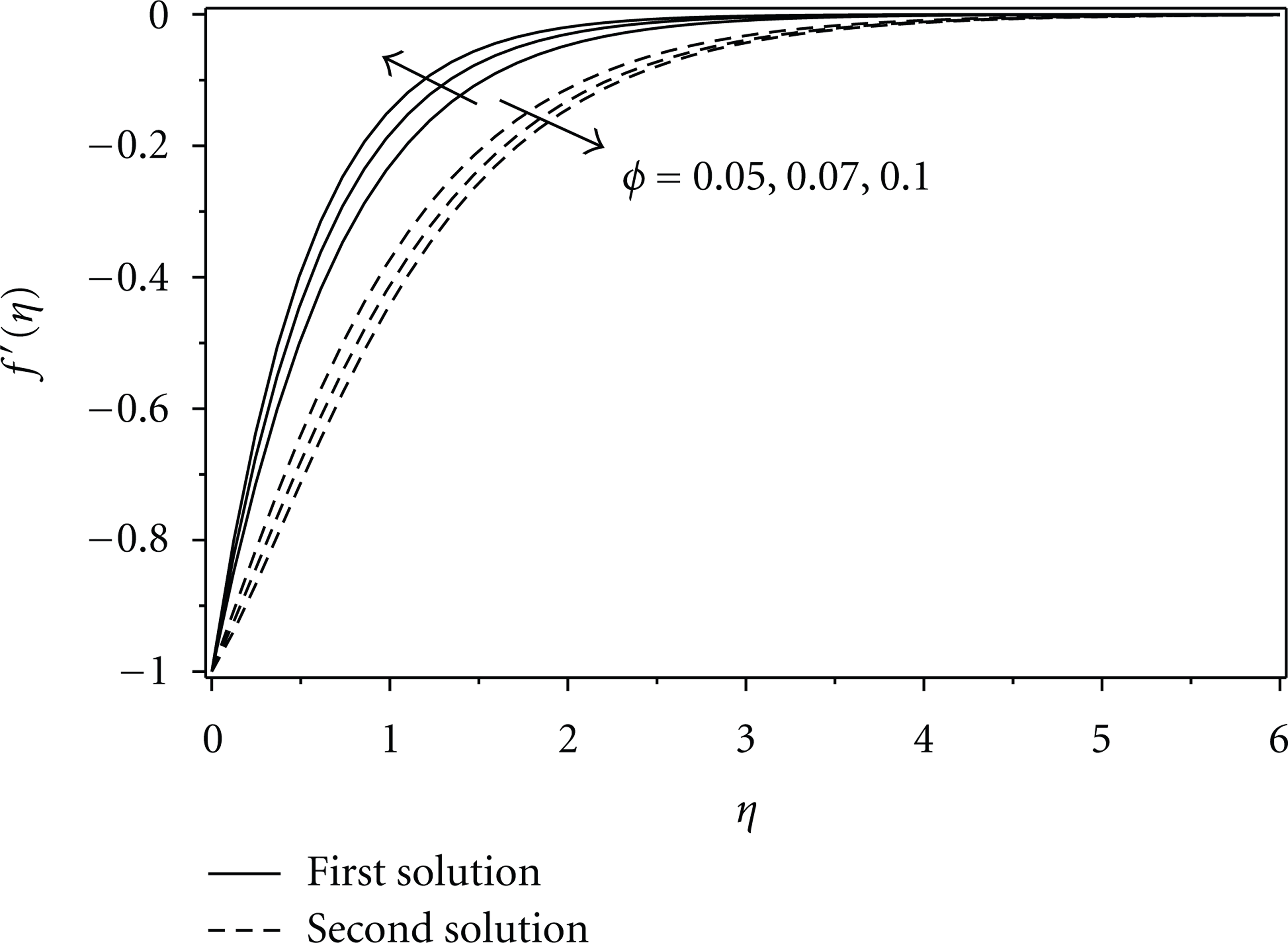
The effect of nanoparticle volume fraction ϕ on velocity profile

The effect of nanoparticle volume fraction ϕ on temperature profile
4. Conclusions
In the present paper, we studied numerically the problem of boundary layer flow and heat transfer over a shrinking sheet in a nanofluid. The governing partial differential equations for mass, momentum, and energy are transformed into a set of ordinary differential equations and then solved numerically using the shooting method. The influences of the governing parameters, namely, nanoparticle volume fraction ϕ, shrinking parameter n, suction parameter S, and viscous dissipation parameter Ec on the heat transfer characteristics are shown graphically and discussed. It was found that the skin friction coefficient increases with an increase in the nonlinear shrinking parameter n and suction parameter S, while it decreases with the nanoparticle volume fraction ϕ. Moreover, the local Nusselt number which represents the heat transfer rates at the surface increases with increasing the nanoparticle volume fraction ϕ and suction parameter S but decreases with increasing the shrinking parameter n and viscous dissipation parameter Ec. The presence of nanoparticles in the base fluid significantly changes the heat transfer characteristics. Dual solutions were found to exist in certain range of the suction parameter S. It is also found that Cu-water nanofluid has the highest skin friction coefficient and the local Nusselt number compared to TiO2-water and Al2O3-water nanofluids.
Footnotes
Nomenclature
Greek Symbols
Subscripts
Superscript
Acknowledgments
The authors wish to express their thanks to the anonymous reviewers for the valuable comments and suggestions. The financial supports received from the Ministry of Higher Education, Malaysia (Project Code: FRGS/1/2012/SG04/UKM/01/1), and the Universiti Kebangsaan Malaysia (Project Code: DIP-2012-31) are gratefully acknowledged.