




Abstract
Based on the dynamic spherical cavity expansion theory of concrete and the analysis of experimental data, a mass abrasion model of projectile considering the hardness of aggregates, the relative strength of target and projectile, and the initial impact velocity is constructed in this paper. Furthermore, the effect of mass abrasion on the penetration depth of projectile and the influence of hardness of aggregates and strength of projectile on penetration depth and mass loss are also analyzed. The results show that, for the ogive-nose projectile with the CRH of 3 and aspect ratio of 7 penetrating the concrete of 35 MPa, the “rigid-body penetration” model is available when the initial impact velocity is lower than 800 m/s. However, when the initial impact velocity is higher than 800 m/s, the “deforming/eroding body penetration” model should be adopted. Through theoretical analysis and numerical calculation, the results indicate that the initial impact velocity is the most important factor of mass abrasion. The hardness of aggregates and the strength of projectile are also significant factors. But relatively speaking, the sensitivity of strength of projectile to mass abrasion is higher, which indicates that the effect of projectile material on mass abrasion is more dramatic than the hardness of aggregates.
1. Introduction
The mass abrasion of projectile would occur in high-speed penetration. With the increasing of impact velocity (penetration velocity > 800 m/s), the mass abrasion of projectile is more and more obvious, so the “rigid-body penetration” model would be inapplicable. The nose sharp of projectile and the penetration property of projectile would be changed because of mass abrasion. Hence, we should take mass abrasion into account in the analysis of high-speed penetration.
Forrestal et al. [1, 2] conducted penetration experiments into concrete and grout targets with different high-strength alloy steel and geometry projectiles, respectively. Mass loss had been recorded in these experiments as well. The results indicated mass loss, which makes the nose sharp of projectile blunt, always focuses on the surface of projectile including nose and shank and the mass loss percentage could be up to 7%. Beissel et al. [3] constructed an axisymmetrical and 3D FEA model for the mass abrasion of projectile. The basic assumption of this model is that the rate of mass loss is proportional to the normal stress on projectile surface and the relative sliding velocity between projectile and target. Klepaczko et al. [4] defined some primary parameters, such as the rate of wear and the rate sensitivity of wear, and constructed an effective method to analyze the rate of mass loss. Based on experiments, they further indicated that the mass abrasion mostly occurred on the nose of projectile and a little on the shank. Based on the fitting of partial experimental data, Silling et al. [5] indicated that the mass abrasion of projectile was linearly proportional to the initial kinetic energy of projectile and developed a new mass abrasion model.
The experimental observation of Forrestal et al. [1, 2] indicates, for the common unconfined compressive strength of concretes with quartz aggregate and limestone aggregate, that the level of mass abrasion is different obviously. Chen et al. [6] confirmed that the mass abrasion of projectile was significantly influenced by the initial impact velocity and the hardness of aggregates. The other factors, such as the strength and density of concrete, the size of aggregates, and the geometry of projectile, play a limited influence on the mass abrasion of projectile. Meanwhile, he also proposed that the influence of the strength of projectile on mass loss would be more important than the hardness of aggregates based on the engineering experience. Figure 1 shows relation between the mass loss of projectiles and impact function I of projectile and Figure 2 shows modification on the relation of Figure 1 with accounting for the effect of aggregates. Jones et al. [7] investigated that mass abrasion should be decided by the melting of projectile material, ignoring the effect of the aggregates. All the work of friction could be translated into heat which acts on the penetrator. He et al. [8] indicated that the hardness of aggregates should be taken into account. Then she developed the mass abrasion model of Jones and Foster. It is found the predictions of new model are in a good agreement with the observation of experiments. Wen et al. [9] constructed an abrasion model which assumes that mass loss is a function of the relative strength of target and projectile materials, the damage number, and the hardness of aggregates. The abrasion model has a strong physical meaning. Wu et al. [10] considered that the mass loss percentage depends linearly on the initial impact velocities of projectile according to the fitting results of experimental data and developed a mass abrasion model of projectile.

Relation between the mass loss of projectiles and the impact function I of projectile [6].

In this paper, based on the work of Wang and Wu [10–15], a mass abrasion model of projectile including the hardness of aggregates, the relative strength of target and projectile, and the initial impact velocity is developed. The mass loss of deforming/eroding penetrator is calculated and the effect of mass loss on the penetration depth of projectile is analyzed as well. The effect of the hardness of aggregates and the strength of projectile on the penetration depth and mass loss are also analyzed at the same time, respectively.
2. Experiments of High-Speed Abrasion of Projectiles (Table 1)
Results of the experiments of high-speed abrasion of projectiles.

The ogive-nose projectile with the CRH of 3, aspect ratio of 7, and diameter of 15 mm was used in the experiments. Because the bending of structure or the failure of projectile could occur for the projectile with hollow structure, the penetrator with solid structure which could avoid the bending of structure is used to investigate the mass abrasion of projectile in high-speed penetration into concrete. The target is the C35 concrete with quartz aggregate. The hardness of aggregates is 7 and the unconfined compressive strength of concrete is tested 27.3 MPa. Figure 3 is the structure and physical Figure of projectile. The material of projectile is 30CrMnSi and the yield strength of projectile is 1130 MPa. Figure 4 is those residual projectiles. The experimental results indicate that the phenomenon of nose abrasion is significant when the projectile penetrates into the concrete with quartz aggregate in high-speed penetration, and the nose sharp of residual projectile finally approaches flat when the initial impact velocity is very high.

Structure and physical maps of projectile in the experiments.

Experimental projectiles and maps of residual projectiles.
3. Nose Mass Abrasion Model of Projectile
3.1. Penetration Resistance of Projectile
The revised spherical cavity expansion theory [12–15] by using HJC model and Mohr-Coulomb criterion can give the cavity expansion radial stress σ r :

where

Stress on the nose of any shape.
The normal stress and tangential stress on projectile nose are

Then the axial component of normal and tangential stress of the projectile in Figure 5 is

The penetration process of concrete is divided into two phases: the crater phase and the tunnel phase. In the crater phase, the mass loss and nose shape change is neglected, because spalling is the main mode of failure, and the diameter of crater is much larger than that of the projectile which would cause the nonclose contact between the projectile and the concrete; at the same time, the friction and cutting of the concrete on the projectile are fairly small. The mass loss and nose shape change begins at the tunnel phase was considered. The axial force on projectile nose of crater and tunnel phases is

where c is the coefficient to be determined;

3.2. Nose Mass Abrasion Model of Projectile
Silling et al. [5] considered that the mass loss percentage linearly depends on the initial kinetic energy of projectile. But this line goes through the origin, which shows mass loss would occur under a very low velocity. This is out of step with reality. Based on the mass abrasion model of Wu et al. [10], the important parameters of the hardness of aggregates, the relative strength of target and projectile should be taken into account. Based on experimental mass loss data, we plot mass loss percentage versus the hardness of aggregate, the relative strength of target and projectile, and the initial impact velocity and find mass loss percentage 
where 
In Figure 6, the fitted parameters are

The relation between mass loss percentage
Assuming there is a linear relationship between the instantaneous mass and velocity during the penetration process as in the case of (6), namely, mass is linear function of velocity:

Let 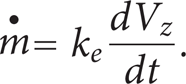
For the penetrating projectile, according to the momentum theorem, we have

In (10), referring to the work of Zhao et al. [16], the second-order small quantity
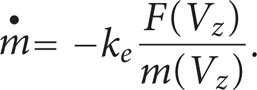
Now the similarly as [5] assumed, the relation between force and mass change rate in (11) holds not only globally, but also locally on the surface of the projectile nose. Therefore, the abrasion process on the projectile nose is assumed as shown in Figure 7. The shadowed part in Figure 4 is the abrasion quantity corresponding to the area increment. Thus, the mass change rate of area increment on nose is

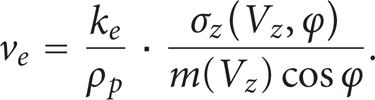
where dA is area increment corresponding to axial stress and σ z , v e is the abrasion velocity on the area increment. Then the abrasion velocity on area increment can be obtained:

The figure of nose eroding process.
Calculating the integrals of (13) about time t, the displacement of area increment in the integral limit
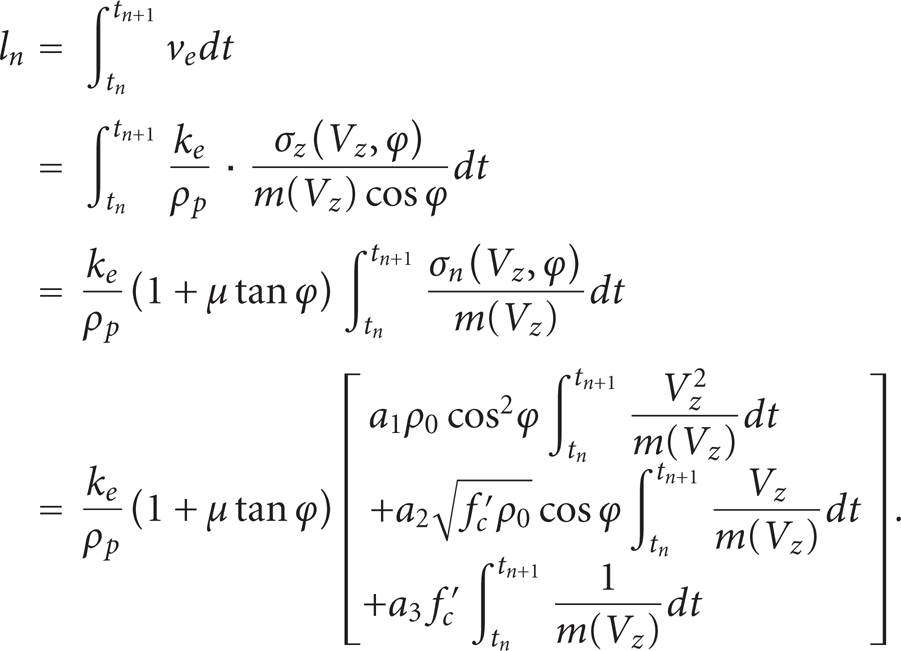
From (10) we know
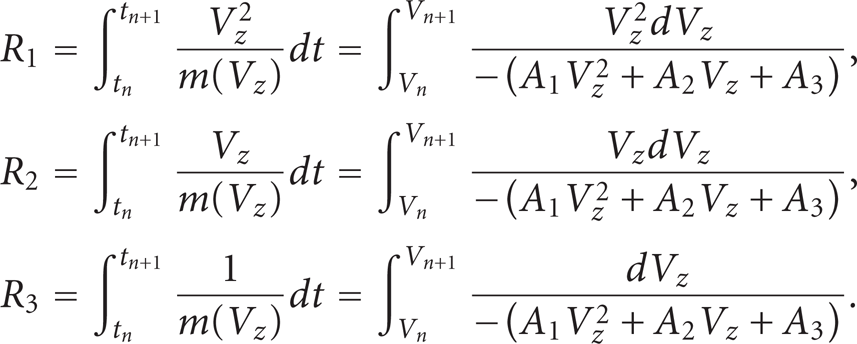
Then the displacement of area increment due to mass loss at velocity interval
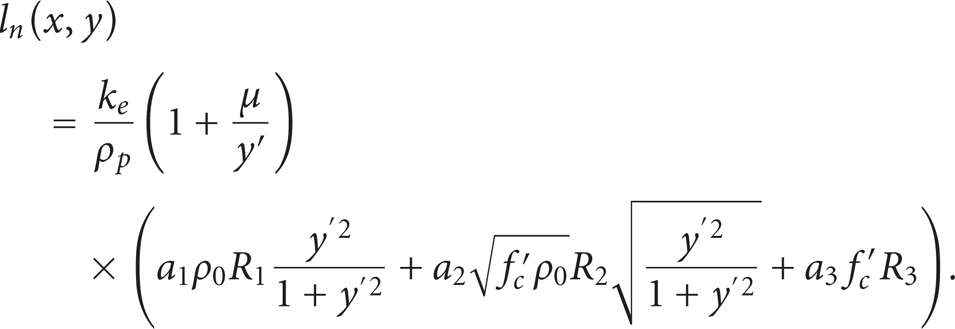
What has to be emphasized is that the force parameters

where the subscript n stands for variables of nth section, m
n
is projectile mass of nth section, and

4. Analysis and Discussion of the Mass Abrasion of Projectile
4.1. The Effect of Mass Abrasion on the Penetration Depth
In this paper, the projectile and the target are, respectively, solid structure as can be seen in Figure 3 and C35 concrete with quartz aggregate. The coefficients in (1) calculated by revised spherical cavity expansion theory are

The model results of penetration depth.

The absolute value between the rigid penetration depth and the penetration depth considering mass abrasion.

The relative value between the rigid penetration depth and the penetration depth considering mass abrasion.
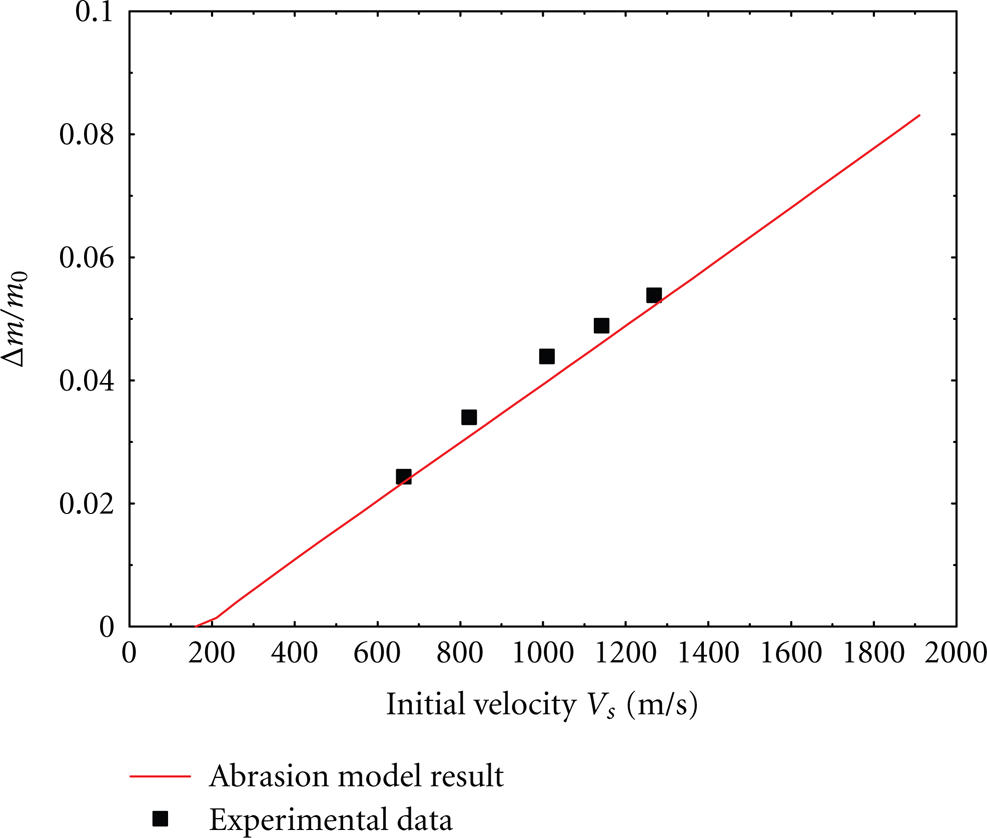
The model results of mass loss.
4.2. The Influence of the Hardness of Aggregates on Penetration Depth and Mass Loss
The mass abrasion of projectile is significantly influenced by the hardness of aggregates. The hardness of aggregates with 2, 4, 6, 8, and 10 are, respectively, selected to calculate and the results are shown in Figures 12 and 13 which, respectively, demonstrate the effect of the hardness of aggregates on penetration depth and mass loss. From Figure 12, we can see that the influence of the hardness of aggregates on penetration depth is limited, or even no influence, when the initial impact velocity is lower than 800 m/s. The reason is that the relative strength of target and projectile is the primary factor and there is little influence for the hardness of aggregates at this moment. But in the process of high-speed penetration, the action of the hardness of aggregates is more and more significant. With the increasing of the hardness of aggregates, its effect on the penetration depth is more and more obvious. This is because, with the cutting action of aggregates growing, the mass abrasion of projectile is increasingly serious. It makes the nose sharp of projectile increasingly becomes blunt and adds penetration resistance force. All of these decrease the penetration efficiency and lead to the falling of penetration depth. What we can see from Figure 13 is the mass loss percentage of projectile gradually becomes large in the common velocity with the increasing of the hardness of aggregates. The initial impact velocity leading to mass loss is different for the different hardness of aggregates and it is lower with the increasing of the hardness of aggregates. We could obtain a conclusion that the mass abrasion of projectile is caused by the cutting effect of aggregates. Hence, when building defend engineering such as bunkers and other defend works, the hardness of the aggregates could be increased properly to improve the antipenetration ability of defend engineering and enhance its defend ability.

The influence of hardness of aggregates on penetration depth.

The influence of hardness of aggregates on mass loss.
4.3. The Influence of the Strength of Projectile on Penetration Depth and Mass Loss
Assuming the unconfined compressive strength of concrete is invariable and the strength of projectile is 15, 20, 40, 60, 75, and 82 times of the unconfined compressive strength of concrete; the calculational results are shown in the Figures 14 and 15. What we can see from Figure 14 is that the penetration depth is almost common when the initial impact velocity is lower than 600 m/s. Because the strength of projectile is still high enough at this moment which leads to mass loss small, so the penetration can be regarded as a rigid penetration. By comparing the difference about the penetration depth in the effect of the hardness of aggregates and the strength of projectile, it indicates the sensitivity of the strength of projectile to mass abrasion is higher, or we can say that the effect of the strength of projectile on mass abrasion is more significant than the hardness of aggregates. When the initial impact velocity is higher than 600 m/s, the influence of the strength of projectile is increasingly obvious. With the increasing of the strength of projectile, the penetration depth is deeper and gradually approaches the rigid penetration depth. This is because the greater strength of projectile, the smaller mass loss of projectile which would remain its original shape, so that the second item in (18) would not exist and becomes the formula in [12, 13]. In Figure 15, with the increasing of the strength of projectile, the mass loss percentage is gradually small. From the real line in Figure 15, we can find that the line become flat when the initial impact velocity comes to 1200 m/s or so and the penetration depth also reaches maximum from the blue-dashed line in Figure 14. It indicates, when the initial impact velocity reaches about 1200 m/s, the penetration efficiency of projectile decreases because of mass abrasion, or even the penetration process could end.
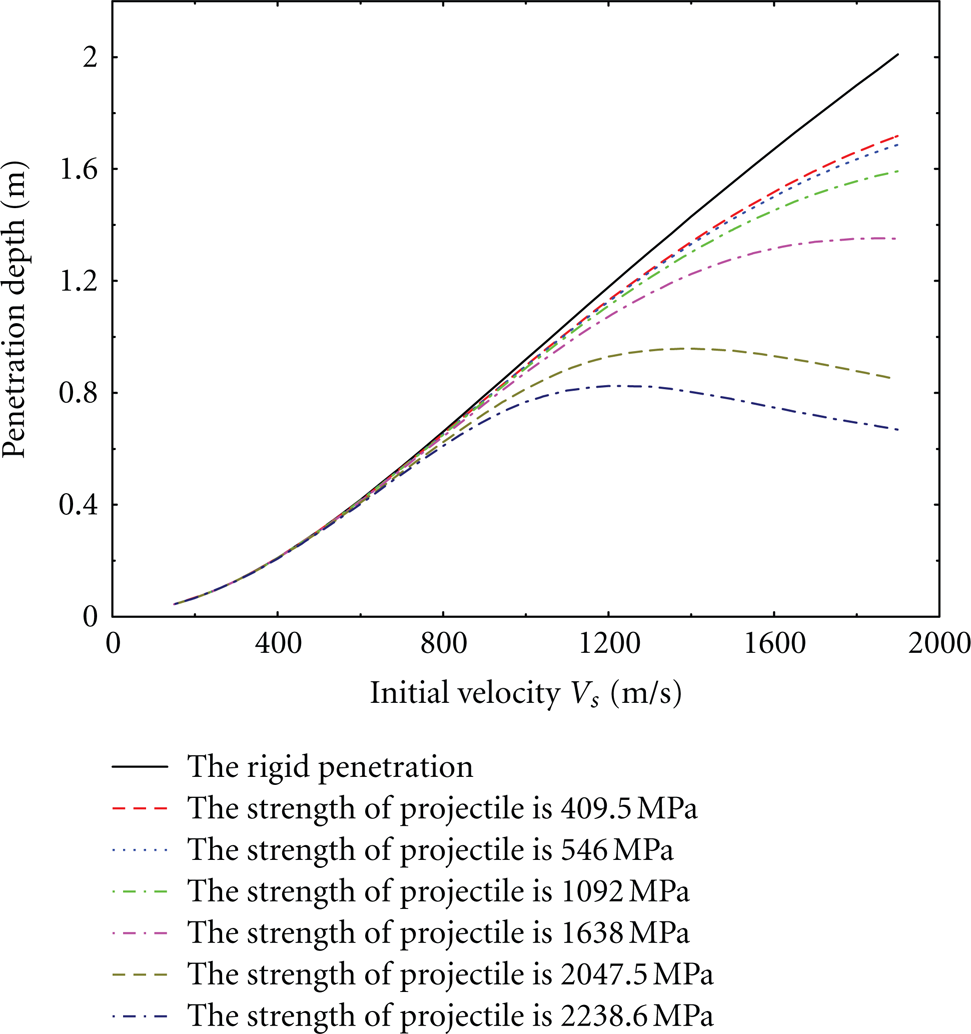
The influence of strength of projectile on penetration depth.
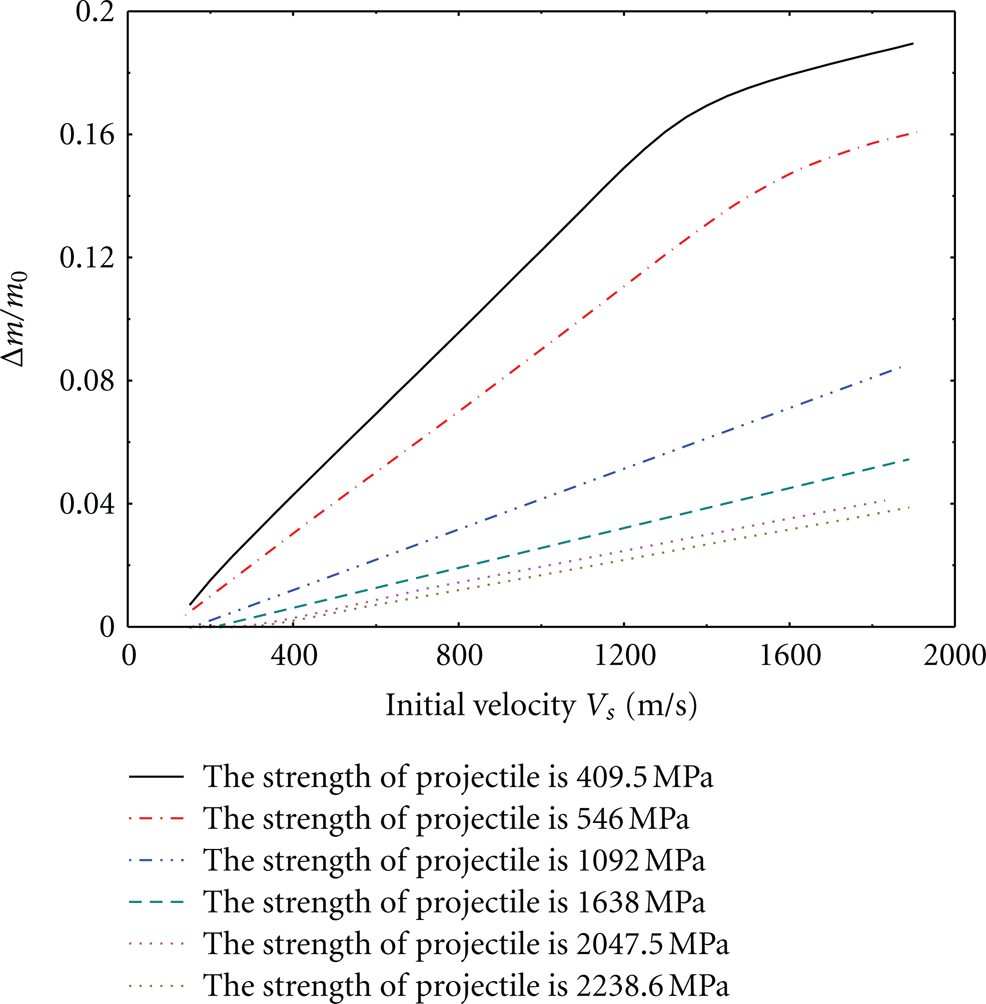
The influence of strength of projectile on mass loss.
5. Conclusions
In this paper, the relationship between the mass loss percentage and the hardness of aggregates, the relative strength of target and projectile, and the initial impact velocity is obtained by fitting the experiment data, and the penetration resistance force based on the revised spherical cavity expansion theory is applied to calculate mass loss and the influence of mass loss on the penetration depth is also analyzed. The results through calculating and analyzing advocate, for the ogive-nose projectile with the CRH of 3 and aspect ratio of 7 penetrating into the concrete of 35 MPa, the “rigid-body penetration” model is available when the initial impact velocity is lower than 800 m/s. However, the “deforming/eroding body penetration” model should be used when the initial impact velocity is higher than 800 m/s. The reason is the nose shape would become blunt to make the penetration resistance force increase. Meanwhile, the stress on projectile would be unsymmetrical to make the structure of projectile and the trajectory become unstable. The result is the structural damage of projectile and the deviation of trajectory could occur, which reduces the penetration efficiency and the penetration depth. By, respectively, analyzing the effect of different hardness of aggregates and strength of projectile on the penetration depth and mass loss, the results indicate that the initial impact velocity is the most important factor of mass abrasion of projectile. The hardness of aggregates and the strength of projectile also significant factors, but relatively speaking, the sensitivity of the strength of projectile to mass abrasion is higher, which illustrates that the effect of projectile material on mass abrasion is more dramatic than the influence of the hardness of aggregates.
Footnotes
Acknowledgment
The research work in this paper was supported by the Defense Industrial Technology Development Program (C152011001).