




Abstract
We investigate the problem of uneven energy consumption in large-scale many-to-one sensor networks (modeled as concentric coronas) with constant data reporting, which is known as an energy hole around the sink. We conclude that lifetime maximization and the energy hole problem can be solved by searching optimal transmission range for the sensors in each corona and then prove this is an NP-hard optimization problem. In view of the effectiveness of ant colony algorithms in solving combinatorial optimization problems, we propose an ant-based heuristic algorithm (ASTRL) to address the optimal transmission range assignment for the goal of achieving life maximization of sensor networks. Experimentation shows that the performance of ASTRL is very close to the optimal results obtained from exhaustive search method. Furthermore, extensive simulations have also been performed to evaluate the performance of ASTRL using various simulation parameters. The simulation results reveal that, with low communication cost, ASTRL can significantly mitigate the energy hole problem in wireless sensor networks with either uniform or nonuniform node distribution.
1. Introduction
Rapid technological advances in microelectromechanical systems (MEMS) and low-power wireless communications have enabled the deployment of large scale wireless sensor networks (WSNs). The potential applications of sensor networks are highly varied, such as environmental monitoring, target tracking, and battlefield surveillance [1, 2]. Due to limited and nonrechargeable energy provision, the energy resource of sensor networks should be managed wisely to extend the lifetime of sensors [3–7].
The sink node in a WSN receives the data from the sensor nodes and forwards these data to the applications over the WSN. Usually, the sensor nodes closest to the sink tend to deplete their energy budget more rapidly than others [8–10] because such nodes need to transmit more data than other nodes. This causes the problem of energy hole around the sink. A WSN suffering from the energy hole problem cannot deliver more data, and consequently the network lifetime has been greatly shortened, although most of the sensor nodes can still work properly.
Recently, there have been a number of studies done on the energy hole problem for improving the network lifetime. Generally, these studies aiming to mitigate or solve the energy hole problem can be divided into 3 categories: (i) assistant approaches, such as deployment assistance, traffic compression, and aggregation in [11]; (ii) node distribution strategies. Lian et al. in [9] propose a nonuniform sensor distribution strategy. The density of sensors increases when their distance to the sink decreases; (iii) adjustable transmission range. Jarry et al. [12] propose a mixed routing algorithm which allows each sensor node to send a message either to one of its immediate neighbors or to the base station directly.
Since adjusting transmission range of sensors is a promising way to be used for prolonging lifetime of sensor networks, we solve the energy hole problem by performing optimizing the transmission range assignment based on corona model in [8]. We prove that the problem of optimal transmission range assignment in coronas to achieve minimum energy consumption is an NP-hard problem, and therefore an approximation algorithm with low communication cost should be proposed for network lifetime optimization. However, the existing researches [3, 12, 13] on addressing energy hole problem in category (iii) mainly work in a preplanned manner. The cooperation, communication, and management are deliberately modeled, designed, and tuned before the deployment of sensors. These methods usually ignore the requirements of self-adaptation and self-calibration and always produce complex protocols with higher overhead and just passable performance, which act dully to the change of environment. Fortunately, inspired by the ecosystem, some biologic models are applied in networks [14–16]. These biologic models exhibit swarm intelligence in pursuing a global optimal goal and throw new light on the energy hole problem in WSN.
Recently, the Ant Colony Algorithm (ACO) has been widely used in solving the combinatorial optimization problems. Through the simple cooperation of solo entity and the positive feedback mechanism, ACO outperforms tradition manners in terms of self-adaptation and self-calibration. In this paper, we propose an ant-based algorithm (ASTRL) for mitigating the energy hole problem in order to prolong the lifetime of networks with different node distributions. As far as we know, we are the first to use bioinspired methods to solve the energy hole problem in WSNs.
The remainder of the paper is organized as follows. Section 2 presents our literature review. Section 3 introduces the system assumption used throughout our work and then analyzes the energy hole problem and concludes that the problem of searching optimal transmission range list is a multiobjective problem. Section 4 gives the design details of ANT-based algorithm for mitigating energy hole problem in WSNs. Section 5 shows the effectiveness of the ASTRL via extensive simulations. Section 6 concludes this paper.
2. Related Works
Li and Mohapatra [17] investigate the problem of uneven energy consumption in a large class of many-to-one sensor networks. The authors describe the energy hole in a ring model (like corona model) and present the definitions of the per node traffic load and the per node energy consuming rate (ECR). In a many-to-one sensor network, all sensor nodes generate constant bit rate (CBR) data and send them to a single sink via multihop transmissions. Based on the observation that sensor nodes sitting around the sink need to relay more traffic compared to other nodes in outer subregions, their analysis verifies that nodes in inner rings suffer much faster energy consumption rates and thus have much shorter expected lifetime. The authors term this phenomenon of uneven energy consumption rates as the energy hole problem, which may result in serious consequences, for example, early dysfunction of the entire network. The authors present some approaches to the energy hole problem, including deployment assistance, traffic compression, and aggregation. Jarry et al. [12] propose an algorithm to resolve the energy hole problem, which uses mobile sensors to heal energy holes. The cost of these assistant approaches is a lot.
Lian et al. [9] argue that, in static situations, for large-scale networks, after the lifetime of the sensor network is over, there is still a great amount of energy left unused, which can be up to 90% of total initial energy. Thus, the static models with uniformly distributed homogenous sensors cannot efficiently utilize their energy. The authors propose a nonuniform sensor distribution strategy. The density of sensors increases when their distance to the sink decreases. Their simulation results show that, for networks with high density, the nonuniform sensor distribution strategy can increase the total data capacity by an order of magnitude. Wu et al. [18] propose a nonuniform node distribution strategy to achieve the subbalanced energy depletion. The authors state that, if the number of nodes in coronas increases from corona
Olariu and Stojmenovic [8] discuss the relationship between the network lifetime and the width of each corona in concentric corona model. The authors prove that, in order to minimize the total amount of energy spent on routing along a path originating from a sensor in a corona and ending at the sink, all the coronas must have the same width. However, the authors assume that all nodes in corona
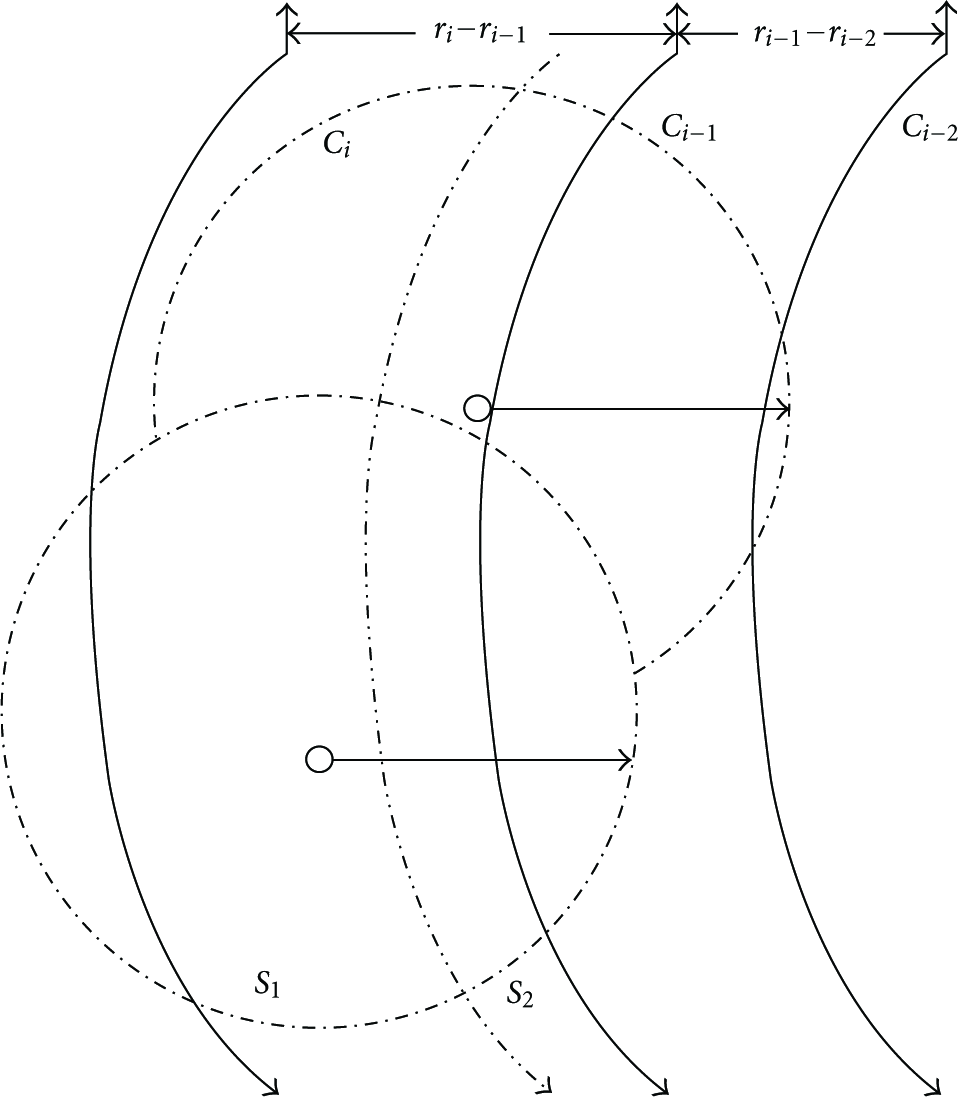
The energy problem caused by corona model with different width.
For balancing the energy load among sensors in the network, Jarry et al. [12] propose a mixed routing algorithm which allows each sensor node to send a message either to one of its immediate neighbors or to the base station directly. The decision about the next receiver is determined by a potential function depending on its remaining energy. However, when the network area radius is bigger than the sensors maximal transmission range, the proposed algorithm cannot be applicable.
Some biologically intelligent algorithms have been used to solve routing problems in networks. Di Caro and Dorigo [19] propose AntNet, an approach to the adaptive learning of routing tables in communications networks. AntNet, the routing algorithm they proposed, is a mobile agents system showing some essential features of parallel replicated Monte Carlo systems. The algorithm takes inspiration from previous work on artificial ant colonies techniques to solve combinatorial optimization problems and telephone network routing. The core ideas of these techniques are (i) the use of repeated and concurrent simulations carried out by a population of artificial agents called ants to generate new solutions to the problem, (ii) the use by the agents of stochastic local search to build the solutions in an incremental way, and (iii) the use of information collected during past simulations to direct future search for better solutions.
Ant routing has shown excellent performance for sensor networks. Aghaei et al. [20] present an AntNet-based routing network, which meets the enhanced sensor network requirements, including energy consumption, success rate, and time delay. Okdem and Karaboga [21] have developed a routing scheme and adapted ACO algorithm to this scheme to get a dynamic and reliable routing protocol. Their algorithm has also been implemented in router chip, which provides an easy handling of WSN routing operations for sensor node designers.
3. System Model
In this section, the network model, energy model and corona model will be presented, respectively.
3.1. Network Model
We assume our sensor network model as follows: (1) once deployed, the sensors must work unattended, and all sensor nodes are static. Each sensor has a nonrenewable energy budget, and the initial energy of each sensor is
Definition 1 (network lifetime).
Li and Mohapatra in [17] present the definition of system lifetime, which is the time till a proportion of nodes die. A corona of sensor nodes in the network is said to be dead when it is unable to forward any data or send its own data. So the network lifetime in this paper is defined as the duration from the very beginning of the network until the first corona of sensor nodes dies.
3.2. Energy Model
A typical sensor node comprises three basic units: sensing unit, processing unit, and transceivers. Our energy model only involves the power for receiving and transmitting data without considering the energy consumed for sensing and processing data, which depends on the computation hardware architecture and the computation complexity. According to [17], the energy consumption formulas that we use in the analysis and simulations throughout the rest of this paper are as follows:


Here


3.3. Corona Model with Adjustable Transmission Range
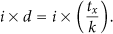
In order to save energy, sensors can adjust their transmission ranges. For simplicity, we divide the maximum transmission range into k levels, that is,

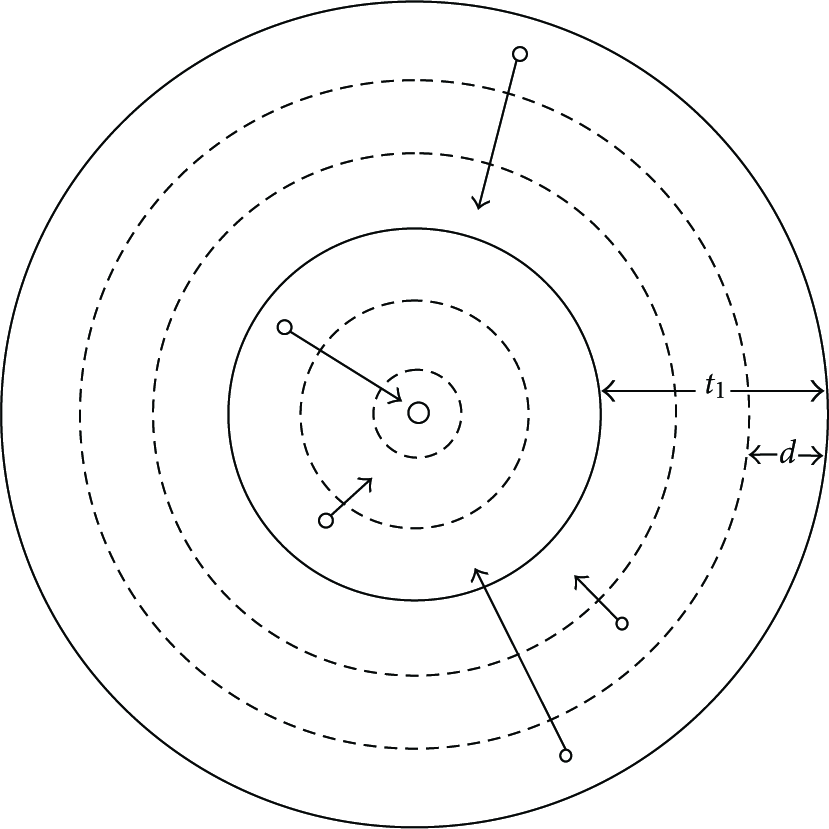
Illustration of adjustable transmission ranges.
We partition the whole area with radius R into m adjacent concentric parts termed coronas. They are presented as follows (see Figure 3), which has been discussed in [22, 23]. The width of each corona is 1ULTR therefore,


Concentric coronas.
Generally, there are the following two data forwarding patterns in corona model.

Two data forwarding patterns in corona model.
4. Ant-Based Algorithm for Searching Transmission Range List (ASTRL)
Consider an arbitrary wedge W subtended by an angle of θ, and refer to Figure 5. W is partitioned into msectors

A sector W and the associated subcoronas.
4.1. Construction Graph
Each node has k transmission range levels to choose, so nodes in each corona have k coronas to be the possible next hop. Figure 6(a) shows all available routes with
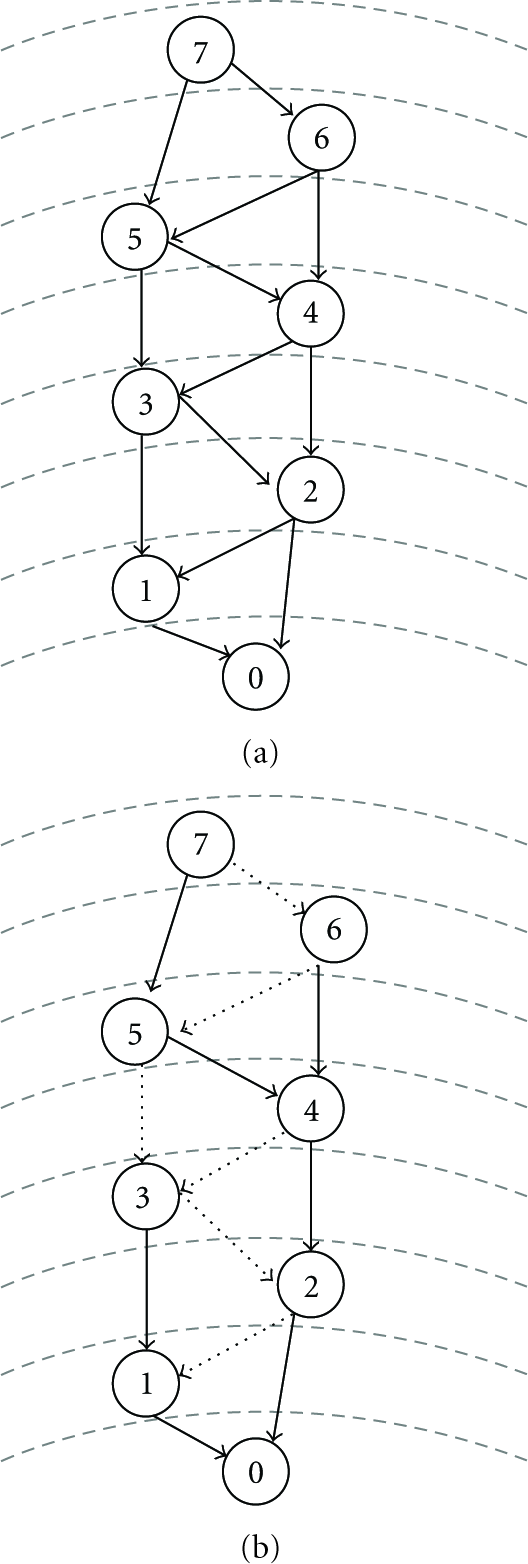
Construction graph and spanning tree.
The characters of the construction graph are as follows.
Out-degree: vertexes with ID bigger than k have k out-degrees, and the out degree of each vertex whose ID is not-bigger than k is equal to its sector ID. In-degree: the vertexes of outmost k sectors have The edge
In Section 3, we have discussed that, in order to mitigate energy hole problem and maximize network lifetime, we need to search an optimal transmission range list. According to the list we can obtain a spanning tree from the construction graph (see Figure 6(b)). The root of the obtained spanning tree is sink node. The following are the characters of the spanning tree.
Out-degree: each vertex has only one out-degree. In-degree: each vertex has not more than k in-degrees. The edge
Because searching optimal transmission range lists is NP hard, we propose an ant-based algorithm to achieve optimizing using energy for transmission. In the construction graph, artificial ants generated from each vertexes travel toward the sink node to discover feasible paths with low energy consumption.
4.2. ASTRL Design
In ASTRL, we employ two types of ants: (i) forward ant (
The artificial ants read and write in the following three data structures stored in each corona head (see in Figure 7).
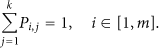
A pheromone table A routing table The per node traffic load of corona




The energy problem caused by corona model with a different width.
The ant-based algorithm is described as follows.
At regular intervals of While traveling toward their destination nodes, the ants keep memory of their paths and of the energy consumption found. The identifier of every visited node r and the energy consumption are pushed onto a memory stack At each node r, each traveling ant heading towards sink node selects from the neighbors it has not visited yet the node t to move to; otherwise, the node t will be selected from all the neighbors in case all of them had been previously visited. The neighbor t is selected with a probability (goodness) When sink node is reached, the ant The backward ant Arriving at a node r from a neighbor node f, the backward ant updates the pheromone of edge After the optimizing time


5. Simulation Results
Based on the energy model described in Section 3, we simulate the ASTRL proposed in this paper with consideration of the two strategies of deploying nodes, namely, uniform and nonuniform node distributions. Here, we have to mention that it is the greed forwarding strategy that is adopted in simulations for data forwarding, which has been presented in Section 3.
5.1. Simulation Parameters
The initial energy of each node (denoted as ε) is
Simulation parameters.

Our simulation includes three parts: (1) using an ant colony optimizing process as an example to show the variation in probabilities of using different transmission ranges during the whole process; (2) compare ASTRL with other algorithms under different situations, which include optimal algorithm and the algorithms proposed in other papers. Under any of the situations the results are an average over
5.2. Variation in the Probabilities of Using Certain Transmission Range
With the parameters listed in Table 1, the simulations examine the variation in the probabilities of using certain transmission range of the specific coronas selected from all coronas (

Variation in the probabilities of using certain transmission range of specific coronas.
5.3. Comparison with Other Algorithms
In this section, we evaluate the performance of the algorithm we proposed in this paper through comparing it with other existing algorithms. In the simulation, we compare ASTRL with two other algorithms.
Optimal list (OL), namely, the optimal transmission range list. Since it is obtained by enumerating all available transmission range lists and selecting from them the list with maximal lifetime, it must be the optimal transmission range list compared to other transmission range lists of the network.
We experimentally compare the network lifetime with different network sizes (different coronas). As the results in Figure 9(a) show, in terms of the network lifetime, ASTRL is close to OL obtained by exhaustive search but significantly outperforms

Network lifetime and average residual energy ratios of different algorithms.
The simulation is performed with
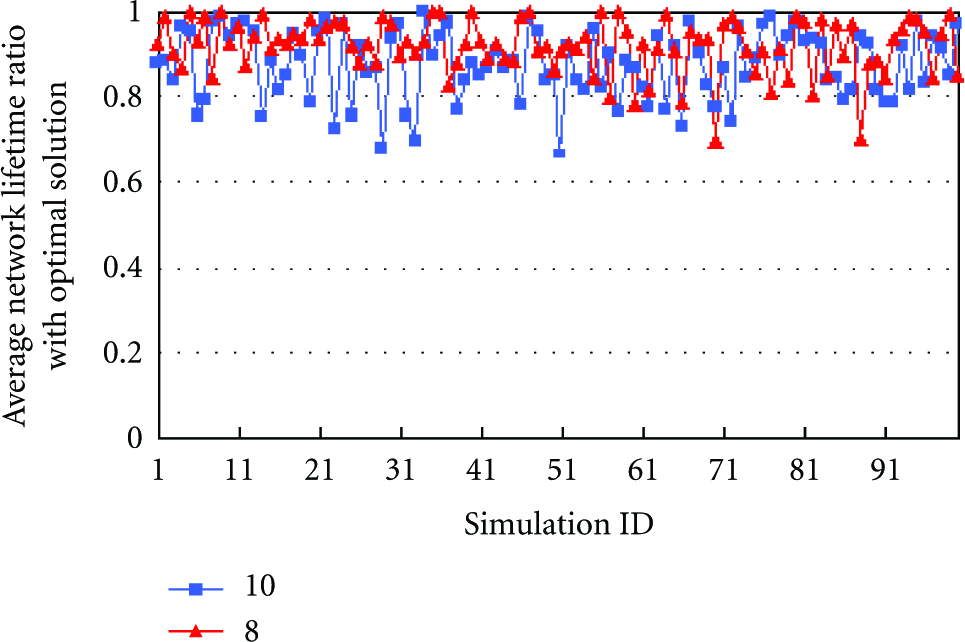
Network lifetime ratio with optimal solution in uniform random node distribution.
The simulations mentioned above are designed just for small-scale networks. This is because it is almost impossible to enumerate all potential transmission range lists in large-scale networks. For this reason, we have to compare ASTRL with

Network lifetime and average residual energy ratios of different algorithms.
ASTRL will take some optimizing time to determine the transmission range of each corona, and therefore we have to analyze the influence of the optimizing time of ASTRL on the lifetime of the whole network, and that will be done from the following four aspects. (1) After the optimizing time, the transmission range of the sensor nodes in each corona will be fixed without any change henceforth. (However, if the sensor network suffers from high node fault ratio, ASTRL can run again for adapting to the topology changes of the network. In this case, sink node can play the role of a decision-maker to decide whether to perform the optimizing process again or not.) (2) As shown in Figures 9(a) and 11(a), the ratio of the optimizing time to the lifetime of the whole network is very low. (3) Since the energy consumption for transmitting the ants can be ignored (see Section 3.2), the energy consumed by ASTRL itself is insignificant, which has little influence on the network lifetime accordingly. (4) As Figures 9(a) and 11(a) show, compared with
The authors in [18] propose to use a strategy of nonuniform node distribution to achieve maximum energy efficiency. According to the strategy, from the corona
Since the width of each corona in the corona model proposed in [18] is the maximum transmission range
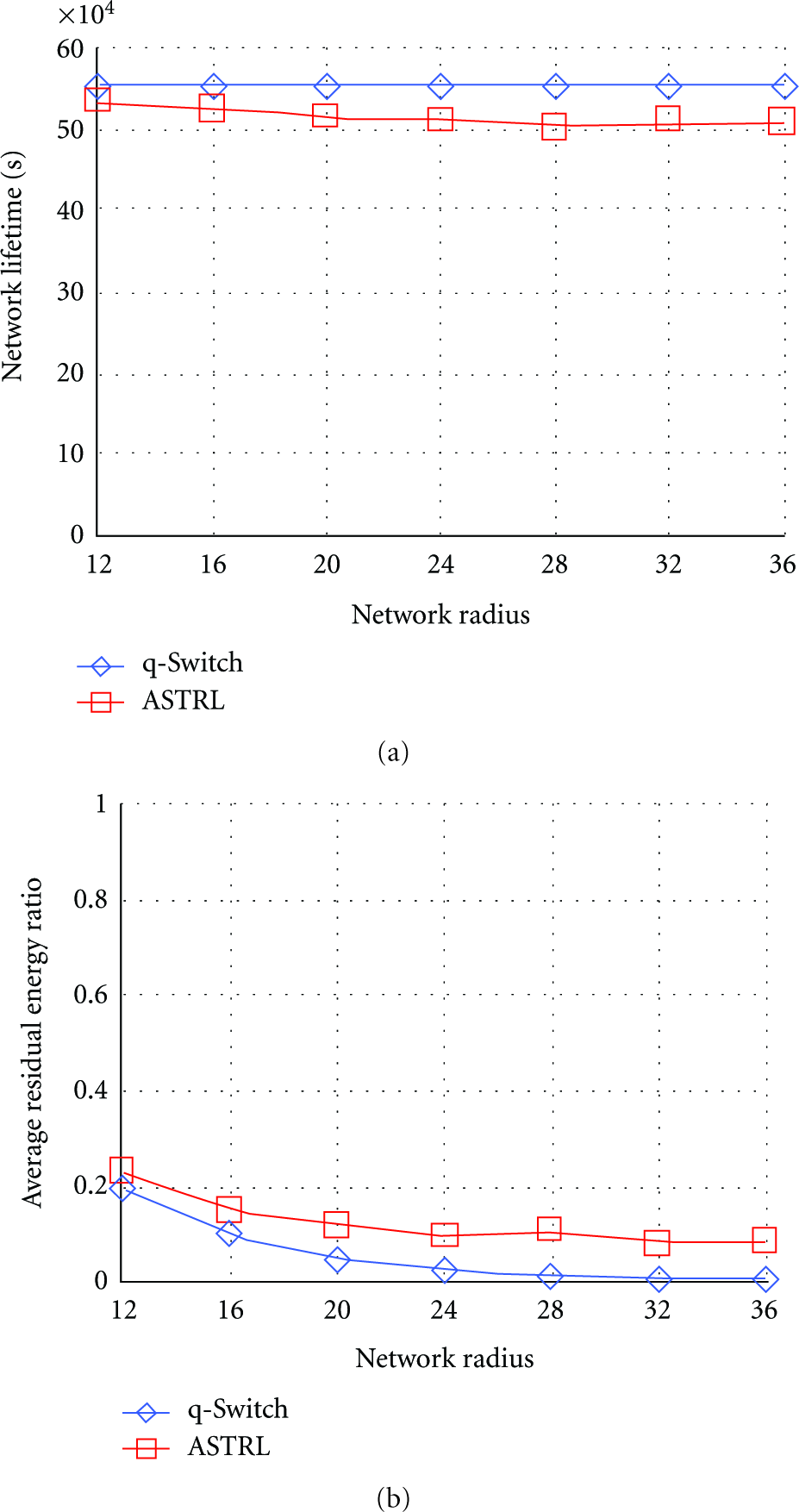
Network lifetime and average residual energy ratios with nonuniform deterministic node distribution.
5.4. Effect of the Algorithm Parameters on the Performance
The simulation results in Figure 13 show the variation in the ratios of the average network lifetime of the ant colony algorithm with different evaporation coefficients to that of OL in the uniform node distribution. As Figure 13 shows, when the value of evaporation coefficient (denoted as γ) is
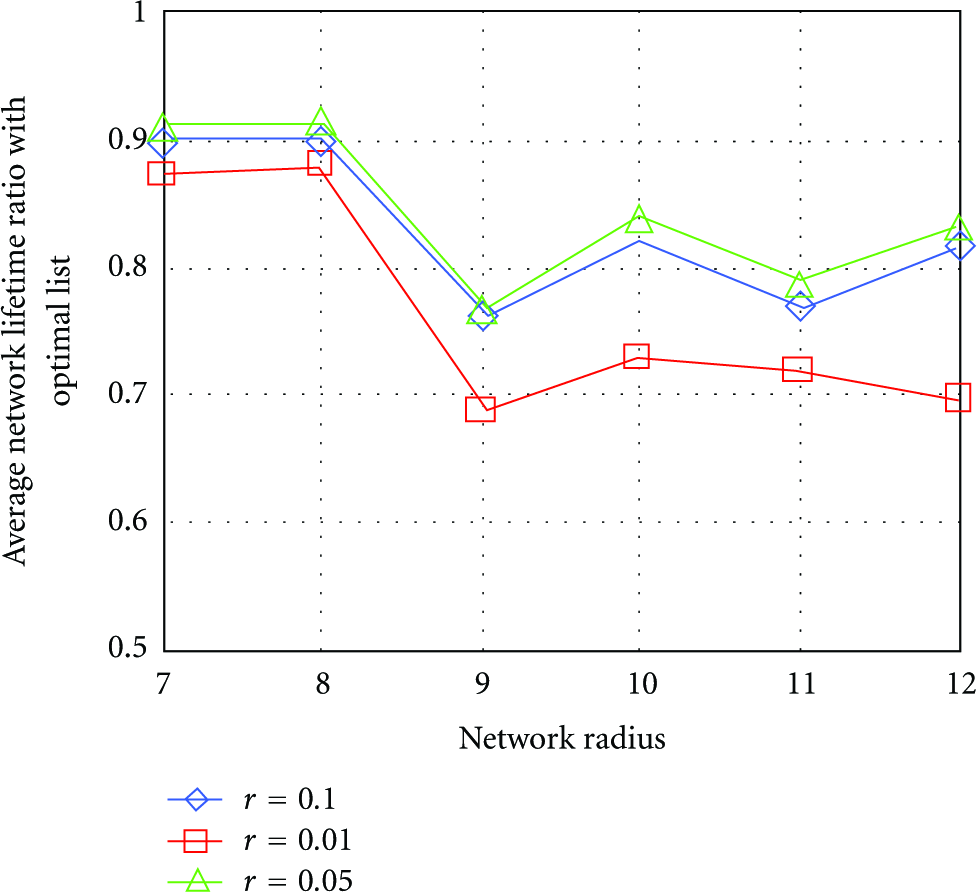
Average network lifetime ratio with optimal list in uniform node distribution.
We conduct simulations to evaluate the performance of a network with

Network lifetime with different optimizing time.
The ant generation rate refers to the number of the ants generated by each node during every time interval
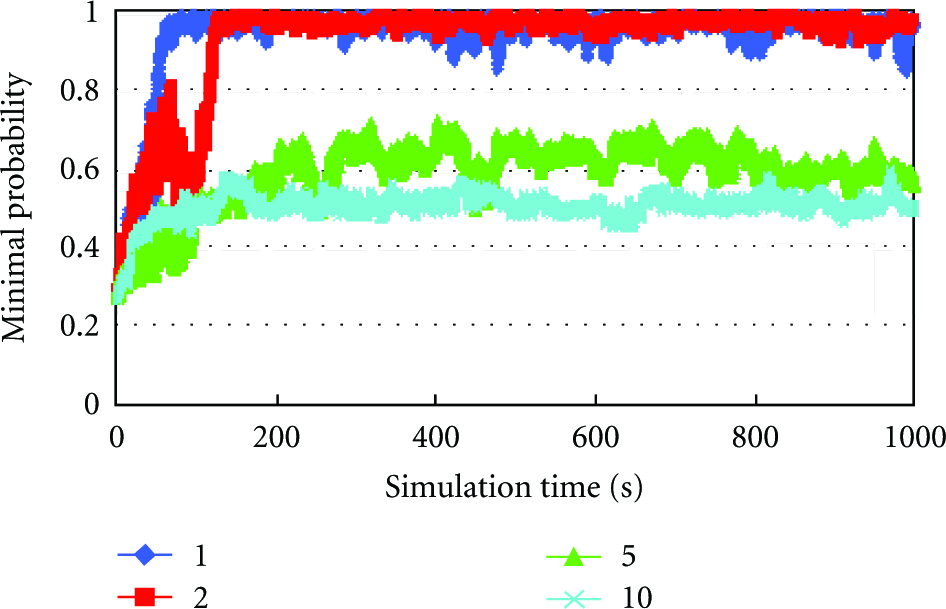
The changes of minimal probability with different ants generating rates.
6. Conclusion
The energy hole problem is caused by uneven energy consumption. Because data transmission is achieved by forwarding scheme among coronas, the sensor nodes closest to the sink need to relay more traffic so as to deplete their energy budget faster than other sensors. Based on our analysis, the key factor of improving the network lifetime is that different transmission ranges should be adopted in different regions of the network. Therefore, in this paper, we start with finding the optimal transmission range list based on corona model and propose the ant-based distributed algorithm (ASTRL) which tends to prolong the network lifetime by assigning appropriate transmission range for each corona. The simulation results show our algorithm can significantly improve the network lifetime; actually, it is close to optimal list (OL) in terms of the network lifetime and can perform equally well in the nonuniform node distribution.
Footnotes
Acknowledgments
This work is supported by China National Science Foundation under Grants no. 60903158, 61170256, 61173172, and 61103226 and the Fundamental Research Funds of China for the Central Universities under Grants no. ZYGX2010J074 and ZYGX2011J102.