




Abstract
Convective flows can develop naturally within the porous materials if they are subject to external heating with/without internal heat source. In this work, the heat is assumed to be generated internally within the porous enclosure at a rate proportional to a power of the temperature difference. This relation is an approximation of the state of some exothermic chemical reaction. An inclined magnetic field is imposed to the porous enclosure. Darcy, model is used to formulate the porous layer and finite difference method is applied to solve the governing equations. The obtained results indicate that strong internal heating can generate significant maximum fluid temperatures above the heated wall temperature, and location of the maximum fluid temperature moves towards the center of the top wall by strengthening the magnetic field. Local heating exponent does not have a major effect on the flow and temperature distributions as well as the heat transfer performance within the porous medium. The large magnetic fields, regardless of direction, are effective to suppress the convective flows and reduce the rate of heat transfer.
1. Introduction
A porous medium means a material consisting of a solid matrix with an interconnected void [1]. The interconnectedness of the void (the pores) allows the flow of one or more fluids through the material. Examples of natural porous media are beach sand, sandstone, limestone, rye bread, wood, rocks, and soil. Fluid which flows in porous media has occupied the central stage in many fundamental heat transfer analysis and has received considerable attention over the last few decades. This interest is due to its wide range of applications, for example, high-performance insulation for buildings, chemical catalytic reactors, packed sphere beds, grain storage, and geophysical problems as frost heave. Porous media are also of interest in relation to the underground spread of pollutants, solar power collectors, and to geothermal energy systems. The literature concerning convective flow in porous media is abundant and representative studies in this may be found in the recent books by Ingham and Pop [2], Pop and Ingham [3], Ingham et al. [4], Ingham and Pop [5], Vafai [6], de Lemos [7], and Vadasz [8].
Convective flows can develop naturally within the porous materials if they are subject to some form of external heating. In some situations this material provides its own source of heat such as spontaneous combustion in coal stockpiles, heat removal from nuclear fuel debris in nuclear reactors, underground disposal of radioactive waste materials, and exothermic chemical reactions in packed-bed reactors. Moreover, this phenomenon can be encountered during the storage of agricultural products where heat is generated as a result of metabolism of the products [9]. Uncontrolled the spontaneous combustion cause a destruction and financial losses [10] and [11]. Thus, understanding and controlling the convective flows are clearly important for prevention of fires in the coal stockpiles.
The study of the interaction of the geomagnetic field with the fluid, such as oil, gas, and water, in the geothermal regions arises in geophysics. We can determine the flow and temperature distribution by solving the Navier-Stokes and energy equations. Early studies on hydromagnetic natural convection flow through a porous medium are due to Raptis et al. [12] and Raptis and Vlahos [13]. The effect of the transverse magnetic field within an inclined porous tall enclosure were investigated numerically by Vasseur et al. [14] and Bian et al. [15]. They found that the temperature and the velocity fields are significantly modified with the application of the magnetic. Khanafer and Chamkha [16] studied a transverse magnetic field and fluid heat generation effects. Grosan et al. [17] and Saleh et al. [18] extended this to include an inclined magnetic field. They reported an optimum reducing of the heat transfer performance that was obtained for a large magnetic field in the horizontal direction. Recently, analytical solutions of the magnetohydrodynamic problem were obtained by Raftari and Yildirim [19] and Raftari et al. [20]. The present work investigates the effect of an inclined magnetic field on natural convection in an enclosure filled with a porous medium saturated with an electrically conducting fluid having nonuniform internal heat generation. The special purpose is to find the optimum parameters in controlling the convective flows within the enclosure.
2. Mathematical Formulation
We consider the steady, two-dimensional natural convection flow in a square region filled with an electrically conducting fluid-saturated porous medium (see Figure 1). The coordinate system employed is also depicted in this figure. The top and bottom surfaces of the convective region are assumed to be thermally insulated, the face

Schematic representation of the model.
The viscous, radiation and Joule heating effects are neglected. The resulting convective flow is governed by the combined mechanism of buoyancy force, internal heat generation, and magnetic field. The magnetic Reynolds number is assumed to be small so that the induced magnetic field can be neglected compared to the applied magnetic field. Under these assumptions, the conservation equations for mass, momentum, energy, and electric transfer are as follows:



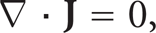


where
The above equations correspond to having the porous medium-modeled according to Darcy's law. Because of the complexity of pore geometries in a porous medium, Darcy's law has to be used to obtain any meaningful insights into the physics of flow in porous media. Darcy's law has been verified by the results of many experiments. Theoretical backing for it has been obtained in various ways, with the aid of either deterministic or statistical models [1]. Vafai [6] have described that Darcy's approximation is reasonable for the geothermal flows, except perhaps near boreholes [6]. Darcy's law is valid only when the pore Reynolds number is of the order of 1 and for many practical applications, Darcy's law is not valid, and boundary and inertial effects need to be accounted for [6]. For example, modeling fluid flows in the fuel cells. This is because the fuel cell consists of a number of distinct layers of different porosities. Darcy's law assumes no effect of boundaries and the fluid velocity in Darcy's equation is determined by the permeability of the matrix. Therefore at the interface between the regions of different porosity in the fuel cell, particularly between the free fluid flow region, such as a gas flow channel and a permeable medium, then a discontinuity in the fluid velocity and/or the shear stress could emerge [5].
Eliminating the pressure term in [2] in the usual way, the governing equations [1–3] can be written as

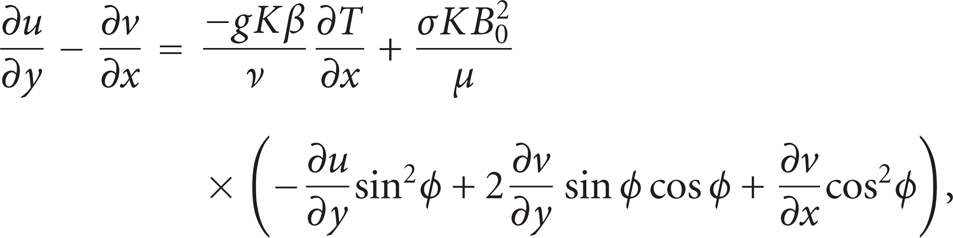

where

Further, we introduce the following nondimensional variables:

where

subject to the boundary condition

where
Once we know the temperature we can obtain the rate of heat transfer from each of the vertical walls, which are given in terms of the mean Nusselt number as Nu h = ∞01(∂θ/∂X)X=0 at the hot wall and Nu c = ∞01(∂θ/∂X)X=1 at the cold wall.
3. Numerical Method and Validation
An iterative finite difference procedure will be applied to solve (12), (13). Central difference method is applied for discretization of equations. Forward and backward difference schemes are used for the Neumann boundary conditions. The solution of algebraic equations was performed using Gauss-Seidel iteration. The unknown θ and ψ were calculated until the following criteria of convergence were fulfilled:

where ζ is either ψ or θ, n represents the iteration number, and ϵ is the convergence criterion.
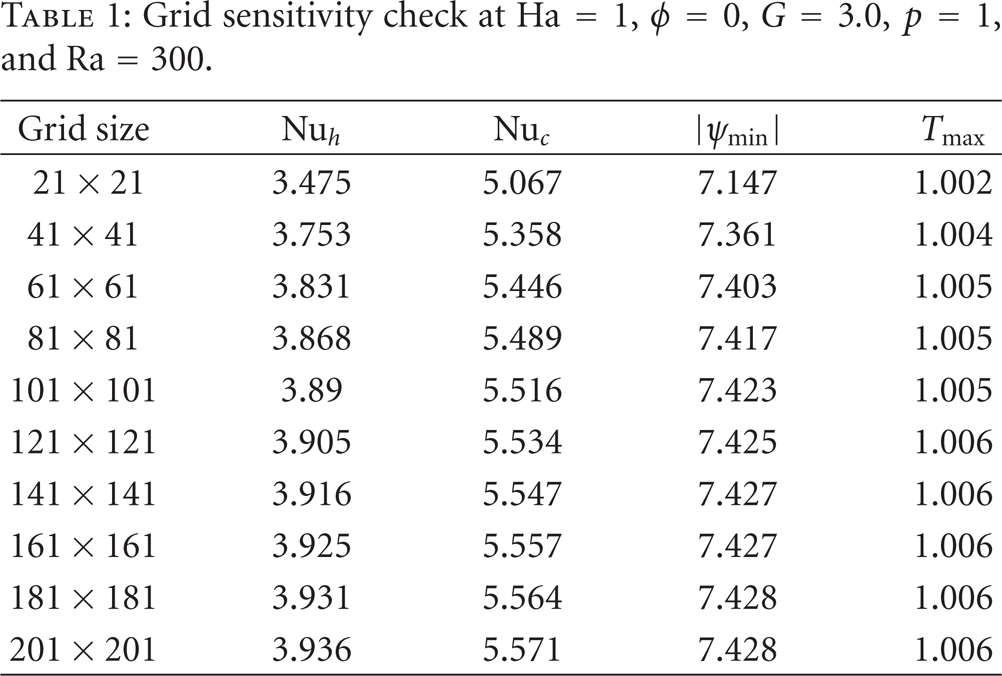
In this study, the convergence criterion is set at
Grid sensitivity check at
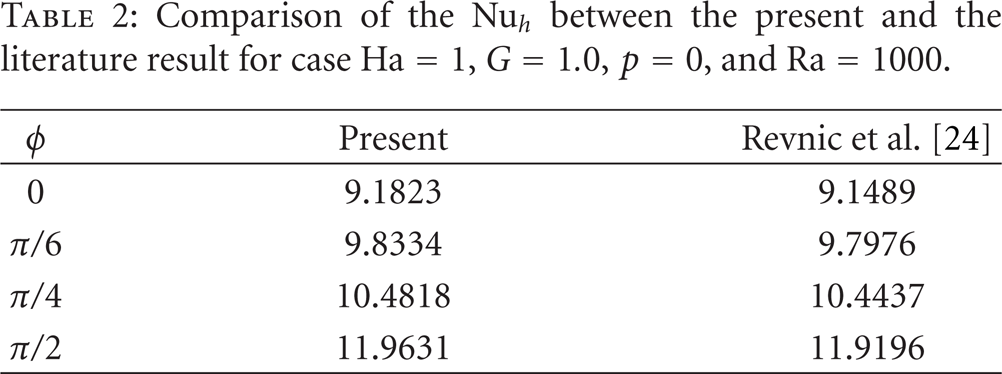
Comparison of the
4. Results and Discussion
In this section, we present numerical results for the streamlines and isotherms for various values of the magnetic field parameter, Ha, the inclination angle, ϕ, the internal heat generation parameter, G, and the exponent p in the local-heating term as well as the Rayleigh number, Ra. Mealey and Merkin [21] have investigated that the steady solutions exist only for a finite range of Ra and G. In this study, we performed calculation for range G from 0 until 5 and Ra from 0 until 300. The low Ra is also parallel with the fact of coefficient permeability K values from
Figure 2 shows the streamlines and isotherms for the no internal heating case (

Contour plots of the stream function and temperature for
Figure 3 shows the streamlines and isotherms for the strong heating case (

Contour plots of the stream function and temperature for
The streamlines and isotherms for a range of values of p with

Contour plots of the stream function and temperature for
Figure 5 shows the influence of the inclination angle ϕ of the applied magnetic field on flow and temperature distributions for

Contour plots of the stream function and temperature for
The effect of Ra on the stream function and temperature are shown in Figure 6 for

Contour plots of the stream function and temperature for G = 3, p = 1,
Figure 7 presents relationship between the mean Nusselt number along the hot wall Nu
h
and along the cold wall Nu
c
against the Rayleigh number Ra for the case

Plots of the mean Nusselt number along the hot wall (a),
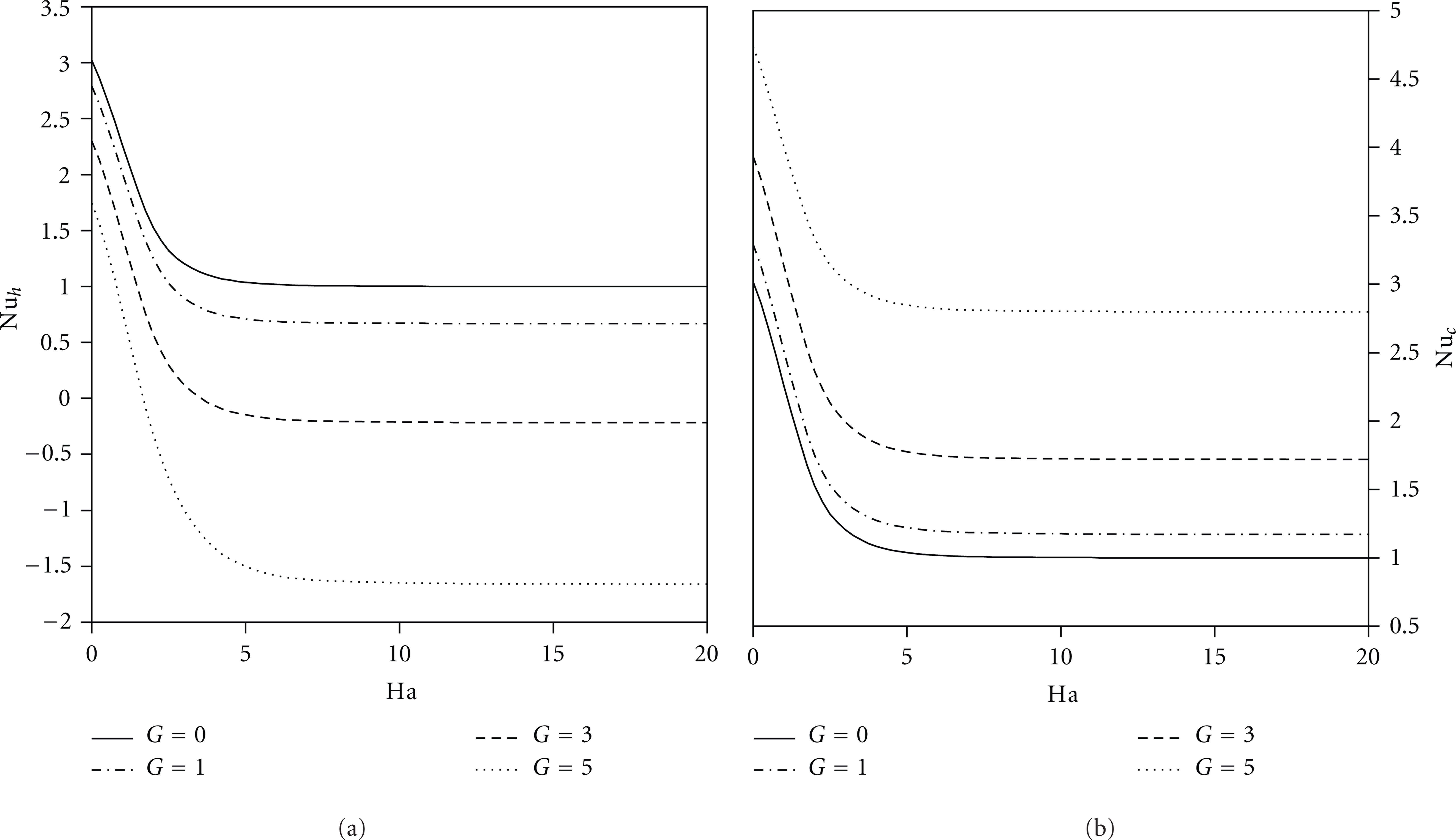
Plots of the mean Nusselt number along the hot wall (a),
Figure 9 shows the variations of Nu
h
and Nu
c
with Ha when p is varied for the case

Plots of the mean Nusselt number along the hot wall (a),

Plots of the mean Nusselt number along the hot wall (a),
5. Conclusions
The present numerical study exhibits many interesting features concerning the effect of the inclined magnetic fields on natural convection in square enclosure filled with a porous medium having nonuniform internal heat source. Detailed numerical results for flow field, temperature distribution, and heat transfer performance have been presented in graphical form. The results of the numerical analysis lead to the following conclusions.
Strong internal heating can generate significant maximum fluid temperatures above the heated wall temperature and location of the maximum fluid temperature moves towards the center of the top wall by strengthening the magnetic field. Local heating exponent does not have a major effect on the flow and temperature distributions as well as the heat transfer performance within the porous medium. In general, effect of magnetic field is to retard the convective flows circulation within the porous enclosure. Combination of the large of applied magnetic field in any direction having a strong internal heat source with a small local heating exponent was found to be most effective in suppressing the heat transfer performance along the hot wall. However, combination of the large of applied magnetic field in any direction having a low internal heat source with a high local heating exponent was found to be most effective in suppressing the heat transfer performance along the cold wall.
The findings may be useful to find an effective way in controlling the convective flows due to external and internal heating. The results of the problem are also useful in the study of movement of oil or gas and water through the reservoir of an oil or gas field in the migration of underground water.