




Abstract
A solution to obtain efficient cooling systems is represented by the use of confined or unconfined impinging jets. Moreover, the possibility of improving the thermal performances of the working fluids can be taken into account and the introduction of nanoparticles in a base fluid can be considered. In this paper, a numerical investigation on confined impinging slot jet working with a mixture of water and Al2O3 nanoparticles is described. The flow is laminar and a uniform temperature is applied on the target surface. The single-phase model approach has been adopted. Different geometric ratios, particle volume concentrations, and Reynolds numbers have been considered in order to study the behaviour of the system in terms of average and local Nusselt number, convective heat transfer coefficient and required pumping power profiles, temperature fields, and stream function contours.
1. Introduction
Heat transfer enhancement is a significant issue in the research and industry fields. Both active and passive techniques can be employed. The impinging jets are classified into the category of the active methods, and they have been widely used in several industrial applications as a means of providing high localized heat transfer coefficients. In fact, impinging jets are applied to drying of textiles, film, and paper, cooling of gas turbine components and the outer wall of combustors, freezing of tissue in cryosurgery and manufacturing, material processing, and electronic cooling. There are numerous papers concerning this problem, and the analyses have been performed both numerically and experimentally [1–6].
Several studies have been developed on impinging air jets [1, 2] but liquid jets have been recently studied because they have possible application to the cooling of heat engines [5, 7], thermal control in electronic devices [8, 9], and the thermal treatment of metals and material processing [10–12].
The main configurations include circular or slot jets, and their flow and heat transfer mechanics are significantly different. It seems that more research activity on heat and mass transfer with circular impinging jets has been predominantly published [1–3, 13, 14]. However, investigations on heat and mass transfer with slot jet impingement have attracted more attention recently. In fact, slot jet impingements offer some benefits in cooling effectiveness, uniformity, and controllability, as underlined in [15]. These features are suitable with ones required by the modern electronic packages, characterized by increasing heat flux and decreasing dimensions [15–21]. Impinging jets can be confined or unconfined. Small space designs mark the confined configurations while unconfined impinging jets provide advantages in terms of simple design and easy fabrication. These types of impinging jets are both commonly used, and literature reviews on the subject have been provided in [2, 3, 6]. The effects of confinement on impinging jet heat transfer have been considered in [22–25]. The importance of the subject is underlined by the several investigations performed on impingement on moving plates [25], obliquely flat surfaces [26], porous mediums [27], semicircular concave surfaces [28], jet arrays [29], and adopting foams or fins [30]. Moreover, laminar [20, 31] and turbulent [23, 32, 33] flow regimes can be considered.
Another way can be adopted in order to enhance heat transfer rates without modifications in the cooling system, such as the employment of nanosize particles dispersed in the working fluids [34]. The investigation on nanofluid behaviour is becoming more and more popular, as testified by recent reviews and papers on this issue [35–44] but inconsistencies in published data and disagreements on the heat transfer mechanisms have been underlined by Keblinski et al. [45] and recently by Gherasim et al. [46]. However, a few examples of studies on nanofluids in impinging jets have been investigated experimentally and numerically and, according to the best knowledge of the present authors, their investigations have been reported in [46–59]. Roy et al. [50] provided the first numerical results on the hydrodynamic and thermal fields of Al2O3/water nanofluid in a radial laminar flow cooling system, underlining a heat transfer enhancement up to 200% in the case of a nanofluid with 10% in nanoparticle volume concentration at a Reynolds number equal to 1200. However, a significant increase in wall shear stress was noticed. Also Palm et al. [51] numerically investigated laminar impinging jets but they considered temperature-dependent properties of fluids. Results indicated an increase of 25% in terms of average wall heat transfer coefficient, referred to the water at a concentration equal to 4%. Moreover, the use of temperature-dependent properties determined for greater heat transfer predictions with corresponding decreases in wall shear stresses when compared to evaluations employing constant properties. The significant heat removal capabilities of nanofluids were confirmed by the numerical study on steady, laminar radial flow of a nanofluid in a simplified axisymmetric configuration with axial coolant injection, performed by Roy et al. [52]. Roy et al. [50] numerically simulated the behaviour of various particle volume fractions in a circular confined and submerged jet impinging on a horizontal hot plate. Both laminar and turbulent impinging jets in various nozzle-to-plate distances and Reynolds numbers were considered. They underlined the higher heat removal performances of laminar jets in comparison with the base fluid. The investigation on steady laminar incompressible alumina/water flow between parallel disks was performed by Vaziei and Abouali [53] who evaluated increasing Nusselt number values with higher nanoparticle volume fraction, smaller nanoparticle diameter, reduced disk spacing, and larger jet Reynolds number. Gherasim et al. [46] highlighted the limitations in the use of Al2O3/water nanofluid in a radial flow configuration due to the significant increase in the associated pumping power. Also, Yang and Lai presented numerical results on confined jets with constant [55] and temperature-dependent [56] properties. Results confirmed the Nusselt number increases with the increase of Reynolds number and nanoparticle volume fraction and the increase in pressure drop. Furthermore, temperature-dependent thermophysical properties of nanofluids were found to have a marked bearing on the simulation results. Manca et al. [57] numerically investigated the confining effects on impinging slot jets in the turbulent regime, such as for Reynolds numbers, ranging from 5000 to 20000. They adopted the single-phase approach in order to describe the Al2O3/water nanofluid behaviour for particle concentrations up to 5%. A significant enhancement in terms of convective heat transfer coefficients was evaluated for high particle volume concentrations as well as an increase of required pumping power.
On the experimental side, an interesting investigation was carried out by Nguyen et al. [58]. They paid attention to a confined and submerged impinging jet on a flat, horizontal, and circular heated surface with Al2O3/water nanofluid. Results were obtained for both laminar and turbulent flow regimes, and the authors showed that, depending upon the combination of nozzle-to-heated surface distance and particle volume fraction, the use of a nanofluid can determine a heat transfer enhancement. Gherasim et al. [59] studied heat transfer enhancement capabilities of coolants with suspended nanoparticles inside a laminar radial flow cooling device. Mean Nusselt number was found to increase with particle volume fraction, Reynolds number, and a decrease in disk spacing.
It seems that a slot confined and submerged impinging jet on a flat surface with nanofluids has not been investigated in laminar flow regime in spite of its importance in engineering applications such as electronic cooling and material processing. In particular, localized and microsized cooling devices are significantly suitable for the thermal control requirements in electronic applications [46–59]. The present paper describes a numerical investigation on laminar flow on a confined and submerged impinging slot jet on an isothermal flat surface that is carried out by means of Fluent code [60]. The results are given to evaluate the fluid dynamic and thermal features of the considered geometry with water/Al2O3-based nanofluids as the working fluids. The single-phase model was adopted.
2. Governing Equations
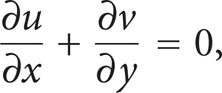
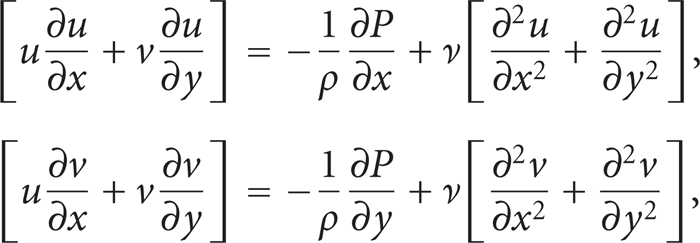
A computational analysis of a two-dimensional confined impinging slot jet, depicted in Figure 1, is considered in order to evaluate its thermal and fluid-dynamic behaviours and study the temperature and velocity fields in the cases with Al2O3/water nanofluid as working fluid. The jet width is W while the distance between the slot jet and the heated plate is H. A constant uniform temperature is applied on the target surface. The use of a two-dimensional slot jet is fair when the lateral length, in the orthogonal direction in respect to the jet, is significant. In particular, Zhou and Lee [61] suggested dimensionless lateral distances, referred to the nozzle width, greater than 6–7 in order to neglect the effect of lateral distance. Different jet velocities are considered in the ranges of laminar regime, and the fluid properties were considered constant with temperature. Governing equations of continuity, momentum, and energy are solved for a steady-state laminar flow in rectangular coordinates, under the hypotheses of two-dimensional, incompressible, temperature-constant properties flow conditions:
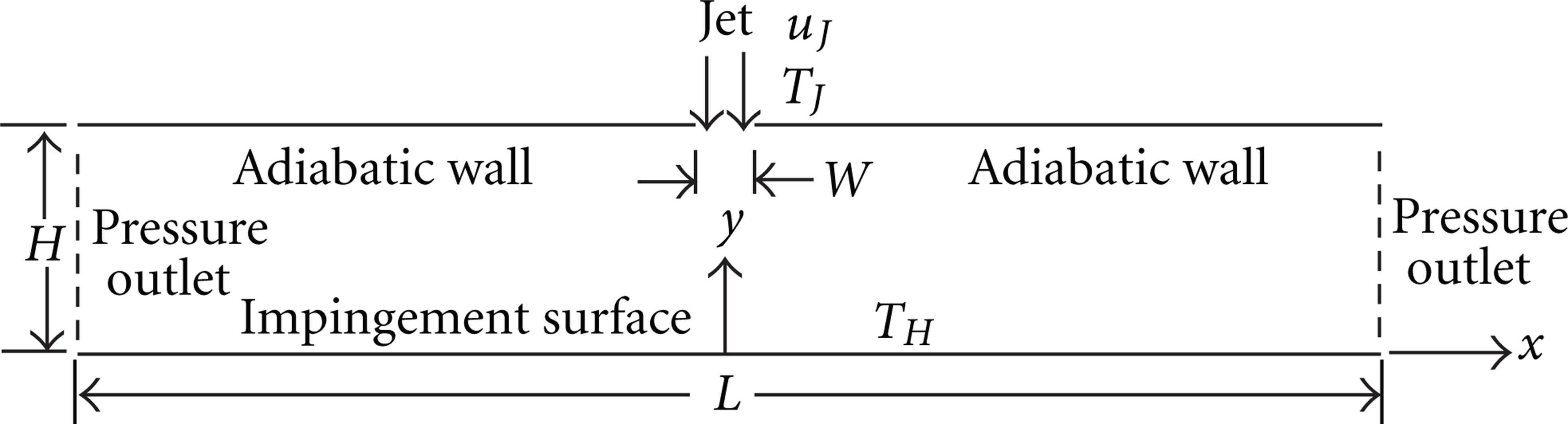
Sketch of the geometrical model with boundary conditions.
continuity:
momentum:
energy:

The assigned boundary conditions are the following:
jet section: uniform velocity and temperature profile;
outlet sections: pressure outlet in order to define the static pressure at flow outlets;
target surface: velocity components equal to zero and assigned temperature value;
upper wall: velocity components and heat flux equal to zero.
3. Physical Properties of Nanofluids
The working fluid is water or a mixture of water and Al2O3 nanoparticles characterized by a diameter of 30 nm and volume fractions equal to 1%, 4%, and 5%. In Table 1 the values of density, specific heat, dynamic viscosity, and thermal conductivity, given by Rohsenow et al. [62], are reported for water and Al2O3. The presence of nanoparticles and their concentrations influence the working fluid properties. A single-phase model was adopted because nanofluids may be considered as Newtonian fluids for low volume fractions, such as up to 10%, and for small temperature increases. Thus, it is necessary to employ relations, available in literature, in order to compute the thermal and physical properties of the considered nanofluids [51, 63–66], given in Table 2. Density was evaluated by using the classical formula developed for conventional solid-liquid mixtures while the specific heat values were obtained by assuming the thermal equilibrium between particles and surrounding fluid [46, 51, 63, 64]:
Properties of pure water and Al2O3 particles at T = 293 K.

Thermophysical properties of the working fluids.

Density:

Specific heat:

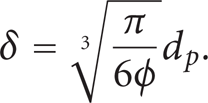
For the viscosity as well as for thermal conductivity, equations given by [65, 66] were adopted because these relations are expressed as a function of particle volume concentration and diameter:
Dynamic viscosity:

Thermal conductivity:

where

with
4. Geometrical Configuration
A computational thermofluiddynamic analysis of a two-dimensional model, reported in Figure 1, which concerns with a confined impinging jet on a heated wall with nanofluids, is considered in order to evaluate the thermal and fluid-dynamic performances and study the velocity and temperature fields. The two-dimensional model has the jet orifice width, W, equal to 6.2 mm and a length L/W equal to 50 while the height H/W ranges from 4 to 8. A constant temperature value of 313 K is applied on the impingement bottom surface. Two values of H/W ratio, equal to 4 and 8, are considered. The working fluid is pure water or a water/Al2O3-based nanofluid at different volume fractions.
The dimensionless parameters of Reynolds number, Nusselt number, dimensionless temperature, and dimensionless pressure or pressure coefficient, here considered, are expressed by the following relations:

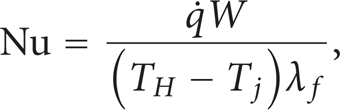

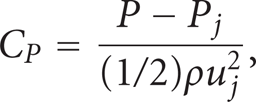
where u
j
is the average jet velocity, W is the jet width,
5. Numerical Procedure
The governing equations are solved by means of the finite volume method, adopting Fluent v6.3.26 code. A steady-state solution and a segregated method are chosen to solve the governing equations, which are linearized implicitly with respect to dependent variables of the equation. A second-order upwind scheme is chosen for energy and momentum equations. The SIMPLE coupling scheme is chosen to couple pressure and velocity. The convergence criteria of 10−5 and 10−8 are assumed for the residuals of the velocity components and energy, respectively. It is assumed that the incoming flow is laminar at ambient temperature equal to 293 K and pressure. Different inlet uniform velocities, u j , corresponding to Reynolds number values ranging from 100 to 400, were considered. Along the solid walls no slip condition is employed whereas a velocity inlet and pressure outlet conditions are given for the inlet and outlet surfaces.
Four different grid distributions are tested, to ensure that the numerical results were grid independent for the case characterized by

Grid independence test results in terms of average and stagnation point Nusselt number.
Results are validated by comparing the obtained numerical data with the ones given in [20, 66]. In particular, comparisons in terms of local and stagnation point Nusselt number values and pressure coefficients are reported in Figure 3 for the cases with

Validation of results, cases with H/W = 4: (a) local Nusselt number; (b) pressure coefficient; (c) stagnation point Nusselt number.
6. Results and Discussion
A computational analysis of a two-dimensional model, regarding a confined impinging jet on a heated wall with nanofluids, is considered in order to evaluate the thermal and fluid-dynamic performances and study the velocity and temperature fields. Different inlet velocities are considered in order to ensure a steady laminar regime, and the working fluids are water and mixtures of water and Al2O3 at different volume fractions. The single-phase model approach is adopted. The ranges of the considered Reynolds numbers, geometric ratio, and volume fractions are given follows:
Reynolds number (Re):100, 200, 300, and 400;
H/W ratio:4 and 8;
particle concentrations (ϕ):0%, 1%, 4%, and 5%.
Results are presented in terms of average and local convective heat transfer coefficients, Nusselt number, required pumping power profiles as a function of Reynolds number, H/W ratio, and particle concentrations; moreover, dimensionless temperature fields and stream function contours are reported.
Figures 4 and 5 depict the stream function contours and the dimensionless temperature fields, respectively, for the cases with two values of H/W ratio and Re, equal to 100 and 300,
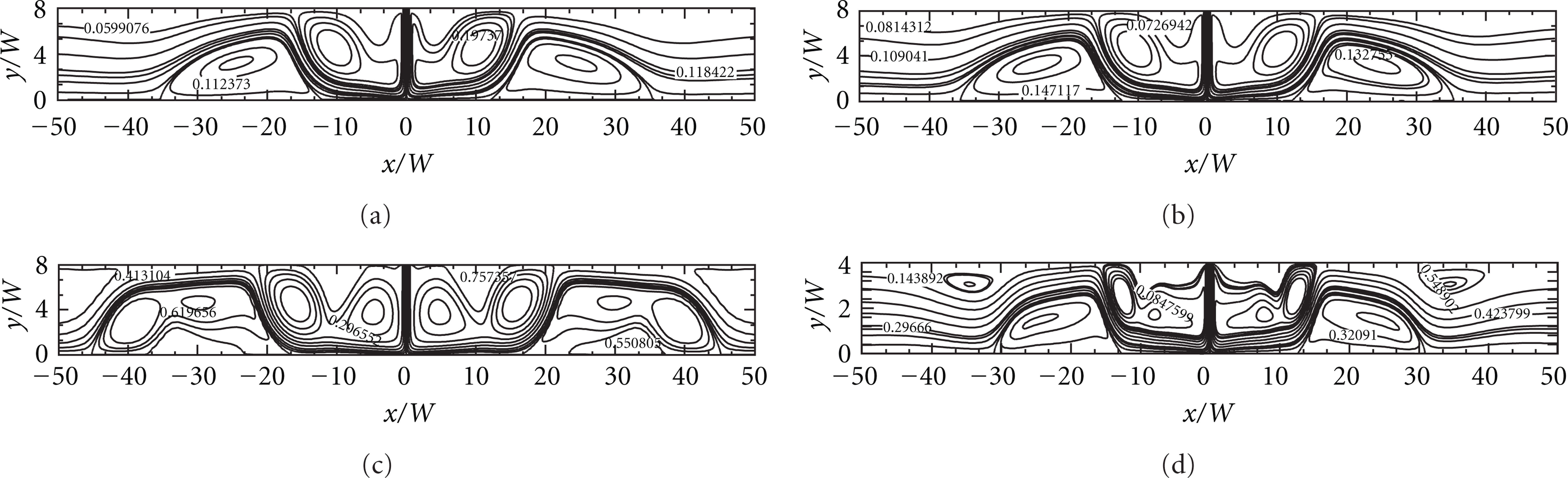
Stream function contours: (a) H/W = 8, Re = 100, and ϕ = 0%; (b) H/W = 8, Re = 100, and ϕ = 4%; (c) H/W = 8, Re = 300, and ϕ = 4%; (d) H/W = 4, Re = 300, and ϕ = 4%.

Dimensionless temperature fields: (a) H/W = 8, Re = 100, and ϕ = 0%; (b) H/W = 8, Re = 100, and ϕ = 4%; (c) H/W = 8, Re = 300, and ϕ = 4%; (d) H/W = 4, Re = 300, and ϕ = 4%.
The dimensionless temperature fields are presented in Figure 5 for the same configurations analyzed in Figure 4. They follow the stream line contours. In fact, the fluid temperature is very high near the stagnation point, where the highest values of heat transfer efficiency are detected then it decreases for increasing values of x/W. Nanofluids produce an increase of fluid bulk temperature because of the improved thermal conductivity of working fluids. For larger Reynolds numbers the efficiency of heat transfer increases while the confinement leads to higher temperatures in the separation zone and lower for increasing values of x/W values.
Figures 6 and 7 describe the convective heat transfer coefficient distributions along the target surface at Re = 100, 200, 300 and 400, for

Local convective heat transfer coefficient profiles along x/W, H/W = 4, and Re = 100, 200, 300, and 400: (a) ϕ = 0%; (b) ϕ = 1%; (c) ϕ = 4%; (d) ϕ = 5%.

Local convective heat transfer coefficient profiles along x/W, H/W = 8, and Re = 100, 200, 300 and 400: (a) ϕ = 0%; (b) ϕ = 1%; (c) ϕ = 4%; (d) ϕ = 5%.
The variation of local Nusselt number along the target plate for different values of

Local Nusselt number profiles along x/W, Re = 100, 200, 300 and 400: (a) H/W =4, ϕ = 0%; (b) H/W =4, ϕ = 5%; (c) H/W =8, ϕ = 0%; (d) H/W =8, ϕ = 5%.
The stagnation point values in terms of convective heat transfer coefficients and Nusselt number are depicted in Figure 9 as a function of Reynolds number for H/W = 4 and 8, and ϕ=0%, 1%, 4% and 5%. If Figure 9(a) is observed, h0 is equal to about 1020, 1450, 1800, and 2020 W/m2K at ϕ = 0% and 1315, 1850, 2280, and 2600 W/m2K at ϕ = 5%, respectively, for H/W = 4 and Re = 100, 200, 300, and 400. The consequent

Profiles of stagnation point convective heat transfer coefficients and Nusselt number, as a function of Re for different concentrations: (a) convective heat transfer coefficients, H/W = 4 and 8; (b) Nusselt number, H/W = 4 and 8.
The average values of convective heat transfer coefficient and Nusselt number increase as H/W ratio increases as shown in Figure 10, which reports the profiles as a function of Reynolds number at different values of particle volume fractions. Profiles increase linearly as Re increases and higher values are detected for larger nanoparticle volume fractions. For example, for

Profiles of average heat transfer coefficients and Nusselt number, as a function of Re for different concentrations: (a) convective heat transfer coefficients, H/W = 4 and 8; (b) Nusselt number, H/W = 4 and 8.
The pumping power ratio, referred to the base fluid values is described in Figure 11 for H/W = 4 and 8 and for different values of particle concentrations. The required pumping power is defined as
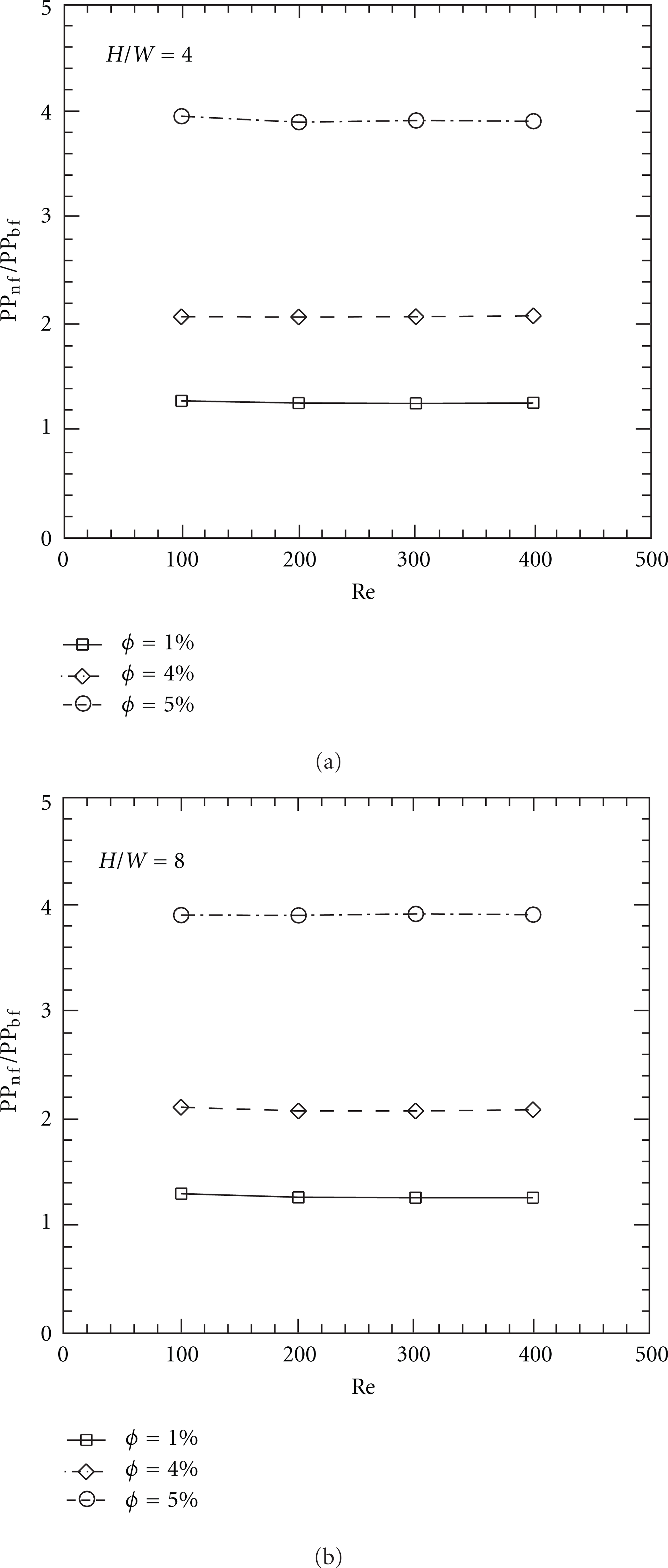
Pumping power profiles, referred to the base fluid values, as a function of Re, ϕ = 1%, 4%, and 5%: (a) H/W = 4; (b) H/W = 8.
7. Conclusions
A numerical analysis of a two-dimensional model on a confined impinging slot jet with nanofluids has been performed in order to evaluate the thermal and fluid-dynamic behaviours. A uniform temperature is applied on the target surface and jet Reynolds number ranges from 100 to 400. The base fluidis water, and different volume concentrations of Al2O3 nanoparticles are taken into account by adopting the single-phase model. Furthermore, the confining effects are considered by adopting H/W ratios equal to 4 and 8. The dimensionless stream function contours showed that the vortex intensity and size depend on the confinement, Reynolds number, and particle concentration values. The introduction of nanoparticle produces an increase of fluid bulk temperature because of the elevated thermal conductivity of nanofluids. The local heat transfer coefficient and Nusselt number values are the highest at the stagnation point and they increase as particle concentrations and Reynolds numbers increase. A maximum increase of 32% in terms of average heat transfer coefficients is detected at ϕ = 5% for H/W = 8. The required pumping power increases as well as the Reynolds number and particle concentration and they are at most 3.9 times greater than the values calculated in the case of water.
It should be underlined that the present investigation present the following limits.
Thermo-physical properties of fluids have been considered constant with temperature because of the small difference between the temperature of the heated target surface and the fluid one in the inlet section. However, temperature-dependent properties for nanofluids could be adopted in future works.
The use of a two-dimensional slot jet is fair when the lateral length, in the orthogonal direction in respect to the jet, is significant. In particular, Zhou and Lee [61] suggested dimensionless lateral distances, referred to the nozzle width, greater than 6–7 in order to neglect the effect of lateral distance, as also remarked previously.
Footnotes
Nomenclature
Acknowledgments
This work was supported by SUN with a 2010 grant and by MIUR with Articolo D.M. 593/2000 Grandi Laboratori “EliosLab”.