




Abstract
Power assignment in wireless ad hoc networks is an important issue of topology control which assigns power for each wireless node so that the induced communication graph satisfies some desired properties such as the connectivity and the energy spanner. In this paper, we study the problem of power assignment in order that its induced communication graph meets the following properties: (1) it is an energy-t-spanner which is energy efficient; (2) it is k-fault resistant which can withstand up to
1. Introduction
Ad hoc networks are formed by autonomous nodes communicating via radio without any additional backbone infrastructure. Ad hoc networks have received significant attention in recent years due to their potential civilian and military applications. In wireless ad hoc networks, each node has limited resources such as energy, computing power, storage capacity; there are more challenges and problems compared with traditional fixed infrastructure networks.
A fundamental problem in wireless ad hoc network is to find a power assignment so that the induced communication graph can satisfy some properties such as connectivity and energy spanner.
An energy-t-spanner
Nodes in a wireless network are typically battery powered, and it is infeasible or unable to recharge the device. Due to constrained power capacity, hostile deployment environment, and other factors, node failures are more likely to happen, which might cause network partitions and badly degrade network performance. Therefore, it is important to construct k-fault resistant topologies which can withstand up to
In wireless networks, a node is not able to receive correct data from its neighbor if any of other neighbors is transmitting at the same time. This mutual disturbance of communication is called interference. Interference which causes collisions and retransmissions has a negative impact on prolonging network lifetime in wireless networks. Reducing interference in wireless network leads to fewer collisions and packet retransmissions, which indirectly extends the lifetime of the network and improves network performance. Reducing the interference in wireless networks is consequently considered one of the foremost goals [5]. In order to make topology withstand up to
The rest of the paper is organized as follows. Section 2 presents an overview of previous related work. In Section 3, we state the problem studied in this paper. The models will be presented in Section 4. Then the details of our power assignment algorithms and simulation results will be given in Section 5. Finally, we conclude this paper in Section 6.
2. Related Work
To assign power to each node of a wireless network so that the induced communication graph can satisfy some desired properties (such as connectivity, spanner) is an important research topic. Chew [6] first introduced the concept of spanners. Recently, several papers focus on dealing with the problem of power assignment simultaneously with spanning properties.
Wang and Li [1] first studied how to find a power assignment that the induced communication graph is energy spanner with objectives that minimizes the maximum node power and the total energy consumption (also referred to as the cost of the power assignment
Shpungin and Segal [2] studied the spanner problem from a theoretical point of view under two optimization objectives: minimizing the cost of the power assignment and keep the spanner property. They studied both energy spanner and distance spanner. For the energy spanner model, they present a basic construction of a power assignment p, so that the resulting network is an energy-2-spanner with a total energy of at most O(
Abu-Affash et al. [3] studied the minimal energy spanner problem, they proved that for any constant
All these papers study the spanner problem with additional objective of minimizing the total node power. In many scenarios wireless ad hoc networks are deployed in hostile environments where node failures are very likely to happen. In order to keep network connectivity in wireless networks which is a node-failure prone environment, fault tolerant is especially important. Previous works addressing fault tolerance usually construct a k-connected topology by improving node's transmission range greatly; there are some recent works addressing fault tolerance [7–9]. However, in these works addressing fault tolerance fails to consider the spanner of the networks. Shpungin and Segal [4] studied the power assignment problem which combines fault resistance with spanner property. They addressed the minimum power k-fault resistant energy spanner problem (MPkES). For
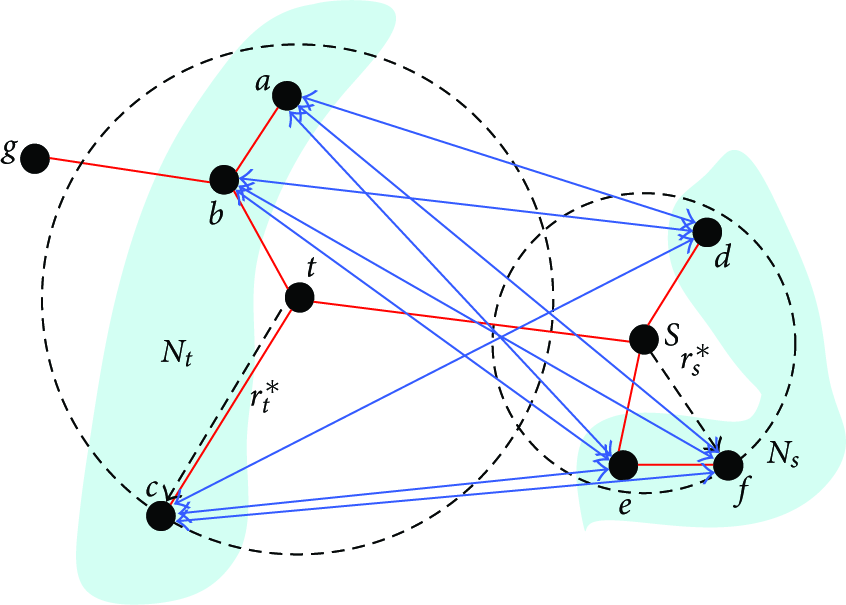
The process of
Rickenbach et al. [5] argued that reducing the interference in wireless networks is considered one of the foremost goals. Interference which causes collisions and retransmissions has a negative impact on prolonging network lifetime in wireless networks. An interesting combination of fault resistance, energy spanner, and interference reducing is studied in this paper.
3. Problem Statement
In this paper, we study the Interference Minimal Fault-tolerant Energy Spanner (
4. Models
We consider a 2D wireless network that consists of a set V of n wireless nodes distributed in a 2D plane
When using common path loss model, the signal strength received by a node can be described as
For two nodes
We define the notion of an energy-t-spanner of G.
Definition 1.
A graph
Here, we also give the definition of k-connected used in this paper.
Definition 2.
A graph
In order to measure the interference, we define the interference model first. Generally, a node v may not correctly decode the transmission from node u if the signal to interference and noise ratio (SINR) perceived by v is below a certain threshold. While this threshold is dependent on various factors like antenna sensitivity of receivers, signal modulation techniques, and other environmental factors, it is well understood that a third node w interferes node v's signal reception from node u if w is located at a nearby position of v and transmitting simultaneously with u. The distance (region) within which a node w interferes another node is called the interference range (region) of w. For simplicity of analysis, we assume that the interference range and the transmission range are the same for any node w. However, the solution is also applicable where the assumption does not hold. All common models of interference define the notion of coverage, which is the number of nodes or edges that are affected by a transmission over a specific link in the induced communication graph. For simplicity, in this paper, the interference of a node v is defined as the number of nodes covered by v with its transmission range.
Definition 3.
The interference value of a single node v is defined as

Definition 4.
The interference of an edge

Definition 5.
The interference of graph
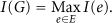
As can be seen in Figure 2, the interference of node u is

Interference of edge (u, v).
Based on these definitions, we will address the problem described in Section 3.
5. Interference Minimal Fault-Tolerant Energy Spanner
In this section, we address the Interference Minimal Fault-tolerant Energy Spanner problem and propose algorithm
In the first step,
1: Compute original topology 2: For each edge 3: sort all edges in E by ascending weight. 4: 5: For each edge 6: if uand vis not kconnected in 7: 8: 9: else if all nodes are kconnected in 10: go to step two 11: end if 12: end for
13: For each edge 14: if 15: 16: end if 17: end for 18: Return
Algorithm 1
5.1. Analyze
In this section, we will prove that the graph induced by
Let the path
Lemma 6.
Let
Proof.
In order to prove
There is an edge since all the paths in There is no edge from according to the definition of
For the sake of contradiction, we assume that
We have proved that for any two vertices
Lemma 7.
Let G and
Proof.
Let Base: Induction: if
Now we have proved that
We denote by
Lemma 8.
Proof.
Since edges are inserted into
Theorem 9.
Proof.
From Lemma 8 we can get that after the first step of IMFES,
Lemma 10.
Let u1 and u2 be two vertices in an energy-t-spanner
Proof.
Let
Theorem 11.
Proof.
To show that
Let
Lemma 12.
The interference of
Proof.
Let
Now consider a graph
We prove by contradiction that C is not k-connected. Assume that C is k-connected and hence
Theorem 13.
The interference of
Proof.
Lemma 12 shows that the interference of
Assume that F is k-connected energy-t-spanner,
Thus, The interference of
Theorem 14.
The time complexity of
Proof.
All the edges can be sorted in
Therefore, the time complexity of
5.2. Simulations
In this section, we evaluate the performance of
We analyze the performance of
Interference
We measure the level of interference of a network based on the interference graph model proposed in Section 4.
Power Stretch Factor
A low value of power stretch factor implies low energy spent by relay nodes in propagating a message, or we can say that this topology is energy efficient.
We will evaluate
In our experiments, we randomly generate a set Vof n wireless nodes in a
Figure 3 shows the average edge interference of the resulting 2-connected topologies induced by the power assignment

Average edge interference when the induced topologies are 2-connected.
Figure 4 shows the average edge interference of the resulting 3-connected topologies induced by the power assignment

Average edge interference when the induced topologies are 3-connected.
Figures 5 and 6 show the power stretch factor of the resulting topologies induced by

Power stretch factor when the induced topologies are 2-connected.
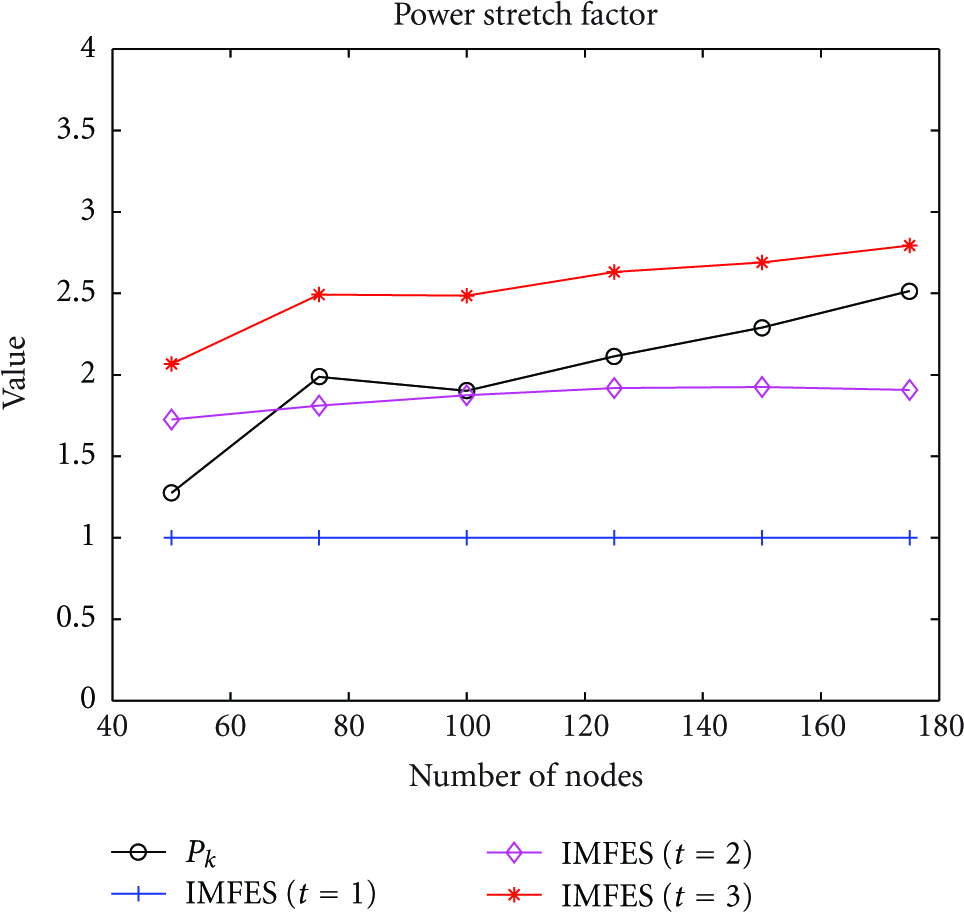
Power stretch factor when the induced topologies are 3-connected.
From Figures 3 to 4, we have got that the smaller the parameter t is, the larger the value of edge interference will be in the topology induced by IMFES. Figures 5 and 6 show that the smaller the parameter t is, the smaller the power stretch factor will be in the topology induced by IMFES. Therefore, there is a tradeoff between energy efficient and interference reduction.
6. Conclusion
In this paper, we study how to find a power assignment that the induced communication graph is k-fault resistant energy-t-spanner, in addition that the interference is minimal in it. We propose IMFES to address this problem in two-dimensional wireless ad hoc networks. To the best of our knowledge, this is the first paper to study the problem. We also prove that the communication graph induced by IMFES is an interference minimal k-connected energy-t-spanner, and the energy stretch factor
Footnotes
Acknowledgments
This work was partly supported by the National Natural Science Foundation of China (no. 61272061, no. 61202289, and no. 61003305), the Fundamental Research Funds for the Central Universities of China (no. 531107040263), and Hunan Natural Science Foundation of China (no. 10JJ5069).