




Abstract
Recently, wireless sensor networks (WSNs) have gained great attention from the research community for various smart grid applications, including advanced metering infrastructure (AMI), power outage detection, distribution automation, towers and poles monitoring, line fault diagnostics, power fraud detection, and underground cable system monitoring. However, multipath, fading, environmental noise, and obstructions in harsh smart grid environments make reliable communication a challenging task for wireless-sensor-network- (WSN-) based smart grid applications. To overcome varying link conditions in smart grid environments, sensor nodes must be capable of estimating link quality dynamically and reliably. In this paper, the performance of the state-of-the-art link-quality estimation methods is investigated for different smart power grid environments, such as outdoor substation, underground network transformer vault, and main power control room, in terms of packet delivery ratio, average number of packet retransmissions, average number of parent changes, average number of hops, and average communication delay. In addition, main smart grid characteristics and potential applications of WSNs in smart grid have been introduced along with the related technical challenges. Overall, our performance evaluations show that the link-quality estimators, called Expected Transmission Count (ETX) and four-bit, show the best performance in harsh smart grid environments.
1. Introduction
In today's competitive electric utility marketplace, the demand for energy increases sharply in parallel to the industrial developments and growing world population. With the increasing demand on the energy, while some of the scientists and the engineers are making investigations for clean and renewable energy sources, others try to create novel solutions to utilize existing power grid more effectively [1–7]. In most countries today, the increasing power demand has caused blackouts, voltage sags, and overloads, which significantly decrease the power quality and reliability. In addition to these problems, the existing power grid suffers from the lack of pervasive and effective communications, monitoring, and automation [8, 9]. All these drawbacks cause region-wide system breakdowns due to the cascading effects initiated by a single fault [8].
To address these problems in today's electric power systems, a new concept of next generation electric power system, a smart grid, has been proposed. The smart grid is an advanced electric power grid, which provides improved productivity, high reliability, and safety by the help of modern communications and advanced sensing technologies [9]. Because of strict application and business requirements, reliable and online information is the core of the smart grid infrastructure. To this end, wireless sensor networks (WSNs) can offer a cost-effective solution for electric power network monitoring and control instead of traditional wired systems [8–15]. WSNs bring important advantages over traditional power systems, including rapid deployment, flexibility, and aggregated intelligence via parallel processing [16, 17]. However, the realization of smart grid depends on the communication capabilities of deployed sensor network in harsh power grid environments, which pose communication challenges for reliability and energy efficiency in WSNs.
Recent field tests using IEEE 802.15.4-compliant sensor networks show that wireless links in smart grid have high packet error rates and variable link capacity because of electromagnetic interference, equipment noise, dynamic topology changes, fading, and obstructions [9]. To overcome varying link conditions in time and space domains, sensor nodes must be capable of estimating link quality dynamically and reliably. However, in WSNs, estimating the instantaneous value of the link quality is challenging due to rapid fluctuations in the wireless channel. Furthermore, in bandwidth-limited and energy-constrained sensor networks, there is a tradeoff between keeping energy consumption and communication overhead as minimum as possible, which requires link-quality measurements with long periods, and estimating link quality reliably, which requires frequent link-quality measurements. Until now, several link-quality estimators have been proposed to obtain a good balance in this tradeoff [16–24]. However, it is not clear how the existing link-quality estimators will perform under varying and harsh conditions of smart power grid. This motivates us to explore if it is possible to obtain a good estimate of the link quality in smart power grid environments.
To address this need, in this paper, the performance of five different link-quality estimation algorithms is investigated for different smart power grid environments, for example, 500 kV outdoor substation, underground network transformer vault, and main power control room. Specifically, the state-of-the-art link-quality estimation methods, such as Packet Reception Rate (PRR), Required Number of Packet Transmissions (RNP), Window Mean with Exponentially Weighted Moving Average (WMEWMA), Expected Transmission Count (ETX), and four-bit, have been evaluated in terms of packet delivery ratio, average number of packet retransmissions, average number of parent changes, average number of hops and average communication delay to better understand the advantages and disadvantages of each link-quality estimation method in different smart grid spectrum environments. In this work, we also introduce main smart grid characteristics and potential applications of WSNs in smart grid along with the related technical challenges. Here, our main goal is to describe potential advantages and applications of WSNs for smart grid and show how the existing link-quality estimators will perform under harsh conditions of smart power grid. Consequently, the main contributions of this study can be summarized as follows.
The main smart grid characteristics and potential applications of WSNs in smart grid have been introduced along with the related technical challenges. This is the first work on performance evaluations of different types of link-quality estimation algorithms specifically under harsh smart grid spectrum environments. Based on these evaluations, important design decisions on how to develop routing protocols specifically for smart grid environments can be made. Our performance evaluations are based on field experiments using IEEE 802.15.4 compliant wireless sensor nodes deployed in different smart grid environments. Upon request, the complete experimental data will be made available. This can help the research community develop novel wireless communication protocols for smart grid applications.
The remainder of this paper is organized as follows. In Section 2, we introduce major WSN-based smart grid applications. Section 3 is an overview of the related work about the link-quality estimation. Section 4 addresses the research challenges of the link-quality estimation in WSNs. In Section 5, computational methods and characteristics of the link-quality estimators are presented. In Section 6, wireless channel model used in performance evaluations has been described. In Section 7, performance evaluations are explained. Finally, the paper is concluded with Section 8.
2. Characteristics of Smart Grid and WSN-Based Smart Grid Applications
The complex nature of the electric power grid with different types of load and increasing power demand cause serious problems on overstressed power grid, such as blackouts, which can significantly decrease the power quality and reliability. All these reasons call for the smart grid, which is expected to satisfy following important characteristics mentioned in the US Energy Department Report [6].
Reliability: smart grid provides more reliable energy generation and distributions than the current grid by the help of the monitoring and controlling mechanisms. It uses fault prevention methods and takes proper actions in advance. Thus, the consumers would not be affected from the possible blackouts. Security: to improve the security, modern grid takes precautions for the cyber and the physical attacks. It is also more resistant for the natural disasters and recovers itself more quickly. Efficiency: modern grid system reduces the electric losses caused by the old transmission and distribution systems. It also provides more effective energy production and utilization. Environmentally friendly: smart grid has inter-operability with the clean and the renewable energy providing systems. It also reduces the harmful environmental effects originated from the energy generation, storage and distribution. Customer friendly: in the smart grid, customers have an active role. They are informed about power utilization and the instant energy consumption, which aims to distribute the electric utilization and reduce the burden of the grid at the peak hours.
Overall, electric power grid contains three main subsystems, that is, power generation, power transmission and distribution, and customer facilities. The first subsystem includes systems and infrastructures to generate the energy. The second subsystem is the transmission and the distribution of the produced energy and the last subsystem is the demand side, including the consumers. These three major subsystems have a great need for monitoring and fault diagnostic systems based on wireless sensor networks (WSNs). There are several potential WSN-based smart grid applications. In Table 1, an overview of these important applications and their corresponding power grid segments are summarized. In the following, we briefly summarize some of WSN-based smart grid applications.
Transmission and distribution (T&D) side: there are many reasons causing line faults in power delivery systems. However, in the most of the traditional power systems, there are no monitoring and control systems to detect the line faults and the location of the fault. Thus, the faults along the transmission and distribution lines cannot be fixed in a timely manner by the electric utilities. An effective, low cost, and reliable monitoring system developed by wireless sensor nodes can help the electric utility to detect and fix the line faults immediately [10, 15]. Another major problem especially for some underdeveloped countries and the urban areas is power fraud and theft. Traditional systems are inadequate to detect power thefts, since these systems do not include online monitoring. WSN-based monitoring technologies can also provide solutions to prevent power thefts. Consumer side: Wireless Automatic Meter Reading (WAMR) applications work on the consumer side. WAMR system is an approach to reduce the need for manpower by using wireless sensor networks. In traditional electricity systems human meter readers are used and it is a costly and also ineffective way of reading meters. On the other hand, WAMR provides a low-cost and easy solution to gather the energy consumption data for the billing systems. Another advantage of WAMR is that real-time pricing can be possible for the customers [9, 12]. Furthermore, wireless sensor technologies are widely used in the smart homes. For the smart home systems, Reduced Function Nodes (RFNs) are used widely in Home Area Networks (HANs), which help users to monitor and control their home devices remotely [17]. Generation side: traditional power grid monitoring systems use wired sensor nodes to control and monitor the energy generation facilities. However, the deployment cost of wired power monitoring systems might be high, and thus, they are not widely implemented in power grid. With the recent advances in wireless sensor networks (WSNs), the realization of low-cost embedded power monitoring systems have become possible [8–15]. In these embedded systems, wireless sensor nodes are deployed on power grid components and monitor important operational parameters related to each component's efficiency based on different measurements, such as temperature, voltage, current, and power quality [9].
Summary of WSN-based smart grid applications.

3. Related Work on Link-Quality Estimators
There are many research efforts and studies about link-quality estimators (LQEs) and link-quality measurements in wireless sensor networks [2–5, 13, 14, 22, 23, 38]. Some of these studies focus on performance evaluations of the existing LQE protocols [19] and the others are about design of new LQE mechanisms [22–27]. In addition, the coexistence between IEEE 802.11b networks and IEEE 802.15.4 networks has been studied in [18].
In general, there are two different types of link-quality estimators in WSNs, that is, hardware-based estimators and the software-based estimators. Widely used hardware-based estimators are based on the Received Signal Strength Indicator (RSSI), the Link Quality Indicator (LQI), and the Signal-to-Noise Ratio (SNR). LQI and RSSI are both calculated by the successfully received packets [22–24]. Therefore, when a link suffers from excessive lost packets, they overestimate the quality of the link. The RSSI can also make low-quality estimations when the received signal quality of a link is low even though the packet reception rate of the link is good [22]. The SNR compares the desired signal strength with the noise level on the floor. However, using only SNR values may not provide accurate link-quality estimation due to varying link conditions in time and space domains.
The Packet Reception Ratio (PRR) and the Required Number of Packets (RNPs) [25] are the basic software-based link-quality estimators (LQEs). While the PRR counts the number of received packets of the all sent packets, the RNP counts the number of transmitted/retransmitted packets of all sent packets. The Window Mean with Exponentially Weighted Moving Average (WMEWMA) [27] is another software-based estimator. Compared to the PRR-based estimator, the difference of WMEWMA is that it applies a Kalman filter on PRR values to get more stable results. Expected Transmission Count (ETX) [28] is another PRR-based estimator, which is evaluated by using both forward and backward PRR values. The four-bit [26] is a software-based hybrid estimator that combines information from the network, link, and physical layer.
In the related literature, there are also several studies on different propagation models [29–34], such as one-slope model [35], two-slope model [36], and multi-wall component model [37], and log-normal channel model [29–31]. These studies have shown that the quality of low-power wireless links varies over space and time, deviating from the idealized unit disc graph models used in some network simulation tools. In fact, experimental studies and measurements have shown the existence of different packet reception regions in a low-power wireless link, that is, connected, transitional, and disconnected. Depending on the propagation environment characteristics, the width of the transitional region could be very large, and is characterized by high-variance in packet reception rates. Thus, these studies reveal that low power wireless links can be highly unreliable and that this must be explicitly considered when designing routing layer solutions with proper link-quality estimators.
Although all these studies provide valuable and solid foundations in WSNs, none of them addresses low power wireless link-quality estimation in indoor, outdoor, and underground smart grid environments. Consequently, different from previous work, this paper focuses on the performance of different types of link-quality estimators in different smart power grid environments, such as 500 kV substation, underground transform vault, and main power room. Overall, the main goal of this paper is to quantify the impact of the smart grid propagation environment characteristics on the overall network performance in smart grid spectrum environments in terms of packet delivery ratio, average number of packet retransmissions, average number of parent changes, average number of hops, and average communication delay.
4. Research Challenges of the Link-Quality Estimation in WSN
Link-quality estimation is an important function because accurate estimations improve the performance of the higher layer communication protocols. Especially, routing layer uses the information gathered from link-quality estimators to choose the optimal path while sending a packet. If the estimation results are far from being realistic, then the routing algorithm performs in a poor manner. In smart grid spectrum environments, link-quality estimation is challenging due to the following major factors.
Shadowing and multipath effects in power grid: due to the multipath and shadowing effects, link quality can significantly change irrespective of communication distance between transmitter and receiver. Environmental effects in power grid: Reflection, diffraction, scattering, and absorption due to obstacles also affect the link quality significantly. Interference and noise in power grid: The RF interference and environmental noise can change dynamically and the nodes in communication also cause RF interference for the other nodes. Link asymmetry: All above-mentioned factors also improve the asymmetry level of the wireless links. A good estimator has to take into account the both uplink and the downlink qualities to prevent the undesirable effects of the asymmetric links.
5. Evaluated Methods
In this study, we have evaluated the state-of-the-art five different link-quality estimators, which are PRR [25], RNP [25], WMEWMA [27], ETX [28], and four-bit [26]. These metrics and their evaluation techniques are presented in this section. Common properties of the link-quality estimators can be classified in three main categories [19]: (i) monitoring type, (ii) location type, and (iii) symmetry type.
Monitoring type (passive versus active): while making estimation, if the link-quality estimator (LQE) uses data packets, then its monitoring type is called passive. In the active monitoring, nodes periodically send probe packets to gather the environment information. The active monitoring causes overhead and additional energy consumption while estimating the link quality, since it uses additional probe packets different from data packets. Among five evaluated link-quality estimators, the ETX uses active monitoring and four-bit uses both active and passive monitoring. The rest of them use passive monitoring. Location type (receiver side versus sender side): link-quality estimators run either at the receiver side or at the sender side. Among five evaluated link-quality estimators, the RNP and four-bit are run at the sender and the others are run at the receiver. Symmetry type (symmetric versus asymmetric): in wireless sensor networks, there might be two-way data flow. Sensor nodes can send data to the sink and the sink may send configuration data or feedback to sensor nodes in the reverse direction. If an estimator takes into account both the uplink and downlink qualities, then it can make asymmetric link-quality estimation. Among five evaluated link-quality estimators, the ETX and four-bit consider the link asymmetry.
In the following, each link-quality estimators used in our performance evaluations have been briefly described based on the explanations in [19, 25–28].
PRR: the Packet Reception Rate (PRR) is a receiver side link-quality estimator. PRR is calculated as the average number of successfully received packets over number of sent packets. Receiver uses the packet sequence numbers to figure out the number of total sent packets:
RNP: the Required Number of Packet Transmissions (RNPs) is a sender side link-quality estimator. It computes the average number of required retransmissions to send a packet successfully by counting all the transmissions and retransmissions for every transmitted packet:
WMEWMA: The window Mean with Exponentially Weighted Moving Average (WMEWMA) is the third estimator, which is based on PRR. It actually applies a filter on the PRR value for every n received packets in order to increase stability against instant fluctuations. It controls the effect of the former computed value to the new one by changing the value of history control factor (α):
ETX: The expected Transmission Count (ETX) is another PRR-based estimator computed at the receiver side. However, ETX is based on active monitoring, in which each node broadcasts probe packets to collect statistical link-quality information. It also considers the asymmetry by computing the downlink quality in addition to the uplink quality. It computes uplink quality in the same way with PRR, using the data collected from received probe packets. The downlink quality is computed at the receiver side and sent with last probe packet to the receiver:
Four-bit: The last estimator, four-bit, which uses both active and passive monitoring, is initiated at the sender side. The downlink quality is computed during active monitoring using the received probe packets. Sender computes the downlink quality like WMEWMA using the probe packets collected from the receiver and then approximates it to RNP:





At the passive monitoring stage, the sender computes RNP, and applies a filter to the RNP values:

Four-bit estimator merges these two estimated values using a filter:

6. Channel Model
It is well known that when an electromagnetic signal propagates, it may be diffracted, reflected, and scattered [29]. Reflection occurs when an electromagnetic signal encounters an object, such as a building, that is larger than the signal's wavelength. Diffraction occurs when the signal encounters an irregular surface, such as a stone with sharp edges. Scattering occurs when the medium through which the electromagnetic wave propagates contains a large number of objects smaller than the signal wavelength. All these effects have two significant effects on the signal strength. First, the signal decreases exponentially with respect to communication distance. Second, for a given communication distance, the signal strength is random and log-normally distributed about the mean distance dependent value [29, 31, 32].
Recently, the wireless channel in different smart grid environments has been modeled through a comprehensive set of real-world field tests using IEEE 802.15.4 compliant wireless sensor nodes in different electric power system environments at Georgia Power, Atlanta, GA, USA [9]. Through these field tests, the wireless channel has been modelled using log-normal shadowing path loss model through a combination of analytical and empirical methods. This model is used for large and small coverage systems [31–33] and experimental measurements have shown that it provides more accurate multipath channel models compared to Nakagami and Rayleigh models for indoor wireless environments [29, 31, 34]:

In Table 2, the radio propagation parameters for different electric power system environments, such as 500 kV substation, underground, and main power control room, have been presented based on the measurements in [9]. Here, it is important to note that in Table 2, the values of η (the path loss exponent of the propagation environment) and σ (the shadowing deviation) were calculated from the measured data in electric power system environments, using a regression model such that the difference between the measured and estimated path losses is minimized in a mean square error sense over a wide range of measurement locations and transmitter-receiver separations as recommended in [29, 31]. In our measurements, we have observed that substation environment has several obstructions, high path loss with high amount of noise due to transformers, main power control room is an indoor environment with some obstructions having relatively less path loss compared to substation environment, and lastly, underground transformer vaults look like a tunnel having high amount of noise due to underground transformers. From the field measurements, the average noise level is found to be around −93, −92, −88 dBm for substation, underground transformer vault, main power control room, respectively. Note that these noise levels are significantly higher than that of outdoor environments, that is, −105 dbm background noise is found in outdoor environments. Here, it is also important to note that all these field tests have been conducted over a period of several weeks for various locations and network configurations at Georgia Power.
Log-normal shadowing model parameters.

7. Performance Evaluations
In this section, the performance evaluations of five different link-quality estimators in different power distribution environments, including indoor power control room, outdoor 500 kV substation, and underground network transformer vault environments, are shown. In this study, we have compared the effects of the PRR, RNP, WMEWMA, ETX, and four-bit estimators on the collection tree routing protocol (CTP) [30] in six different smart grid environments in terms of the following performance metrics.
Packet Delivery Ratio is the ratio between the number of successfully received packets and the total number of sent packets. Average Number of Packet Retransmissions is the ratio of the number of retransmissions over number of successfully received packets. Shortly, it is the cost of the sending a packet successfully in terms of retransmission. Average Number of Parent Changes: when a packet fails to reach the destination over a link, a parent change occurs. The Collection Tree Protocol (CTP) changes the route and tries to send the packet again. Average number of parent changes is the total number of parent changes during the simulation divided to number of successfully received packets. Average Number of Hops is the ratio between total number of hops during the simulation and the number of successfully received packets. Average number of hops can also be considered as average path length. Average Delay represents the total delay of successfully received packets divided to number of successfully received packets.
In this study, we have performed simulations in TOSSIM [38], which is a discrete event simulator for simulating WSNs. TOSSIM is used by many researchers for analyzing protocols, since its accuracy of results between the real and simulated environments is well appreciated. For the performance evaluations, we have used the TOSSIM simulation environment developed in [19]. The simulations are conducted in different electric power system environments, such as 500 kV substation, underground, and main power control room. Through field tests, the wireless channel in different smart grid environments has been modeled using log-normal shadowing path loss model based on the propagation parameters shown in Table 2.
In addition, the comparison of different link-quality estimators is achieved by deploying 81 nodes in a grid topology. One node in the bottom left is selected as the sink and 10 nodes are selected to be CBR (Constant Bit Rate) senders. We also run the simulations with different seed values in order to improve and stimulate randomness and the results are averaged. Nodes are equipped with a single transmitter/receiver with IEEE 802.15.4 CSMA based medium access control layer. The Collection Tree Protocol (CTP) [30], which is supported by TOSSIM, is used as a routing layer protocol. The CTP is a routing and data collection protocol building and maintaining a tree towards the sink node based on link quality estimation. Unless specified otherwise, the radio propagation parameters and the parameters used in our performance evaluations are listed in Tables 2 and 3, respectively.
Simulation parameters.

Figure 1 shows the packet delivery ratios of the link-quality estimators in different smart grid environments. Environments are independent from each other, but the link-quality estimators have been compared under the same conditions. It is clear from Figure 1 that four-bit and ETX provide the highest performance in terms of packet delivery ratio in all smart grid environments. The RNP also performs acceptable results. On the other hand, the PRR and WMEWMA could not achieve high packet delivery ratios. Performance results of the WMEWMA are the worst, since it overestimates the link qualities due to the fact that it does not consider link asymmetries and the number of retransmissions to send a packet successfully.

Packet delivery ratios (PDRs) of the LQEs in different smart grid environments.
Figure 2 shows the ratio of the number of retransmissions over number of successfully received packets for each link-quality estimator. In Figure 2, we see that the ETX and four-bit achieve successful packet delivery with the minimum number of retransmissions. The RNP and PRR values are not far from each other, but the RNP is slightly better. In the 500 kV Substation (LOS) environment, the WMEWMA has the minimum number of packet retransmissions, but in the same case, the PDR of the WMEWMA is also the minimum. Due to the fact that every retransmission is extra cost, which increases the energy consumption of the nodes, the ETX is more energy efficient than the others, since they achieve successful packet delivery with the minimum number of retransmissions.

Average number of packet retransmission ratios of the LQEs in different smart grid environments.
Figure 3 shows average number of parent changes for each link-quality estimator. In Figure 3, we observe that the ETX and four-bit have similar behaviors in terms of number of parent changes. The RNP and PRR also perform similar to each other. The number of parent changes of the WMEWMA is absolutely the worst. When we look at the average number of hops in Figure 4, PRR achieves successful packet delivery with minimum number of hops. The average number of hops for the ETX and four-bit values are slightly higher than those of PRR values. Overall, it is observed that for different link-quality estimators, average number of hops for successful packet delivery change between 2 hops and 10 hops. In the related literature, it is shown that the total energy consumption of sending data over multihops can be more energy efficient compared to single hop case. However, it might be better to limit the total number of hops (up to 4-5 hops) to minimize interference among data flows and reduce packet processing and forwarding in the network.

Average number of parent changes of the LQEs in different smart grid.

Average number of hops for the LQEs in different smart grid environments.
Communication delay is another important criterion for WSNs for smart grid environments. In Figure 5, we observe that average communication delay of ETX and four-bit is smaller for most of the cases compared to other link-quality estimators. The communication delay results of the WMEWMA show variability depending on the environment characteristics.
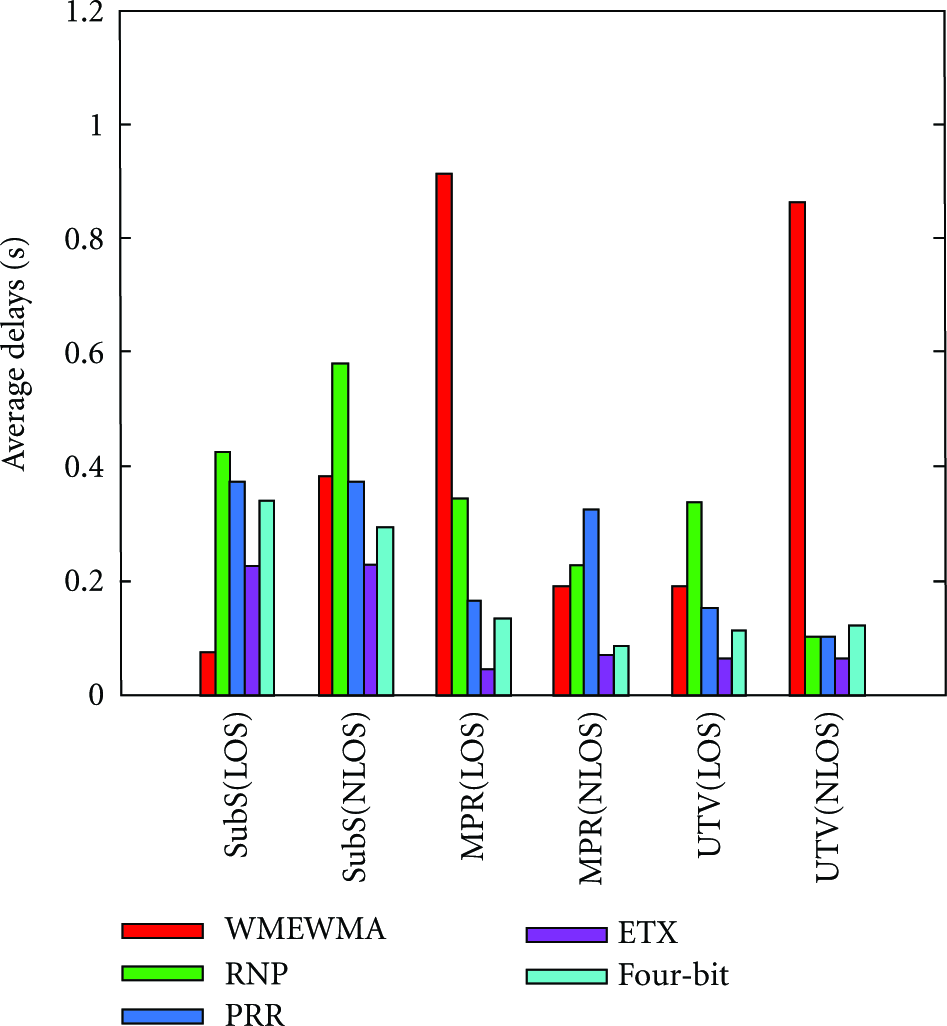
Average delays of the LQEs in different smart grid environments.
Overall, Table 4 shows the comparisons of the link-quality estimators in terms of packet delivery ratio, average number of packet retransmissions, average number of parent changes, average number of hops, and average communication delay. The summary of our performance evaluations can be made as follows.
Our performance evaluations point out that the ETX and four-bit show the best performance in different smart grid environments compared to PRR, RNP, and WMEWMA in terms of packet delivery ratio, and average number of packet retransmissions, average number of parent changes, average communication delay for all smart grid environments. This is because the ETX and four-bit consider the link asymmetry by evaluating uplink and downlink qualities in their estimation methods. Thus, they can quickly react to the changes in link qualities in the network. It is also observed that the RNP usually performs better than the PRR and WMEWMA-based estimators, but it is not as good as ETX or four-bit. In terms of average number of hops, it is observed that the ETX and four-bit tend to choose routing paths, including high quality links and having high number of hops, while constructing the routing paths. Although they select routing paths with high number of hops, they lead to the best performance in terms of packet delivery ratio and delay. Hence, the shortest paths, including low number of hops, may not yield the best performance in multihop wireless sensor networks. Our performance evaluations also show that the WMEWMA may overestimate the wireless link quality, since it does not consider link asymmetries and the number of retransmissions to send a packet successfully.
Overview of performance evaluations of link-quality estimators in smart grid environments.

Good:  Bad:
Bad:  Moderate:
8. Conclusion
Recently, wireless sensor networks (WSNs) have gained great attention from the research community for various smart grid applications, which span a wide range, including remote power grid monitoring and control, automatic meter reading, power outage detection, distribution automation, towers and poles monitoring, line fault and electric fraud detection, and underground cable system monitoring. However, multipath, fading, environmental noise, and obstructions in harsh smart grid environments make reliable communication a challenging task for WSN-based smart grid applications. To overcome varying link conditions in smart grid environments, sensor nodes must be capable of estimating link quality dynamically and reliably.
To address this need, in this paper, the performance of five different link-quality estimation algorithms is investigated for different smart power grid environments, for example, 500 kV outdoor substation, underground network transformer vault, and main power control room. Specifically, the state-of-the-art link-quality estimation methods, such as PRR [25], RNP [25], WMEWMA [27], ETX [28], four-bit [26], have been evaluated in terms of packet delivery ratio, average number of packet retransmissions, average number of parent changes, average number of hops and average delays to better understand the advantages and disadvantages of each link-quality estimation method in different smart grid spectrum environments. In summary, our performance evaluations show that the ETX and four-bit show the best performance in harsh smart grid environments in terms of packet delivery ratio, average number of packet retransmissions, average number of parent changes, average communication delay for all smart grid environments. This is because the ETX and four-bit consider the link asymmetry by evaluating uplink and downlink qualities in their estimation methods. Therefore, they quickly react to the changes in link qualities in the network.
While the performance evaluations in this work provide valuable insights about the performance of link-quality estimators in smart grid environments and guide design decisions and tradeoffs for WSN-based smart grid applications, future work still remains in the area of development of adaptive communication protocols and hybrid link-quality estimators to improve overall network performance in harsh smart grid environments. We expect that this paper will provide a better understanding of the potential applications and research challenges of the WSN-based smart grid applications and motivate the research community to further explore this promising research area.
Footnotes
Acknowledgments
This work was supported by the European Union FP7 Marie Curie International Reintegration Grant (IRG) under Grant PIRG05-GA-2009-249206 with the Research Project entitled “Spectrum-Aware and Reliable Wireless Sensor Networks for Europe's Future Electricity Networks and Power Systems.” The authors also would like to thank Baran Aytaş for his valuable help.