




Abstract
We consider signal transmission with the aid of multiple half-duplex single-antenna relay nodes using the amplify-and-forward (AF) strategy for a multiuser wireless machine-to-machine (M2M) communication system. In such a scenario, relay beamforming has been proved to be an effective way to improve system performance by employing spatial diversity gains. Early works have mostly focused on various centralized relay beamforming schemes based on global channel state information (CSI). Since global CSI is often unavailable due to geometric locations, power limitation, or other constraints of the relay nodes in M2M networks, our work aims to develop distributed algorithms that each relay node individually learns its own beamforming weights with local CSI. We propose two suboptimal relay beamforming schemes that only require local CSI to minimize mean square error (MSE) for all the users with nonorthogonal channels. For multiuser systems with orthogonal channels, we divide the optimization problem into multiple single user problems which then can be solved by each relay independently. Numerical simulations for the proposed algorithms are presented showing the performance of the proposed schemes is close to that of the optimal scheme with global CSI in terms of bit error rate (BER) criterion.
1. Introduction
With the ability to provide reliable transmission and improve the coverage and capacity of wireless networks, cooperative communication using relay beamforming has attracted considerable attention [1]. Multiple cooperative relays can act as a virtual array of transmit antennas to provide spatial multiplexing and hence gain diversity for users. Such kind of relay techniques can be employed in many different communication scenarios. For instance, relays can be placed at the edge of a cell to extend the coverage of the network or at the intersection of adjacent cells for interference coordination [2]. Wireless machine-to-machine (M2M) sensor networks are another possible applications. In these networks, signals can be relayed by one or more relay sensor nodes while they might be attenuated beyond detection by propagation loss if directly targeting the destination sensor nodes, due to the low-power machine devices [3]. Also, the spatial diversity of distributed relays can help to mitigate the effect of fading channels.
Typically, communications with the aid of relay beamforming are implemented in two phases where the relays work in a half-duplex mode. In the first phase, signals are broadcast from source nodes to relay nodes. In the second phase, the relay nodes process the received signals according to relay beamforming strategies and then forward the processed messages to destination nodes. Orthogonal or nonorthogonal transmissions can be used in cooperative communication. In this paper, transmission systems over orthogonal channels are referred to as orthogonal systems, where each source node transmits messages to its destination node through a dedicated orthogonal channel with the help of relays. A practical example of such kind of system is the M2M networks that based on the long-term evolution or long-term evolution-advanced (LTE/LTE-A) system, in which each user receives its signals through an orthogonal frequency-division multiplexing (OFDM) subchannel. Transmission systems over nonorthogonal channels are referred to as nonorthogonal systems, where all users transmit signals simultaneously in a multiple access channel and cause interference to each other. Such kind of multiple access channel system can be realized with time division multiple access (TDMA). Since M2M networks could be connected by various wireless network technologies, we consider both orthogonal and nonorthogonal systems in this paper.
In general, there are broadly three kinds of relay beamforming strategies: amplify-and-forward (AF), compress-and-forward (CF), and decode-and-forward (DF) [4–6]. In the AF strategy, relay nodes receive and amplify the signals transmitted from the source nodes and forward them to the destination nodes. Among the three strategies, the AF strategy is the most attractive one due to its low implementation complexity, which means low cost for the relay node devices and is essentially important for M2M sensor networks with large amounts of distributed relay sensor nodes. In our paper, the AF beamforming strategy is used in relay schemes for M2M sensor networks.
Various research work has been presented to propose AF relay beamforming schemes. To guarantee certain quality of service (QoS), relay beamforming approaches are mostly focused on signal-to-noise ratio (SNR) at the destinations for single user systems or orthogonal multiuser systems and signal-to-interference-plus-noise ratio (SINR) for nonorthogonal multiuser systems. Optimal relay beamforming schemes with relay power constraints are studied in [7, 8], in which algorithms are designed to achieve maximum SNR (MSNR) for a single user system and an orthogonal multiuser system, respectively. In [9], optimal relay beamforming weights for a nonorthogonal multiuser system are found to meet a given set of target SINR at the destinations while minimizing transmission power at the relays. These relay schemes aiming to MSNR or target SINR assume that all the relay nodes can communicate with each other and therefore each relay has global channel state information (CSI), that is, channel coefficients of all the relay nodes. The requirement of global CSI makes the MSNR or target SINR relay beamforming schemes not applicable for M2M sensor networks with a large number of relay nodes, where either the overhead of CSI exchange could be exceedingly high or even CSI exchange among relay nodes might be impossible due to the geographical locations of the relay nodes. It is appealing to derive an algorithm that each relay can learn its own beamforming weights independently based on local CSI without knowing other relays’ channel information. To avoid the need of global CSI, minimum mean square error (MMSE) criterion instead of MSNR or target SINR is considered in [10–12]. In [10], MMSE-based approaches subject to individual power constraints with local CSI are derived for a single user system, which yield suboptimal but effective results. It is also demonstrated in [12] that the MMSE-based distributed implementation of signal detection can guarantee the system performance close to that of joint implementation with global CSI. However, the previous works do not consider the relay networks, such as the M2M networks. As a result, it is expected that the MSE cost function can be used to design the relay beamforming schemes with local CSI for multiuser M2M sensor networks. Thus, in our work, we study the distributed beamforming scheme with multiple relay nodes. The MSE cost function instead of the SNR or SINR cost function is considered for relay beamforming schemes. We aim at developing efficient distributed relay beamforming algorithms with local CSI that minimize the sum MSE of all users for a multiuser wireless M2M network using the AF strategy. We define MMSE as the minimum of sum MSE of all users in this paper, and, therefore, the relay beamforming schemes studied in our work are also referred to as the MMSE-based relay beamforming schemes.
The rest of the paper is organized as follows. In Section 2, the system model for relay assisted multiuser M2M networks is presented. In Section 3, we study the relay beamforming schemes with local CSI that minimizes the sum MSE of all users in nonorthogonal systems. Relay beamforming schemes for orthogonal systems are discussed in Section 4. In Section 5, simulation results under various conditions are presented. Conclusion of the paper can be found in Section 6.
Notations
Bold lower letters are used for vectors, for example,
2. System Model
Consider an AF relay assisted wireless M2M network, consisting of L pairs of source-destination user nodes and K relay nodes. All the users and the relays are equipped with only one antenna. As discussed in Section 1, relays operate in a half-duplex mode, that is, they cannot receive and transmit at the same time. The communication is implemented in two phases. Assume there is no direct link between any source node and destination node. In this paper, we consider both orthogonal and nonorthogonal systems. In orthogonal system, each user-destination pair takes up one orthogonal subchannel and the relay nodes design different sets of beamforming weights for different users. In nonorthogonal systems, each user causes interference to the other users in the same system, and only one set of beamforming weights are designed for all the users to cooperatively transmit all the signals to the destination nodes on the same frequency band. In addition, both cases face the relay power transmission constraints. The system model is depicted in Figure 1.

AF multiuser multirelay M2M communication system model.
Let
As in most research work, in this paper, all the channels are assumed to be independent, with a Rayleigh flat fading distribution expressed as
2.1. Nonorthogonal Channel Scenario
If the channels are nonorthogonal, the received signals at the relays in the first phase can be written as

where
The relays then process the received signals with complex beamforming weights. Define a row vector

In the second phase, the relays broadcast the processed signals to all the destination nodes simultaneously. The channels between relay nodes and destination nodes are also nonorthogonal. As a result, the received signal at the ith destination node is given by

2.2. Orthogonal Channel Scenario
In the case of orthogonal channels, relays can separate the messages sent from different users. For user l, the received signal at the relays can be written as

where
The relays design different sets of complex beamforming weights for different users. Define a row vector

In the second phase, the relay nodes simultaneously broadcast the processed signals to all the destination nodes. The transmission to each destination node is carried out over orthogonal channels to avoid interuser interference. Thus, the received signal at the lth destination node is given by

It can be seen from the above that the goal of relay beamforming schemes for nonorthogonal systems is to design a set of
As mentioned in Section 1, the aim of this paper is to develop distributed algorithms using local CSI instead of full global CSI. In the discussed system, local CSI for relay i is referred to as incoming channel coefficients
3. MMSE-Based Distributed Beamforming for Nonorthogonal Systems
In this section, we are interested in choosing a beamforming weight vector that minimizes the sum of the mean square error between the uncorrupted received signals at the destination nodes and the transmitted signals at the source nodes for nonorthogonal systems. The optimization problem is first formulated and then two suboptimal ways to obtain beamforming weights from the original problem using local CSI are put forward.
3.1. MMSE Optimization Problem Formulation
The uncorrupted received signal at the ith destination node is

The sum of the MSE of all the source and destination pairs is given by

Transmission power limitation of the relay sensor nodes needs to be taken into consideration in wireless M2M networks. The transmission power of each relay node is constrained within the maximum power capacity denoted by

where
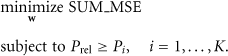
To obtain the best performance for the system, we design a beamforming scheme that generates the smallest sum of MSE. Thus, the optimization problem can be formulated as an MMSE problem subject to individual relay transmission power constraints and is expressed as
To solve the optimization problem, we first introduce the Lagrangian of the problem

where
The Lagrangian dual function is defined as

The dual problem is to maximize


Due to the symmetry of

where
Note that

where
3.2. MSE Minimization Suboptimal Algorithm
In this part, we are dedicated to find the suboptimal beamforming weights assuming that each relay only has local CSI and there is no information exchange between the relays. Below, we propose two suboptimal approaches to deal with the lack of global CSI.
3.2.1. Suboptimal Algorithm 1
First, in (17), we can see that it does not involve channel information from other relays except for the second term of the numerator. It can also be seen from (14) that

Substitute (18) into (14), and

When

In this case, the relay node does not need to turn to the maximum transmission power. To let

With the inequality

When the right term of (22) is less than 1, (21) is satisfied. It means that if the channel gains between the relay nodes and the destination nodes are strong enough, that is,
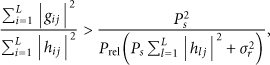
the relays do not need to transmit the maximum power. This result is similar to that in single user systems [10]. However, if
By ignoring other relays’ CSI, the above algorithm allows each relay to calculate its own beamforming weight independently. Simulation results show that this suboptimal approach can give satisfactory performance which is very close to the optimal approach.
3.2.2. Suboptimal Algorithm 2
Second, instead of ignoring other relays’ channel coefficients, we may substitute them with appropriate approximations. In [10], it assumes symmetric conditions for all the channels in a single user system, that is, it uses the corresponding local CSI statistics as approximations of the unknown global CSI. Here, we extent this idea to our multiuser system. As shown in (17), relay node j still needs to know

Reformulate the above equation, and the suboptimal solution of relay j's beamforming weight is given by

As discussed in the Suboptimal Algorithm 1, substitute (25) into the power constraint of (14). The Lagrangian multiplier

Similar to Suboptimal Algorithm 1, if

then
As can be seen, both of the proposed suboptimal algorithms only require local CSI.
4. MMSE Beamforming for Orthogonal Systems
In this section, we develop distributed relay beamforming algorithms for a different multiuser system where each user transmits signals through orthogonal channels. In this scenario, the sum of MSE criterion is also considered to design the beamforming weights. The optimization problem is first established and then we will show the optimization problem can be divided into several single user problems.
4.1. Optimization Problem Formulation
The uncorrupted received signal at the ith destination node is

The sum of MSE of all the source nodes and destination nodes is given by

Similar to that in nonorthogonal channel systems, power constraints of the relay sensor nodes also need to be taken into consideration. The transmission power of each relay is constrained within the maximum power denoted by

where
Then the optimization problem can be formulated as

4.2. Suboptimal Algorithms for Orthogonal Scenarios
In orthogonal systems, each relay needs to learn L weights for L users. To learn the beamforming weights independently by relay nodes, we can establish the Lagrangian function as in the nonorthogonal cases,

The optimal solution

where
For relay i, it needs to decide the value of
Substituting the suboptimal
Also, note that the transmissions through orthogonal channels make the minimization of sum MSE without power constraints equivalent to each user minimizing its own MSE with its beamforming vector. By preallocating the total relay transmission power capacity to each user, the original problem can be decoupled into L single user beamforming problems expressed as

where
5. Simulation Results
In this section, we present numerical results for the proposed algorithms. It is assumed that all the channel coefficients are generated as zero-mean and unit-variance independent complex Gaussian random variables. Noise variances at the relays and the destinations are set to be the same as
Figures 2, 3, and 4 show the performance of Suboptimal Algorithm 1 in nonorthogonal systems. Figure 2 shows the BER performance over the level of SNR with different number of relays deployed in a three-user system. It is clearly that increasing the number of relays improves the system performance as expected because of the benefit of diversity gain. In Figure 3, BER performance is depicted when the number of users increases under different source transmission power. It shows that the number of users can have a great impact on the system performance. Although the source transmission power increases, the BER performance still degrades a lot with six or more users in the system. This is reasonable for that in nonorthogonal systems each user causes interference to the others and it needs sufficient relay nodes to provide a stronger beamforming to cancel out the interference for all the users at the same time. Thus, the same performance could be maintained for a larger number of users by increasing the number of relay nodes. Wireless M2M networks can deploy large numbers of low-cost relay nodes or allow some user nodes to act as relays to guarantee communication quality.
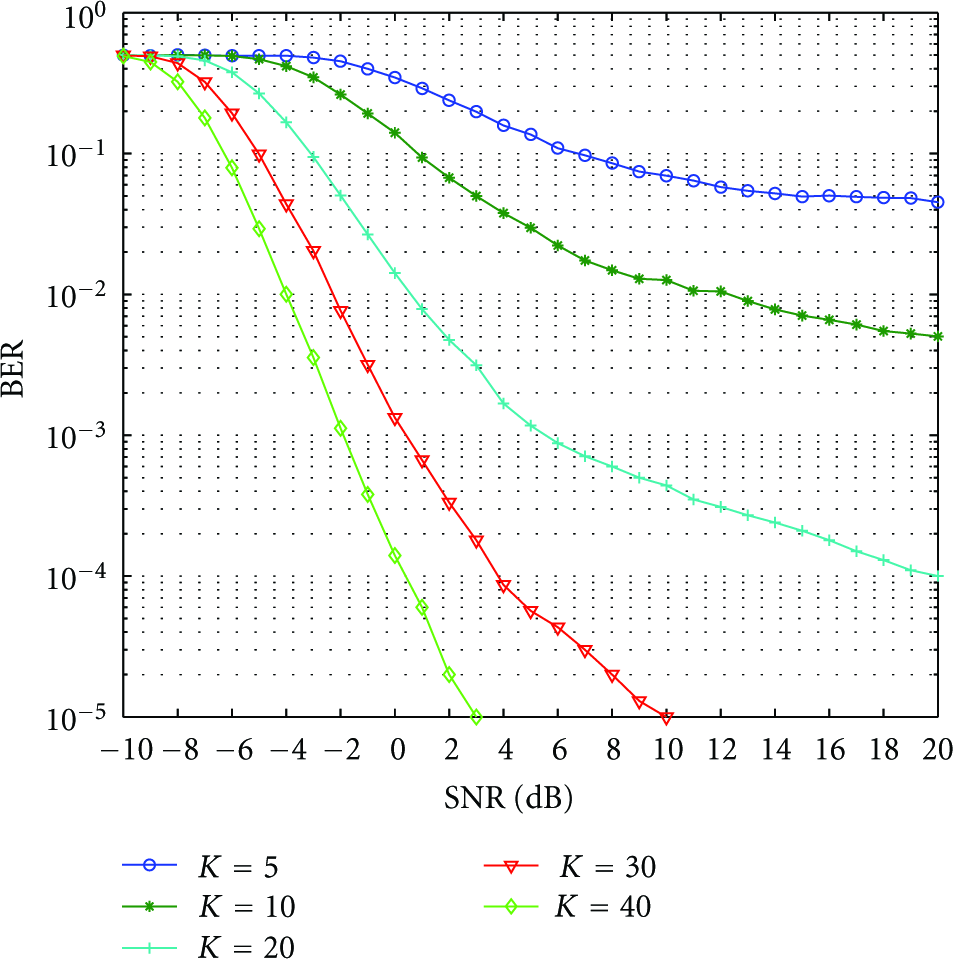
BER performance versus source transmission power with different number of relays in a 3 user nonorthogonal system.

BER performance versus the number of users for different values of SNR with 20 relays in nonorthogonal system.

BER performance versus relay power constraint for different relays in nonorthogonal system.
Figure 4 shows the BER performance versus different relay power constraints when different number of relays are deployed. Relay SNR is defined as the relay maximum power with relay noise
Figure 5 shows the performance in orthogonal channel systems. In Figure 5, we consider both cases where the relay power is equally allocated to all the users and optimized based on lagrange multipliers, with lines labeled as Eq and Ineq, respectively. Also, we compare the proposed schemes with the one based on MSNR criterion using global CSI proposed in [8] labeled as MSNR in Figure 5. It can be seen that the scheme optimizing the relay power allocation to different users have better performance than that with equal allocation. It is also clear that the performance of both schemes is close to that of [8]. Since users are not interfered with each other, BER performance is slightly affected by the number of users. However, as the number of users grows, the relay transmission capacity for each user decreases and ends in performance degradation. Compare Figure 5 with Figure 2, and it can be seen that the performance of orthogonal system is better than the nonorthogonal system at the cost of more frequency resource.

BER performance versus source transmission power for orthogonal system.
Figure 6 compares the optimal results using global CSI with that of the Suboptimal Algorithm 1 and Suboptimal Algorithm 2 in nonorthogonal systems. The schemes using global CSI are proposed in [9, 13], based on MSNR and MMSE criterion, and labeled as joint MSNR and joint MMSE, respectively. It can be seen that the performance of Suboptimal Algorithm 1 is very close to the optimal performance. As the number of relays increases, the difference becomes larger but remains acceptable. Suboptimal Algorithm 2 gives quite good approximates when the number of relays is small. The instantaneous global CSI estimated with local CSI gets less accurate as the number grows, and hence degrades the performance of Suboptimal Algorithm 2.
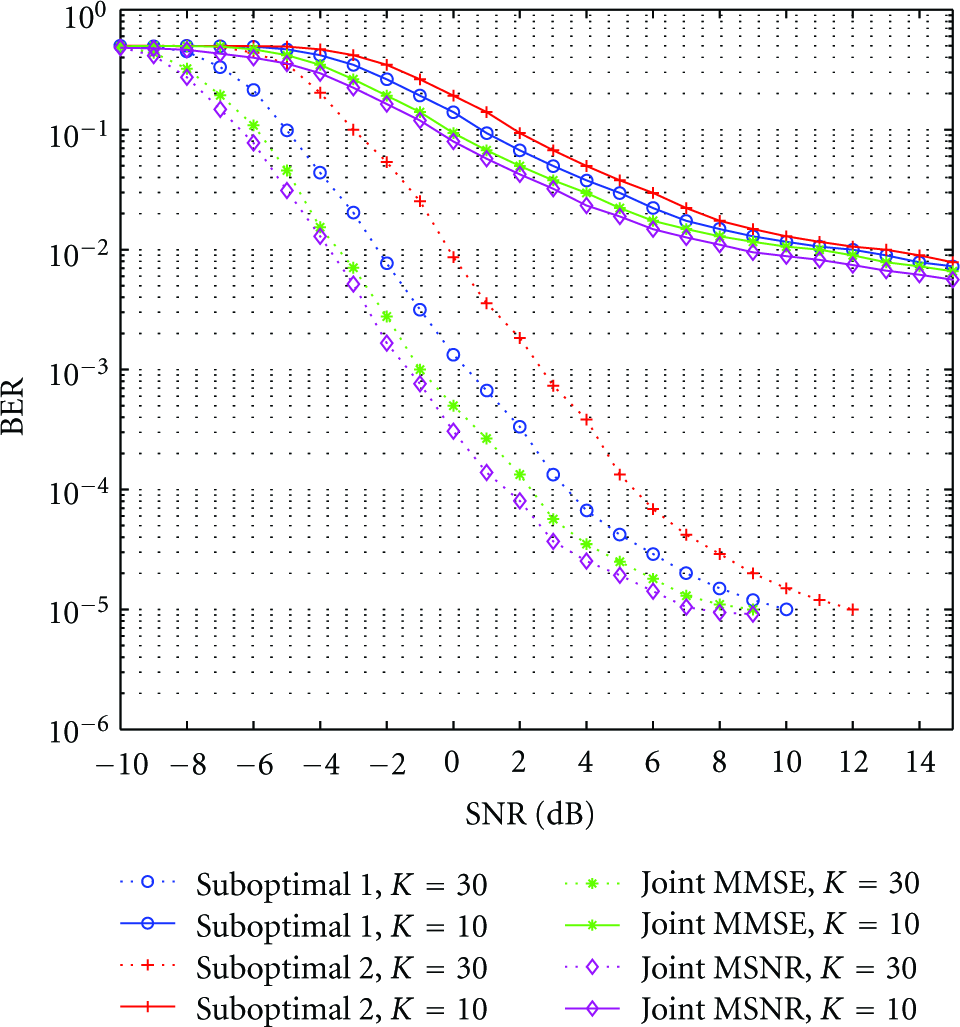
BER performance comparison for nonorthogonal system.
6. Conclusion
In this paper, we considered distributed relay beamforming schemes with local CSI for AF multiuser multirelay M2M networks with orthogonal channels and nonorthogonal channels based on MMSE criterion. In nonorthogonal systems, two approximate approaches were provided where each relay could learn its own weight independently and respectively with local CSI. Simulation results showed that the performance of the proposed algorithm was close to the optimal one using global CSI. In orthogonal systems, the optimization problem was separated into single user problems which then could be solved with distributed algorithms. Simulation results were presented in the end of the paper to show the BER performance of the proposed relay beamforming schemes.
Footnotes
Acknowledgment
This work has been supported by the National Basic Research Program of China (973 Program no. 2009CB320403).