




Abstract
To mitigate the performance degradation induced by the cell outage, in this paper, a centralized cell outage compensation management mechanism and the corresponding workflow are proposed. Then a concrete algorithm named autonomic particle swarm compensation algorithm (APSCA) is proposed to generate the compensation scheme. The simulation results show that the proposed APSCA is effective to resolve the coverage problems induced by the outage. In the simulation scenario, almost 98.3% users that would otherwise be dropped will be served by the surrounding cells, and the block probabilities of the compensating cells are still kept on the accepted levels.
1. Introduction
Self-healing is one of the functionalities of self-organizing network (SON). The purpose of self-healing is to solve or mitigate the faults which could be solved automatically by triggering appropriate recovery actions [1]. Cell outage Management (COM) is the main task of self-healing. COM includes several phases, such as cell outage detection (COD) and cell outage compensation (COC) [2, 3]. Cell outage is the total loss of radio services in the coverage area of a cell. There are diverse reasons for the cell outage, including
system hardware or software failures (e.g., circuit pack failure, channel processing error, or configuration error, etc.),
transmission problems (e.g., connectivity failure, optical cable failure, etc.),
external failures (e.g., power supply outage, lightning strike, etc.).
In practical network, some outage causes can be detected by the network itself. In such cases, alarms will be sent to the operation, administration, and maintenance (OAM) system or operators. Some causes can be detected by OAM through analyzing performance counters or other measurement data. Also some causes cannot be detected by network or OAM directly in real time. In such cases, automatic cell outage detection is needed to derive the probability of an outage [4]. The aim of COD is to automatically detect the occurrence, type, and scope of an outage.
When a cell is in the outage, the coverage gap is induced, and almost all the users cannot establish or maintain the radio bearers via that particular cell. The aim of COC is to mitigate the performance degradation induced by the outage to the utmost extent by automatically adjusting the related radio parameters of the neighboring cells. Adjusting such parameters may influence the users served by those cells, and the performance may be degraded in those cells, such as throughput decrease and interference increase. The trade-off between the coverage/capacity gain of outage cell and the performance degradation of the surrounding cells should be considered and achieved. The design of COC mechanism and algorithm is extremely necessary to meet the coverage, capacity, and quality requirements based on the operator's compensation policy.
In this paper, we mainly focus on the COC under the precondition that cell outage has already been detected. Firstly, a centralized COC management mechanism and the corresponding workflow are proposed. Then a concrete algorithm named autonomic particle swarm compensation algorithm (APSCA) is proposed to generate the parameter adjustment scheme. APSCA is used to compensate the coverage gap induced by the outage while considering the balance between coverage/capacity and quality. At last, the achieved performance effects are evaluated.
The rest of this paper is organized as follows. Section 2 introduces the related works about COC. Section 3 proposes the centralized COC management mechanism and corresponding workflow. In Section 4, the COC algorithm APSCA is described and the complexity is analyzed, followed by the simulation results and discussion in Section 5. The paper is concluded in Section 6, where we conclude the current work and present a prospect of the future work.
2. Related Works
In 3GPP TS 32.541 [1], the general steps of automatic cell outage recovery and cell outage compensation are presented, but no any concrete COC algorithm is presented. The network parameters that can be adjusted by COC include cell reference signal transmission power
In paper [7], an automated coverage optimization algorithm is proposed to optimize wireless downlink coverage in the RAN. However, the algorithm is based on the long-term measurements and analysis which is suitable for the normal network optimization scenario, but not suitable for the real-time cell outage compensation scenario. In papers [8–11], the algorithms, respectively, adjusting pilot power, target received power density, or antenna tilt of the surrounding cells to compensate the coverage gap are proposed. But these algorithms are all based on the stepwise adjustment methods in which the control parameters are consecutively adjusted step by step. After each step the system performance should be evaluated and then go to the next adjustment step until the compensation objective is reached. The convergence speed of those stepwise adjustment algorithms is comparatively fast, but the interim parameters may not be suitable and will usually bring instability to the system.
In this paper, we present a framework for centralized COC management mechanism and propose a heuristic COC algorithm for LTE networks, which is named Autonomic Particle Swarm Compensation Algorithm (APSCA). By APSCA, the final optimal parameter adjustment scheme can be automatically generated by the centralized node. APSCA can overcome shortcomings of the previous work, and the convergence speed is rapid enough to meet the real-time requirements of COC.
3. Centralized COC Management Mechanism
When a cell is out of the service, the control parameters of the surrounding cells need be adjusted to implement the coverage compensation and guarantee the quality of network service. Several factors should be considered when adjusting the control parameters, such as traffic load, amount of users, interference, downlink reference signal transmission power, uplink target received power, and antenna patterns. If the distributed COC management framework is adopted, large numbers of data need be exchanged among different eNodeBs, which will greatly increase the complexity of the COC algorithm and the difficulty of the implementation. As such, a centralized COC management framework is proposed in the paper. In the framework, it is the responsibility of OAM to collect and process all kinds of data and generate the final adjustment scheme. The centralized framework is more suitable for COC features.
To realize the COC management, a closed control loop is designed, which is shown in Figure 1.

Centralized COC management framework.
The COC closed control loop, including monitor, analysis, plan, enforcement, and evaluation functionalities, is located in the OAM node, and the managed elements (eNodeBs in LTE networks) communicate with OAM through the management interface. There are two kinds of data exchanged through the management interface for COC. On one hand, eNodeBs report necessary measurement data to the OAM, and on the other hand, OAM delivers the control parameter adjustment request to the specified eNodeBs.
The workflow of the centralized COC management is illustrated in Figure 2.

Workflow of centralized COC management.
The steps of the workflow are described as follows.
Monitor function continuously collects the necessary data from eNodeB, UE, and OAM to determine the cell outage and the conditions of COC. The necessary data can be alarms, event notifications, KPIs, counters, and other measurement data. In [2, 6], a list of major data is presented.
For cell outage detection, measurement data mentioned above is considered to determine whether an outage has occurred. As cell outage detection is not a major concern of this paper, there is no detailed discussion about it. For more information, please refer to [4]. If the cell outage is detected, then go to step 3 else continue step (1).
When the cell outage is detected, the COC specified measurements will be triggered. Monitor function gathers more necessary information from UEs and eNodeBs in LTE, such as configuration, performance, and measurement data. Compared with the data monitored in step (1), these data are more detailed and particular.
Analysis function analyzes and diagnoses above information and makes a conclusion.
If the conclusion shows that the problem can be directly recovered, then go to step (6); else go to step (7).
The network elements directly recover the problem which is not discussed in this paper. When the recovery action is finished, then go to step (9).
To mitigate the influence of the cell outage and guarantee the QoS of users, COC will be triggered to take appropriate actions. A COC scheme generation algorithm named Autonomic Particle Swarm Compensation Algorithm (APSCA) is proposed, which will be discussed in detail in Section 4.
After the COC scheme is generated, the enforcement function executes the COC scheme by delivering the parameter adjustment request to the specified eNodeBs. It should be noted that it is the eNodeBs that really adjust the control parameters according to the request.
After recovery or COC, the evaluation function begins to assess the performance improvement brought by the recovery or COC. It is necessary to clarify the criteria to evaluate to what extent the compensation actions have reached in meeting the optimization goals. The COC evaluation criteria are given in Section 4.1.
If the problems are recovered or the COC meets the requirements, then go to step (12), else go to step (11).
If the problems are not recovered, then execute the rollback process when required.
Report the COC enforcement result. OAM can record the necessary information according to the requirements. Then go to step (1) to continue monitoring the related data.
4. COC Algorithm
4.1. Coverage Evaluation Criteria
In LTE networks, the coverage effect can be evaluated by reference signal received power (RSRP) and reference signal received quality (RSRQ) measured by mobile users. The objective reference values of effective coverage of TD-LTE macrocell are as follows: firstly, the probability that the RSRP received by mobile users from the serving cell is stronger than RSRPminTh should exceed RSRPminRate; secondly, the probability that the RSRQ received by mobile users from the serving cell is stronger than RSRQminTh should exceed RSRQminRate.
Coverage problems can be represented as coverage gap and pilot pollution. In TD-LTE network, the coverage gap is defined as the area where RSRP < RSRPgapTh, and the pilot pollution is defined by two criteria:
number of cells whose RSRP > RSRPpolTh exceeds K, and,
the strongest RSRP−the Kth strongest RSRP ≤ R.
According to the practical network, the typical values of the above criteria are chosen as in Table 1.
Coverage evaluation criteria.

4.2. Model of COC Problem
In this paper, the cell reference signal transmission power
Assume that outage cell is
Minimize the Coverage Gap
The optimization objective can be described by the following expression:

where
(2) Minimize the Pilot Pollution
The optimization objective can be described by the following expression:

When the dominant pilots received by the user exceed K (see Table 1), expressed as
According to the expressions (1) and (2), the optimization problem is a multiobjective nonlinear optimization problem. In the paper, an Autonomic Particle Swarm Compensation Algorithm (APSCA) is proposed to solve it. APSCA is suitable for multiobjective optimization problems and especially suitable for COC scenario because of the high speed of convergence.
4.3. APSCA Description
In APSCA, the surrounding cells are regarded as particle swarm. To find the optimal reference signal transmission powers of surrounding cells is equivalent to finding the optimal positions of particle swarm. Suppose the particle swarm includes m particles. APSCA defines each particle in the D-dimensional space. The location and velocity of the particles are, respectively, denoted as vector
Before finding the best position, the particles update their velocity and position according to the following formulae:


where w is the constant inertia factor,
The process of APSCA is described in Algorithm1.
– Initialize number of particles, dimension of particle, maximum iterations, objective optimization criteria, Initialize Initialize
Initialize
Update Update Evaluate the fitness of current Update criteria is reached.
4.4. Complexity Analysis of APSCA
According to the paper [12], the APSCA is convergent if the algorithm parameters
In APSCA, the number of particles in the swarm is m which denotes the number of surrounding cells, and the dimension of each particle is D. The time complexity of APSCA is calculated as follows.
The time complexity of initialization is
In each iteration, the time complexity to update the location and velocity for all particles is
In each iteration, the time complexity to calculate the fitness function is
In each iteration, the time complexity to update the optimal particle is
In each iteration, the time complexity to update the global optimal particle swarm is
Suppose the iteration times is N; then the total time complexity is represented as
Based on the previous analysis, the time efficiency of the algorithm is high. The APSCA is suitable for the centralized COC management scenario.
5. Simulation and Discussion
The compensation effect of the APSCA is validated in the TD-LTE scenario using Qualnet and Matlab. The simulation shows APSCA can effectively solve the coverage problem induced by cell outage while the performance degradation of compensating cells can be kept on the accepted levels.
5.1. Simulation Parameters Configuration
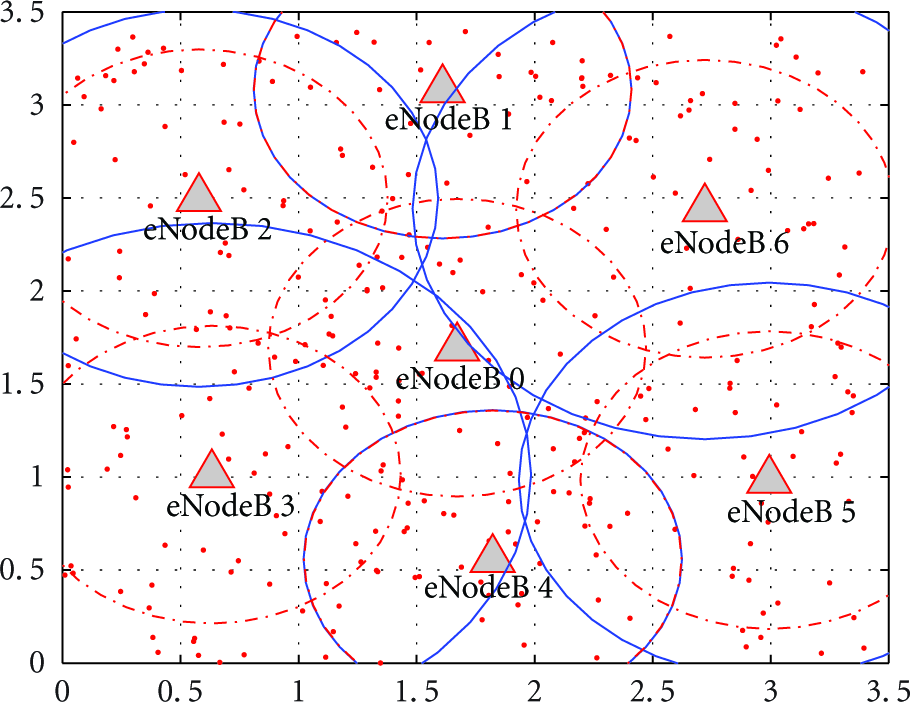
The simulation scenario is a TD-LTE urban macrocell region of 3.5 km × 3.5 km. Top view of simulation environment is shown in Figure 3. In the simulation scenario, there are 7 eNodeBs with space about 500 m and about 300 users randomly scattered in the area which are not totally shown in the figure.

Simulation scenario.
Refer to [13]; the key simulation system parameters are configured as Table 2.
Key simulation system parameters.

5.2. Simulation Results and Discussion
Assume that eNodeB0 (and the corresponding cell
Compensation results.
By calculating the simulation data, we can learn that almost 98.3% of the coverage area of the cell
The coverage gains of the outage cell and the performance degradation of the surrounding cells induced by compensation will be discussed in detail.
Coverage Gains Analysis
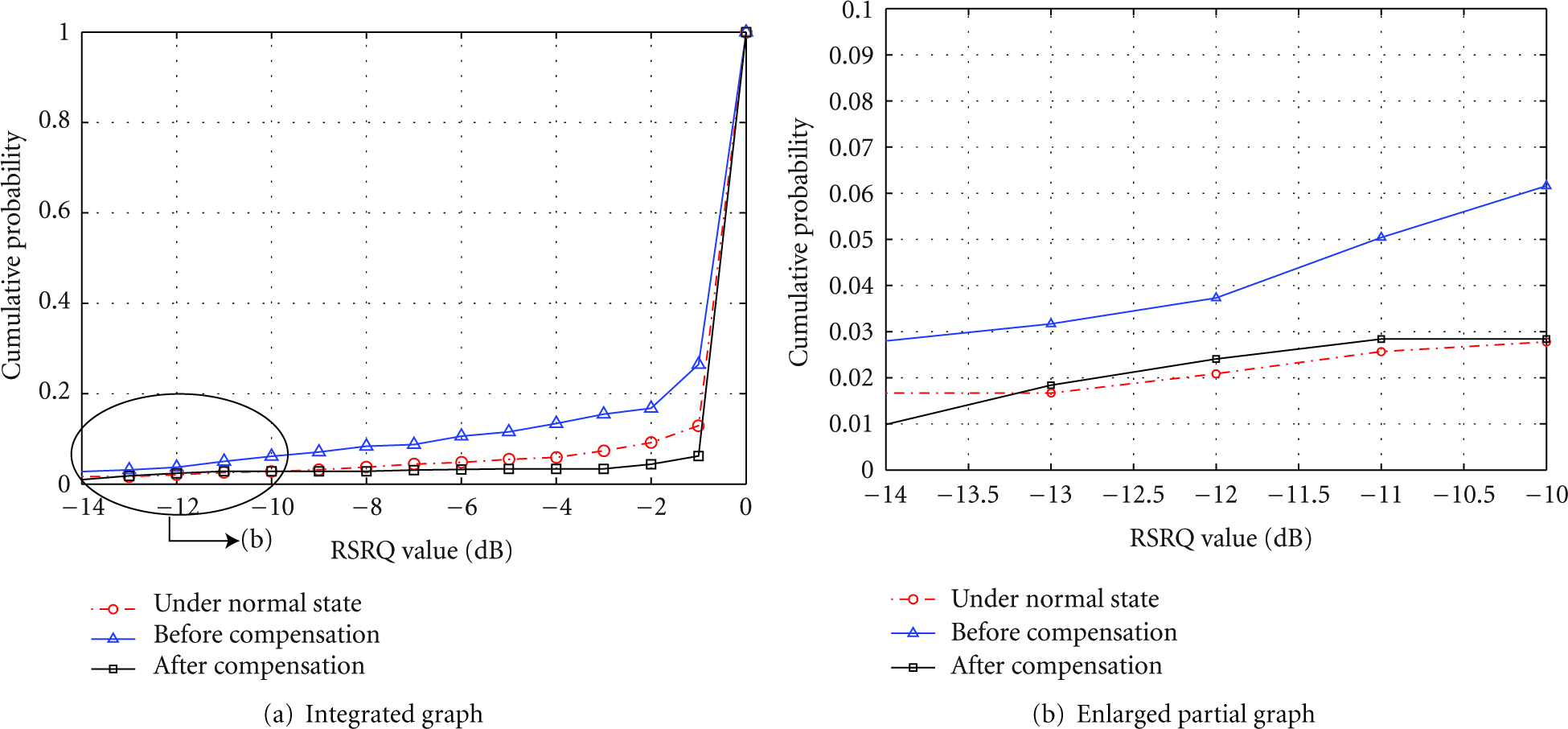
On one hand, from the viewpoint of the users in the outage cell, the received RSRP/RSRQ and their cumulative probabilities are shown in Figures 5 and 6,respectively.

RSRP and cumulative probability of outage cell.
RSRQ and cumulative probability of outage cell.
As illustrated in Figure 5(a), compensation brings obvious coverage gains, especially for the weak coverage. As illustrated in Figure 5(b), before compensation, the cumulative probability that RSRP is lower than RSRPminTh (−105 dBm) exceeds 10% which is far worse than the objective reference value of effective coverage. After compensation, the cumulative probability that RSRP is lower than RSRPminTh (−105 dBm) equals to 3.9% which is within the scope of effective coverage.
Furthermore, according to Figure 5(b), when the RSRP is below −105 dBm, the cumulative probability after compensation is lower than that of normal state, which means compensation is effective in decreasing the probability of weak coverage.
As illustrated in Figures 6(a) and 6(b), after compensation, the cumulative probability that RSRQ is stronger than −13.8 dB is 98.2%, which is within the scope of effective coverage, and is 11.33% higher than that of before compensation.
Figures 5 and 6 show that APSCA can effectively solve the coverage problems induced by cell outage.
(2) Performance Impact Analysis
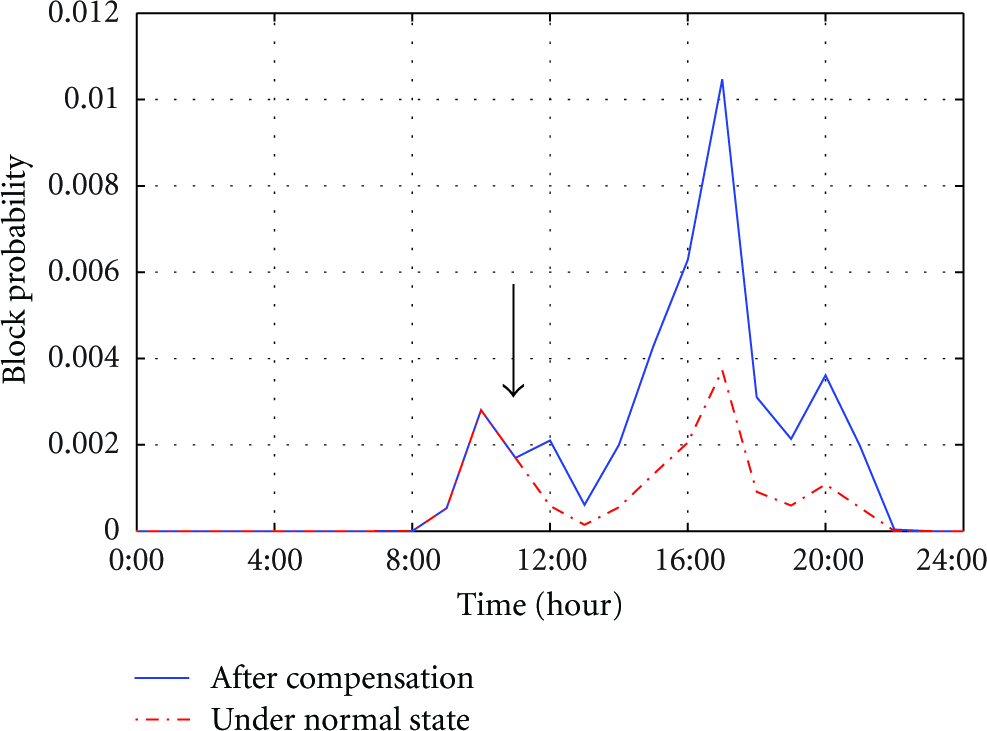
On the other hand, from the viewpoint of users in the compensating cells, the service block probability can reflect the performance impact induced by compensation in some degrees. So we choose the cell
As shown in Figure 7, the cell
Service block probability of compensation cell.
6. Conclusion
To mitigate the performance degradation induced by the cell outage, a centralized cell outage compensation management mechanism and a concrete compensation scheme generation algorithm named APSCA are proposed in the paper. Simulation results show that the APSCA is effective in compensating the coverage problem induced by cell outage while the performance degradation of the compensating cells can be kept on the accepted levels.
Our future work will focus on the following three steps. First, we will investigate how to adjust other control parameters, such as antenna parameter and uplink target received power, to compensate the outage, and analyze which kind of parameters are more suitable for effective compensation in different scenarios. Second, the relations among these control parameters will be studied, and cooperative adjustment scheme generation algorithm will be designed. Lastly, more factors, such as load, interference and services, will be taken into consideration when designing the COC mechanism and algorithm.
Footnotes
Acknowledgments
This research is supported by the Funds for Creative Research Groups of China (61121061), National S&T Major Projects (2011ZX03003-002-01), NCET-10-0240, and Chinese Universities Scientific Fund (BUPT2012RC0608).