




Abstract
This paper reports a numerical study on natural convection from a protruding heater located at the bottom of a square cavity filled with a copper-water nanofluid. The vertical walls of the cavity are cooled isothermally; the horizontal ones are adiabatic, and the heater is attached to the bottom wall. The heat source is assumed either to be isothermal or to have a constant heat flux. The effective viscosity and thermal conductivity of the nanofluid are modeled according to Brinkman and Patel, respectively. Numerical solutions of the full-governing equations, based on the lattice Boltzmann method, are obtained for a wide range of the governing parameters: the Rayleigh number, Ra; the Prandtl number, Pr; the geometrical parameters specifying the heater; the volume fraction of nanoparticles, Φ. For a particular geometry, it has been found that, for a given Ra, heat transfer is enhanced with increasing Φ, independently of the thermal boundary condition applied on the heater.
1. Introduction
The convection of nanofluids, which are a mixture of nanoparticles in a base fluid [1], has recently been an active field of research, because of reports of greatly enhanced thermal properties. Compared with other techniques for enhancing heat transfer in practical applications, nanofluids have the advantage of behaving like pure fluids, because of the small size of nanoparticles. As a result, the possibility of using them as heat transfer fluids for various applications, such as advanced nuclear systems or microchannel and minichannel heat sinks, is currently under consideration.
A review of the literature (see, e.g., Godson et al. [2]) indicates that most studies on this topic are concerned mainly with forced convection applications, but relatively little attention has been devoted to the natural convection of nanofluids. The first study on the natural convection of a nanofluid confined in a differentially heated enclosure seems to be that of Khanafer et al. [3]. The same problem was considered by Jou and Tzeng [4]. The Khanafer et al. model was used to investigate convective heat transfer enhancement in rectangular enclosures filled with an Al2O3-water nanofluid. It was reported that increasing the buoyancy parameter and volume fraction causes an increase in the average heat transfer coefficient. Heat transfer in nanofluids by natural convection in a square cavity heated isothermally from the vertical sides has been investigated numerically by Ho et al. [5] and Santra et al. [6]. Two different formulas have been considered by Ho et al. [5], for the effective viscosity, and thermal conductivity of the nanofluids, while the Ostwald-de Waele model for a non-Newtonian shear-thinning fluid has been used by Santra et al. [6] to calculate the shear stress. It was found that the uncertainties associated with the various expressions adopted to model nanofluids have a major influence on the characteristics of heat transfer by natural convection in the enclosure. Heat transfer enhancement in a differentially heated enclosure using the variable thermal conductivity and variable viscosity of Al2O3-water and Cu-water nanofluids has been investigated numerically by Abu-Nada et al. [7]. The impact of both variable viscosity and variable thermal conductivity, derived from experimental data, has been studied. It was observed that, at high Rayleigh numbers, the Nusselt number is more sensitive to viscosity models than to thermal conductivity models. Numerical study of natural convection in partially heated rectangular enclosures has been performed by Abu-Nada et al. [8]. Different types of nanoparticles were tested. They found that the heater location affects the flow and temperature fields when nanofluids are used. The same configuration was considered recently by Ghasemi and Aminossadati [9] for the case of an oscillating heat source embedded on the vertical wall of the enclosure. Recently, Alloui et al. [10] investigated natural convection, both analytically and numerically, in a shallow rectangular cavity filled with nanofluids. The critical Rayleigh number for the onset of supercritical convection of nanofluids is predicted explicitly by these authors. Also, results are obtained from the analytical model for finite amplitude convection for which the flow and heat transfer are presented in terms of the governing parameters of the problem.
Natural convection heat transfer in partially divided cavities filled with ordinary fluids has been the subject of many studies in the past, because of its importance in many engineering fields. Applications include thermal control of electric components, nuclear reactors, and so forth. Moukalled and Acharya [11] and Moukalled and Darwish [12] numerically investigated buoyancy-induced heat transfer in partially divided trapezoidal cavities representing attic spaces. The effects of the Rayleigh number, baffle height, and baffle location on heat transfer were discussed for various thermal boundary conditions. An experimental investigation concerning laminar convection in a box, with differentially heated end walls, which is divided by a barrier into two connected chambers, was carried out by Coman et al. [13]. They found that heat transfer diminishes rapidly when the barrier is high and also that it changes little when the lateral position of the barrier varies. Oztop and Bilgen [14] studied heat transfer numerically in a differentially heated and partitioned square cavity containing heat-generating fluid. It was found that the flow field and heat transfer are modified considerably with partial dividers. Natural convection heat transfer from a protruding heater located in a triangular enclosure has been analyzed numerically by Varol et al. [15]. They reported that, in order to obtain better heat removal, the heater must be located at the center of the bottom wall. The same problem was considered by AlAmiri et al. [16] for the case of a square cavity. Their investigation revealed that, as well as location, increasing the height and width of the heater results in the enhancement of heat transfer owing to the increase in the surface area of the heater. All the above investigations are concerned only with partially divided enclosures filled with ordinary fluids. To the author's knowledge, the influence of nanofluids on this flow configuration has not yet been studied.
In our investigation here, we consider natural convection in a square enclosure with a protruding heater subjected to various thermal boundary conditions. A numerical study is carried out to predict the effect of the location and dimension of the heat source on the flow and temperature fields in a cavity filled with a Cu-water nanofluid. The paper is organized as follows. The formulation of the problem and the numerical method are presented in Sections 2 and 3, respectively. In Section 4, the results obtained for the flow and heat transfer are discussed in terms of the geometry of the system. The final last section presents some concluding remarks related to optimum heat transfer enhancement based on the nanoparticle volume fraction, the length and the width of the enclosure, the Rayleigh number, and the location of the protruding heater.
2. Mathematical Formulation
Figure 1(a) schematically represents the flow configuration with a coordinate system. The square enclosure is of height H′. The vertical walls of the enclosure are cooled isothermally, at temperature
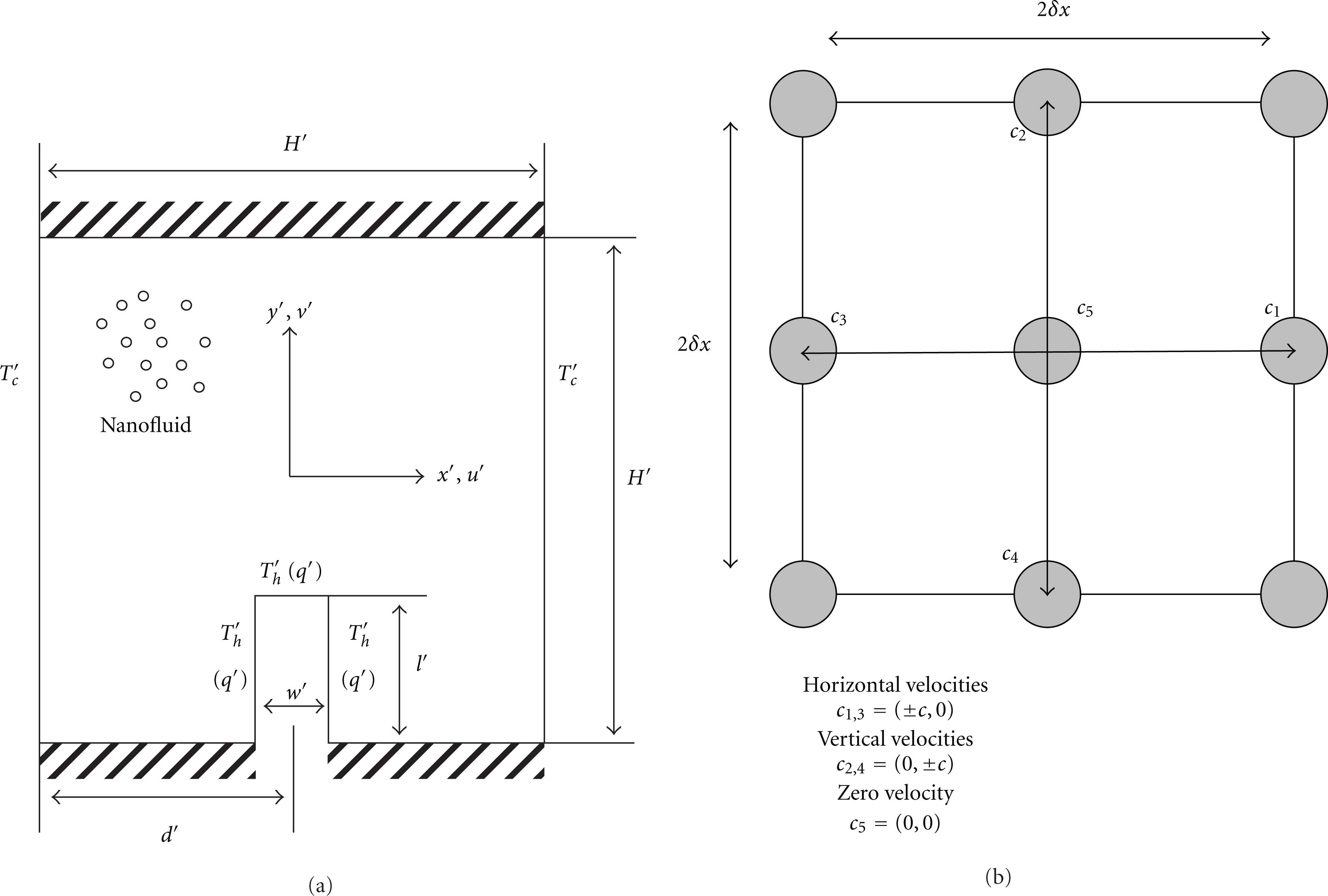
(a) Schematic diagram for physical model with coordinate system. (b) Diagram of the discrete D2Q5 phase space.
The governing macroscopic equations that describe the system behavior are those of conservation of mass, momentum, and energy, which are given as

in terms of stream function Ψ′, vorticity ω′, and temperature T′. As usual, in order to satisfy the continuity equation, the stream function Ψ′ is defined such that
The appropriate boundary conditions applied on the walls of the cavity are

On the heater walls, the hydrodynamic boundary conditions are given by

while the two following thermal boundary conditions are considered:
a constant temperature

a constant heat flux q′, such that
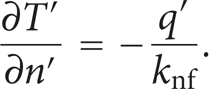
In these equations, n′ represents the normal to the heater walls, and the constant knf is the characteristic thermal conductivity of the fluid considered.
The effective density of the nanofluid is given as

where Φ is the solid volume fraction of nanoparticles.
The thermal diffusivity of the nanofluid is
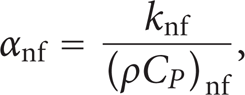
where the heat capacitance of the nanofluid is given by

The thermal expansion coefficient of the nanofluid can be determined by:

The effective dynamic viscosity of the nanofluid is calculated using Brinkman's model [17] as follows:

which gives an estimation of the viscosity of a nanofluid containing a dilute suspension of small, rigid, spherical particles.
The thermal conductivity of the nanofluid is calculated using a model proposed by Patel et al. [18] as follows:

where c = 25000 is a constant determined experimentally, and Anp/A f is defined as

with dnp being the diameter of the solid nanoparticles in the fluid, assumed here to be equal to dnp = 100 nm, and d f = 2 A° being the size of the liquid molecules, namely, those of water.
The Péclet number in (11) is defined as

with u np expressing the Brownian motion velocity of nanoparticle, defined as

where
The governing equations with the above models are made dimensionless by scaling the length by H′ and the velocity by
The dimensionless equations governing the present problem then read


where

The corresponding boundary conditions are
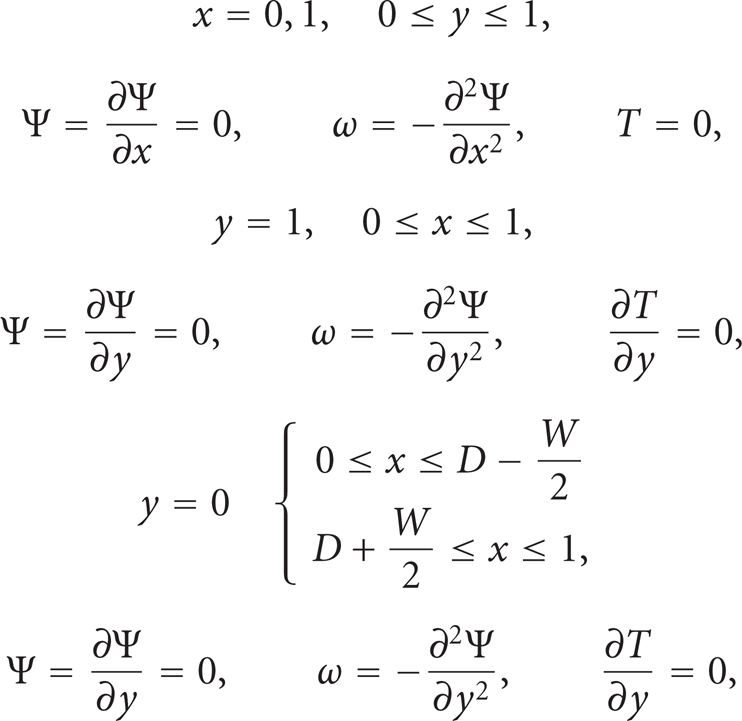
and the no slip condition on the heater wall yields

while the dimensionless thermal boundary conditions are as follows:
the constant temperature applied on the heater

the constant heat flux on the heater
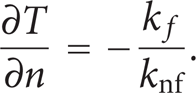
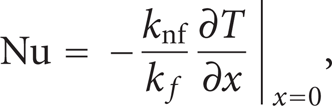
The heat transfer rates along the vertical walls are expressed in terms of the local and average Nusselt's numbers Nu and
(3) on the left vertical wall of the heater for a constant temperature,
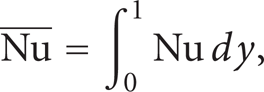
(4) on the heater for a constant heat flux,


with dl representing an elementary length along the walls of the heater.
From the above equations, we can see that the present problem is governed by six dimensionless parameters, namely, the thermal Rayleigh number
3. Numerical Solution
The solution of the governing equations, (15) to (17), is obtained using the lattice Boltzmann method (LBM). The LBM, developed two decades ago, examines fluids in the molecular state instead of at the classical macroscopic level and makes it possible to simulate flows by solving the Boltzmann transport equation for particle distribution functions on a simplified phase space, called the lattice [19, 20].
In this study, we used the LBM to solve the stream function, vorticity, and temperature equations, instead of the classical Navier-Stokes equations for velocity and temperature. This approach, recently proposed by Chai and Shi [21] and Chen et al. [22, 23], enables us to solve the advection-diffusion equations, (16) and (17), and the Poisson equation, (15), using particle distribution functions and applying the lattice Boltzmann approach on the D2Q5-phase space described in Figure 1(b).
We considered three sets of particle distribution functions. One set describes the temperature T and another the vorticity ω, both of them evolving following the collision and propagation steps described by Chen et al. [22, 23]. The third set of particle distribution functions is used for the stream function Ψ and is computed by iterating the collision and propagation steps, as described by Chai and Shi [21].
The parameters characterizing the nanofluid, that is, to say thermal diffusivity
With the present approach, a wide range of simulations were conducted for the simulation of natural convection in partially divided square enclosures. For these simulations, the convergence was considered to be reached when the relative error on variables V = Ψ, ω, and T between two successive iterations, t and t + 1, was smaller than a chosen tolerance:

The calculations were performed on 101 × 101 regular grids using D2Q5 lattices, this refinement being a good compromise between computational time and accuracy.
To check the ability of this LBM formulation to simulate flows in partially divided cavities, various simulations were conducted for pure fluid and compared with results provided by AlAmiri et al. [16]. The accuracy of the LBM was checked for various Rayleigh's numbers, Ra, in different configurations with various heights L, widths W, and positions D of an isothermal heater. The results are summarized in Table 1. Good agreement is observed, with the maximum deviation being of the order of 1.7% for the 101 × 101 grid. We can note that, while increasing Ra, the stream function amplitude
Comparison with results provided by Alimiri et al. [16] of the stream function extremes (Ψmin, Ψmax) for various heat source configurations (Pr = 0.71).

4. Results and Discussion
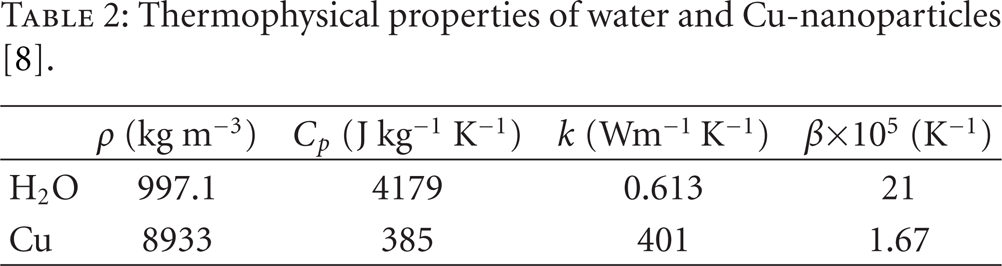
The results presented in this paper were obtained for pure fluid and a copper (Cu)-water mixture. The thermophysical properties of the base fluid, that is, water, and the nanoparticles, are reported in Table 2. Since this study is limited to water-based solutions, it is assumed that the Prandtl number (Pr) equals 7. As discussed by many authors (see, e.g., Trevisan and Bejan [25]), this type of convective heat transfer is independent of this parameter, provided that this latter is of order one or greater. The results are presented for Rayleigh's numbers varying from 103 to 106, for various geometries,
Thermophysical properties of water and Cu-nanoparticles [8].
Typical numerical results are presented in Figure 2 for Ra = 105, D = 0.5, and W = 0.2. On the graphs, streamlines and isotherms are presented from left to right. The calculated maximum stream functions (|Ψmax|) and heat transfer (

Effect of varying the ratio of nanoparticles, Φ, and the length, L, of an isothermally heated heater on the streamlines (left) and isotherms (right) for Ra = 105, D = 0.5, W = 0.2, and (a) L = 0.25 and Φ = 0:
Figure 3 illustrates the variation in

Variation of the average Nusselt number
This result indicates that the cooling performance of nanofluids is more effective at low Rayleigh's numbers than at high ones, independently of the heating conditions imposed on the heater. This behavior of
Figure 4 illustrates the variation of

Variation of the average Nusselt number

Effect of varying the position D of the constant heat flux heater on the streamlines (left) and isotherms (right) for Ra = 105, Φ = 0.05, L = 0.25, W = 0.2 and: (a) D = 0.50:
Figure 6 illustrates the results obtained for the same conditions as those of Figure 4, but for the case of an isothermal heater. A bird's eye view of the graphs indicates that, independently of the geometry and position of the heat source, the Nusselt number increases with an increase in the volume fraction Φ, that is, the thermal conductivity of the solution. Thus, as expected, this behavior is independent of the thermal boundary conditions applied on the heat source. The effect of the size of the heater on heat transfer is shown in Figures 6(a) and 6(b), which indicate that

Variation of the average Nusselt number
5. Conclusions
In this paper, a numerical study of natural convection heat transfer in a square enclosure filled with a suspension of copper-water nanofluid is carried out. The simulations were performed using the lattice Boltzmann approach. The system is heated, by a protruding heater located at the bottom of the system, and cooled isothermally from the two vertical walls. The heater is assumed either to be isothermal or to generate a constant heat flux. The governing parameters of the problem are the thermal Rayleigh number, Ra, the solid volume fraction of nanoparticles, Φ, the size (L and W) of the heater and its position, D. The main conclusions of the present analysis are as follows.
In the range of the governing parameters considered in this study, for a given geometry and position of the heater, the heat transfer is improved by enhancing both the Rayleigh number and the nanoparticle volume fraction.
For the case of an isothermal heater, the numerical results indicate that, for a given solid volume fraction of nanoparticles, the heat transfer is improved when the size of the heating source increases. Also, the average Nusselt number is enhanced as the position of the heating block is moved from the center position toward the vertical isothermal boundaries of the enclosure.
For the case of a heater with a constant heat source, for a given Rayleigh number and solid volume fraction of nanoparticles, the increase in the height of the heater results in a rise in the maximum surface temperature of the element. Consequently, the average Nusselt number decreases with the increase in the height of the heat source. The influence of the width, W, on