




Abstract
A mobile agent routing algorithm (MARA) is presented in this paper, and then based on the dual-channel communication model, the two-layer network combination optimization strategy is also proposed. Since this strategy deals with the collision between packets and the multicast suppression in channel competitive process well, the blocking probability of network and the error rate of packet transmission can be cut down by utilizing this strategy. Furthermore, a restore rule for the failure optimal route is presented too. By using this rule, the optimal route can restore quickly in the local of fail nodes and most of the information of original optimal route can be reserved. Compared with other existing algorithms like ant colony optimization-based dynamic energy-efficient mobile agent routing algorithm (ADEEMA) and mobile agent-based wireless sensor network (MAWSN), simulation results show that MARA performs better in improving the success rate of packet transmission and cutting down the delay of communication. The success rate of packet transmission is improved 15%. Simultaneously, this algorithm can keep the ant agents away from the nodes with less residual energy in searching for the optimal route. This way can make the energy of each nodes on the optimal route overall decline and hence improve the lifetime of network.
1. Introduction
Sensor devices have already become more smaller in size, lower power, and lower cost. With the developments of microelectromechanical systems, wireless communications, and digital electronics, such extremely small devices integrate sensing data processing and communication capabilities. Large numbers of sensor nodes can be deployed in the areas of interest such as disaster places and use self-organization and collaborative methods to form a sensor network. The key factors that influence the performance of wireless sensor network are as follows. (1) The packet collision between control packet and data packet. In the process of channel competitive, how to significantly reduce the amount of packets conflict in shared channel is a research hot spot, when two sensor nodes attempt to use the shared channel transiting packets at the same time. The packet conflict between control packet and data packet is the prime reason which causes communication conflict in channel competitive, so the rate of them is the key factors that influence the performance of wireless sensor network. (2) The redundancy information. Since the sensor nodes in a wireless sensor network are deployed in an arbitrary manner, an important task of wireless sensor network is to monitor and collect the relevant data in a set of targets. So a full sensing coverage like in literatures [1, 2] is one of the main requirements, which demands that every location in the target should be covered by at least one sensor. Moreover, to cope with the problem of faulty sensor nodes and guarantee network functionality, duplicate coverage of the same region is an appealing solution through using appropriate sensors redundancy strategies. Sensors redundancy can guarantee that there exists at least one communication path between any pair of sensor nodes and meet the requirement of fault tolerant. But these redundancy sensor nodes will produce a large amount of redundancy data that needs to be processed. These redundancy dates stream need more transportation bandwidth to communication, this can lead to network communication blocking. Cormio and Li et al. proposed an approach to avoid collisions between data packets and control packets by using separate channels for different kinds of packets in literatures [3–6]. This strategy can significantly reduce the amount of communication collisions and hence the energy consumed. But the local transmissions mode presented by these paper cannot balance the energy consumption of each nodes in the proposed route. This local transmission mode can lead to excessive use of some sensor nodes and lead to the premature death of these nodes. Fok, Li, and Chen et al. presented a mobile agent model in literatures [7–13]. Base on this model, they can successfully complete information fusion in sensor node and avoid transmitting large number of data, hence, reduce energy consumption of network. In wireless sensors network, processor node is the leader of data query processing and is the recipient of trade data stream, which can complete the effective collection of the correct data by means of moving the mobile agents from processor node to all the target nodes, and other nodes do not need to direct transmits data to process node. This strategy of collecting data has two advantages: (1) It can reduce the requirement of bandwidth and lowered the network load effectively. (2) According to network load, determine dynamically the way of data processing methods and the way of mobile agent migration strategies. So this strategy can be used to balance network load and improve network performance. Based on the ant colony optimization in literature [14], a dynamic energy-efficient mobile agent routing algorithm is presented in literature [12], the route chosen by this strategy can consider both the energy consumption and the node's residual energy. However, since this algorithm adopted the single channel wireless sensors network, the collisions between control packet and data packets cannot be avoided, and the error rate of packet transmission may be high. To solve the problems in these algorithms, a new mobile agent routing algorithm (MARA) based on the dual channel wireless sensors network is presented in this paper. This algorithm proposes a combination optimization route strategy, when there is enough idle resource in the data plane, the service blocked in the control plane can use these idle resources to transmit control packet in synchronous manner, so the blocking probability of network can be cut down by this means and the effective utilization of these idle resource in dual channel will be realized. Simultaneously, a restore rule for the failure optimal route is presented to adapt to the topology changes in dynamic sensor network as in literatures [15, 16]. When the network topology is changed, a new optimal route can be found fast by using this strategy and most information of the original optimal route can be reserved. So both the delay of communication and the energy consumption for restoring the optimal route can be cut down by this means.
The remainder of this paper is organized as follows: in Section 2, the related work is summarized; in Section 3, we describe the models in our work; in Section 4, we present the mobile agent combination optimization routing algorithm in detail; in Section 5, we present the strategy of rapid restoring optimal route on the basis of keeping most information of the original optimal route; in Section 6, we provide experimental results; finally, we conclude this paper in Section 7.
2. Related Work
The factors that influence the performance of wireless sensor network has been widely discussed in many papers. According to the cause of these factors, the factors that influence the performance of network are classified into three categories: the packet collision between control packet and data packet, the redundancy information, and topology control of network.
In a single channel ad hoc network as in literatures [1, 2], one channel is shared by a number of communication nodes, located in close proximity. The throughput of such a network depends largely upon the performance of the multiple access control (MAC) protocol in use, which controls and coordinates the access of the nodes to the shared channel. In order to increase the throughput, many MAC schemes require nodes to sense the common channel before packet transmission. However, collisions which arise when more than one packet is received at a node at the same time are still possible. The authors of [5] propose a collision avoidance scheme, they propose the dual busy tone multiple access protocol, they use the RTS packets to initiate channel request, two out-of-band busy tones are then used to protect the RTS packets and the data packets, respectively. In this strategy, the whole channel is split into two subchannels for message transmission and control packet transmission. A ready node sends its request to the target node on the request channel, successful requests will be acknowledged by the node passed through before the data packet is transmitted. This way can successfully put down the collision of network.
In literatures [4, 6], it was proved that the packet conflict between control packet and data packet is the prime reason which causes communication conflict in the process of channel competing. These communication conflict and interference seriously decrease the packet delivery ration of multihop flows. So the rate of them is the key factors that lead to the poor throughput performance of wireless sensor network. The authors of literature [6] present a novel effective random medium access control protocol. This new protocol uses an out-of-band busy tone and two communication channels, one for control frames and the other for data frames, and can give a comprehensive solution to the aforementioned problems in single channel ad hoc network. This protocol can improve the throughput by up to 20% for one-hop flows and by up to 5 times for multihop flows under heavy traffic.
Sensors redundancy can guarantee connection of network and meet the requirement of fault tolerant. But these redundancy sensor nodes will produce a large amount of redundancy information that needs to be processed. So, how to complete data aggregation in order to put down the amount of redundancy information has been well studied in recent years. In network aggregation means, computing and transmitting partially aggregated data rather than transmitting all the raw data to reduce energy consumption. There are a vast amount of extant works on data aggregation in the literatures [7–13].
Mobile agent model was proposed for completing data aggregation and putting down the amount of redundancy information in literature [12], the mobile agent is a special kind of software that propagates over the network either periodically or on demand (when required by the applications). It performs data processing autonomously while migrating from node to node. As described in [12], many inherent advantages of the mobile agent architecture make it more suitable for wireless sensor network, and it is found to be particularly useful for data fusion tasks in distributed wireless sensor network. To solve the problem of the overwhelming data traffic, Fok et al. [7] proposed mobile agent-based distributed sensor network for scalable and energy efficient data aggregation too. By transmitting mobile agent to sensor nodes, a large amount of sensory data can be reduced or transformed into a small amount of data by eliminating the redundancy.
How to adapt to the topology changes is a research hot point in the learning of the dynamic wireless sensor network. Precious sensor node battery power can be saved by topology control measures that can dynamically adjust the radio transmission range of individual sensor nodes to balance energy efficiency while maintaining adequate network connectivity [15, 16]. In order to adapt to the topology changes in dynamic sensor network, a restore rule for the failure optimal route is presented in literature [15]. A new optimal route can be found fast by this strategy and most information of the original optimal route can be reserved. Base on this restore rule, we propose a new restore strategy, this strategy is that, when there are some nodes failed in the optimal route, we first draw a circle such that its diameter is denoted by the line between the failure node's father node and child node, then we can find some new nodes around the failure node to repair this failed optimal route in this circle, thus we can get a new optimal route near the old one. So both the delay of communication and the energy consumption for restoring the optimal route can be cut down by this means.
3. The Model of MARA Algorithm
3.1. Mobile Agent's Attributes and the Communication Energy Consumption Model
In this paper, mobile agent has the properties as follows. (1) Mobile agent has to store the position information of the processing node, the target node and the nodes visited by this mobile agent. (2) Mobile agent has the function to complete data fusion on each target node. (3) Mobile agent has the function to complete data acquisition and processing on each target node. The capacity of data taken by mobile agent is constantly and the data precision will be increased when the mobile agent travels along the optimal route which can reach all the target nodes in network. At the same time, we use the radio model as discussed in [15] to analyze energy consumption of sensor nodes. For transferring k-bits data message between the father node and the child node, the transmitting and receiving energy costs are given by (1) and (2), respectively, d in (1) is the distance between the two nodes:
Transmitting energy costs model:

Receiving energy costs model:

3.2. The Two-Layered Graph Network Model
In this section, to solve the channel converter problem in wireless sensor network, the two-layered graph model is constructed based on graph theory. In this model, the number of available channels is always one. Each channel can be represented by a layer which has the same set of sensor nodes and links that are duplicated in each layer (Figure 1).

Two-layered graph model.
In this model, two layers, each of which corresponds to a single channel, are generated. The channel converter can be represented by the inter layer links between the same node in different layer. By utilizing this model, because each node and link deals with only one channel, so the channel converter problem is simplified into a routing problem over the two-layered graph model. The two layers are one for transmitting control packet and the other for transmitting data packet. By using the separate channel layers, we can avoid collisions between control packets and data packets. The channel layer used to transmit control packet is referred to as the control plane, and the other one is referred to as the data plane, when there is enough idle resource in data plane, a combination optimal strategy in control plane and data plane is proposed. The service blocked in control plane can use this idle resource to transmit control packet in synchronous manner. So the blocking probability of network can be cut down and the success ratio of packet transmissions can be improved by using this strategy.
3.3. Neighbor Information Table and the Optimal Route Evaluation Standard
In this paper, a wireless sensor network model similar to those used in literatures [9–12] is applied, with the following properties.
All sensor nodes are immobile and have a unique ID. All sensor nodes are energy constrained with a uniform initial energy accusation. All sensor nodes have two communication channels, one for transmitting control packets and the other for transmitting data packets. All sensor nodes have two omni-directional antennas, one for transmitting packets and the other for receiving packets.
Each sensor nodes should build its own neighbor information table. Every neighbor information table has its own memorizer to store the information as follows.
The ID of the local sensor node and its neighbor sensor nodes. The residual energy of the local sensor node and its neighbor sensor nodes. The position information of the local sensor node and its neighbor sensor nodes. The density of ant pheromones between the local sensor node and its neighbor sensor nodes.
This paper also proposes a new optimal route evaluation standard which can be used to evaluate the performance of the optimal route. This evaluation standard is considerate to both the overhead on the route and the residual energy of the nodes. This evaluation standard can keep the optimal route away from the nodes with less residual energy and make the energy of each nodes on the optimal route overall decline and hence improve the lifetime of wireless sensor network. This evaluation standard is defined as

The less value of D, the better route is. In expression (3),
4. The Algorithm of MARA
In dual-channel wireless sensor network, to put down the probability of collision between data packet and control packet, an isolation transmission strategy is proposed in this paper. This strategy can avoid collision between the different packets by transmitting control packet in control plane and transmitting data packet in data plane. The optimal route between the source node and the target node can be found through using the Mode 1 of the mobile agent routing algorithm to search in control plane. In data plane, the data packets can be sent across the optimal route which was found by using Mode 1 of the mobile agent routing algorithm. When there is enough idle resource in data plane, the blocking transport traffic in control plane can be sent down to search for the optimal route in data plane. This way can put down the blocking probability of network and the Mode 2 of combination optimization strategy can be put into effect.
Mode 1.
The process of searching for the optimal route in control plane by using the mobile agent routing algorithm is given as below.
There are m species ants in the control plane and every species has n ants. If the initialization source node v gets the request from the set of target nodes When the ant k arrived at the i-node, the information of the i-node's neighbor nodes in the neighbor information table will be modified as the following rules: (1) if the target node In this expression, ξ and When the ant k arrived at the target node Put the initialization source v-node into the set of the target nodes, and let the initialization source v-node as the target node The route optimal degree can be calculated according to formula (3). When the whole of a species ants arrive in the target nodes v, the route which has the smallest route optimal degree should be put into the set of the optimization routes, then the global pheromone will be modified as follows formula:
Phase 1.
Phase 2.
Phase 3.
Phase 4.
Phase 5.


Mode 2.
The process of searching for the optimal route in two-layers plane by using the combination optimization strategy is described as follows.
Ant agents search the optimal route for each traffic synchronously in control plane. When there is enough network resources in the control plane, the ant agents will search the optimal route for this traffic in control plane like Mode 1, otherwise, proceed to next step. First, the ant agents in the i-node conduct a survey to make sure whether there is enough bandwidth resources in data plane between the i-node and the nodes lay in the i-node's neighbor information table which the ant agent did not visit before. If there are not enough bandwidth resources, the ant agents ceased implementing this searching route business, otherwise, proceed to next step. The ant agents find the next hop node j to transmit inquiry information between i-node and j-node in data plane like Mode 1. When the inquiry information arrived at j-node, the ant agents should conduct a survey to make sure whether there is enough bandwidth resources in the control plane between the j-node and the nodes lay in the j-node's neighbor information table which the ant agents did not visit before. If there are not enough bandwidth resources, the ant agents continue to search the next hop node in data plane. Otherwise, the ant agents return to the control plane and search the optimal route in control plane like Mode 1.Phase 1.
Phase 2.
Phase 3.
5. The Strategy of Rapid Restoring Failed Optimal Route
Let v-node be the source node and let u-node be the target node. In the free space model, the energy consuming for transmitting a unit of information between v-node and u-node is denoted by
Theorem 1.
Let
Proof.
Since the nodes
Now turn to the case of two-ray model. We compare this with the case of the free-space model and claim that Theorem 1 still holds good under these circumstances. In the free-space model, the distance between nodes is large than
Hence, under the two-ray model, w-node is also a infection shortcut node in the infection circle whose diameter is
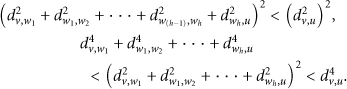
Theorem 1 provides a rapid restoration strategy for the failed optimal route, The detail is that, when there are some nodes failed in the optimal route. we first draw a circle such that its diameter is denoted by the line between the failure node's father node and child node, then we apply the MARA algorithm to restore this section failed optimal route in this circle. Finally, we can find some new infection shortcut nodes around the failure node to repair this failed optimal route on the basis of keeping most information of the original optimal route. Figure 2 shows a section of the optimal route from the source node to the target node, the c-node in this optimal route cannot work due to some reasons. We draw a circle which diameter is denoted by the line between the failure node's father b-node and child e-node. Then, we can find some infection shortcut nodes in this circle to restore this section of the optimal route. Since d-node in this circle, b-node, and e-node in the neighbor list of the d-node's, we can replace the failure route

The local route restoration.
6. Experimental Results
In this section, we perform the experiments with the network simulator platform
Figure 3 shows the relationships of different algorithms' success rate of packet transmission. According to Figure 3, we can conclude that, when the load of network is heavy, the production rate of data packet have significant influence upon the success rate of packet transmission. The reason is that the collision between the data packet and the control packet will aggravate constantly with the network load going up. However, since the MARA algorithm adopts the strategy of isolation transmission, which can avoid the collision between the data packet and the control packet during the course of network load going up and hence improve the success rate of the packet transmission.

The success rate of packet transmission.
Figure 4 shows the relationships of different algorithms' average communication delay. The delay of consumption is estimated by using the average value of the absolute differences between two frames. One is the time consumption for transmitting packets from source node to target node in a light load network, the other is the time consumption for transmitting packets use different algorithms separately under different load conditions. According to Figure 4, we can conclude that, when the load of network is heavy, the average communication delay of MARA is the smallest one. The reason is that the strategy of combination optimal is adopted by MARA, this way can make full use of the idle channel resource in different layers. When there is enough idle resource in the data plane, the service blocked in the control plane can use these idle resource to transmit control packet in synchronous manner. So this way can put down the delay of communication efficiently.
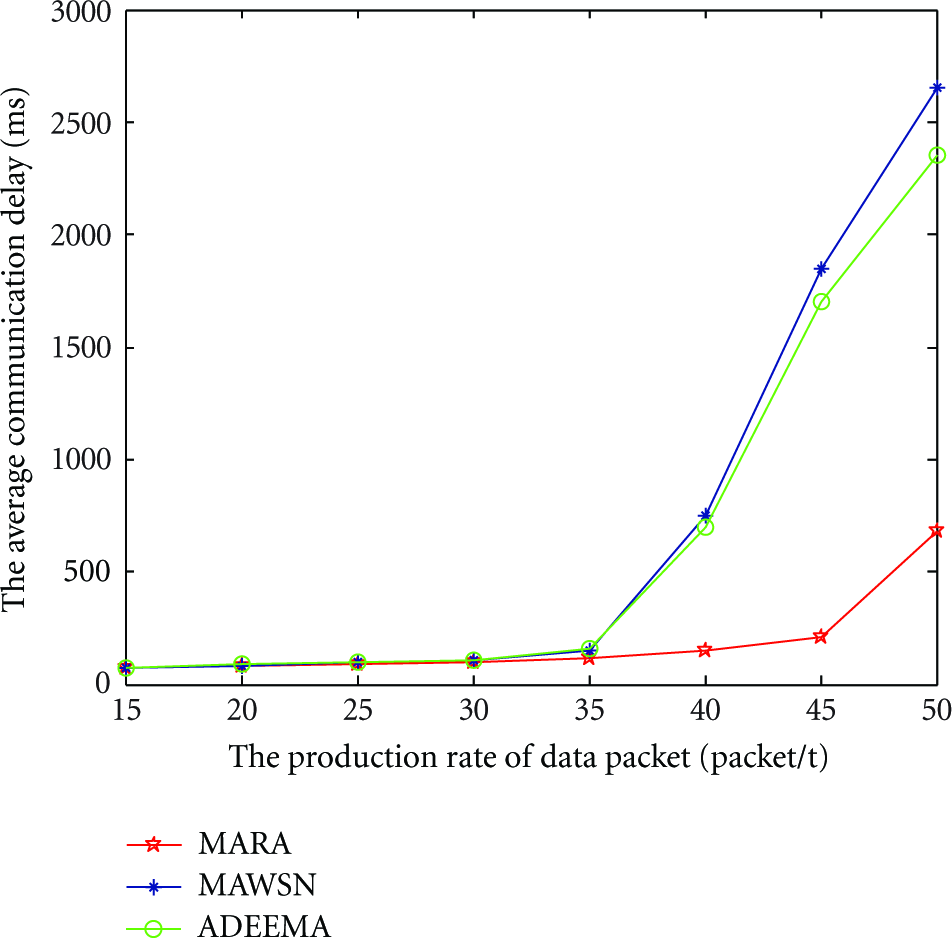
The average delay of communication.
To further verify the performance of three algorithms, the following experiment is done. Fixed the position of the source node at (

The minimal residual energy of the nodes.
Figure 6 shows the relationships of total energy cost of the different optimal routes. According to Figure 6, we can conclude that the total energy consumption of the optimal route which was found by MARA is smaller than the total energy consumption of the optimal routes which were found by ADEEMA and MAWSN, this stems from two respect reasons commonly. Firstly, this is because MARA algorithm adopts the strategy of combination optimal, this way can improve the success rate of packet transmission, hence put down the total energy consumption of the optimal route. Secondly, MARA algorithm uses the inquire information to search for the optimal route and lets the mobile agent travel along the optimal route to complete data acquisition and processing. This strategy can put down the workload of data transmission, hence reduce the total energy cost. However, MAWSN and ADEEMA algorithm use the mobile agent to search for the optimal route, mobile agent contain more data quantity than inquire information, so these algorithms improve the amount of data transmission and hence improve the total energy cost.

The total energy cost of the optimal routes.
How to adapt to the topology changes is a research hot point in learning of the dynamic wireless sensor network, the simplest way is to restart the algorithm to search for the other optimal route in network. But this strategy does not make full use of the information of original optimal route, while the new optimal route will be in some sense related to the original one. A new rapid restoring strategy is presented in Section 4, this strategy can reserve enough original information to speed up the process of searching for the new optimal route. This rule can search some shortcut nodes around the failure node to repair this failed route, hence the new optimal route can be obtained quickly, and most information of original optimal route can be reserved. We can see from the following experiment that our strategy can find a new optimal route quickly when the topology changes. Fixed the position of the source node at (

(a) The original optimization route. (b) The restoring optimization route.
MARA is a novel evolutionary algorithm based on ant colony strategy which derived from the foraging behavior of real ant. This strategy let sensor nodes periodically release inquiry information which has the property of ants. The node received inquiry information will updat its local information opportunely. So, MARA is a scalability algorithm which is of strong suitability. MARA has polynomial computational complexity, its computational complexity is
7. Conclusions
A mobile agent routing algorithm is presented in this paper to solve the problems of collision between packets and multicast suppression in channel competitive process. First, with a two-layer graph model, the channel converter problem in dual-channel wireless sensor network can be simplified into a routing problem over the two-layer graph, so we can search for routes in the control plane and transport traffic in the data plane synchronously. Then, the control plane and the data plane are integrated into a two-layer network, and searching route for each traffic in the two-layer network opportunely. This algorithm can make full use of these idle resource in different layers, when there is enough idle resource in the data plane, the service blocked in the control plane can use these idle resource to transmit control packet in synchronous manner, so the blocking probability of network can be cut down by this way. This strategy deals with the collision between packets and multicast suppression in channel competitive process well, so the error rate of packet transmission can be cut down by this strategy. Second, a data fusion strategy based on the mobile agent model is also presented. This strategy can reduce the amount of transmitted data, hence reduce the energy consumption of wireless sensor network. Last, a restore rule for the failure optimal route is developed to adopt to the topology changes in dynamic sensor network. The optimal route can restore quickly in the local area of failure sensor nodes, and most of the information of original optimal route can be reserved by this rule. So both the delay of communication and the energy consumption to restore the optimal route can be cut down by this way. Although the assumption of node has two communication channel improving the cost of sensor about 6%, this way can improve the success rate of packet transmission by 15% and cut down the delay of communication evident. Hence, these benefits are worth to improve the cost of sensor.
Footnotes
Acknowledgment
This project is supported by the National Natural Science Foundation of China (Grants nos. 60874085, 60974082), the Fundamental Research Funds for the Central Universities (Grant no. JY10000970013), the Foundation of State Key Laboratory of ISN.