




Abstract
The energy efficiency optimization of the binary power control scheme for MIMO-OFDM wireless communication systems is formulated, and then a global optimization solution of power allocation is derived. Furthermore, a new energy efficiency binary power control (EEBPC) algorithm is designed to improve the energy efficiency of MIMO-OFDM wireless communication systems. Simulation results show that the EEBPC algorithm has better energy efficiency and spectrum efficiency than the average power control algorithm in MIMO-OFDM wireless communication systems.
1. Introduction
It is beyond question that information and communication technology (ICT) industries play a significant role in current global economy. Among all energy-consuming industries, the ICT industry takes 2% of global total CO2 emissions while consuming 3% of global energy storage [1, 2]. Within the 3% consumption, 57% is caused in mobile and wireless communication systems [3]. From another perspective of ICT growth, there has risen a high demand for broadband data transmission with high-quality services, which is further triggering the Multi-Input and Multi-Output (MIMO) and Orthogonal Frequency Division Multiplexing (OFDM) techniques to be adopted in the next generation wireless communication systems [4–6]. Therefore, the optimization of energy efficiency in MIMO-OFDM wireless communication systems has become an urgent requirement.
In wireless communication systems, the transmission power consumption of base station is controlled by power allocation schemes. In early analog mobile communication systems, the key aim of transmission power allocation scheme is to improve user signal-to-noise (SNR). Therefore, some transmission power allocation schemes of base station are developed to enhance the SNR of terminal users [7–9]. In digital mobile communication systems, the traditional transmission power allocation schemes sought to realize the maximization of wireless channel capacity [10–12]. One of the most popular power allocation schemes of base station is the power water-filling scheme, which performs power allocation based on the state of wireless channels to close the wireless channel capacity to the Shannon capacity limit [10]. To overcome the requirement of continuous-rate adaptation in the power water-filling scheme, a new scheme based on a fixed number of codes, was proposed to maximize average spectral efficiency (ASE) of dual-branch MIMO systems with perfect transmitter and receiver channel state information (CSI) [11]. To formulate the link adaptation problem as a convex optimization problem, Kim and Daneshrad proposed a link adaptation power strategy to maximize energy efficiency or data throughput subject to a given quality of service (QoS) constraint [12]. Considering the complexity of optimization transmission power allocation scheme, a simple transmission power allocation scheme, that is, the binary power control scheme was proposed to maximize wireless channel capacity in practical engineering applications [13, 14]. However, the energy efficiency problem in the traditional binary power control scheme of MIMO-OFDM wireless communication systems is not considered.
In this paper, we investigate the energy efficiency problem of the binary power control scheme and formulate the binary power control scheme with energy efficiency constraint. Moreover, a new algorithm is designed to address the energy efficiency power allocation in MIMO-OFDM wireless communication systems. The contributions and novelty of this paper are summarized as follows.
We formulate the energy efficiency problem of the binary power control scheme in MIMO-OFDM wireless communication systems. A global optimization solution of power allocation in MIMO-OFDM wireless communication systems is derived. Furthermore, two derivation results can be used for potential engineering application with the low calculation complexity. A new algorithm is designed to realize the energy efficiency binary power control scheme in communication systems. Performance of the new algorithm is analyzed and some interesting observations are presented.
The rest of paper is organized as follows. In Section 2, the energy efficiency concept is introduced and the binary power control scheme is introduced. In Section 3, we investigate optimal conditions for energy efficiency transmission with the binary power control scheme. Moreover, the global optimization solution of power distribution model is derived and a new algorithm is proposed. Furthermore, we apply the new algorithm in a MIMO-OFDM communication system and provide simulation results to demonstrate energy efficiency improvement in Section 4. Finally, we conclude the paper in Section 5.
2. Energy Efficiency in Wireless Communication Systems
As introduced in this section, more and more energy efficiency optimization schemes in wireless communication systems were studied. To estimate the energy efficiency, the definition of energy efficiency should be first declared. In this paper, a definition of energy efficiency is described as follows.
2.1. Definition of Energy Efficiency in Wireless Communication Systems
Typically, the energy consumption of transmitting per bit is a main concern in evaluating the energy efficiency of a communication system. In addition, the definition should include the transmission power from the base station and the capacity of wireless channels. Considering the Shannon capacity theory [15], the maximum achievable capacity of a wireless channel is related to the transmission power from a base station. Therefore, an energy efficiency used in wireless communication systems is defined as follows:

2.2. Binary Power Control Scheme
For wireless communication systems, the transmission power P over wireless channels is allocated from the minimum value

From research results in [13, 14, 17], when there are many wireless channels in wireless communication systems, the capacity and rate performance of wireless communication systems adopting the binary power control scheme can approximate the Shannon capacity limit. However, when the energy efficiency of wireless communication systems is considered as an optimal aim, how to adopt the binary power control scheme of wireless communication systems to approximate the global energy efficiency optimal solution is a great challenge.
3. Problem Formulation of Energy Efficiency Binary Power Control Scheme
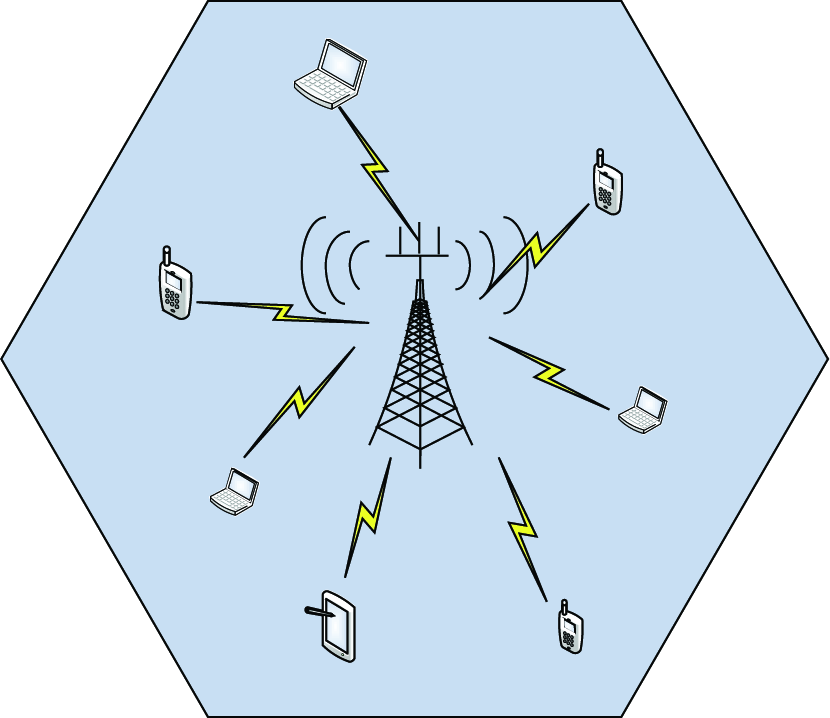
To investigate the binary power control scheme in energy efficiency of wireless communication systems, a single cell MIMO-OFDM wireless communication system is illustrated in Figure 1. One base station integrated with
System model of MIMO-OFDM wireless communication systems.
3.1. Problem Formulation
Based on the system model in Figure 1, the total capacity of MIMO-OFDM communication system is described as

In this case, the total transmission power in the downlink of MIMO-OFDM communication system is denoted as

Furthermore, the energy efficiency of MIMO-OFDM communication system is given by

The wireless subchannel set K is defined as follows:

Assume that the binary power control scheme is used to allocate the transmission power for the wireless subchannel set K. In this case, the set K is divided into two subsets: one is the maximum power transmission subchannel subset

To optimize the global energy efficiency of MIMO-OFDM wireless communication system, some basic assumptions and a principle are defined as follows.
Assumption 1.
The total transmission power of MIMO-OFDM wireless communication system is fixed as a constant.
Assumption 2.
Principle 1.
A wireless subchannel
3.2. Optimization of Power Allocation
For the energy efficiency binary power control scheme, how to optimize the power allocation in the maximum power transmission subchannel subset and the minimum power transmission subchannel subset is a key problem. Based on assumption, principle and (7) in Section 3.1, we find that
When a candidate wireless subchannel


When a candidate wireless subchannel
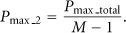

Based on Principle 1, the candidate wireless subchannel

Compared with the transmission power over wireless subchannels, the value of AWGN



Based on (14c), we can derive a current global optimization solution of maximum transmission power
When the number of subchannels M approaches to infinite, we have the following result:

From the numerical simulation of threshold values

Threshold values versus number of subchannels.
Result 1.
When the number of current subchannel in the maximum power transmission subchannel subset is less than 30, the value of maximum transmission power

Result 2.
When the number of current subchannel in the maximum power transmission subchannel subset is larger than or equal to 30, the value of maximum transmission power

From above results, especially from Result 2, the complexity of maximum transmission power derivation can be reduced.
3.3. Algorithm Design
Based on Results 1 and 2, an energy efficiency binary power control (EEBPC) algorithm is designed for improving energy efficiency of MIMO-OFDM wireless communication systems. The detailed EEBPC algorithm is illustrated in Algorithm 1. Morever, an assumption of Algorithm 1 is that all subchannels of wireless subchannel set K are degressively ordered.
subset
(1) Create a new set (2) compare compare add add break, (3)
4. Simulation Results and Performance Analysis
Based on the new EEBPC algorithm, the energy efficiency and spectrum efficiency performance of MIMO-OFDM wireless communication systems is simulated and analyzed. In the following simulation, some parameters of the system model in Figure 1 are configured as follows: the total transmission power of base station is ranged from 0.6 to 1.4 watt (W); considering the OFDM scheme used in MIMO wireless communication system, the number of subchannels is ranged from 8 to 128; the AWGN
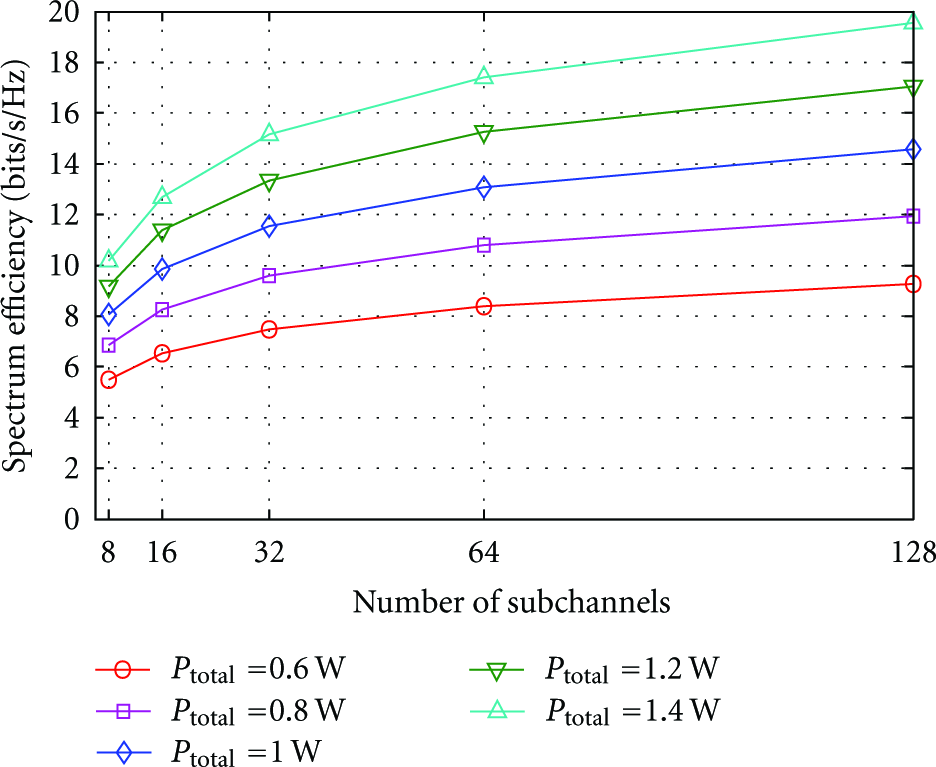
From Figure 3, the impact of the number of subchannels on the spectrum efficiency of MIMO-OFDM communication system with the EEBPC algorithm is investigated. The spectrum efficiency of MIMO-OFDM communication system increases with the number of subchannels and the total transmission power of base station.
Spectrum efficiency analysis with number of subchannels limited by different total transmission power.
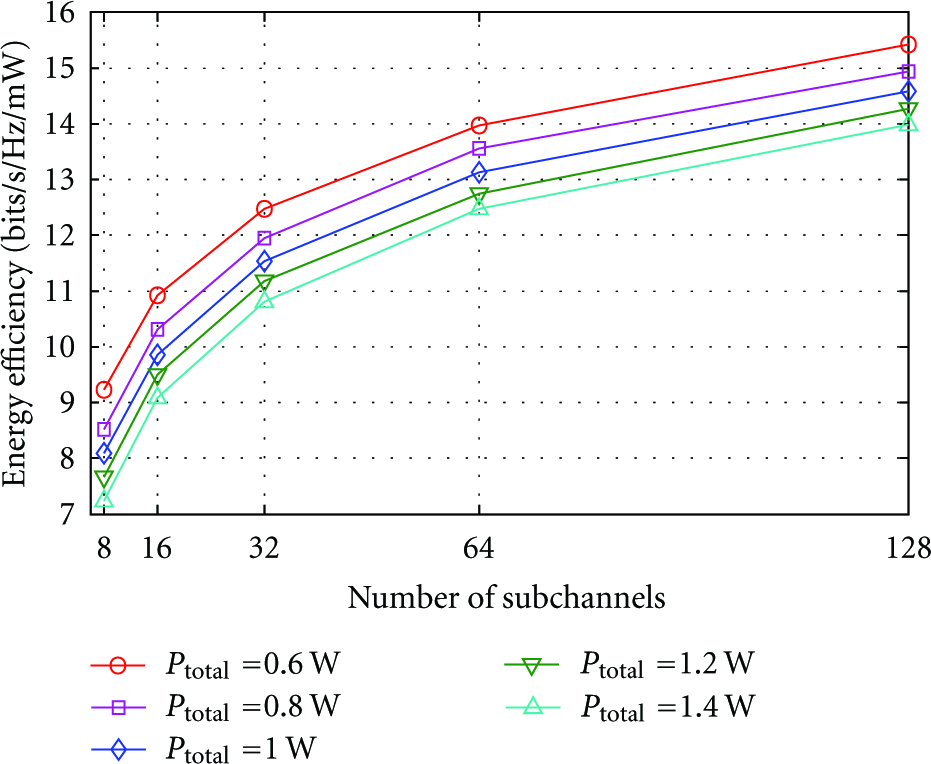
From Figure 4, the impact of number of subchannels on the energy efficiency of MIMO-OFDM communication system with the EEBPC algorithm is analyzed. The energy efficiency of MIMO-OFDM communication system increases with the number of subchannels, but the energy efficiency of MIMO-OFDM communication system decreases with the total transmission power of base station.
Energy efficiency analysis with number of subchannels limited by different total transmission power.
From Figure 5, the EEBPC algorithm is compared with the traditional average power control algorithm [16] in the spectrum efficiency of MIMO-OFDM communication system with different number of subchannels. Assume that the total transmission power of base station is configured as 1 W. When the number of subchannels is less than 12, the spectrum efficiency of MIMO-OFDM communication system with average power control algorithm is larger than that with EEBPC algorithm. When the number of subchannels is larger than or equal to 12, the spectrum efficiency of MIMO-OFDM communication system with EEBPC algorithm is larger than that with average power control algorithm. Moreover, the spectrum efficiency gain of EEBPC algorithm increases with the number of subchannels.

Comparison spectrum efficiency of EEBPC and average power control algorithms with different number of subchannels.
From Figure 6, the EEBPC algorithm is compared with the traditional average power control algorithm in the energy efficiency of MIMO-OFDM communication system with different number of subchannels. Assume that the total transmission power of base station is configured as 1 W. When the number of subchannels is less than 12, the energy efficiency of MIMO-OFDM communication system with average power control algorithm is larger than that with EEBPC algorithm. When the number of subchannels is larger than or equal to 12, the energy efficiency of MIMO-OFDM communication system with EEBPC algorithm is large than that with average power control algorithm. Moreover, the energy efficiency gain of EEBPC algorithm increases with the number of subchannels.
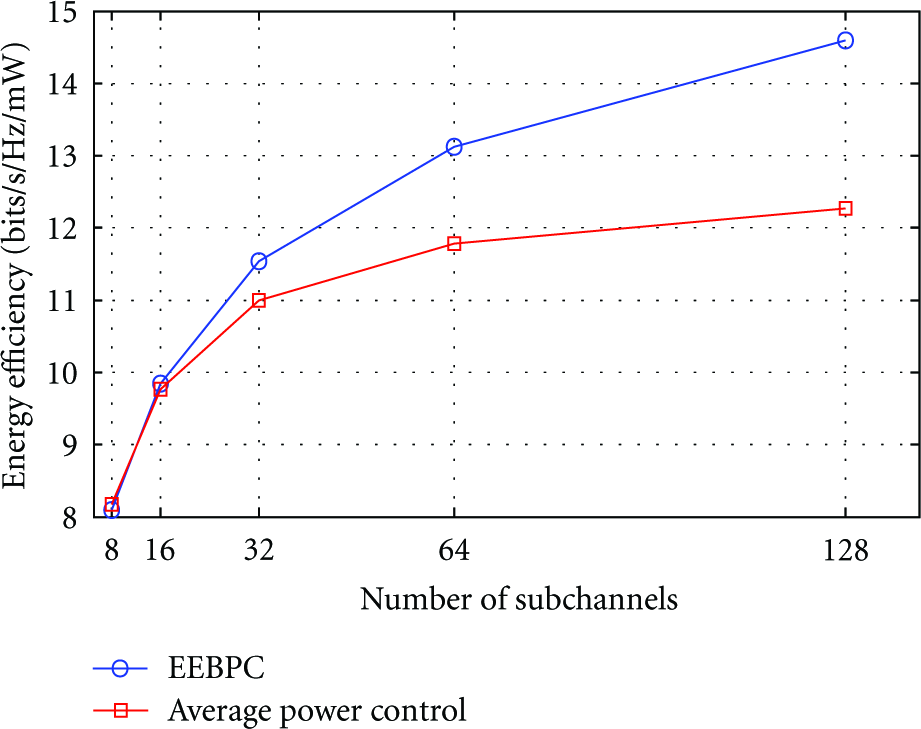
Comparison energy efficiency of EEBPC and average power control algorithms with different number of subchannels.
From Figure 7, the EEBPC algorithm is compared with the traditional average power control algorithm in the spectrum efficiency of MIMO-OFDM communication system with different total transmission power of base station. Assume that the number of subchannels is configured as 64. The spectrum efficiency of MIMO-OFDM communication system with EEBPC algorithm is large than that with average power control algorithm. Moreover, the spectrum efficiency gain of EEBPC algorithm is invariable with the total transmission power of base station.
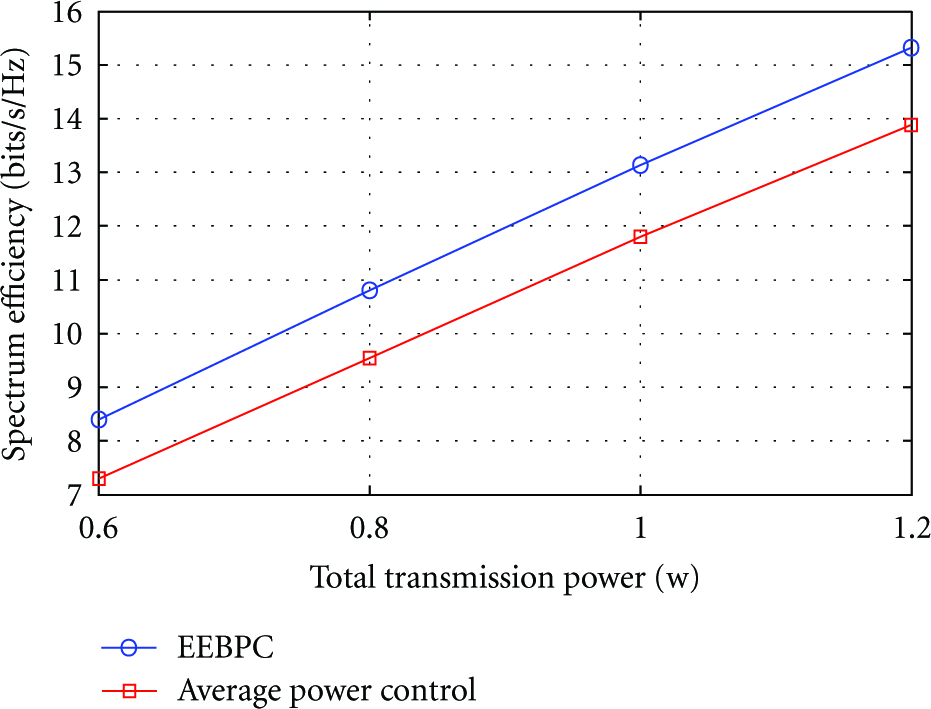
Comparison spectrum efficiency of EEBPC and average power control algorithms with different total transmission power.
From Figure 8, the EEBPC algorithm is compared with the traditional average power control algorithm in the energy efficiency of MIMO-OFDM communication system with different total transmission power of base station. Assume that the number of subchannels is configured as 64. The energy efficiency of MIMO-OFDM communication system with EEBPC algorithm is large than that with average power control algorithm. Moreover, the energy efficiency gain of EEBPC algorithm decreases with the total transmission power of base station.
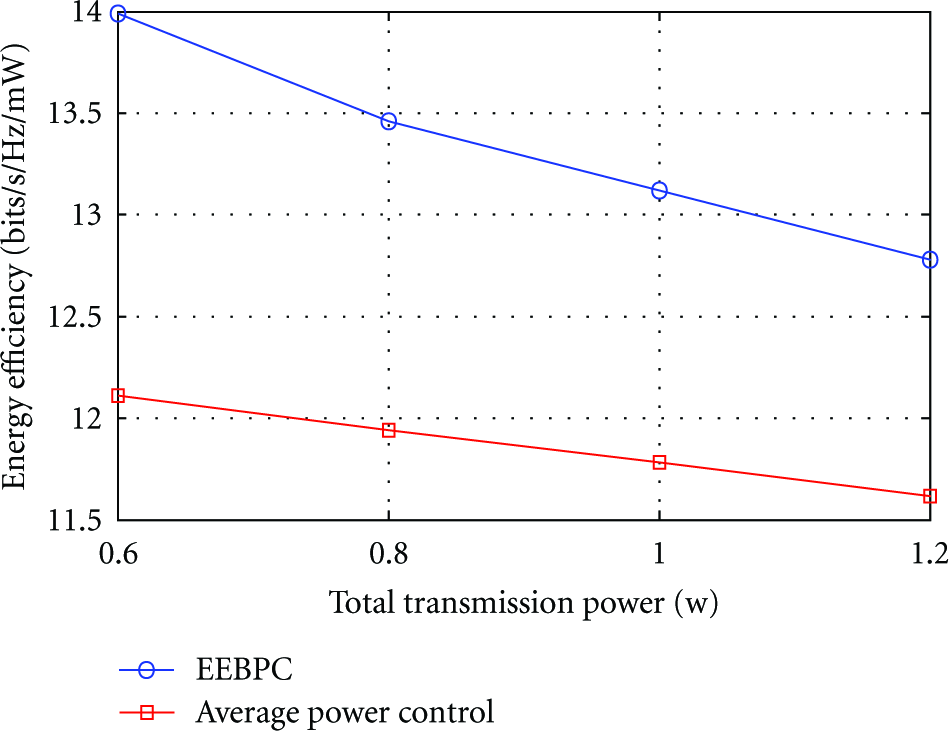
Comparison of energy efficiency of EEBPC and average power control algorithms with different total transmission power.
5. Conclusion
In this paper, the energy efficiency of binary power control scheme is investigated and formulated by three principles. Furthermore, a global optimalsolution of the maximum transmission power of MIMO-OFDM wireless communication system is derived. Moreover, a simple engineering application result is proposed for reducing the complexity of calculation. Based on them, a new EEBPC algorithm is designed for performance analysis. The exact impact of EEBPC algorithm on the spectrum efficiency and the energy efficiency has been fully investigated under different number of subchannels and total transmission power of base station. Simulation results have shown that the energy efficiency and spectrum efficiency of EEBPC algorithm is better than that of traditional average power control algorithm when the number of subchannels is larger than 11. Our future work includes a further investigation of the impact of multicell on the EEBPC algorithm.
Footnotes
Appendix
Acknowledgments
This research was supported by the National Natural Science Foundation of China (NSFC), Contract/Grant number: 60872007, 61103177; National 863 High Technology Program of China, Contract/Grant number 2009AA01Z239; The Ministry of Science and Technology (MOST), China, International Science and Technology Collaboration Program, Contract/Grant number 0903; EU FP7-PEOPLE-IRSES, project acronym S2EuNet, Contract/Grant number 247083.