




Abstract
We study game-theoretic mechanisms for routing in wireless ad hoc networks. Our major results include a combination of theoretical bounds and extensive simulations, showing that VCG-based routing in wireless ad-hoc networks exhibits small frugality ratio with high probability. Game-theoretic mechanisms capture the noncooperative and selfish behavior of nodes in a resource-constrained environment. There have been some recent proposals to use these mechanisms (in particular VCG) for routing in wireless ad-hoc networks, and some frugality bounds are known when the connectivity graph is essentially complete. We are the first to show frugality bounds for random geometric graphs, a well-known model for ad-hoc wireless connectivity. In addition, we generalize the model of agent behavior by allowing sets of nodes to form communities to maximize total profit. We are the first to analyze the performance of VCG under such a community model. While some recent truthful protocols for the traditional (individual) agent model have improved upon the frugality of VCG by selecting paths to minimize not only the cost but the overpayment, we show that extending such protocols to the community model requires solving NP-complete problems which are provably hard to approximate.
1. Introduction
Reliable and cost-efficient routing in ad hoc networks is a well-studied problem, with numerous proposals for routing protocols. Many of these protocols assume that the nodes in the network behave co-operatively; a node will always agree to forward a packet to its recipient. In resource-scarce environments (prevalent in ad-hoc networks), this co-operativeness assumption is suspect. Forwarding a packet incurs some cost to the node (i.e., the use of battery power), and in the absence of other incentives, nodes belonging to one community may refuse to forward packets belonging to another community. Under these assumptions, it is often more reasonable to model a network as a game played between independent selfish agents and to apply game theoretic reasoning to develop incentive-based routing protocols [1, 2].
In an incentive-based routing protocol, a node is paid monetary compensation in return for forwarding a packet. The compensation covers the cost incurred by the node in forwarding the packet. Specifically, in order to route a packet from node s to node t, each node in the graph demands some payment commensurate with the cost it incurs, and the minimum cost path is chosen as the route, each node along the path getting the payment it demanded. Unfortunately, in most cases, the actual cost incurred is information private to the community owning the node, and the protocol must assume that the community sets its own price. This can lead to cheating: communities will tend to inflate their operating costs to maximize the benefits received, leading to instability in the protocol. Thus, the protocol must be designed so that individual communities have no incentive to cheat. Such a truthful mechanism [1, 3, 4] will ensure that each community will demand a payment equal to its actual cost. This simplifies the protocol design by eliminating the need to model each community's knowledge of each other or their cost distributions. For network routing, the VCG mechanism [4–7] implements a truthful mechanism; the chosen route is the minimum cost according to the demanded payments, and each community gets paid the maximum amount it could have demanded to still be part of the chosen route, all other communities' demands remaining the same.
Since VCG is truthful, the chosen route is indeed the cheapest path with respect to the true cost. However, there is a cost to truthfulness. The payment made to the communities can be significantly greater than the cost of the solution. Hence, one has to analyze the the amount by which the mechanism overpays, called the frugality of the mechanism [8–10]. This is measured by the frugality ratio, the maximum over all source-sink pairs of the ratio of the total payment made to the cost of the route.
The VCG mechanism and associated frugality ratio have been studied for shortest path routing on graphs, where each node or edge is considered an independent agent. In particular, some different routing protocols for wireless ad-hoc networks that are based on variations of the VCG mechanism have been proposed by the research community [2, 11–13]. We demonstrate in this work that the mechanism extends to the presence of communities (i.e., where nodes of the graph are partitioned into independent profit-making agents). This captures the real-world nature of ad-hoc networks where nodes are organized into companies or communities acting together, for example, mobile users who group together following common social interests [14–17], mobile users that have a relation of trust [18], and so forth. While this extension is simple for the standard VCG mechanism, we show that many natural extensions to VCG that remain computationally tractable in the usual case become intractable once communities are explicitly added to the model.
We study the frugality ratio (a measure of cost-efficiency) of the generalized VCG mechanism for reliable routing in the presence of noncooperative behavior on wireless ad-hoc networks. We provide theoretical bounds on the frugality ratio and additionally validate VCG-based routing with extensive simulations. We are the first to demonstrate frugal bounds on VCG both for random geometric graphs and under the generalized community model.
Random geometric graphs [19] are constructed by placing nodes at random in the unit square and adding an edge between two nodes if they are closer than the parameter r, which represents the broadcast radius. Such graphs have been well studied as theoretical models of wireless ad-hoc networks [20–25]. We consider various organizations of the nodes into k communities, including the traditional individual agent model in which each node is its own community (and
For a random geometric graph with k communities populated uniformly at random, where the costs are chosen uniformly at random from the interval
We also perform a detailed study of VCG-based routing and its frugality ratio through extensive simulation of network models. We simulate random geometric graphs with few (
Our experiments demonstrate that the frugality ratio goes up as the number of communities increases. This indicates that in the presence of many communities, a mechanism which explicitly minimizes the frugality ratio by weighting paths based on the number of communities may be desirable. In fact, this is the intuition behind the result of [10] to improve over the frugality ratio of VCG. Unfortunately, we show that in the community model such weighting schemes become computationally intractable (NP-hard and even hard to approximate), implying that these improved mechanisms will be difficult to implement in practice.
While we only concentrate on the frugality of VCG mechanisms in this paper, our protocols can be implemented for real-world networks using the techniques of [2], using real or virtual payments [28].
2. Related Work
The theory of algorithmic mechanism design was initiated by Nisan and Ronen in [4, 29], in which they considered the generalized Vickrey-Clarke-Groves (VCG) mechanism [5–7] for various computational problems, including shortest path auctions. Since then, with the observation that VCG overpayments can be quite excessive for path auctions in worst cases, work has been put forth towards finding more frugal truthful mechanisms [8, 9]. Much of this research has resulted in similarly worst case bounds for any truthful mechanism [30]. However, the appropriate question to ask is whether we can define a mechanism for a particular graph which comes close to the best possible mechanism for that graph. To resolve this question, [10] proposed the
Although VCG performs badly in worst cases, it has been observed that VCG yields small frugality ratio for various random graph models such as random Bernoulli graphs and random scale-free graphs [32–34]. Here, as we are interested in path auctions for ad-hoc and wireless networks, we study the performance of VCG for random geometric graphs [19], a classical model for wireless networks that has been considered in much theoretical work in this area [20–25]. In particular, it is the model that has been considered by Gupta and Kumar [20] in their analysis of the critical radius required for asymptotic connectivity in such networks, and in this work, we consider radii on this order as we require connectivity and small radius. Random geometric graphs have repeatedly been found to share similar threshold properties with random Bernoulli graphs [19, 21], such as asymptotic connectivity probability and radius [20], optimal cover time [23], and, as we show in this work, constant frugality ratio for VCG under unit costs in the standard model. However, despite the similarities in resulting thresholds, proof and analysis of these thresholds have required strikingly different methodologies due to inherent sharp differences between random Bernoulli graphs and random geometric graphs [21, 23]. Similarly, here we may not utilize previous methods of bounding VCG overpayments derived from the results on random Bernoulli graphs (or random scale-free graphs) as that analysis relies heavily on expansion properties or short diameter of such graphs, neither of which is shared by random geometric graphs.
An alternative to the VCG is the first-path auction where the agents on the winning path are paid their bid value. Immorlica et al. in [35] characterized all strong ϵ-Nash equilibria of a first-path auction and showed that the total payment of this mechanism is often better than the VCG total payment. However, the drawback of this mechanism is that there is no guarantee that the bidders will reach an equilibrium; moreover, unlike the VCG, the preferred bid may depend on the communicating pair, which might not be known in advance.
VCG and variations thereof have been previously considered for routing in networks, fitting into a recent body of research tackling the problem of game-theoretic formalization of reliable routing incentives for various networking domains, such as peer-to-peer networks and ad-hoc networks [2, 11–13], only [2]. Closest to our work in this regard is the paper of Anderegg and Eidenbenz [2] in which they propose VCG for routing in ad-hoc networks. Although our work is nominally similar, there are crucial differences. In particular, although both works consider VCG on ad-hoc networks, in their mechanism they consider nodes to have unbounded maximum potential radius, paying selected nodes to set their actual radius as desired according to how many bits they forward for the source-sink, and take each node to be an independent agent. We, on the other hand, consider a fixed topology in which radii are already set (one may view this as assuming bounded transmission radius) and pay nodes to transmit according to some cost function set by the community that the nodes belong to taking into account various factors (e.g., energy, quality of service, etc.). Our work fits a more general framework for routing mechanisms where we do not assume to know exactly how forwarding costs are dictated. Also, our analysis of frugality ratios considers both arbitrary and random cost distributions both in the presence of communities and for individual independent agents, and in simulations, we further consider the case of clustered graphs as well.
Finally, we focus on previously unconsidered important theoretical aspects of the problem in this work, leaving the concrete implementation to a large body of work on implementation of internet currency [28] and other previous work dealing extensively with the implementation of game-theoretic multihop routing [2, 11–13]. We reiterate both our results on NP-hardness and APX-hardness of natural extensions as well as previous work on impossibility of ensuring truthfulness for some extremely generalized agent models [31]. In light of these, as well as our low frugality bounds for VCG obtained via proofs and simulations, we recommend VCG as both a reliable and cost-efficient routing protocol for wireless ad-hoc networks under reasonable generalized (in comparison to traditional models) modes of node behavior, selfishness, and cooperation.
3. The Payment Model
In this section, we describe our model. We model an ad-hoc network with k communities as a connected undirected graph
Given a k-community ad-hoc network
One protocol is to let each community declare its true cost and then find a shortest path in the resulting graph, each community along the path getting paid the amount it had demanded for each of its nodes in the path. However, since communities want to maximize their profit independently, they might inflate their actual cost in order to maximize their payment. Hence, what we want is a protocol that provides no incentive for cheating. We use tools from mechanism design [3, 4, 29] to design such a truthful mechanism.
We define our protocol as a mechanism design problem as follows.
We define a game on a k-community ad-hoc network For each path Each community defines a (private) valuation function If the path o is chosen as the route from s to t, then the utility function of community i will be
The payment
The frugality ratio is the “overpayment” ratio of the mechanism. Since VCG selects the shortest path o, the frugality ratio will be
4. Graph and Cost Model
We represent ad-hoc and wireless networks as random geometric graphs with radius at least on the order of asymptotic connectivity
Our models have four parameters: the number of nodes (n), the radius of the random geometric graph (r), the number and choice of communities (k), and choice of transmission costs (F).
As explained above, we use
We consider 3 types of cost distribution functions F. First, we study arbitrary bounded cost distributions
In our theoretical results and our simulations, we study the following models (obtained by varying the parameters) in our paper. The models and the results are summarized in Table 1.
Summary of all the models that we consider in this paper. “uar bdd” (resp., “uar unbdd”) is the uniformly at random bounded (resp., uniformly at random unbounded) cost distribution.

Individual Agent Model
In the individual agent model (IAM), each node of the graph is its own community. This corresponds to the traditionally studied shortest path VCG mechanism on graphs where each node is an independent agent. We provide theoretical bounds on the frugality ratio for the IAM for random geometric graphs with both arbitrary bounded cost distributions and uniformly-at-random bounded cost distributions. We write
Random Graph with Communities
Given a number k of communities, each node in the random graph is assigned a community uniformly at random. We write
Further, for our simulation, we study three different cases: a small number of large communities corresponding to
Clustered Graph
In order to evaluate the VCG mechanism in the presence of real-world structures, we also simulate a clustered model that reflects geographical structure in the real world. In the clustered model, each community i chooses a center
5. Theoretical Results
5.1. Frugality Ratio with High Probability
In many of the bounds, we use the following well-known lemma on occupancy.
Lemma 5.1 (balls in bins [23, 26]).
For a constant
Due to the critical nature of the above threshold, we are able to give bounds with high probability for uniform distributions of costs and communities.
As mentioned previously, we consider random geometric graphs with radius chosen to guarantee connectivity with high probability. Recalling that
Our first theorem considers the case of arbitrary costs in the individual agents model (IAM), the standard model for path auctions.
Theorem 5.2 (IAM with arbitrary costs).
Given an IAM
In particular, for IAM
In standard shortest path auctions [4], unlike our model, costs are assigned on edges rather than nodes. For an IAM
When costs are distributed uniformly at random (i.e., under the cost model
Theorem 5.3 (IAM with random costs).
Given
Now, we give our results for models with communities. The bounds of arbitrary costs are almost identical to that of the IAM.
Theorem 5.4 (community model with arbitrary costs).
Given
In particular, for
Theorem 5.5 (community model with random costs).
Let 
Proof.
Let s and t be an arbitrary source and sink pair and
By Lemma 5.1 and the choice of r, there are
5.2. Frugality Ratio in Expectation
The bounds so far are all with very high probability. However, in the case of fewer communities we may find significantly improved bounds of VCG with communities for RGGs in expectation. When the number of communities, k is
Theorem 5.6.
Let
Proof.
Due to aforementioned geometric bin properties and normalization, it suffices to show that the expected ratio of the second cheapest to the cheapest of k costs chosen uniformly at random from 
5.3. Unbounded Distributions
We may generalize the expected ratio of the second cheapest to the cheapest of k i.i.d. random costs given cumulative distribution F and density function f as follows. The probability that the minimum is in 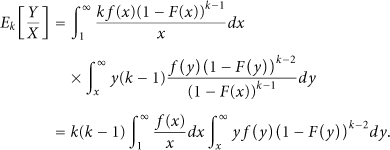
Substituting accordingly, we immediately obtain the following corollaries for some natural distribution functions.
Corollary 5.7.
Let
Now, consider the distribution
Corollary 5.8.
Let
In fact, for this distribution, we may say something much stronger.
Lemma 5.9.
Let
Proof.
Due to the geometric bin properties, all that is needed is to show that within each bin the probability that the second cheapest in that bin is more than
By noting, for
Lemma 5.10.
Let
6. Experimental Results
We now complement our theoretical investigations using network simulations. For this, in addition to the IAM and communities model on the random geometric graph (for which we provided theoretical bounds), we simulate several models of realistic wireless networks. While the theoretical bounds pertain to worst-case guarantees on the frugality ratio, in the simulations we can observe the distribution of frugality ratios, in many cases seeing much better performance than the worst-case bounds.
In our simulations, we consider networks consisting of 500 nodes. The primary reason for considering such a network is that while we have theoretical justification of bounds for the asymptotic case, we may obtain experimental justification for smaller numbers of nodes. This is particularly important as most realistic ad-hoc networks do not have more than 500 nodes [36]. Thus, 500 nodes is a reasonable size to consider; not so small that the FR obtained would be small trivially, something that we confirmed by simulations that showed that the FR is lower when the number of nodes in the graph is smaller. On the other hand, 500 nodes is not so large as to be redundant to the theoretical bounds and unrealistic in most circumstances.
We take the radius to be on the order to guarantee asymptotic connectivity. In particular, we take
As mentioned in Table 1, we ran simulations on 4 different community models.
The first model has a small number of communities with a large number of nodes in each community. In this model, we choose the number of communities The second model has a large number of communities with a small number of nodes in each community. Here, we choose k to be The mixed model has a small number of large communities (4) mixed with a large number of small communities (20). With probability of 0.7, a node decides to join a large community and then chooses one of the large communities uniformly at random. With probability 0.3, a node decides to join a small community and then chooses one of the small communities uniformly at random. We choose these numbers so that the large communities will be about the same size as in the The individual agent model (IAM) where all nodes are independent agents.
Each community chooses a price uniformly at random
We ran simulations on two different graph structures, the random geometric graph
We split the results into three parts: (1) UAR-BDD for
In general (unless we mention otherwise), the figures that will be shown below are combined from 3 different seeds, with measurements for around 75,000 (source, destination) pair samples.
6.1. The UAR-BDD Cost Model on RGG
In this section, we focus only on random geometric (RG) graphs where each community chooses uniformly at random a price
We compare the frugality ratio (FR) between the different community models. Figure 1 shows that, overall, we get a very good ratio; in fact, more than 95% of all the cases have frugality ratio below 1.4, which is much lower than the upper bounds that were proven in Theorem 5.3 for the IAM and Theorem 5.5 for the community models. In addition, we can see that when there are a small number of big communities in the graph, we get better results. For example, 88% of the cases in the

Comparing FR in the RGG with UAR-BDD cost distribution.

CDF of the number of communities in the spath (shortest path) on the RGG with UAR-BDD cost distribution.
We further justify the proposed explanation by showing that when there are more communities on the shortest path the frugality ratio is higher. In Figure 3, we represent each community by a box and whisker plot. The box has lines at the lower quartile, median, and upper quartile values. The whiskers are lines extending from each end of the box to show the extent of the rest of the data.

Frugality ratio versus number of communities in the spath, on the RGG with UAR-BDD cost distribution.
Outliers are data with values beyond the ends of the whiskers. We can see that, in general, the frugality ratio slowly increases as the number of communities on the shortest path increases (One may notice that when the number of communities is 5 and the number of communities on the shortest path is 5, the FR actually decreases; however, looking at Figure 2, we can see that we have few samples in this case since the curve almost reaches the 100%, and this is in fact an unusual case to happen). However, we can see that the worst-case frugality ratio is higher when the shortest path has fewer communities since the cheapest community is more dominant (a fact which we confirmed by the data).
In summary, a model with a small number of communities has lower frugality ratio. We will show next that this trend is consistent even when the costs are not bounded by a small constant, and therefore longer fluctuate in FR values may be expected.
6.2. The UAR-UNBDD Cost Model on RGG
In this subsection, we still focus on the random geometric graph, but now we will observe the UAR-UNBDD cost distribution model where a community's price
Overall, the results are consistent with the results of the previous section. Figure 4 shows that the frugality ratio in more than 99% of the cases is bounded by 4. The frugality ratio is, as expected, much larger than in the previous bounded case since the ratio between one community's price and another can be very big; however, it is still bounded by a small constatnt. Here, again, the

Comparing frugality ratio in the RGG with UAR-UNBDD cost distribution.

CDF of the number of communities in the spath on the RGG with UAR-UNBDD cost distribution.
As in the previous sections, Figure 6 shows that when the number of communities on the shortest path grows, the FR is higher. Also, we can see very clearly again that the worst-case frugality ratio is higher when the number of communities in the shortest path is smaller.

Frugality versus number of communities in the spath, with UAR-UNBDD cost distribution, in the RGG.
The difference here is in the individual agent model results. In the previous section, the individual agent model had similar results to the
We can see that even with weaker assumptions on the cost distribution we still obtain very low frugality ratios. The results remain consistent with the previous results, and models with smaller numbers of communities still yield better results in terms of the frugality ratio.
6.3. The UAR-BDD Cost Model on a Cluster Graph
We now consider the clustered graph model with UAR-BDD cost distribution. Figure 7 shows one example of a clustered graph in the mixed model. For a better clarity, we present only 8 communities (4 large communities and 4 small communities) out of 24 communities in total.
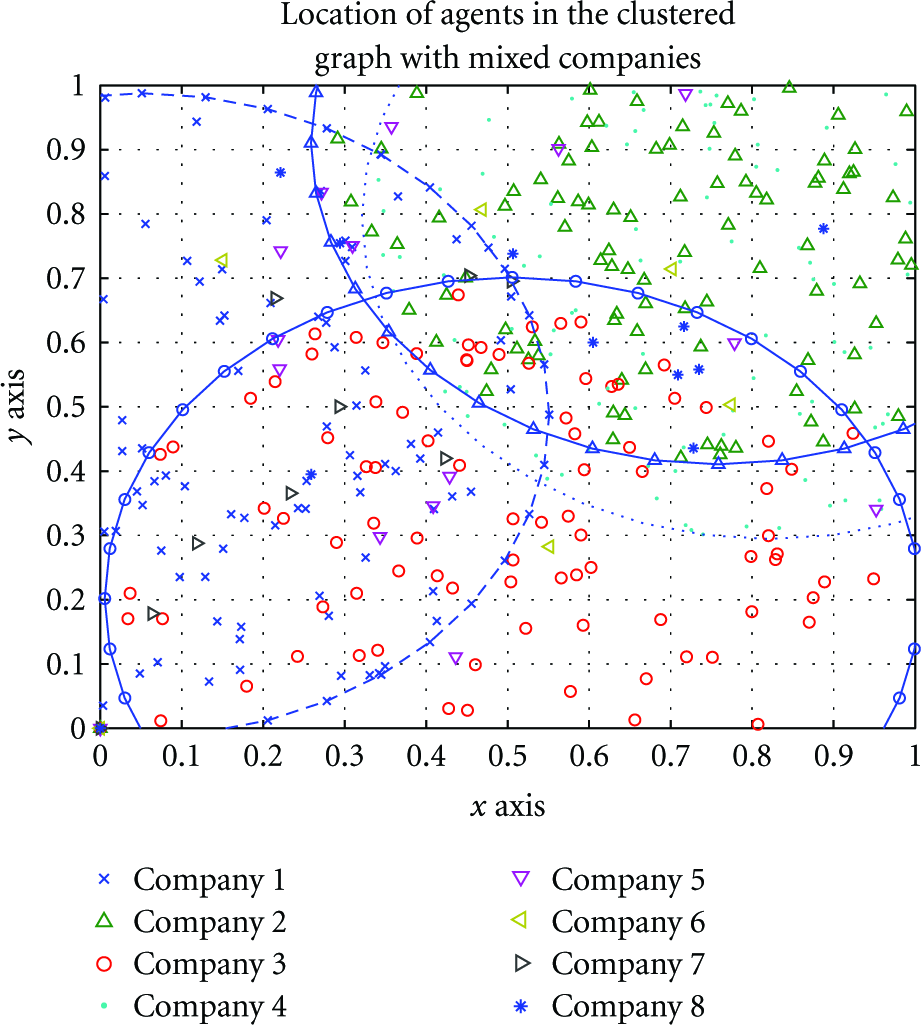
Example for a clustered graph in the mixed model, the figure shows only 8 communities (out of 24 communities in total).
As Figure 8 shows compared to Figure 1, there are some differences in these results. The frugality ratio of the
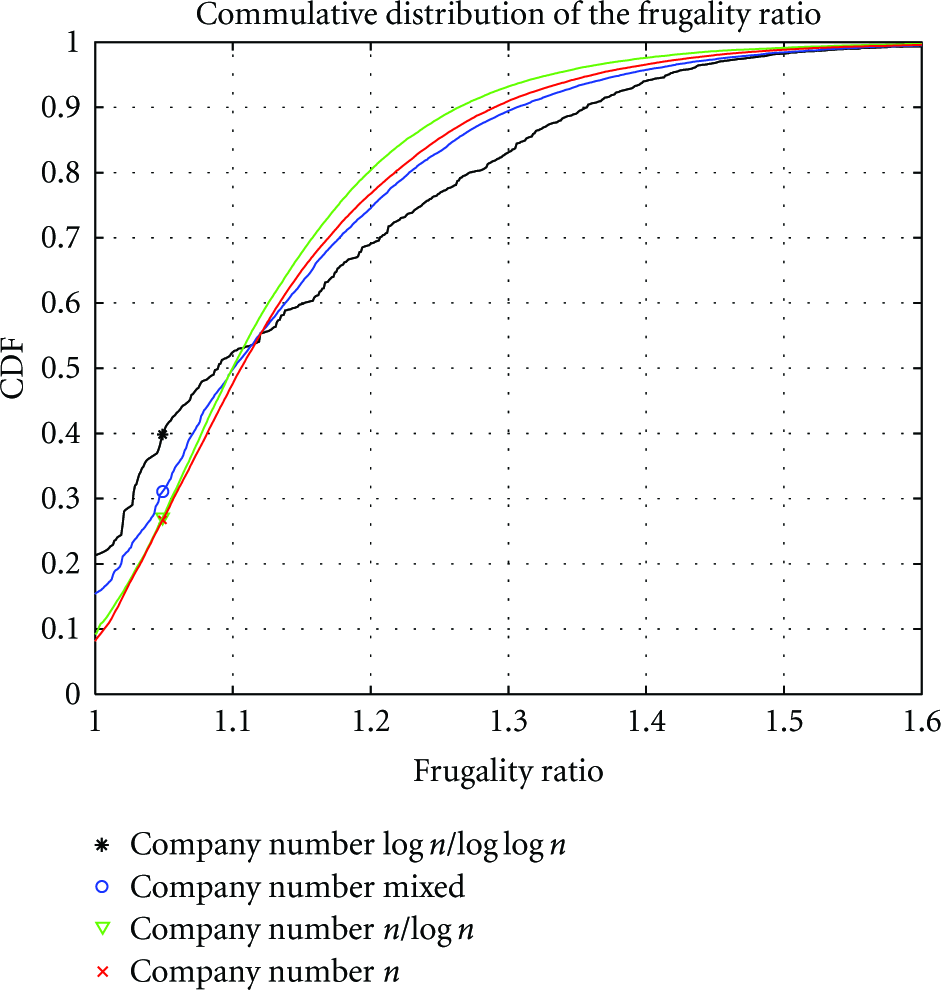
Comparing frugality ratio in the cluster graph with UAR-BDD cost distribution.

CDF of the number of communities in the spath with UAR-BDD cost distribution on a cluster graph.
We can see another big difference in the results of the
Consistent with Sections 6.1 and 6.2, Figure 10 shows that as the number of communities in the shortest path increases, the FR increases, and the worst-case FR decreases.
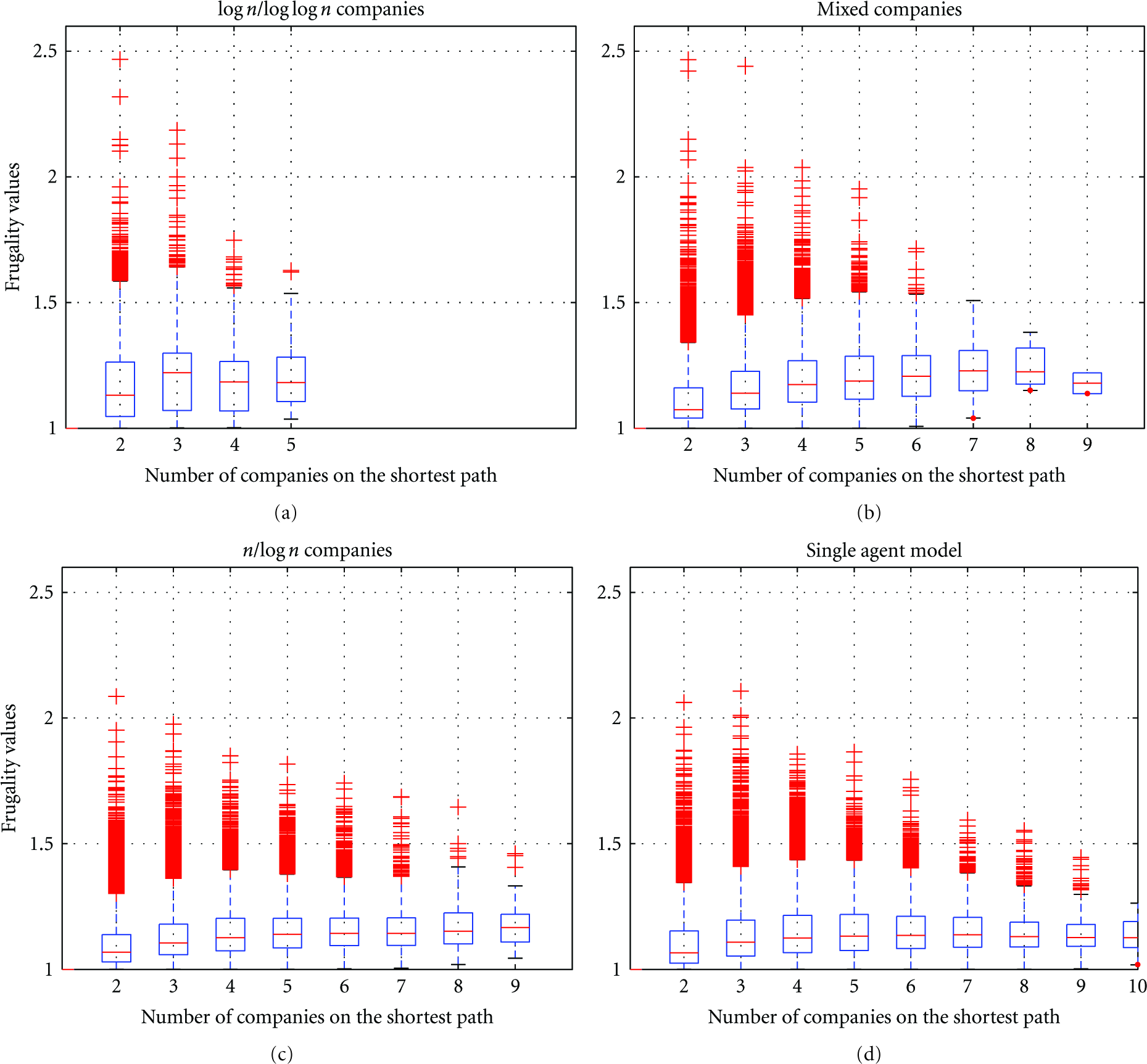
Frugality versus number of communities in the spath, with UAR-BDD cost distribution, in the clustered graph.

IAM and alternate paths.
In summary of this subsection, we can see that there are some major differences between the random geometric graph results and the clustered graph results. In particular, a model with large number of small community in clustered graph has better results in terms of frugality ratio.
In addition, we checked the sensitivity of payments when the prices changed by individual community, and the other communities' costs remain the same. We ran two different sets of simulations one on the random geometric graphs and another on the clustered graphs both using the UAR-UNBDD cost model. The simulations show that as expected from a truthful mechanism, a community gets about the same revenue if it has the cheapest price, and it does not matter what the price is. Overall, a community has a lower probability to be affected by price changes in the clustered model. However, once it is effected, the effect will be stronger in the cluster model. We omit the simulation results due to space constraints.
7. Hardness of Extensions
As has been noted, both simulation results and related work on the traditional path auction model [8–10, 30] suggest that a mechanism that minimizes some weighting of total path costs by the number of communities on the path may have a lower frugality ratio than VCG. Another immediate question is how one might generalize the
7.1. NP-Hardness of Extending
The first step of the
Lemma 7.1.
Consider the problem ℭ. Given a graph
7.2. APX-Hardness of Natural Extensions
Here, we show that any natural truthful mechanism with a selection rule incorporating some kind of minimization of the number of communities on the path is strongly approximation hard to compute. The same proof also implies the approximation hardness of even computing VCG for various other cost functions involving the community model, such as fixed community-network entrance fees (i.e., a one-time fee
First, for ease of notation, let us note the following:
Now, define a natural class of truthful mechanisms for path auctions in the community model.
Definition 7.2.
We call a truthful mechanism for path auctions in the community model (with per unit costs) a min-agent mechanism if its monotonic selection rule is of the following form. Given source s and destination t, select the path P from s to t that minimizes the product
Now, we proceed to our hardness results.
Theorem 7.3.
For any
Proof.
Let σ be an instance of
Taking g to be a constant function, we may obtain the following corollary.
Corollary 7.4.
VCG for the community model under fixed community subnetwork entrance fees is hard to approximate to within
8. Discussion
8.1. Summary
We have considered the cost of the generalized second price path auction (VCG) for incentive-compatible source-destination routing in a random ad-hoc network setting in which nodes may potentially be grouped, where we refer to each grouping as a community. We have proven bounds on the frugality ratio in this setting, namely, the ratio of the total payment made to every independent agent in order to ensure truthfulness over the actual cost of the shortest path. Whereas it is well known that this ratio may be arbitrarily bad for VCG as well as for truthful mechanisms in general, even when every edge or node is of unit cost, we are motivated by the understanding that worst-case results are often exhibited on pathological rather than typical case graphs and cost distributions. Therefore, we have asked our questions on a model of the typical case class of graphs for ad-hoc networks, namely, random geometric graphs. And, we have considered both arbitrary costs without any assumption made on the distribution, as well as costs drawn from natural probability distributions. In all such cases, we have shown that VCG extended to capture communities exhibits constant frugality ratio with high probability given some reasonable assumptions on the maximum cost offset as well as certain natural unbounded cost distributions, and when no assumption is made on the maximum cost offset, the performance of VCG with communities is still very efficient (logarithmic in the offset) in expectation. Simulation experiments demonstrate even smaller frugality bounds than those given via theoretical results, and simulations also demonstrate small constant frugality ratio in the clustered community setting which was not considered in the theoretical bounds. We are the first to prove bounds on frugality for random geometric graphs. We are also the first to consider path auctions in the community setting, as well as the first to consider frugality bounds under natural cost distributions. None of our bounds follow from previous work and, thus, indeed pose as pleasant surprises.
Despite the positive note obtained from low frugality ratio in many natural settings for random ad-hoc networks, experimental results do suggest that frugality would still be improved had the truthful mechanism taken the number of communities on the chosen path (and thus the number of overpayments made) into account in addition to the total cost of the path which it already considers. Therefore, we examined general ways in which a truthful mechanism may take into account such considerations, but in all cases came across hurdles in computational complexity. We proved that for such classes of truthful mechanisms, even approximately computing the winning path is provably hard theoretically. Therefore, we contend with the positive note on low frugality ratio for VCG extended for communities, which we see is not only good but also “as good as it gets.”
8.2. Robustness of Results
We would like to note the robustness of our results under some alternative modeling assumptions. First, the assumption that all nodes in a community have the same cost is in a way strongly defining the community concept. If this assumption was wanting of relaxation, then note that one may take the bounds we have proven for the individual agent models (in which each node is its own community) as an extreme worst case, or simply enlarge the number of communities (change parameter k) considered to obtain tighter bounds. Second, if we were to relax the assumption of bounded broadcast radii, but rather assume a completely connected graph with only the cost distribution affecting payments, then this corresponds to the special case of taking the radius
Footnotes
Appendix
Acknowledgments
The authors thank Deborah Estrin for many helpful discussions about models for ad-hoc networks. We also thank Chen Avin, Ilya Shpitser, and Sandra Batista for helpful discussions, as well as the anonymous reviewers for very useful comments. This research was sponsored in part by the NSF Grants CCF-0427202 and CCF-0546170.