




Abstract
Routing metric is very important for performance of wireless ad hoc sensor networks. ETX and ETT routing metrics cannot accurately estimate the average transmission time since they do not take back-off scheme of IEEE 802.11 in Mac layer into account. We present a new available transmission time (ATT) routing metric based on IEEE 802.11 DCF, which considers available link bandwidth and also takes physical transmission rates into account. A plugin for OLSR routing protocol daemon is implemented on Linux platform, and experiments are taken to compare ATT with ETX and ETT. Our results show that the ATT metric has the lowest packet loss rate and the lowest jitter rate among the analyzed metrics. ATT also outweigh other two metrics in the network performance, so it is the most appropriate for wireless ad hoc sensor networks.
1. Introduction
Wireless ad hoc sensor network combines advantages of both wireless LAN and mobile ad hoc networks. It has become the key technology of next generation wireless networks [1]. IEEE 802.11 protocol is widely used as standard. It supports fixed infrastructure and ad hoc operation modes. Wireless nodes working in Ad Hoc mode, can construct routing in multihop collaborative manner. Wireless ad-hoc networks support multihops communication between access points to improve communication coverage and ensure connectivity. Thus, power consumption and mobility is not a major problem, routing protocols generally concern about the link quality [2–4].
Appropriate routing metric is significant for the performance of routing protocols. In [5], expected transmission count (ETX) routing metric is proposed. It considers the impact of links' packet loss rate on network performance. To further improve the performance of routing protocols, expected transmission time (ETT) is proposed in [6], which is based on the ETX and takes the influence of data transmission rate into consideration. Experiments show that ETT outweighs ETX [7] in network performance. Considering the link-competitive interference of IEEE 802.11 DCF, a new routing metric of expected data rate (EDR) is proposed in [7]. Reference [8] gives a theoretical analysis on various routing metrics and proposes several essential requirements for routing metric design. On the basis of EDR, a new routing metric which comprehensively take interpath and intrapath interference as well as channel diversity is presented and validated by simulation in [9]. In [10], the ETT-routing metric for open link state routing (OLSR) is implemented and tested in wireless test beds. Test results show that ETT is better than ETX. Reference [11] studies the MAC-aware link quality metrics and proposes a new wireless link quality metric of estimated channel occupancy Time (ECOT) which focus on improving network throughput.
IEEE 802.11 distributed coordination function (DCF) is widely used as the medium access control mechanism for wireless networks. Researches on routing metric usually do not consider the exponential back-off strategy in IEEE 802.11 MAC layer [12], which influences such performance as throughput, jitter, packet loss rate, and time delay. Thus, ETT-based routing metrics are not effective to assess the average time of packets transmission and reflect the available link bandwidth. OLSR may choose one 1-hop low quality links not two-hop high quality ones. Therefore, we propose a new kind of routing mechanism based on available transmission time measurement. Besides, in the platform of embedded Linux platform, we implemented an extension OLSR protocol [13] using ETX, ETT, and ATT.
2. Routing Metric
2.1. Expected Transmission Count
The ETX routing metric [5] is associated with packet loss rate. It is defined as the transmissions or retransmissions count required to successfully delivering a packet over wireless link. The ETX of a path is the sum of the ETX of each link along the path. ETX takes into account the possibility that link loss rates are asymmetric to calculate packet loss rate for bidirectional links. The probability that packets from senders to receivers are transmitted without errors is called forward delivery ratio and represented by
In order to calculate forward delivery ratio, probe package is sent by wireless node. Finally, ETX is defined as in the following equation:

ETX contributes to achieving maximization of link throughput. But the ETX cannot distinguish from different link bandwidths, packet loss rates of data frames with different sizes. Besides, it does not support multirate.
2.2. Expected Transmission Time
Expected transmission time [14] is used to estimate the time cost of sending a packet through link successfully. In order to calculate the link packet loss rate and bandwidth for forward and reverse link, respectively. The same method of broadcasting probe frame as ETX is used to detect packet loss rate. Link bandwidth is measured by packet-pair technology. ETT can be defined as in the following equation:

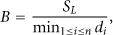
The advance of ETT is that it takes the link bandwidth into account. Suppose that there are N destination nodes in the wireless network, the source node could use back-to-back (unicast) packet-pair probings. This requires
3. ATT Routing Metric
In order to address the existing problems that ETX and ETT do not consider the MAC layer features, an available transmission time routing metric based on link bandwidth availability is proposed. This metric considers the relationship between the lost packet quality and the characteristics of 802.11 DCF. ATT is defined as the time of transmission required to successfully deliver a packet over the available bandwidth. The new metric is defined in the following equation:

Here,
IEEE 802.11 uses DCF algorithm to control media access, which is carrier sense multiple access with collision avoidance (CSMA/CA) strategy. DCF computes back-off time by binary exponential strategy as in the following equation:

CSMA/CA confirms a successful transmission through the ACK frame which is sent by the destination node. The destination node waits a short interval frame space (SIFS) and sends the ACK frame after receiving a packet. Since SIFS is shorter than DIFS, other nodes will not detect that the channel is idle longer than DIFS during transmission of ACK frame. If the source node did not receive ACK during extended interval frame space (EIFS), it will start retransmission according to the back-off rule of (5). At this time, an exception is that a destination node may have successfully received a packet but failed in the transmission of the ACK frame. The source node cannot differentiate in transmission errors between data frame and ACK.
As known, for the IEEE 802.11 protocol, the relationship between packet loss rate and back-off time is not linear. Linear growth of packet loss count will result in binary exponential growth of backoff time. Therefore, the node will have to wait longer for a chance to send frame, which causes link's bandwidth utilization to decline. ETT cannot accurately assess the average packet transmission time since it does not consider exponential back-off strategy in 802.11 MAC layer.
There are four states for DCF, wait, back-off, success, and collision, as shown in Figure 1.

States.
Let




It experiences success and back-off states when node successfully delivers a packet. If packet loss happens during transmission, the node needs to go through states of backoff, conflict, and success. If packets lose n times, the node experiences n conflicts additionally. Each additional packet loss leads to that back-off time increase in an exponential manner, which causes the cost of link bandwidth. So bandwidth availability




Generally speaking,
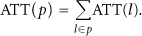
It is known that ATT is based on ETX. So ATT inherits the feature of additive. The cost of a path p can be described as the accumulative value of each link l in the path
4. Experiments
4.1. Experimental Settings
We have developed wireless nodes based on PXA270 processor and embedded Linux. Wireless communication is achieved by RT3070 chip which is compatible with 802.11n protocol. The full-function OLSR protocol is implemented on the basis of OLSR daemon written by University UniK. It supports both IPv4 and IPv6 addressing. Differing from other protocol stacks in the Linux kernel, OLSR daemon is implemented at the application layer in order to avoid kernel collapsing because of error programs. ETT and ATT routing metrics are implemented using the plugin of link probe which is developed by Pedro. In our experimental platform, B is obtained from lower layer and maintained by higher layer protocol according to the quality of the transmission medium. Besides, we also bring ETT and ATT link quality algorithm code to olsrd, which corporates with routing metrics and additional ETT and ATT value to LQ HELLO and LQ TC messages. Therefore, latest ETT and ATT will be carried to its neighbors with LQ HELLO messages and spread to all other nodes in the MANET through TC messages periodically, which makes no additional cost to global information collection of routing protocol.
Due to limited actual conditions, the test environmental layout is shown in Figure 2. Wireless nodes work in ad hoc and 802.11n mode using channel 1. The highest point to point bandwidth is 130 Mbps. In order to test the actual throughput, packet loss rate and delay jitter from end to end. Laptop computers A and B, which run Iperf UDP server and client respectively with 250 KB UDP buffer, are placed at the ends of the corridor.

Performance testing.
4.2. Test Results
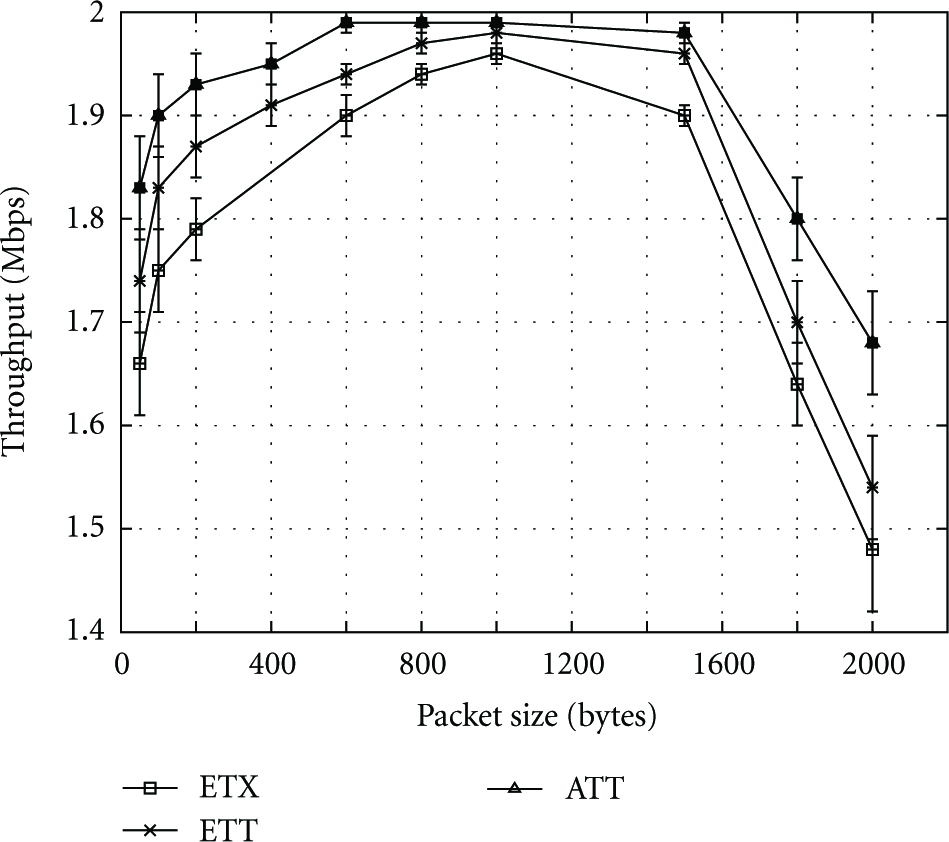
IEEE 802.11 and Ethernet protocols use the same size of MTU (1500 Bytes). In our experiments, we use different size of UDP packets under 2 M bandwidth to test throughput, packet loss rate, and delay jitter between node A and B. Parameters of OLSR daemon are shown in Table 1, and ATT's parameters are the same with ETX's. The experimental results are shown in Figure 3.
OLSR parameters.

Throughput.
As shown in Figures 4, 5, and 6, along with the change of packet size, ATT does better than ETT and ETX. Actually, the packet of 1000 bytes could take full advantage of channel bandwidth with minimal jitter delay. The throughput is very close to 2 M. Otherwise, large packet (>1500 bytes) has greater impact on the throughput and jitter than small one. It is due to that UDP protocol cannot guarantee the arriving order of packets according to ID because of packet fragmentation and defragmentation. Basically, small packet has better performance than large packet.

Jitter.

Packet loss rate.
Throughput.
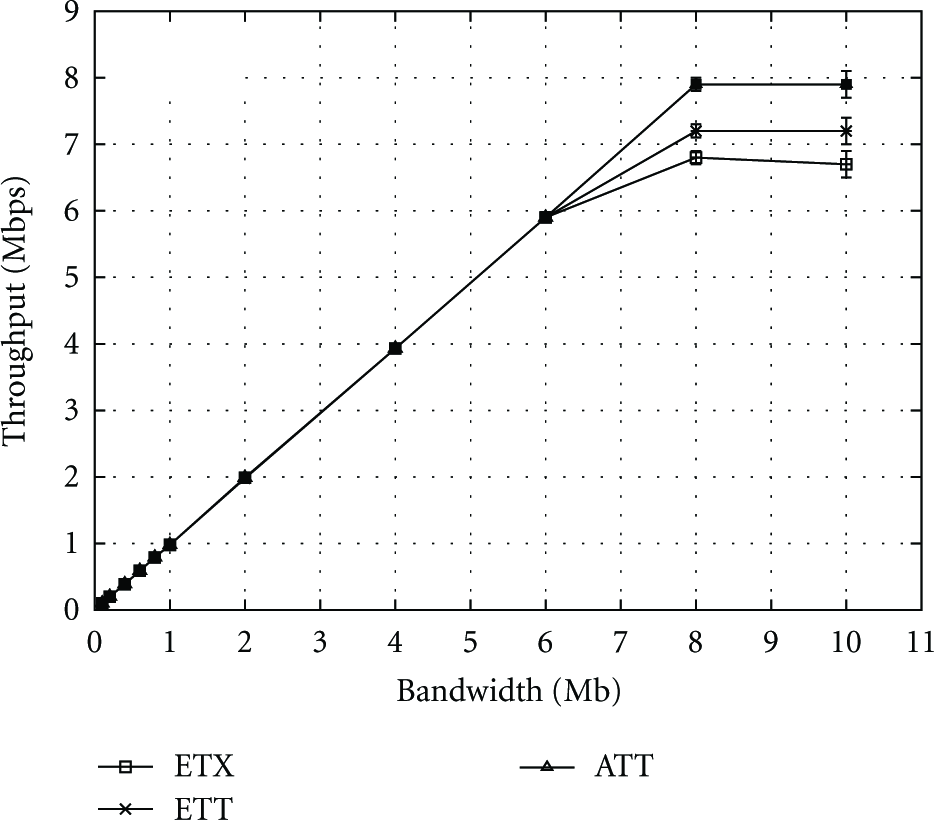
The packet of 1000 bytes has the lowest packet loss rate. Based on the above discussion, we know that it has better performance than others under bandwidth of 2 M. Subsequently, we use packet of 1000 bytes to test and compare performance of ETX, ETT, and ATT under different bandwidth conditions.
Figure 6 shows the end-to-end throughput. Benefiting from the high bandwidth of 802.11n, the end-to-end throughput is up to 8 Mbps satisfying the various requirements of transmission bandwidth for different services.
Figures 6 and 7 show that packet loss rate increase along with bandwidth because of radio channel competition and UDP buffer overflow. In Figure 8, when the bandwidth increases, jitter increases. More UDP packets will be cached in the buffer. Packets can not be transmitted timely will result in the increasing of delay jitter. Audio signal is more sensitive to jitter than channel bandwidth. Certain audio application should choose the appropriate bandwidth.
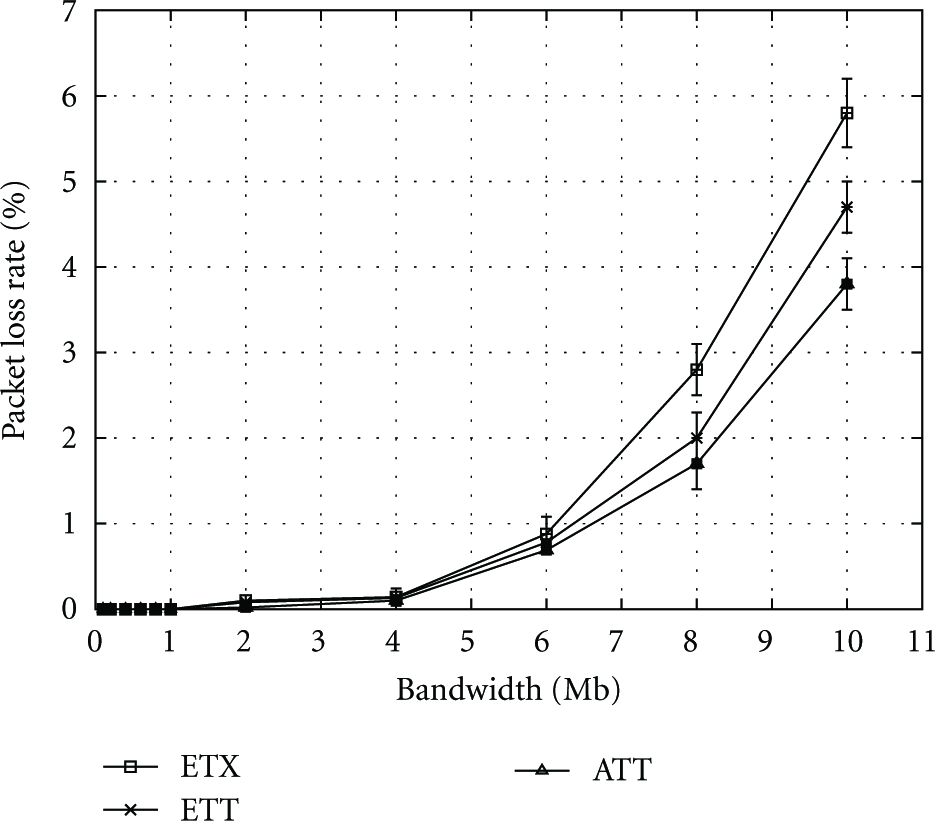
Packet loss rate.
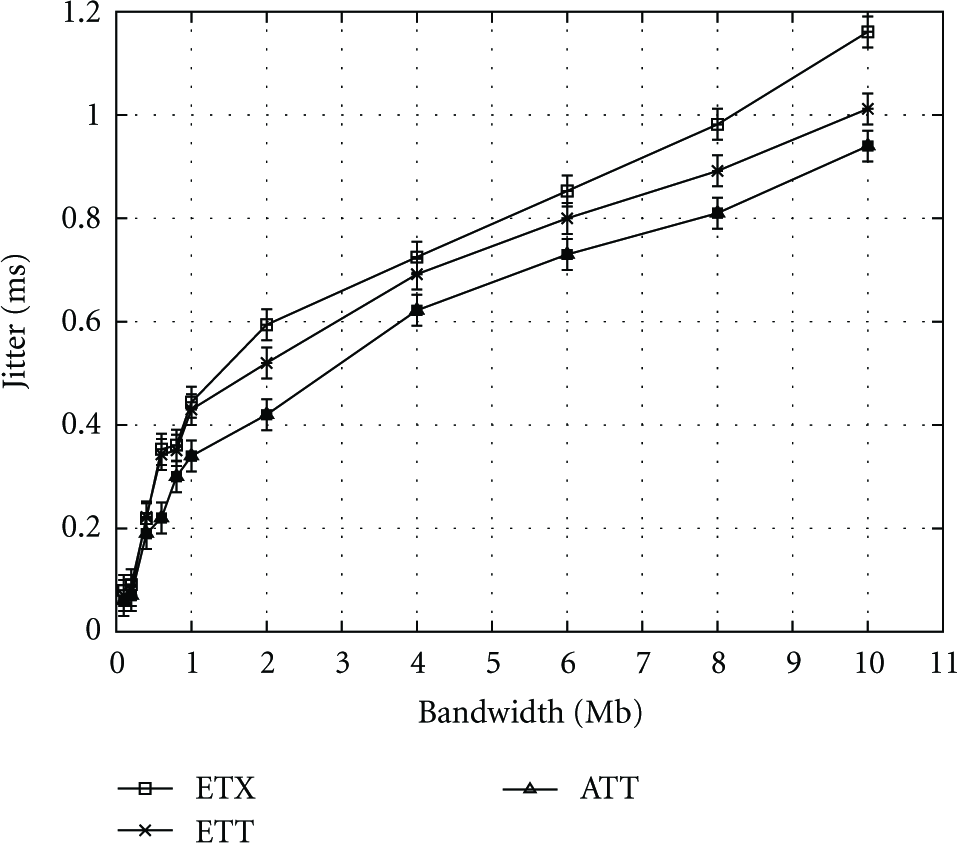
Jitter.
5. Conclusions
This paper takes back-off algorithm of MAC layer, which is ignored in ETX and ETT into account. With the analysis of 802.11 DCF, the route metric of ATT based on bandwidth availability is proposed. The ATT routing metric is extended and implemented using the Linux platform with 802.11n/OLSR protocols. The test results in experiments of ETX, ETT, and ATT show that ATT is more excellent in packet loss rate, jitter, and throughput than other two routing metrics since that ATT considers link condition together with actual transfer rate to get the best performance.