




Abstract
Tropical Cyclone (TC) track changes associated with Rossby wave energy dispersion are simulated in a shallow water primitive equation model with an initial field where a TC is located south of a subtropical high. An anticyclone east of the TC appears because of Rossby wave energy dispersion. The connection of the anticyclone with the subtropical high leads to a poleward TC track deflection. The TC eventually moves across the axis of the subtropical ridge. The formation of the track may be attributed to the nonlinear interaction between the subtropical high and the TC. This work validates the conceptual model proposed by previous observational research. The scenario of the nonlinear interaction between the TC and the subtropical high may also be modified through the influence of mesoscale vortices. The main modifications are (1) the anticyclone induced by energy dispersion of the TC weakens, (2) the connection between the anticyclone and the subtropical high is delayed, and (3) the TC shifts more westward and does not move across the ridge axis. We propose that some of the mesoscale vortices are axisymmetrized by the TC and results in an increase in TC size which modifies the properties of the energy dispersion. The phase and group speeds decrease and produce a simulated track deflection to the left compared to the simulation without mesoscale vortices. Our numerical results demonstrate that multiple scale nonlinear interactions have an essential role in influencing TC track changes.
1. Introduction
The dynamics of TC motion have been studied over a long period of time. The main influences on motion are (1) environmental currents (e.g., [1, 2]), (2) the beta effect (e.g., [3–6]), and (3) asymmetric convection (e.g., [7, 8]). The problem of TC track prediction, in fact, is made more difficult when all three factors are operating simultaneously. As indicated by Elsberry [9], each of the components varies in time and interacts in a nonlinear manner, and the key point is that TC motion is a multiple scale, nonlinear interaction problem. In the current study, we use idealized simulations to investigate aspects of factors (1) and (3) and describe firstly how the steering flow can be modified by a nonlinear interaction between the TC and the environmental flow and secondly how asymmetric convection in the form of mesoscale vortices can also influence the track.
As we know, as a TC moves northwestward in the Northern Hemisphere, it emits Rossby wave energy southeastward, forming a synoptic-scale wave train with alternating anticyclonic and cyclonic vorticity perturbations [10, 11]. Most studies have focused on the development of cyclonic systems by the energy dispersion process [12–14] and its effect on TC genesis. The study here focuses on how the dispersion process can change the environment of the storm and, hence, influence TC motion. If a TC is located south of a subtropical high, the anticyclone that forms by energy dispersion may connect with the subtropical high. It results in an increase in the north-south extent of the subtropical high and leads to a poleward TC track deflection (see Figure 1(c) in [15]). Therefore, not only does the TC move northwestward because of steering by a subtropical high and the beta effect but also the flow structure of the subtropical high can be modified through the presence of the TC and thus influence its motion.
The dynamics of the interaction between the subtropical high and the TC (which we call the western TC from here on) may also be changed when another TC (called the eastern TC), located to the east of the western TC, is involved. In the conceptual model regarding the indirect TC interaction proposed by Carr and Elsberry [15], the cyclonic relative vorticity advection to the northwest of the approaching eastern TC will tend to weaken the anticyclone induced by the western TC energy dispersion, and may even cause a break between the anticyclone and the subtropical high. In this scenario, the poleward steering flow decreases, and the western TC track becomes more westward. We then ask the question: can adjacent mesoscale vortices produce similar changes in track of the western TC?
In this study, we focus on the scenario related to the interaction between a subtropical high and a TC in two-dimensional simulations to validate the Carr and Elsberry's conceptual model. In particular, noting that the introduction of another TC could change the interaction process [15], we also consider whether the dynamics of the interaction of the subtropical high with the TC could also be changed when adjacent mesoscale vortices are involved. We then consider the scenario related to the dynamics of the interaction between the three components (subtropical high, TC, and mesoscale vortices).
The remainder of the paper is organized as follows. In Section 2, we briefly introduce the model and experimental design. The interaction of a subtropical high with a TC, and its effects on the TC track in two-dimensional simulations are presented in Section 3. Also in Section 3, the interaction dynamics between a subtropical high, a TC, and mesoscale vortices are described. Interpretation of the simulations is discussed in the context of theoretical linear barotropic dynamics in Section 4. Finally, a summary is given in Section 5.
2. Model and Experiment Design
2.1. Shallow Water Primitive Equation Model
A shallow water primitive equation model is used. The complete prognostic equations are,

where u is the east-west zonal velocity, v is the north-south meridional velocity, P=gh is the geopotential, g is the gravitational acceleration, and h is the depth of the fluid. Here u * =hu, and v * =hv, K=(u2+v2)/2. The potential vorticity q is given by

where f is the Coriolis parameter.
2.2. Boundary Conditions
At the north and south borders, set

To prevent gravity waves reflected at the edges of the domain from propagating back into the vortical area, a simple sponge ring is employed. The computational formula is as follows (taking the west border as an example):

where
2.3. Initial Conditions
Set

where h T ,h S , and h R stand for the fields of height of the TC, the subtropical ridge, and the mesoscale vortices, respectively. H is the resting fluid depth with H=5 km. Set

where h0T is the TC intensity parameter, r
m
is the radius of maximum wind,
Set

where f=2Ωsin φ, Ω the angular velocity of earth rotation, φ the latitude, f0 = 2Ωsin φ0, φ0 the latitude at the middle line of the computational domain. hS0 is the parameter of the subtropical high intensity, w the distance between the north and the south borders. β=(2Ω/a)cos φ, a the earth radius. Let φ0 = 20° N, hS0 = 10 m, and w=2000 km.
The method proposed by McWilliams [16] was used to produce the initial mesoscale vorticity field ξ R (x,y,0). McWilliams's method has been already applied extensively (e.g., [17–20]).
Ψ R (x,y,0) can be worked out from ξ R (x,y,0) by successive overrelaxation, and then ξ R A (x,y,0) through ξ R A (x,y,0) = ∇2Ψ R (x,y,0), and the difference Δξ R = ξ R A − ξ R can also be obtained. The maximum of Δξ R /ξ R is smaller than 0.1%. u R (x,y,0) and v R (x,y,0) are then calculated via Z×∇Ψ R (x,y,0), where Z is the vertical unit vector.
∇2h R (x,y,0) can be calculated from ξ R (x,y,0),u R (x,y,0) and v R (x,y,0) using the following formula:

h R (x,y,0) may be obtained from ∇2h R (x,y,0) by successive overrelaxation. (g(∇2h R (x,y,0)) − (fξ R +2J(u R ,v R ))) max is smaller than 0.01%.
The initial height field can be computed by replacing h T (x,y,0),h S (y,0) and h R (x,y,0) into (5).
u(x,y,0),v(x,y,0) are determined by the following formulas:

where u S ,v S can be obtained from h S (y,0) in terms of the geostrophic wind approximation, and u T ,v T can be obtained from h T (x,y,0) and the gradient wind approximation.
2.4. Computational Scheme
The model domain is 2000 km × 2000 km with 5 km grid resolution, the time step is 2.5 s. Five-point spatial smoothing is performed every 10 minutes. The Arakawa scheme is employed for special difference and the Asselin scheme for time integration. Let (x m ,y m ) = (1000,1000) km, let (x o ,y o ) = (1750,750) km, and let y s = 1500 km, where (x m ,y m ) the coordinates of the domain center, (x o ,y o ) the initial TC center, y s the initial position of the subtropical high ridge. The positions of the TC and subtropical high are shown in the ensuing section.
2.5. Assessment of Initial Stochastic Vorticity Field
The initial stochastic vorticity fields ξ R (x,y,0) are generated using McWilliams's method that is adaptable to two-dimensional decaying turbulence. There is a need to assess whether this method can also be applied to vortex interaction dynamics.
The distribution of initial vorticity over the lower half of the domain, where 0┼y┼1000 km, is shown in Figure 1. Several mesoscale vortices are located west and southwest of the TC. The distribution over the upper half of the domain, where 1000 km┼y┼2000 km, is not shown because the subtropical high calculated from (7) is located over this region and shown in Figure 3. The effect of the stochastic vorticity field on the subtropical high is very weak.
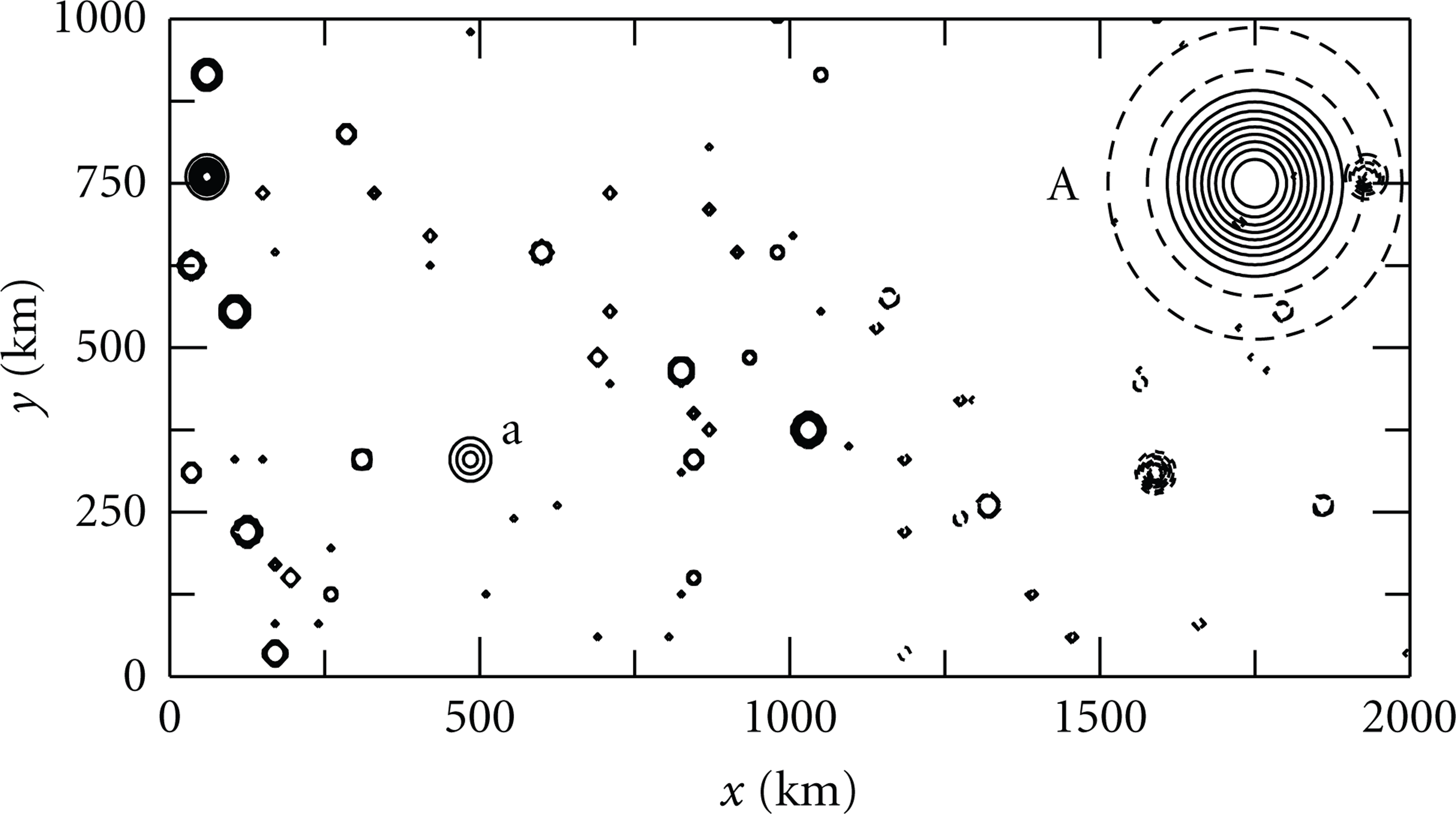
Distribution of initial vorticity in the lower half domain. Latter a denotes a mesoscale vortex, A denotes the TC, and solid (dashed) lines denote positive (negative) value; respectively, the interval is 2.0 × 10⁻⁴ S−1.
Tropical depression David in the real atmosphere was located southeast of Taiwan Island at 03:00 UTC 20 September 2005. It has a double-centered structure. Several mesoscale cloud clusters Gama1, Gama2,…, to Gama7 are located west and southwest of David's center (Figure 2) and extend to at least 1000 km from the center. The distribution and spatial scales are somewhat similar to the representation of mesoscale vortices shown in Figure 1.
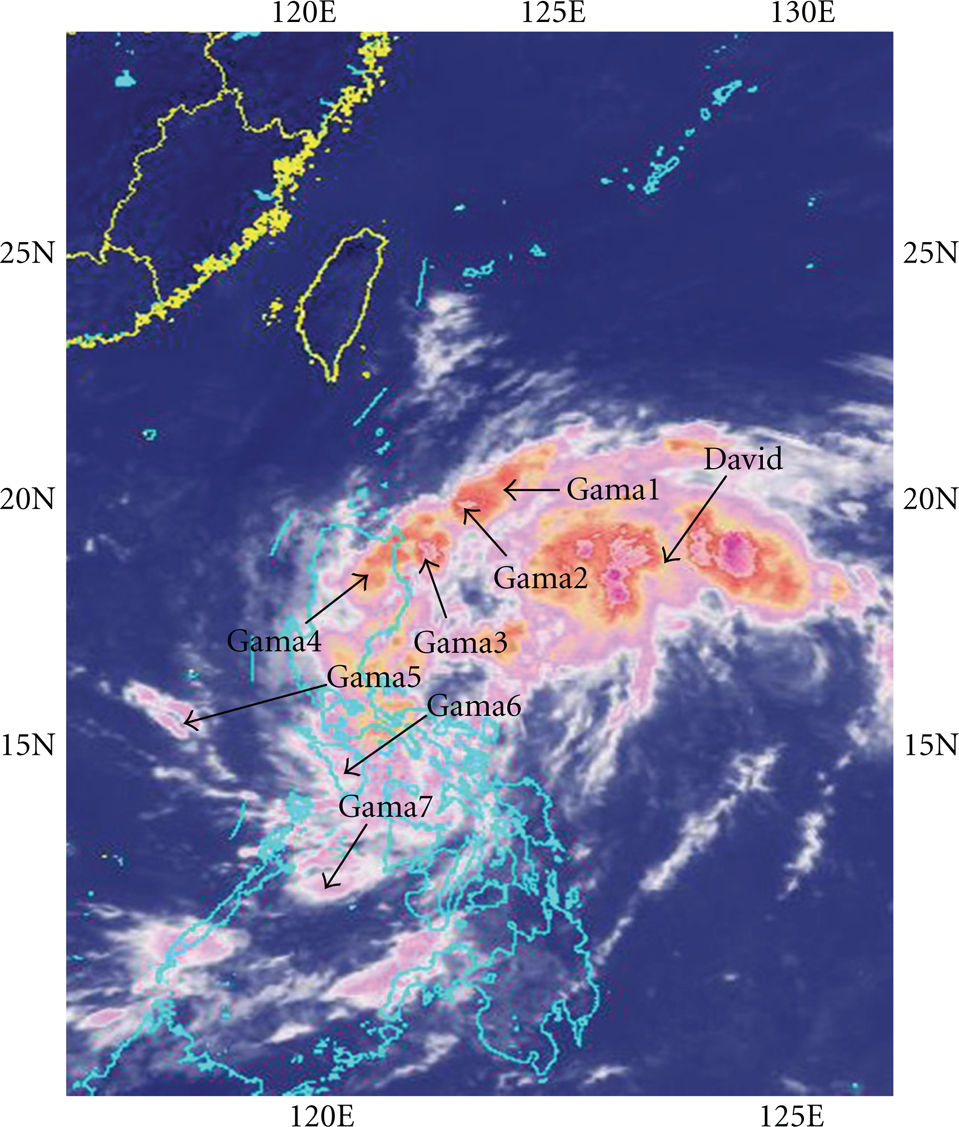
FY-2 infrared cloud imagery at 03:00 UTC 20 September 2005.
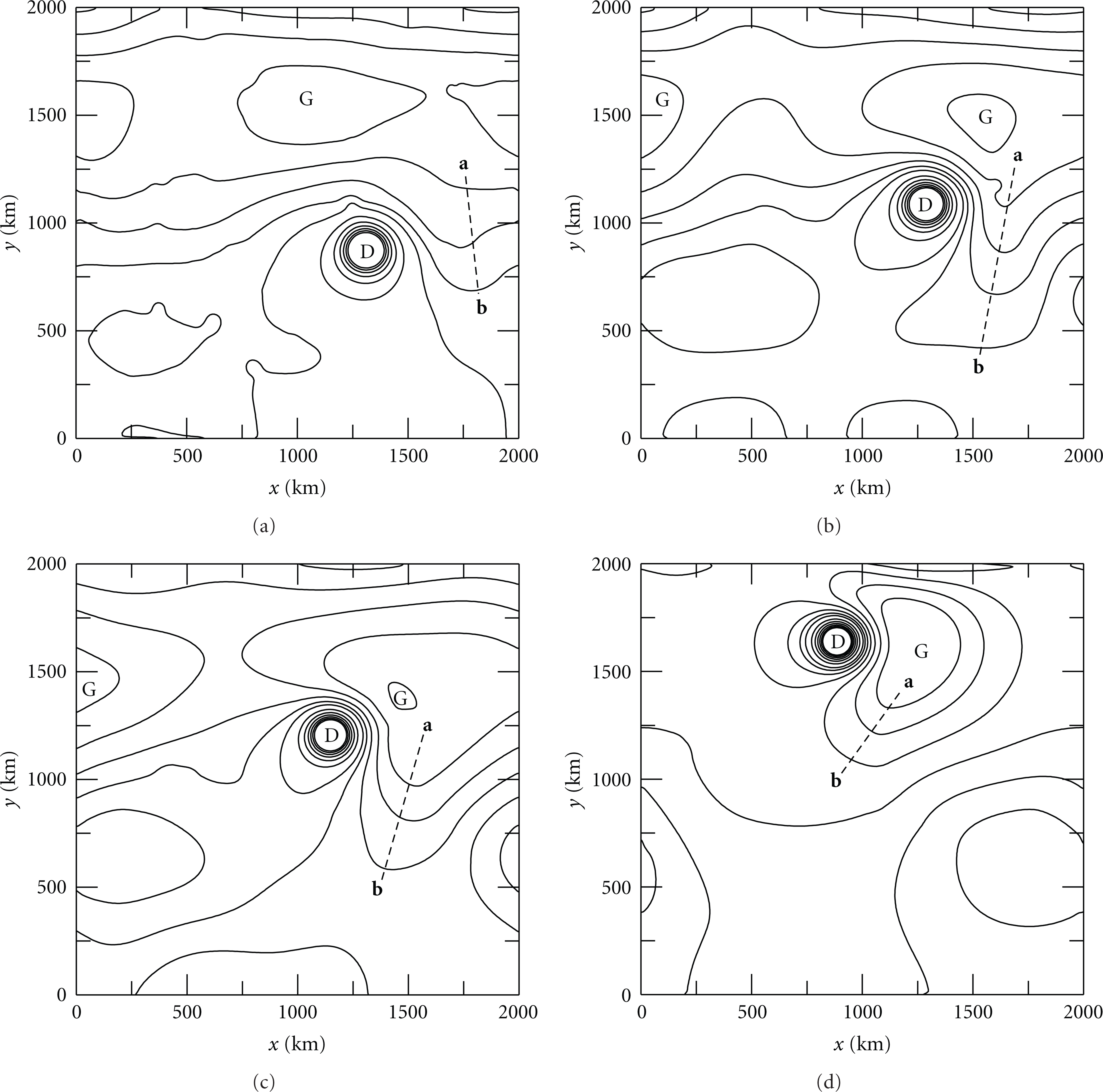
The height fields in EX1. At t=16 h (a), 40 h (b), 48 h (c), and 72 h (d). D indicates the TC center; G is the center of subtropical high; (
Kondo et al. [21] analyzed the statistical characteristics of the mesoscale convective cloud clusters in summer over the West Pacific and the neighboring coastal continents. Their results indicate that there is a peak near 30 km in the frequency curve of the radii of cloud clusters. The radii of the mesoscale vortices in Figure 1 are approximately 25–35 km.
Gentry et al. [22] reported the low-level convergence field for a large convective asymmetry derived from aircraft observations of Hurricane Gladys. The total circulation for the low-level convergence field was estimated to be approximately 1.9 × 10⁶ m2s−1 by Enagonio and Montgomery [23]. The total circulation for the mesoscale vortex in the initial field in Enagonio and Montgomery [23] is equal to 1.6 × 10⁶ m2 s−1. The total circulation for mesoscale vortex
The assessment described above is preliminary. There is a need to continue to understand the adaptability of the McWilliams's method to the application here. However, the method provides a very useful way of setting up mesoscale vortices with appropriate horizontal scales for our experiments.
2.6. Experimental Design
Four simulations are performed. The integration times are 72 h. Experiments are labeled as follows:
EX1: TC and a subtropical high in the initial field;
EX2: TC only in the initial field;
EX3: TC and mesoscale vortices in the initial field;
EX4: TC, subtropical high and mesoscale vortices coexist in the initial field.
We note that further experimentation on varying the background state and TC size and intensity is planned to further understand the processes discussed here. This work will be reported on at a later time.
3. Results and Discussions
3.1. Dynamics of the Subtropical High-TC Interaction: EX1
The change in the Coriolis force with latitude determines that a mature TC is subject to Rossby wave energy dispersion. As a result of this process, a synoptic scale wave train with alternating anticyclonic and cyclonic vorticity perturbations can form [10]. Carr and Elsberry [11] found the existence of these wave trains in both a barotropic model and the Naval Operational Global Atmospheric Prediction System forecast fields. Carr and Elsberry [15] further proposed a conceptual model regarding the dynamics of the interaction between a subtropical high and a TC, based on Rossby wave energy dispersion. While the TC is located south of the subtropical high, an anticyclone produced by the energy dispersion of the TC can connect with the subtropical high, resulting in a poleward track deflection (see Figure 1(c) in [15]).
A subtropical high and a TC coexist in the initial field in EX1. A weak ridge (
3.2. Effect of the Interaction between a TC and Mesoscale Vortices on TC Energy Dispersion and Track: EX2 and EX3
EX2 is the TC's only experiment. A weak anticyclone appears northeast of the TC at t=16 h because of Rossby wave energy dispersion (Figure 4(a)). The anticyclone intensifies and extends southward at t=24 h and 32 h (Figures 4(b) and 4(c)). The center of the anticyclone is located east of the TC at t=40 h (Figure 4(d)). This anticyclone corresponds to the ridge(

The height fields in EX2 and EX3. (a) 16 h in EX2, (b) 16 h in EX3, (c) 24 h in EX2, (d) 24 h in EX3, (e) 32 h in EX2, (f) 32 h in EX3, (g) 40 h in EX2, (h) 40 h in EX3. D indicates the TC center, G is the center of the anticyclone. The contour interval is 20 m in the TC area and 5 m over the rest of the domain.
In EX3, a TC and several mesoscale vortices are present in the initial field (see Figures 1 and 2). Effects of the mesoscale vortices on the TC energy dispersion and track are as follows. First, the size of the TC increases relative to the run without mesoscale vortices. Second, the mesoscale vortices delay the formation of the anticyclone. The anticyclone induced by the Rossby wave energy dispersion does not emerge until t=24 h (Figures 4(b) and 4(d)). Third, the anticyclone is weaker at t=32 h in EX3 when mesoscale vortices are present (Figure 4(f)) compared with EX2 without them (Figure 4(e)). Fourth, the introduction of mesoscale vortices leads to a TC track deflection. Luo [10] focused on the effect of the anticyclone induced by Rossby wave energy dispersion on the TC track using a nondivergent barotropic model. He found that the TC moves in the direction of 327° in the presence of a strong anticyclone, while it moves in the direction of 314° in the case of a weak anticyclone. It implies that a weaker anticyclone will result in a track deflection to the left. In the current work, the TC moves in the direction of 298° during the interval (0–24) h in EX2, when there are no mesoscale vortices and the anticyclone is strong (Figures 4(a) and 4(c)); while it moves in the direction of 275° during the same period in EX3 when mesoscale vortices are introduced and the anticyclone is weak (Figures 4(b) and 4(d)). The track deflection to the left is thus associated with the mesoscale vortices and the weaker anticyclone during the (0–72) h period.
A comparison between TC center positions from EX2 and EX3 shows that the TC center position difference is around 120 km at t=16 h (Figures 4(a) and 4(b)), 150 km at t=24 h (Figures 4(c) and 4(d)), 120 km at t=32 h (Figures 4(e) and 4(f)), and 87 km at t=40 h (Figures 4(g) and 4(h)). The average value is 119 km. The differences are related to the slower energy dispersion process (e.g., Figures 4(c) and 4(d) and later discussion). The average value differs from EX1 and EX4 where the track difference is around 200 km at t=48 h. Note that group and phase propagation are dependent on the background flow, and so we might expect that in the absence of environmental flow in EX2 and EX3, the influence mesoscale vortices may be altered. This dynamical interpretation is further discussed in Section 4.
In addition, the TC David in the real atmosphere seems to move westward rather than northwestward when adjacent mesoscale cloud clusters located southwest and west of its center exist (Figure 1). Although there are likely to be other physical processes forcing David's track, comparison between the numerical result (Figures 4(b) and 4(d)), and the observations for David suggest some preliminary similarities.
3.3. Effects of the Interaction between a TC, a Subtropical High, and MesoScale Vortices on TC Energy Dispersion and Track
In Ex4, the initial condition contains a subtropical high, a TC and mesoscale vortices. The anticyclone induced by the Rossby wave energy dispersion does not appear at t=16 h (Figure 5(a)). A weak ridge (

The height fields in EX4. (a) 16 h, (b) 40 h, (c) 48 h, and (d) 72 h. D stands for the TC center, G for the center of subtropical high
Comparison of Figure 5 with Figure 3 shows that the mesoscale vortices are able to modify the dynamics of the subtropical high-TC interaction. The main modifications are as follows: (1) the formation of the anticyclone slows down, (2) there is a smaller latitudinal extent of the merged anticyclone-subtropical ridge, and (3) the TC track no longer crosses the subtropical ridge (Figure 6).
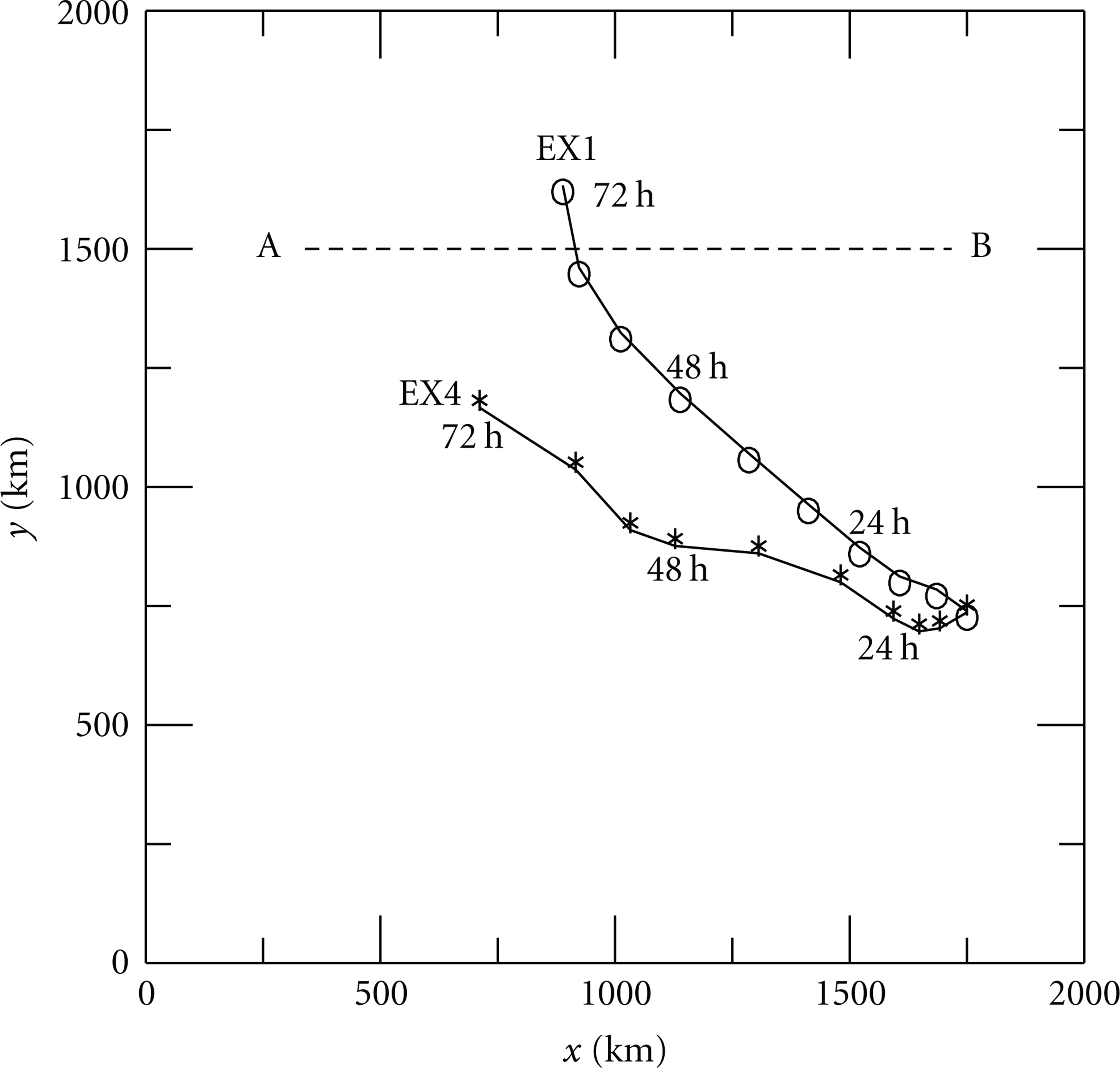
Tracks in EX1 and EX4. The TC center position is marked every eight hours. AB denotes the axis of the subtropical high.
4. Physical Interpretation of Dynamics
Our interpretation of the simulations is discussed in the context of the theoretical behavior of Planetary Rossby Waves. The dispersion relation for Planetary Rossby Waves (PRWs) in a meridionally varying background zonal flow, U(y), can be written as
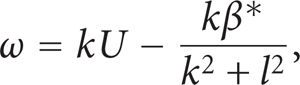
where ω is frequency, U is the background zonal flow, k is the zonal wavenumber (k=2π/L x , L x is zonal wavelength), l is the meridional wavenumber (l=2π/L y ,L y is meridional wavelength), and β * =β-d2U/dy2, the meridional gradient in the absolute vorticity of the background flow, with β the beta-plane parameter.
The zonal phase and group propagation speeds are:

It is straightforward to show from the above equations that as storm size increases both Cp and Cg decrease.
In our simulations, the size of a TC may be defined by the total number of grid points enclosed by the outermost contour of the TC circulation. The height contour of 4980 m is used to define the TC circulation. The average value of the total number of TC grid points for the period (0–24) h in EX2, when only a TC exists, is 5637, while that in EX3, when the TC and mesoscale vortices are present, is 6585. This represents a size increase of 16%. Similarly, the average value of the total number for the period (0–24) h in EX1, when a TC and subtropical high are present, equals 5934, while that in EX4, when the TC, subtropical high, and mesoscale vortices coexist, equals 6732. This is a 13% size increase. Therefore, it is found by diagnosing the model output that the introduction of mesoscale vortices produces an increase in the size of the TC during the early part of the simulation. It appears that many of mesoscale features are axisymmetrized by the original TC and become part of the outer circulation. As discussed theoretically above, we suggest that this influences the properties of the energy dispersion.
Since Cg decreases as storm size increases, there is a delay in the formation of the anticyclone. This delays the onset of the enhanced southerly steering flow, and the storm's motion to the north is reduced when mesoscale vortices are introduced. The zonal phase speed, Cp, also decreases for larger storms, and so the net effect of the introduction of mesoscale vortices is to produce a deflection to the left of track compared with simulations without mesoscale vortices. We propose that this deflection stems from the initial presence of mesoscale vortices, which then change the size of the storm and this in turn influences the properties of the energy dispersion.
5. Summary
TC track changes associated with Rossby wave energy dispersion are simulated in a shallow water primitive equation model. The sequence of events may be summarized as follows: (1) while a TC is located south of a subtropical high in the initial field, it moves westward because of the steering flow from the subtropical high, (2) an anticyclone east of the TC develops because of the Rossby wave energy dispersion, (3) the connection of the anticyclone with the subtropical high increases the latitudinal extent of the latter and leads to a poleward deflection in the TC track, and (4) the TC finally moves across the ridge axis of the subtropical high, forming an unusual track. Our numerical results validate the conceptual model proposed by Carr and Elsberry [15].
We also find that the scenario related to the interaction between a TC and a subtropical high may be modified because of the involvement of mesoscale vortices. The main modifications are (1) the anticyclone induced by energy dispersion of the TC weakens; (2) the connection between the anticyclone and the subtropical high is delayed; (3) a TC track deflection to left occurs. As a result, the TC does not move across the subtropical ridge axis, and the unusual track does not appear. We suggest that the mesoscale vortices are axisymmetrized by the TC circulation and initially increase the storm size. This increase in size modifies the properties of the energy dispersion. The group propagation decreases, and delays the development of the anticyclone to the east of the storm, which in turn delays the onset of the southerly steering flow. The zonal phase speed also decreases and the net result is a track deflection to the left of the original track.
Luo [10] pointed out that a TC track deflection to left could occur when the anticyclone induced by energy dispersion of the TC weakens using a barotropic quasi-geostrophic model simulation. It implies that the results in both the quasgeostrophic model in Luo [10] and the shallow water primitive equation model in this paper are consistent.
Previous studies have suggested that Rossby wave energy dispersion of a preexisting TC may be a triggering mechanism for TC genesis (e.g., [12, 24, 25]). Li and Fu [26] and Li et al. [2] demonstrated that six cases are associated with Rossby wave energy dispersion of a preexisting TC among 34 cyclogenesis cases analyzed in the Western North Pacific during 2000–2001 typhoon seasons. Follow-up studies [13, 14, 27] also shed more light on the dynamics of such events. Our numerical results show that Rossby wave energy dispersion plays an important role not only for genesis but also for unusual TC track changes.
We also note that the initial stochastic vorticity field used in this study to generate mesoscale vortices has a similar distribution with the cloud imagery for some TCs in the real atmosphere (e.g., Figure 1 and TC David in Figure 2). The TC track deflection to the left induced by the involvement of mesoscale vortices in the simulation is also possibly similar to that which occurred for TC David. It would be interesting to consolidate this finding and study how frequently and how such processes influence storm structure and motion.
As indicated by Elsberry [9], the key point is that TC motion is a multiple scale, nonlinear interaction problem. Our numerical results confirm this point of view. Nonlinear interactions among the three components involved have an essential role in unusual TC track changes.
We have produced the initial mesoscale vorticity field using the McWilliam's method. Although preliminary assessment of the technique is encouraging for the application here; how to more accurately prescribe the initial mesoscale systems is still a problem to be solved. Further, the sensitivity of the simulations to the choice of parameters such as background flow and TC structure and intensity require further investigation. It would also be valuable to study observationally and using full physics numerical simulations, the influence of mesoscale vortices on TC behavior. The idealized simulations discussed here have provided valuable insights into the behavior of TCs, but clearly have limitations in representing the real atmosphere. We believe it is now possible, armed with the knowledge gained from analysis of the idealized simulations, to explore these important scale interactions in more complex numerical simulations. The dynamics of scale interactions still require further detailed investigation. Specifically, we want to understand the way in which the mesoscale vortices interact with the TC circulation to affect its structure. These are possible directions of future research.
Footnotes
Acknowledgments
This work was supported by the National Natural Science Foundation of China (Grants no. 40775038, 40875031, 40975036, and 40730948) and the Oversea Professor Program of the Chinese Academy of Sciences under the Grant no. 2010T1Z28. The authors are grateful to an anonymous Reviewer for his thoughtful comments, which improved the manuscript.