




Abstract
Experimental tests were carried out to investigate the effects of adding water-based ferrofluid to diesel fuel in a diesel engine. These effects included the combustion performance and exhaust emission characteristics of the diesel engine. To this end, emulsified diesel fuels of 0, 0.4, and 0.8 ferrofluid/diesel ratios by volume were used in a four-stroke diesel engine, operating at 2200 rpm. The results indicate that adding ferrofluid to diesel fuel has a perceptible effect on engine performance, increasing the brake thermal efficiency relatively up to 12% and decreasing the brake-specific fuel consumption relatively up to 11% as compared to diesel fuel. Furthermore, from the analysis of gaseous species of engine exhaust, it was found that NO x emissions were lower than that of diesel fuel while the CO emissions increased. In addition, it was found that nanoparticles can be collected at the exhaust flow using a magnetic bar.
1. Introduction
In recent years, the concept of using water-diesel emulsion to reduce undesirable emissions and fuel conservation in compression ignition engines has been an active area of research. Water injection is an old technique, dating back to the early days of internal combustion engines when it was used to increase power [1].
Many claims have been made for the use of fuel emulsions, such as reduction of fuel consumption, more complete combustion, and reduced exhaust emissions [2, 3]. Studies have shown that using emulsion fuels in internal combustion engines is an effective method for the reduction of NO x , soot, and particulate emission [4–6], In addition, it was found that adding water to diesel fuel can lead to reduction of heat flux, metal temperatures, and the thermal loading of combustion chamber components [7].
Recently, scientists and engineers have applied nanotechnologies to the field of fuel engineering. Since nanoparticles are small enough, their properties are significantly different from those of large, microsized particles [8]. Studies have shown that nanosized energetic metals and boron particles (with dimensions less than 100 nanometers) possess desirable combustion characteristics such as high heats of combustion and fast energy release rates. Because of their capability to enhance performance, various metals have been introduced in solid propellant formulations, gel propellants, and solid fuels [9]. According to this study, there are many advantages of incorporating nanosized materials into fuels and propellants, such as shorter ignition delay and shorter burn times. Furthermore, nanosized particles can be dispersed into high-temperature zones for direct oxidation reaction, rapid energy release, and enhanced propulsive performance with increased density impulse.
Studies have been also done to investigate the effect of adding nanoparticles to fluids. It has been reported that adding nanoparticles to a fluid can enhance its physical properties such as thermal conductivity, mass diffusivity, and radiative heat transfer [10–12].
In recent years, adding nanoparticles to liquid fuels has been the subject of much investigation, and results have been reported. Using nanoparticles with a high surface area to volume ratio can considerably increase contact between the fuel and oxidizer [13]. In addition, nanoparticles affect the time scale of chemical reactions, and as a result, the ignition delay time will decrease [14]. Furthermore, it has been reported that adding nanoparticles to diesel fuel can significantly increase the ignition probability of the mixture [15]. However, little work has been reported on the effect of adding nanoparticles to diesel fuels.
An experimental study on a diesel engine in 2008 showed that adding aqueous aluminum nanofluid to diesel fuel will increase the total combustion heat, while the concentration of smoke and nitrogen oxides in the exhaust emission from diesel engine will decrease [16]. Similar results have been reported in 2010 for adding Cerium oxide nanoparticles to biodiesel [17]. According to this study, adding nanoparticles will improve the brake thermal efficiency and will reduce the emission level of hydrocarbon and NO x .
The studies cited have shown that emulsified fuels and nanoparticles promote fuel combustion. To our knowledge, Magnetic nanoparticles have not been used before. So in this study, a water-based ferrofluid is added to diesel fuel to explore the effects on engine performance and exhaust emissions of a diesel engine. In addition to the novelty of this study, using water-based ferrofluid has two advantages compared to other nanopowders. First, it can be diluted and can therefore reap the benefits of water-diesel emulsion. Secondly, the most important preference of ferrofluids compared to other nanoparticles is that magnetic nanoparticles can be collected at the exhaust of the engine and they will not cause pollution.
2. Ferrofluid
Ferrofluids are colloidal suspensions of magnetic material in a liquid medium that respond to an external magnetic field. In other words, ferrofluids exhibit liquid-magnetic coupling behavior, in which the liquid's location can be manipulated by an applied magnetic field.
One of the most important features of ferrofluids is their stability, which means that particles in the fluid do not agglomerate and phase-separate even in the presence of strong magnetic fields [18].
The ferrofluid used in this study is a handmade water-based ferrofluid prepared by the authors. The synthesis was based on reacting iron II (FeCl2) and iron III (FeCl3) ions in an aqueous ammonia solution to form magnetite, Fe3O4, as shown in the following equation:

The cited procedure claims that those nanoparticle diameters are on the order of 10 nm [18]. Furthermore, aqueous tetramethylammonium hydroxide ((CH3)4NOH) solution which was used as a surfactant can surround the magnetite particles with hydroxide anions and tetramethylammonium cations to create electrostatic interparticle repulsion in an aqueous environment [18]. Figure 1 shows a TEM graph of Fe3O4 particle distribution. The average particle diameter is about 10 nm, which is in accordance with prediction.

TEM graph of Fe3O4 particle distribution.
3. Experimental Setup and Procedure
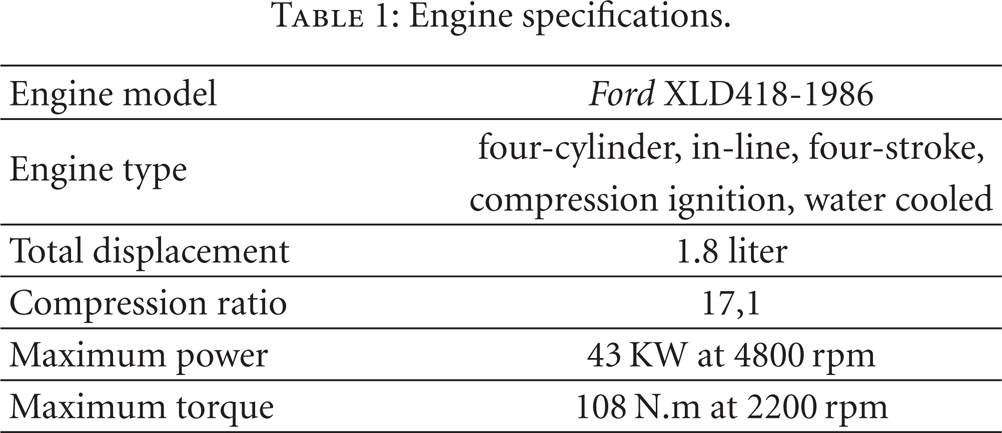
The engine used was a Ford XLD418. The engine specifications are listed in Table 1.
Engine specifications.
To measure the speed and the torque of the engine, a hydraulic dynamometer was coupled with the engine. The gaseous species of engine exhaust were measured by a flue gas analyzer (Testo 350). A schematic of the experimental setup is shown in Figure 2.

Schematic view of experimental setup. (1) Diesel Engine, (2) Dynamometer, (3) Control panel, (4) Fuel tank, (5) Fuel flow meter, (6) Air tank, (7) Air filter, (8) Gas analyzer.
In order to study the effects of adding ferrofluid to diesel fuel, tests were conducted at 2200 rpm. Initially, all experiments were carried out with diesel fuel. Then, mixtures of diesel and ferrofluid having 0.4% and 0.8% volumetric proportions of ferrofluid, respectively, named D+4F and D+8F, were used as fuel, and the experiments were repeated.
To minimize the effects of different fuels on each other, the engine was allowed to operate for 15 minutes to clean the fuel system before testing each fuel. In each test mode, the engine was allowed to operate for a few minutes to reach a sTable condition. Subsequently, the performance and exhaust emission parameters were collected. The accuracies of the measured parameters are given in Table 2. The error analysis for derived quantities was performed by the method of Kline and McClintrok [19].
The accuracy of measurements.

During the test, the engine was cooled continuously to maintain the temperature in a certain range. Furthermore, to ensure the repeatability of the experiments, all tests were repeated twice.
In order to collect magnetic nanoparticles, a magnetic bar consisting of longitudinal magnetic fins was placed in the exhaust pipe. Figure 3 shows a schematic of the magnetic bar. An electronic balance (Sartorius BP221S) with accuracy of 0.1 gr was used to weigh the collected magnetic nanoparticles.

Schematic view of magnetic bar located in the exhaust pipe.
4. Result and Discussion
4.1. Engine Performance
The brake-specific fuel consumption (BSFC) and the brake thermal efficiency (BTE) can be calculated by the engine torque, the engine speed, and the mass consumption rate of the fuel. Figures 4 and 5 show the BSFC and the BTE variations under different loads for 2200 rpm.

Variation of BSFC with respect to engine load at 2200 rpm.

Variation of BTE with respect to engine load at 2200 rpm.
For all fuels, the BSFC decreases with an increase in the engine load, while the BTE increases with the increase in engine load for all different fuels. This is obvious from the fact that the increase in fuel required to operate the engine is less than the increase in brake power at higher loads.
As shown in Figure 4, adding a ferrofluid to diesel fuel will decrease the BSFC. According to experimental results, adding 0.4% ferrofluid to diesel fuel decreased the BSFC relatively by 3.23–6.45%, and adding 0.8% ferrofluid to diesel fuel decreased the BSFC relatively by 5.06–10.85%.
The decrease in BSFC can be due to the positive effects of nanoparticles on physical properties of fuel [10–12] and also reduction of the ignition delay time, which lead to more complete combustion [14]. In addition, it can be due to effects of nanoparticles on fuel propagation in the combustion chamber. On the other hand, nanoparticles added to diesel fuel increase the mixture momentum and, consequently, the penetration depth in the cylinder. As a result, combustion is improved. This result is also in agreement with similar experiments done [16, 17].
In addition, the higher viscosity of the emulsified fuel than that of the base fuel and the presence of water promote a finer, cloud-like atomization of the emulsified mixture during injection, resulting in improving combustion efficiency significantly [20].
It has been claimed that the water in the emulsified fuel improves the combustion process owing to the simultaneous additional braking of the droplets, to the increase in evaporation surface of the droplets and to better mixing of the burning fuel in air [21].
Figure 5 shows the variation of BTE under different loads for all fuels. BTE is dependent on BSFC, and thus the BTE of D+4F and D+8F similarly improved compared to diesel fuel for the same reasons.
As shown in Figure 5, BTE increases with an increase in load for each fuel. Adding 0.4% ferrofluid to diesel fuel increased the BTE by 3.33–6.89% relatively and adding 0.8% ferrofluid to diesel fuel increased the BTE by 5.33–12.17% relatively.
Based on the results, it can be concluded that adding ferrofluid to diesel fuel has a perceptible effect on engine performance.
4.2. Oxides of Nitrogen
The variation of nitrogen oxides (NO x ) emissions with load is presented in Figure 6 for different fuels. As seen in this graph, NO x emissions increase with engine load for all fuels. Furthermore, compared with diesel fuel, D+4F and D+8F decreased NO x emissions at all loads.

Variation of NO x with respect to engine load at 2200 rpm.
Adding 0.4% ferrofluid to diesel fuel decreased NO x emissions by 9 to 15 ppm, and adding 0.8% ferrofluid to diesel fuel decreased NO x emissions by 14 to 24 ppm.
Many factors contribute to the formation of NO x emissions. According to the Zeldovich mechanism, the formation of NO x is dependent on oxygen concentration, residence time, and temperature [22].
This reduction may be due to the latent heat of evaporation of water, the high thermal capacity of water, and also nanoparticles, which can reduce the temperature in the combustion chamber and consequently reduce NO x emissions. This result is also in agreement with similar experiments done with aqueous aluminum nanopowder [16] and cerium oxide nanoparticles [17].
4.3. Carbon Monoxide
The variation of carbon monoxide (CO) emissions with load is presented in Figure 7 for different fuels. It is observed that the CO emission decreased with an increase in engine speed for all fuels.
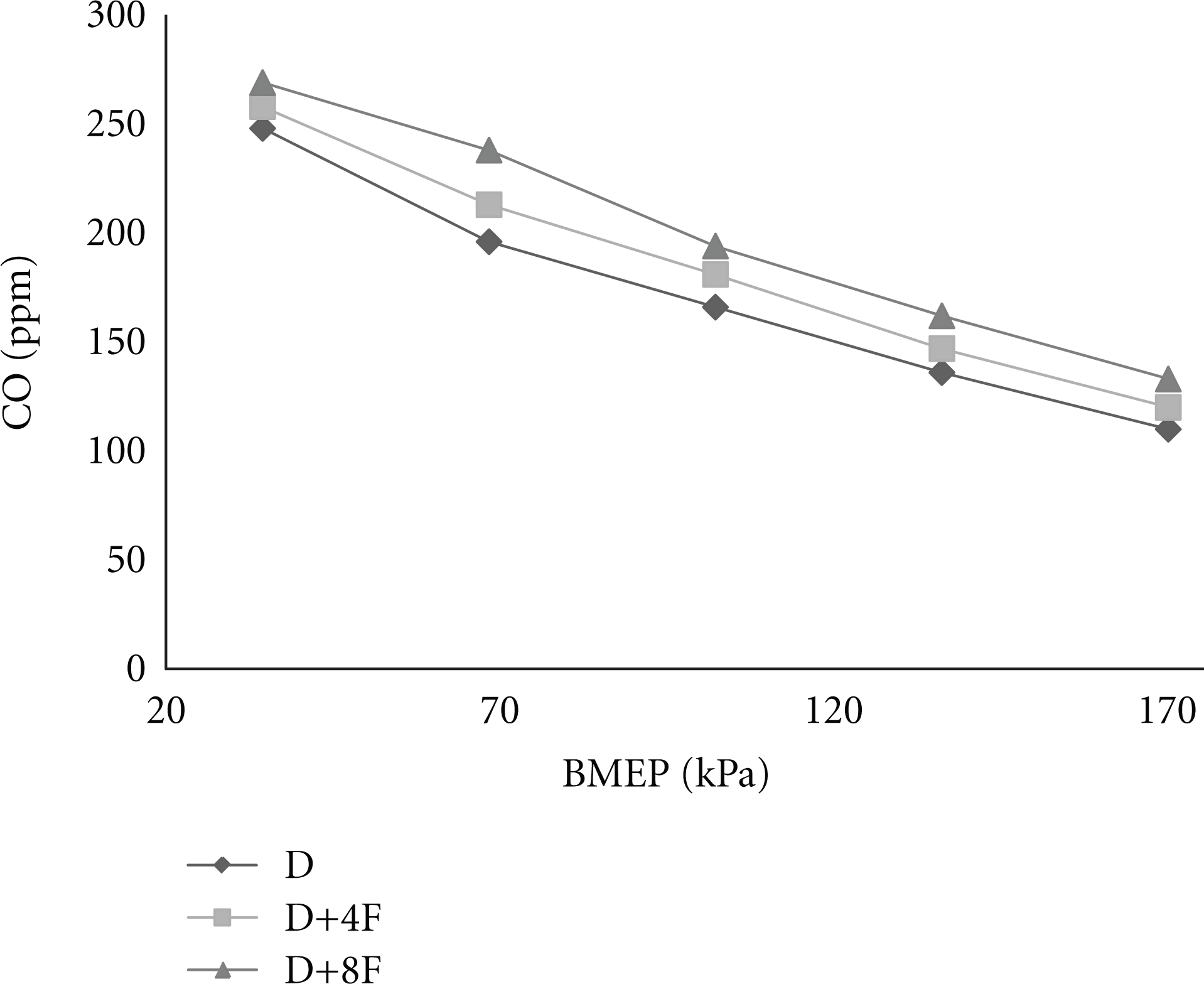
Variation of CO with respect to engine load at 2200 rpm.
An observation of Figure 7 shows that adding ferrofluid to diesel fuel increases CO emissions. D+4F increased CO emission by 10 to 17 ppm, and adding 0.8% ferrofluid to diesel fuel increased CO emissions by 21 to 42 ppm. Similar results are reported for adding cerium oxide to biodiesel [17].
CO emission greatly depends on the air-to-fuel ratio relative to stoichiometric proportions. Generally, CI engines operate with lean mixture, and hence CO emissions would be low [14].
As mentioned before, nanoparticles may have affected fuel propagation in the combustion chamber. Hence, the increase in CO emission may be due to operation of the engine using D+4F and D+8F in different situation compared to diesel fuel.
4.4. Nanoparticles
As mentioned previously, a magnetic bar was used to see whether nanoparticles added to diesel fuel can be collected or not.
After all tests, a magnetic bar was placed at the exhaust pipe for five minutes. After removal, it was observed that a portion of the magnetic nanoparticles were collected. Figure 8 shows the collected magnetic nanoparticles. Therefore, the results demonstrate one of the most important advantages of using ferrofluids as compared to other nanofluids; that is, magnetic nanoparticles can be collected and will not cause pollution.
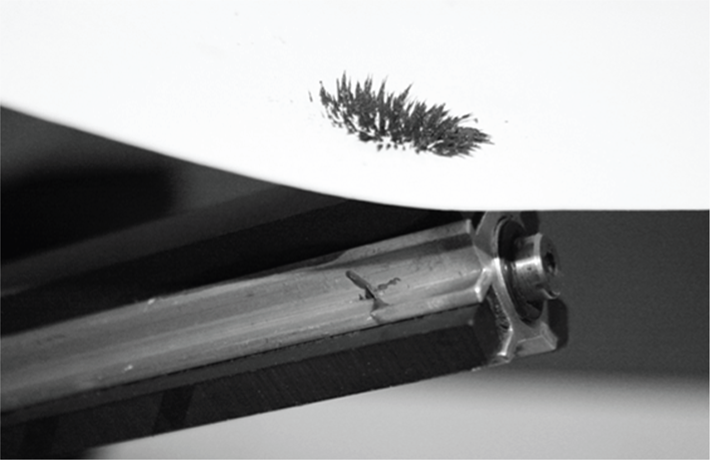
A side view of collected magnetic nanoparticles.
5. Conclusion
Experimental measurements and analysis were conducted on a four-stroke diesel engine to investigate the effects of adding water-based ferrofluid to diesel fuel. Engine tests were done for emulsified diesel fuels of 0, 0.4, and 0.8 ferrofluid/diesel ratios by volume at 2200 rpm.
The test results indicated that adding ferrofluid to diesel fuel not only improves engine performance (increasing BTE and decreasing BSFC) but also reduces NO x emissions. However, CO emissions increase. Furthermore, the results showed that increasing ferrofluid concentration will magnify the results.
In addition, results indicated that magnetic nanoparticles added to diesel fuel can be collected at the engine exhaust. However, further research and development on the collection of magnetic particles is also necessary.