




Abstract
Dynamic spectrum access technology has attracted much attention for its capability of improving spectrum efficiency. For attracting primary users to participate in secondary spectrum market, an auction was proposed as an alternative for spectrum trade. Existing auction schemes are either to be unilateral trade which only supports heterogeneous cognitive radio networks without guarantee of bid truthfulness, or to be truthful single-unit auction which only supports homogeneous channels. Few of them could comprehensively take all aspects of actual spectrum trade into consideration, such as spectrum allocation and reusability, channel diversity, and economic property. A truthful bilateral multiunit auction scheme which has characteristics of supporting heterogeneous networks (TBMAH) and polynomial complexity is proposed in this paper. We do experiments with both simulation and real networks, and the results show that TBMAH trades more spectrum resources than TRUST by 13.01% on average.
1. Introduction
Many researchers are interested and engaged in solving how to dynamically utilize spectrum resources efficiently in recent years. So far many dynamic spectrum access technologies have been proposed and auction is one of the best-known market-driven mechanisms among them. In contrast to the primary spectrum market conducted by spectrum administration department like Federal Communications Commission (FCC) in the USA and its counterparts in other countries, we mainly focus on secondary spectrum market in this paper, which is different from the primary one in three major aspects. Firstly, permitted spectrum access period of secondary spectrum auction is much shorter than that of primary auction, probably to be several hours versus several years. Secondly, secondary auction is performed within a local area while primary auction is executed across a nation or state area wide. Thirdly, many sellers and buyers are involved in secondary auction which is executed periodically by an acknowledged auctioneer with high reputation while primary auction is conducted by governmental department and participated in by some competitive wireless service providers.
Zhou et al. [1] proposes the first truthful spectrum auction-VERITAS which supports diverse bidding formats and multiple units auction, but VERITAS only addresses unilateral auction. Subramanian et al. [2] presents a coordinated dynamic spectrum access architecture which is composed of multiple buyers with heterogeneous channel width and one spectrum broker. The broker takes charge of collecting spectrum supply and demand information from sellers and buyers respectively, and executing auction process periodically. This architecture adopts physical interference model during spectrum allocation and multiplexes channel among nonconflict base stations. However, it is a unilateral auction and has no guarantee of truthfulness of bidding function. Zhou puts forward a general framework, TRUST, for truthful bilateral spectrum auction in [3, 4]. For the purpose of avoiding bid manipulation, TRUST adopts a bid-independent buyer grouping method and employs a truthful auction mechanism like McAfee double auction. This framework also considers the problem of spectrum reusability among nonadjacent buyers however, TRUST is a single-unit auction and only supports homogeneous channel. Other efforts either lead to market manipulation due to loss of truthfulness like [5–8] or have no consideration of reusability like [9, 10].
In order to establish a more practical secondary spectrum market, we analyze the problem comprehensively and propose a truthful bilateral multiunit auction which supports participations of heterogeneous networks. Our contributions are mainly in the following aspects.
For multiplexing channel among nonconflict buyers, we adopt a bid-independent grouping method with high reusability, tightly integrate spectrum allocation, and truthful auction components. For supporting multiunit heterogeneous auction, we generate bidding series for each competitive group according to bids of its group members and devise winners determination algorithm with polynomial complexity. For validating our auction scheme comprehensively and fairly, we compare our scheme with extended version of TRUST using different spectrum allocation algorithms, bid distributions, and real networks.
The rest of our paper is organized as follows. Section 2 describes spectrum auction problem formally and shows considerable factors in designing spectrum auction. We make detailed description of our auction scheme in Section 3 and illustrate results in Section 4 with both simulation and real networks, finally, Section 5 makes a conclusion for the full paper.
2. Spectrum Auction Problem Description
The scenario we considered consists of multiple spectrum providers and multiple spectrum demanders. Spectrum providers (probably to be licensed users with low spectrum utilization like TV stations) want to earn additional revenues by leasing spectrum at their spare time. Spectrum demanders (probably to be small wireless networks like AP or Femtocell) require more spectrum resources to alleviate their heavy business load, and accordingly they should pay spectrum providers some rental expenses. Like many literatures which pointed out that this problem is NP-complete, most researchers are pursuing its approximate algorithm. For the purpose of trading efficiently, we assume that there is one broker responsible for establishing relationship between both sides, executing spectrum allocation, charging buyers, and paying sellers in secondary spectrum market. We define spectrum auction problem of secondary market formally in the next part.
2.1. Spectrum Auction Problem Definition
For clarity of description, we define some notations first.
Set Similarly, set
Definition 1.
In a secondary spectrum market participated in by M sellers and N buyers, both seller
Secondary bilateral spectrum auction is carried out periodically, and both spectrum owners and lessees, respectively, submit their bids to the auctioneer during each auction period. We assume that the auction is bid-sealed and neither sellers nor buyers collude, spectrum resources collected from different sellers are not necessarily continuous, and demands of all buyers are not channel-specific.
For the purpose of simplicity, we adopt coverage-based interference model during spectrum allocation like [3], that is to say, two networks interfering with each other solely depends on whether their coverages overlap or not. So we assume that the auctioneer is capable of obtaining coordinates and transmission power of each node. With conflict graph generated and bids gathered from both sellers and buyers, what the auctioneer needs to do next is allocating the right number of resources to proper buyers with the goal of maximizing spectrum utilization, while guaranteeing economic properties and getting close to real market situation. Worthy considerations in designing and implementing an auction scheme are introduced in the next part.
2.2. Considerations of Spectrum Auction Scheme Design
We assume that all participants of the auction are sane enough and no participant is allowed to go back on his words. No seller is charitable enough to sell more resources with less revenue, and no buyer prefers to pay more money without obtaining more resources.
2.2.1. Truthfulness
An auction is considered to be truthful if it can ensure that the optimal strategy for each bidder is bidding with his true valuation of the object. That is to say, for any participant who bids untruthfully, the resulting utility he received is not bigger than that if he bids truthfully, which makes him have no incentive to bid untruthfully. A truthful auction simplifies bidding strategy of each bidder by just bidding what he really estimates instead of guessing what his competitors would bid.
2.2.2. Individual Rationality
For each seller
2.2.3. Ex-Post Budget Balance
After finishing the auction, charges collected from winning buyers should not be less than payments to winning sellers, so that the auctioneer can make both ends meet. The auctioneer is not allowed to pay out of his own pocket for promoting resources transaction.
2.2.4. Bilateral Auction
Existing unilateral auctions assume that there is only one spectrum seller or an agent gathering spectrum resources from multiple sellers. However, these schemes ignore competition among sellers in actual spectrum trade. So we insist on devising a bilateral auction for secondary spectrum market.
2.2.5. Reusability
Different from conventional goods (e.g., porcelain and painting), spectrum resource can be accessed simultaneously by more than one network provided that they do not interfere with each other. So a well-designed spectrum auction scheme should not neglect spectrum reusability problem.
2.2.6. Support of Multiunit
Both sellers and buyers may be eager to trade more than one unit spectrum resource in order to increase their revenue or alleviate business burden, the auctioneer may satisfy their entire or partial requirements according to supply and demand situations. So the auction should be devised strategically to support multiunit trade.
2.2.7. Support of Heterogeneous Networks
Every wireless network is deployed with an orientation to specific application area. Different spectrum buyers (cognitive users) have diverse spectrum usage rules. One of the most obvious and important differences is heterogeneous channel width, which equals to 200 KHz in GSM network and 20 MHz in WiFi. So the spectrum auction scheme should support heterogeneous networks.
Seldom prior efforts on spectrum auction consider this problem comprehensively, resulting that existing schemes can meet only a few of these requirements, which motivates us to do this work.
2.3. Utilities of Each Participant
In order to meet all of the requirements listed above, we adopt a Vickrey-Clarke-Groves (VCG-) style forward auction and a McAfee-style reverse auction.
Suppose that there are T items in set
For a McAfee auction, sellers are sorted in nondecreasing order by their bidding prices, the utility one individual seller obtains from single-unit spectrum equals to
What the auctioneer benefits from this auction is the difference between incomes from buyers and payments to sellers. We will give concrete utility calculation of each participant for our spectrum auction scheme in the next part.
3. Design Details of TBMAH
Design and implementation details of the truthful bilateral multiunit auction scheme with support of heterogeneous networks (TBMAH) proposed by us is composed of the following components.
3.1. Buyer Grouping Method
In order to utilize spectrum efficiently, we divide nodes which can share the same spectrum into groups. According to the coverage-based interference model we adopt, any two nodes within the same group are not interfering with each other. Buyer grouping problem can be transformed into the problem of finding chromatic number or maximum independent set of a graph, which is NP-hard and there is no efficient algorithm till now. Many approximate algorithms have been proposed, and we will make brief introduction of each algorithm and detailed comparison between them in Section 4.1.
3.2. Bidding Series Generation
After forming potential buyers into groups with a certain grouping algorithm, we generate bidding series for each bidding group. Details of bidding series generation algorithm is described as Algorithm 1, in which two notations are defined as follows.
Set Set
(1) consists of a certain number of nonconflict potential buyers. (2) (3) Initialize (4) (5) Traverse each buyer find the largest amount of resources requested by members of this group and denotes it with (6) (7) Symbol increasing resource amount and least unit spectrum price willing to pay by this group when k resources assigned. (8) (9) (10) (11) (12) (13) (14) (15) (16) (17) (18) (19) (20) (21) Push (22)
Algorithm 1: Bidding series generation algorithm.
As described in Algorithm 1, we first check the largest amount of resources requested by each group. For any
3.3. Winners Determination
Our winners determination algorithm is composed of two parts, namely, winning buyers determination and winning sellers determination respectively.
3.3.1. Winning Buyers Determination
With bidding series of competitive groups and the number of resources on sale in one auction period, the auctioneer assigns spectrum with the goal of maximizing total revenues from these bidders, which would lead to maximized number of transacted resources. Variable

In which symbol
We solve this problem with dynamic programming algorithm and record each intermediate state with an auxiliary two-dimensional array
(1) set G and the number of resources T for sale. (2) set G, those bidding groups with the amount of allocated resources larger than 0 are winners. (3) Initialize temporary two-dimensional vector rows and T columns. (4) Update this array with the following procedure: (5) (6) (7) Find the proper k resources allocated to buyer group there are i buyer groups and j resources left. (8) (9) (10) (11) (12) (13) (14) (15) (16) Initialize final assignment result R with size of λ and set temporary variable (17) (18) (19)
Algorithm 2: Winning Buyer determination algorithm.
3.3.2. Winning Sellers Determination
Our winning seller determination follows what McAfee proposed in [10], which is a VCG scheme in nature and commonly used in truthful auction. Sort sellers by their bidding price in nondecreasing order first, then find the maximal possible argument k with seller's asking price smaller than buyer's promising price, and the first
3.4. Pricing
Corresponding to winners determination, our pricing mechanism also consists of two components.
3.4.1. Costs of Buyers
Before charging each single buyer, we need to calculate firstly how much should one bidding group
(1) set G and assignment solution R produced in Algorithm 2, the amount of current available spectrum resource T. (2) resources allocated. (3) Derive net increasing bid resources allocated from neighboring elements of bidding series Π. (4) (5) (6) (7) (8) (9) (10) (11) Replace series bidding series (12) Substitute Algorithm 2, generate a new assignment (13) Initialize temporary variables zeros. Accumulate from other bidding groups when group or participates in the auction, respectively. (14) (15) (16) (17) (18) (19) (20) (21) (22) (23) (24) (25) (26) (27) (28) (29) (30) Charge of bidding group allocated equals to the difference of revenues obtained under these two situations. (31) (32) (33)
Algorithm 3: Pricing algorithm for bidding groups.
According to descriptions of Algorithm 3, after deriving net increasing bid of each group
Charge of each buyer

In (2), we accumulate charge of buyer
Consequently, the utility that buyer

As
3.4.2. Revenues of Sellers
For the sellers side auction, we simplify McAfee's double auction into single side auction. Revenues of each seller

In (4),

As sellers are sorted in nondecreasing order by their bidding price and seller
3.5. Complexity Analysis
With detailed descriptions above, our spectrum auction scheme TBMAH can be summarized in the following steps.
Step 1.
Accumulate total number of available resource T declared by potential sellers. Substitute T into Algorithm 1 to generate bidding series.
Step 2.
Substitute bidding series Π generated by Algorithm 1 and T into Algorithm 2 to determine final winning buyers.
Step 3.
Substitute bidding series Π and the optimal assignment result with T available resources into Algorithm 3 to produce pricing scheme for each bidding group and individual buyer.
Step 4.
Accumulate charge of each bidding group and revenue of each seller. For the auctioneer, if the total revenues from winning buyers are not less than payments to winning sellers, the auctioneer finishes the auction process with an extra profit, otherwise decrease T by 1 and go back to Step 2.
So time complexity of our scheme TBMAH is
Theorem 1.
For each bidding group

Proof.
Expression
TBMAH is executed iteratively, during a certain auction period, utility of the auctioneer equals to

3.6. Proof of Economic Properties
3.6.1. Individual Rationality
We prove individual rationality of winning buyers and winning sellers, respectively. If charges of all winning buyers are not bigger than their bids and revenues of all winning sellers are not less than their expected earnings, we say that they are rational.
Proof.
The difference between real charged value of buyer

According to (3) and Algorithm 1, we know that
For each winning seller, the clearing price is the kth bidding price and sellers are sorted by their bidding price in nondecreasing order, so winning sellers are payed more than what they desire.
Individuals in summary, both buyers and sellers are rational in our spectrum auction scheme-TBMAH.
3.6.2. Truthfulness
In this section, we try to prove that any bidding buyer
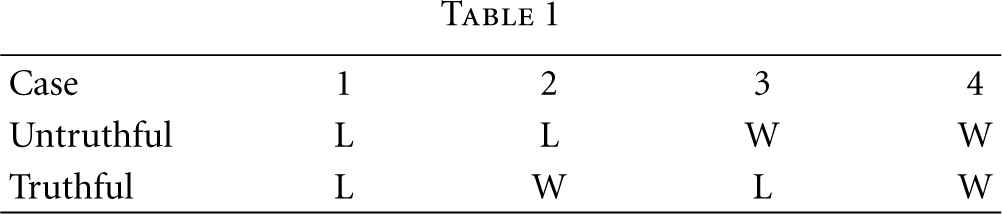
Proof.
Either bidding truthfully or untruthfully in this case will make buyer According to our winning buyers determination method as described in Algorithm 2, TBMAH always tries to maximize its revenue from potential buyers during spectrum allocation. So it is easy to infer that our auction scheme is monotonic, that is to say, there is no winner becoming a loser by raising his bid. In this case, buyer For the same reason of monotonicity of our auction scheme, this case only happens when In this case, no matter buyer Case 1.
Case 2.
Case 3.

Case 4.
In summary, neither bids lower nor higher purposely can bring extra utility, so each potential buyer has no motivation to bid untruthfully and bidding truthfully becomes his dominating strategy.
Proof of truthfulness for sellers side in TBMAH is similar to McAfee double auction, for the sake of saving space we omit this part, anyone who wants to see details, please refer to [10].
3.6.3. Ex-Post Budget Balance
From descriptions in Section 3.5, it is easy to find that the auctioneer stops spectrum auction process when its income is not less than outcome, so TBMAH keeps ex-post budget balance and the final transacted resources T is maximal under current bidding functions of potential buyers.
4. Experimental Results
In this section, we first make comparisons between different grouping algorithms, then discuss all kinds of possible scenarios encountered in practical spectrum auction and study the impact of different distributions, and finally we do some experiments with real networks.
4.1. Grouping Algorithms
Recall that each bidding group which consists of potential buyers is real participant of our spectrum auction, TBMAH. We make brief introduction of 6 buyer grouping algorithms in the following part. Potential buyers with coverage radius that equals to 50 are uniformly distributed within area Stripe: this algorithm first partitions interested area into stripes with each stripe Max-IS: Max-IS recursively picks a node which has the minimal size of maximum independent set, pushes it into current independent set and Repeats this procedure until all nodes are processed [12]. Greedy-U: to form a group, it recursively chooses a node which has the minimal degree in current conflict graph and eliminates the chosen node and its neighbors and updates degree values of remaining nodes [13]. Greedy: it is the same as Greedy-U except that it chooses the nodes based on degree values of original conflict graph without updating degree of nodes [13]. Rand: It randomly chooses a node and tries to allocate one channel while satisfying nonconflict constraints. Lexicographic: this algorithm orders vertices first by their X- and then by their Y-coordinates, then colors each unit disk one by one according to their coverage area. Two disks with identical color are in the same group [14].
Performance of different grouping algorithms are measured with reusability which is defined as the average number of nodes in each group. Standard deviation of reusability characterizes uniformity among different groups. The X-coordinates of both figures are case index of different network scale. From Figure 1(a) we can see that reusability of Greedy-U and Greedy algorithm are relatively lower than other four algorithms. Result shown in Figure 1(b) tells us that standard deviation of Stripe is minimum among all these algorithms, which states that Stripe groups potential buyers evenly than any other algorithms.
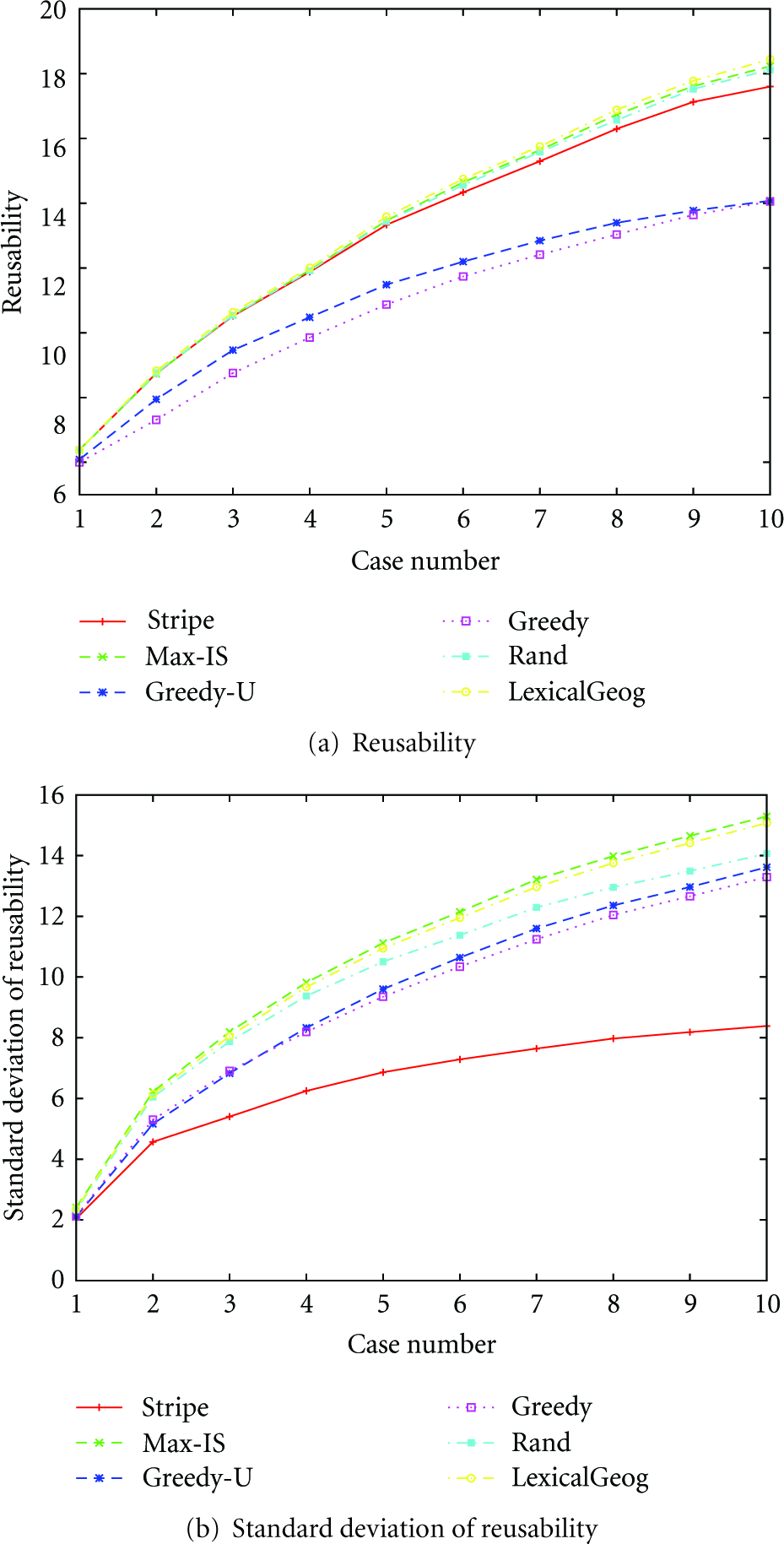
Group with different algorithms.
4.2. Performance Comparisons in Different Scenarios
In a practical spectrum auction, auction pattern can be single-unit homogeneous, single-unit heterogeneous, multiunit homogeneous, and multiunit heterogeneous. However, TRUST can only support single-unit homogeneous, for the sake of comprehensive and fair comparisons with our scheme we make minor extensions of TRUST. For supporting heterogeneous channel width, we extend TRUST by dividing the sorted potential sellers into segments and considering each segment as a super seller, with size of each segment equals to the maximal demanding channel width. Asking price of each super seller equals to sum of asking price of sellers in this segment. Accordingly, we normalize each buyer's demanding channel width with the maximal demanding channel width and modify their bidding price with a scaling factor. So TRUST becomes a single-unit homogeneous auction with each unit size equal to the maximal possible channel width instead of 1. For multiunit scenario, we firstly duplicate nodes whose requested channel amount
We assume that both sellers' asking prices and buyers' bids are uniformly distributed. Experimental parameters of each seller's asking price
For single-unit homogeneous scenario, each buyer can only demand one unit spectrum resource, channel width of all potential buyers are identical. According to our bidding series generation algorithm described in Algorithm 1, bid of each group equals to the product of least buyer's bidding price for each spectrum resource, channel width, and group size. Each winning group will be charged with its critical bidding value [9]. So in this scenario, our spectrum auction scheme TBMAH is degraded to TRUST. Experimental result also validates that the number of resources transacted of TBMAH is the same as that of TRUST in this scenario, so we do not show result of this case. However, for the other three scenarios which are commonly seen in practical auction, TBMAH outperforms extended version of TRUST with Stripe grouping algorithm, as can be seen in Figure 2. The X-coordinate values are still case index of different network scales. In Figure 2(b), the reason of extended version of TRUST exceeds TBMAH at the beginning is that increasing nodes by duplicating nodes with request large than 1 is favor of trade with sellers. Moreover, trades with different grouping algorithms obtain similar results, and we omit results of other grouping algorithms for the sake of saving space.
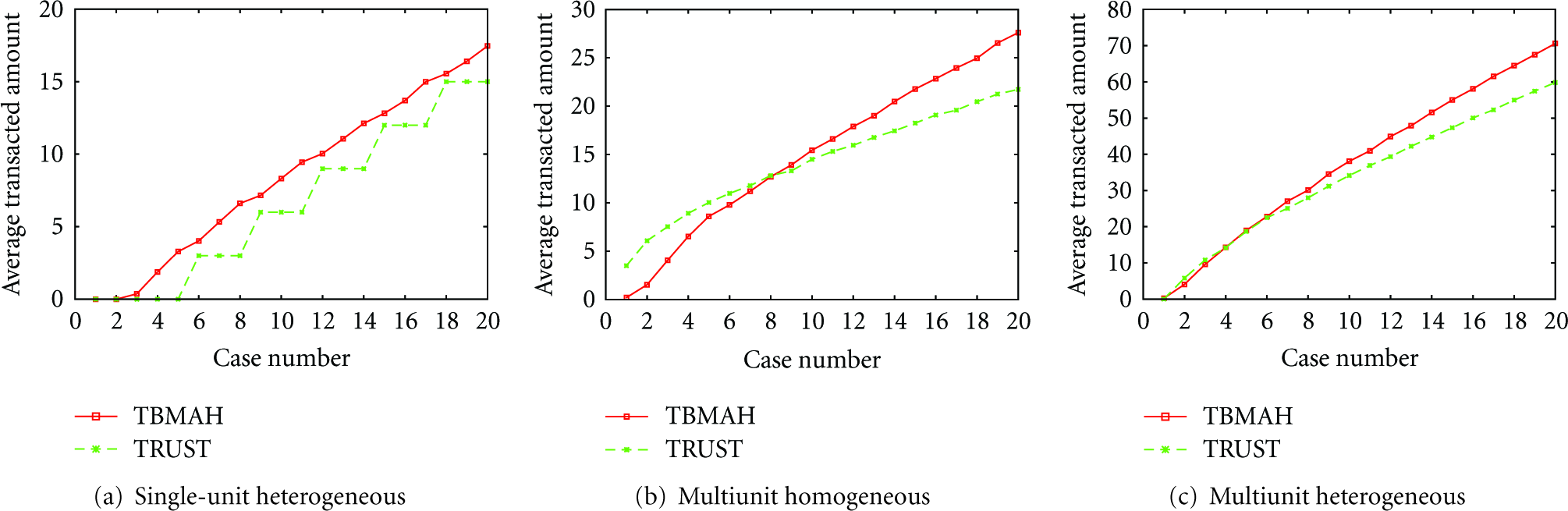
TBMAH versus TRUST in different scenarios.
4.3. Impact of Distribution
We study the impact of bidding price, requested amount, and heterogeneous channel width distribution on transaction. For bid distribution experiment, buyer's bidding price and seller's asking price are uniformly distributed within interval
From Figure 3(a) we can see that with seller's asking price increasing from 0.5 to 5, the number of resources transacted of both TBMAH and TRUST decreases due to elevation of spectrum price goes against transaction. With the amount of spectrum buyer requested increases from 1 to 10 in Figure 3(b), the transacted amount of both TBMAH and TRUST increases at the beginning due to abundant free spectrum resources and relative few requests, then both curves go flat because of reaching system's maximal capacity and not being able to accommodate any more requests. With buyer's requested channel width increases, the number of resources transacted of TBMAH rises then becomes saturated. While the number of resources transacted of TRUST rises at the beginning due to oversupply. With increase of requested channel width, the number of super sellers decreases and asking prices of them increase, so the number of successful trade of extended version of TRUST declines afterwards.

TBMAH versus TRUST with different distributions.
4.4. Comparisons with Real Network
Besides making detailed comparisons between TBMAH and TRUST with simulation networks, we also study their performances with real networks. We use locations of real cellular base stations available in FCC public GIS database [15], experimental parameters are set the same as that of experiment in Section 4.2, and experimental results are averaged over 500 times. The number of sellers is 50, both TBMAH and TRUST are set to support multiunit heterogeneous channel width auction and the number of potential buyers varies from 10 to 100.
Figure 4 shows that TBMAH outperforms TRUST. With the increasing number of potential buyers, the number of transacted resources of both TBMAH and TRUST increases and gets saturated finally. It is obvious that due to limited available resources, the number of buyers required to get TBMAH saturated is less than that of TRUST. This is because that it is unnecessary for TBMAH to format diverse channel widths with the largest one and reconstruct the graph by making mirrors of nodes whose requested amount of resources larger than 1.

TBMAH versus TRUST with real networks.
5. Conclusion
We propose a truthful bilateral multiunit auction with characteristic of supporting heterogeneous networks (TBMAH) in this paper. We firstly describe spectrum auction problem and introduce considerable factors of designing and implementing a practical spectrum auction, then show details of bidding series generation, winners determination, and pricing algorithms in our auction scheme. Results of both simulation and real networks experiments show that TBMAH outperforms TRUST on the whole, especially in different scenarios, TBMAH trades more spectrum resources than TRUST by 13.01% in average. In future work, we will consider using aggregate interference effects instead of coverage areas to determine whether two base stations conflict.
Footnotes
Acknowledgments
The authors would like to thank Education Ministry of China for their support of this paper under the National Foundation for the Doctoral Program (200800060018), and also support by Aviation Science Fund (2009ZD51038) and Beijing Natural Science Foundation (4102032).