




Abstract
As a kind of small-scale cyber-physical systems (CPSs), body sensor networks (BSNs) can provide the pervasive, long-term, and real-time health monitoring. A high degree of quality-of-service (QoS) for BSN is extremely required to meet some critical services. Interuser interference between different BSNs can cause unreliable critical data transmission and high bite error rate. In this paper, a game theoretic decentralized interuser interference reduction scheme for BSN is proposed. The selection of the channel and transmission power is modeled as a noncooperative game between different BSNs congregating in the same area. Each BSN measures the interference from other BSNs and then can adaptively select the suitable channel and transmission power by utilizing no-regret learning algorithm. The correctness and effectiveness of our proposed scheme are theoretically proved, and the extensive experimental results demonstrate that the effect of inter-user interference can be reduced effectively with low power consumption.
1. Introduction
The recent significant advances in wireless biomedical sensors, ubiquitous computing, and wireless communication offer great potential for the body sensor networks (BSNs) that are small-scale cyber-physical systems (CPSs). BSNs are becoming increasingly common in enabling many of the pervasive computing technologies that are becoming available today such as smart-homes and pervasive health monitoring systems [1–5]. By using various wireless wearable or implanted sensors which are capable of sensing, processing, and communicating one or more vital signs, BSNs can continuously monitor physiological vital signs (such as EEG, ECG, EMG, blood pressure, and oxygen saturation), physical activities (such as posture and gait) and environmental parameters (such as ambient temperature, humidity, and presence of allergens) and transmit them in real time to a centralized location for remote diagnosis. BSNs bring a significant impact to the scope of medical services in areas such as rehabilitation, geriatric care, sports medicine, fall detection, and gait analysis.
The challenges faced by BSNs are in many ways similar to general wireless sensor networks (WSNs), but there are intrinsic differences between the two which require special attention. Reliability is one of the crucial elements of BSN, as sensitive health information is being transmitted through the wireless [6]. However, compared with the conventional WSN, the architecture for BSN is highly dynamic, placing more rigorous constraints on power supply, communication bandwidth, storage, and computational resources. Different from the general WSN, as a human-centered sensor network, BSNs are usually deployed in open environments and the mobility of BSN users implies that individuals carrying BSN may meet other BSN users, and thus radio transmissions on different BSN users will interfere with each other when BSN users gather in the same place and their sensors transmit data simultaneously. Furthermore, such interuser interference will be increased in some architecture which predisposes some of the sensor nodes to transmit with high power. In addition, some extraneous interference in the same band (e.g., WiFi and bluetooth) can also increase the interuser interference [7]. Interuser interference causes unreliable critical data transmission and high bite error rate; hence, the critical data cannot be sent to control nodes in time and the quality of health monitoring is affected directly. Consequently, the doctor may give the wrong diagnosis and the patient may be delayed to cure and even die. Moreover, the packet loss caused by the interuser interference results in data retransmission. Due to the characteristics of energy sensitiveness and resource limitedness, numerous data retransmissions consume much energy and thus may impel the node to fail. Thus, the interuser interference in BSN should be overcome before successful deployment. In the literature, several mechanisms (outlined in Section 2) have been proposed to mitigate the problems of interference in wireless sensor networks. However, there is almost no underlying interuser interference reduction infrastructure particularly for BSNs. To this end, our work aims to design an interuser interference reduction scheme for BSN.
In this paper, we propose a game theoretic decentralized interuser interference reduction scheme, namely DISG, to enhance the reliability in BSN. In our previous work [8], we briefly discussed the advantages of the proposed scheme. In this paper, we give more comprehensive analysis and extensive simulations. The key contribution of our work is summarized as follows. Firstly, game theory is used as a mathematical basis for the analysis of the interactive decision making process between the rational BSN users. The selection of the channel and transmission power is modeled as a noncooperative game between different BSN users congregating in the same area to reduce the effect of interuser interference. Thus, DISG is distributed, noncooperative, and self-organizing. In the scheme, each BSN just needs to measure the interference from other BSNs and then adaptively select the suitable channel and transmission power by utilizing no-regret learning algorithm without intercommunication. Secondly, different from the relative researches, the deployment of the fixed WSN infrastructure is not required in DISG. Therefore, the system with DISG is more flexible and suitable for outdoor environments. Finally, DISG does not only focus on the reliability but trades off the signal to interference-plus-noise ratio (SINR) and the energy cost as well. Moreover, the weighting factors can be configured dynamically based on the remaining battery capacity to adapt to different situations. For that reason, this scheme can reduce the effect of interuser interference with low power consumption. In addition, the feasibility proof and performance analysis of the DISG are presented. Note that our scheme could be applied in a variety of scenarios, for example, hospitals, geriatric care, sports, rehabilitation, and battlefield. However, for simplicity we use the terminology patient, physician, and medical service in this paper.
The remainder of the paper is organized as follows. In Section 2, we summarize the related work and describe the key limitations of them. Subsequently, the system architecture and the definitions used in the DISG scheme are given in Section 3. Section 4 presents the detailed description of the proposed game theoretic framework in the DISG scheme. In Section 5, the simulation and performance evaluation are presented. Finally, we conclude the paper in Section 6.
2. Related Works
Extensive research has been focusing on the interference analysis and reduction for the conventional wireless networks. Reference [9] relaxes the assumption that the interference range is equal to the reception range and develops closed-form expressions for the frequency of interference occurrence. Reference [10] studies the convergence of the average consensus algorithm in wireless networks in the presence of interference and characterizes the convergence properties of an optimal Time Division Multiple Access protocol that maximises the speed of convergence on these networks. Reference [11] addresses the problem of interference modeling for wireless networks and analyzes standard interference functions and general interference functions. Reference [12] studies the minimum-latency broadcast scheduling problem in the probabilistic model and establishes an explicit relationship between the tolerated transmission-failure probability and the latency of the corresponding broadcast schedule. Reference [13] investigates the impact of time diversity and space-time diversity schemes on the traffic capacity of large-scale wireless networks with low-cost radios and analyzes the tradeoff between relaying gain and increased interference due to additional traffic. Reference [14] establishes a fundamental lower bound on the performance of a wireless system with single-hop traffic and general interference constraints. Reference [15] proposes a novel consensus algorithm based on the simple self-synchronization mechanism in Reference [16], which is effective in suppressing both noise and interference for arbitrary network topology. In [17], the authors propose a cluster-based MAC protocol combining TDMA, FDMA with CSMA/CA, which adopts TDMA mechanism in the clusters and FDMA mechanism among different clusters to reduce the interference. Reference [18] presents a self-reorganizing slot allocation (SRSA) mechanism for TDMA-based medium access control (MAC) in multicluster sensor networks to reduce inter-cluster TDMA interference without having to use spectrum expensive and complex wideband mechanisms. Reference [19] proposes an algorithm named “Minimizing Interference in Sensor Network (MI-S)” to minimize the maximum interference for set of nodes in polynomial time maintaining the connectivity of the graph. Reference [20] presents a new greedy heuristic channel assignment algorithm (termed CLICA) for finding connected, low interference topologies. References [21, 22] treat the problem of assigning power level to a set of nodes in the plane as the problem of yielding a connected geometric graph and study the performance of a number of heuristics through simulation to minimize interference in wireless sensor networks. However, there is a significant gap between the conventional wireless sensor network systems due to the characteristics of BSN, especially, the mobility of BSN, and thus none of these interference reduction mechanisms in WSN can be directly applied in BSN.
The reliability research of BSN mainly focuses on the reliability of intra-BSN communications. In [23, 24], a novel QoS cross-layer scheduling mechanism based on fuzzy-logic rules is proposed. An energy-saving distributed queuing MAC protocol is adopted. It can guarantee all packets are served with a specific bit-error-rate (BER) and within the particular latency limit while keeping low power consumption. In [25, 26], an active replication algorithm for the reliability of communication in multihop BSN is proposed, which can guarantee k-connectivity between nodes. In [27], the challenges brought by BSN applications are presented and a statistical bandwidth strategy, namely BodyQoS, is proposed to guarantee reliable data communication. Reference [28] presents an adaptive and flexible fault-tolerant communication scheme for BSNs to fulfill the reliability requirements of critical sensors by a channel bandwidth reservation strategy based on the fault-tolerant priority and queue. In [29], an interference-aware topology control algorithm is proposed for wireless personal area network (WPAN) to minimize the interference effects by adjusting the transmission power dynamically based on the interference effect and maintaining the local topology of each sensor node adaptively. A new quality of service (QoS) routing protocol that relies on traffic diversity of these applications and ensures a differentiation routing using QoS metrics is proposed in [30]. Reference [31] presents a data-centric multiobjective QoS-aware routing protocol that facilitates the system to achieve customized QoS services for each traffic category differentiated according to the generated data types. Nonetheless, all of them neglect the problem of interuser interference. Reference [7] highlights the existence of the interuser interference effect in BSN from the perspective of network architectures and describes the interuser interference as the interference due to the communications of wireless BSNs operating in proximity of one another, but the issue of interuser interference is not investigated. In [32], the authors conduct a preliminary investigation of the impact and significance of interuser interference and investigate its behavior with respect to parameters. It gives three techniques that can be used to mitigate interference and implements an instance with a fixed WSN infrastructure to identify when BSNs are interfering with each other and make the BSNs communicate on different frequency channels to reduce interference between them. However, that paper does not conduct a comprehensive study of interuser interference and mainly intends to provide an indication of the impact of the interuser interference effect. In addition, the fixed WSN infrastructure is only suitable for indoor environments and thus limits the application of BSN. In [8] the decentralized interuser interference suppression approach with noncooperative game is briefly discussed and evaluated. As an extension of [8], in this paper we give the architecture sketch of the interference reduction system implemented on the control node of BSN and propose a weighing factor configuration algorithm to configure the weighting factors dynamically to adapt to different situations. In addition, the concepts of DISG are investigated more thoroughly, and the simulations are more elaborated.
3. System Architecture and Definitions
In this section, we present the system architecture and the definitions used in the DISG scheme. Figure 1 shows a generalized overview of the system architecture that encompasses a set of intelligent physiological sensors, control nodes (Internet-enabled PDA or cell phone), and base stations and a network of remote health care servers and related services (such as caregiver, physician). In general, the biosensor is a wireless wearable or implanted vital sign sensor (such as sweat, EKG, and temperature) that consists of a processor, memory, transceiver, sensors, and a power unit. Each biosensor node is responsible for sensing one or more physiological signals, processing these signals (coding, filtering, aggregation, feature extraction, feature recognition, etc.), storing the processed data, and forwarding the data to the control node. Due to the size and energy consumption restrictions, the biosensor has limited memory and power and cannot afford heavy computation and communication. Compared to the biosensor, the control node that is a PDA or a 3G cell phone has relatively high energy and computing capability. In other words, BSN is a typical asymmetric structure. The control node provides the human-computer interface and communicates with the remote medical server(s) through the base station to result in patient-specific recommendations [33]. It is worth mentioning that the above system architecture is not only suitable for medical healthcare applications but also for sports and battlefield.

System architecture.
As illustrated in Figure 1, the transmissions of sensors in different users will interfere with each other, when they operate in the same vicinity and communicate concurrently. In order to reduce the effect of interuser interference in the network, the DISG scheme is proposed to guarantee reliability performance by modeling the problem as a noncooperative game to decentralize the interuser interference reduction. We first give some definitions in the DISG scheme, as listed in Table 1.
Variables and notations.

Definition 1.
Interuser interference: interuser interference is the interference in desired communication when several BSNs operate in the same vicinity.
Definition 2.
Noncooperative interuser interference reduction game: the noncooperative game is made up of three basic components, a set of players, a set of actions, and a set of costs, and represented by the tuple
Definition 3.
Players in the system: in this game, each BSN user is a player as the decision maker in the modelled scenario, and
Definition 4.
Available nonoverlapping frequency channels: the set of all available nonoverlapping frequency channels for BSN users is represented by
Definition 5.
The action space of the system:
Definition 6.
The cost set of the system: the cost set of the system is denoted by
4. Interuser Interference Reduction Game Theoretic Framework
Figure 2 illustrates the architecture sketch of the proposed framework that is implemented on the control node of BSN. This framework consists of four components: interference detector, strategy analyzer, strategy selector, and strategy actuator. The interference detector monitors interference plus noise and produces periodic reports. The strategy analyzer examines the report derived from the interference detector and the available channel as well as transmission power level. Then the strategy selector uses the noncooperative game model between different BSNs (users) defined in the scheme to choose the suitable strategy. In the game model, each BSN user is selfish and tends to close to the ideal SINR to ensure specific QoS requirement without regard to the QoS of other BSN users. In the strategy selector component, the status of the current strategy is read in and checked against the QoS requirement. If the requirement is satisfied, no change is necessary and the strategy selector terminates. Otherwise, the rules defined in the game model are followed to determine the appropriate channel and transmission power level by utilizing no-regret learning algorithm, and the strategy decision is made accordingly. It is worth mentioning that any environment change such as user movement or noise variation might trigger a strategy adjustment. Finally, the strategy actuator will send the new strategy decision to sensor nodes deployed in the same BSN users to reconfigure RF to switch to the newly selected channel and uses the appropriate transmission power level. In the scheme, the interuser interference reduction game model is the key to making strategy decisions and will be discussed in detail in the following section.
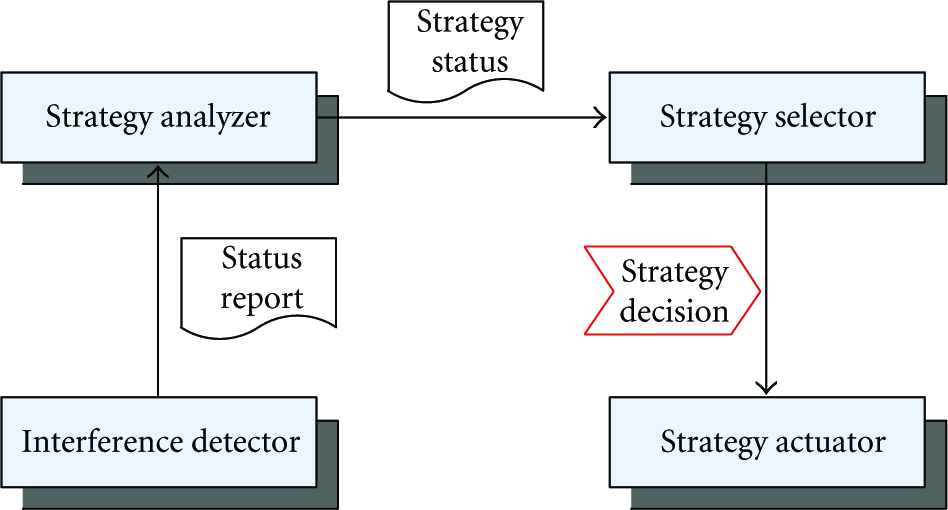
Interference reduction system on control node.
4.1. Cost Function
In the purpose of reducing the effect of interuser interference in the network, the selection of the channel and transmission power is modeled as a noncooperative game between different BSNs (users). In this game, each user is a rational player. They observe local conditions and neighbors' actions and independently adapt their strategy using no-regret learning algorithm to minimize the interuser interference. Obviously, this framework of the noncooperative game is propitious to solving the problem of the interuser interference in BSN. In the noncooperative game, the cost function normally represents the hate of a selfish user, who wants to minimize its own loss. Similarly, a player in our game may somehow modify its channel and transmission power in such a way that can not only decrease its own loss but also increase interferences to others. Due to the energy limitedness of the control node, the desired cost function should take account of the SINR and power utilization. Thus, similar to [34, 35], the cost function of each user that considers the tradeoff between attaining high SINR and maintaining lower power utilization is expressed as


Formally, based on (1) and (2), the cost function is defined as follows:
In the game, the goal of user 
4.2. Nash Equilibrium in the Game
In order to analyze the outcome of the game, we will give how the game will be played by rational players using the concept of Nash Equilibrium (NE), which states that at equilibrium every player selects a cost-minimizing strategy given the strategies of other players.
The Nash Equilibrium 
Theorem 1.
For a specific channel
Proof.
Let 
Taking the derivative of (7) with respect to 

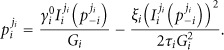


For given values of 


According to [36], in order to make the game converge to a unique fixed point, a fixed point from (10) should satisfy the following properties: (1) positivity; (2) monotonicity; (3) scalability. Therefore, based on [34], we can get

Based on (12), (15), and (16), we can get that the noncooperative game has a unique NE for the transmission power
In order to configure the weighting factors
(1) (2) Estimate (3) (4) Obtain the set of the remaining battery capacity of each sensor (5) (6) (7) (8) (9) (10) (11)
Algorithm 1: Weighing factor configuration algorithm.
A probability distribution ω is a correlated equilibrium (CE) over the set of user strategies if and only if the following inequality is satisfied:
Theorem 2.
Each user
Proof.
Based on (17), we can find that the set of correlated equilibrium is nonempty, convex, and closed in the finite game. Thus, according to [37], when players select their strategy randomly, there exists a no-regret strategy such that, if every player follows such a strategy, then the empirical frequencies of play converge to the set of correlated equilibrium. In addition, this correlated equilibrium is NE, because the correlated equilibrium corresponds to the special case in which
Theorem 3.
Nash Equilibrium exists in the noncooperative interuser interference reduction game.
Proof.
For each user
4.3. No-Regret Learning Algorithm for the Game
In order to analyze the behaviour of the selfish users in the noncooperative interuser interference reduction game, we resort to the regret minimization learning algorithms [38]. No-regret learning algorithms are probabilistic learning strategies that specify that players explore the space of actions by playing all actions with some nonzero probability and exploit successful strategies by increasing their selection probability. In the game, each user 
The resulting historical cumulative regret of user 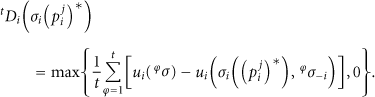
Based on (19), the probability 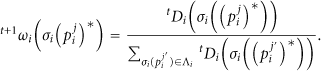
The above learning algorithm can converge to Nash equilibrium in the game, and thus each user 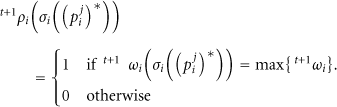
By following the no-regret learning adaptation process, the user can learn how to choose the channel and transmission power to minimize the cost through repeated play of the game. Algorithm 2 presents the pseudocode of the iterative no-regret learning algorithm used in the interuser interference reduction game. At the initial step, each user
(1) (2) (3) (4) (5) Estimate the interference from other BSN users plus noise (6) Obtain the optimal transmission power (7) Get the cost (8) Calculate the regret (9) Get the historical cumulative regret (10) Update the probability of the channel selection (11) (12) (13) (14) Estimate the interference from other BSN users plus noise (15) Obtain the optimal transmitted power (16) Get the cost (17) Calculate the regret (18) Get the historical cumulative regret (19) Update the probability of the channel selection (20) (21) Determine the strategy using (21)
Algorithm 2: No-regret learning algorithm for the game.
It is worth mentioning that the no-regret learning algorithm is a distributed iterative best-response scheme. In the noncooperative game, based on the information available locally, each player determines its own strategy (i.e., the channel and transmission power) to ensure that the solution converges. The convergence of the solution indicates that every user achieves its desirable operating point, where no user intends to change its strategy.
5. Simulation and Performance Analysis
5.1. Simulation Model and Method
The performance of the proposed interuser interference reduction scheme is evaluated by extending the Castalia simulator [39] to support the simulation of interuser interference in BSN. Castalia is an open source, discrete event-driven simulator designed specifically for WSN, BAN, and generally networks of low-power embedded devices based on OMNeT++ [40].
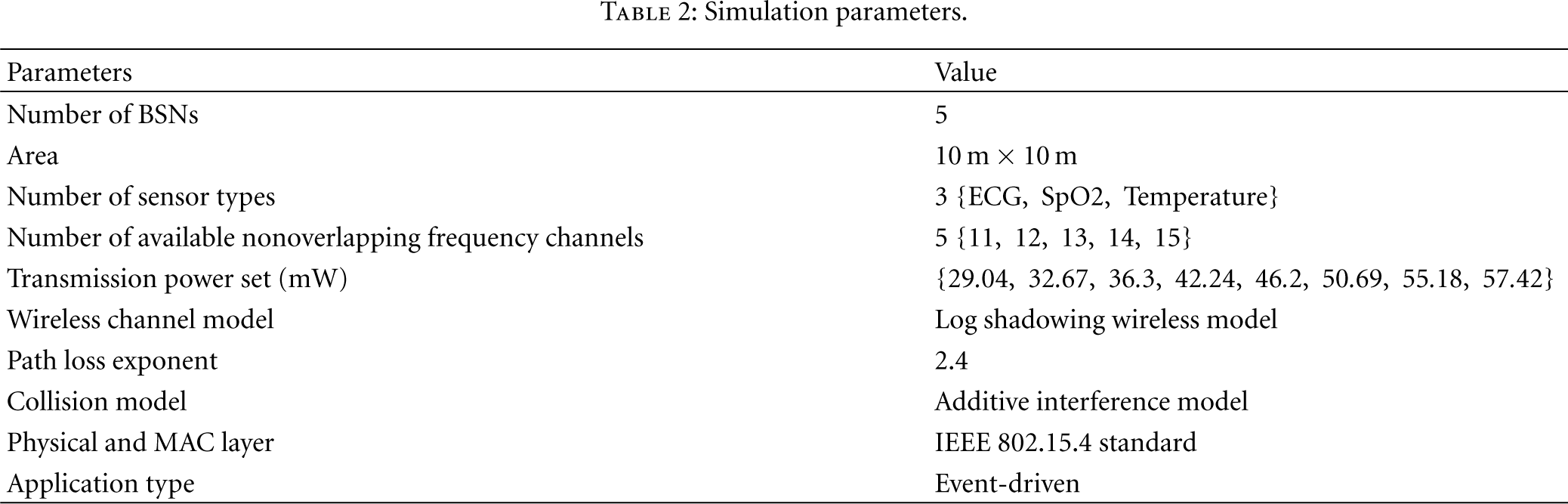
For simulation purposes, five BSNs are distributed over a 10 m × 10 m square area, and each BSN simulates a typical on-body sensor network, in which sensors measure a person's physiological parameters. Each BSN has a control node and three biosensors (i.e., ECG sensor, SpO2 sensor, and temperature sensor). All sensor nodes adopt Castalia standard CC2420 IEEE802.15.4 radios. The number of available nonoverlapping frequency channels for each BSN is five in the experiment. The detailed configuration of simulation parameters is shown in Table 2. Note here that the configuration of parameters may vary depending upon the kind of sensors. In order to evaluate the performance of the scheme to copy with interuser interference for the different user densities and system typologies generated by the mobility of BSN users, we set up four representative system topologies to perform the simulation. Figure 3 presents the BSN user distributions of four representative system topologies during the simulation, where the dotted line represents the interuser interference between two users. In the initial state, all BSN users use the same channel and select a random transmission power level as the initial strategy. In our experiment, we compare the performance of the system in the initial state and the final state after convergence to demonstrate the performance of the DISG scheme.
Simulation parameters.
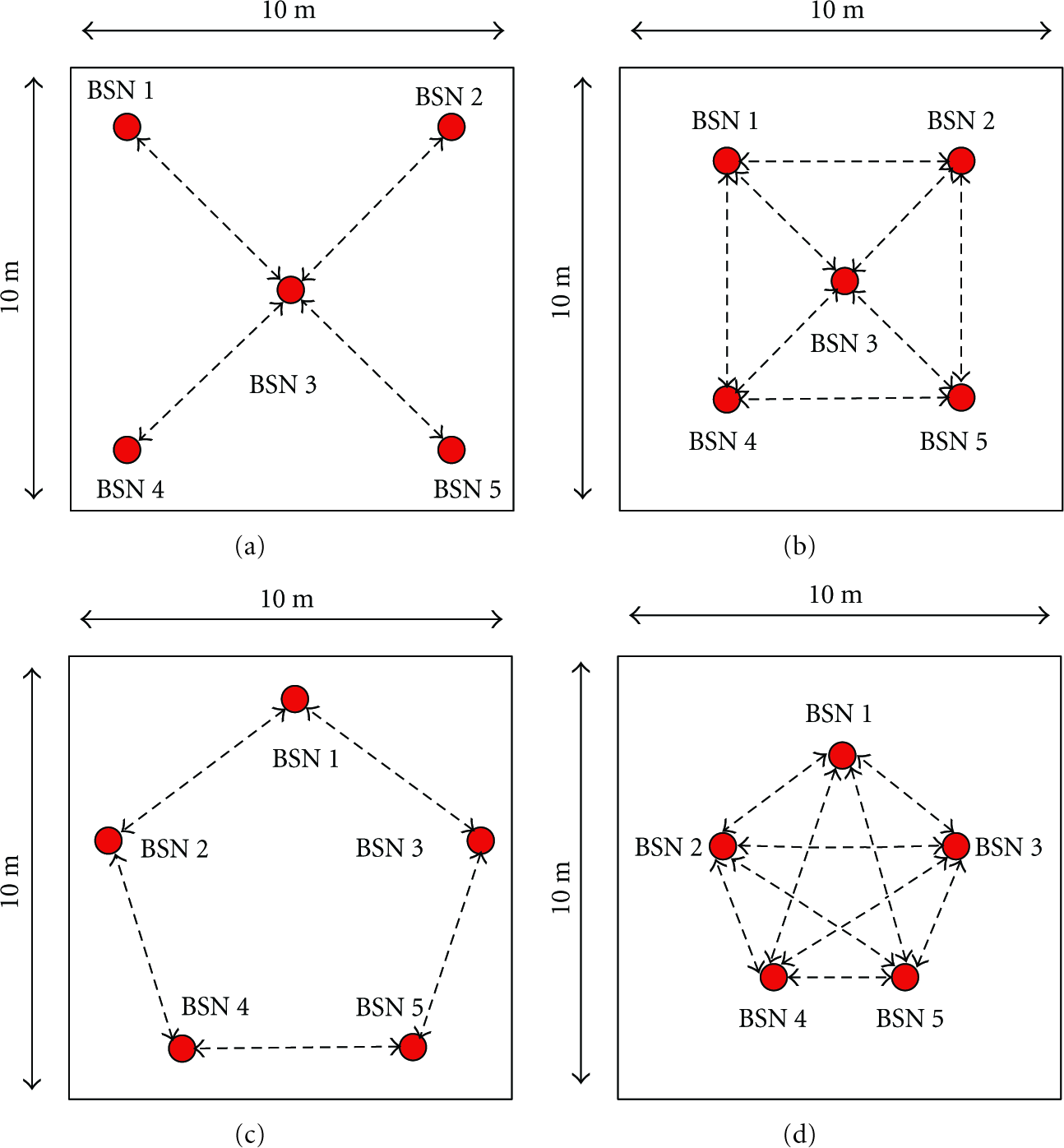
System topology.
5.2. Simulation Results
We repeated the simulations several times and got similar results in each trial. In the following, we present a representative result from one trial and analyze it in detail.
The convergence property of the proposed no-regret learning algorithm for the interuser interference reduction game is evaluated first to demonstrate the correctness and effectiveness of the scheme. From Figure 4 that shows the user distribution on different channels over time during the simulation of the proposed no-regret learning algorithm for the topology 4, we can find that, at the beginning of the experiment, all BSN users select their channels randomly with equal probability, and, at last, the learning solution converges to a stable and desirable state (i.e., the equilibrium state) after a few iterations where all BSN users select different frequency channels to minimize interference.

User distribution on different channels.
As performance measures for the proposed interuser interference reduction scheme, we consider the average SINR of the system (Figure 5), the packet delivery rate (PDR) (Figure 6), and the energy consumption of per delivered date byte (Figure 7) in the simulation.

Average SINR initially and after convergence.
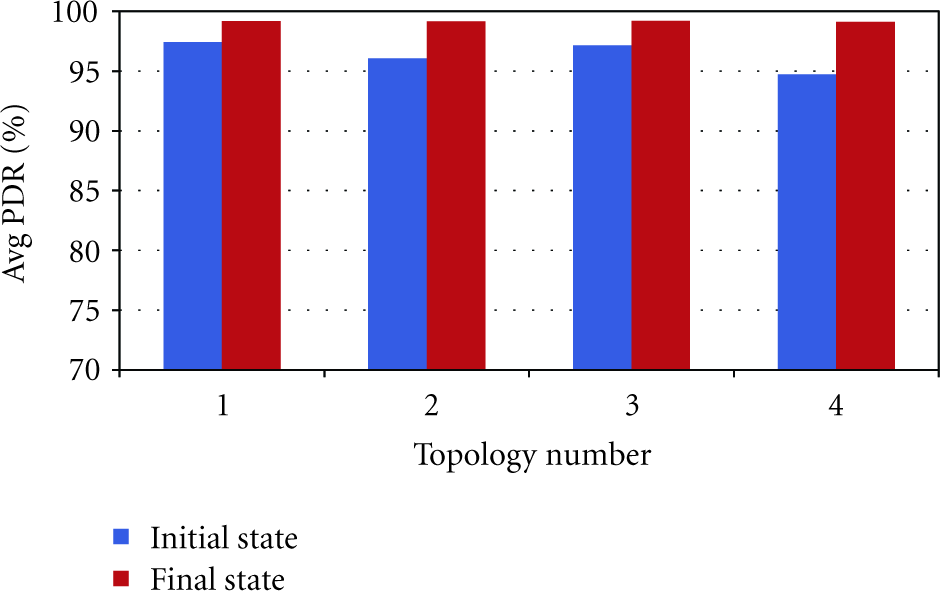
Average PDR initially and after convergence.

Energy consumption of per delivered byte initially and after convergence.
As can be seen from Figure 5, in all system topologies, the average SINR of the system after convergence is obviously higher than that of the initial state owing to the adaptive selection of strategies. In addition, the higher the user density is, the more obvious the effect of our scheme is. In all topologies, the average SINR of the system in the final state is almost 90 dB.
In Figure 6 we compare the obtained average PDR of the system after equilibrium using our scheme against the initial average PDR in different typologies. The result shows that the system after convergence achieves higher average PDR than the system without operating our scheme in all system topologies.
As illustrated in Figure 7, the average energy consumption per delivered data byte of the system in the final state is lower than that of the system that has not performed our scheme. The reason is that the retransmission overhead in the system is reduced by ensuring the QoS of the system after performing our scheme. Moreover, trade-off between obtaining high SINR and maintaining low power utilization also can reduce power dissipation.
5.3. Discussions
From the above described simulation results, we can conclude that, in the system with DISG, an equilibrium state is reached after a few iterations of no-regret learning, where each BSN user selects the suitable strategy to reduce the effect of interuser interference. The system with DISG can provide the appropriate SINR by minimizing the interuser interference, and thus the average PDR is enhanced compared with the system without DISG. The average energy consumption of the system with DISG is reduced owning to the reduction of retransmission overhead as well as the trade-off between SINR and power utilization. In addition, DISG can be applied to different topologies generated by the mobility of BSN users. Therefore, DISG can reduce the effect of interuser interference effectively to ensure specific QoS requirement and save transmission energy at the same time to prolong the lifetime of network.
6. Conclusions and Future Work
We have presented a decentralized interuser interference reduction scheme with noncooperative game for BSN (termed DISG). A no-regret learning algorithm for reducing the effect of the interuser interference with low power consumption has been proposed, and the correctness and effectiveness of DISG have been proved theoretically. The performance of the proposed interuser interference reduction scheme has been evaluated by some experiments performed on the Castalia simulator. Experimental results show that the proposed interuser interference reduction scheme can reduce the effect of the interuser interference effectively by the adaptive selection of strategies to ensure specific QoS requirement, while saving transmission energy and thus prolonging the lifetime of network.
In terms of future work, we would like to implement our scheme on real-life BSNs to further evaluate the performance of the DISG scheme based on more metrics and revise it.
Footnotes
Acknowledgments
This work was partially supported by the National Natural Science Foundation of China under Grants no. 61173179 and no. 60903153, the Fundamental Research Funds for the Central Universities, and the SRF for ROCS, SEM.