




Abstract
Flow drag and heat transfer reduction effects are useful in heat energy transportation systems and can lead to lower pumping energy requirements. The purpose of this research is to describe the flow drag and heat transfer reduction characteristics of organic (potassium acetate) and inorganic (calcium chloride) brine solutions. The nonionic surfactant oleyl dihydroxyethyl amine oxide (ODEAO) is used as a drag-reducing additive. The pipe friction coefficient and heat transfer coefficient are investigated experimentally in a straight pipe for each type of solution with ODEAO. These coefficients are found to be lower than those of water in the turbulent flow range. However, the rod-like micelles of ODEAO, which are necessary to induce the flow drag reduction effect, are not readily formed in these solutions. Hence, the flow drag and heat transfer reduction effects are measured only under limited conditions and it is difficult to apply these solutions practically as heat transfer media.
1. Introduction
Recently, there has been some interest in flow drag and heat transfer reduction effects as a practical means of reducing energy consumption. Previous studies have verified the energy conservation capabilities of flow drag and heat transfer reduction effects [1]. If a surfactant used as a flow drag reduction fluid is capable of lowering the pipe friction coefficient by up to 78%, the energy consumption efficiency of the surfactant solution will decrease by 44% compared to water. The flow drag and heat transfer reduction effects of organic brine solution are particularly useful for transport energy conservation, since the high viscosity of organic brine solution requires high pumping power for transportation. The reduced heat transfer coefficient of the flow drag reduction fluid not only decreases the heat loss from the pipe, but also degrades the performance of the heat exchanger. Heat transfer enhancement methods have been proposed by Kawaguchi et al. [2], Sato et al. [3], and the present authors [4] to increase this reduced heat transfer coefficient.
When a surfactant is added to water, rod-like micelles can be formed by the functioning of the hydrophobic and hydrophilic groups of surfactant molecules [5]. In previous studies of the flow drag and heat transfer reduction effects of this phenomenon, suppression of the small-scale turbulent eddies of the solution caused the turbulent flow to laminarize [6]. Moreover, a surfactant was verified to be the most suitable additive, since its micelles are thermodynamically stable and self-assemble quickly after degradation [7]. Accordingly, there have been a number of reports on flow drag and heat transfer reduction effects.
In our previous research (e.g., [1, 8–11]), the nonionic surfactant oleyl dihydroxyethyl amine oxide (= ODEAO, C16H35N (C2H4OH)2O = 371.6) was used as a flow drag reduction additive. ODEAO has less sterilization (acute oral toxicity: LD50 > 5,000 mg/kg [1]) and a low environmental load. Nakata et al. [1] used transmission electron microscopy (TEM) to confirm the shape of ODEAO micelles. Figure 1 shows an electron micrograph (photographic magnification: 60,000) of the rod-like micelles of ODEAO. This specimen was prepared from an aqueous solution of ODEAO at a concentration of 5,000 ppm. The figure indicates rod-like or worm-like micelles (400 nm long and 160 nm wide) of ODEAO (or an entanglement network of rod-like micelles).

Rod-like micelles of ODEAO.
Our previous studies [8–11] have investigated the flow drag and heat transfer reduction effects of a surfactant (ODEAO) in organic brine (ethylene glycol (EG, C2H4(OH)2 = 62.1)) and (propylene glycol (PG, CH3CH(OH)CH2OH = 76.11)) solutions. Aggregation of the rod-like micelles of the surfactant was reinforced by a polar-nonpolar solubilization between the micelles and the EG or PG molecules. Therefore, the flow velocity range in which flow drag and heat transfer reduction effects occurred was much greater for EG or PG solution with surfactant than for an ODEAO water solution.
Inorganic brine (= calcium chloride (CC, CaCl2 = 111.0) solution) has been used in actual heat energy transportation systems until recently, even though it presents some problems (including corrosion of steel and damage to equipment). CC solution is a strong acid and strong base solution. Potassium acetate (PA, CH3COOK = 98.15) solution has been developed as a new type of brine for use in place of EG or PG solution, since its biodegradability is more rapid than that of glycol-based solutions and the environmental load is relatively small [12]. PA solution is a weak acid and strong base solution. However, there is very little quantitative data on the flow drag and heat transfer reduction effects of PA solution and CC solution. In order to apply flow drag and heat transfer reduction effects to these brine solutions, it is important to clarify the flow drag and heat transfer reduction characteristics of PA or CC solution with surfactant. In this paper, the pipe friction coefficient and mean forced convection heat transfer coefficient are investigated experimentally in a straight pipe for each of these solutions with surfactant, relative to the measurement parameters of brine concentration, surfactant concentration, and temperature of the brine solution.
2. Viscosity Measurement
It has been reported previously that EG and PG solutions with ODEAO are non-Newtonian fluids [5]. Thus, it is necessary to investigate the viscous characteristics of PA solution with ODEAO. In this study, the apparent viscosity of the solution was measured using a rotational (torsional) rheometer with a double gap cylinder sensor system (Viscotester VT550, Thermo Haake, Germany). This sensor system was able to measure low viscosity (0.5–104 mPa·s) of a small sample (4.5 cm3) while a stepwise increase in the shear rate was imposed. The accuracy of the apparent viscosity measurements could be maintained within 6.0% by calibration with viscosity standards.
Figure 2 shows the relationship between the shear rate γ (1/s) and the shear stress τ (Pa) of PA solution with ODEAO (ODEAO concentration: Co = 790 ppm and PA concentration: CPA = 20 mass%) for various solution temperatures (To = −5–30°C). The shear stress τ at To = 30°C indicated an increase in the high shear rate range ( γ > 3000 1/s). This increase was caused by the generation of Taylor flow. With the double cylindrical rotor, Taylor flow was generated under low-viscosity and high-speed rotational conditions. However, the viscosity could not be measured under these conditions. Therefore, data indicative of Taylor flow was omitted from the viscosity measurements. As Figure 2 shows, the shear stress τ (Pa) at To = 30°C varied linearly with the shear rate γ (1/s). However, the shear stress τ (Pa) did not vary linearly with the shear rate γ (1/s) at lower solution temperatures (To ┼ 20°C). This indicates that PA solution with ODEAO is a non-Newtonian fluid, except when To = 30°C.

Relationship between γ and τ of PA solution with ODEAO.
In order to quantify the viscosity characteristics of PA solution with ODEAO, the relationship between the shear stress and shear rate was fitted to a power-law model ( τ = Kγn, where K (Pa·sn) is the pseudoplastic viscosity and n is the power-law exponent). Figures 3 and 4 show the relationship between K, n, and To for PA solutions with ODEAO and CPA = 20 mass% and CPA = 30 mass%, respectively. As these figures indicate, a decrease in the solution temperature led to a decrease in the power-law exponent n and an increase in the pseudoplastic viscosity K of the solution. These results show that a decrease in the solution temperature increased the non-Newtonian characteristics of PA solution with ODEAO. If the power-law exponent n was equal to 1 at higher solution temperatures, the solution became a Newtonian fluid under such conditions and the pseudoplastic viscosity K was equal to the viscosity μ .

Relationship between To and K, n (CPA = 20 mass%).

Relationship between To and K, n (CPA = 30 mass%).
The apparent viscosity of CC solution with ODEAO was not measured with the rotational rheometer. One reason for this was to avoid breakdown of the rheometer due to the corrosive effects of CC solution. Another reason was to verify that the apparent viscosity of CC solution with ODEAO was almost consistent with that of plain CC solution. From the nondimensional experimental result shown in Figure 14, the relationship between the pipe friction coefficient and the Reynolds number of CC solution with ODEAO without flow drag reduction effect was in agreement with the Blasius resistance formula in the turbulent flow range if the viscosity of CC solution was used as the apparent viscosity of CC solution with ODEAO.
3. Experimental Apparatus and Procedure
In order to examine the flow drag and heat transfer reduction characteristics of brine solutions with ODEAO, it is necessary to measure the pipe friction coefficients and mean heat transfer coefficients of these solutions. Figure 5 shows a schematic of the experimental apparatus used in this research. Since the apparatus was the same as that used in our previous work, only the main points are noted here. It was comprised of four units: a stainless steel test section (1.74 m length (L) × 0.016 m inside diameter (di)), a pump for circulating the test fluid, a low-temperature thermostatic water bath (with a minimum water temperature of −20°C), and an AC power supply unit for the heat input.

Schematic diagram of the experimental apparatus.
To determine the flow drag reduction effect, the pressure loss (ΔP) of the test fluid between the input and output of the test section was measured via a differential pressure gauge and manometer. The mean velocity (Um) of the test fluid was measured with a magnetic flow meter. The pipe friction coefficient ( λ ) was then calculated from

where ρ is the density of the test fluid. The experimental uncertainty for the pipe friction coefficient ( λ ) was ±5.3%, allowing for other experimental uncertainties such as temperature ±0.1 K, pressure loss ±24 Pa, flow rate ±0.001 kg/s, and so forth.
The heat transfer characteristics were examined under constant heat flux conditions, provided by Joule heat. The mean heat transfer coefficient hm (W/(m2·K)) was calculated using the integrated equation (2). The local heat transfer coefficient (hx(x)) in (2) was evaluated from the pipe wall temperature (Twx) at the position (x) along the pipe, the bulk temperature of the test fluid (Tb), and the heat flux (Q/A, where Q is the input heat (W) and A is the heated area (m2)). The wall temperatures were measured with 20 T thermocouples over the pipe length

The experimental uncertainty for the mean heat transfer coefficient (hm) was ±7.5%, allowing for other experimental uncertainties (temperature ±0.1 K, heat flux ±0.8 W/m2, flow rate ±0.001 kg/s, etc.).
In order to conduct non-dimensional analysis of the experimental results, the Reynolds number Re and Prandtl number Pr were determined from the following equations in the case of a Newtonian test fluid:

where μ is the viscosity, κ is the thermal conductivity, and Cp is the specific heat. When calculating Re and Pr for brine solutions with ODEAO, the values of the thermal conductivity κ , specific heat Cp, and density ρ of the brine solution (= solvent) were used, since the ODEAO concentrations were very low. The viscosities μ are shown as the pseudoplastic viscosity K in Figures 3 and 4, because the pseudoplastic viscosity K was equal to the viscosities μ in the case of a Newtonian test fluid.
In the case of a non-Newtonian fluid, the modified Reynolds number Re′ (4) and modified Prandtl number Pr′ (5) were calculated using the K and n values of the brine solutions with ODEAO:


If the test fluid was Newtonian (n = 1), the equations for Re′ and Pr′ reduced to the equations for Re and Pr.
Finally, the non-dimensional heat transfer coefficient (= Nusselt number) was defined by the following equation in these non-dimensional plots:

4. Experimental Results and Discussion
4.1. PA Solution with ODEAO (CPA = 20 mass%)
Figures 6 and 7 show the non-dimensional pipe friction coefficient (λ) and heat transfer coefficient (




where
μ
w
is the apparent viscosity on the wall. As these figures indicate, the pipe friction coefficient (
λ
) and heat transfer (

Relationship between Re′ and λ (CPA = 20 mass%, Co = 790 ppm).
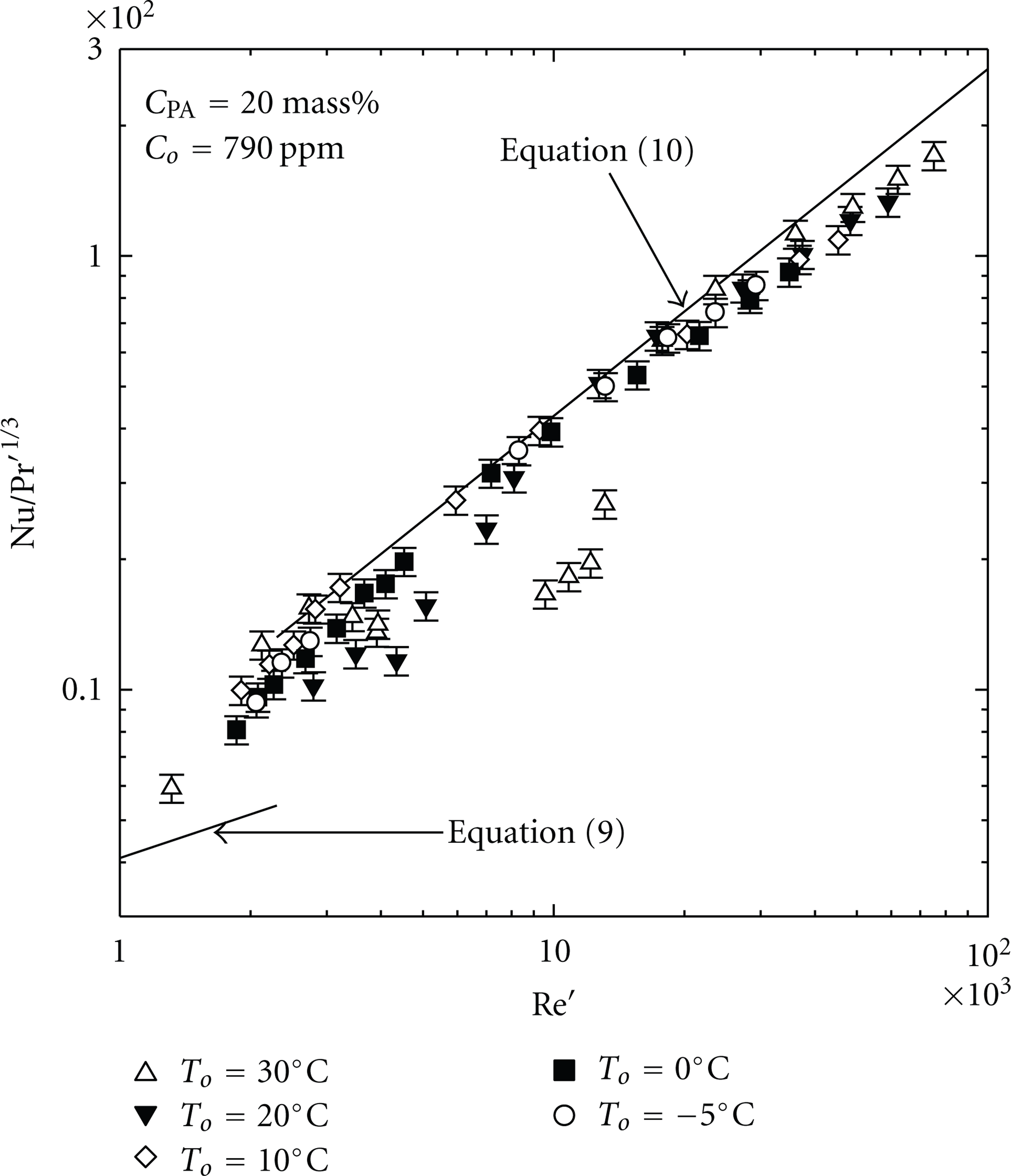
Relationship between Re′ and Nu/Pr′/3 (CPA = 20 mass%, Co = 790 ppm).
Figure 8 shows the flow drag reduction rate (DR) and heat transfer reduction rate (HDR) of a PA solution with ODEAO, which could be used to evaluate the reduction rate of the pipe friction coefficient and the heat transfer. The DR and HDR values were defined by the following equations:

where λ w and Nu w are the pipe friction coefficient and heat transfer value of water under the same experimental conditions. Figure 8 indicates that DR at To = 30°C reached a maximum value of 65% at Re′ = 10000 and HDR at To = 30°C had almost the same value as DR. The range of Re′ in which the drag reduction effect existed was equal to the range of Re′ in which the heat transfer reduction effect appeared. In contrast, the maximum values of DR and HDR at To = 20°C were about 50% at Re′ = 4000, less than the value at To = 30°C and Re′ = 10000.

Relationship between Re′ and DR, HDR (CPA = 20 mass%, Co = 790 ppm).
For quaternary ammonium salt cationic surfactants, the length of the rod-like micelles can be changed by increasing the solution temperature. When this type of solution contains aggregations above 40 nm in size, a large drag reduction effect is observed [13]. However, the effect suddenly disappears below an aggregate size of 30 nm. Assuming that the aggregation length changes with increasing solution temperature, aggregations of ODEAO rod-like micelles at only To = 20 or 30°C can result in an additional resistance against vortex stretching and turbulent eddy growth over the entire range of Re′. It can be inferred that the aggregation length of ODEAO rod-like micelles is more suitable for producing flow drag and heat transfer reduction effects at To = 30°C than at To = 20°C. When To = 0 or 10°C, the aggregation length is too long or too short to suppress vortex stretching and turbulent eddy growth, or else the micelles are not formed when the temperature decreases beyond a certain level.
In contrast, the flow drag and heat transfer reduction effects at CPA = 20 mass% were refuted qualitatively at other ODEAO concentrations (Co = 1980, 4970, and 8000 ppm). The reason for this seems to be that the rod-like micelles are transformed into lamellar or oblate micelles by increasing the ODEAO concentration and lamellar or oblate micelles cannot suppress vortex stretching and turbulent eddy growth.
4.2. PA Solution with ODEAO (CPA = 30 mass%)
Figures 9 and 10 show the variation of the flow drag and heat transfer reduction effects of a PA solution with ODEAO (To = 15°C and CPA = 30 mass%) with respect to the ODEAO concentration (Co). When CPA = 30 mass%, the flow drag and heat transfer reduction effects were confirmed only for Co = 7860 ppm, and there were no drag reduction effects under other experimental conditions (Co = 2740, 5240, and 10580 ppm).

Relationship between Re′ and λ (To = 15°C, CPA = 30 mass%).

Relationship between Re′ and Nu/Pr′1/3(To = 15°C, CPA = 30 mass%).
In a PA solution, potassium acetate molecules are hydrolyzed into potassium ions (K+), hydroxide ions (OH−) and acetic acid (CH3COOH). Acetic acid is slightly ionized into acetate ions (CH3COO−) and hydrogen ions (H+). Since the hydrophilic group (= hydroxyl group −OH) of an ODEAO molecule is hydrated by K+ and CH3COO−, we inferred that ODEAO molecules could not form rod-like micelles at a low ODEAO concentration. Therefore, the flow drag and heat transfer reduction effects were lost at Co = 2740 and 5240 ppm. In contrast, flow drag and heat transfer reduction effects could be observed at a high ODEAO concentration (Co = 7860 ppm). This tendency was due to the formation of rod-like micelles of ODEAO after saturating the hydration reaction. However, the flow drag and heat transfer reduction effects were lost at Co = 10580 ppm, because increasing the ODEAO concentration transforms the rod-like micelles to lamellar or oblate micelles [5].
When the ODEAO concentration was decreased (CPA = 20 mass%), flow drag and heat transfer reduction effects of a PA solution with ODEAO were confirmed only at Co = 790 ppm. This result indicates that rod-like micelles can be formed at a lower ODEAO concentration. This is because there is less K+ and CH3COO− in the solution with CPA = 20 mass% than in the solution with CPA = 30 mass%, and hence the ODEAO concentration decreased when the hydration reaction was saturated.
Figures 11 and 12 show the relationship between the flow drag and heat transfer reduction effects of a PA solution with ODEAO (Co = 7860 ppm and CPA = 30 mass%) and the solution temperature (To). The flow drag and heat transfer reduction effects were measured in a range of solution temperatures from 15 to 20°C, due to the increasing length of the rod-like micelles with increasing solution temperature. However, the length transition of the micelles at CPA = 30 mass% was different from that at CPA = 20 mass%. Therefore, the drag reduction temperature ranges at CPA = 30 mass% and CPA = 20 mass% were different. The flow drag reduction rate (DR) and heat transfer reduction rate (HDR) of a PA solution with ODEAO (Co = 7860 ppm and CPA = 30 mass%) are shown in Figure 13. The maximum values of DR and HDR were about 60% and were almost the same as those of Figure 8 (CPA = 20 mass%). However, the maximum values of DR and HDR at CPA = 30 mass% occurred at To = 15°C, which was different from the case of CPA = 20 mass%. We hypothesized that this temperature difference was caused by a critical length change of the rod-like micelles with increasing PA concentration.

Relationship between Re′ and λ (CPA = 30 mass%, Co = 7860 ppm).

Relationship between Re′ and Nu/Pr′1/3(CPA = 30 mass%, Co = 7860 ppm).

Relationship between Re′ and DR, HDR (CPA = 30 mass%, Co = 7860 ppm).

Relationship between Re and λ (CCC = 10 mass%).
Taking these experimental results into account, we inferred that it would be difficult to use PA solution with ODEAO as an actual heat transfer medium. The reason is that flow drag and heat transfer reduction effects can only be exhibited under particular conditions.
4.3. CC Solution with ODEAO
Figures 14 and 15 show the experimental results for the pipe friction coefficient ( λ ) and heat transfer (Nu/Pr1/3) of a CC solution with ODEAO (CCC = 10 mass% and Co = 3000, 6000, and 9000 ppm), and Figure 16 shows the relationship between Re and DR, HDR. Figures 14 and 15 indicate that flow drag and heat transfer reduction effects appeared at To = 20 and 30°C for Co = 6000 and 9000 ppm. In particular, at around Re = 1.2 × 10⁴, the pipe friction coefficient ( λ ) and heat transfer (Nu/Pr1/3) increased markedly with slightly increasing Re (Re ranging from 1.25 × 10⁴ to 1.26 × 10⁴) in the case CCC = 10 mass% and Co = 9000 ppm. This is caused by breakage of the rod-like micelles due to wall shear stress. This result indicates that the wall shear stress at the minimum value of the pipe friction coefficient (λ) has been estimated precisely. Comparison of Figures 8 and 13 shows that the DR and HDR tendencies of the CC solution with ODEAO (CCC = 10 mass% and Co = 9000 ppm) were almost the same as those of the PA solution with ODEAO.
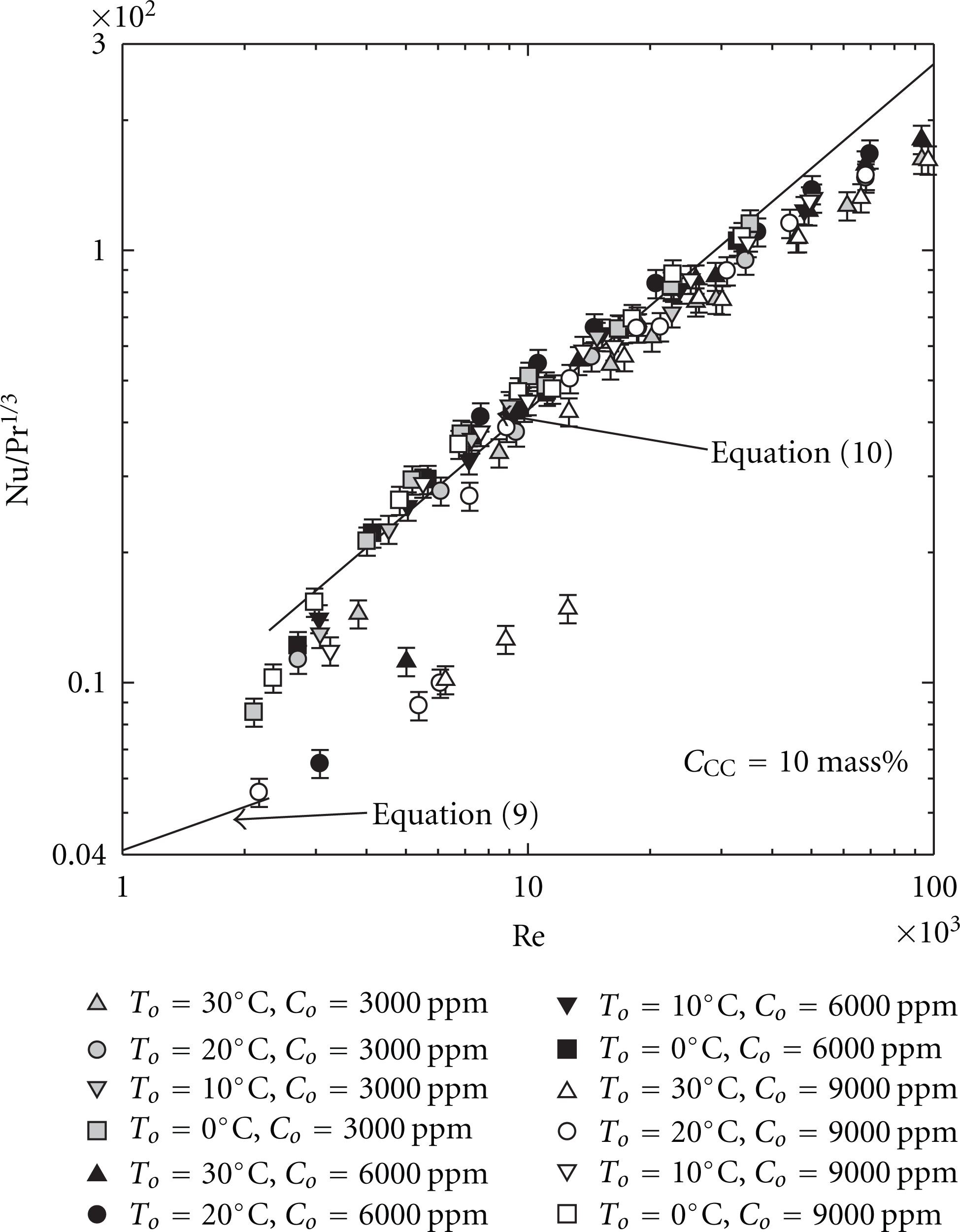
Relationship between Re and Nu/Pr 1/3 (CCC = 10 mass%).

Relationship between Re and DR, HDR (CCC = 10 mass%, C o = 9000 ppm).
However, the Reynolds number range for flow drag and heat transfer reduction effects in a CC solution with ODEAO was smaller at Co = 6000 ppm than at Co = 9000 ppm. No flow drag and heat transfer reduction effects occurred at Co = 3000 ppm. This tendency is probably due to the fact that the length or number of rod-like micelle aggregations increases with increasing ODEAO concentration and the length or number of rod-like micelle aggregations is most suitable for flow drag and heat transfer reduction effects at Co = 9000 ppm.
In contrast, flow drag and heat transfer reduction effects in case of increasing CC concentration (CCC = 20 mass%) were not confirmed. This is due to the decrease in the cloud point of the CC solution with increasing mineral salt (CC) concentration. If the solution temperature exceeds the cloud point, dissolved surfactants are no longer completely soluble and it is difficult to form surfactant micelles.
When CC is added to another nonionic surfactant solution [14], the cloud point at CCC = 10 mass% is estimated to be about 30°C and the cloud point at CCC = 20 mass% is estimated to be about −48°C. Therefore, a CC solution with ODEAO at CCC = 10 mass% and temperatures of 20 or 30°C is capable of exhibiting flow drag and heat transfer reduction effects, since these experimental temperatures are lower than the cloud point (30°C). On the other hand, at CCC = 20 mass%, the experimental temperatures are higher than the cloud point (−48°C), and hence rod-like micelles cannot be formed in this case.
Finally, the experimental results indicate that flow drag and heat transfer reduction effects of a CC solution with ODEAO occurred only at CCC = 10 mass% and Co = 9000 ppm. This suggests that it would be difficult to use CC solution with ODEAO as a heat transfer medium.
4.4. Critical Wall Shear Stress
Previous research (e.g., [5]) has indicated that drag reduction disappears when the wall shear stress exceeds a critical value. In order to understand the flow drag reduction effect of a PA or CC solution with ODEAO, the critical wall shear stress ( τ max) at the minimum value of the pipe friction coefficient (λ) was investigated and compared with the critical wall shear stress ( τ max) of the ODEAO water solution. The wall shear stress ( τ max) in a fully developed pipe flow is related to the pressure drop (ΔP) by the following equation:

Figure 17 shows the relationship between To and τ max for a PA or CC solution with ODEAO, as well as for an ODEAO water solution. This graph indicates that the critical wall shear stress (τmax) of the PA solution with ODEAO was higher than that of the ODEAO water solution. This increase in τmax is probably due to solubilization between the PA molecules and the rod-like micelles of the ODEAO. As a result, the PA molecules are slightly mixed with the micelles and the micelles are reinforced by this mixture.

Relationship between To and τ max of PA and CC solutions with ODEAO.
The critical wall shear stress (τmax) of the CC solution with ODEAO was slightly less than that of the ODEAO water solution. This result suggests that there is no solubilization between the rod-like micelles of the ODEAO and the CC molecules and that the micelles become weak in a strongly acid brine solution such as CC solution. Hence, we hypothesized that the formation of rod-like micelles in an ODEAO is related to the ionic strength of the brine solution.
5. Conclusions
Pipe friction coefficients and mean heat transfer coefficients were measured to investigate the flow drag and heat transfer reduction effects of potassium acetate (PA) solution and calcium chloride (CC) solution with the surfactant ODEAO. The experimental parameters considered were PA concentration, CC concentration, ODEAO concentration, and solution temperature. The following conclusions may be drawn from the results and discussion.
The flow drag and heat transfer reduction effects of PA solution with ODEAO and PA concentration = 20 mass% were confirmed only under particular conditions (ODEAO concentration of 790 ppm and solution temperatures of 20 and 30°C). The reason for this result is that the length of the rod-like micelles of ODEAO in the solution is not always suitable for producing a drag reduction effect, since the aggregation length of the micelles is dependent on the solution temperature and ODEAO concentration.
When the PA concentration = 30 mass%, the ODEAO concentration that produces flow drag and heat transfer reduction effects (= 7860 ppm) was larger than in the case of 20 mass% concentration (= 790 ppm). This increase in PA concentration also increased the saturation concentration of the hydration reaction.
CC solution with ODEAO at a CC concentration of 10 mass% could produce flow drag and heat transfer reduction effects, but there was no drag reduction at a CC concentration of 20 mass%. This is due to the decreasing cloud point of the CC solution with increasing CC concentration.
The critical wall shear stress of a PA solution with ODEAO was larger than that of an ODEAO water solution, whereas the critical wall shear stress of a CC solution with ODEAO was slightly less than that of an ODEAO water solution. For a strongly acid brine solution such as CC solution, there was no solubilization between the rod-like micelles of ODEAO and the CC molecules and the micelles became weak. Therefore, it can be concluded that the formation of rod-like micelles in a nonionic surfactant is related to the ionic strength of the brine solution.
In view of these findings, it would be difficult to put PA and CC solutions with ODEAO to practical use as heat transfer media, since the flow drag and heat transfer reduction effects of these solutions only appear under limited conditions.
Footnotes
Acknowledgment
The authors would like to thank Mr. Kazuma Yamagata for his cooperation in this study.