




Abstract
Due to the imbalance of energy consumption of nodes in wireless sensor networks (WSNs), some local nodes die prematurely, which causes the network partitions and then shortens the lifetime of the network. The phenomenon is called “hot spot” or “energy hole” problem. For this problem, an energy-aware distributed unequal clustering protocol (EADUC) in multihop heterogeneous WSNs is proposed. Compared with the previous protocols, the cluster heads obtained by EADUC can achieve balanced energy, good distribution, and seamless coverage for all the nodes. Moreover, the complexity of time and control message is low. Simulation experiments show that EADUC can prolong the lifetime of the network significantly.
1. Introduction
A wireless sensor network (WSN) consists of thousands of low-cost, low-power, and tiny sensor nodes which can be widely used in military, national security, environmental science, traffic management, disaster prediction, medical, manufacturing industry, and city information construction. As sensor networks have limited and nonrechargeable energy resources, energy efficiency is a very important issue in designing the topology, which affects the lifetime of sensor networks greatly.
Clustering is proved to be an effective scheme in increasing the scalability and lifetime of WSNs. In clustering schemes, sensor nodes are grouped into clusters and a main node is selected as the cluster head (CH) of a cluster and the other nodes are called cluster members (CMs) [1]. Each CM collects local data from the environment periodically and then sends it to the CH. When the data from all the CMs arrives, the CHs aggregate the data and send it to the BS.
As CHs are responsible for receiving and aggregating the data from their CMs, and transmitting the aggregated data to a long distance, The energy consumption of CHs is much larger than that of CMs. In order to balance the energy among nodes, most clustering algorithms divide the operation into rounds and periodically rotate the roles of CHs in the network. However, there is one more question. Energy consumption among cluster heads is imbalanced due to the distance to the BS. In single-hop networks, CHs farther away from the BS need to transmit data to a long distance. Therefore, the energy of CHs farther away from the BS is larger than that of the CHs closer to the BS. In multihop networks, CHs closer to the BS undertake data forwarding, which means that the energy consumption of CHs closer to the BS is larger. The imbalanced energy consumption of nodes leads to a certain number of nodes dying prematurely, causing network partitions. This phenomenon is called “hot spot” problem or “energy hole” problem [2]. Researchers proved that unequal clustering algorithms can effectively mitigate the “energy hole” problem.
In this paper, an energy-aware distributed unequal clustering protocol in multihop heterogeneous wireless sensor networks is proposed. It elects cluster heads based on the ratio between the average residual energy of neighbor nodes and the residual energy of the node itself, and uses uneven competition ranges to construct clusters of uneven sizes. The cluster heads closer to the BS have smaller cluster sizes to preserve some energy for the intercluster data forwarding, which can balance the energy consumption among cluster heads and prolong the network lifetime.
The rest of the paper is organized as follows. Section 2 covers the related works in this area. Section 3 exhibits the network model and problem description. Section 4 presents the energy-aware distributed unequal clustering protocol in detail. Section 5 analyzes several properties of the algorithm. In Section 6 we describe our simulation efforts and the analysis of results. Finally, Section 7 concludes the paper.
2. Related Work
LEACH [3] is a typical clustering protocol proposed for periodical data gathering applications in wireless sensor networks. In LEACH, each node independently elects itself as a cluster head with a probability. Cluster heads receive and aggregate data from cluster members and send the aggregated data to the BS by single-hop communication. In order to balance the energy consumption, the role of cluster head is periodically rotated among the nodes. LEACH protocol is simple and does not require a large communication overhead. However, the performance of LEACH in heterogeneous networks is not very well, because it elects cluster heads without considering the residual energy of nodes. To solve this problem, researchers improved LEACH and proposed some new algorithms such as centralized algorithm LEACH-C [4], multi-level clustering algorithm EEMLC [5], algorithm based on heterogeneous networks EEHC [6], and algorithm based on multihop communication LEACH-M [7].
EADEEG [8] is a novel distributed clustering algorithm. It elects cluster heads based on the ratio between the average residual energy of neighbor nodes and the residual energy of the node itself, which can achieve a good cluster heads distribution and prolong the network lifetime. There are still two points needed to be improved in EADEEG. (1) In some cases, there are “isolate points” in EADEEG. (2) It chooses 2
In [9, 10], energy-efficient distributed clustering algorithms HEED and EEDC are proposed. They choose sensor nodes to be cluster heads iteratively.
However, none of these algorithms mentioned above takes the solution of “energy hole” problem into account. To solve this problem, Soro and Heinzelman proposed an unequal clustering algorithm in [11]. The network field is divided into cirques. Clusters in the same cirque have the same size while clusters in the different cirques have different sizes. Deploying some high-energy nodes to take on the cluster head role to control network operation ensures that energy dissipation of these cluster heads is balanced. The algorithm can effectively prolong network lifetime. However, some high-energy nodes are needed to play as cluster heads, so the positions of cluster heads must be calculated previously.
EEUC [12] is a distributed unequal clustering algorithm which elects cluster heads based on the residual energy of nodes. Each node becomes a tentative cluster head with a probability T. Tentative cluster heads use uneven competition ranges to construct clusters of uneven sizes. The clusters closer to the BS have smaller sizes than those farther away from it, thus the cluster heads closer to the BS can preserve some energy for the intercluster data forwarding. In this way, the energy consumption among cluster heads is balanced. As the quality of the generated cluster heads is affected by T, there are “isolate points” in EEUC in some case of T.
3. Network Model and Problem Description
3.1. Network Model
To simplify the network model, we adopt a few reasonable assumptions as follows.
There are N sensor nodes that are distributed randomly in an All the nodes and the BS are stationary after deployment. All the sensor nodes can be heterogeneous. All the sensor nodes are location-unaware. All the nodes can use power control to vary the amount of transmit power. The generated cluster heads can communicate with the BS directly. The BS is out of the sensor field. It has a sufficient energy resource and the location of the BS is known by each node. Each node has an identity (
The energy model is adopted from [3].
To transmit an l-bit data to a distance d, the radio expends energy:

While receiving an l-bit data, the radio expends energy:

Additionally, we assume that the energy for data sensing is
3.2. Problem Description
The properties of an effective clustering algorithm are usually summarized as follows.
It is a distributed algorithm. It can evenly generate cluster heads to balance the energy consumption among nodes. It has acceptable algorithm overhead. It has the ability to handle heterogeneous node issues [8].
By analyzing these properties above, two points which are also necessary for an effective clustering algorithm are missed. As we mentioned above, energy hole problem leads to a certain number of nodes dying prematurely, reducing the network lifetime. Therefore, an effective clustering algorithm should have a fifth property:
it has the ability to solve “energy hole” problem.
Moreover, as mentioned above, in some case there are “isolate points” in EADEEG and EEUC protocol. For example, as shown in Figure 1: since the residual energy of node 5 is lower than the average energy of its neighbor nodes 8, 11, 12, and 14, its waiting time t for broadcasting the there exist no “isolate points” in the network.

The “isolate point” of EADEEG algorithm.
In this paper, a clustering algorithm EADUC satisfying the six properties is proposed. The details of EADUC are described in the next section.
4. EADUC Details
The whole operation is divided into rounds, where each round contents a setup phase and a data transmission phase just like LEACH. To form a clustering topology, the setup phase is divided into three subphases: neighbor node information collection phase, cluster head competition phase, and cluster formation phase; in the data transmission phase, cluster members collect local data from the environment, and send the collected data to the cluster heads, cluster heads receive and aggregate the data from their cluster members, and then send the aggregated data to the next hop nodes based on the routing tree we have constructed. Data transmission phase should be longer than setup phase to save the overhead of the algorithm and prolong the lifetime of the network. The state message of each node is listed in Table 1. Several control messages are needed and the description of these messages are shown in Table 2.
Description of node state messages.

Description of control messages.

4.1. Cluster Setup Phase
In the Network Deployment Phase
The BS broadcasts a signal at a certain power level. Each node can compute its approximate distance to the BS based on the received signal strength. There are three subphase in cluster setup phases: neighbor node information collection phase, whose duration is
In Neighbor Node Information Collection Phase
Each node broadcasts a

For each node, we give the following formula to calculate its waiting time t for broadcasting 
After
In order to generate unequal clusters, each node needs to calculate their own competition radius 
In heterogeneous networks, nodes have heterogeneous initial energy. In the case that each node has the same energy consumption, the nodes with low initial energy will die prematurely, reducing the network lifetime. In order to take full advantage of the high-energy nodes, the high-energy nodes should take more task. Therefore, considering the distance between nodes and the BS and the residual energy of nodes, we give the formula of 
Cluster Formation Phase
It is the last subphase of cluster setup phase. Each noncluster-head node chooses the nearest cluster head and sends the
4.2. Data Transmission Phase
4.2.1. Intra-Cluster Communication
Cluster members sense and collect local data from the environment, and send the collected data to the cluster heads. This process is called intra-cluster communication. For simplification, cluster members communicate with cluster heads directly, just like LEACH.
4.2.2. Inter-Cluster Communication
Cluster heads receive and aggregate the data from their cluster members, and then send the aggregated data to the next hop nodes. Here, we introduce a threshold distance 
So
5. Protocol Analysis
Theorem 1.
There is at most one cluster head in the range of any CH with covered radius
Proof.
As we state previously,
Theorem 2.
The cluster head set generated by EADUC can cover all the network nodes.
Proof.
(1) When
(2) When
Therefore, we conclude that the waiting time of any node is smaller than
Theorem 3.
The overhead complexity of control messages in the network is
Proof.
At the beginning of each round, each node broadcasts a
Theorem 4.
EADUC has a processing time complexity of
Proof.
EADUC adopts a distributed clustering strategy. Thus, the time complexity of the entire network is equal to that of a single node
From the above analysis, we can summarize the properties of EADUC as follows.
It elects cluster heads based on the ratio between the average residual energy of neighbor nodes and the residual energy of the node itself. Nodes have relatively higher energy are elected, which is helpful in prolonging the network lifetime [8]. There are no “isolate points” in EADUC, which is proved in Theorem 2. The competition radius From Theorems 1 and 2, there is one and only one cluster head in the range of any cluster head with covered radius
There are three parameters in EADUC: α, β, and
6. Simulations
The simulations were performed in NS-2, and two scenarios are chosen.
Homogeneous Scenario
The initial energy of each node in the network is 2
Heterogeneous Scenario
The initial energy of nodes in the network is uniformly distributed over the interval 1–3
The parameters of simulations are listed in Table 3.
Parameters of the simulation.

6.1. Cluster Head Distribution
We run EADUC in these scenarios, respectively. Figure 2 shows the relationship between the number of cluster heads and
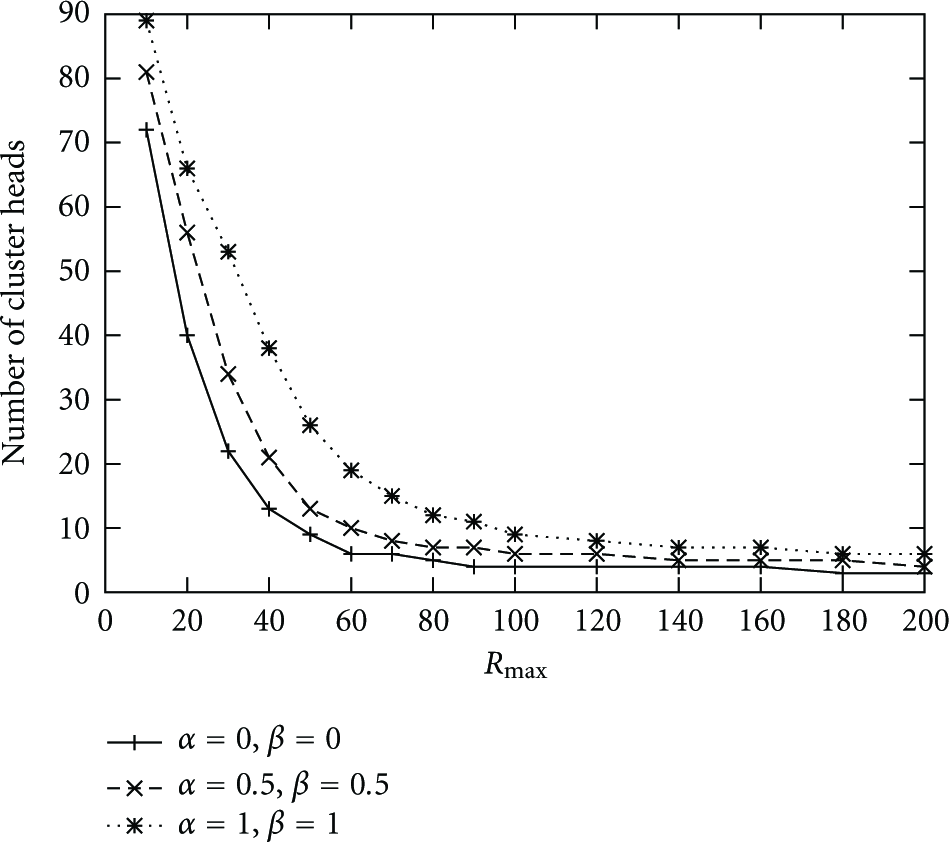
Number of cluster heads generated in the network.
We set
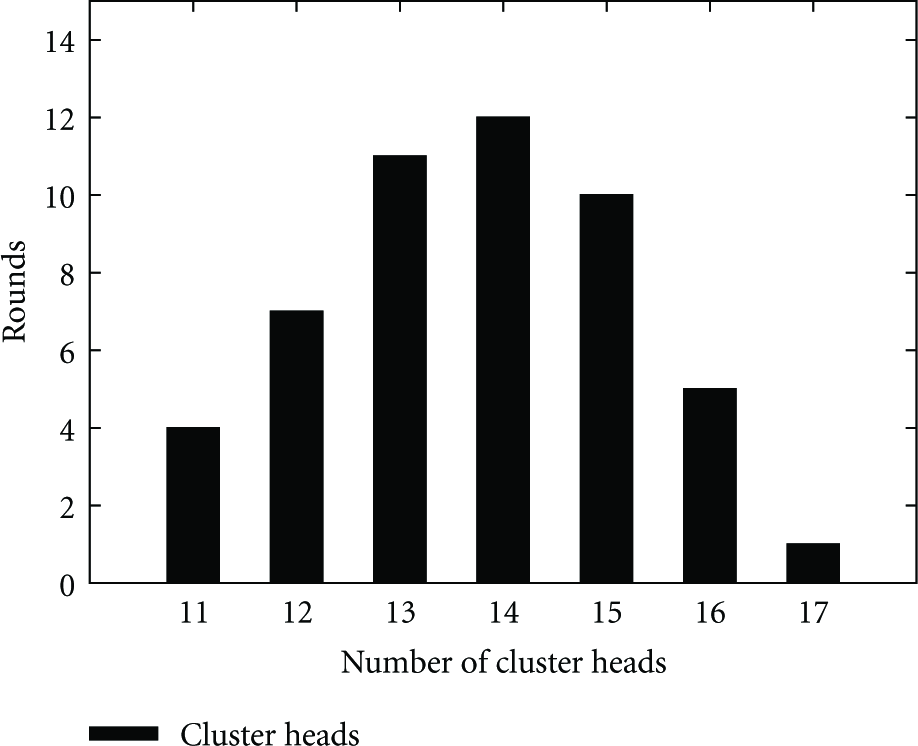
Distribution of the number of cluster heads.
6.2. Network Lifetime
On network lifetime, there is no clear definition. According to the definitions given in [13], the lifetime of a WSN can be quantified using the following three kinds of metrics.
The time from the deployment of the network to the death of the first node (first node dies, FND). The time when a certain percent of nodes alive (percentage nodes alive, PNA). The time when all the nodes are dead in the network (last node dies, LND).
Here, we define the network lifetime as percentage node alive (PNA). That is, the network lifetime is defined as the time when 90 percent of nodes are alive. We set

Network lifetime with different
Networks are not always homogeneous. Therefore, clustering algorithms should have the ability to handle heterogeneous nodes issues. We run EADUC in homogeneous and heterogeneous scenarios. When

Network lifetime in different scenarios.
From Figure 5, we can see that the network lifetime in heterogeneous scenario is slightly longer than that in homogeneous scenario. The reason is that EADUC elects cluster heads considering the residual energy of nodes, which can take advantage of the high-energy nodes in heterogeneous scenario and prolong the network lifetime. As a comparison experiment, we set

Network lifetime of LEACH.
In Figure 6, the network lifetime in heterogeneous scenario is shorter. Since nodes in LEACH elect themselves by a probability without considering the residual energy, low-energy nodes may die prematurely and the network lifetime is reduced.
In heterogeneous scenario, we run LEACH, LEACH-M, HEED, EEUC, and EADUC to compare their performance in network lifetime. As shown in Figure 7, EADUC and EEUC perform far better than LEACH, LEACH-M, and HEED in prolonging network lifetime attributed to the consideration of energy.
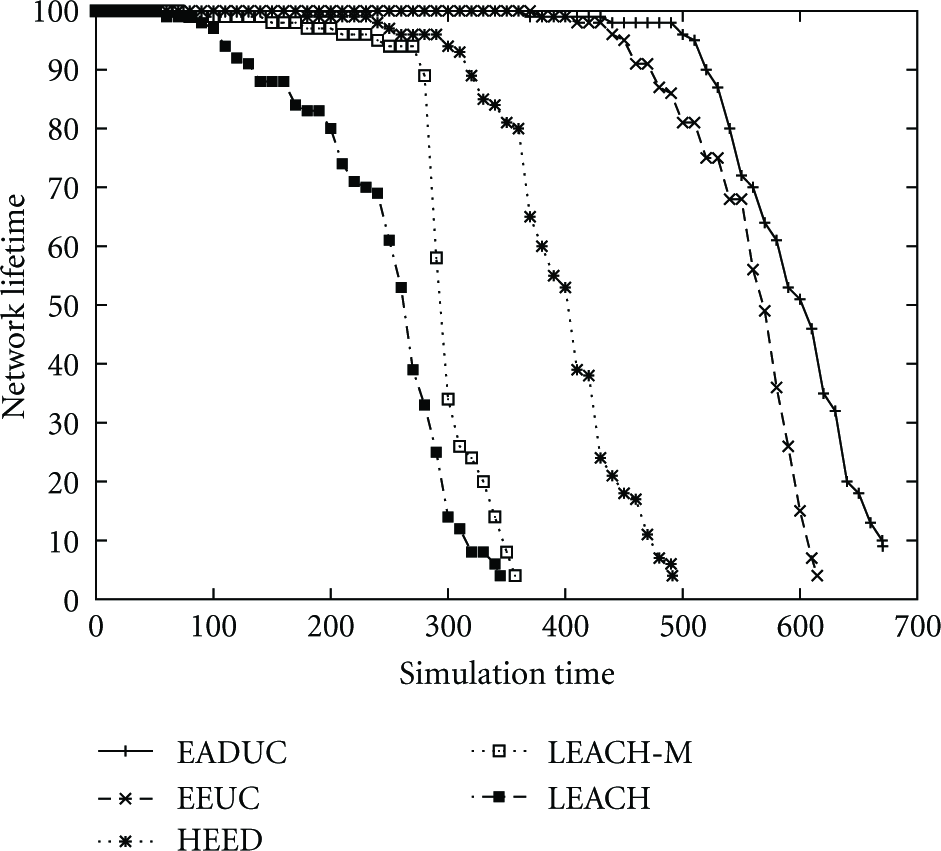
Network lifetime.
7. Conclusions
In this paper, we propose an energy-aware distributed unequal clustering protocol EADUC, which elects cluster heads based on the ratio between the average residual energy of neighbor nodes and the residual energy of the node itself. The unequal competition radius of nodes which is used to construct unequal clusters is determined by the distance to the BS and the residual energy. There are no isolate points in EADUC. Besides, the cluster heads closer to the BS have smaller cluster sizes to preserve some energy for the intercluster data forwarding, which can balance the energy consumption among cluster heads and prolong the network lifetime. Furthermore, EADUC satisfies the properties of an effective clustering algorithm and can prolong the lifetime of the network significantly.
Broadcast Receive Update neighborhood table NT t← broadcast delay time for competing a cluster head NT Continue Broadcast Send Receive Broadcast
Algorithm 1
Footnotes
Acknowledgments
This paper is sponsored by National Science Foundation under Grant no. 60373012 and 10871119 of China, National Science Foundation under Grant no. ZR2009GM009 and ZR2009AM013, and EDRP Foundation under Grant no. J10LG09.